

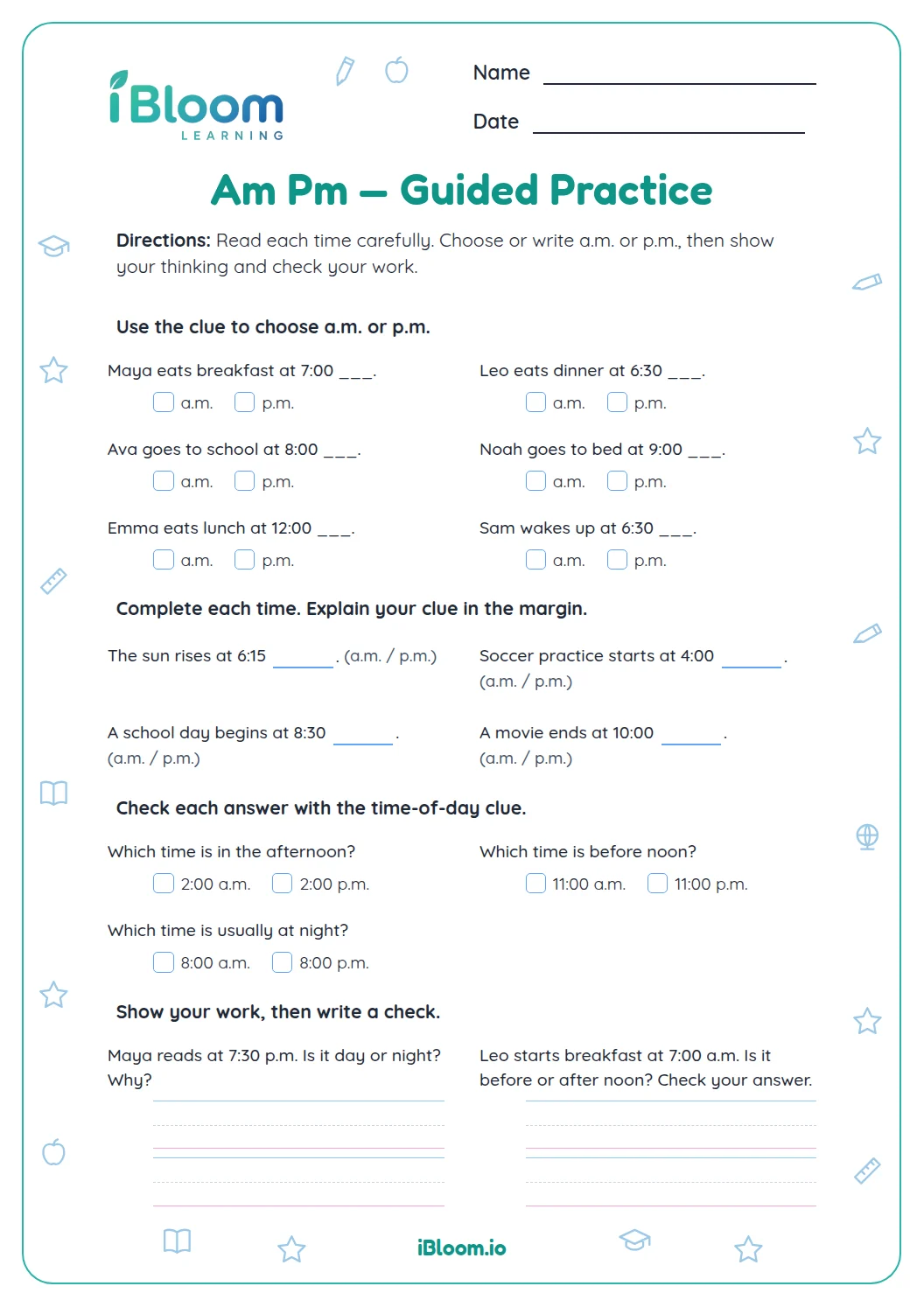

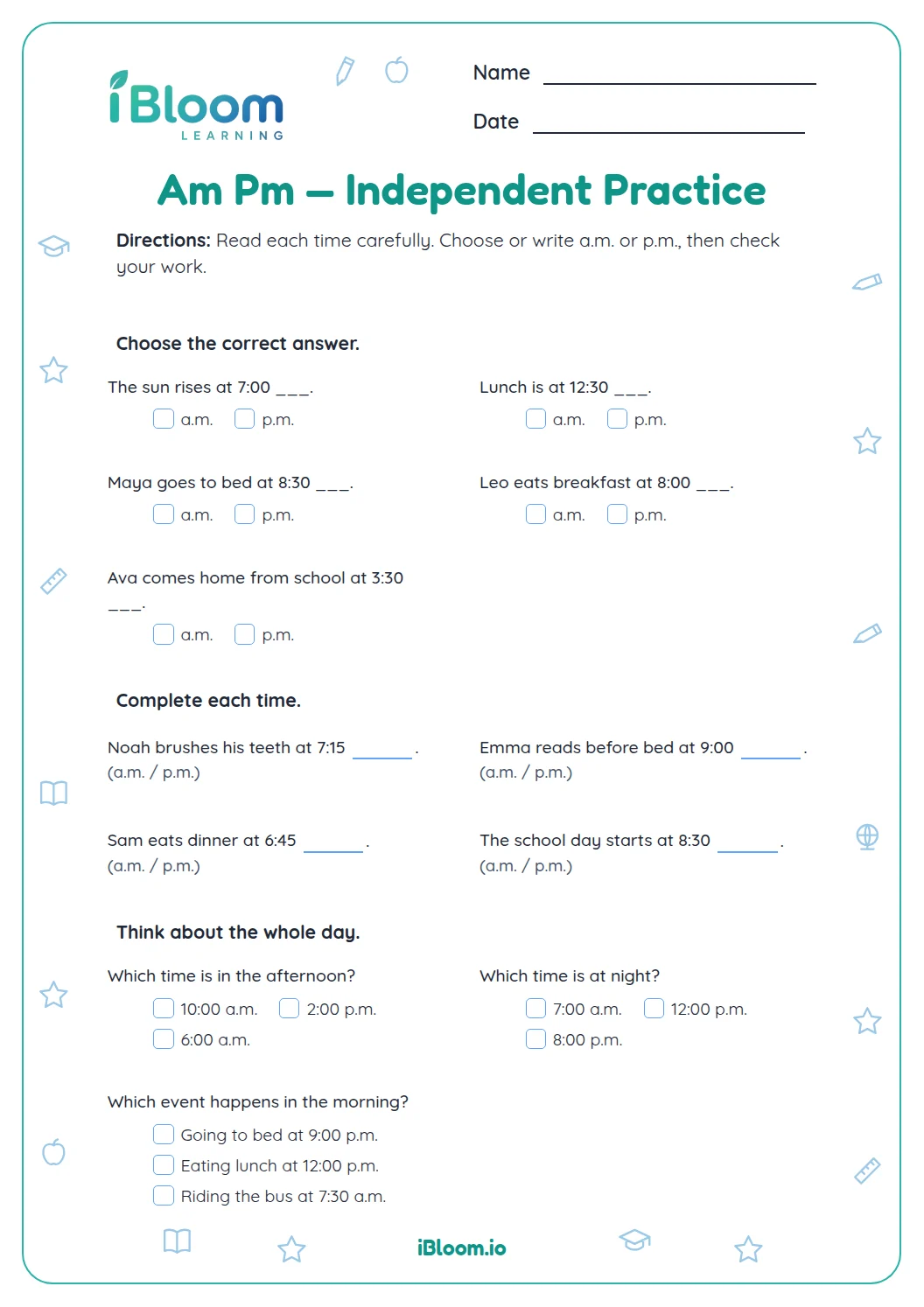


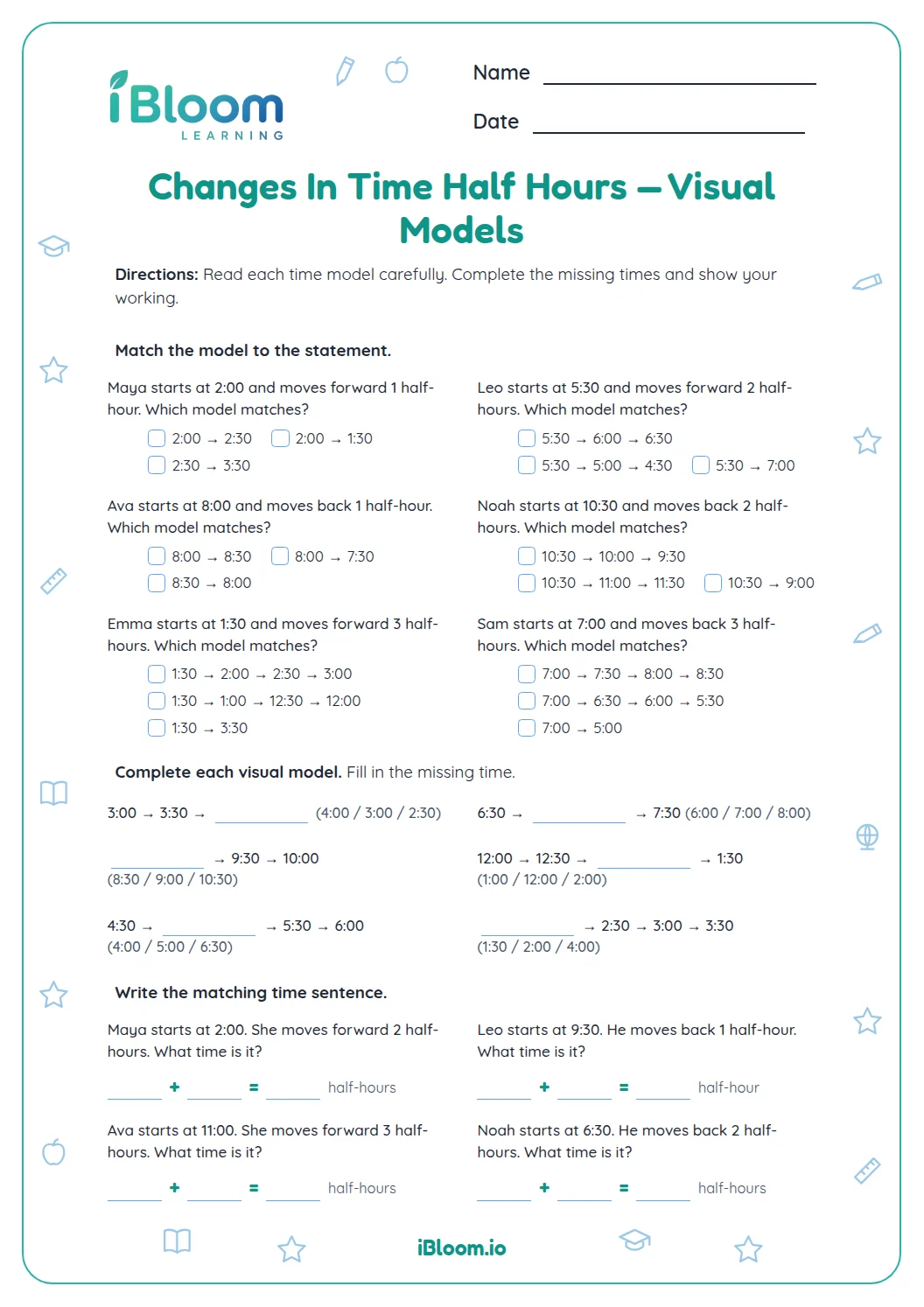

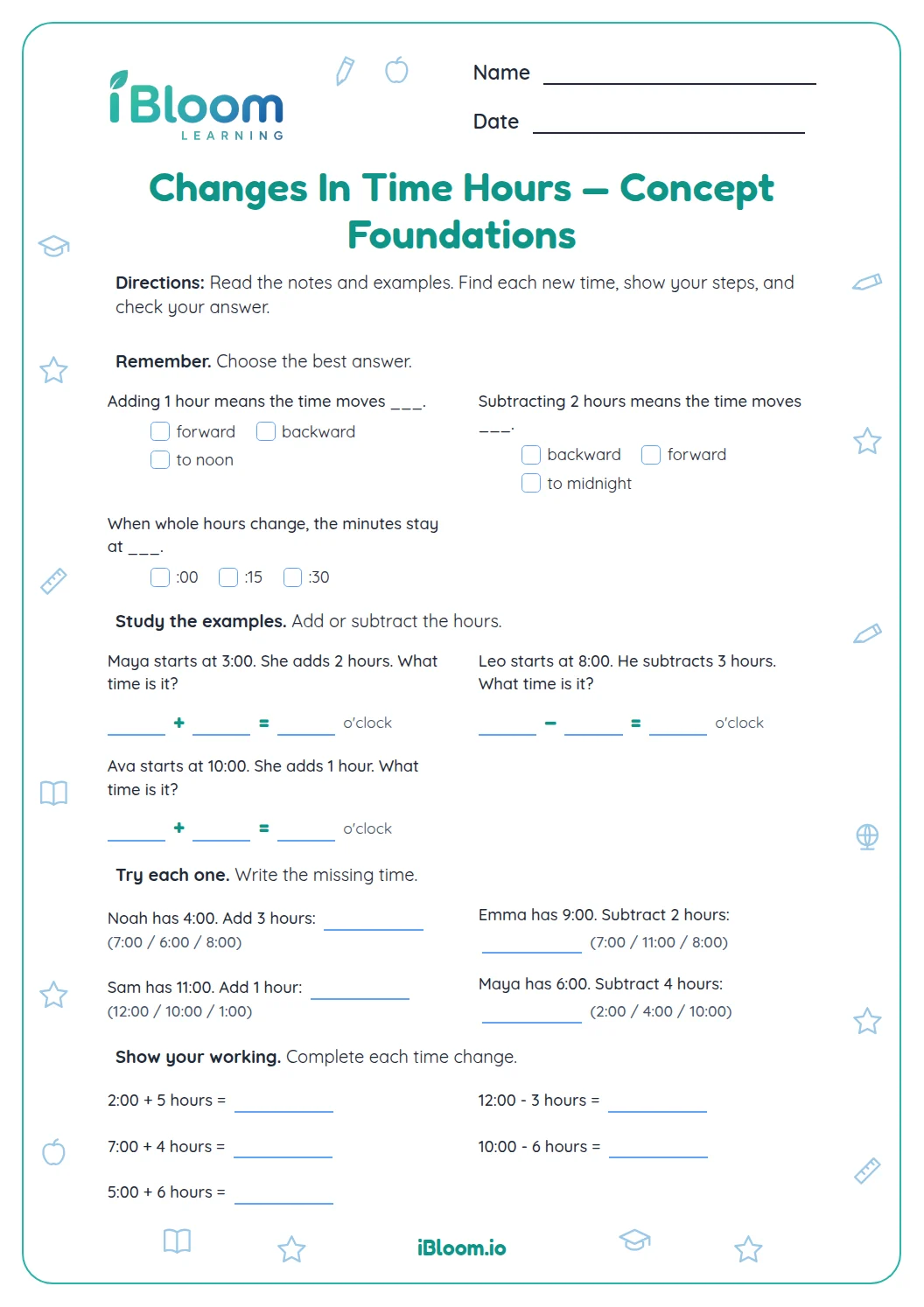

About this worksheet
This Grade 2 printable has 14 analog clocks for learners to read to the nearest quarter hour. Students identify the hour hand and minute hand, then write each time in numbers. The clock-reading practice follows CCSS 2.MD.C.7, which includes telling time from analog and digital clocks to the nearest five minutes; every time on this page lands on a quarter hour.
Aligned to 2.MD.C.7
What will learners practice?
All 14 questions show an analog clock. Read the minute hand first: it points to 3 at :15, 6 at :30, and 9 at :45; then use the hour hand to identify the hour.
- 1The minute hand points to 3, so it is :15.
- 2The hour hand is just past 1.
- 3The clock reads 1:15.
How does the practice progress?
The set moves through different hour numbers and mixes quarter past, half past, and quarter to. For 1:15, the minute hand points to 3 and the hour hand sits just past 1.
How can learners check their work?
Complete the full worksheet before opening the key. Check both the answer and the detail this skill depends on, such as units, punctuation, or the clock hands.
How to use this worksheet
- 1Read each prompt and name the skill it asks you to use.
- 2Work through the questions in order, showing a calculation or rereading the sentence when helpful.
- 3Check your answers with the separate key and correct any missed item.
Common mistakes and quick fixes
The mistake
Reading the long minute hand as the hour
The fix
Find the longer hand first; it shows the minutes.
The mistake
Calling the 3 “3 minutes”
The fix
Each number on the clock stands for five minutes when reading the minute hand.
The mistake
Writing the next hour at quarter to
The fix
At :45, the hour hand is nearing the next number, but the time is still in the current hour.
Common Core alignment
This worksheet practices the stated Common Core skill.
Apply quarter-hour clock models in the worksheet questions.
On this sheet: The questions directly practice quarter-hour clock models.
Show the official wordingHide the official wording
Tell and write time from analog and digital clocks to the nearest five minutes, using a.m. and p.m.
What to practice next
Make more practice
Further reading
Questions parents and teachers ask
What times do the clocks show?
Every clock shows a quarter-hour time: :15, :30, or :45. Learners read each analog face and write the time with numbers. The varied hour values help them attend to both hands instead of memorizing one clock position. Notice whether the minute hand points to 3, 6, or 9 before writing the time.
How do you read quarter past?
When the long minute hand points to 3, it marks 15 minutes past the hour. Read the shorter hour hand to find which hour has just begun, then write the time with :15. Notice whether the minute hand points to 3, 6, or 9 before writing the time.
How do you read half past?
When the long minute hand points to 6, 30 minutes have passed. The shorter hand sits between two hour numbers; use the hour it has passed. Write that hour followed by :30. Notice whether the minute hand points to 3, 6, or 9 before writing the time.
What does quarter to mean on a clock?
When the minute hand points to 9, 45 minutes have passed in the current hour. The hour hand is close to the next number, but the written time uses the hour it has not yet finished, followed by :45. Notice whether the minute hand points to 3, 6, or 9 before writing the time.
Does this worksheet include an answer key?
Yes. The separate two-page key lists the time shown by each of the 14 clocks. Ask the learner to explain where the minute hand points before checking the written time. Notice whether the minute hand points to 3, 6, or 9 before writing the time.