




About this worksheet
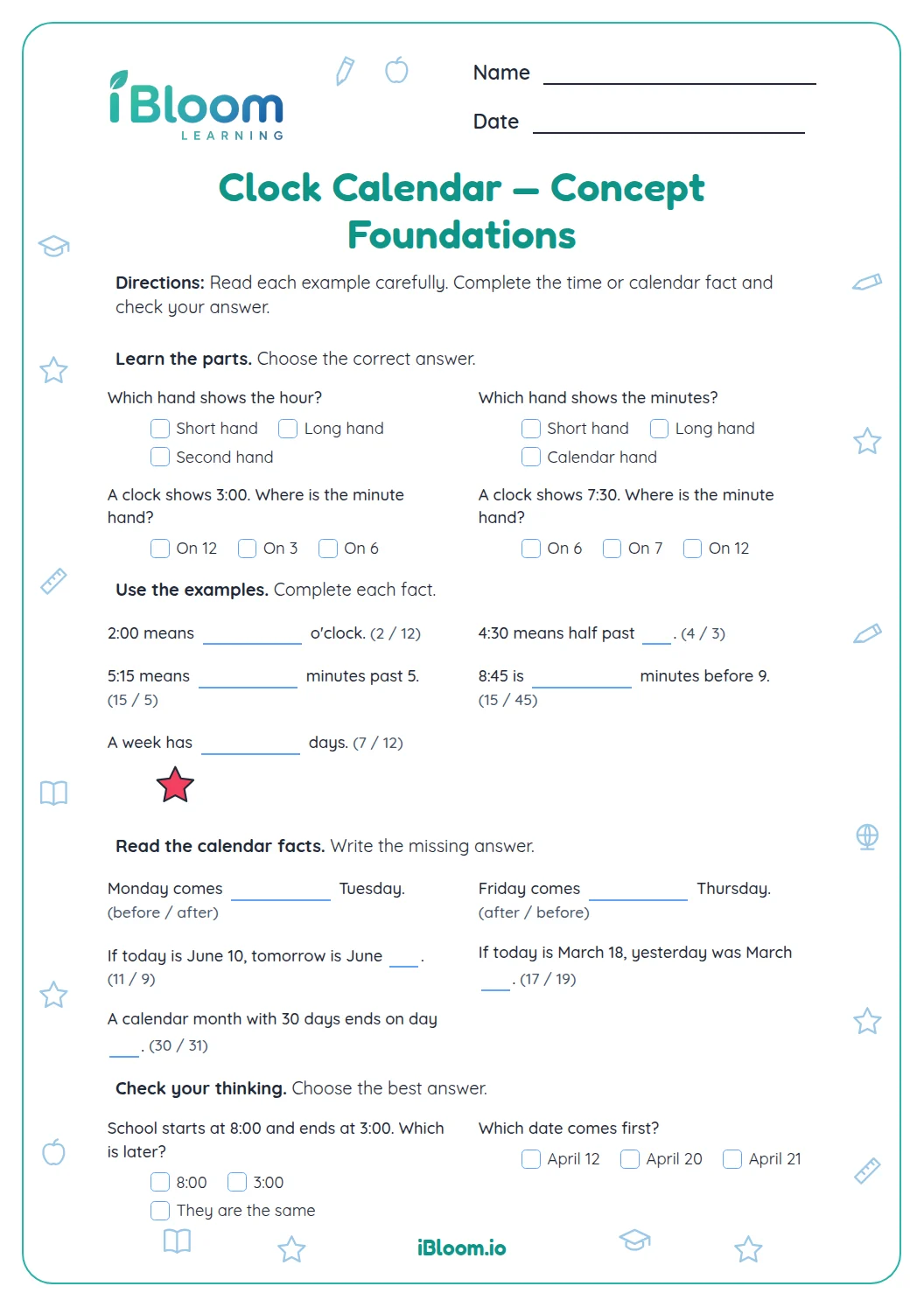
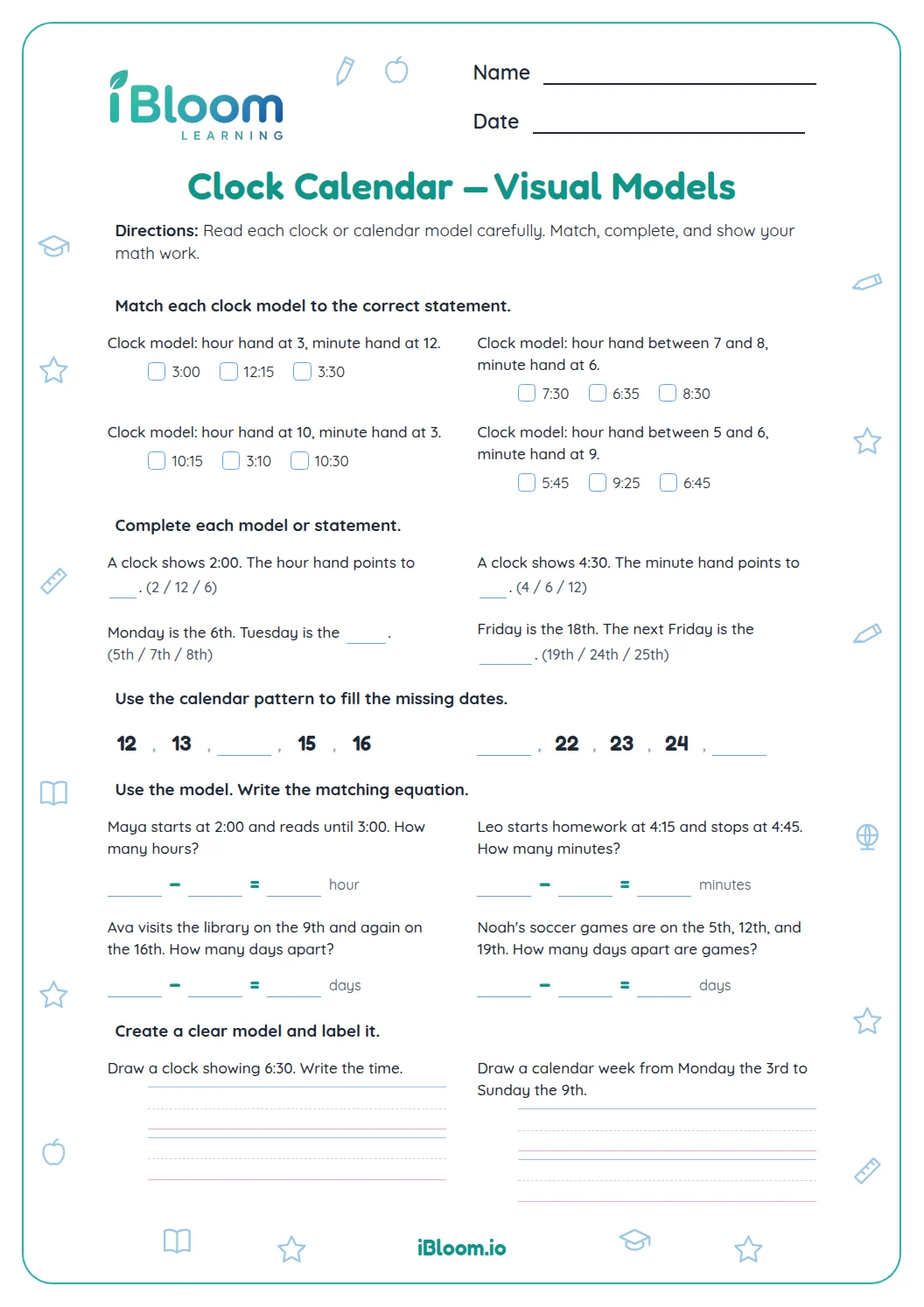
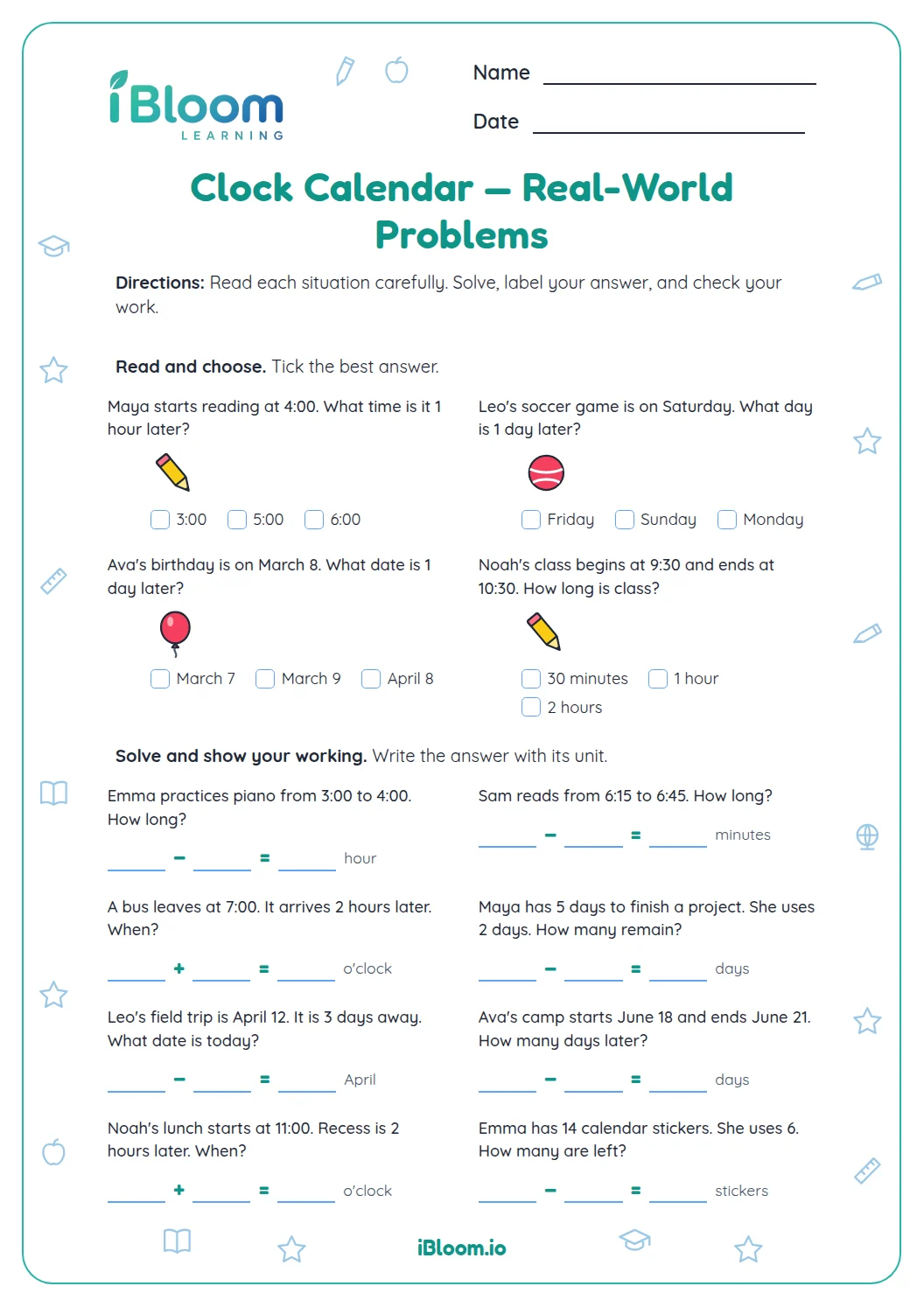
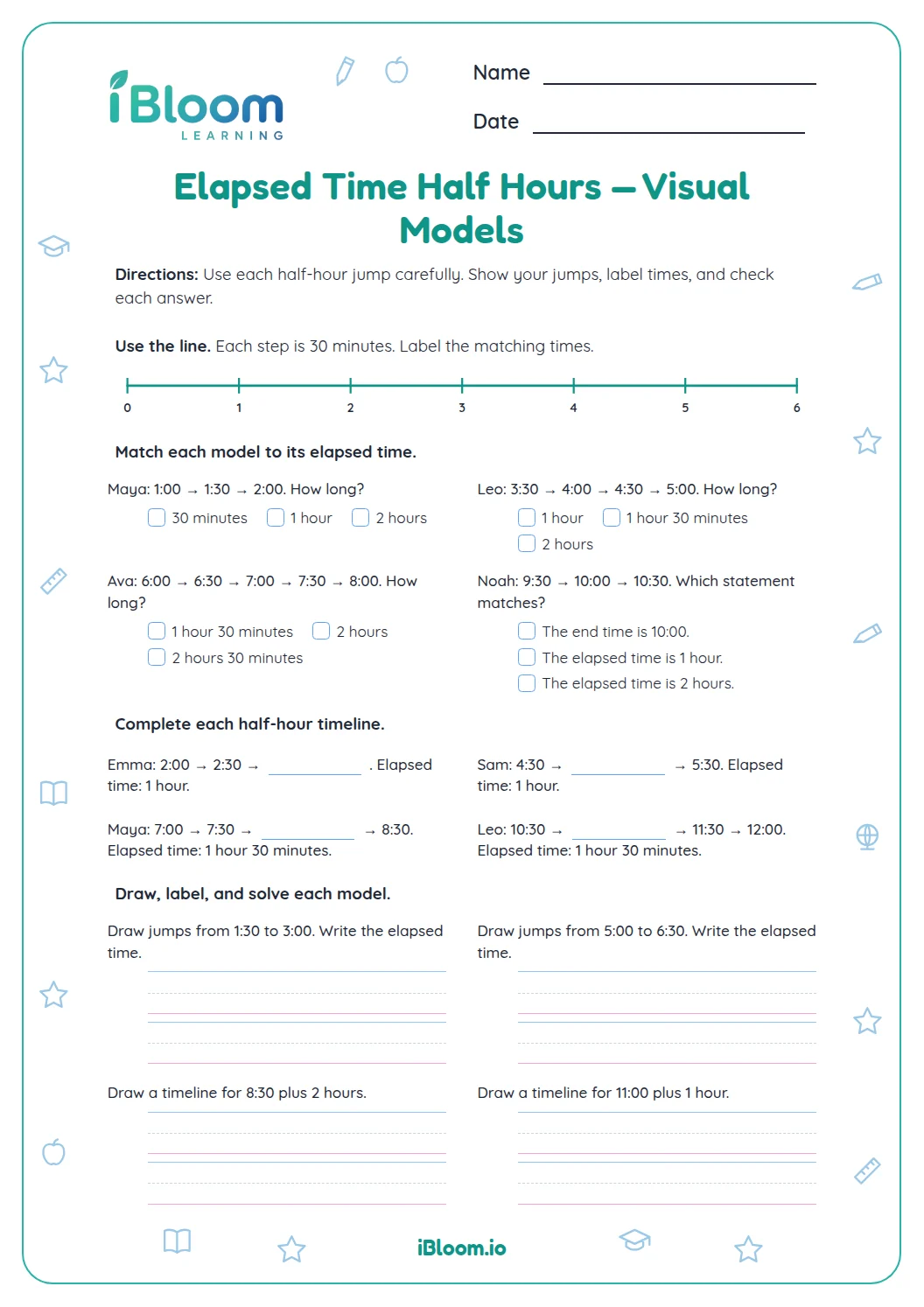
This 14-question sheet practices analog clock reading to five minutes and weekday/date reasoning. Each clock item has a face; calendar questions give the date clues needed to find one weekday or date.
Aligned to 2.MD.C.7
How do you read an analog clock to five minutes?
This 14-question sheet practices analog clock reading to five minutes and weekday/date reasoning. Each clock item has a face; calendar questions give the date clues needed to find one weekday or date.
- 1Clock shows 3:35.
- 2The long hand points to 7, so the minutes are 35.
How can you find an ending time?
This 14-question sheet practices analog clock reading to five minutes and weekday/date reasoning. Each clock item has a face; calendar questions give the date clues needed to find one weekday or date.
How do dates and weekdays move together?
This 14-question sheet practices analog clock reading to five minutes and weekday/date reasoning. Each clock item has a face; calendar questions give the date clues needed to find one weekday or date.
How to solve each challenge
- 1For a clock, locate the short hand first to name the hour.
- 2Count by fives around the clock for the minutes.
- 3For elapsed time, count forward or backward in sensible jumps.
- 4For a calendar question, find the named date and move one weekday at a time.
- 5Check that the final hour, minute, weekday, and date match the clue.
Common mix-ups
The mistake
Reading the short hand as the minute hand.
The fix
The long hand shows minutes; the short hand shows the hour.
The mistake
Adding minutes without changing the hour when the count passes 60.
The fix
Continue counting past :55 to the next hour at :00.
The mistake
Moving the date but keeping the same weekday.
The fix
Advance the date and weekday together, one row at a time.
Common Core alignment
Clock questions practice reading analog time and finding short elapsed intervals.
Read analog clock times to the nearest five minutes and use them in time problems.
On this sheet: Questions 1–7 and 13–14 use clock reading and elapsed minutes.
Show the official wordingHide the official wording
Tell and write time from analog and digital clocks to the nearest five minutes, using a.m. and p.m.
What to practice next
Make more practice
Further reading
Questions parents and teachers ask
How many questions are on this challenge?
This printable includes fourteen questions across the worksheet, followed by a separate answer key. Learners can complete each item independently, then use the key to check their work and revisit any response that needs correction before practicing again.
Do students need to read clocks to the exact minute?
This printable includes fourteen questions across the worksheet, followed by a separate answer key. Learners can complete each item independently, then use the key to check their work and revisit any response that needs correction before practicing again.
How can a student find an elapsed time?
This printable includes fourteen questions across the worksheet, followed by a separate answer key. Learners can complete each item independently, then use the key to check their work and revisit any response that needs correction before practicing again.
How does the calendar table work?
This printable includes fourteen questions across the worksheet, followed by a separate answer key. Learners can complete each item independently, then use the key to check their work and revisit any response that needs correction before practicing again.
What is a common calendar mistake?
This printable includes fourteen questions across the worksheet, followed by a separate answer key. Learners can complete each item independently, then use the key to check their work and revisit any response that needs correction before practicing again.
What should a student practice next?
This printable includes fourteen questions across the worksheet, followed by a separate answer key. Learners can complete each item independently, then use the key to check their work and revisit any response that needs correction before practicing again.