

About this worksheet
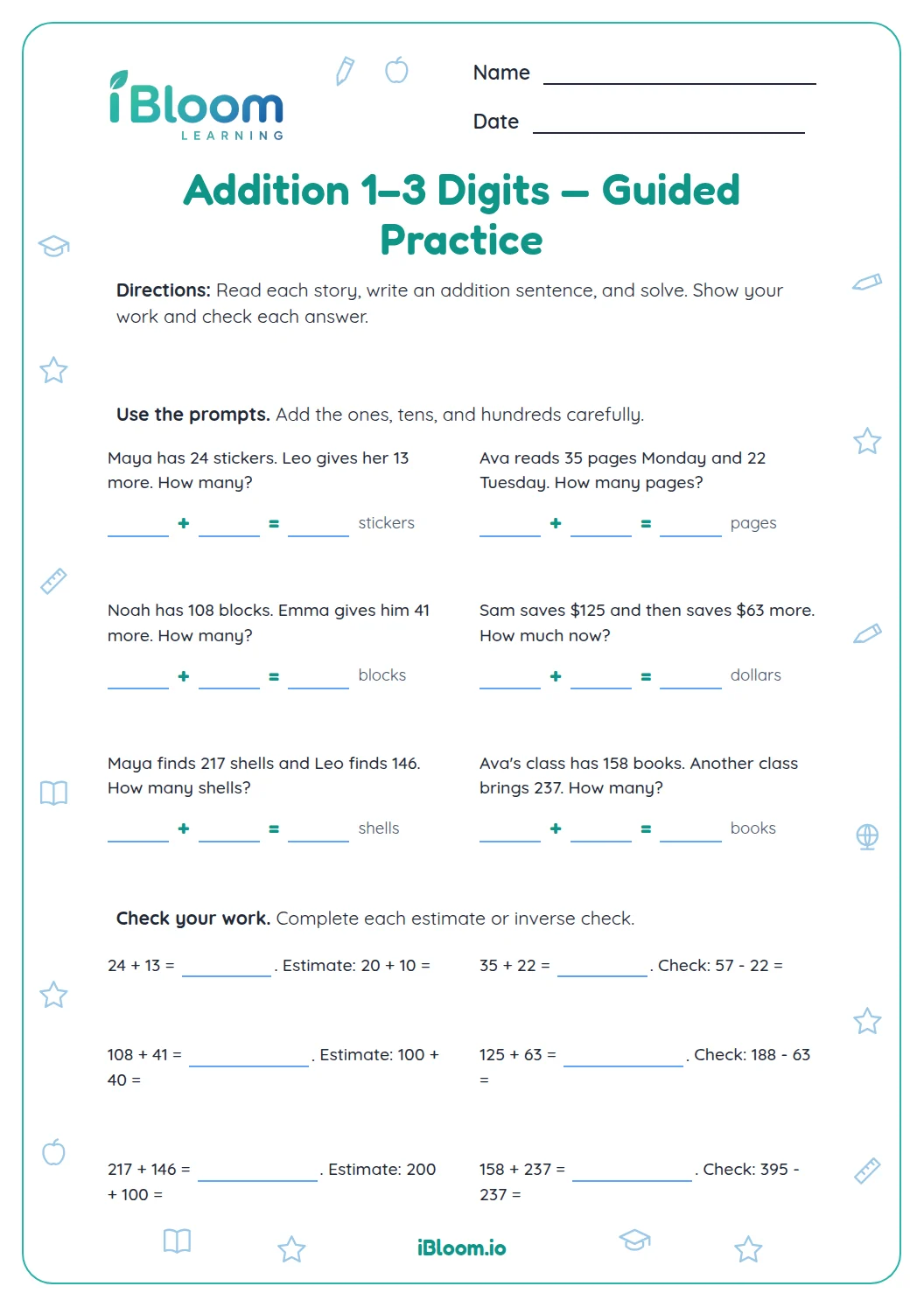
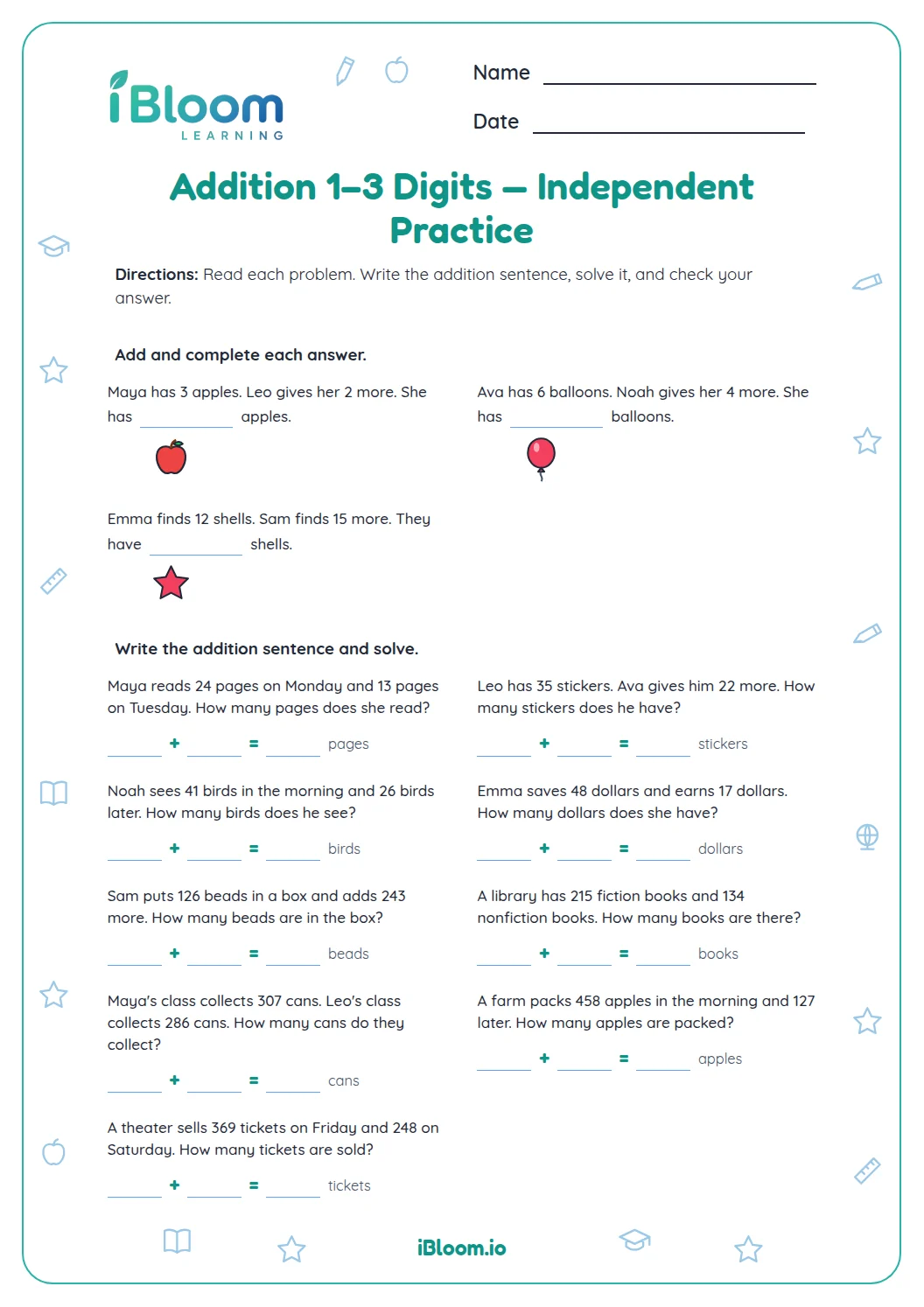
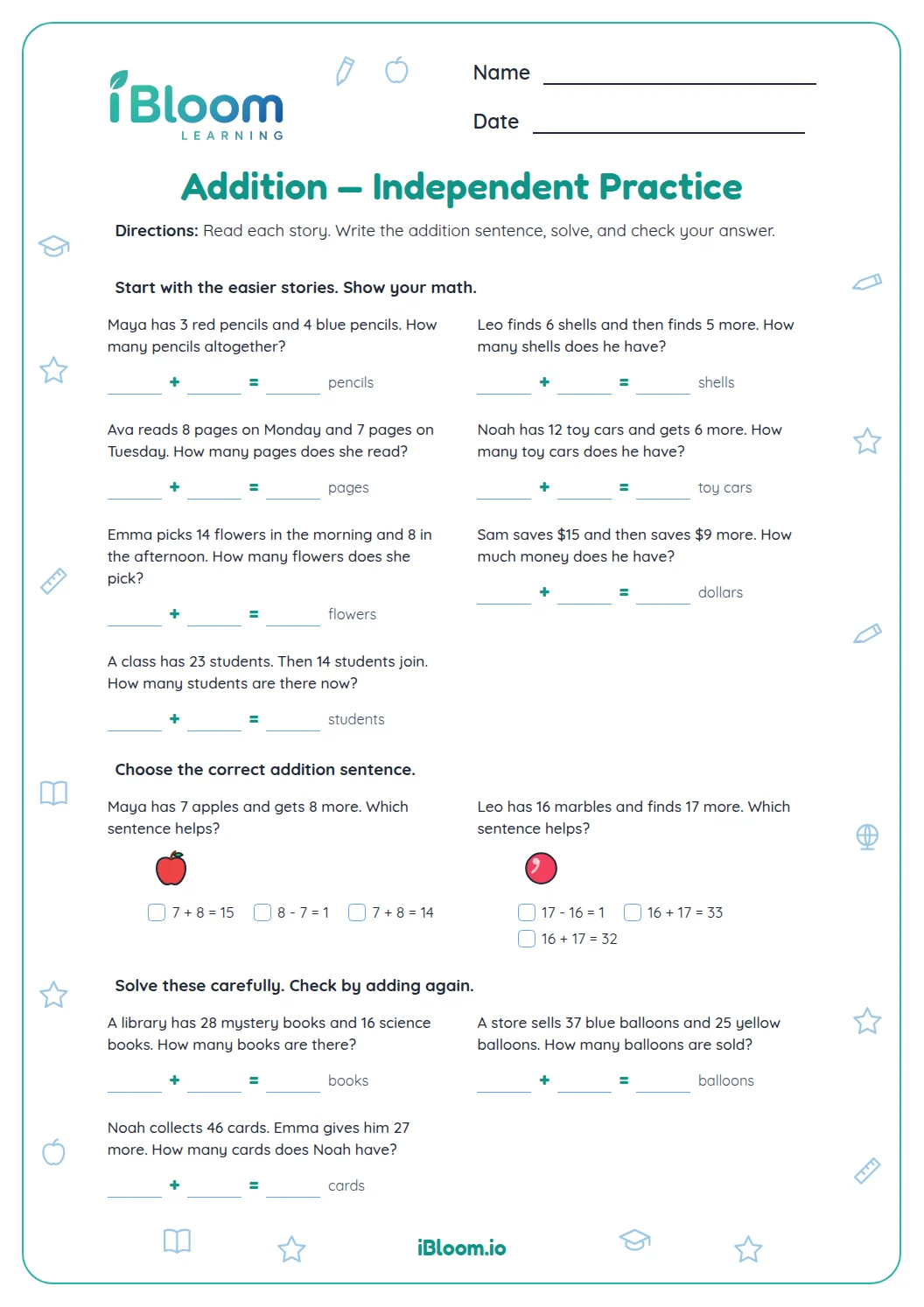
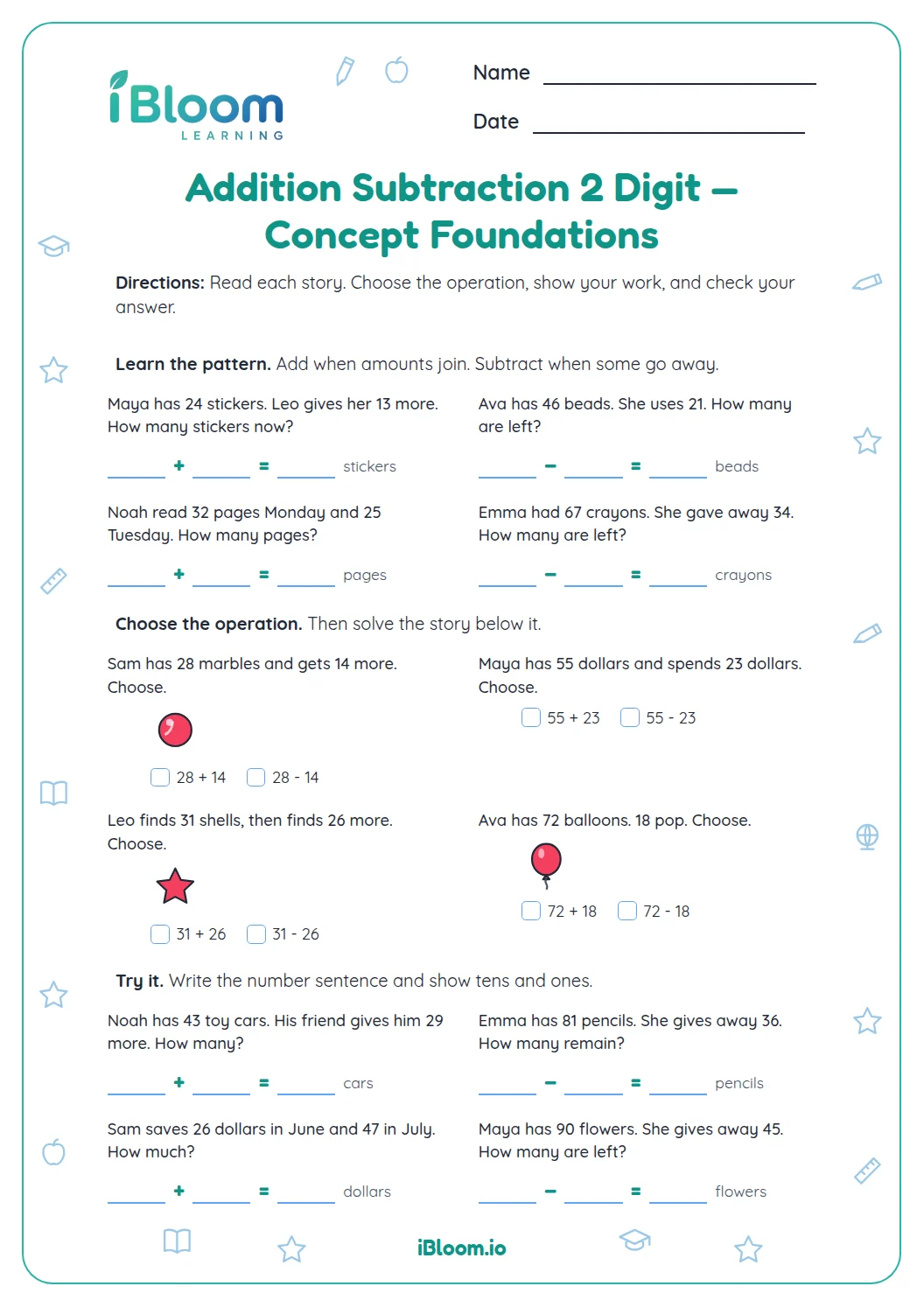
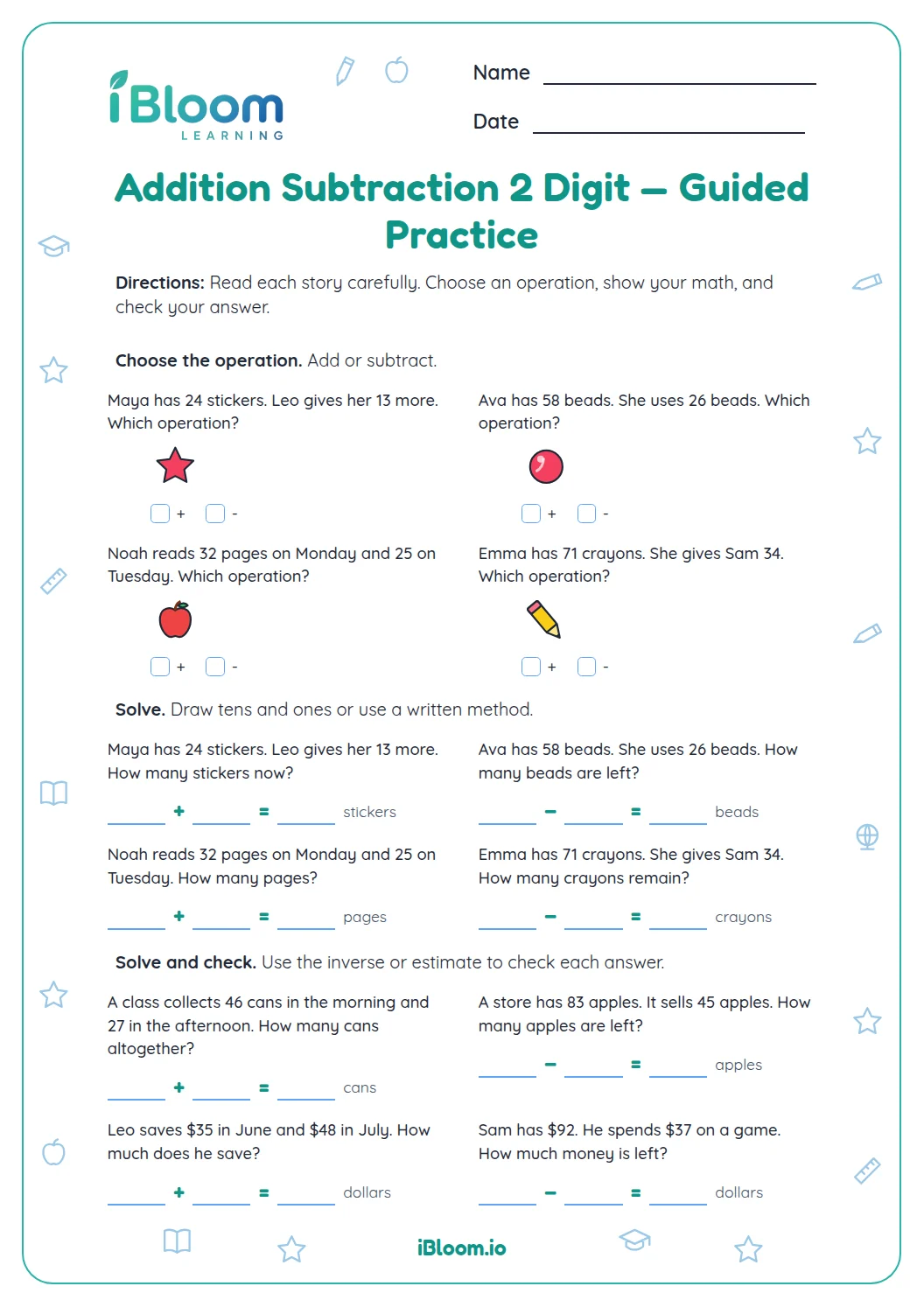
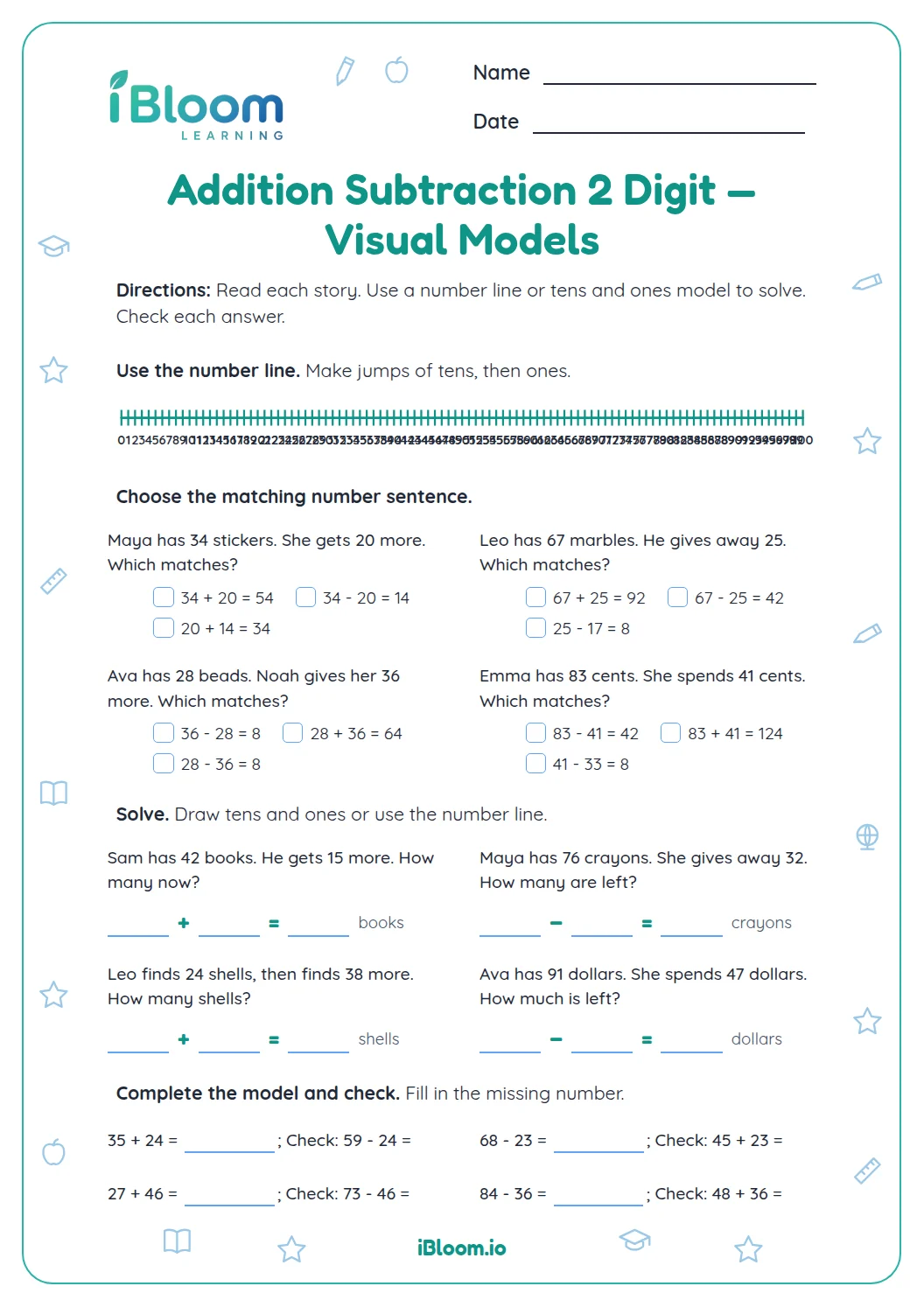
This free Grade 2 printable contains 14 real-world addition word problems with one-, two-, and three-digit addends. Students write equations, regroup when needed, and label totals in shells, pages, flowers, visitors, and other contexts. It practices CCSS 2.NBT.B.7 by representing addition stories with equations and solving them. A separate answer key is included.
Aligned to 2.NBT.B.7
How do you know when to add?
Look for two amounts that are joined or a starting amount that grows. An addition equation combines the amounts. For question 1, 28 shells and 17 shells make 28 + 17 = 45 shells.
For two- and three-digit numbers, add the ones first. Regroup ten ones as one ten when needed, then add the tens and hundreds.
- 128 + 17
- 28 ones + 7 ones = 15 ones
- 3Regroup 10 ones as 1 ten
- 428 + 17 = 45 shells
When do you regroup while adding?
Regroup when a place has ten or more. In 28 + 17, 8 + 7 is 15, so write 5 ones and regroup 1 ten. The tens then total 4 tens.
How can I check a story problem answer?
Estimate or add in reverse place by place. For 125 + 243, the total must be greater than either addend and close to 400. Finish by checking that the unit in the answer matches the story.
How can I use this worksheet?
- 1Read once for the story and again to find both amounts.
- 2Underline the numbers and circle what is being counted.
- 3Write an addition equation before calculating.
- 4Add ones first and regroup if needed, then add tens and hundreds.
- 5Label the total and check it against the story.
Common mistakes and quick fixes
The mistake
Adding the digits in the order they appear without aligning place values.
The fix
Write ones under ones, tens under tens, and hundreds under hundreds.
The mistake
Forgetting a regrouped ten.
The fix
Record the new ten above its place before adding the tens.
The mistake
Giving a number without its unit.
The fix
Name what the total counts, such as pages or visitors.
Curriculum alignment
This worksheet practices the skills described in these Common Core standards.
Add three-digit story-problem amounts using place-value strategies and written equations.
On this sheet: The problems add two- and three-digit story amounts within 1,000 and ask students to write an equation.
Show the official wordingHide the official wording
Add and subtract within 1000, using concrete models or drawings and strategies based on place value, properties of operations, and/or the relationship between addition and subtraction; relate the strategy to a written method. Understand that in adding or subtracting three-digit numbers, one adds or subtracts hundreds and hundreds, tens and tens, ones and ones; and sometimes it is necessary to compose or decompose tens or hundreds.
What to practice next
Make more practice
Further reading
Questions parents and teachers ask
How can my second grader solve an addition story?
Find the two amounts being joined, write them as an addition equation, and add by place value. For question 1, 28 shells plus 17 more shells makes 45 shells. The answer key lets your child check both the total and the label.
Does the worksheet include one-, two-, and three-digit addends?
Yes. The stories include one-digit amounts, such as 6 pages and 7 pages in question 2, as well as two- and three-digit amounts. Several larger problems require regrouping in the ones or tens place. This range gives learners practice moving from simple sums to place-value addition.
When should a student regroup?
Regroup when a place-value column totals ten or more. In question 1, 8 ones plus 7 ones makes 15 ones, so trade ten ones for one ten and write 5 in the ones place. Then add the tens to finish the total.
Does this sheet have room to show equations?
Yes. Each story gives students space to write an addition equation and its answer. The instructions also ask them to label the total with the unit from the story, such as pages, books, students, or dollars. The final amount should include the matching unit from the story.
What is included in the answer key?
The separate key lists all 14 totals with their units. Students can compare their equation and sum with the key after working through the stories, then revisit any problem where the amount, regrouping, or label did not match. It covers the full set of story answers on the page.