




About this worksheet
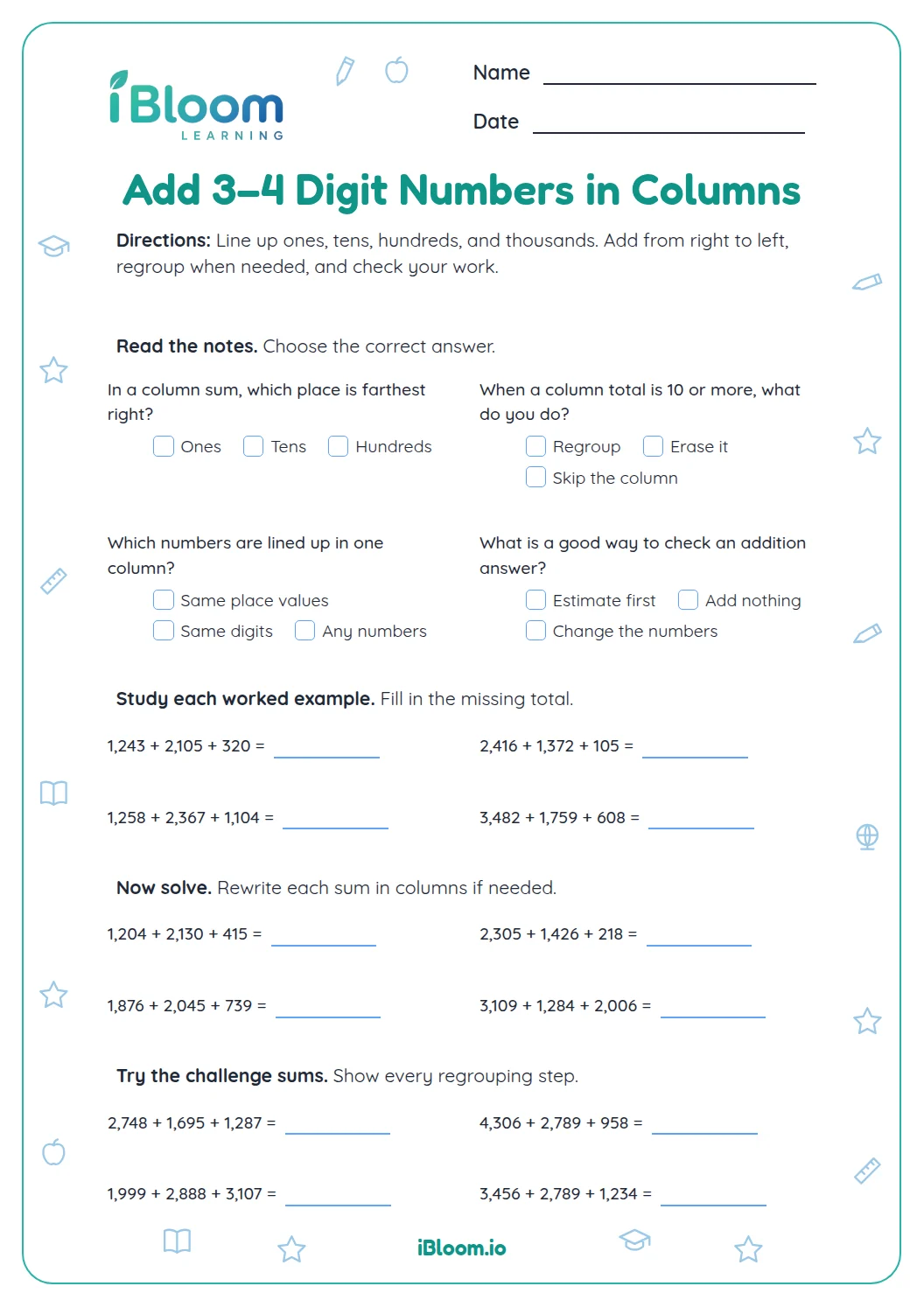
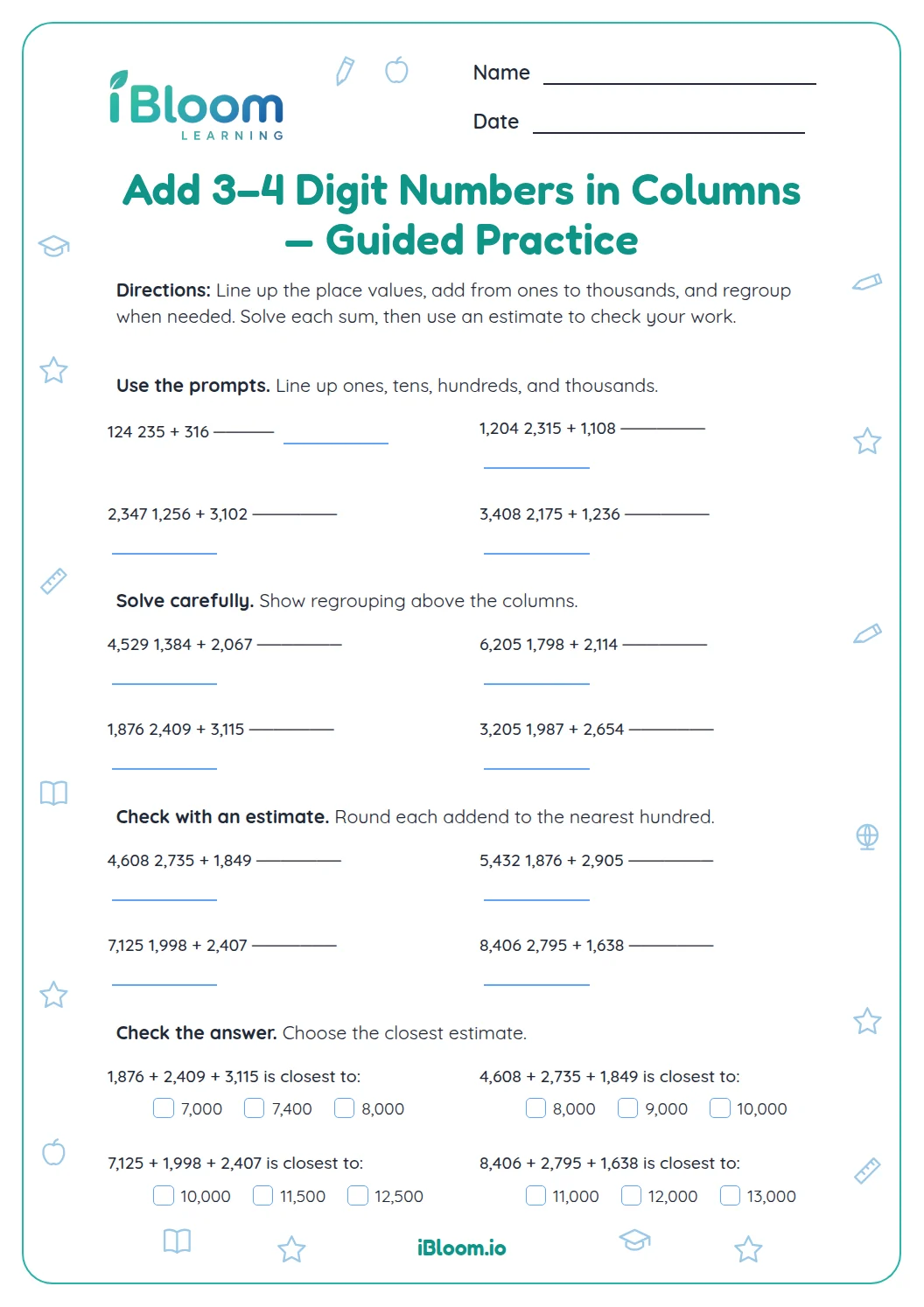
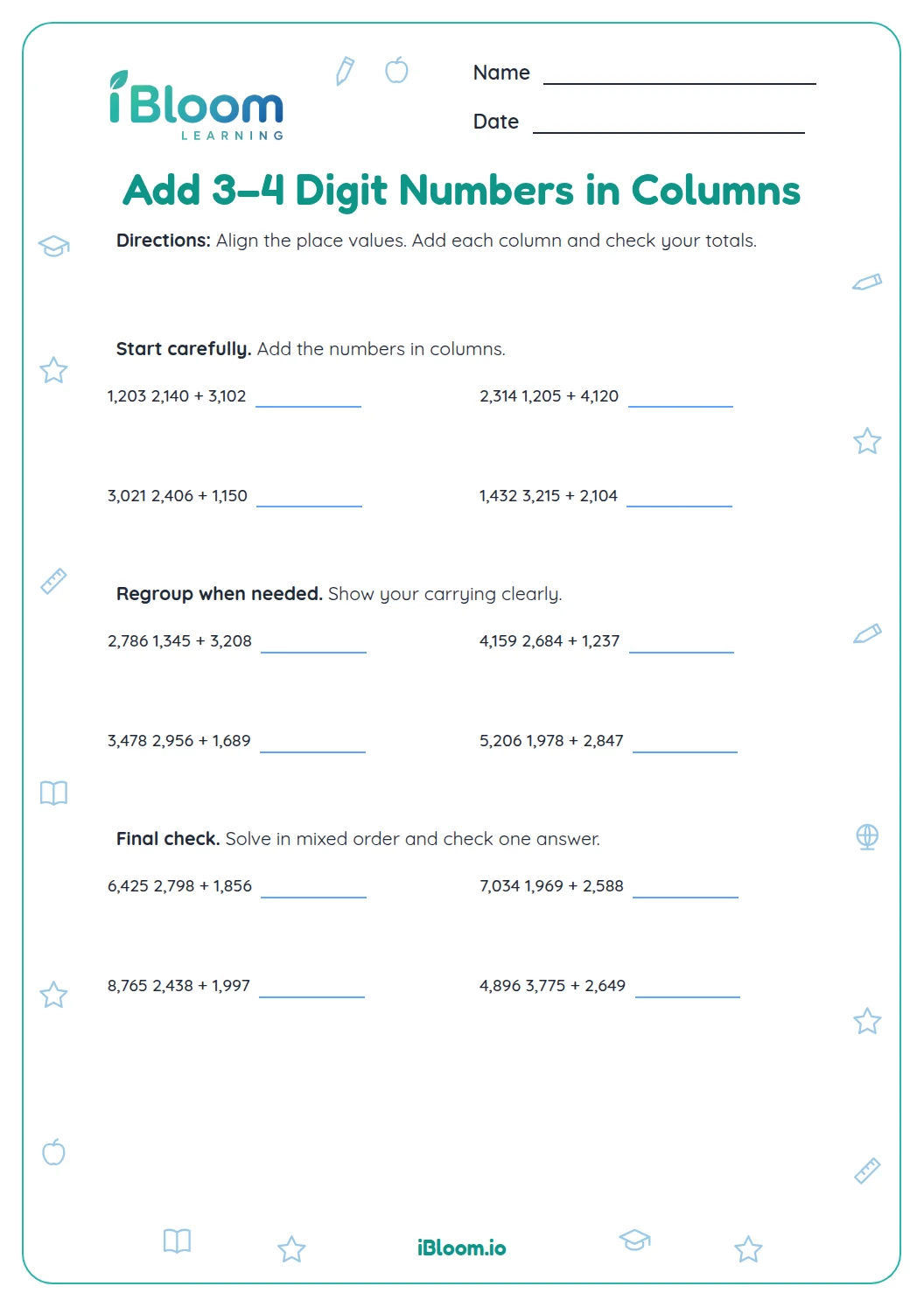
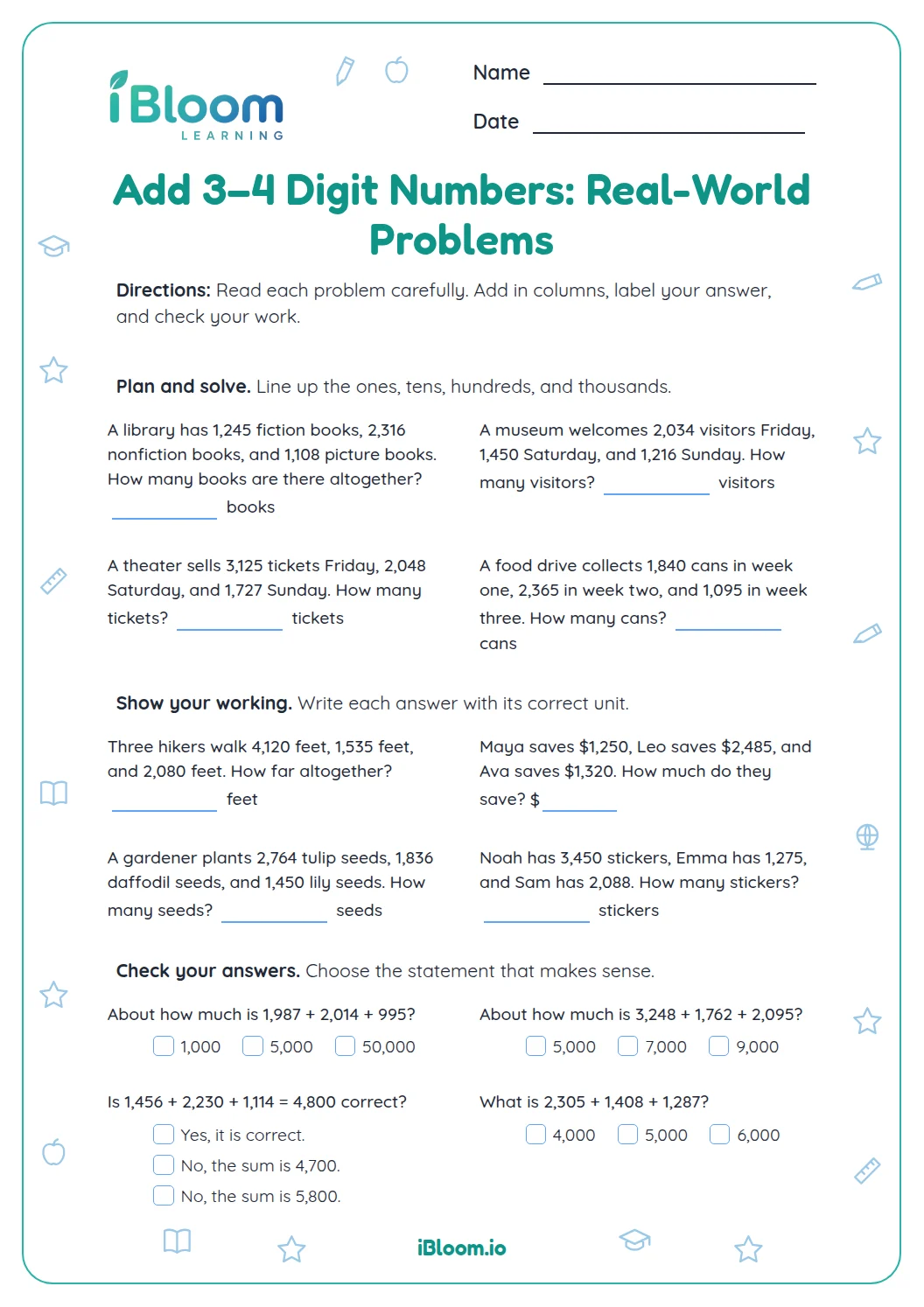
This free printable worksheet gives Grade 3 students twelve ways to reason about three- and four-digit column addition. Six sums provide space to stack addends and record regrouping. Four choices inspect regrouping and alignment, and two written responses diagnose an error and predict how a changed addend affects a sum. Three-digit calculations align with Common Core 3.NBT.A.2; the four-digit standard algorithm work aligns with 4.NBT.B.4. A separate answer key gives totals, choices, and model reasoning.
Aligned to 3.NBT.A.2 and 4.NBT.B.4
How should children set up the columns?
Copy each Part A sum onto its grid with ones under ones, tens under tens, hundreds under hundreds, and thousands under thousands. Start at the right so different number lengths still line up correctly. Leave space above for regrouped amounts.
Question 10 checks this setup with 2,315 and 684. The 4 belongs under the 5 because both are ones. Placing the 6 under the 2 would multiply the second addend by ten.
What does a regrouped digit represent?
A regrouped digit names an amount in the next place. In 368 + 457, fifteen ones become five ones and one ten. The next column includes that extra ten along with the six tens and five tens.
- 1Ones: 8 + 7 = 15; write 5 and regroup 1 ten.
- 2Tens: 6 + 5 + 1 = 12; write 2 and regroup 1 hundred.
- 3Hundreds: 3 + 4 + 1 = 8.
- 4368 + 457 = 825.
How do the reasoning questions reveal mistakes?
Part B focuses on individual decisions: naming a regrouped ten, including it in the next total, moving ten tens into hundreds, and aligning unequal-length numbers. Children can revisit their Part A work while deciding.
Part C asks for a reason as well as a result. In question 11, 9,155 comes from adding 6,840 instead of 684. In question 12, increasing the second addend by ten changes 8,624 to 8,634. The place-value explanation links the old sum to the new one.
Add, inspect, and explain
- 1Copy each Part A calculation onto its grid with equal places aligned.
- 2Begin in the ones column and record each regrouped amount above the next column.
- 3Include regrouped amounts when adding the next column.
- 4Use those calculations to reason through the four Part B choices.
- 5For Part C, write both the correct value and a place-value explanation.
- 6Compare the work with the key and name the column responsible for any difference.
Catch the source of the error
The mistake
Forgetting a regrouped ten and writing 853 for 584 + 279.
The fix
Include the ten from 4 + 9 when adding 8 tens and 7 tens.
The mistake
Lining up the first digits of 684 and 2,315.
The fix
Align the ones digits, 4 and 5, then work left.
The mistake
Writing both digits of a column total into one answer place.
The fix
Write the ones digit of the column total and move the new ten to the next place.
Common Core alignment
Add three-digit numbers within 1,000 and explain regrouping through place value.
On this sheet: The first three sums and their diagnostic questions use addition within 1,000.
Show the official wordingHide the official wording
Fluently add and subtract within 1000 using strategies and algorithms based on place value, properties of operations, and/or the relationship between addition and subtraction.
Use the standard algorithm for four-digit addition.
On this sheet: Students stack four-digit addends, record regrouping, and check an alignment error in a mixed-length sum.
Show the official wordingHide the official wording
Fluently add and subtract multi-digit whole numbers using the standard algorithm.
What to practice next
Make more practice
Further reading
Questions parents and teachers ask
Are the numbers already stacked?
Students stack the six Part A sums on the printed grids. Setting up the columns is part of the practice: they align ones, tens, hundreds, and thousands before adding. The directions tell them to stack each sum, and the later alignment question checks that same habit.
Which sums use three-digit numbers?
The first three calculations use three-digit addends: 243 + 516, 368 + 457, and 584 + 279. Their sums stay within 1,000. The next three calculations use four-digit addends, and a later reasoning question combines 2,315 with the three-digit number 684 to check alignment.
Why does question 8 use the wrong answer 853?
The answer 853 results when the regrouped ten is omitted in 584 + 279. The ones total is 13, so one ten must enter the tens column. Including it makes the tens total 16 and the correct sum 863. Children choose the missing regrouped ten.
What should the answer to question 11 say?
It should give 2,999 and explain that 684 was shifted one place to the left. That shift changes its value to 6,840, which produces the stated wrong total of 9,155. Children may explain this with words or a clearly labeled pair of column setups.
Must children redo the final sum from the beginning?
They can use the known sum to reason directly. The second addend changes from 3,768 to 3,778, an increase of 10, so the total changes from 8,624 to 8,634. A full recalculation can check the result, but the explanation should identify the ten-unit increase.