

About this worksheet
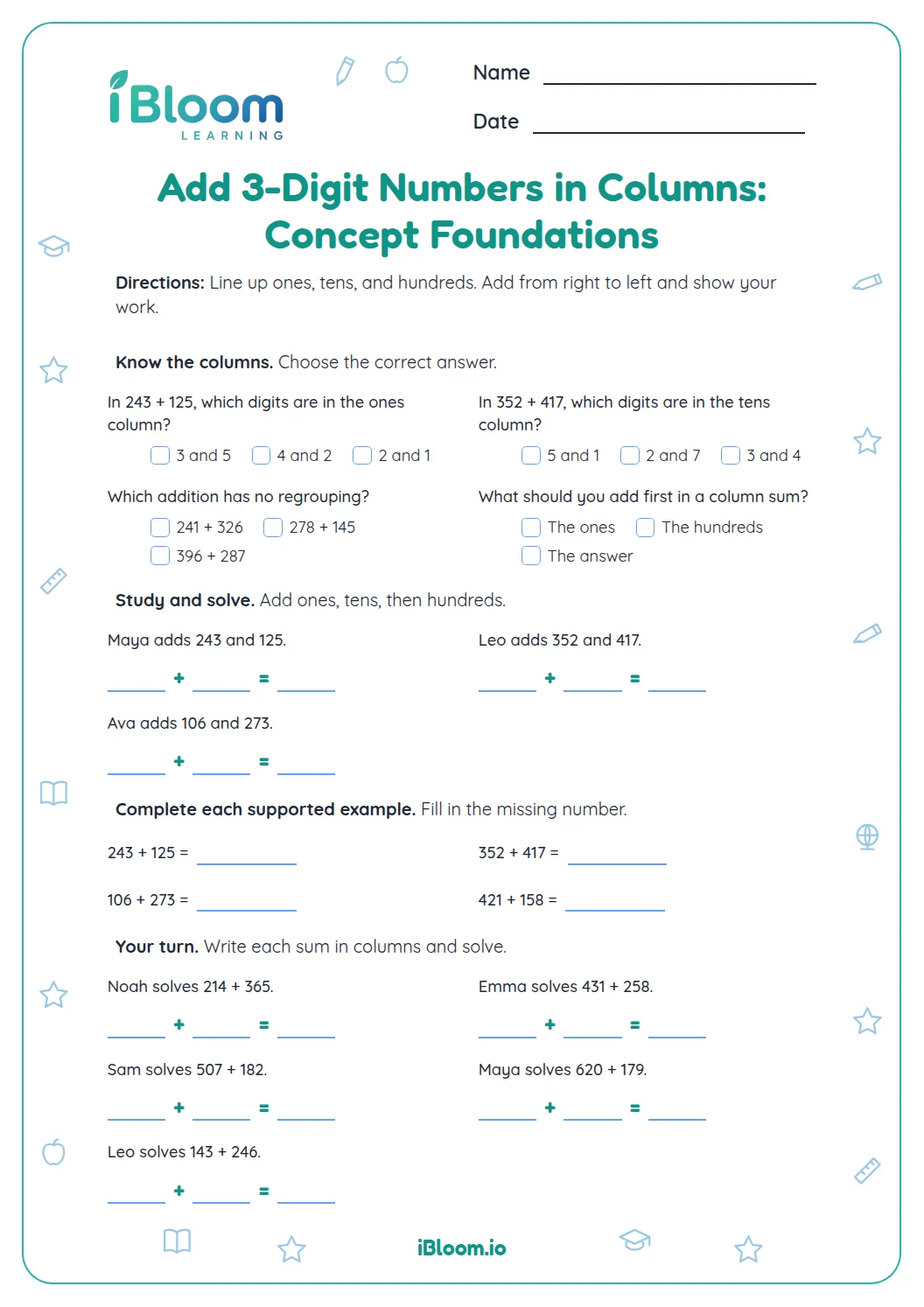
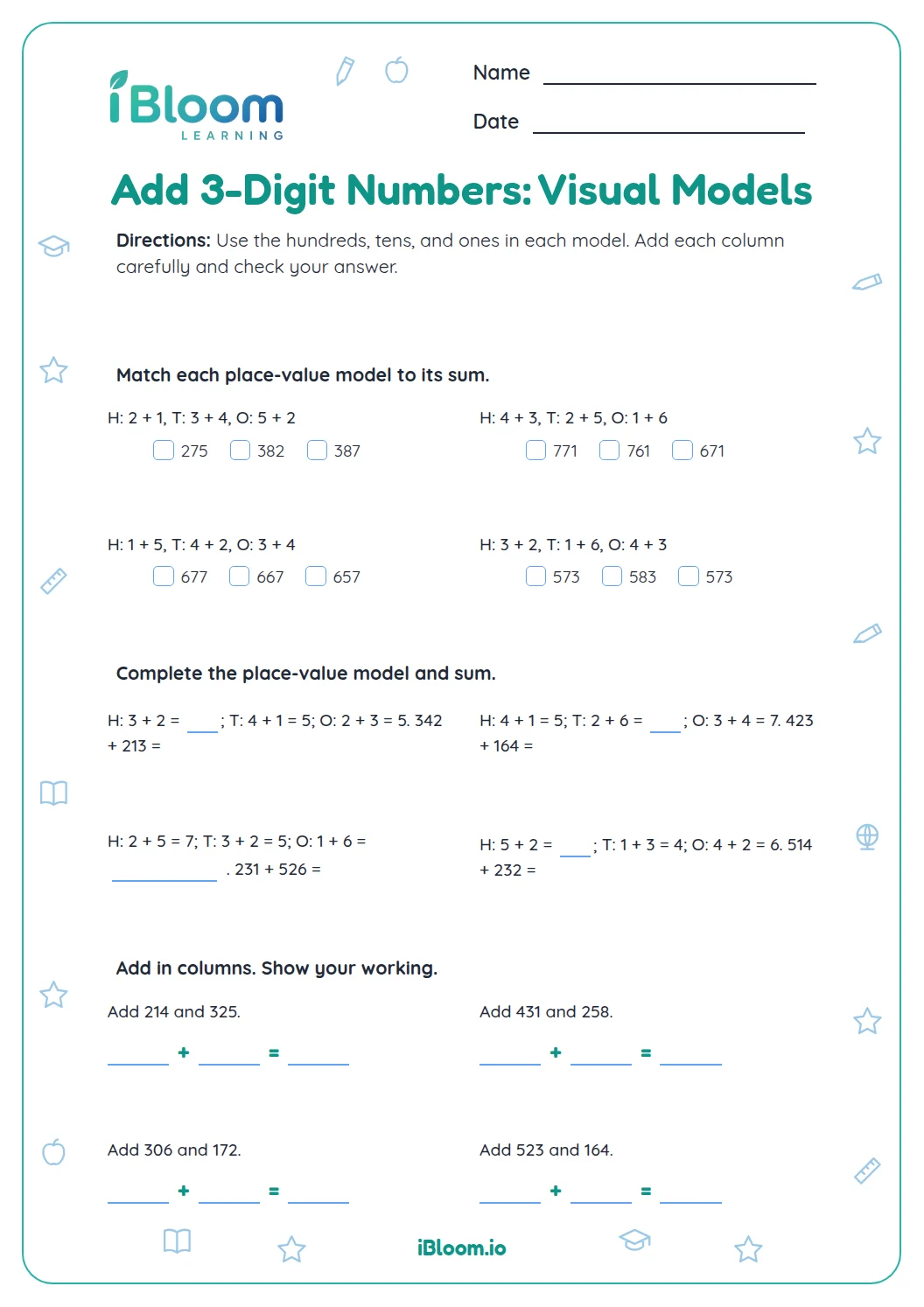
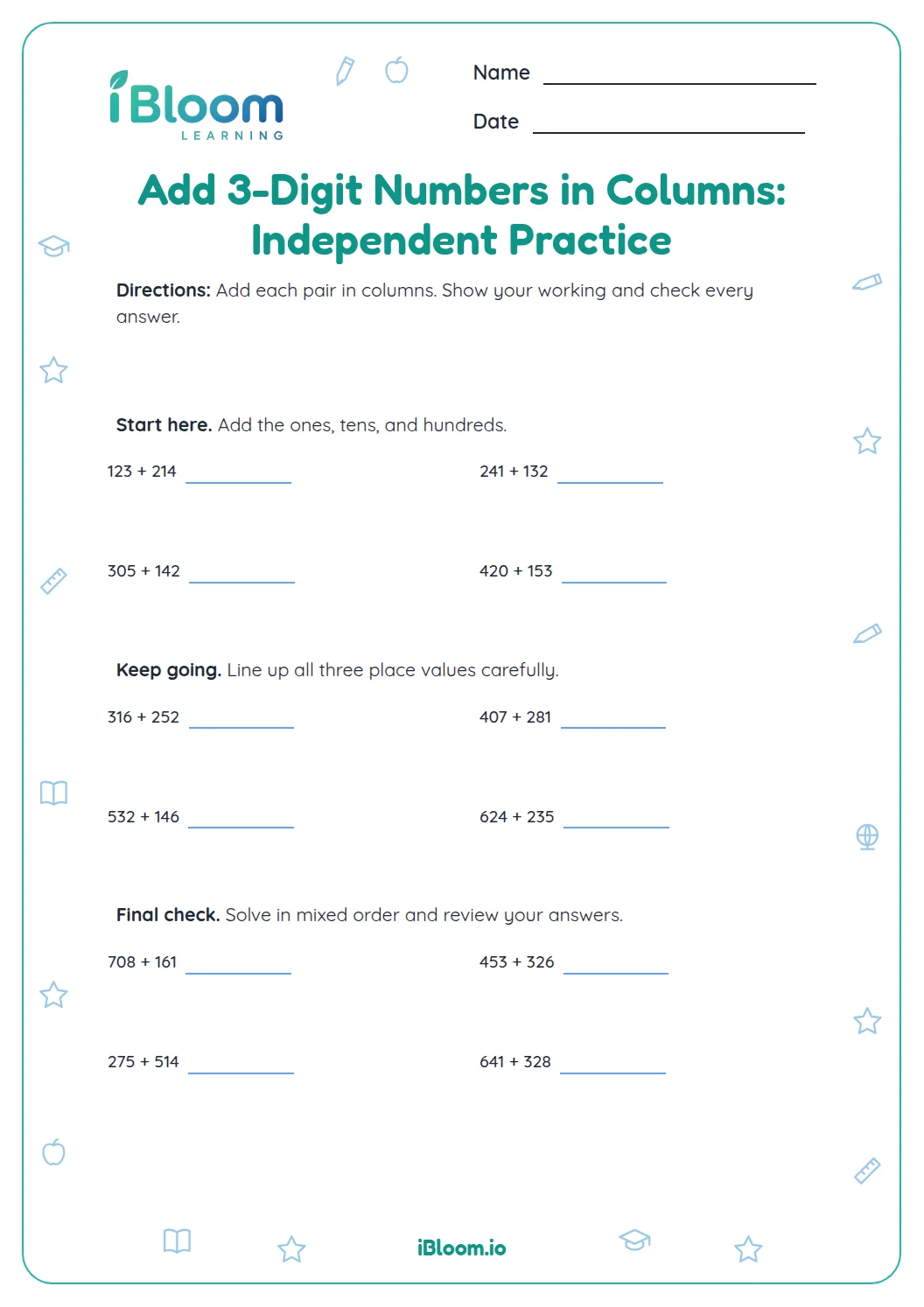
This Grade 3 worksheet gives students 14 real-world problems that require adding two three-digit numbers without regrouping. Contexts include books, flowers, visitors, trail lengths, money, and collections. Each item asks for the combined total, and the answer key lists the sums. Students can use place-value columns to organize and check each addition equation. It aligns with Common Core 3.NBT.A.2.
Aligned to 3.NBT.A.2
How do you turn a story into an addition equation?
Find the two amounts that are being put together. Write them with a plus sign, then add ones to ones, tens to tens, and hundreds to hundreds.
For question 1, the library starts with 214 books and receives 325: 214 + 325 = 539. No column reaches ten, so no regrouping is needed.
- 1214 + 325
- 24 ones + 5 ones = 9 ones
- 31 ten + 2 tens = 3 tens
- 42 hundreds + 3 hundreds = 5 hundreds
- 5Total: 539 books
How can you check each place-value column?
Keep the digits lined up by place. Add the ones, then the tens and hundreds, checking that each column total is less than 10. Every problem is chosen so the columns can be added without regrouping.
For question 2, 3 + 6 = 9 ones, 4 + 5 = 9 tens, and 1 + 2 = 3 hundreds. The total is 399 flowers.
How should the answer match the story?
After finding the sum, name what it counts and include the unit when one appears. A total of 588 meters answers a question about trail length; 588 by itself is less clear.
If the story asks how many items or people there are, the sum gives the combined count.
How to use this worksheet
- 1Underline the two amounts in the story.
- 2Write an addition equation using those amounts.
- 3Line up hundreds, tens, and ones.
- 4Add each column and check that none needs regrouping.
- 5Write the total with the unit or item named in the question.
Common slips and helpful fixes
The mistake
Adding digits across a row without keeping place values.
The fix
Stack the numbers so ones, tens, and hundreds line up.
The mistake
Forgetting one of the two amounts.
The fix
Circle both quantities before writing the equation.
The mistake
Writing only a number when the question asks for a unit.
The fix
Finish with words such as books, meters, dollars, or miles.
Common Core alignment
These activities practice the stated Common Core skill through the worksheet questions.
Add three-digit numbers within 1,000 with place-value strategies.
On this sheet: Each story problem adds two three-digit amounts without regrouping.
Show the official wordingHide the official wording
Fluently add and subtract within 1000 using strategies and algorithms based on place value, properties of operations, and/or the relationship between addition and subtraction.
What to practice next
Make more practice
Further reading
Questions parents and teachers ask
Do these problems require regrouping?
No. In every problem, the ones digits, tens digits, and hundreds digits each add to less than 10. Students can add each place-value column without composing a new ten or hundred, then check that their total is less than 1,000.
Should students write an equation for each story?
Yes. An equation makes the two amounts being combined visible. For question 1, the library’s 214 books and 325 additional books become 214 + 325 = 539. Students can line up the hundreds, tens, and ones to find and check the total.
What does three-digit addition mean here?
Both addends have a hundreds digit, a tens digit, and a ones digit. Students keep those places aligned and combine matching columns. The answers stay within 1,000, and each item uses an everyday quantity such as books, flowers, visitors, or meters.
How many questions and pages are included?
The worksheet has 14 real-world addition questions across two pages. Each gives two three-digit amounts to combine and a blank for the total, with the counted item or unit named. A separate two-page answer key provides the sums for checking.
What is a helpful way to check a total?
Add the ones, tens, and hundreds separately, then make sure each column total is below 10. Check the full sum with an estimate or a second addition strategy. Finally, reread the story and include its unit when the answer is a distance or amount of money.