






About this worksheet
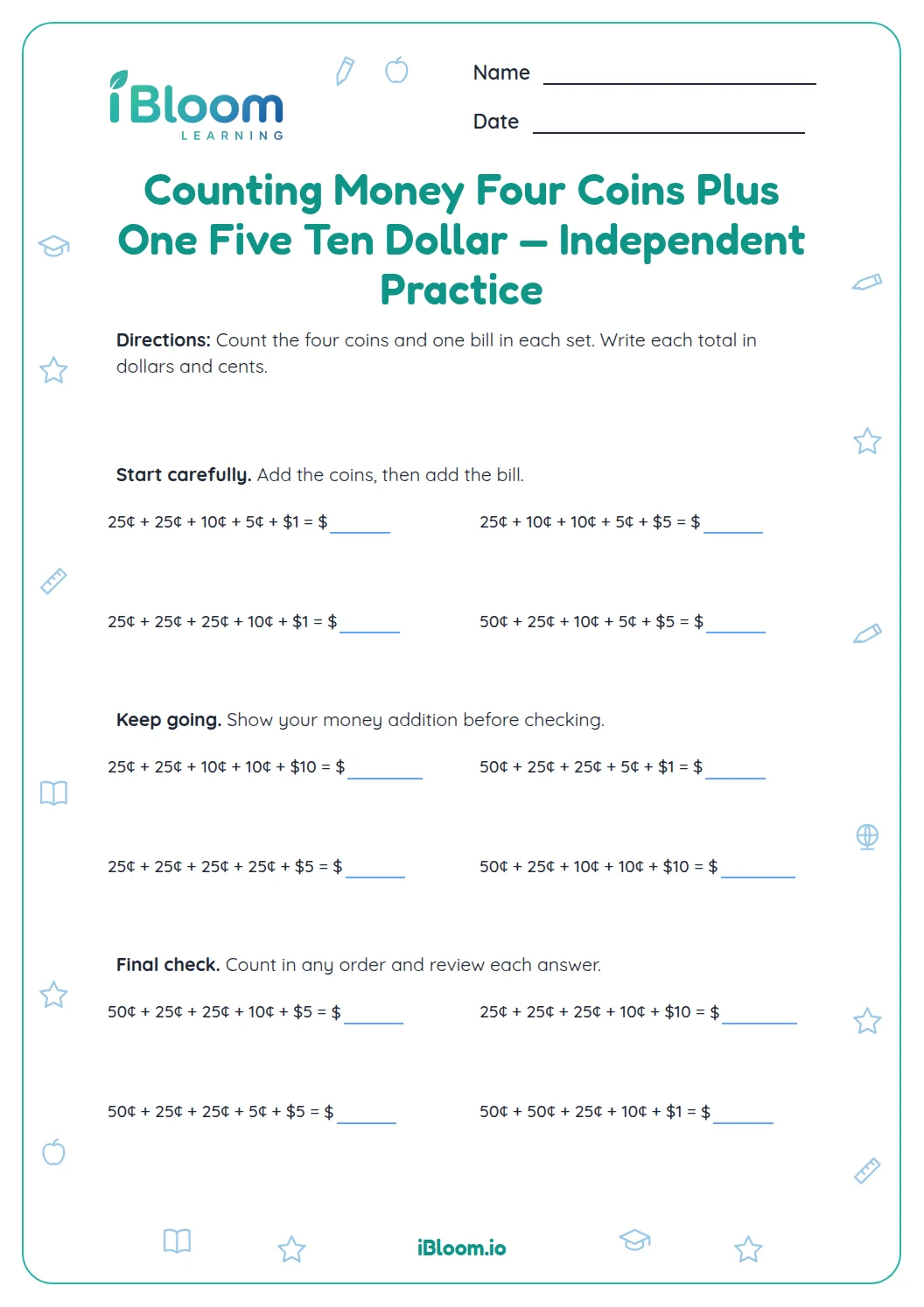
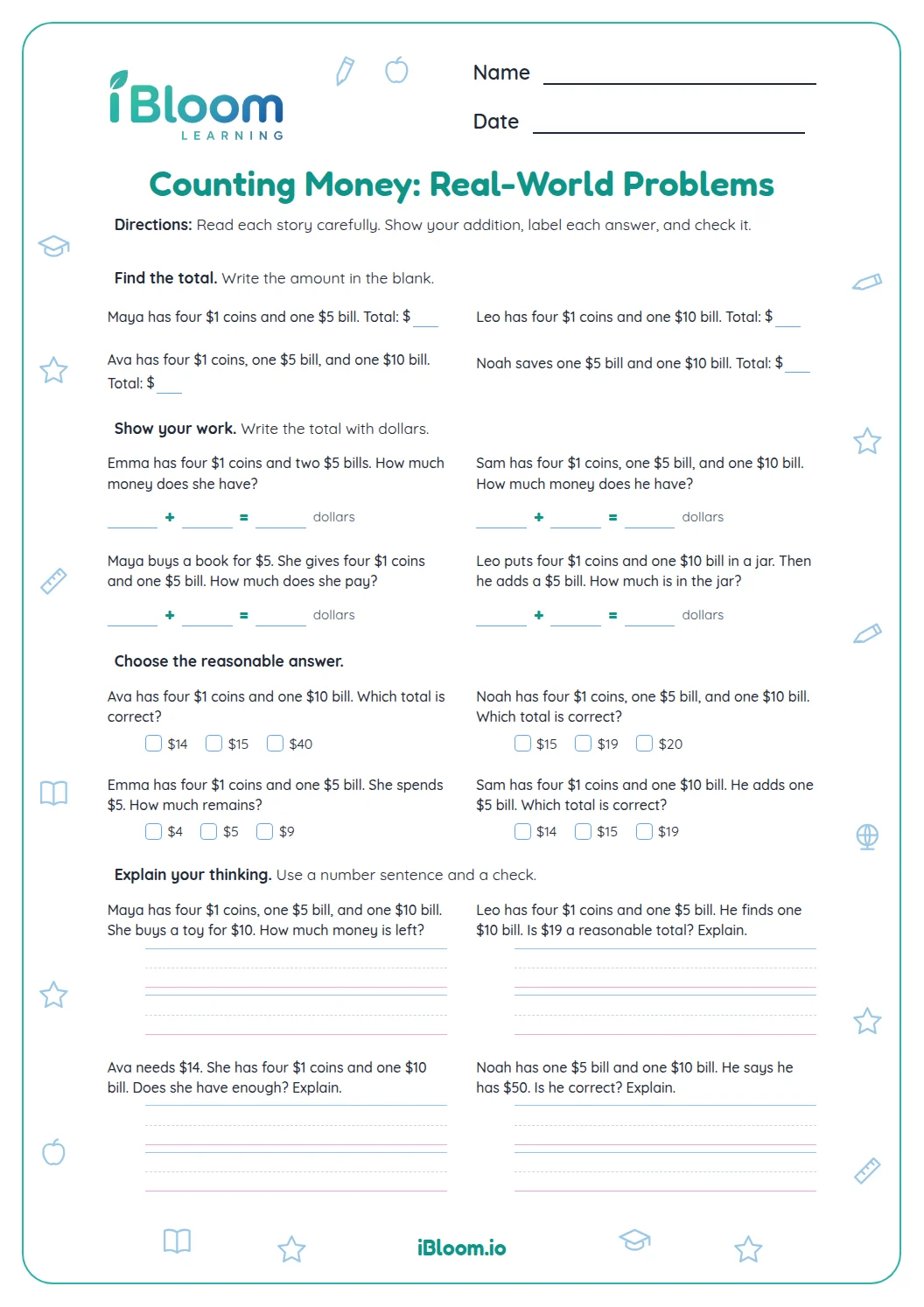
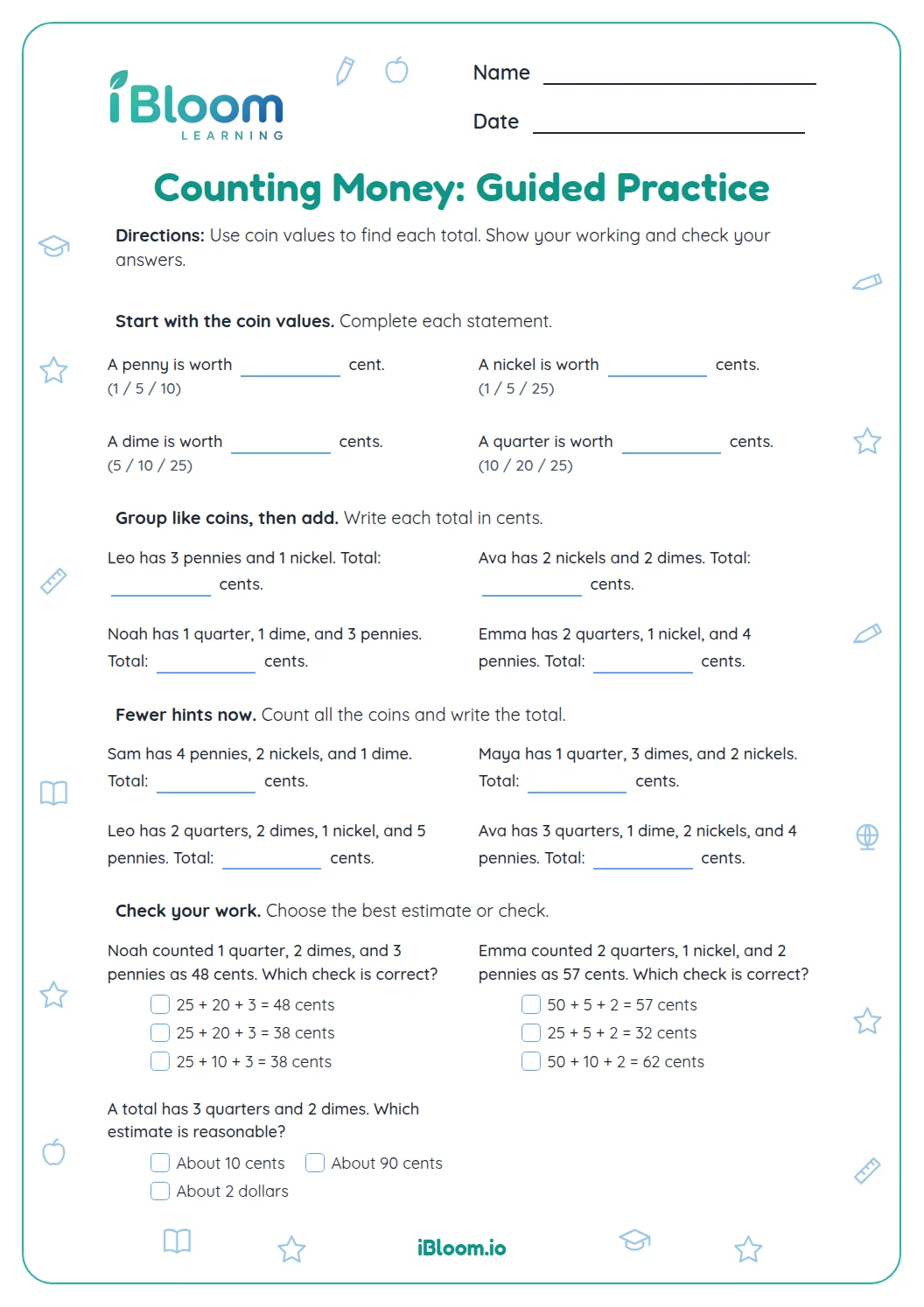
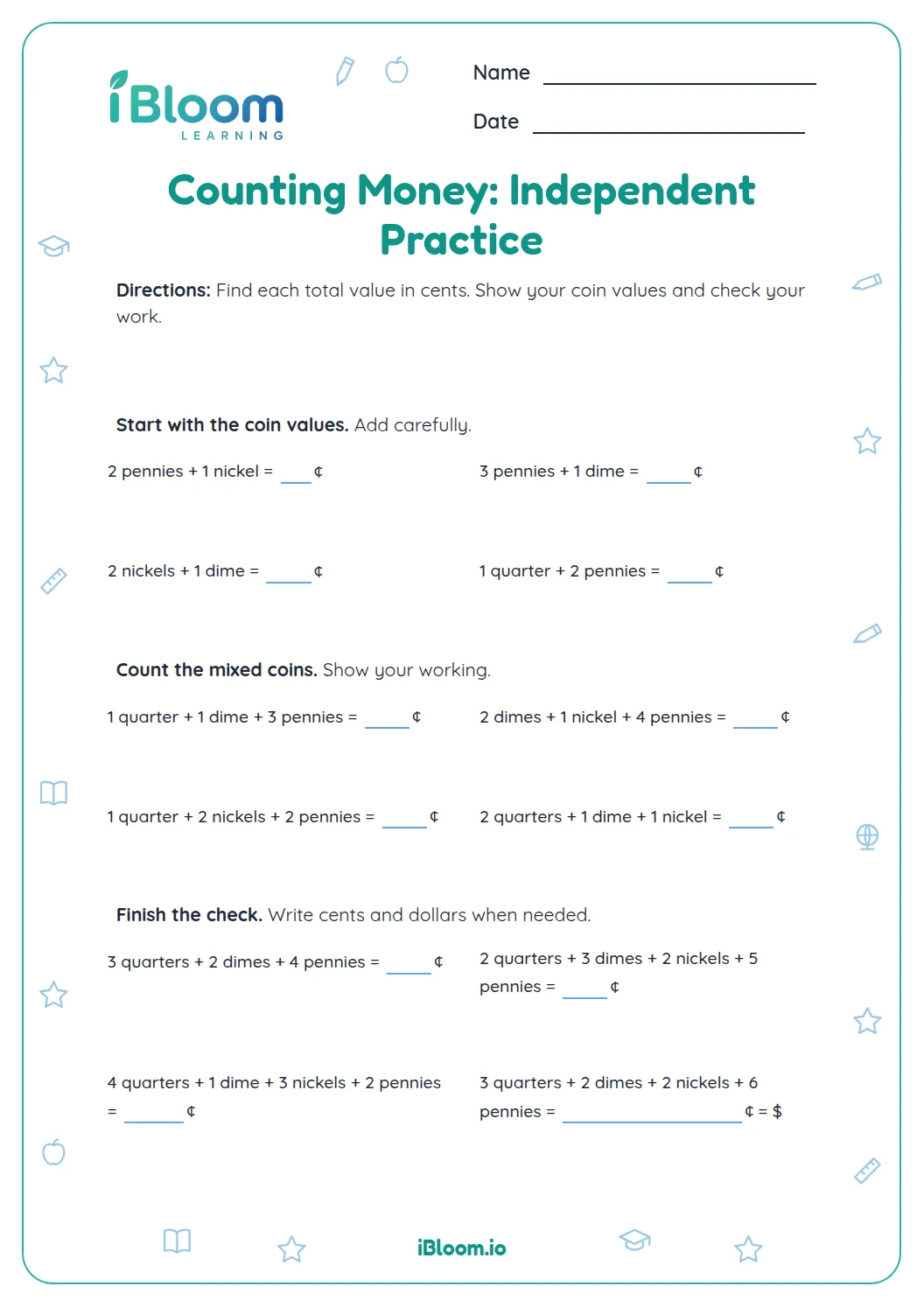
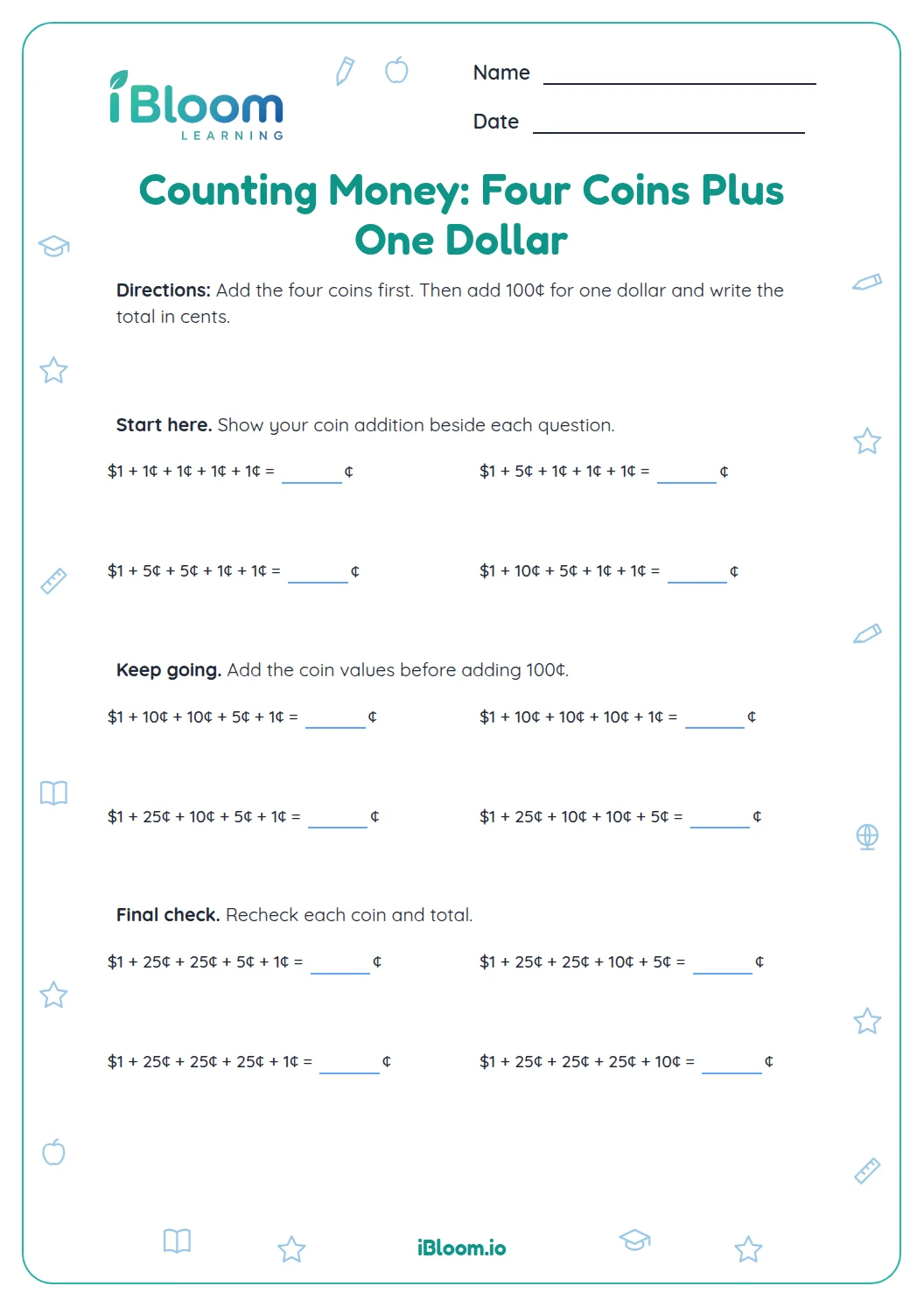
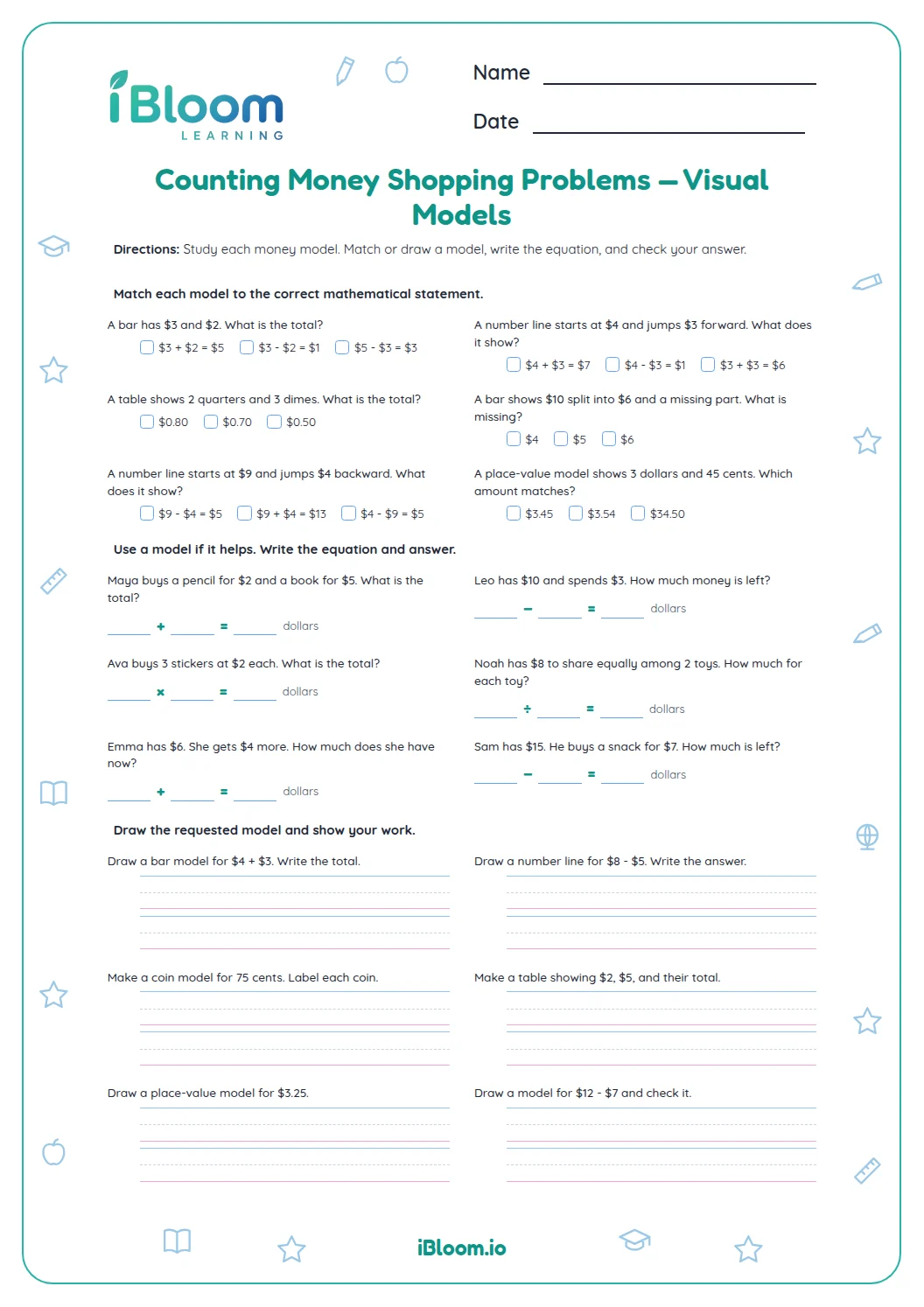
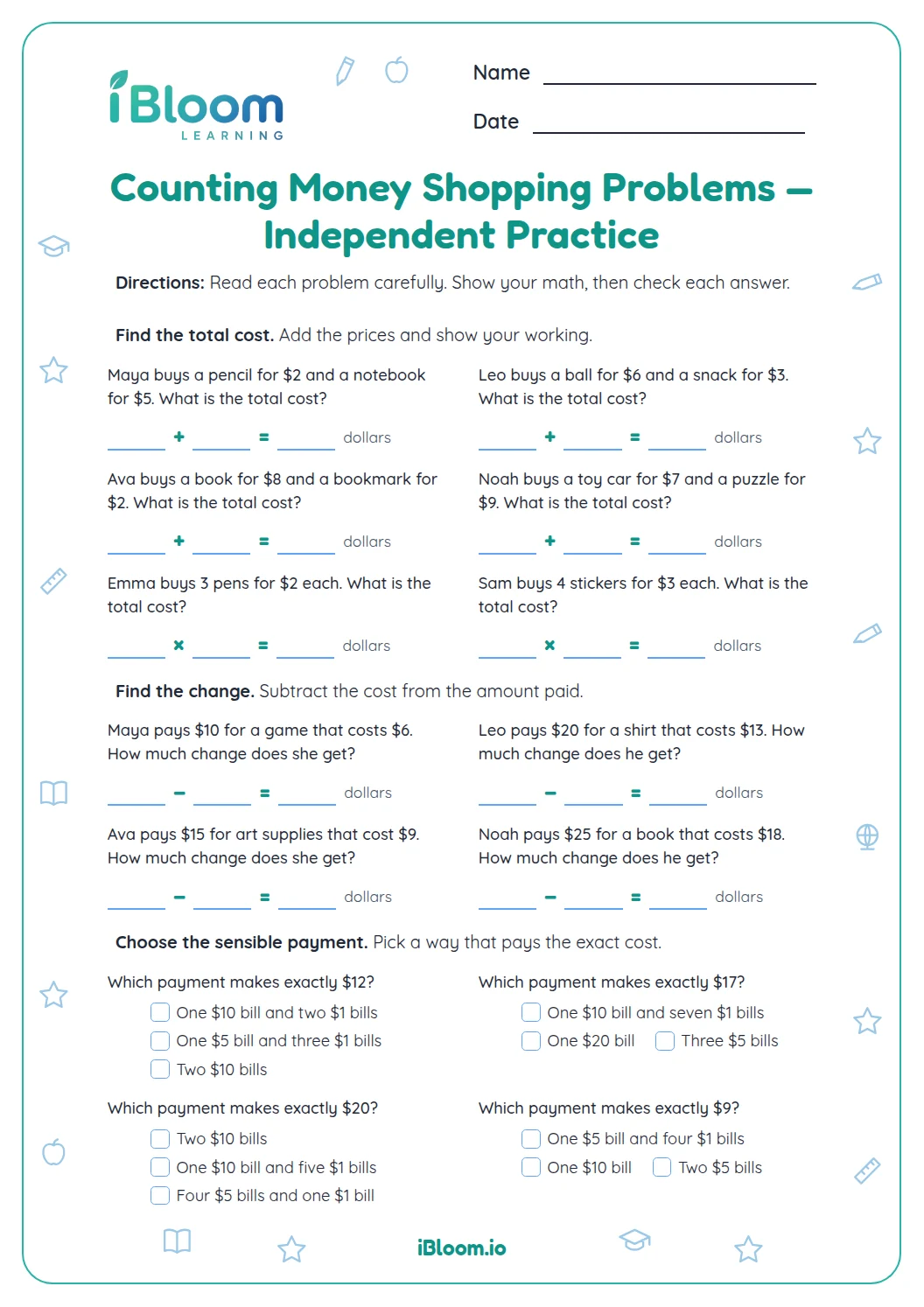
This free Grade 3 worksheet uses coin pictures and named $1, $5, and $10 bills to practice counting US money. Part A has six totals to find, with exactly four coins in each drawing. Part B reuses those models in four situations involving enough money, a missing amount, a combined total, and an extra coin. Pennies, nickels, dimes, and quarters all appear across the sheet. The work practices Common Core 2.MD.C.8 by connecting dollar bills and coin values in word problems. A separate answer key gives every total and choice.
Aligned to 2.MD.C.8
What do the visual models show?
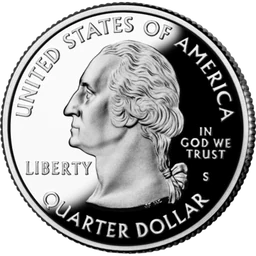
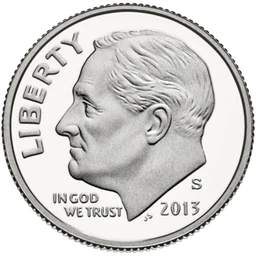
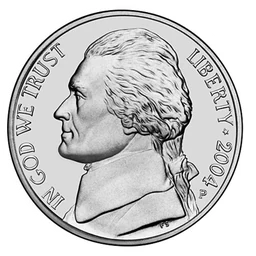
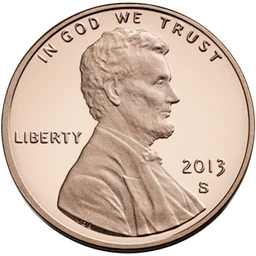
Each of the six drawings contains four US coins. Across the questions, children see pennies worth 1¢, nickels worth 5¢, dimes worth 10¢, and quarters worth 25¢. The prompt names the bills that belong with those coins, so students must read both the words and the drawing.
Some groups repeat a coin type. Count each coin once, even when two coins look alike. A dime is worth more than a nickel despite being smaller.
How do dollars and cents fit together?
Add bill values separately from the coin values. Then write the dollar amount with two digits for cents. In question 3, 17 cents belongs after the decimal point in $10.17; it does not become 17 dollars.
In question 6, four quarters make 100 cents, or $1. Add that dollar to the $15 in bills to get $16.00. The coin amount can add a whole dollar to the total.
- 1Bill: $1
- 2Coins: 25¢ + 10¢ + 5¢ + 1¢ = 41¢
- 3Total: $1.41
How does Part B build on counting?
Students use the Part A models again: they decide whether $5.65 can pay for a $5.80 notebook, find the amount needed to raise $6.50 to $7.00, add a $5 bill to $11.76, and select one coin that raises $6.50 to $6.75.
For a wrong answer, have the child recount just the coins before combining dollars and cents again. This helps locate whether the slip involved coin recognition, adding, or writing the total.
How to use this worksheet
- 1Review the values of a penny, nickel, dime, and quarter.
- 2Read the named bills in each Part A question before counting its coins.
- 3Complete each dollar amount with exactly two digits for cents.
- 4Use those counting steps in Part B, then compare answers with the key.
Mistakes to notice and fix
The mistake
Counting four coins as four cents.
The fix
Name each coin’s value and add those values, rather than the number of coins.
The mistake
Writing $15.100 for fifteen dollars and 100 cents in question 6.
The fix
Trade 100 cents for $1 and add it to the $15 in bills: $16.00.
The mistake
Forgetting the $5 bill when a prompt also names a $10 bill.
The fix
Underline each named bill, add their values, and then add the coins.
Common Core alignment
Find totals and missing amounts using US bills, four coin types, and money symbols.
On this sheet: Students use coin models and named dollar bills to solve money situations.
Show the official wordingHide the official wording
Solve word problems involving dollar bills, quarters, dimes, nickels, and pennies, using $ and ¢ symbols appropriately. Example: If you have 2 dimes and 3 pennies, how many cents do you have?
What to practice next
Make more practice
Further reading
Questions parents and teachers ask
Which coins and bills are included?
The sheet uses pennies, nickels, dimes, and quarters, together with $1, $5, and $10 bills. Each of the six Part A drawings has exactly four coins. Bills are named in the prompts. Part B refers back to those money models for four additional questions.
Should children count the biggest coin first?
They can start with the highest-value coin to make the addition easier. In question 1, count 25, 35, 40, and 41 cents, then add the dollar bill. Remind children to use value rather than physical size, because a dime is smaller than a nickel.
Why must answers have two digits for cents?
Two digits make the cents portion clear in a dollar amount. For example, $6.50 means six dollars and fifty cents, while $6.05 means six dollars and five cents. Question 4 gives practice with fifty cents, and the key shows the full money notation.
How can I help with the notebook problem?
Count Mia’s money before comparing it with the price. Her $5 bill and coins total $5.65, while the notebook costs $5.80. The difference is 15 cents, so she does not have enough. Ask your child to count up from 65 cents to 80 cents.
Can children use real coins beside the sheet?
Yes, matching real coins to the drawings can support coin recognition and counting. Have children build each Part A group, read the bills named in the prompt, and find the combined amount. Then use the same models to solve Part B’s questions about spending and adding money.