





About this worksheet
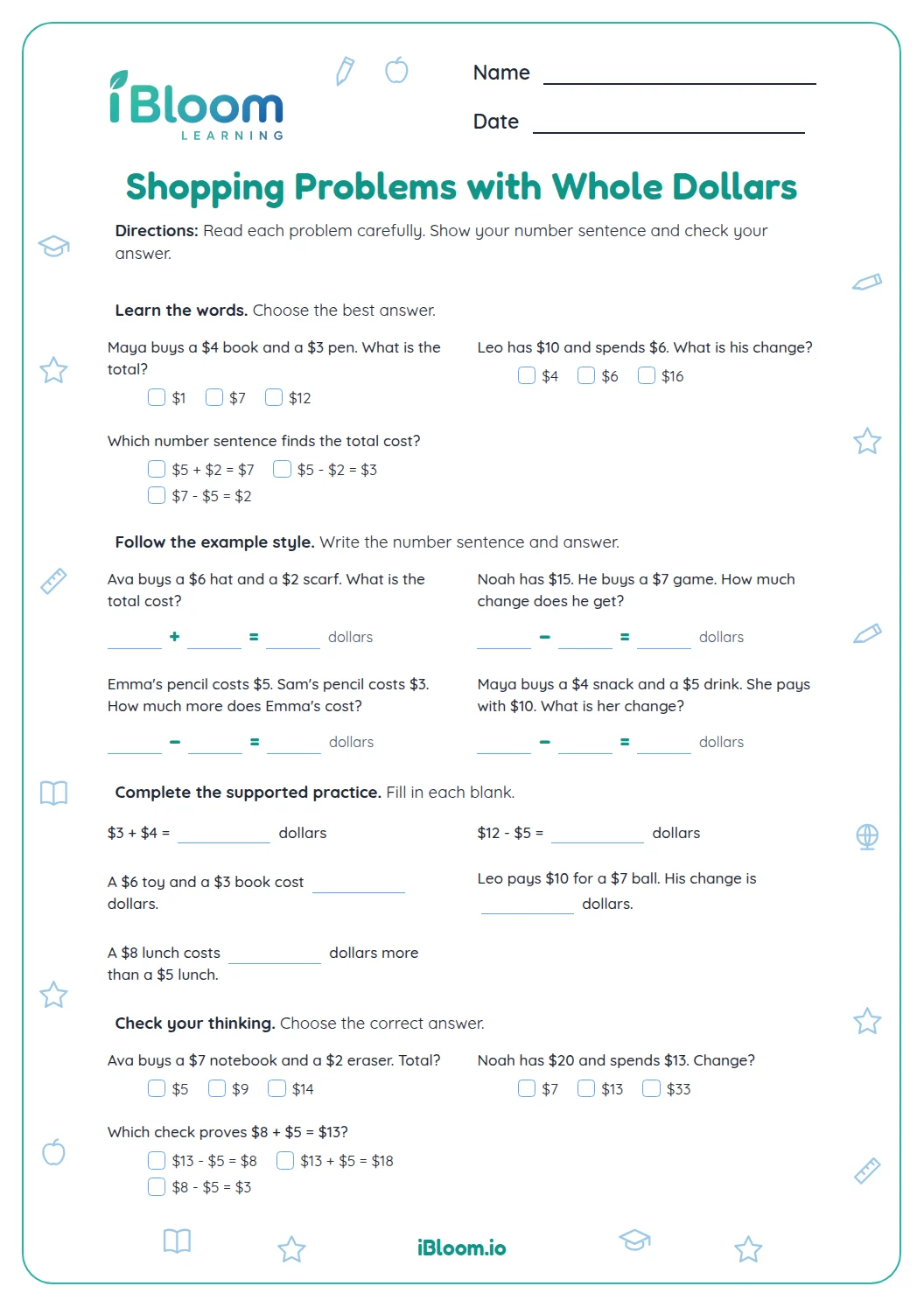
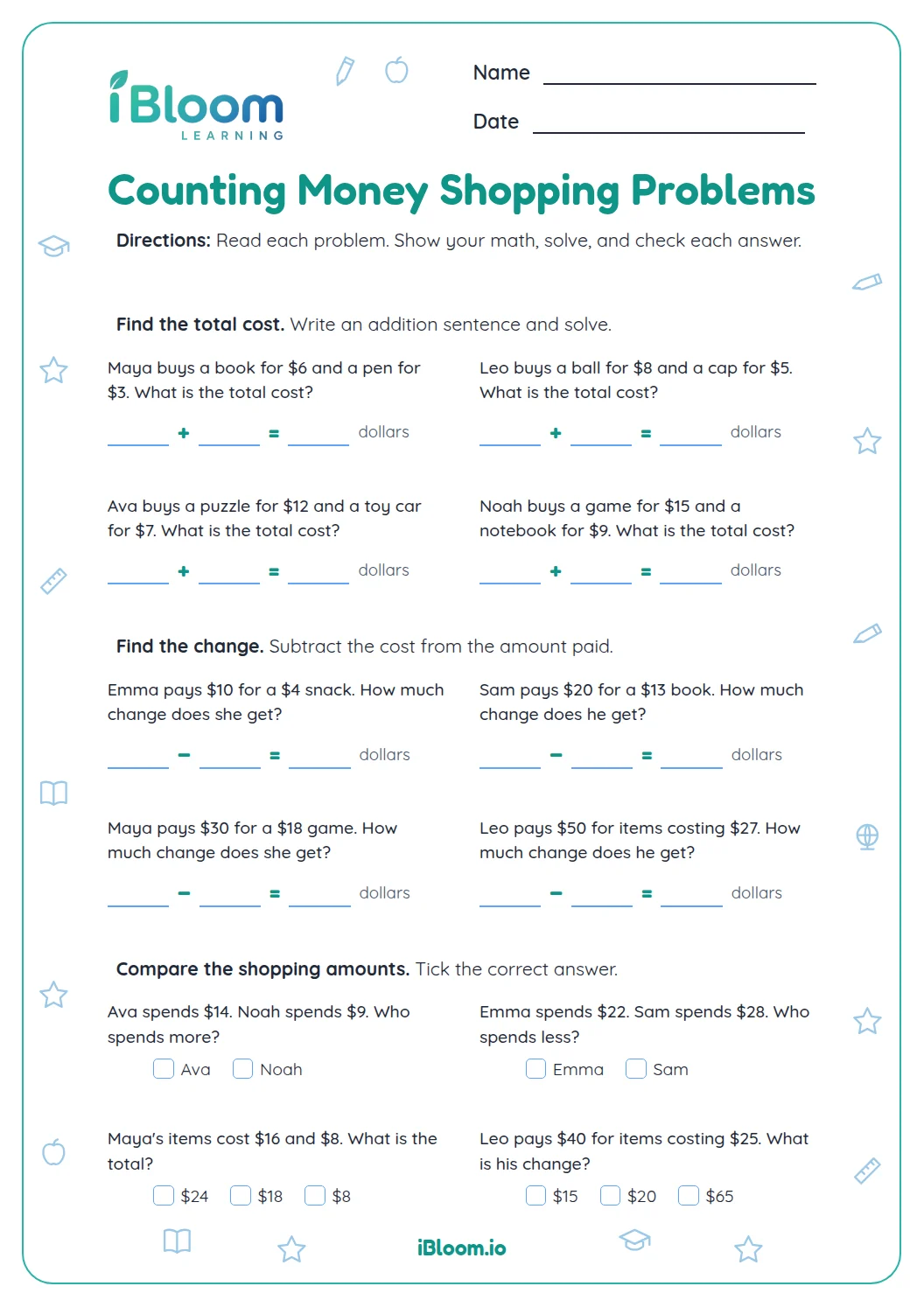
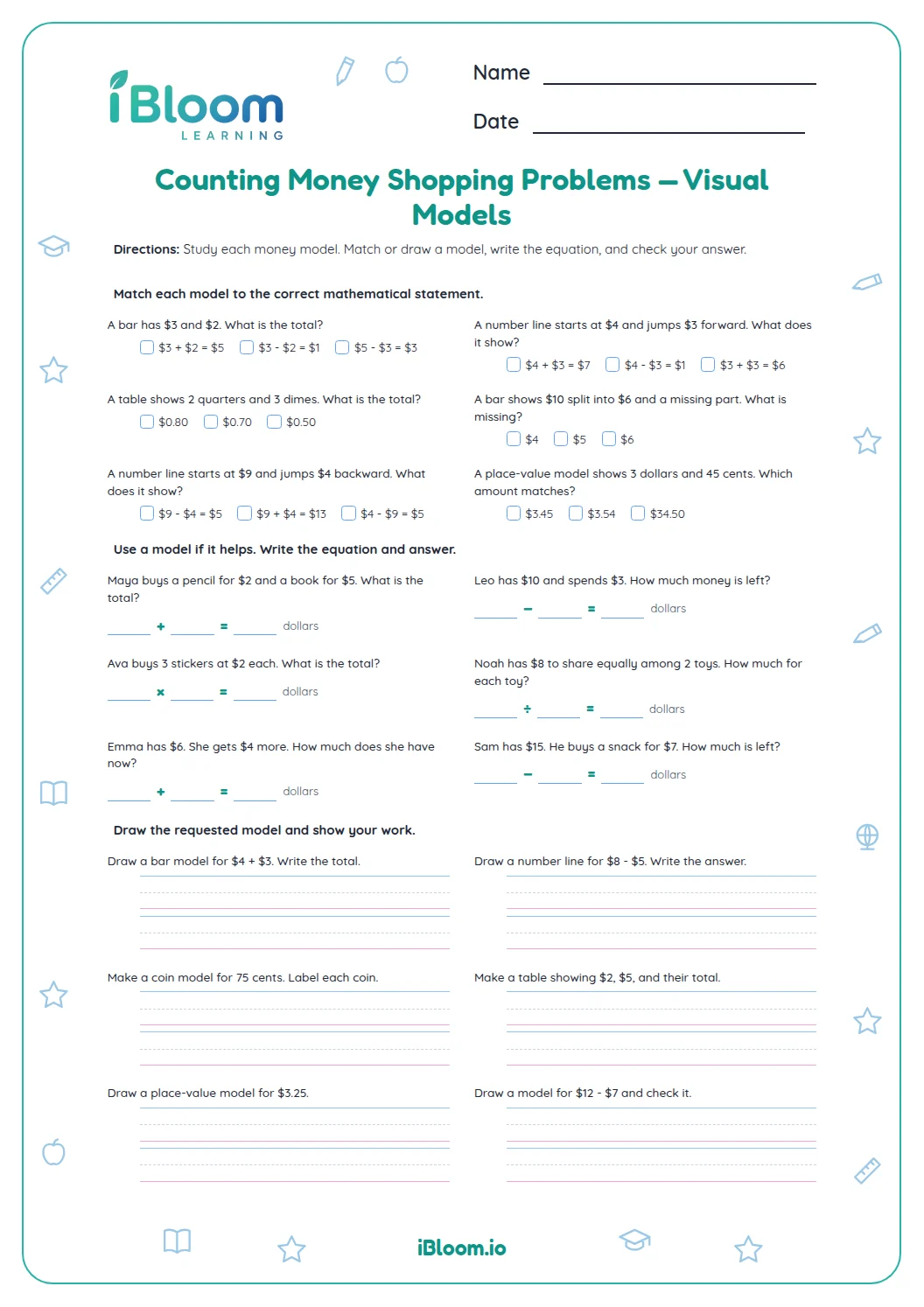
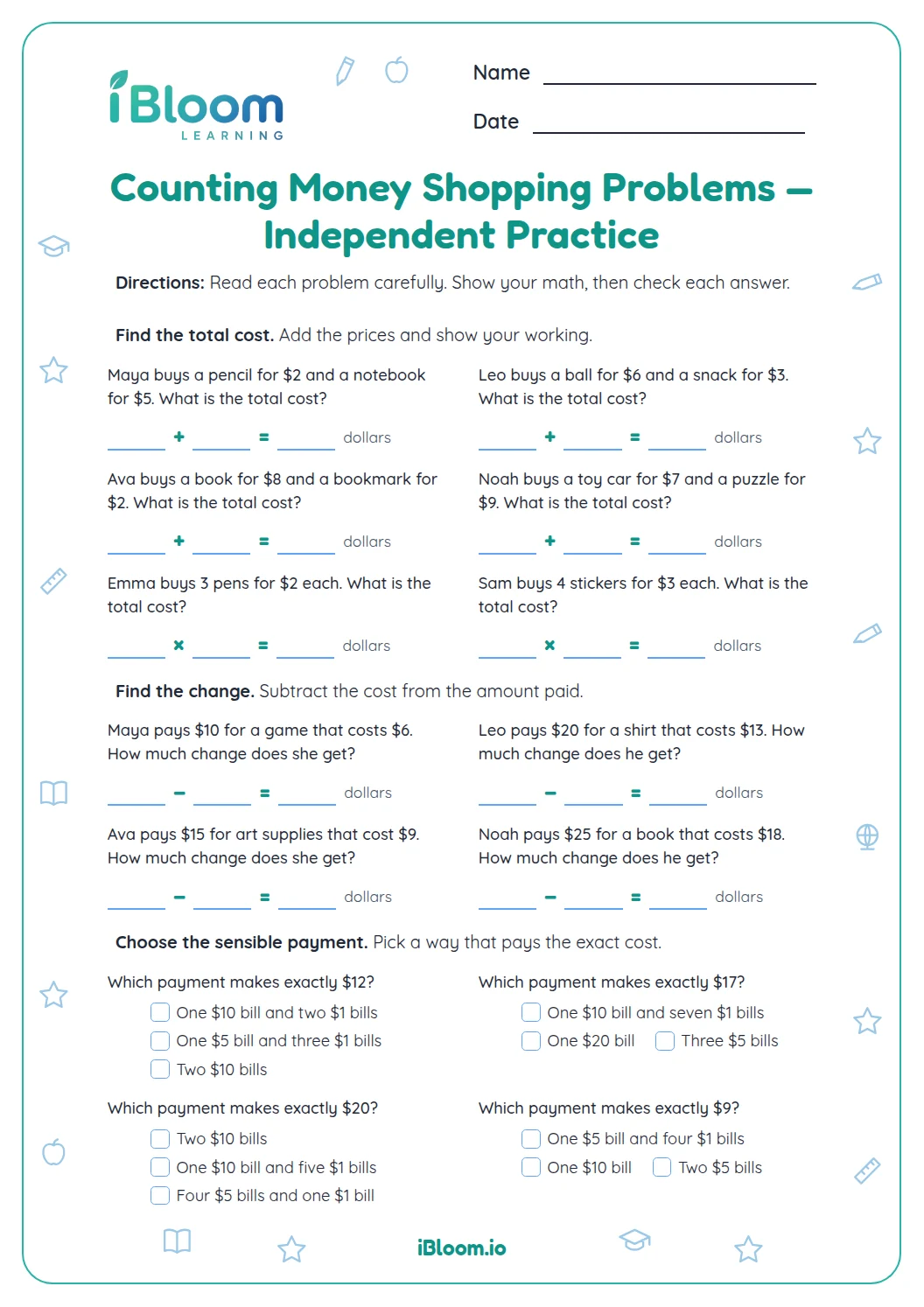
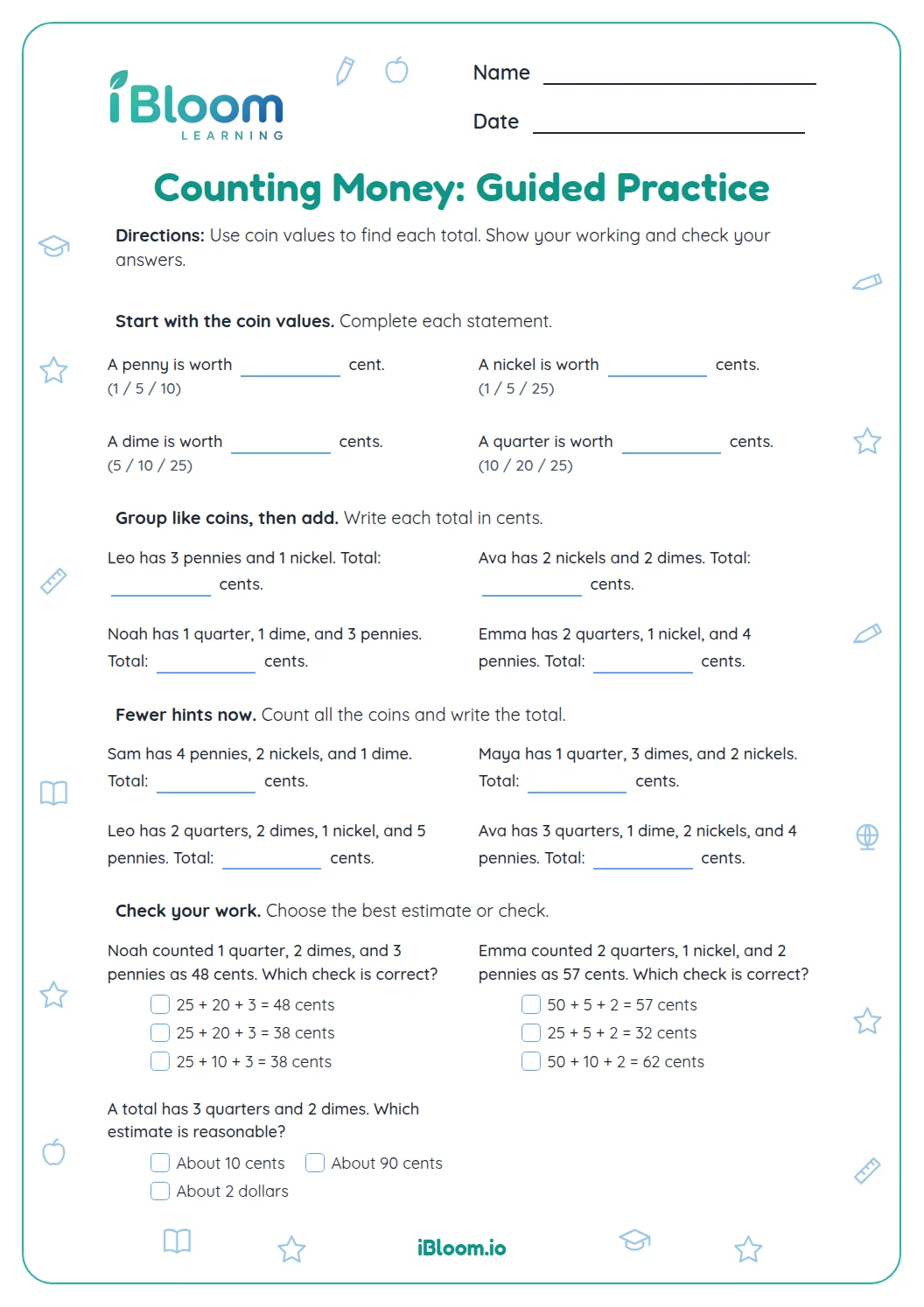
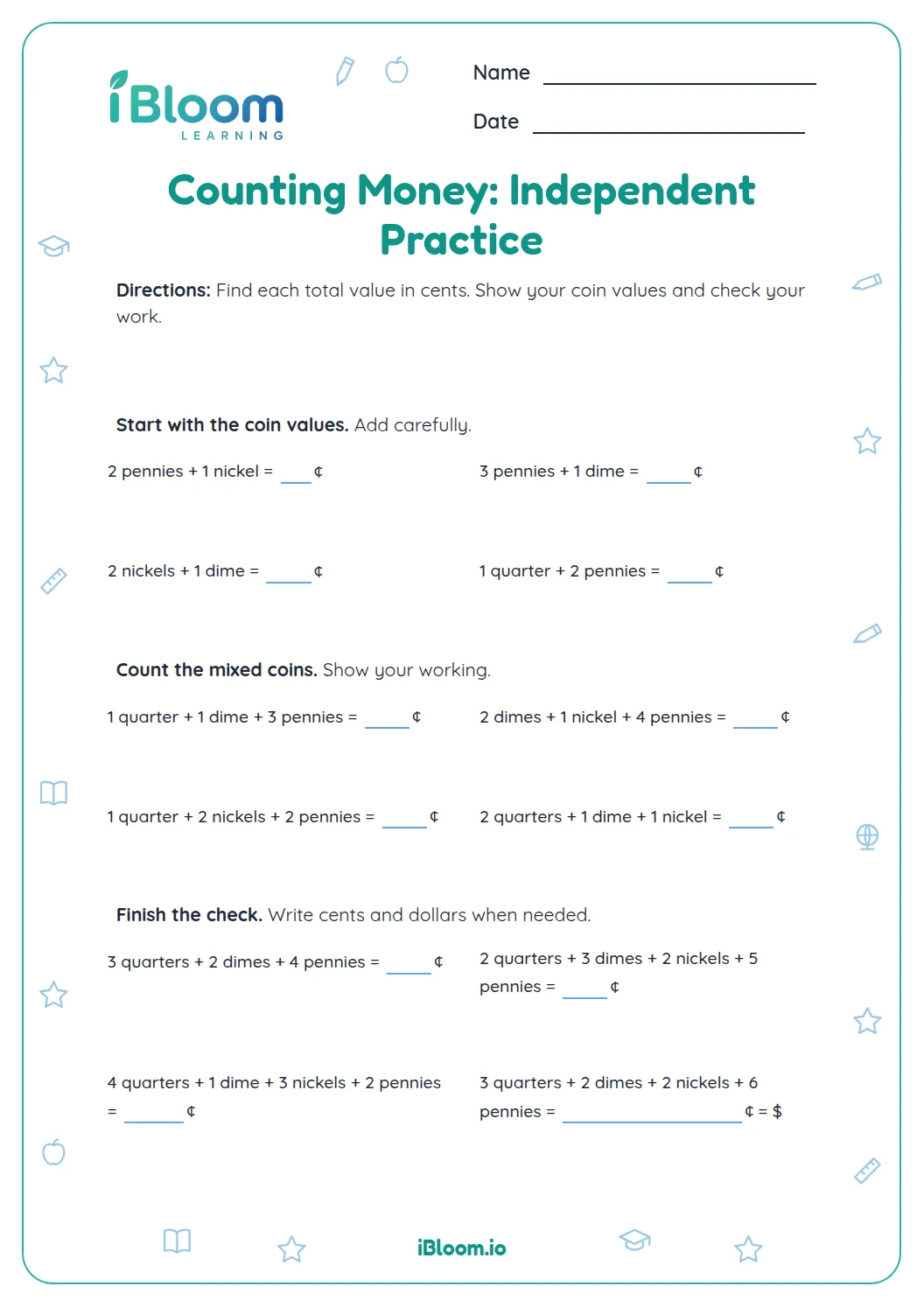
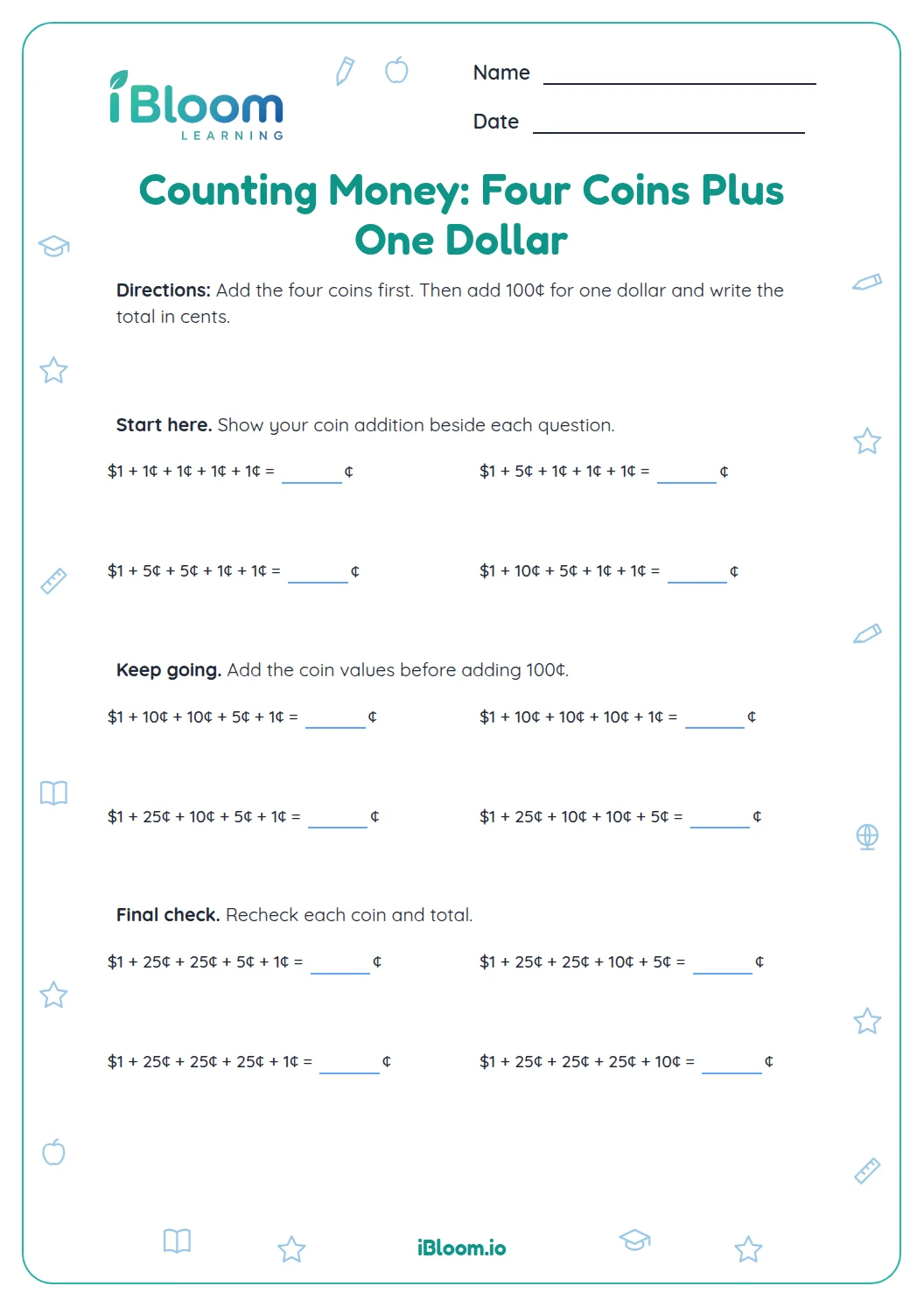
This Grade 3 math worksheet presents 16 shopping problems about combining prices, finding change, and using coin values. Students write an equation and solve each item with whole-dollar or cent amounts. The problems align with Common Core 2.MD.C.8, which asks children to solve money word problems using dollar bills and coins with $ and ¢ symbols. The separate key lists a concise money answer for every question.
Aligned to 2.MD.C.8
What do students solve in Part A?
The first eight items ask for a purchase total or the change from a payment. Students identify whether the situation calls for addition or subtraction, write an equation, and include the money unit.
Prices vary across cents and whole dollars, with familiar items such as notebooks, juice boxes, and a puzzle.
- 1Notebook 35¢ + pencil 20¢ = 55¢
- 2The combined price is 55¢.
How does Part B use coin values?
The last eight questions use facts such as four quarters making one dollar and three quarters making 75¢. Other items involve equal prices or comparing the cost with the amount available.
Keep like units together when combining amounts. If converting quarters to cents helps, write that intermediate amount before solving.
How can a student check an answer?
For a total, add the prices again in a different order. For change, add the change to the price and see whether it equals the amount paid.
A written equation helps show which operation fits the story and makes the result easier to check.
How to use this worksheet
- 1Read the whole situation and identify the amount paid or each price.
- 2Decide whether the story asks for a total or for change.
- 3Write an equation using the same dollar or cent unit.
- 4Solve, then label the answer with $ or ¢.
- 5Check a change answer by adding it back to the price.
Common mistakes and fixes
The mistake
Adding the amount paid to the price when asked for change.
The fix
Find the difference between the amount paid and the price.
The mistake
Forgetting that four quarters make one dollar.
The fix
Count quarters by 25¢ and regroup 100¢ as $1.
The mistake
Writing an unlabeled answer such as 25.
The fix
Include the correct money symbol so the amount is clear.
Curriculum alignment
This page gives children focused practice with the named skill.
Solve word problems with dollar bills and coins using $ and ¢ symbols.
On this sheet: Students add and subtract amounts of money and use coin values to solve shopping problems.
Show the official wordingHide the official wording
Solve word problems involving dollar bills, quarters, dimes, nickels, and pennies, using $ and ¢ symbols appropriately. Example: If you have 2 dimes and 3 pennies, how many cents do you have?
What to practice next
Further reading
Questions parents and teachers ask
What does this worksheet ask students to do?
Students solve shopping stories with whole-dollar prices, totals, and change. They write an operation, solve it, and use related number sentences or estimates to check whether each answer makes sense. The separate key shows completed calculations and useful checks.
How many questions are on the sheet?
There are 16 word problems in two parts. The first eight focus on totals and change in everyday purchases; the next eight include coin facts, repeated prices, and one-step shopping situations. Each question has working space for an equation. Writing the money unit beside each amount helps prevent a cents-and-dollars mix-up.
Should students show an equation?
Yes. The directions ask students to write an equation and solve each problem. An equation such as 35¢ + 20¢ = 55¢ makes it easier to see how the prices were combined and helps a child check whether the answer is a total or change.
Why does the answer key use dollar and cent symbols?
The symbols help show whether an amount is stated as whole dollars or cents. The key keeps the same money units as the question; for example, 15¢ stays in cents and $3 stays in dollars. Writing the money unit beside each amount helps prevent a cents-and-dollars mix-up.
What is a good way to check change?
Subtract the price from the amount paid, or count up from the price to the amount paid. For a 75¢ toy paid for with $1, the difference is 25¢. Checking with 75¢ + 25¢ = $1 confirms the change. Writing the money unit beside each amount helps prevent a cents-and-dollars mix-up.
What can students practice next?
Students ready for another step can work with the related counting-money pages using different coin combinations or dollar amounts. At home, ask them to estimate a small purchase and explain whether a given amount of money is enough. Writing the money unit beside each amount helps prevent a cents-and-dollars mix-up.