






About this worksheet
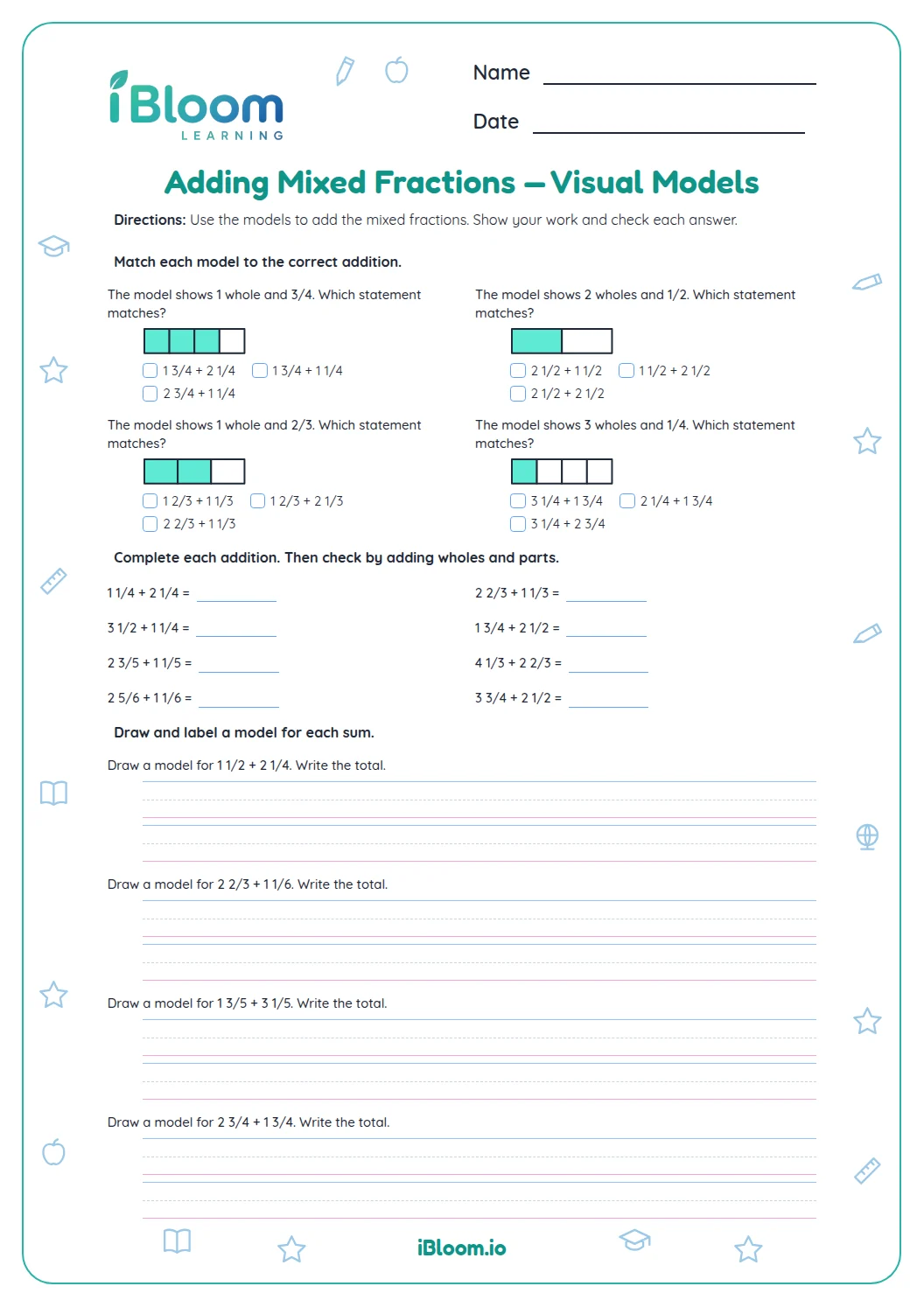
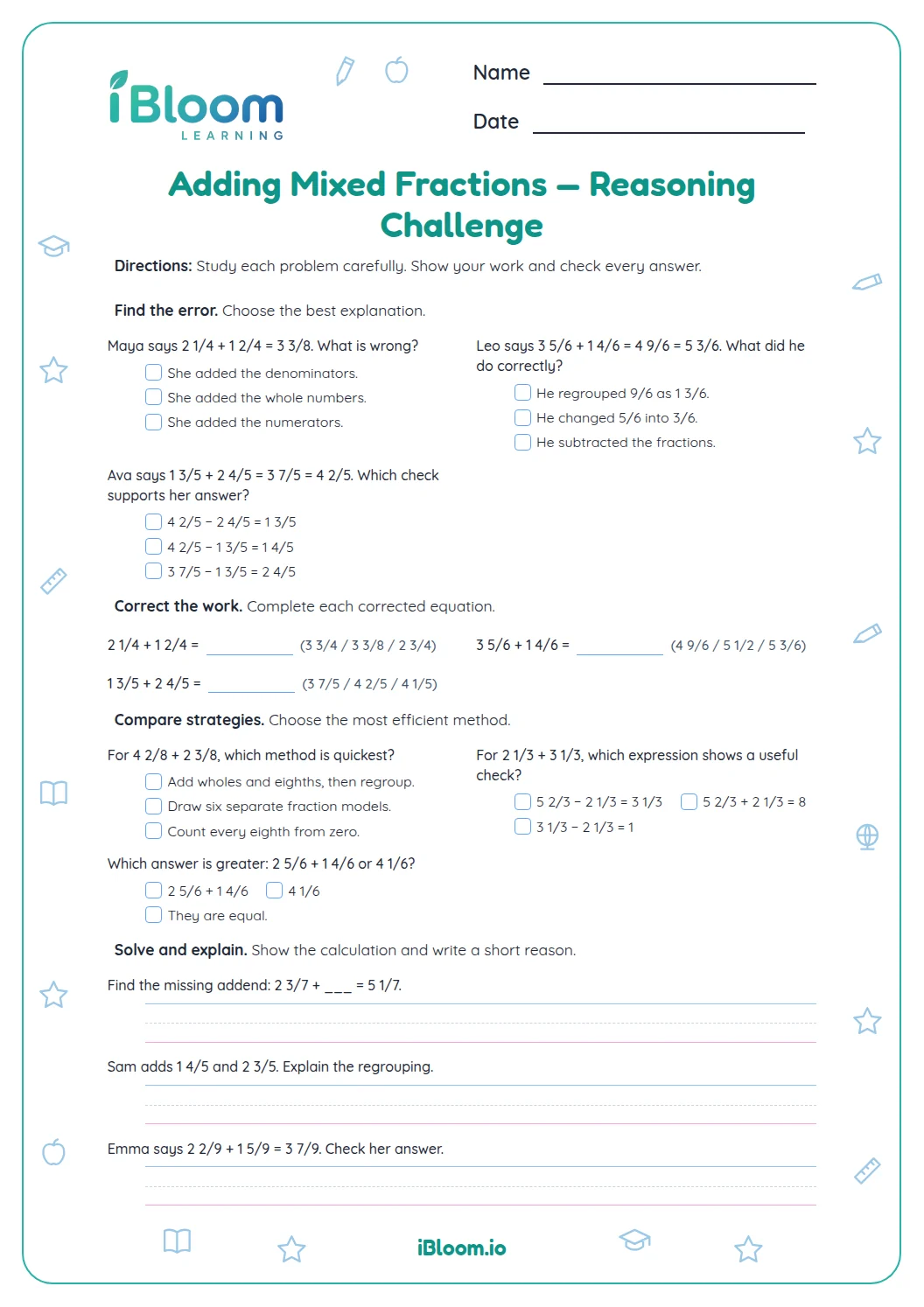
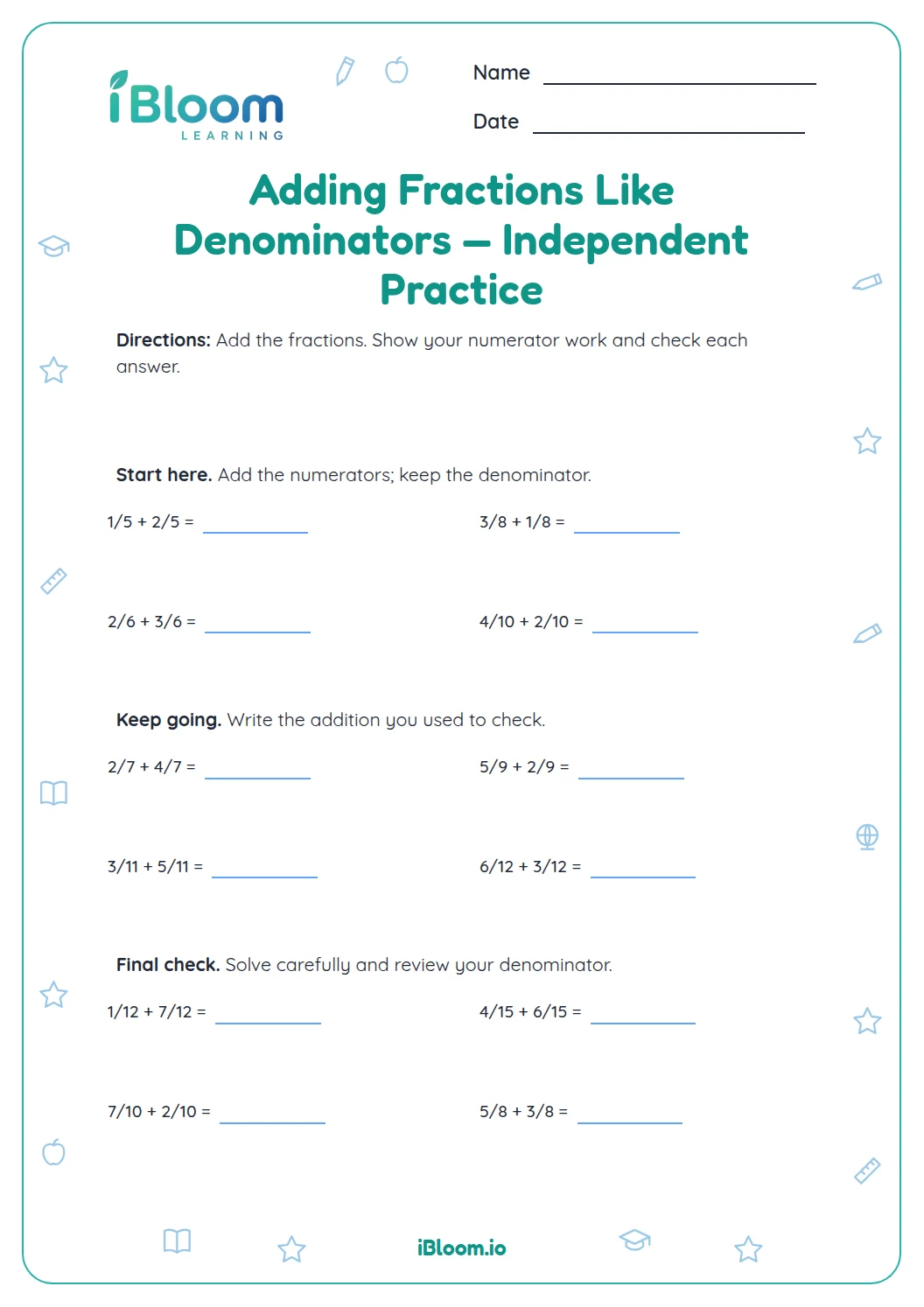
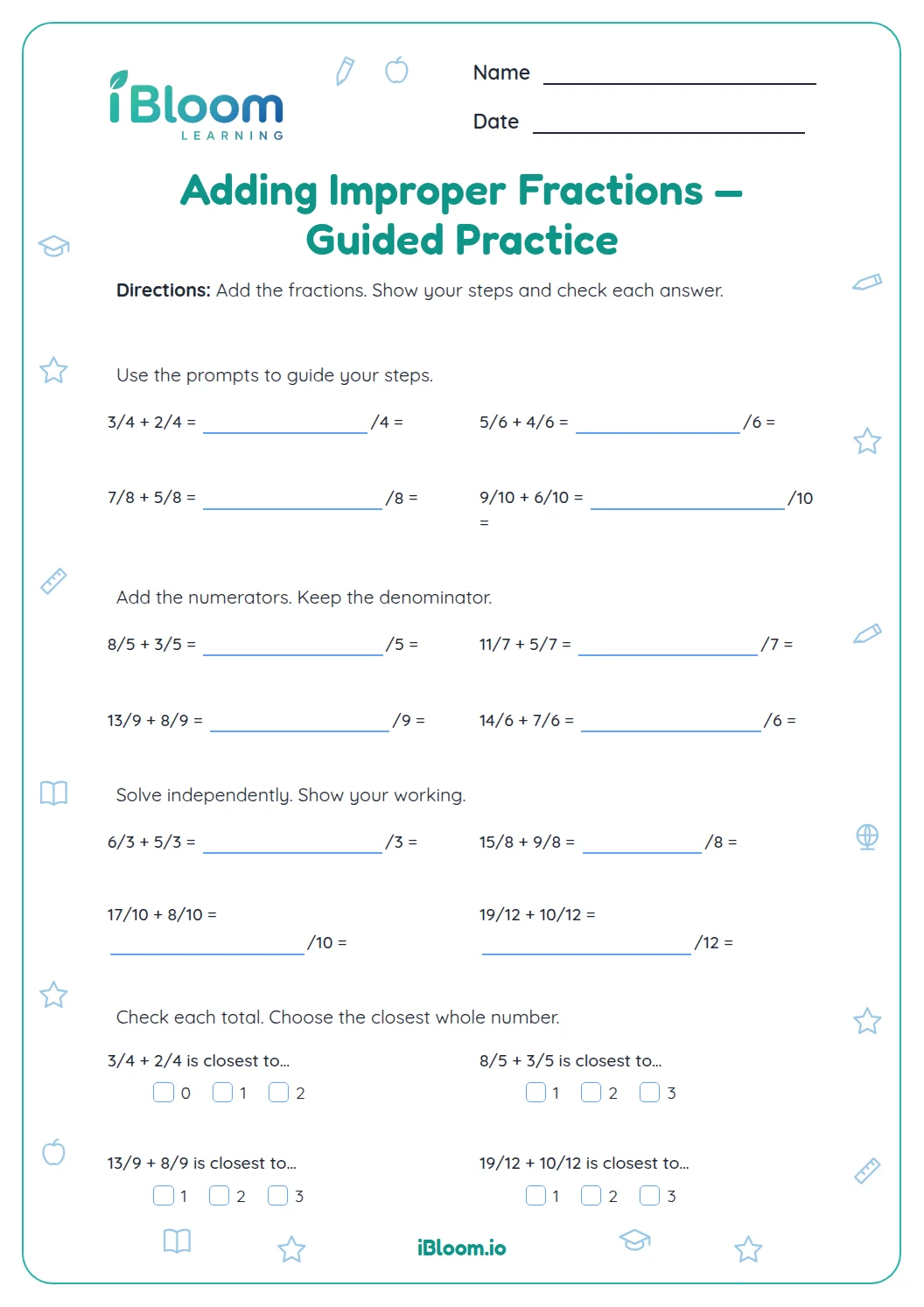
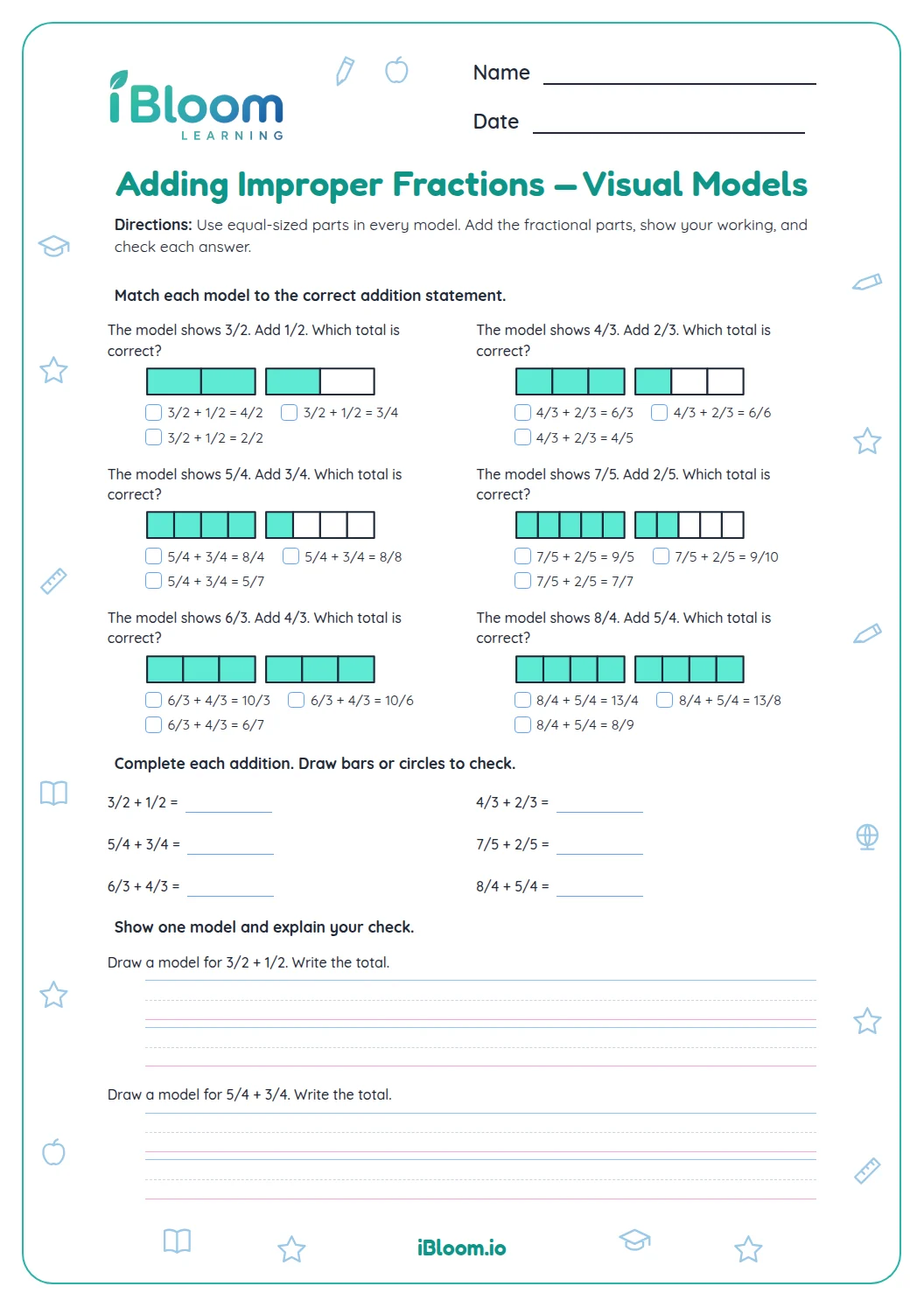
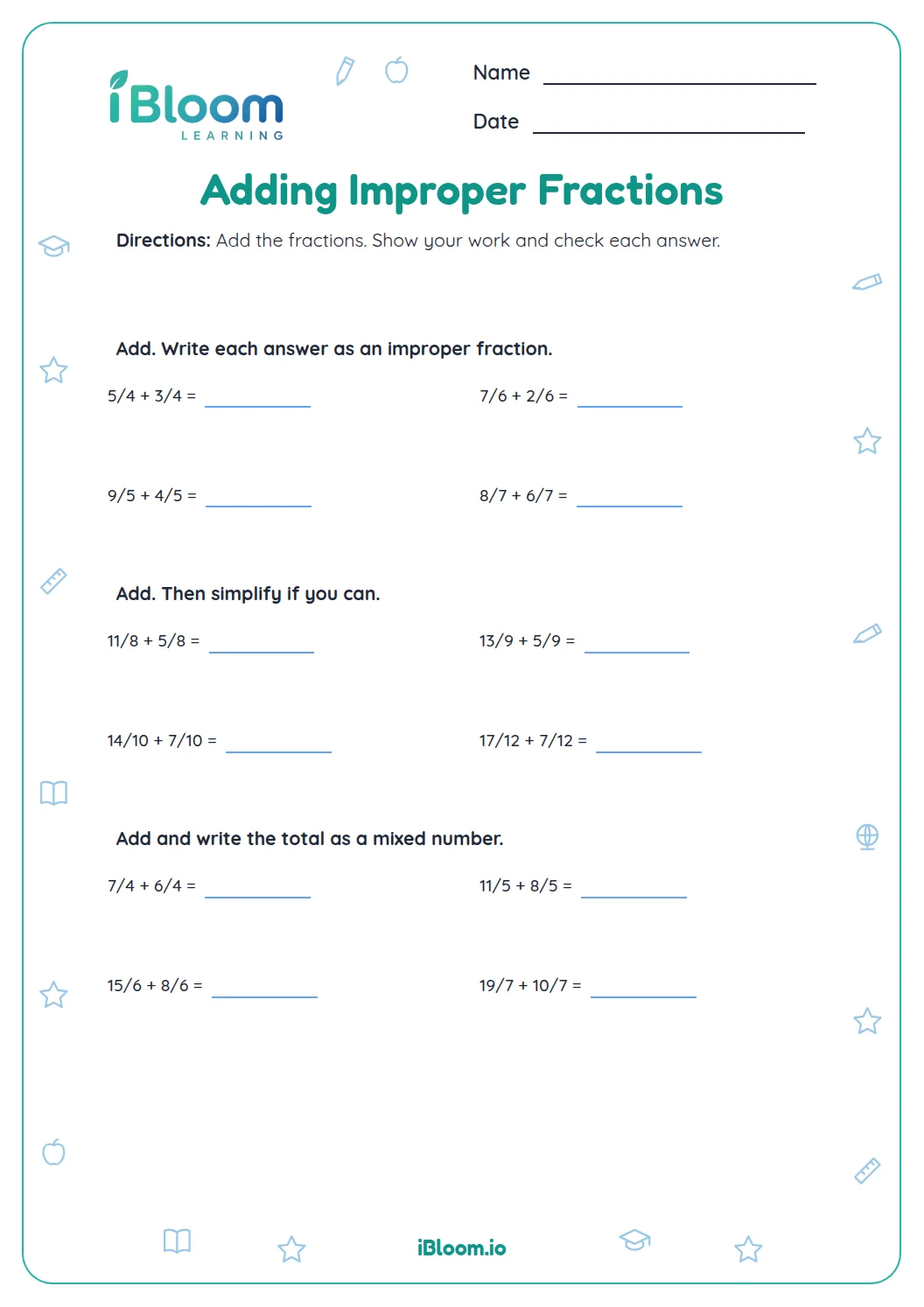
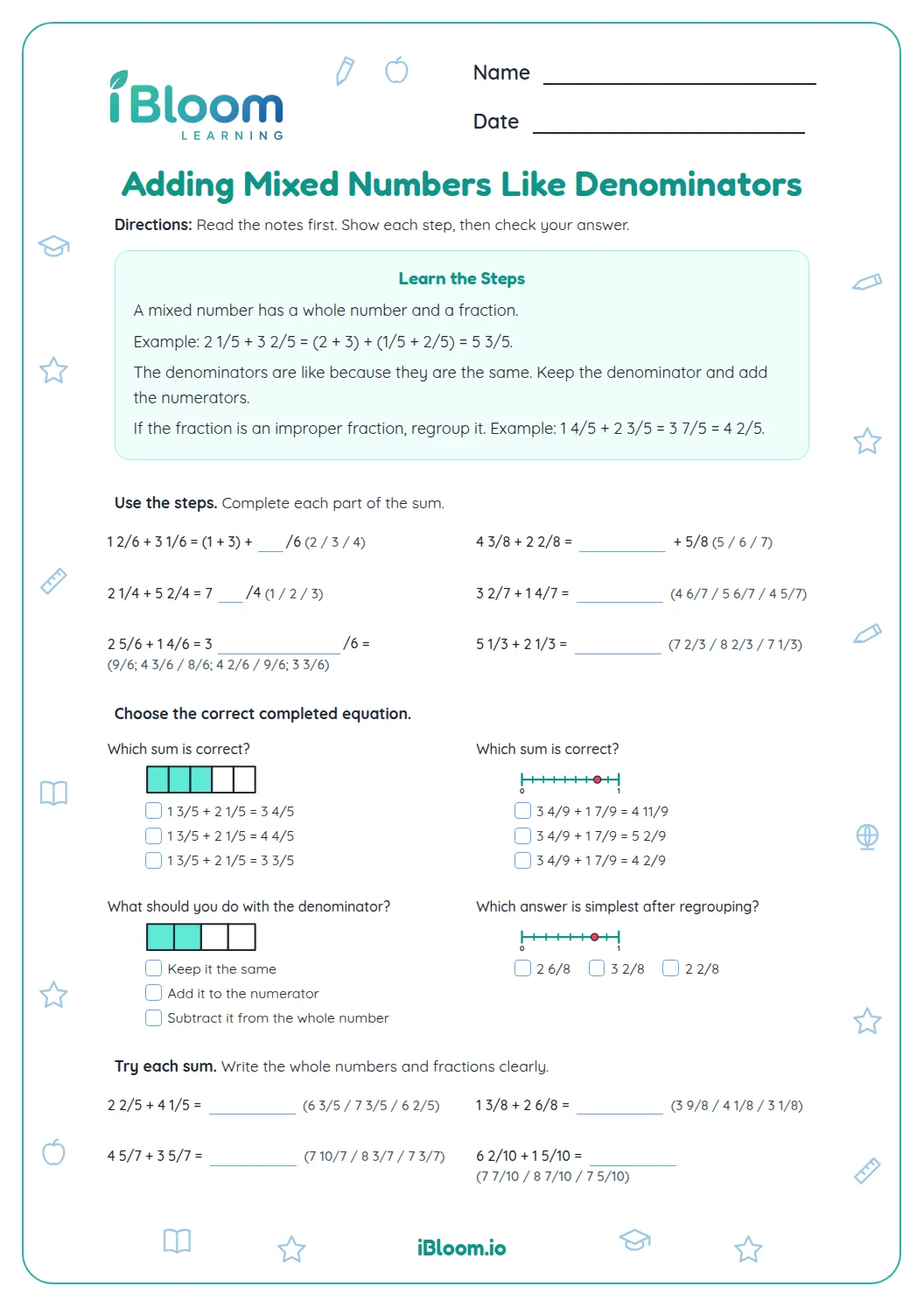
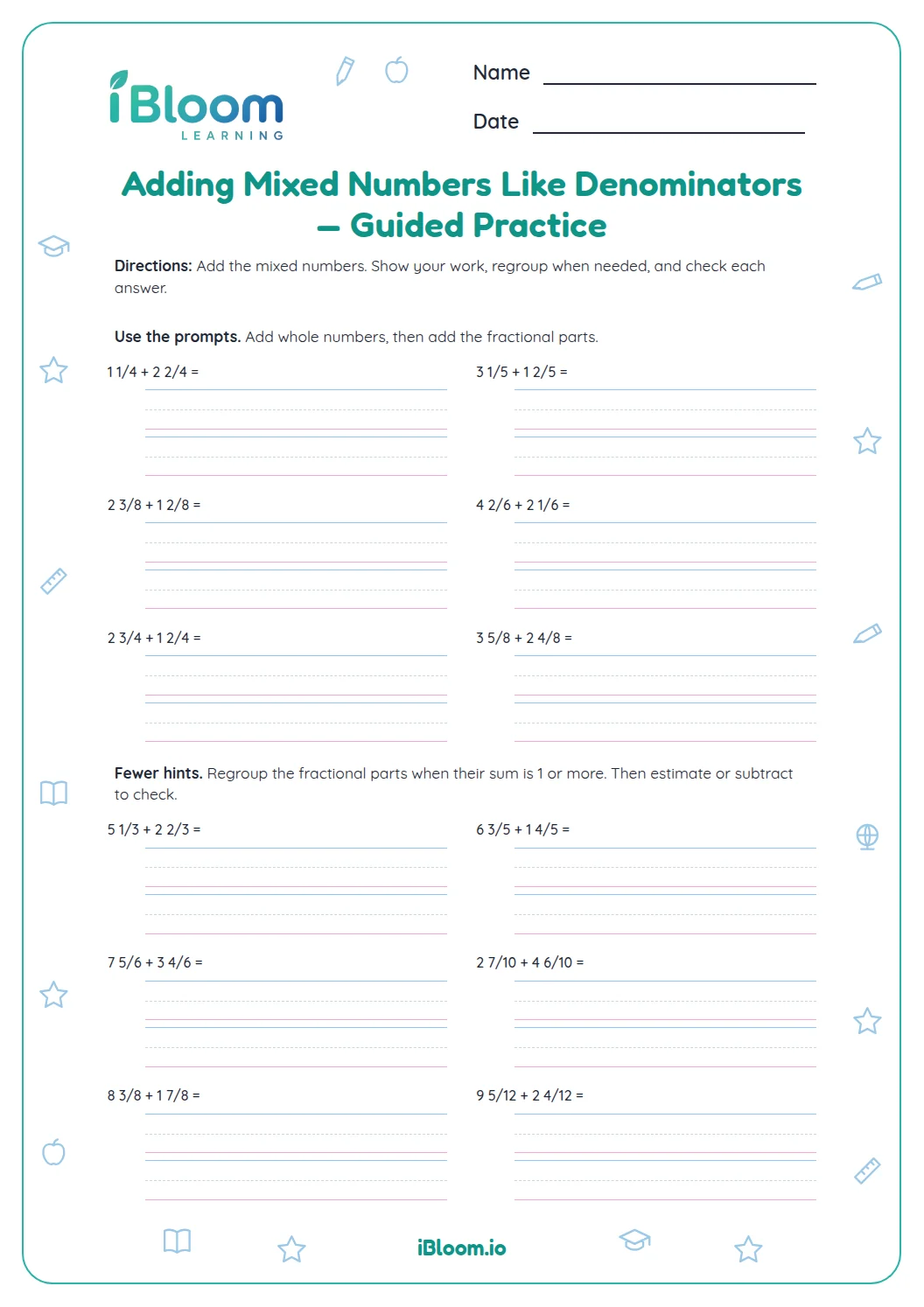
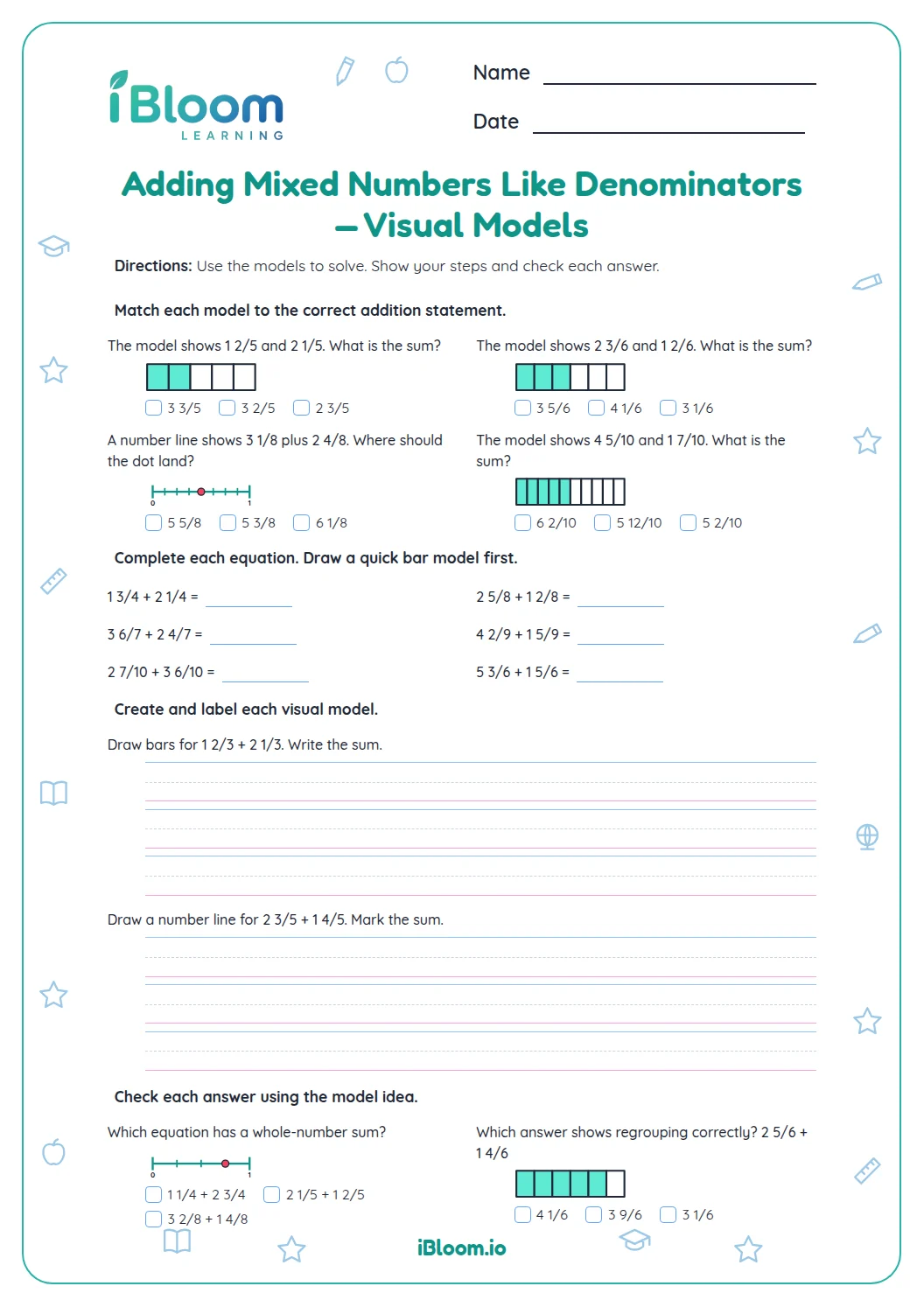
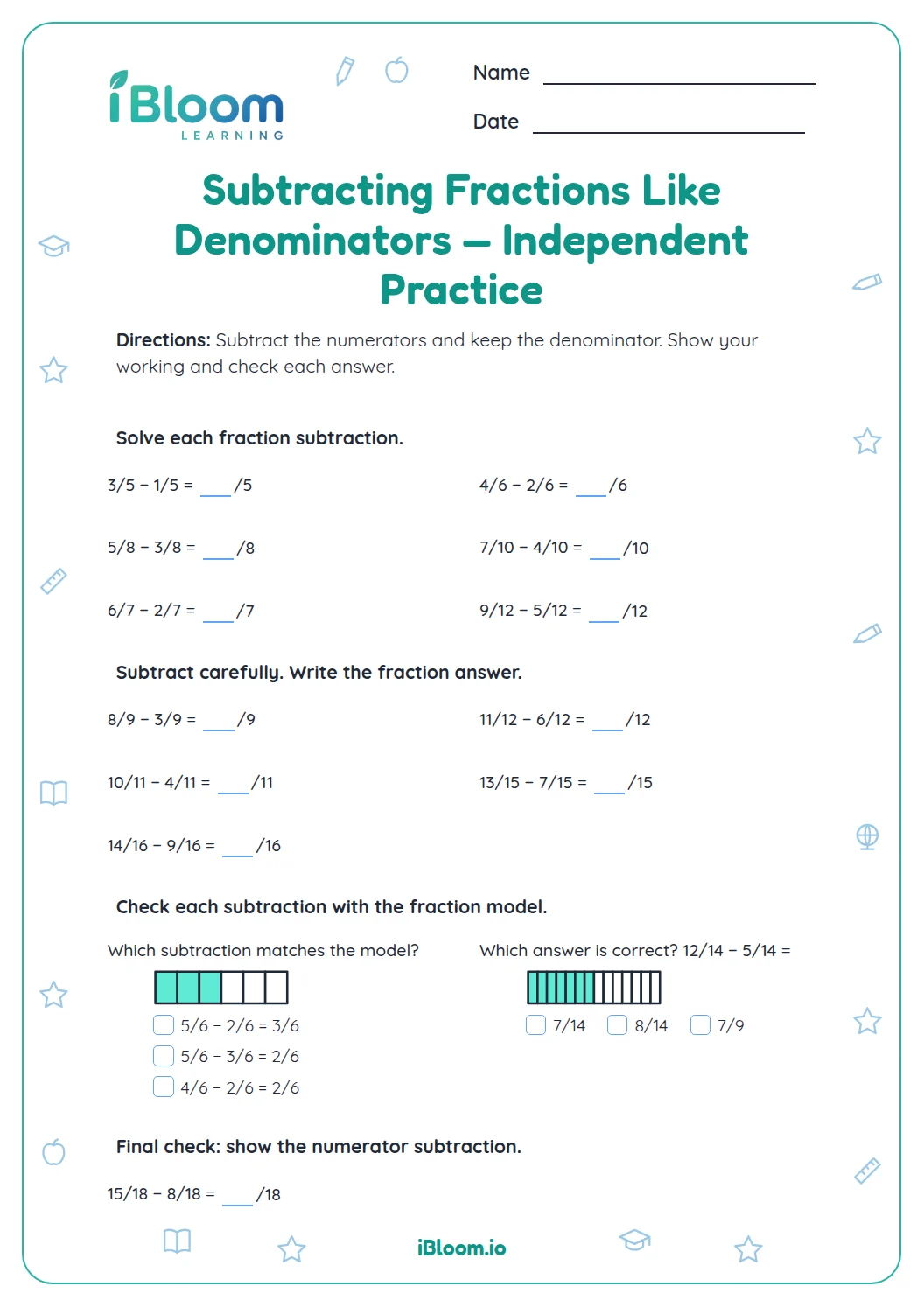
This Grade 3 printable starts with three shaded models, then builds practice adding mixed numbers with like denominators. In 14 questions, learners read whole shapes and fractional parts, combine whole numbers and numerators, and rename a whole when the fraction total reaches the denominator. Two short measurement situations connect the sums to lengths and capacity. The sheet practices CCSS 4.NF.B.3.a and 4.NF.B.3.c. A separate key shows each model reading and simplified answer.
Aligned to 4.NF.B.3.a and 4.NF.B.3.c
How do the models show a mixed number?
A fully shaded shape stands for one whole. The shaded parts in the next shape name the fraction. Question 1 shows one whole bar and one of four equal parts, so it represents 1 1/4.
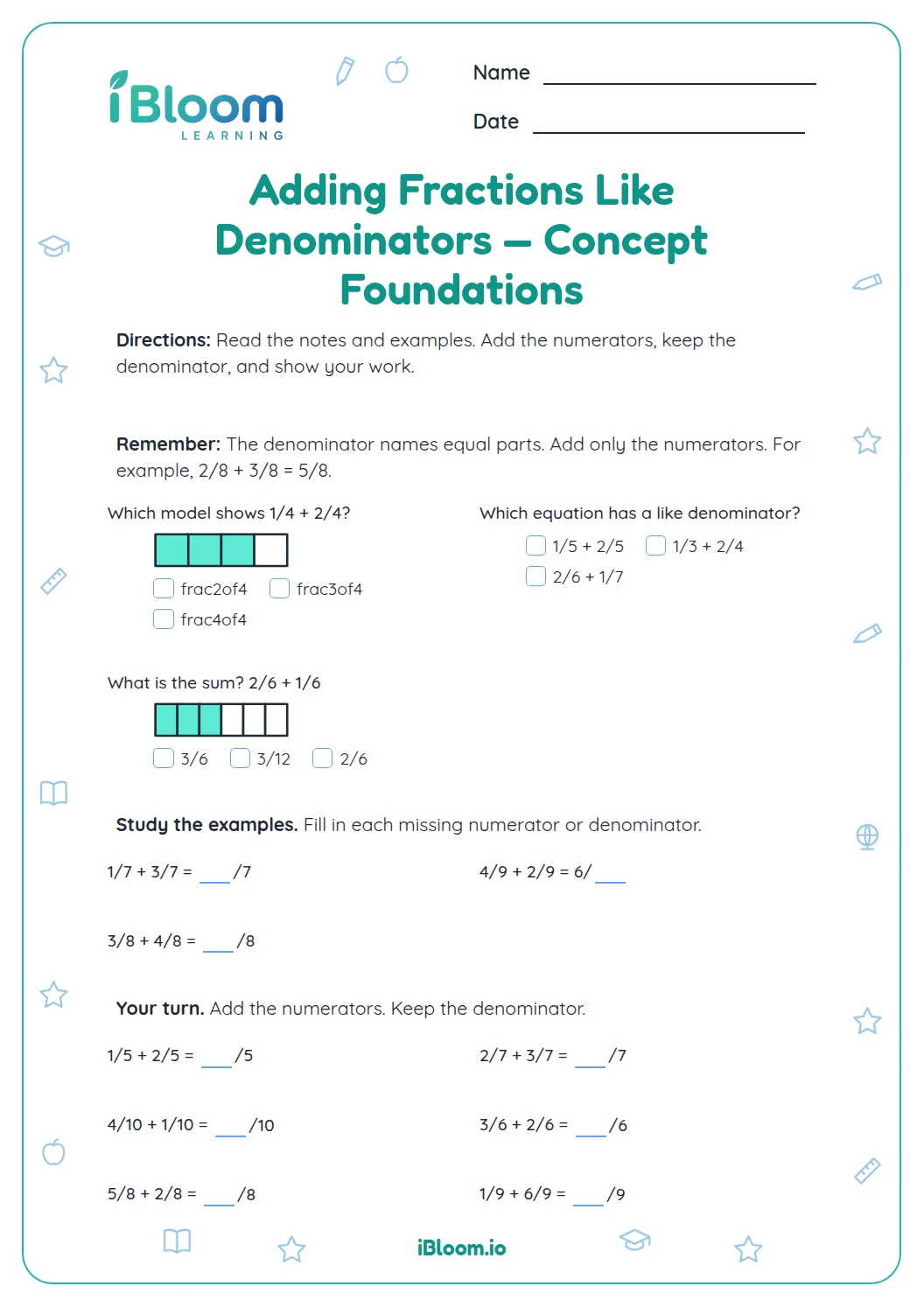
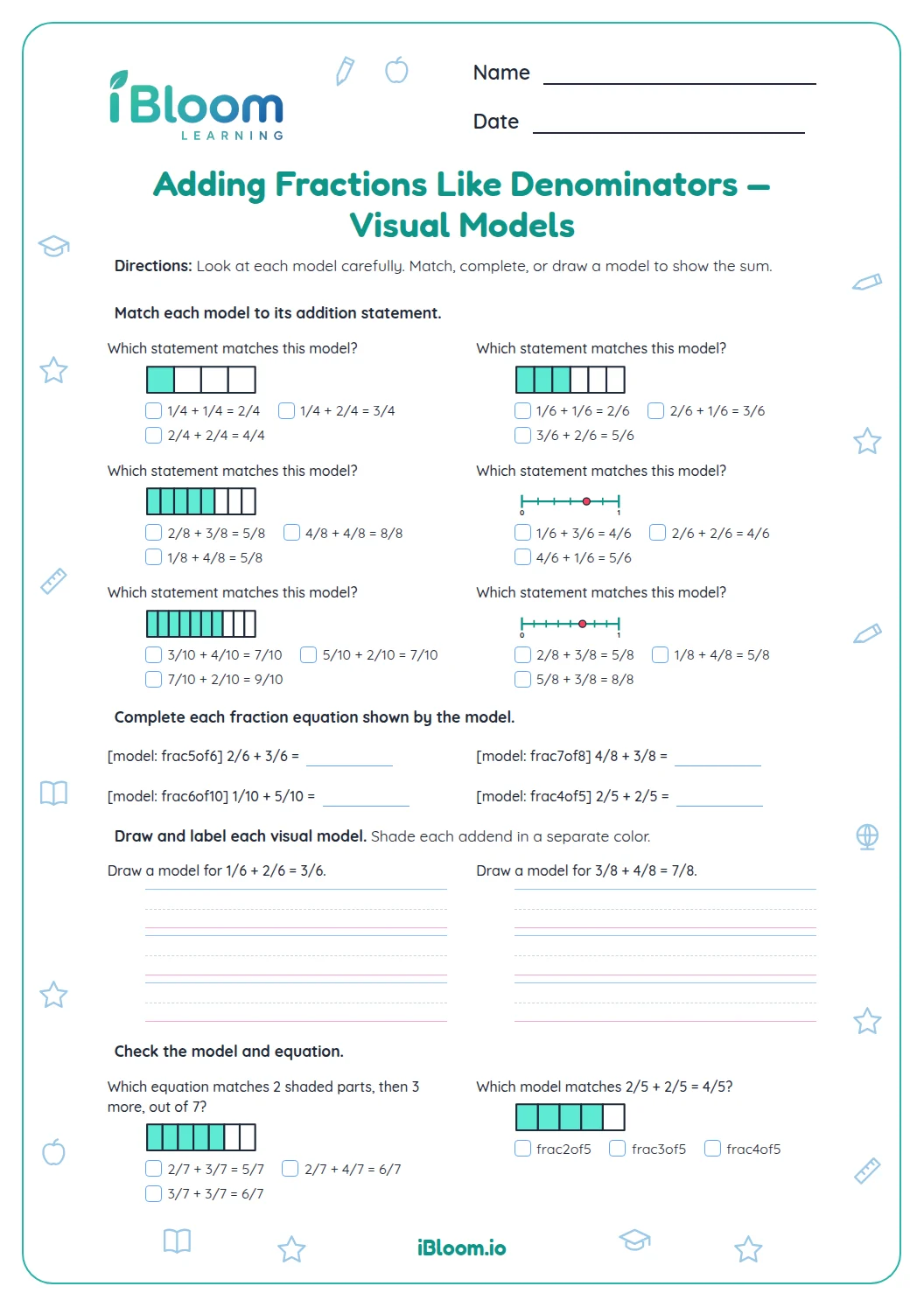
When adding, keep the same denominator because the pieces are the same size. Add the numerators and whole numbers; rename a whole if the fraction total reaches the denominator.
- 1One whole bar is shaded.
- 2One of four parts is shaded.
- 3Write the amount as 1 1/4.
What happens when fractional parts are added?
For 1 3/4 + 2/4, join three fourths and two fourths to make 5/4, or 1 1/4. Add that regrouped whole to the whole-number part, giving 2 1/4. The parts have the same size, so the denominator stays four.
How can children check an addition fact?
Add the whole-number parts and the like-denominator fractions. If the fraction total reaches a whole, rename it before writing the answer in simplest form. In question 12, 3/4 + 2/4 = 1 1/4, so 1 3/4 + 2/4 = 2 1/4.
- Part A reads three shaded fraction models.
- Part B solves nine addition equations and two short measurement problems.
How to use this worksheet
- 1Count complete shaded shapes as whole numbers.
- 2Count the shaded equal parts in the next shape.
- 3For addition, join only parts with the same denominator.
- 4Add the whole numbers and numerators separately.
- 5Write the unit in a word-problem answer and check its size.
Common mistakes and quick fixes
The mistake
Adding the denominators as well as the numerators.
The fix
Keep the denominator: fifths joined to fifths are still fifths.
The mistake
Leaving out the whole shapes in a model.
The fix
Count fully shaded shapes first, then name the fractional part.
The mistake
Dropping the measurement unit from a story answer.
The fix
Copy the unit named in the question after the number.
Common Core alignment
This worksheet practices the following Common Core skill.
Use fraction models to understand addition as joining parts of a whole.
On this sheet: The models and sums join fractional parts with like denominators.
Show the official wordingHide the official wording
Understand addition and subtraction of fractions as joining and separating parts referring to the same whole.
Add mixed numbers with like denominators by joining whole and fractional parts.
On this sheet: Learners add mixed numbers while keeping denominators alike.
Show the official wordingHide the official wording
Add and subtract mixed numbers with like denominators, e.g., by replacing each mixed number with an equivalent fraction, and/or by using properties of operations and the relationship between addition and subtraction.
What to practice next
Make more practice
Further reading
Questions parents and teachers ask
How do you read a shaded mixed-number model?
Count each fully shaded shape as one whole, then count the shaded equal parts in the next shape. Question 1 has one whole and one fourth, so it represents 1 1/4. The denominator tells how many equal parts make the whole.
How do you add mixed numbers with like denominators?
Add the whole numbers and add the numerators while keeping the denominator. For 1 1/2 + 1/2, the fractional parts make 2/2, or one whole, so the sum is 2. The models at the start remind learners that the parts have equal size.
Why does the denominator stay the same?
The denominator names the size of the pieces. When thirds are joined to thirds, the result is still counted in thirds. For example, 1/3 + 1/3 = 2/3. The questions use like denominators so children can focus on joining equal-sized parts.
What if the numerator total makes a whole?
When the numerators make at least one whole, rename that fraction before adding it to the whole-number part. Question 4 shows an exact whole: 1/2 + 1/2 = 1, so 1 1/2 + 1/2 = 2. Question 12 goes past a whole and gives 2 1/4.
What does “like denominators” mean?
Like denominators are the same bottom number, such as 2/8 and 3/8. Both fractions count pieces of the same size. This worksheet uses matching denominators in each addition problem and asks children to keep that unit when joining parts.
How can a child check a mixed-number sum?
Add the whole parts and the fractional parts separately, then check whether the fractional sum needs to be renamed. Question 12 gives 3/4 + 2/4 = 1 1/4, so the total is 2 1/4. The key also keeps units with the two final story answers.