



About this worksheet
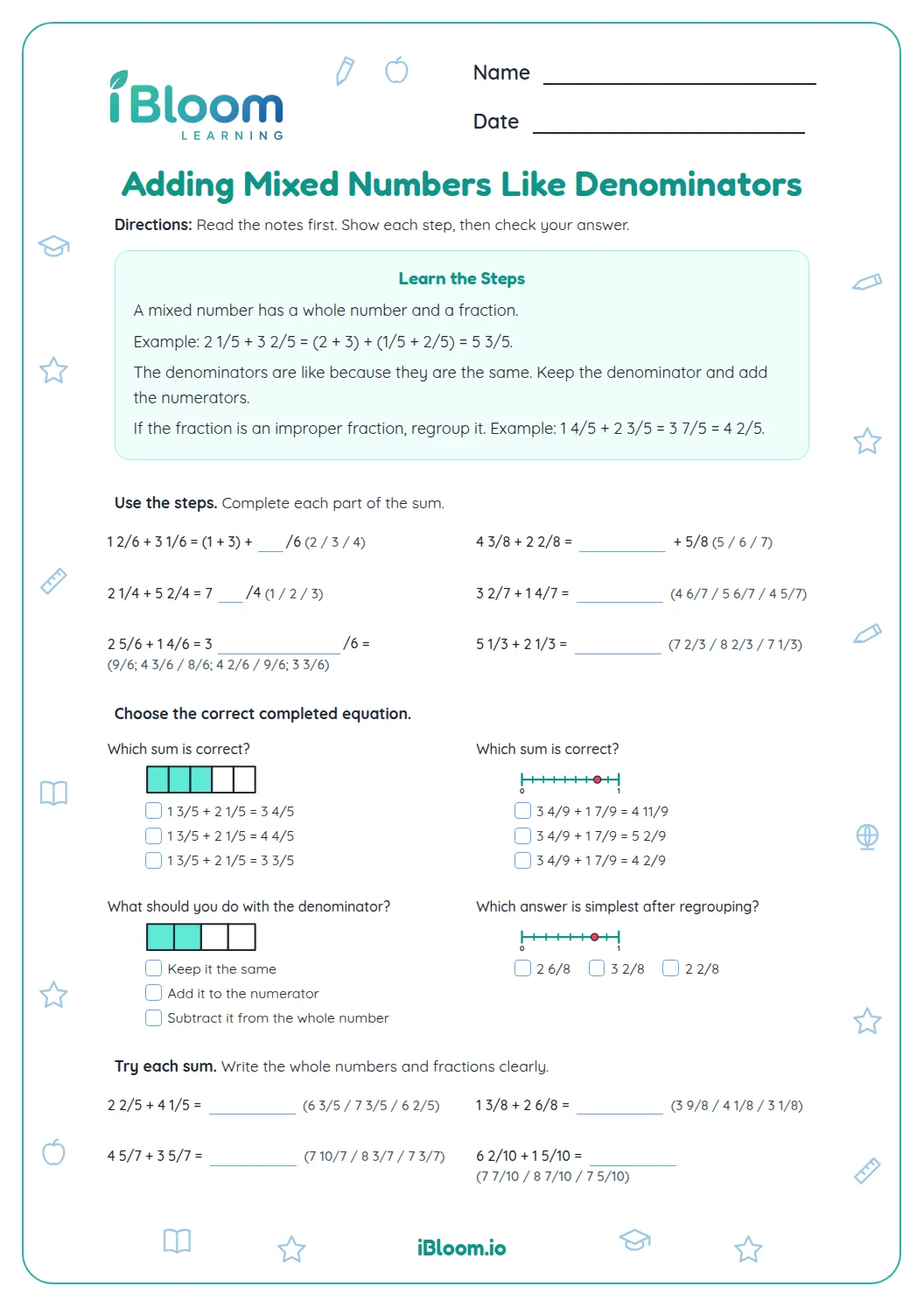
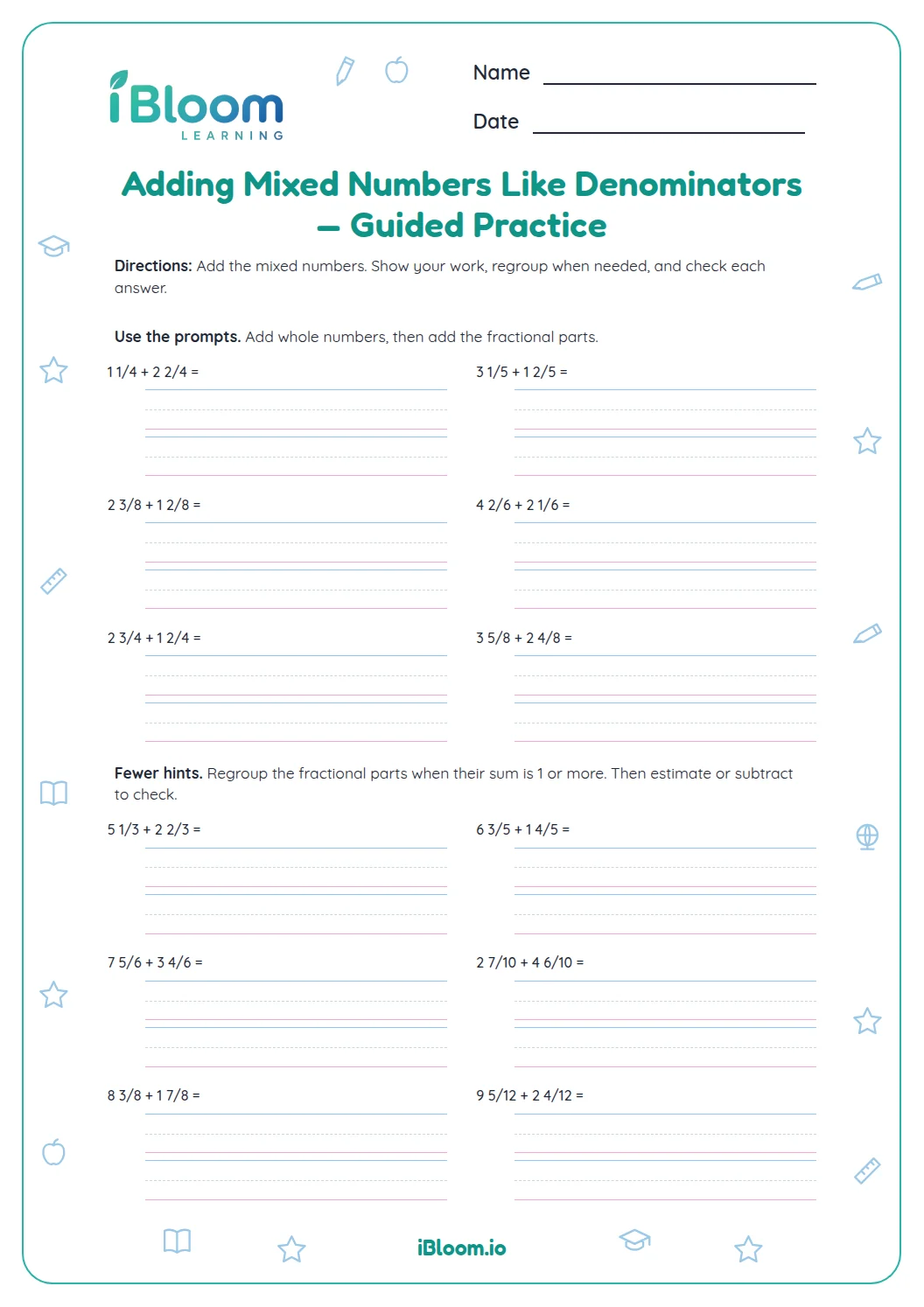
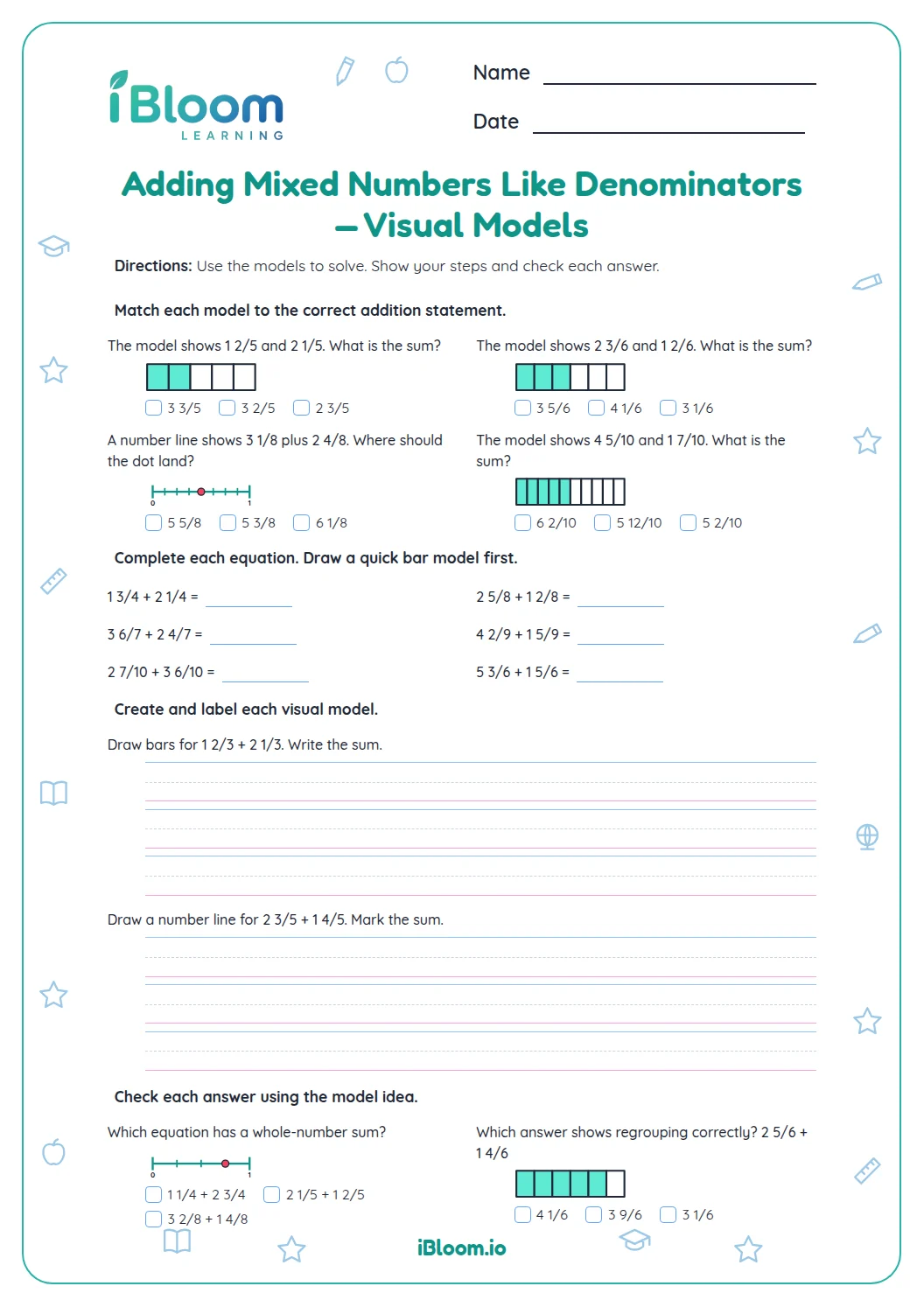
This printable gives Grade 3 students focused practice adding mixed numbers with like denominators. Across 16 problems, students add whole-number and fractional parts, regroup when the fractions make a whole, simplify results, and find missing addends. Every problem uses like denominators, and each correct answer can be checked by adding the parts again. A separate answer key is included.
Aligned to 4.NF.B.3.c
What is the first step when adding mixed numbers?
Add the whole-number parts and the fractional parts separately. Keep the denominator because the pieces are the same size. In question 4, add 1 + 2 and 3/4 + 2/4 to get 3 5/4.
- 11 3/4 + 2 2/4
- 21 + 2 = 3
- 33/4 + 2/4 = 5/4 = 1 1/4
- 4Total: 4 1/4
When should a fractional sum be regrouped?
When the numerator total is equal to or greater than the denominator, trade one whole for that many fractional parts. For example, 9/8 is 1 1/8. Add the new whole to the whole-number sum.
How do you find a missing addend?
Use subtraction or count up from the known addend to the total. In question 12, 4 5/7 − 2 1/7 = 2 4/7, so the missing addend is 2 4/7.
What is included in the printable?
The worksheet has 16 questions in three parts: six direct sums, five multiple-choice sums and five missing-part or missing-total questions. All denominators match within each sum.
How to use this worksheet
- 1Check that both denominators match.
- 2Add the whole-number parts.
- 3Add the numerators and keep the common denominator.
- 4Regroup a full fraction as one whole when needed.
- 5Simplify the fraction in the final mixed number.
Common mistakes and quick fixes
The mistake
Adding denominators as well as numerators
The fix
Keep the common denominator; add only the numerators.
The mistake
Leaving an improper fraction in the mixed number
The fix
Trade groups equal to the denominator for one whole.
The mistake
Forgetting to add the regrouped whole
The fix
Add the carried whole to the total of the whole-number parts.
Common Core alignment
This sheet practices the standard below through focused examples and independent practice.
Add mixed numbers with like denominators, regroup when fractional parts make a whole, and simplify.
On this sheet:
Show the official wordingHide the official wording
Add and subtract mixed numbers with like denominators, e.g., by replacing each mixed number with an equivalent fraction, and/or by using properties of operations and the relationship between addition and subtraction.
What to practice next
Make more practice
Further reading
Questions parents and teachers ask
What does like denominators mean?
The fractions being added have the same denominator, so they name equal-sized parts. For example, fourths can be joined by adding the number of fourths and keeping 4 as the denominator. Add the original mixed numbers again by parts to check both the regrouping and the simplified fractional answer.
How many problems are on the worksheet?
There are 16 questions across three parts: six direct sums, five choices and five missing-number sums. A two-page answer key follows the two-page worksheet. Add the original mixed numbers again by parts to check both the regrouping and the simplified fractional answer.
What if the fractional parts add to more than one whole?
Regroup the fractional sum. For example, 5/8 + 4/8 = 9/8, which is 1 1/8. Add that extra whole to the whole-number sum. Add the original mixed numbers again by parts to check both the regrouping and the simplified fractional answer.
Are students asked to simplify answers?
Yes. Several sums produce a fractional part that can be simplified after regrouping. The directions ask students to simplify when needed, and the answer key gives the simplified mixed number. Add the original mixed numbers again by parts to check both the regrouping and the simplified fractional answer.
How can a student check a missing addend?
Add the proposed missing addend to the known addend. For question 12, 2 4/7 + 2 1/7 = 4 5/7, which matches the total. Add the original mixed numbers again by parts to check both the regrouping and the simplified fractional answer.