





About this worksheet
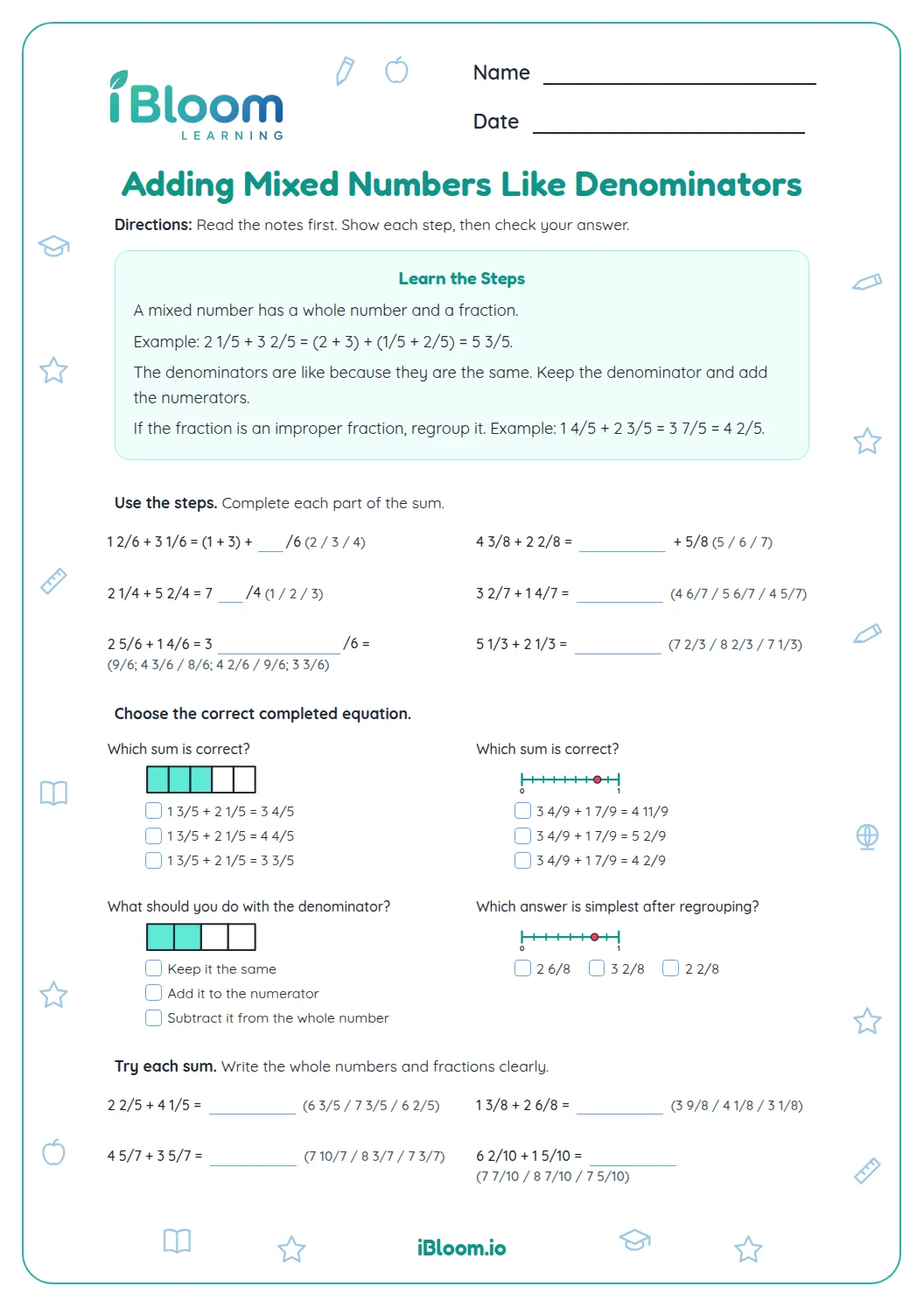
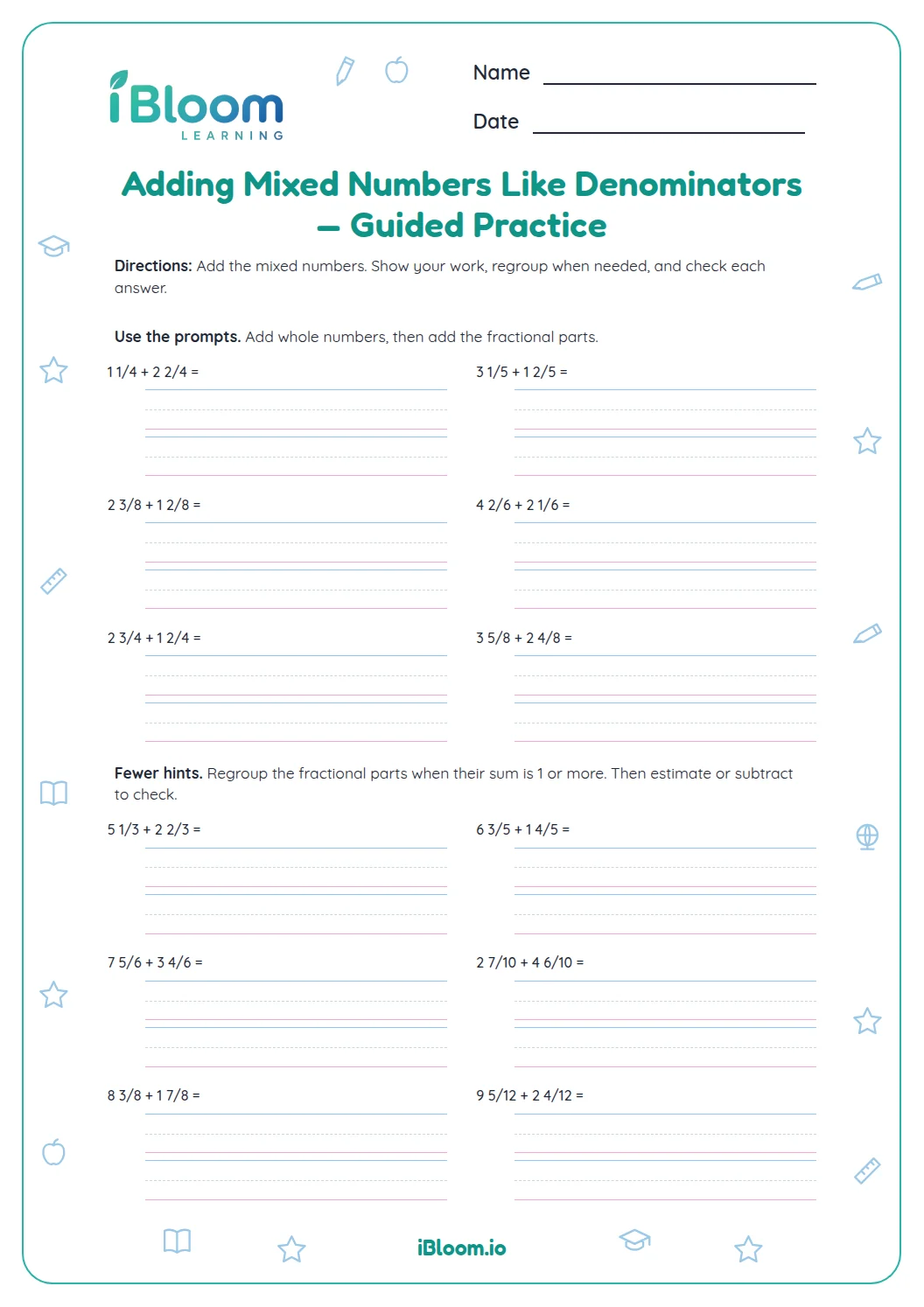
This free printable worksheet gives students practice adding mixed numbers with like denominators. The set moves from direct sums to fraction models, error correction, and short problems about distance, ribbon, and a recipe. Students add the whole numbers and fractional parts, then regroup when the fraction sum reaches a whole. A separate answer key is included. The work aligns with CCSS 4.NF.B.3.c and 4.NF.B.3.d.
Aligned to 4.NF.B.3.c and 4.NF.B.3.d
How do students add the parts?
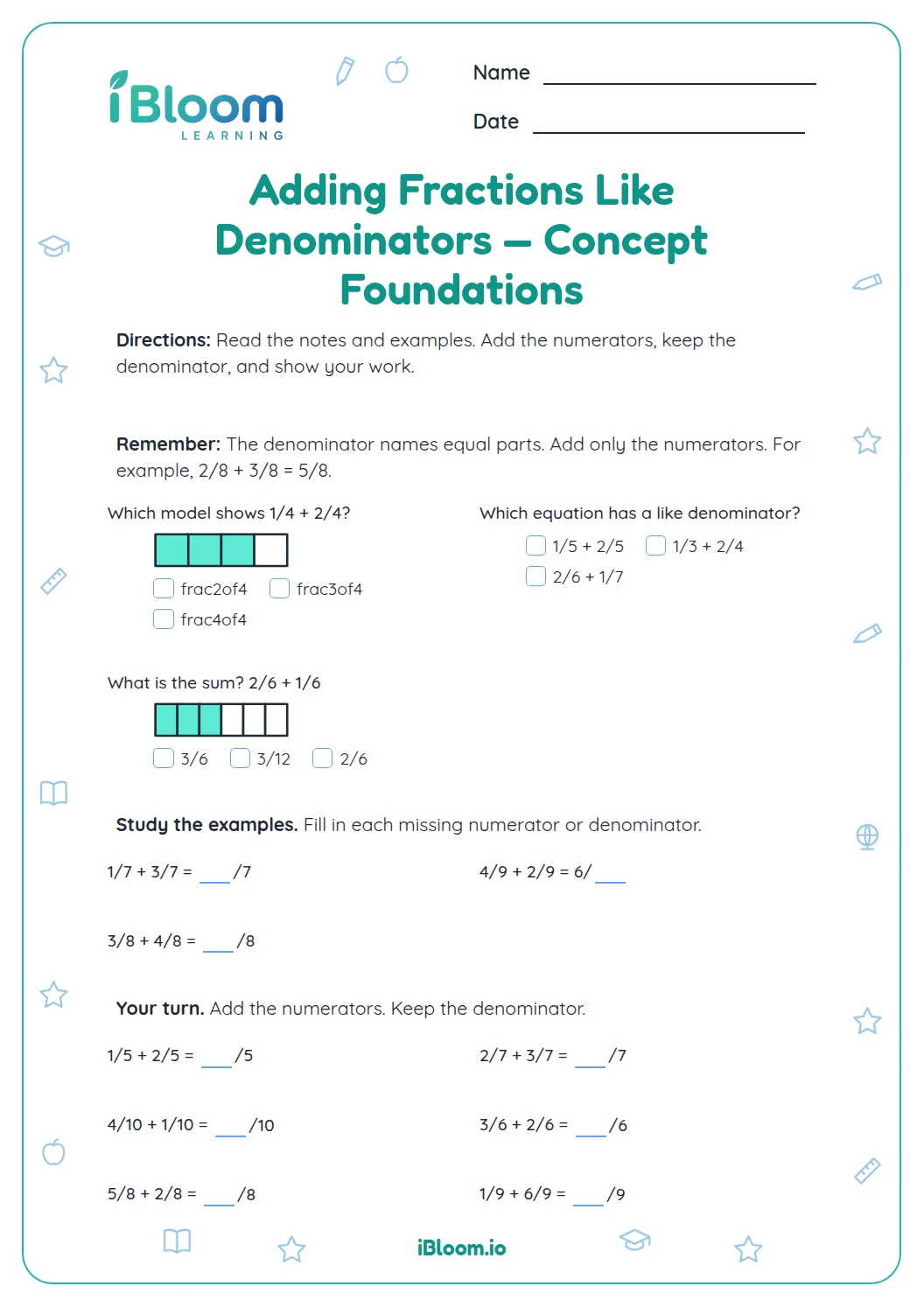
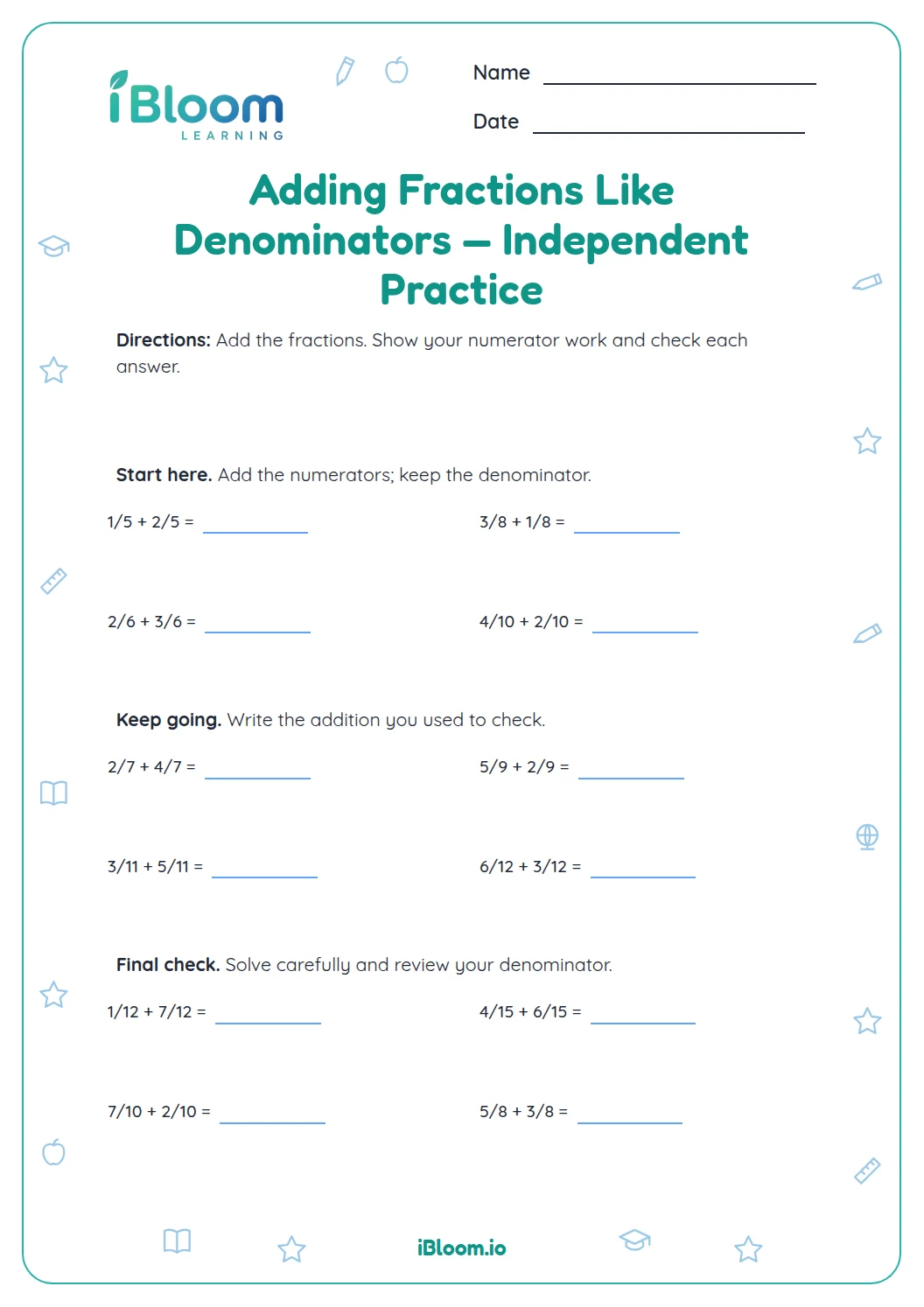
Add whole-number parts together, then add the numerators while keeping the denominator. Finally, combine both results. This works because the denominators name equal-size pieces.
- 11 4/5 + 2 3/5
- 21 + 2 = 3 wholes
- 34/5 + 3/5 = 7/5 = 1 2/5
- 43 + 1 2/5 = 4 2/5
When should a fraction be renamed?
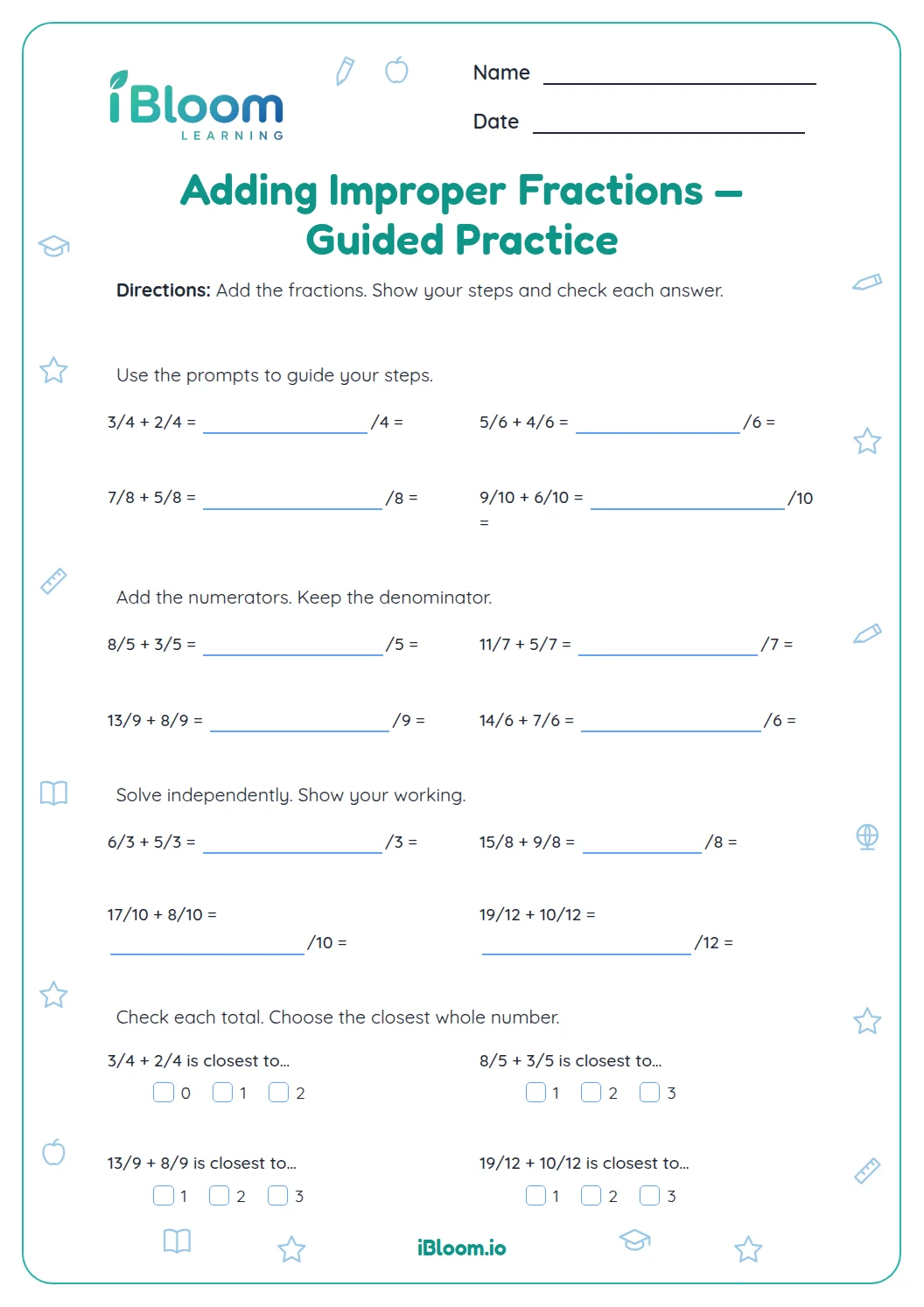
If the numerator total equals or exceeds the denominator, regroup the fraction. Question 5 makes 9/8, which becomes one whole and 1/8. Add the regrouped whole to the other whole-number parts.
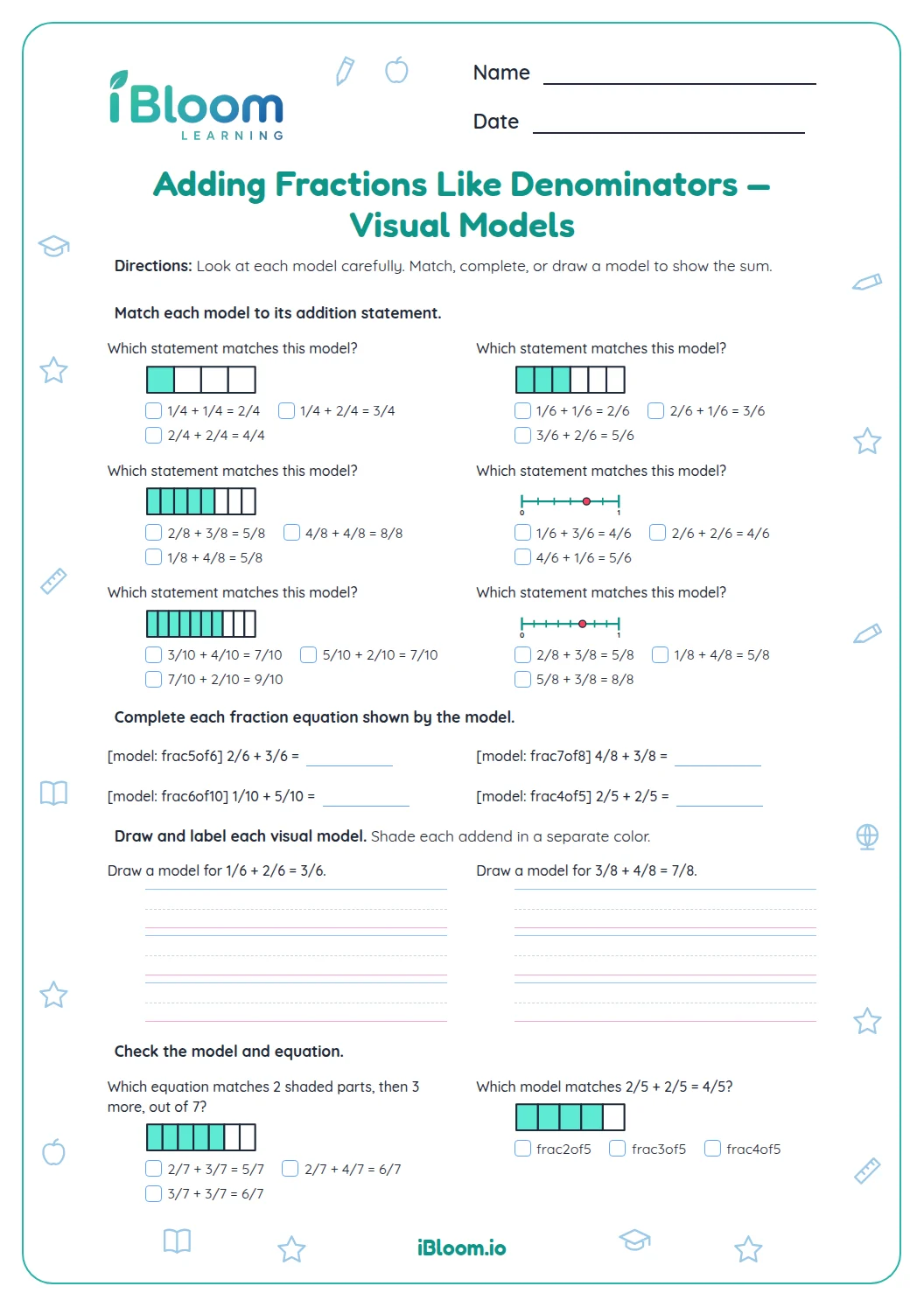
What do the fraction drawings show?
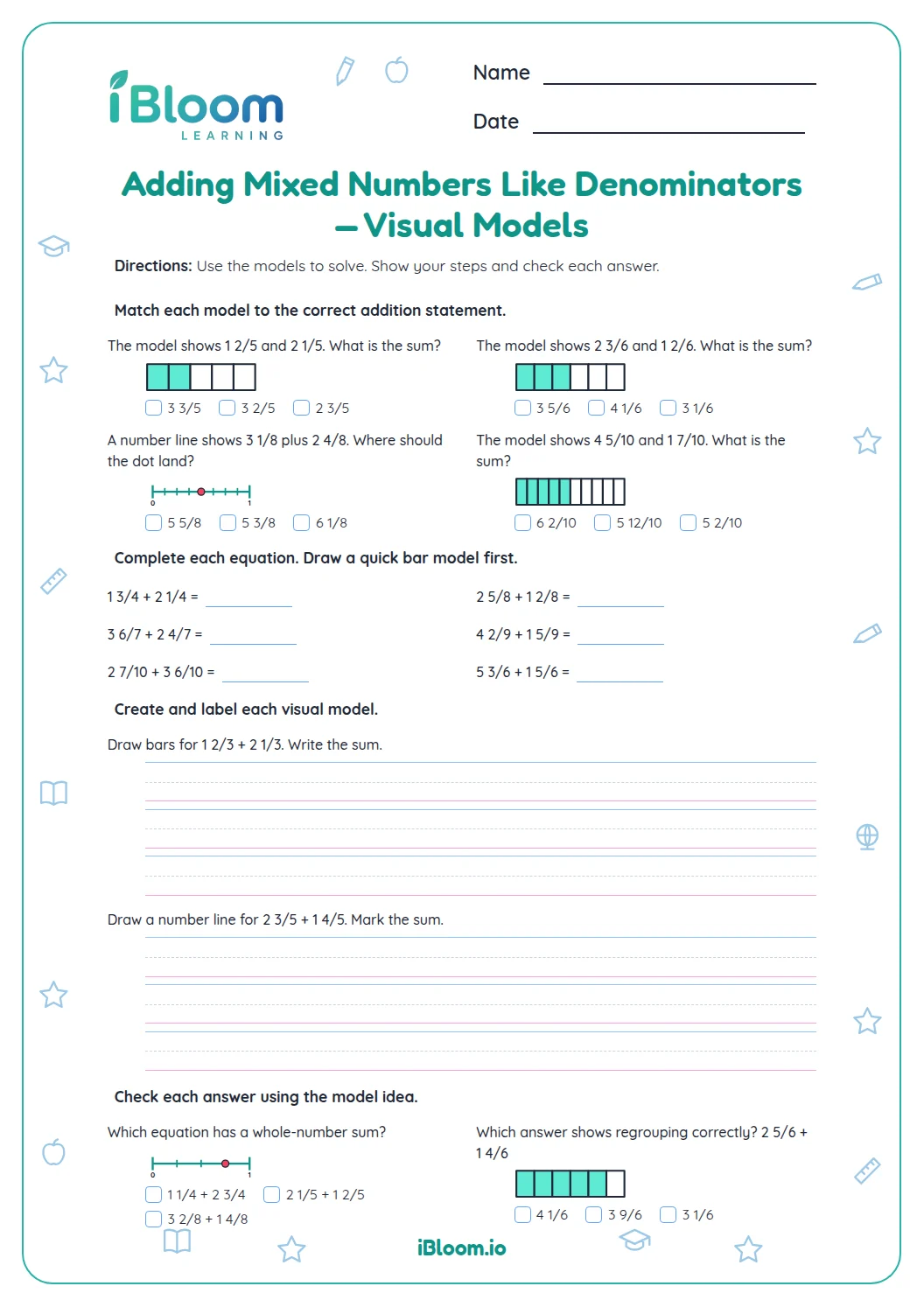
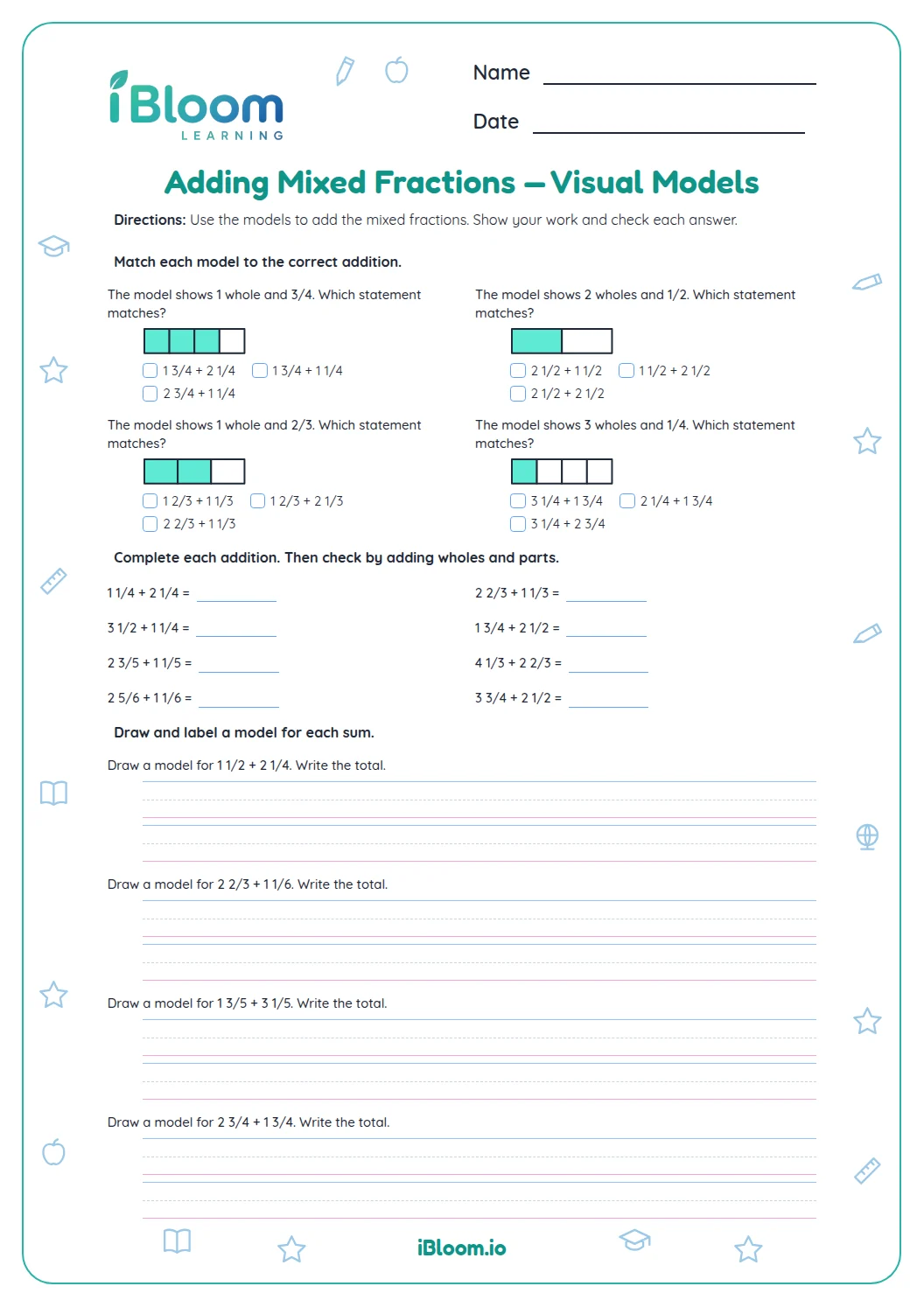
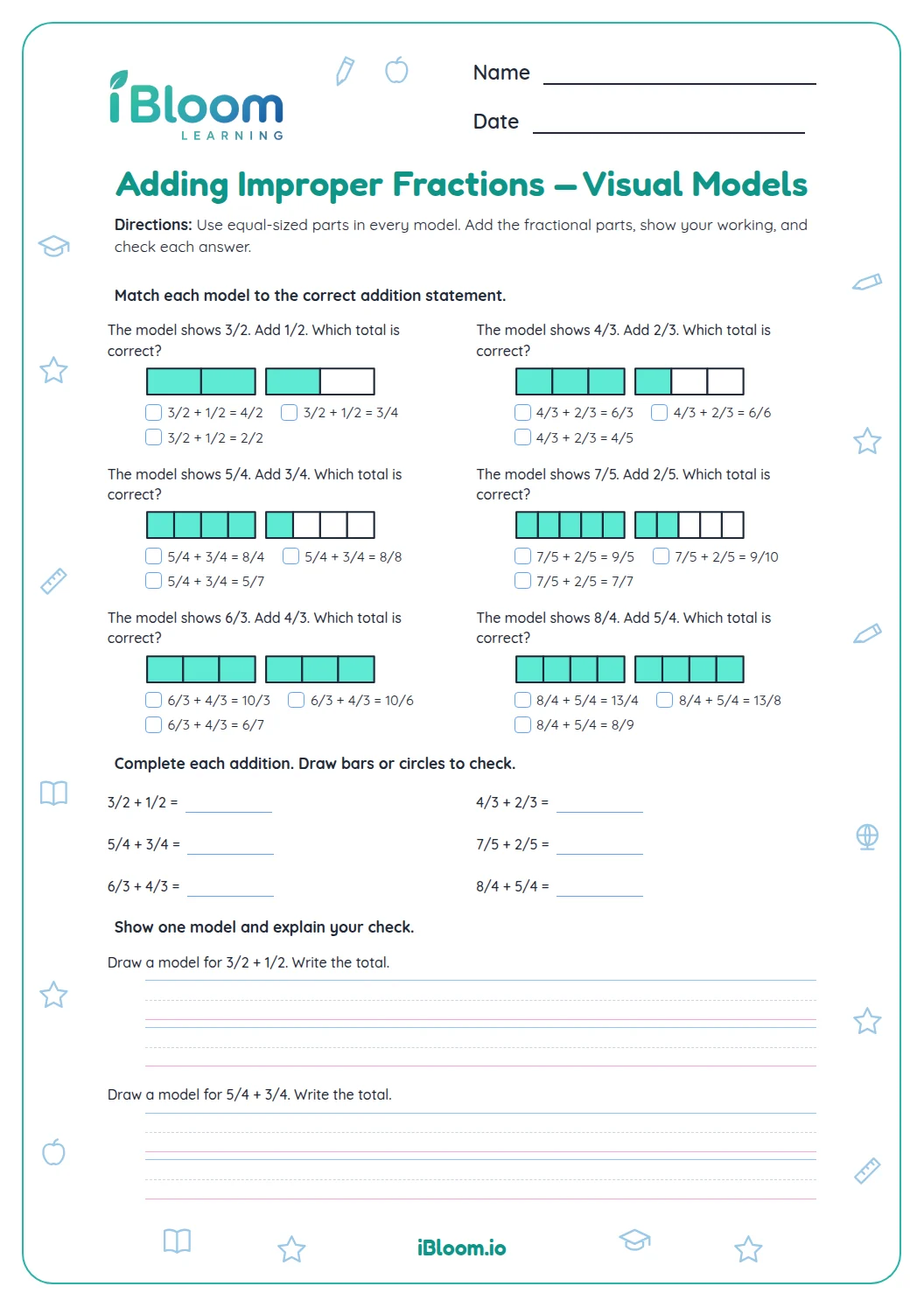
The shaded bars and circle show the mixed numbers represented in the prompts. They connect each whole and equal fractional part to the symbolic sum. Count the shaded pieces in each fraction part, then combine them.
How do word problems use mixed-number sums?
The last four items add measured quantities with matching denominators. Identify both amounts, add them, and keep the unit from the question in the final answer.
How can I use this worksheet?
- 1Check that the denominators match before adding.
- 2Add whole numbers in one line and numerators in another.
- 3Keep the common denominator in the fractional sum.
- 4Regroup a fraction equal to or greater than one whole.
- 5For a story problem, include the unit in the answer.
- 6Check the work against the answer key.
Common mistakes and quick fixes
The mistake
Adding the denominators as well as the numerators.
The fix
Keep the common denominator because the pieces have the same size.
The mistake
Leaving an improper fraction in a mixed-number answer.
The fix
Trade a full group of numerator pieces for one whole.
The mistake
Forgetting to add a regrouped whole.
The fix
Add that new whole to the whole-number total before writing the final answer.
Curriculum alignment
The questions combine like-denominator fraction addition, regrouping, and short word problems.
Add mixed numbers with like denominators by using equivalent fractions or operation properties.
On this sheet: Students add like-denominator mixed numbers and regroup when the fractional sum makes another whole.
Show the official wordingHide the official wording
Add and subtract mixed numbers with like denominators, e.g., by replacing each mixed number with an equivalent fraction, and/or by using properties of operations and the relationship between addition and subtraction.
Represent same-whole fraction addition word problems with equations or models.
On this sheet: The final four questions add measured lengths or amounts with like denominators.
Show the official wordingHide the official wording
Solve word problems involving addition and subtraction of fractions referring to the same whole and having like denominators, e.g., by using visual fraction models and equations to represent the problem.
What to practice next
Make more practice
Further reading
Questions parents and teachers ask
What does adding mixed numbers with like denominators mean?
A mixed number has a whole-number part and a fraction part, such as 1 2/6. Like denominators have the same bottom number, so the fractional parts can be added by adding their numerators. Then combine the fractional sum with the whole-number sum.
When does a sum need regrouping?
Regroup when the fractional parts add to one whole or more. For example, 2 5/8 + 1 4/8 makes 9/8, which is 1 1/8. Add that extra whole to the whole-number sum to get 4 1/8. The worksheet’s key writes this as 4 1/8, with the regrouped whole included in the total.
Why do some answers stay as 3 3/6?
The worksheet accepts a mixed number whose fraction is not simplified when it accurately records the sum. For instance, 1 2/6 + 2 1/6 equals 3 3/6. Keeping the denominator visible can help students check that the like-denominator numerators were added.
How can a fraction model help?
A fraction model shows each whole and its equal parts. Students can count the fractional pieces together and see when they fill a complete whole. The drawing questions support the same addition strategy used in the number sentences.
What should students do with the error questions?
They should add the whole numbers and add the numerators while keeping the common denominator. Nia incorrectly multiplies the denominators; Ari has a fraction greater than one and must rename it as a whole plus the remaining fraction.
Is there a key for the word problems?
Yes. The answer key gives each total with the unit named in the problem, such as miles, feet, or cups. Students can also write a number sentence in the working area to show which two mixed numbers they combined.