



About this worksheet
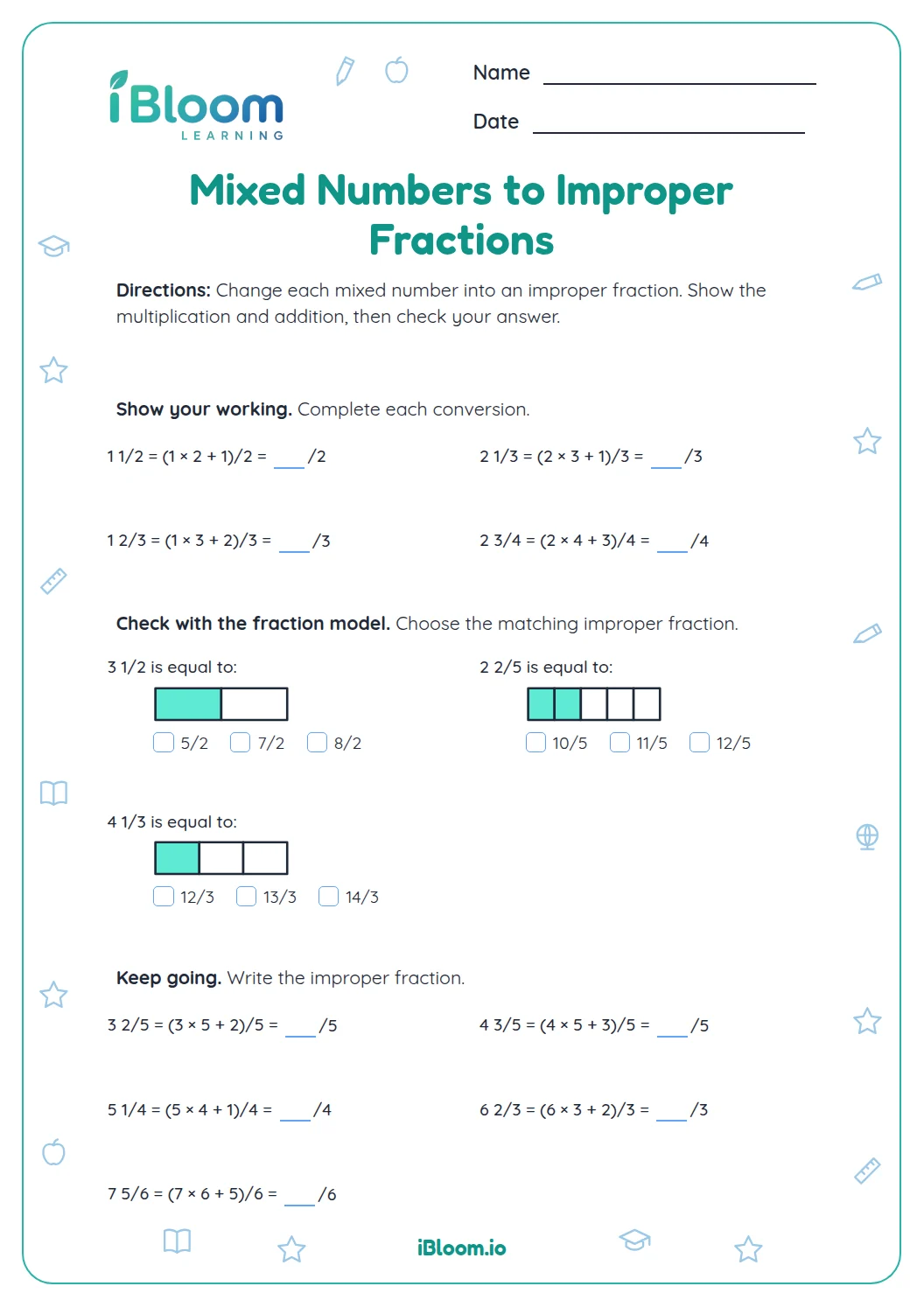
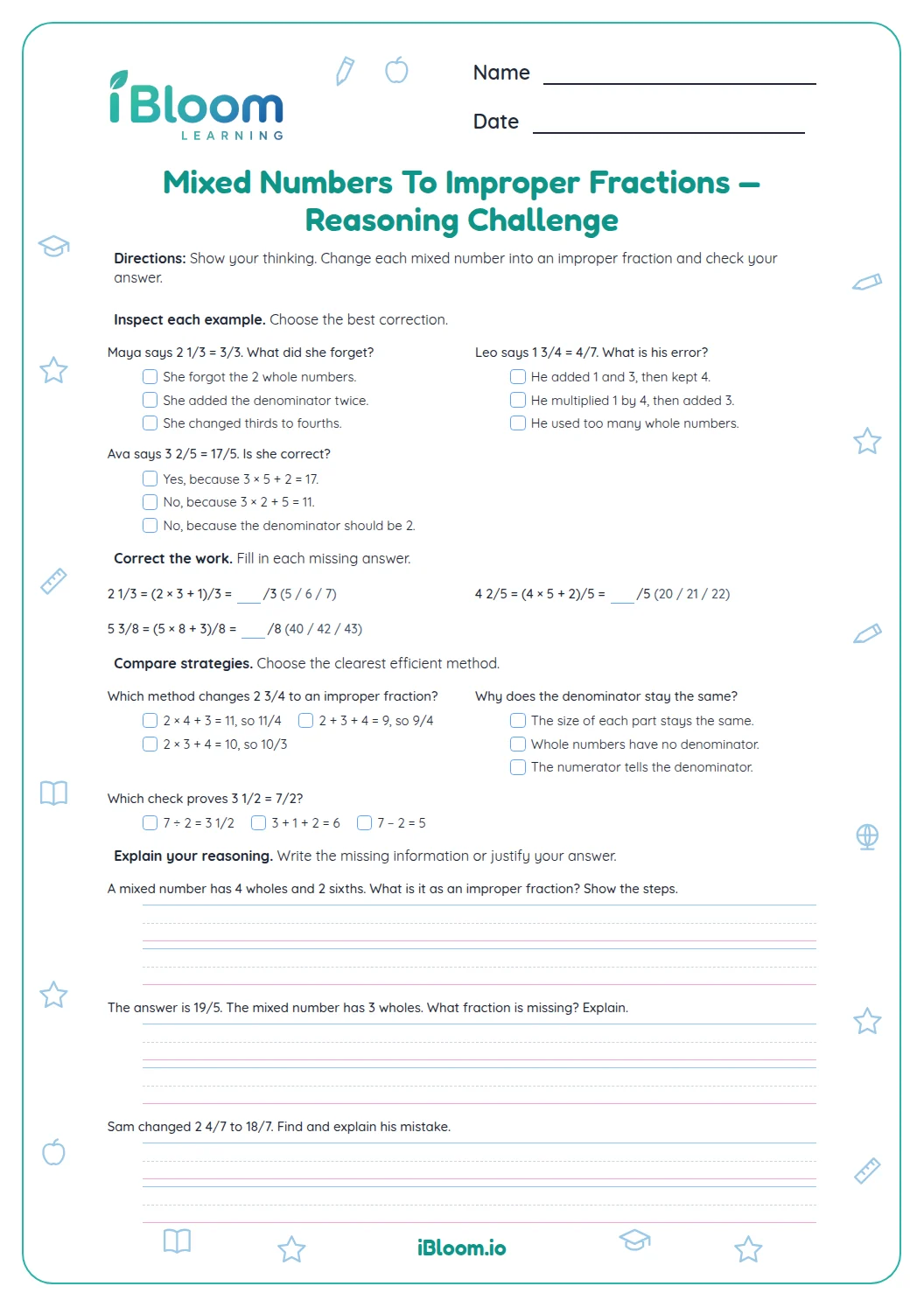
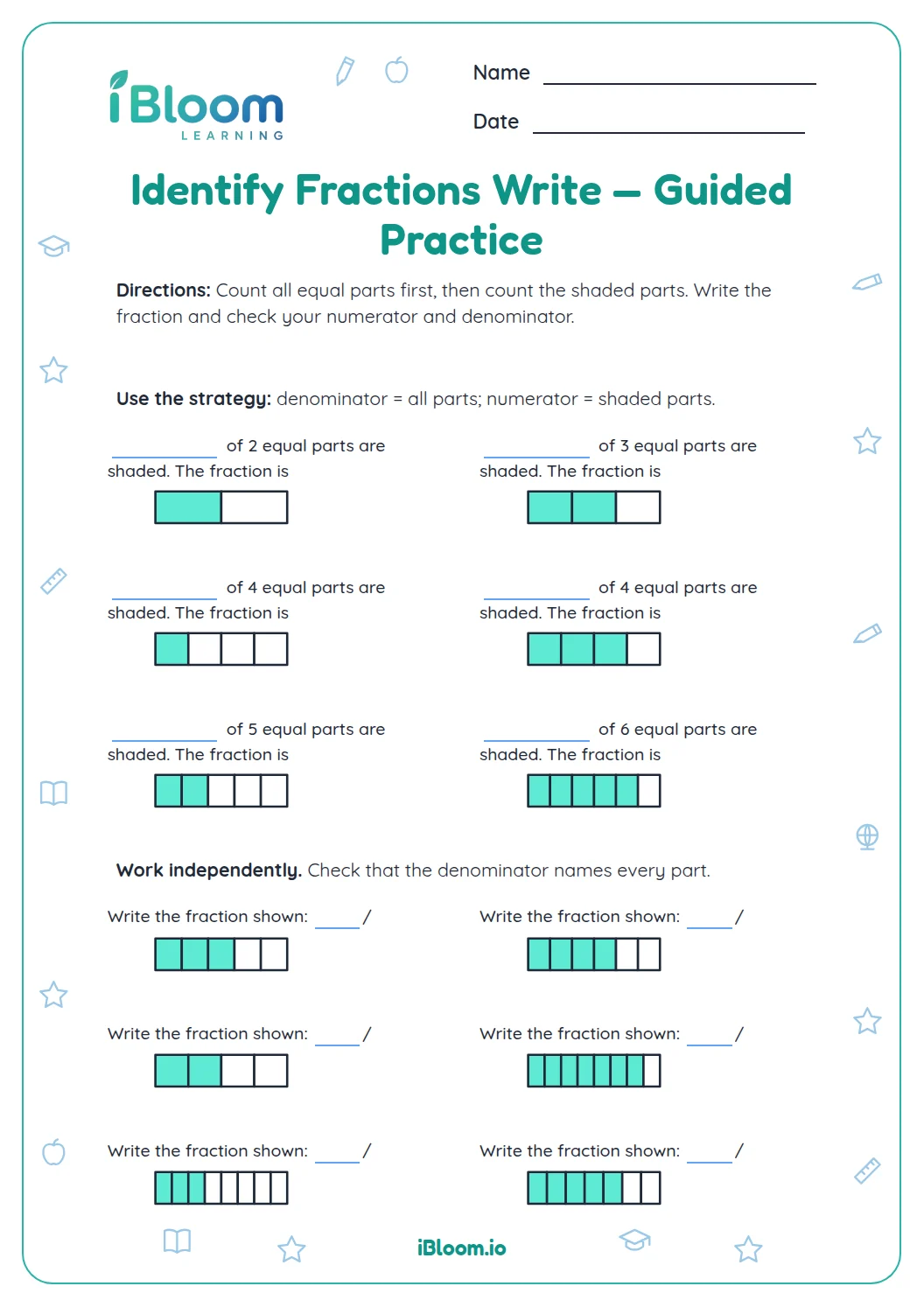
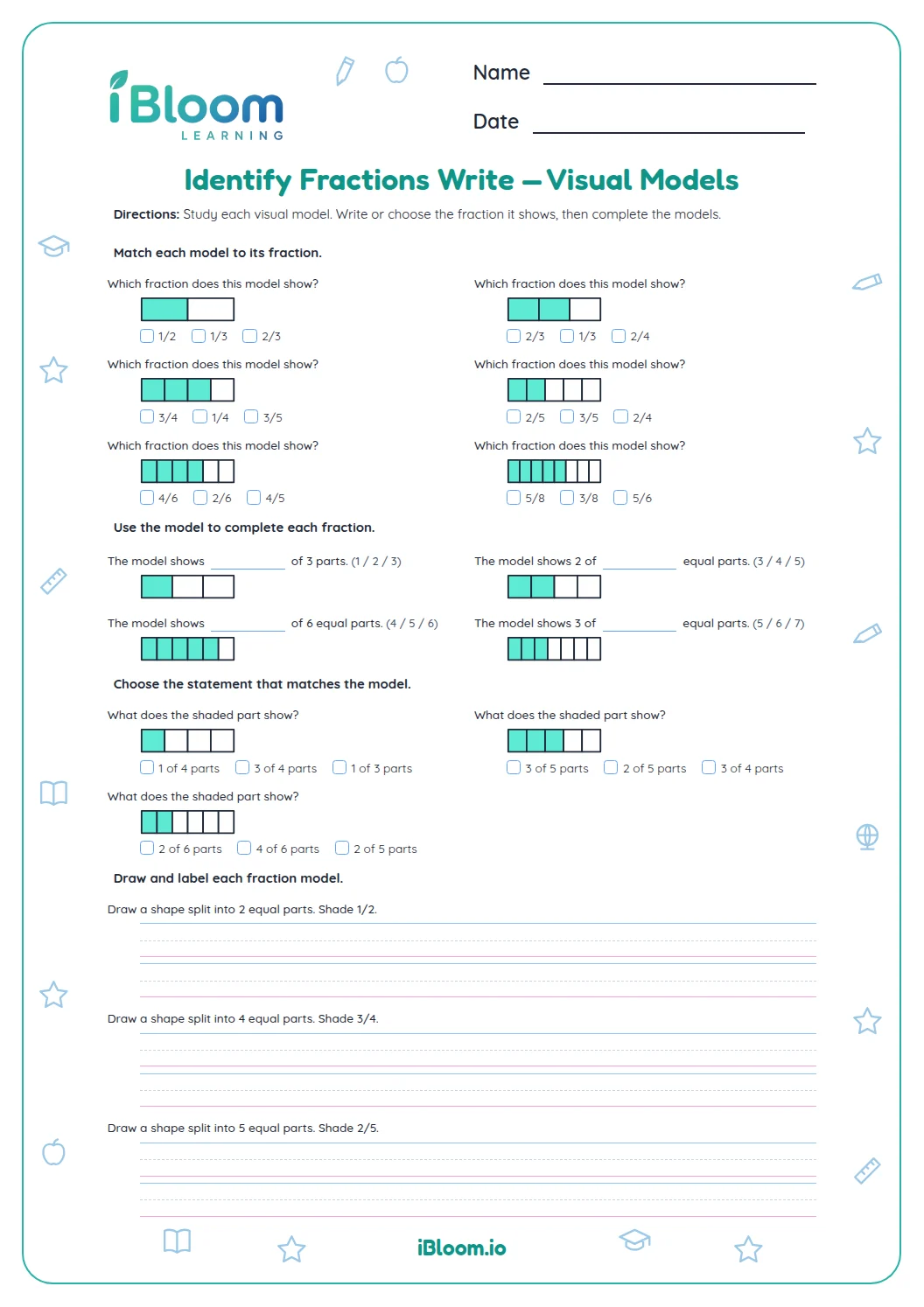
This free Grade 3 worksheet turns mixed numbers into a counting task. Children use twelve shaded bar and circle models to rename amounts such as 1 3/4 as improper fractions. Part A uses halves, thirds, fourths and fifths; Part B adds sixths and eighths and a multiply-and-add check. Each question supplies the denominator so the child can concentrate on counting all the shaded parts, including those inside complete wholes. The sheet practices CCSS 3.NF.A.1, understanding a fraction as a number of equal parts. A separate answer key gives each missing numerator.
Aligned to 3.NF.A.1
What does each whole contribute?
A complete shape contributes as many parts as its denominator names. A whole divided into fourths contributes four fourths, while a whole divided into sixths contributes six sixths. Count the sections inside the complete shapes as well as those in the final shape.
How does 1 3/4 become 7/4?
Question 3 uses two bars of equal size. The first bar is fully shaded and the second has three shaded sections. Counting only the final bar would miss a whole unit of the amount.
- 1One whole = 4/4
- 24 fourths + 3 fourths = 7 fourths
- 31 3/4 = 7/4
- 4Write 7 in the blank.
How does the practice get harder?
Part A has six models with halves, thirds, fourths and fifths. Part B has six models, including sixths, eighths and three complete wholes. Count the shading, then check the numerator by multiplying the number of wholes by the parts per whole and adding the extra shaded parts.
Ask children to say the unit with their count: “one sixth, two sixths…” This keeps the numerator, a count of parts, connected to the denominator, the size of each part.
How to use this worksheet
- 1Point to a complete shape and identify how many equal sections make one whole.
- 2Read the mixed number and match its whole-number part to the fully shaded shapes.
- 3Count every shaded section, including those in the whole shapes.
- 4Write that count above the supplied denominator.
- 5In Part B, check with wholes × parts per whole + extra parts; compare with the key.
Mistakes to discuss
The mistake
Counting only the partly shaded shape.
The fix
Count the complete shapes first, then add the extra shaded sections.
The mistake
Adding the whole number directly to the numerator.
The fix
For 2 2/3, count three thirds in each whole: 3 + 3 + 2 = 8.
The mistake
Changing the denominator when more shapes appear.
The fix
Each part remains the same size. More fourths still have a denominator of 4.
Common Core alignment
Count equal fractional parts across whole shapes to name a fraction greater than one.
On this sheet: Students count halves, thirds, fourths, fifths, sixths and eighths across complete and partly shaded wholes.
Show the official wordingHide the official wording
Understand a fraction 1/b as the quantity formed by 1 part when a whole is partitioned into b equal parts; understand a fraction a/b as the quantity formed by a parts of size 1/b.
What to practice next
Make more practice
Further reading
Questions parents and teachers ask
What does “improper fraction” mean here?
An improper fraction has a numerator at least as large as its denominator. The models on this sheet all show more than one whole, so their numerators are larger. For example, question 1 shows three halves: two halves in one whole and one extra half.
Should children multiply or count the shaded parts?
Children can count first, then notice the multiplication shortcut. In question 7, two wholes contain three thirds each, so there are six thirds before the extra two are counted. This gives eight thirds altogether. The picture makes the calculation 2 × 3 + 2 visible.
Why is the denominator already printed?
The printed denominator tells children which equal parts to count. The missing number records how many of those parts are shaded across all the shapes. This separates the two jobs in a fraction: the denominator names the part size, and the numerator counts those parts.
Do the answers need to be simplified?
Write the numerator that matches the model’s equal parts and the printed denominator. Every answer on this particular sheet is already in simplest form. The purpose is to connect a mixed number with its improper-fraction name while keeping the size of the pictured pieces unchanged.
How should I use the answer key?
Use the key to check the missing numerators after your child counts the models. Ask for a spoken explanation of any correction, such as “I forgot the four fourths in the whole bar.” The completed fraction should describe all the shading, including every complete whole.