






About this worksheet
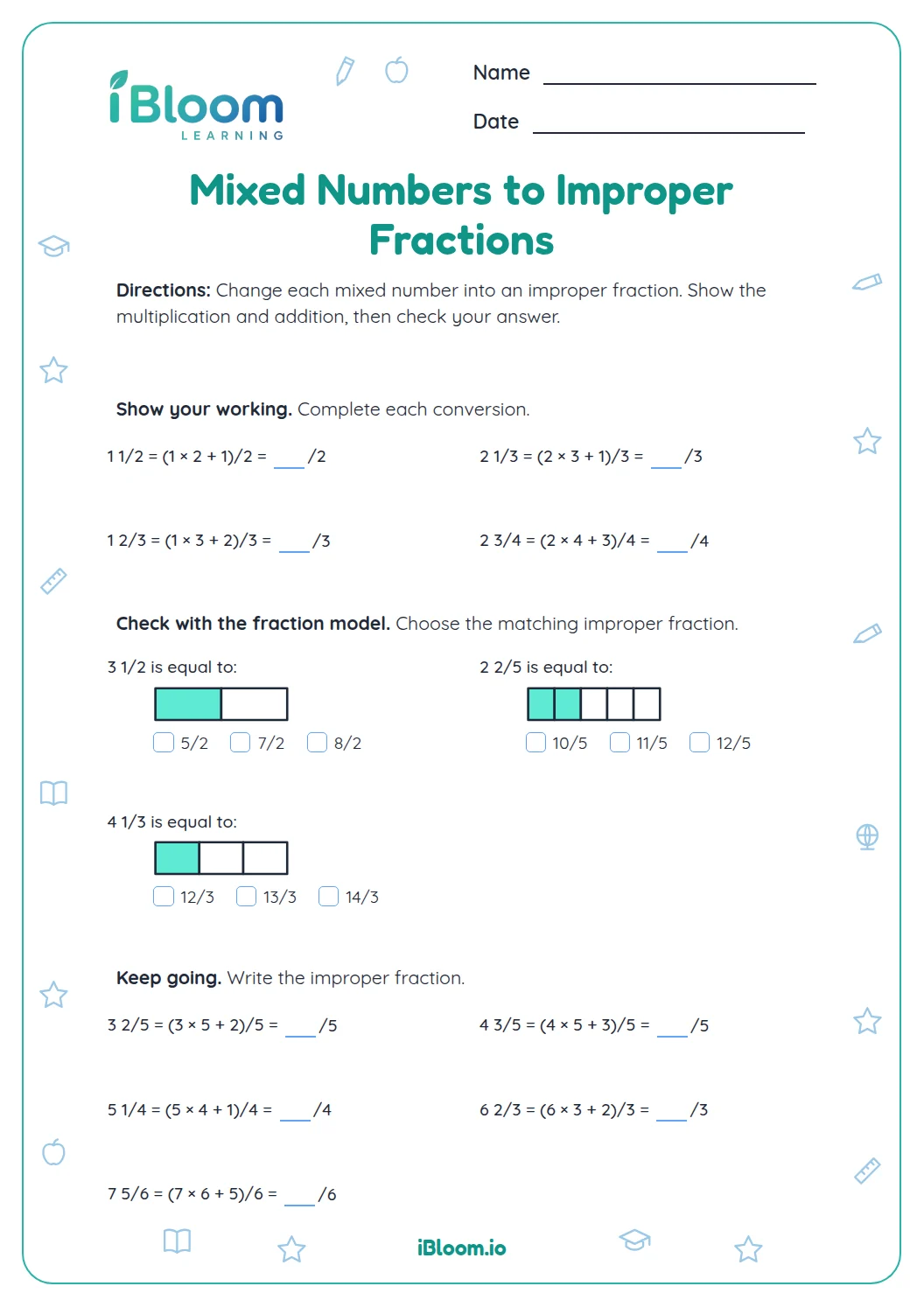
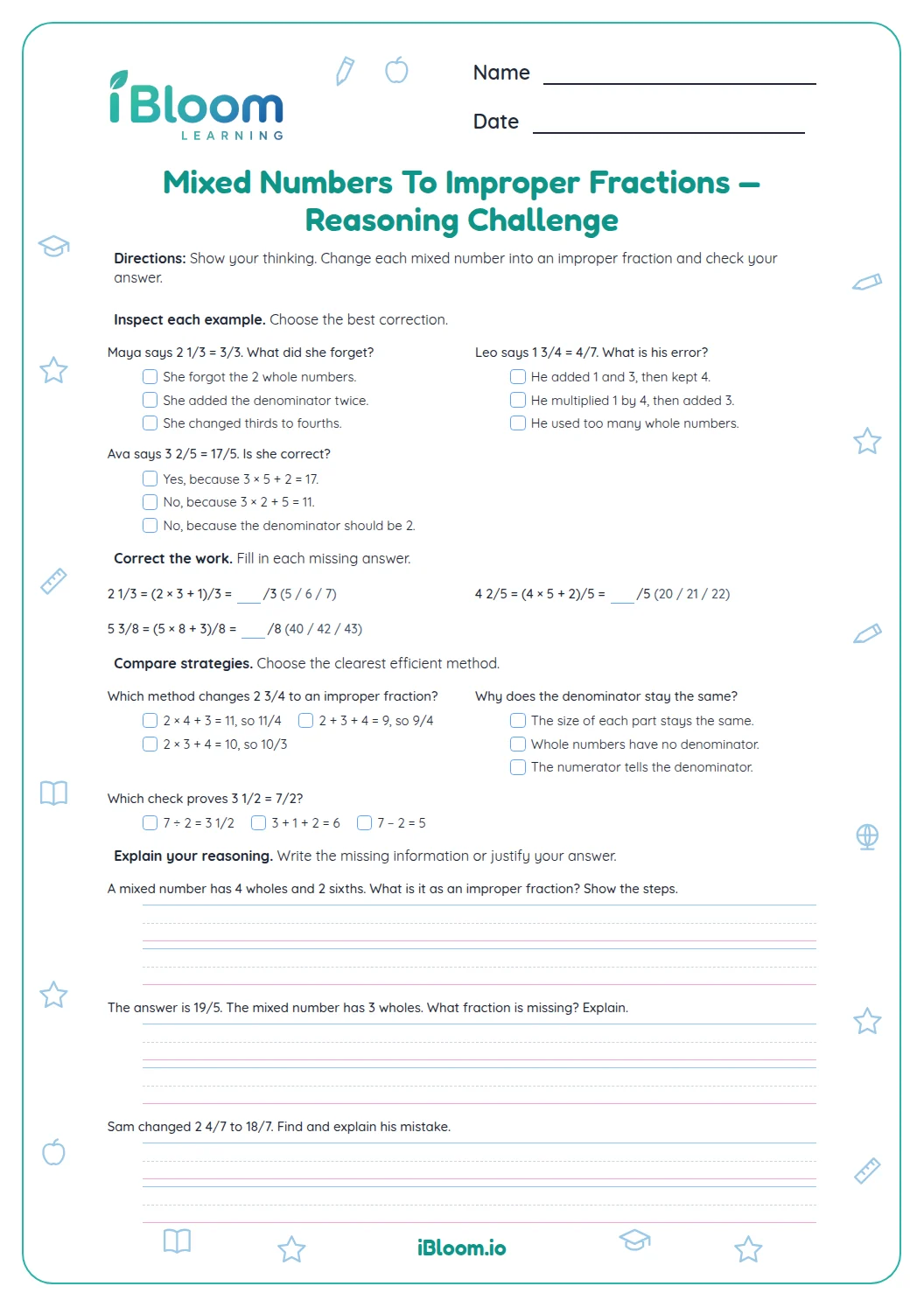
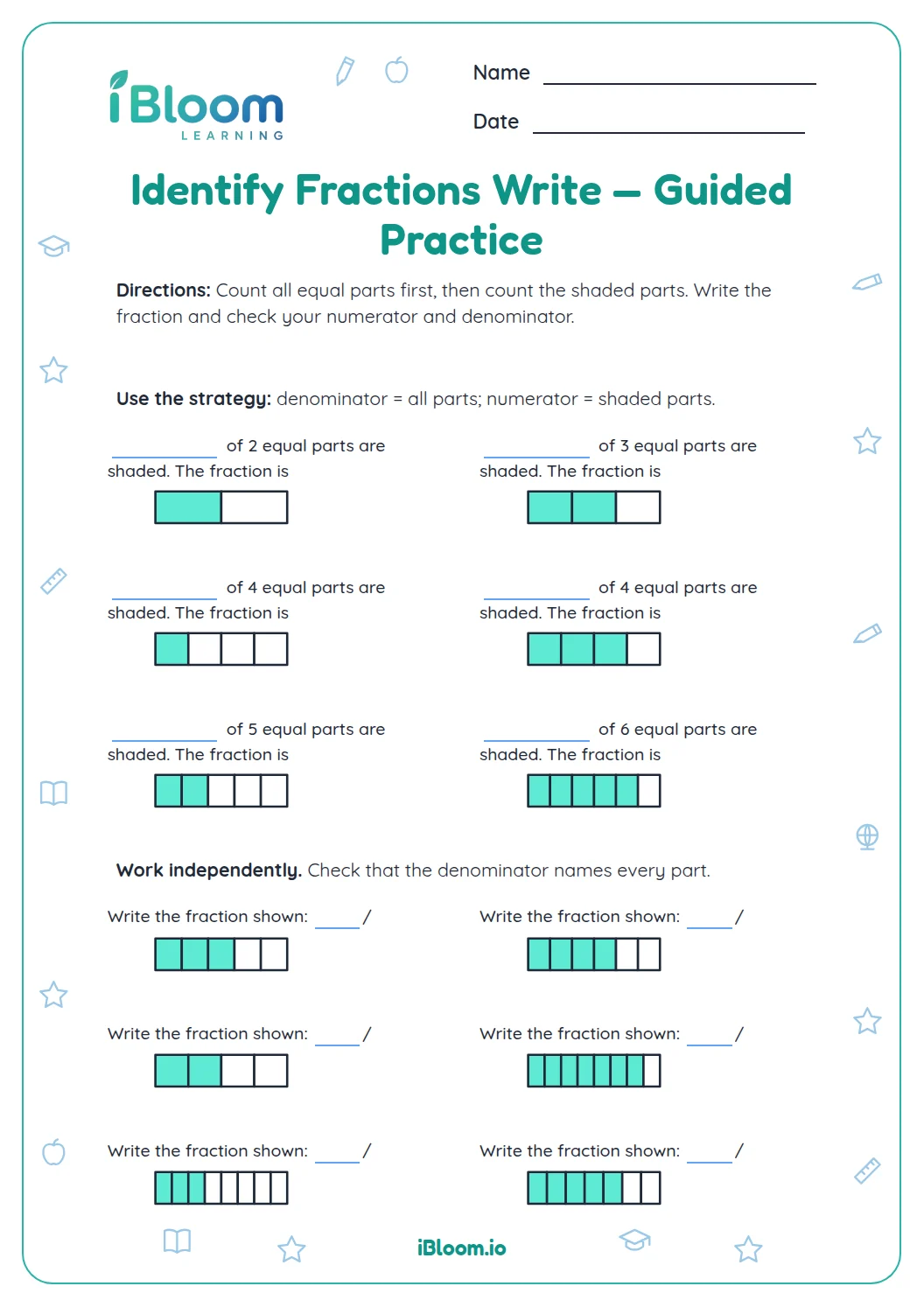
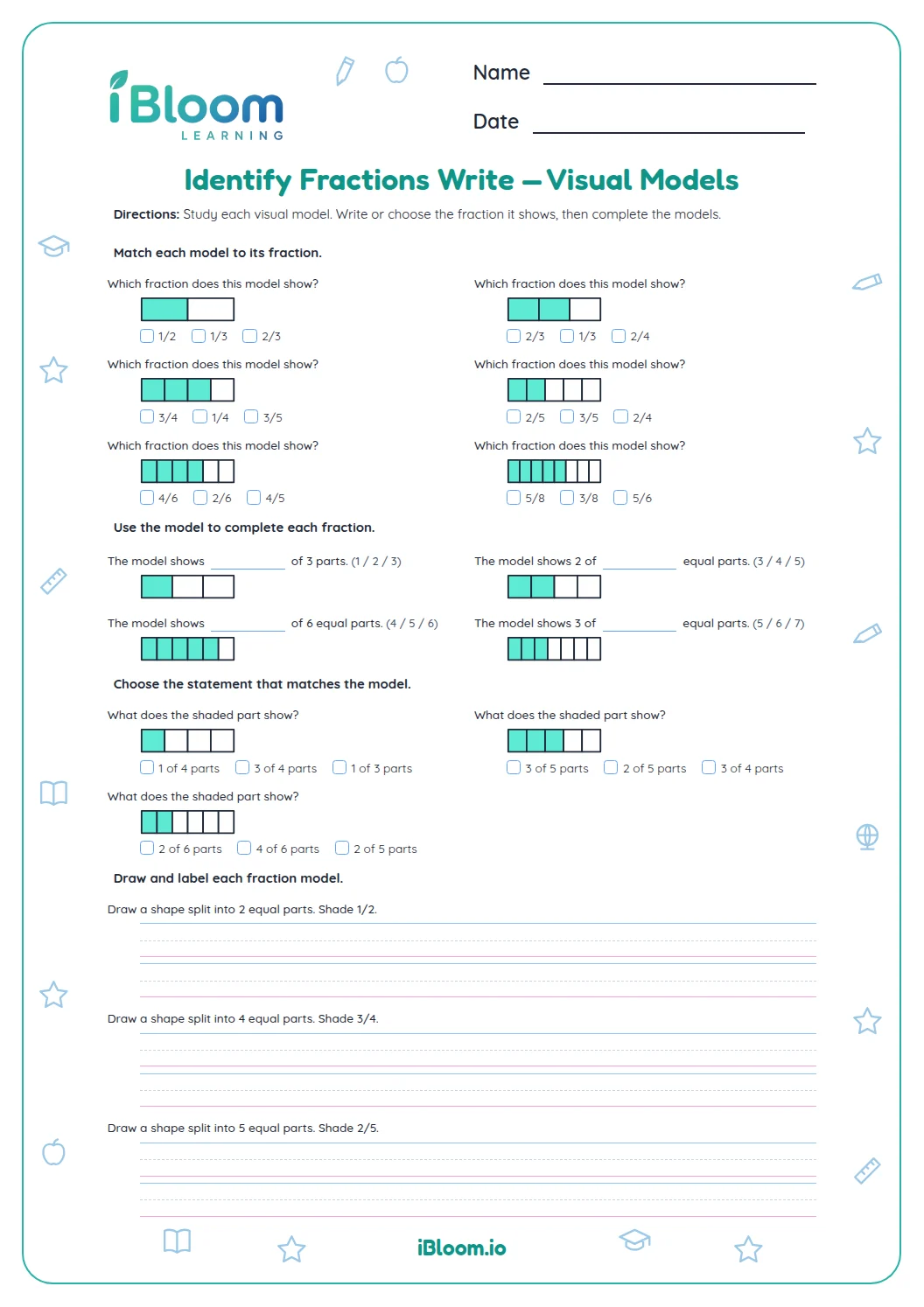
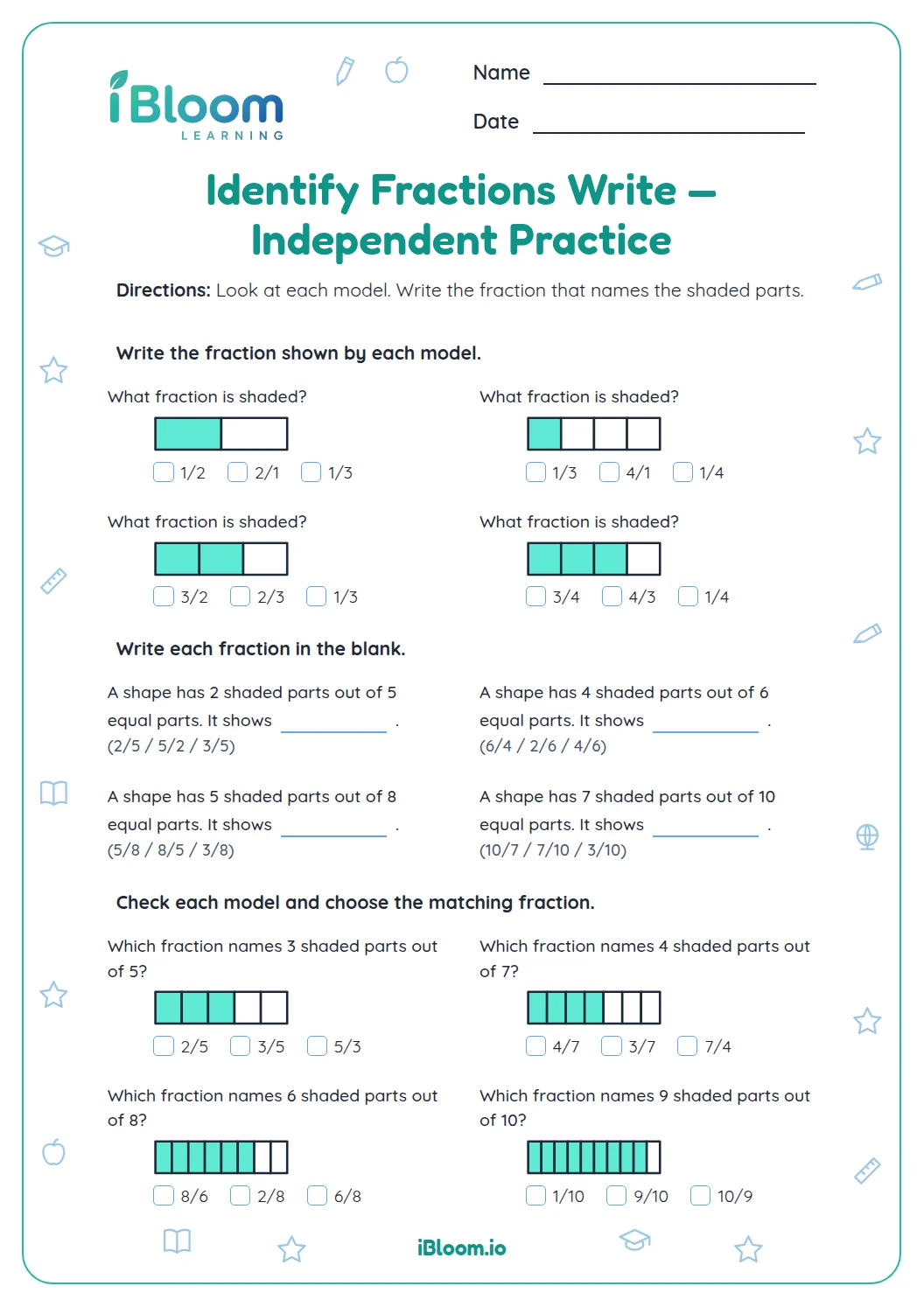
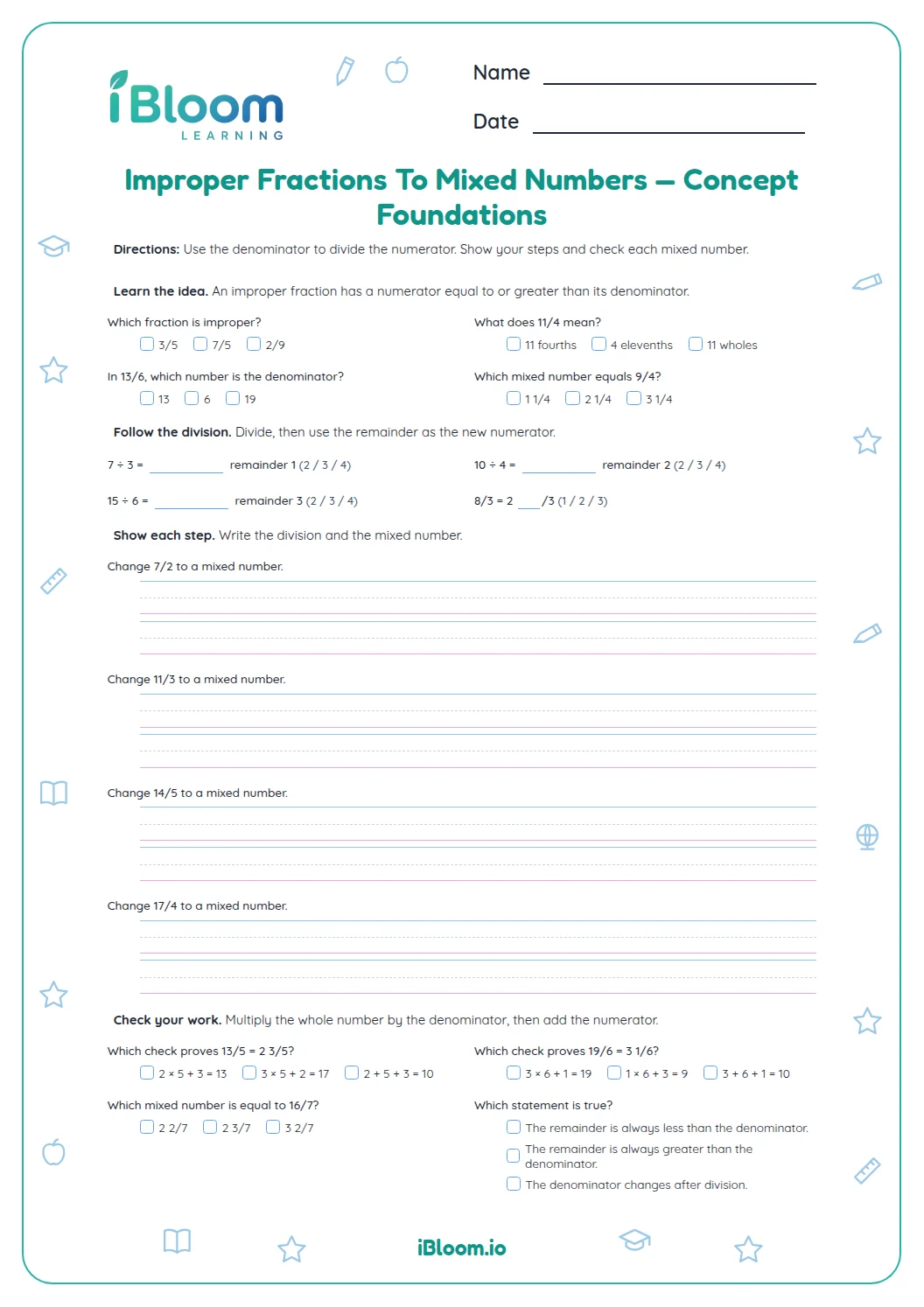
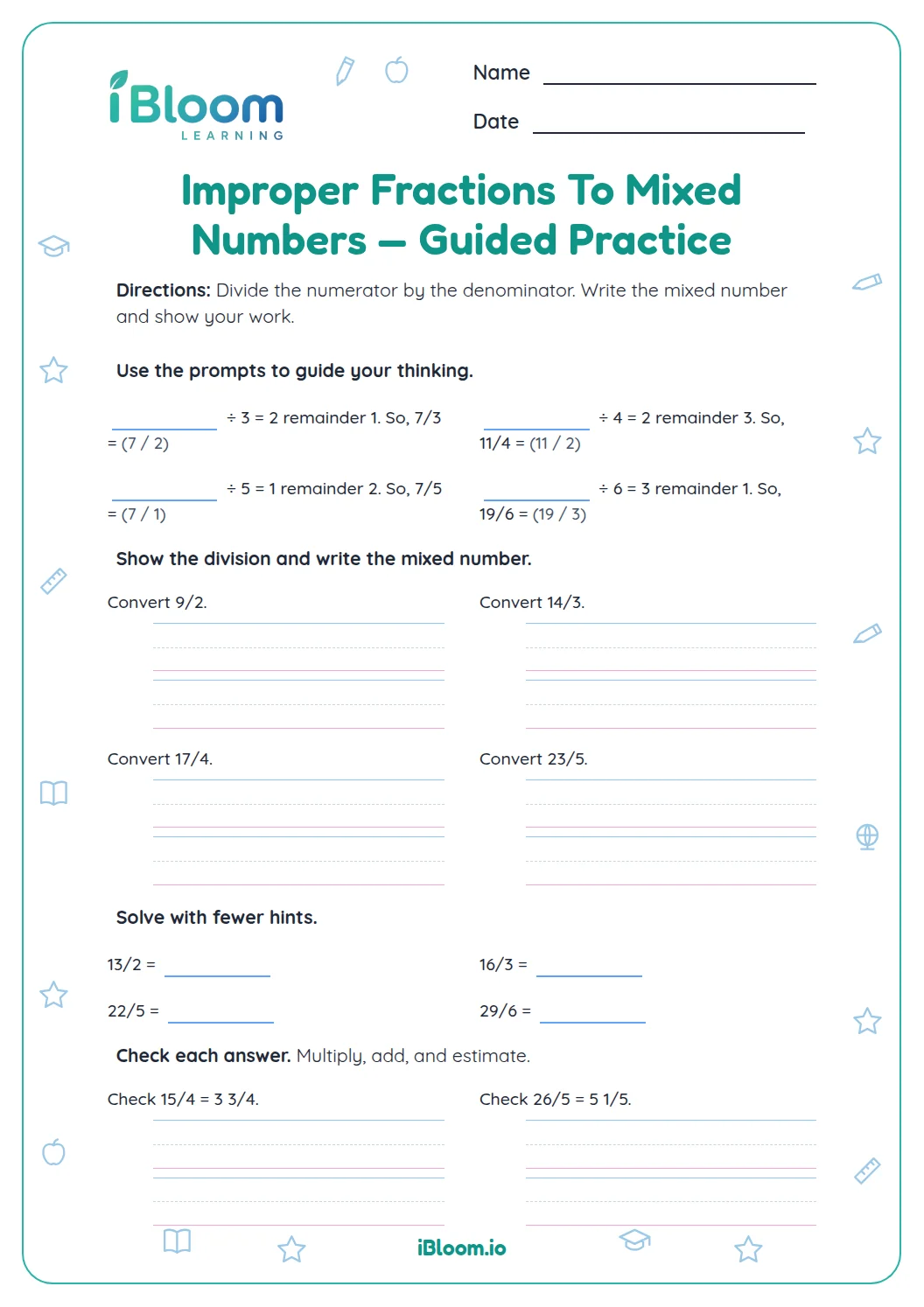
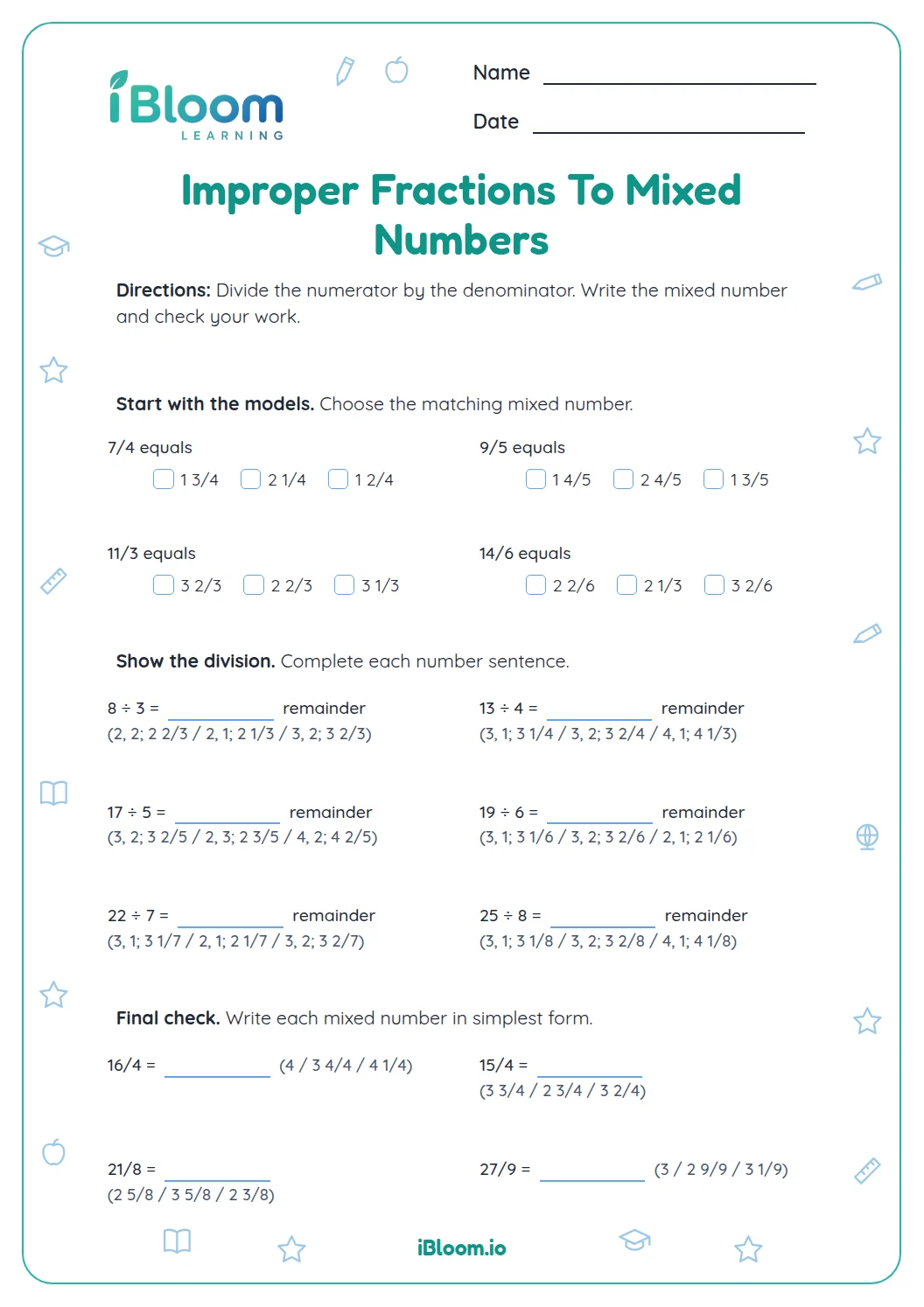
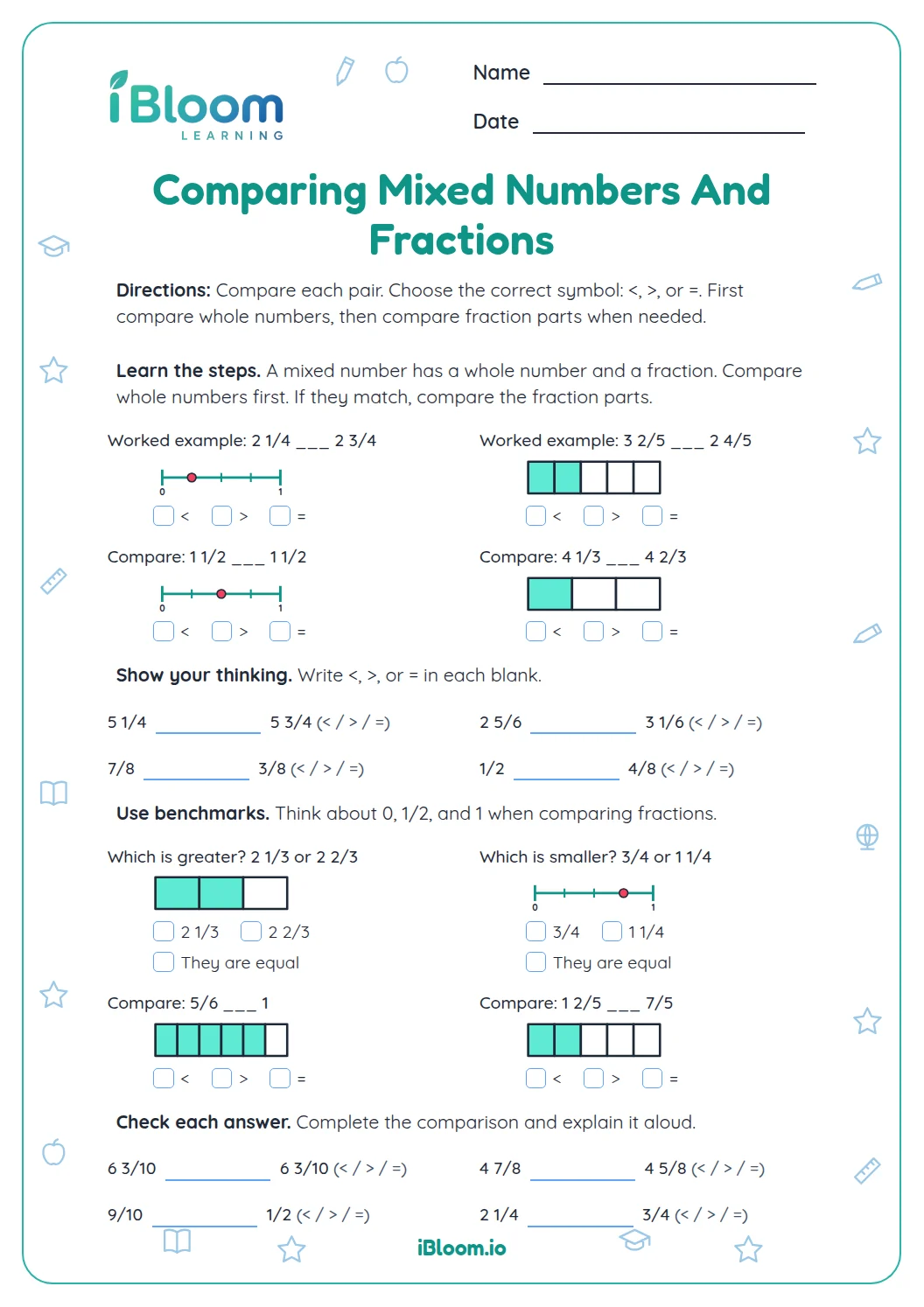
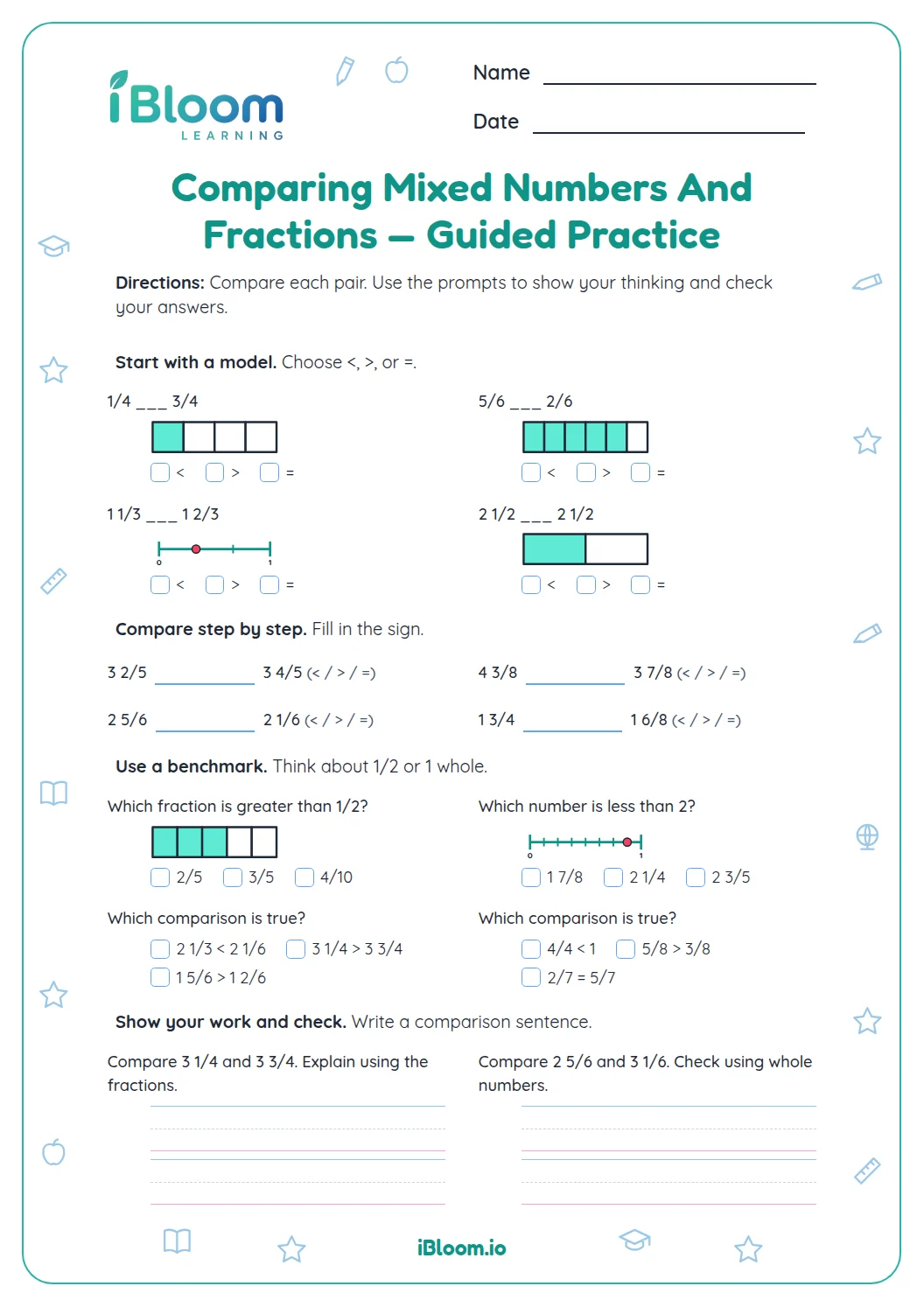
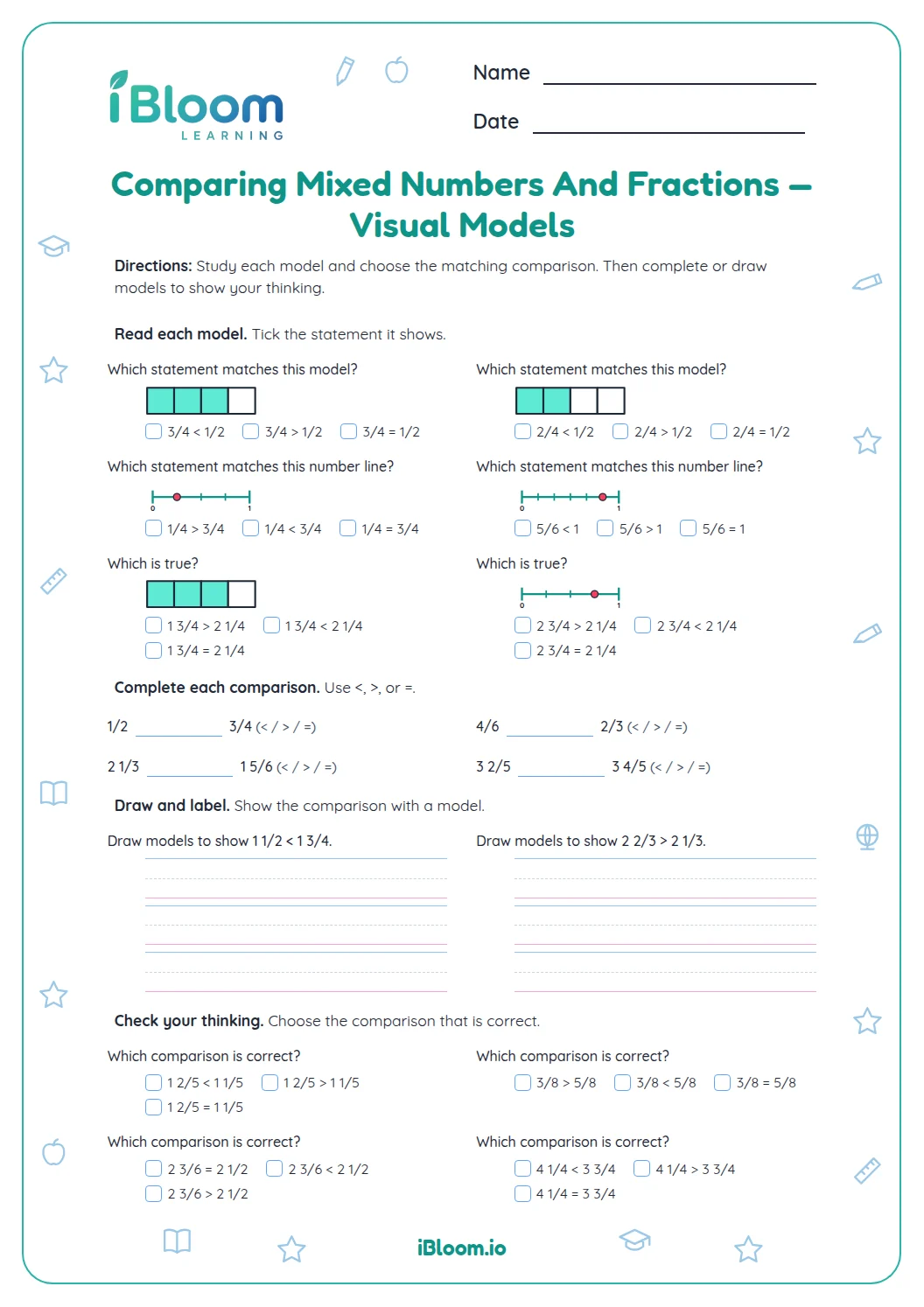
This free Grade 3 worksheet builds mixed-number meaning with shaded parts, then practices the conversion method: multiply the whole number by the denominator, add the numerator, and keep the denominator. Part A counts equal parts in four models. Part B renames whole numbers as fractions. Part C applies the calculation to six mixed numbers. The 16 questions practice counting fractional units and expressing whole numbers as fractions. A separate answer key gives every fraction and missing numerator.
Aligned to 3.NF.A.1 and 3.NF.A.3.c
What does an improper fraction count?
An improper fraction has a numerator at least as large as its denominator. It counts enough equal parts to make one whole or more. Three halves, written 3/2, make one whole and one half.
A mixed number names the same amount using a whole number and a fraction. The models let children count every shaded part across identical wholes instead of memorizing a conversion rule first.
How does the model explain 2 1/3?
Question 3 shows two fully shaded bars and one third of another bar. Each bar is divided into three equal parts, so the two wholes contain six thirds. The extra shaded third makes seven thirds altogether.
The same count can be written as a calculation: multiply the whole number by the denominator, then add the numerator. For 2 1/3, 2 × 3 + 1 = 7, so 2 1/3 = 7/3.
- 1One whole contains 3 thirds.
- 2Two wholes contain 2 × 3 = 6 thirds.
- 36 thirds + 1 third = 7 thirds.
- 42 × 3 + 1 = 7, so 2 1/3 = 7/3.
Why rename the wholes before converting?
Part B isolates the whole-number step children need in Part C. For example, 3 = 12/4 tells them how many fourths are already in three wholes. In question 13, multiply 3 × 4 and add 1 to get 13/4.
The denominator still names the size of each part. Combining fourths gives more fourths, so only the numerator changes. Questions 11–16 leave that numerator blank and ask children to keep the stated denominator.
How to use this worksheet
- 1Name the equal parts in the first model: each piece is one half.
- 2Count all shaded parts across every shape in Part A, including complete wholes.
- 3For Part B, multiply the number of wholes by the denominator to find the total parts.
- 4In Part C, add the extra numerator to that total; for 2 1/3, calculate 2 × 3 + 1 = 7.
- 5Keep the denominator and check that the improper fraction names the same amount.
Mistakes to notice and how to help
The mistake
Adding the whole number directly to the numerator: 2 1/3 becomes 3/3.
The fix
Two wholes contain six thirds. Add the extra third to six, giving 7/3.
The mistake
Counting only the extra shaded part and answering 1/3 for question 3.
The fix
Touch and count the shaded parts in both full bars before counting the extra third.
The mistake
Using all the pieces in all three bars as the denominator and writing 7/9 for question 3.
The fix
Count the parts in one whole bar: three. Then count all seven shaded thirds to write 7/3.
Common Core alignment
Count equal-sized fractional parts across whole and partly shaded shapes.
On this sheet: Part A counts shaded halves, thirds, and fourths across matching shapes.
Show the official wordingHide the official wording
Understand a fraction 1/b as the quantity formed by 1 part when a whole is partitioned into b equal parts; understand a fraction a/b as the quantity formed by a parts of size 1/b.
Rename whole numbers as fractions to count all the parts in a mixed number.
On this sheet: Part B expresses one, two, and three wholes in halves, thirds, fourths, and sixths.
Show the official wordingHide the official wording
Express whole numbers as fractions, and recognize fractions that are equivalent to whole numbers. Examples: Express 3 in the form 3 = 3/1; recognize that 6/1 = 6; locate 4/4 and 1 at the same point of a number line diagram.
What to practice next
Make more practice
Further reading
Questions parents and teachers ask
What does the first shaded model show?
It shows one fully shaded bar and one half of another equal-sized bar. Each bar is divided into two equal parts. There are three shaded halves altogether, so the answer is 3/2. The same amount can also be called one and one half, written as the mixed number 1 1/2.
Why is 2 1/3 equal to 7/3?
Two wholes contain six thirds because each whole has three thirds. Add the one extra third to get seven thirds, or 7/3. The calculation is 2 × 3 + 1 = 7, with the denominator 3 unchanged. Question 3 also shows this count with two full bars and one extra third.
Should children simplify the fractions on this sheet?
Use the denominator shown in each completion. The purpose is to count the same-sized parts while renaming the whole number or mixed number. In the model questions, write one fraction that counts all shaded parts. The answer key keeps those part sizes visible, such as halves, thirds, and fourths.
What should my child know before starting?
Your child should be able to name halves, thirds, fourths, and sixths and recognize equal parts of a whole. Begin with the shaded models to check those ideas. Part B then practices renaming whole numbers, giving children a concrete step to use when they reach the mixed-number completions.
How can I check the answer 17/6?
Separate 17 sixths into 12 sixths and 5 sixths. Twelve sixths make two wholes, leaving five sixths, so 17/6 equals 2 5/6. That matches the last question. Saying the units as sixths helps children keep track of what the numerator counts and why the denominator stays six.