



About this worksheet
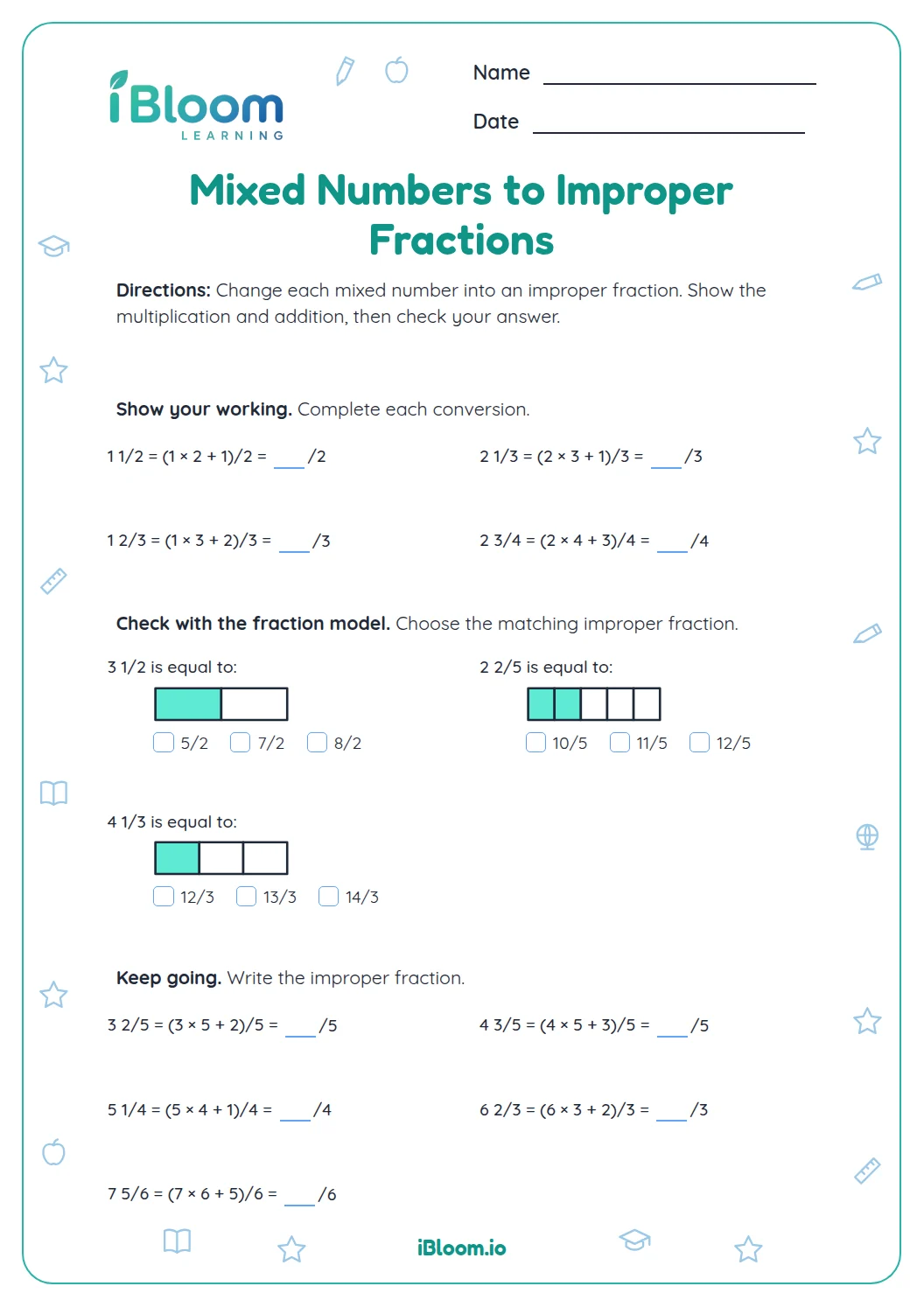
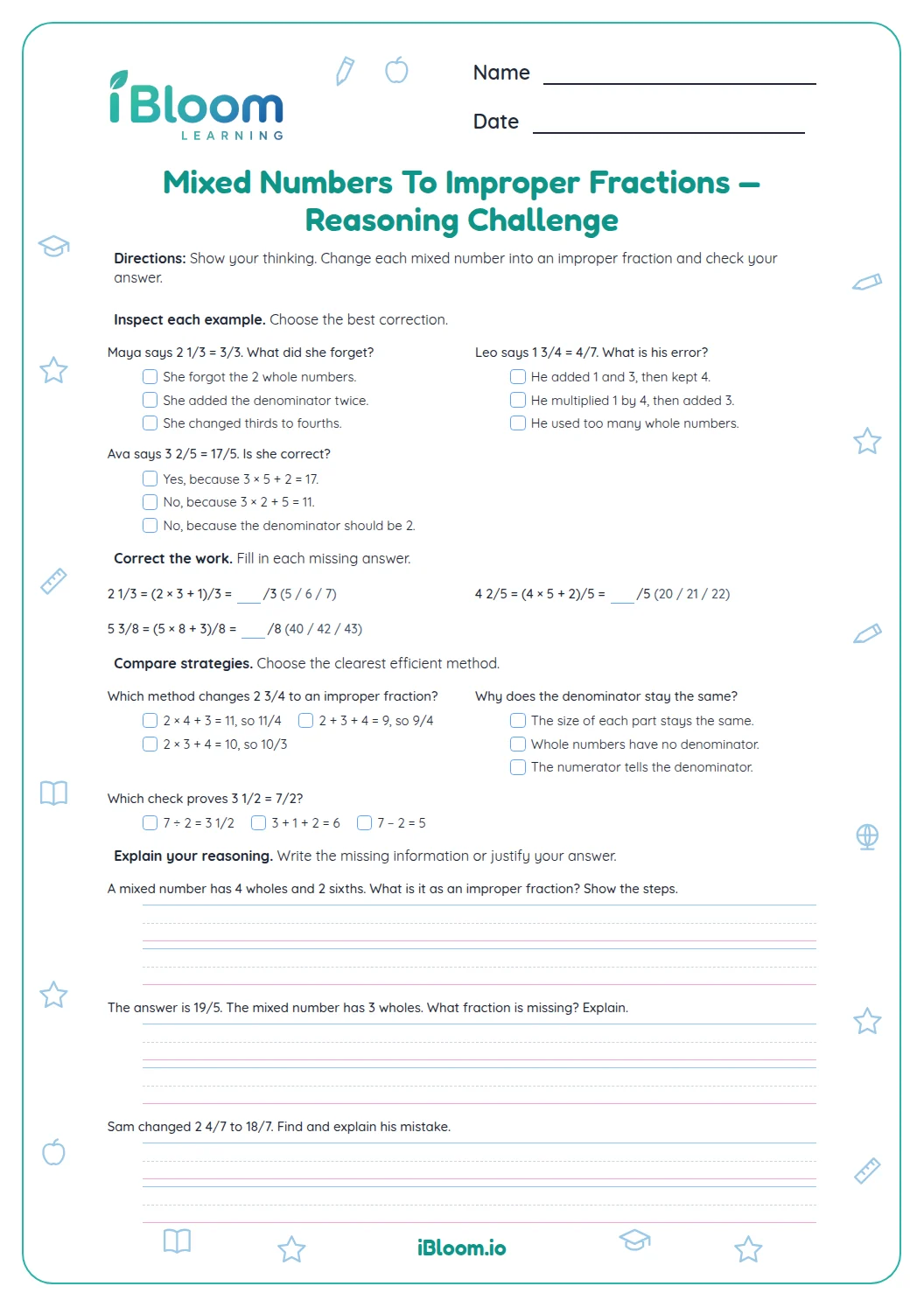
This Grade 3 printable provides 16 guided-practice problems for converting mixed numbers to improper fractions. Students use the same-denominator rule: multiply the whole number by the denominator, then add the numerator. The questions progress from smaller mixed numbers to larger whole-number parts, and the separate answer key lists each improper fraction.
What is the rule for converting a mixed number?
Multiply the whole number by the denominator, add the numerator, and keep the denominator. For 1 1/2, calculate 1 × 2 + 1 = 3, so the improper fraction is 3/2.
Part A finds missing numerators. Part B writes the conversion equation, Part C converts with fewer hints, and Part D checks each conversion by division.
- 11 1/2: (1 × 2) + 1 = 3
- 2So 1 1/2 = 3/2.
How can students check an improper fraction?
The denominator stays the same as the fractional part. Check the numerator by multiplying the whole number by that denominator and adding the original numerator. The result should be greater than the denominator because the mixed number is greater than one.
How does division check a conversion?
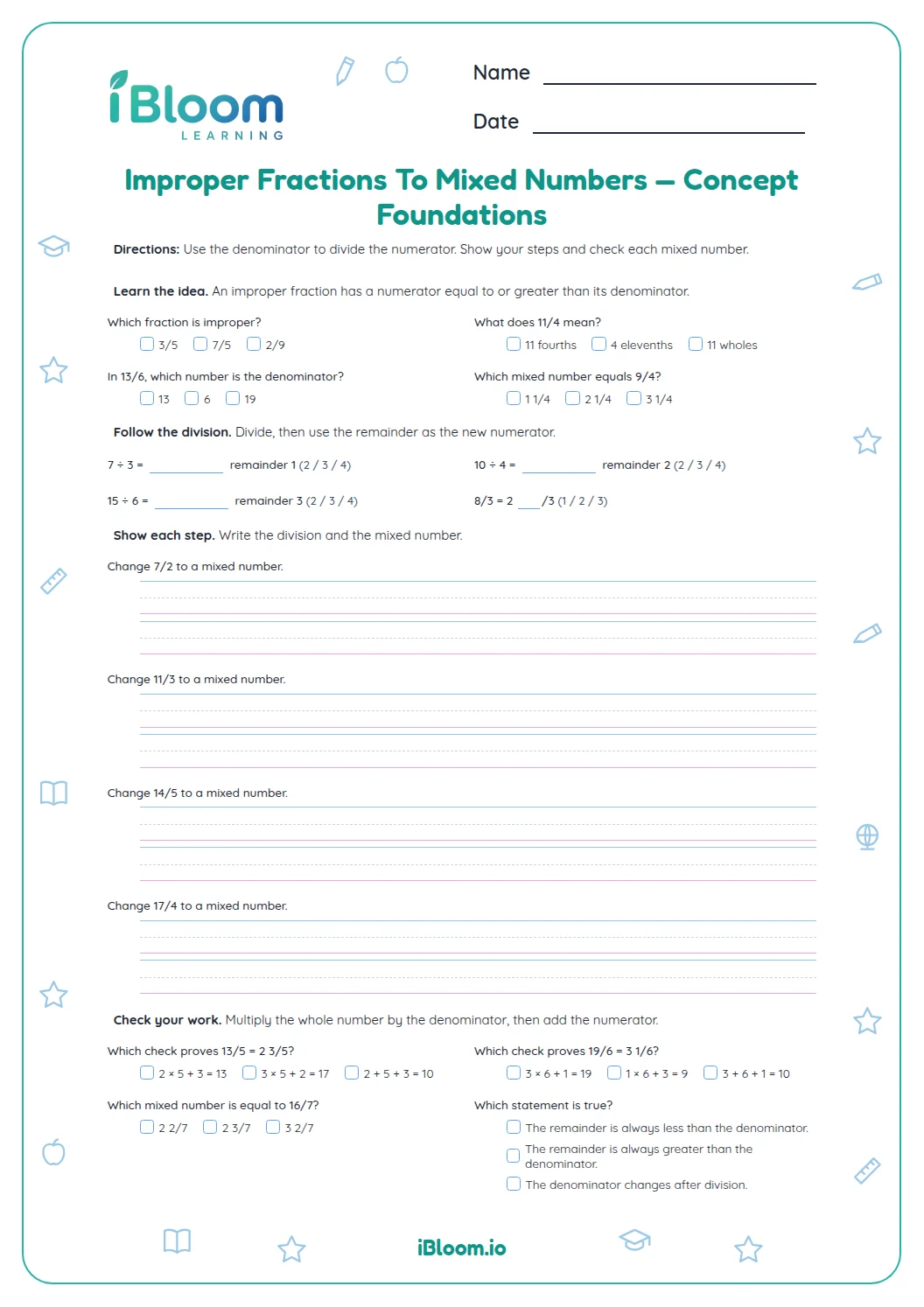
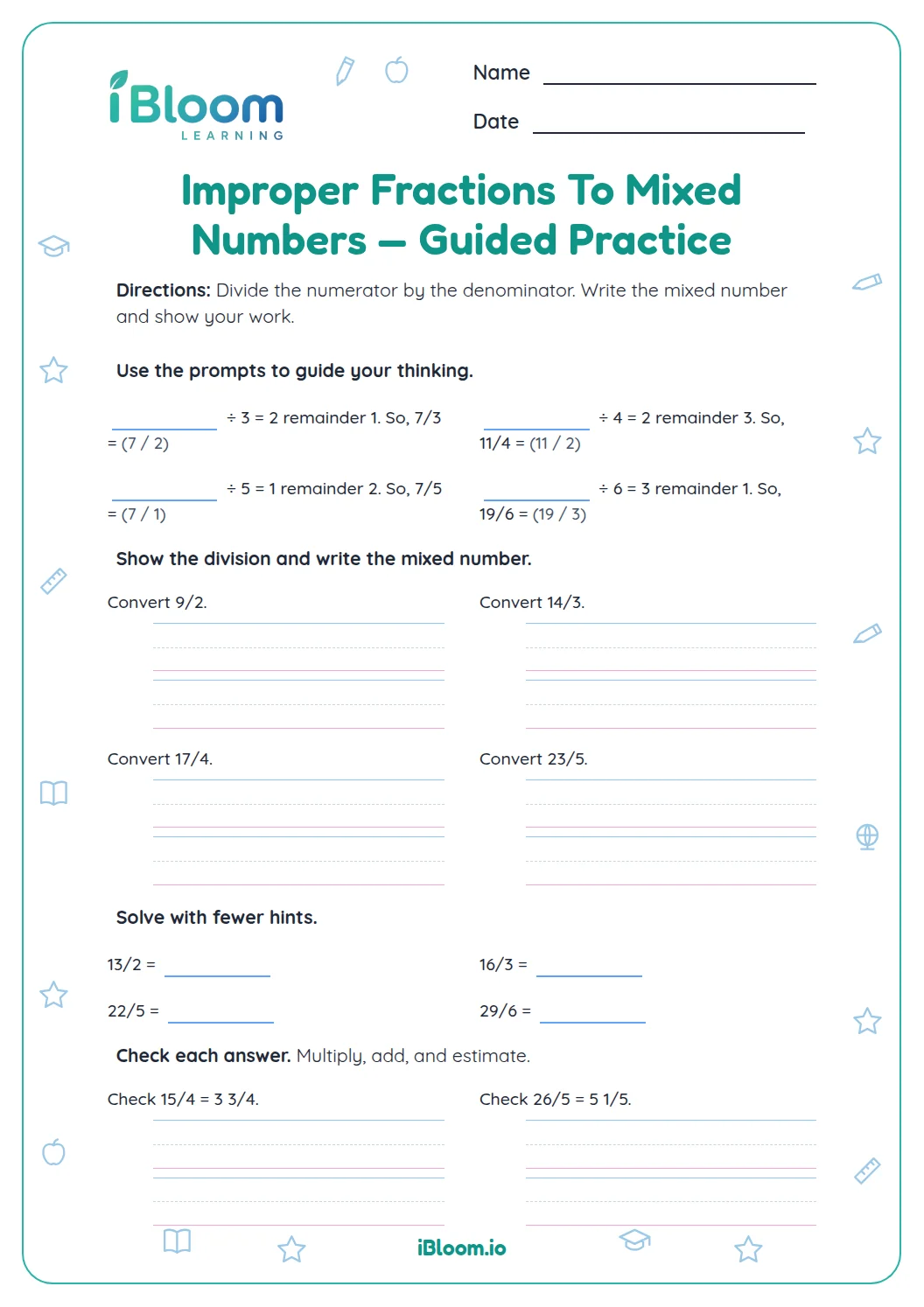
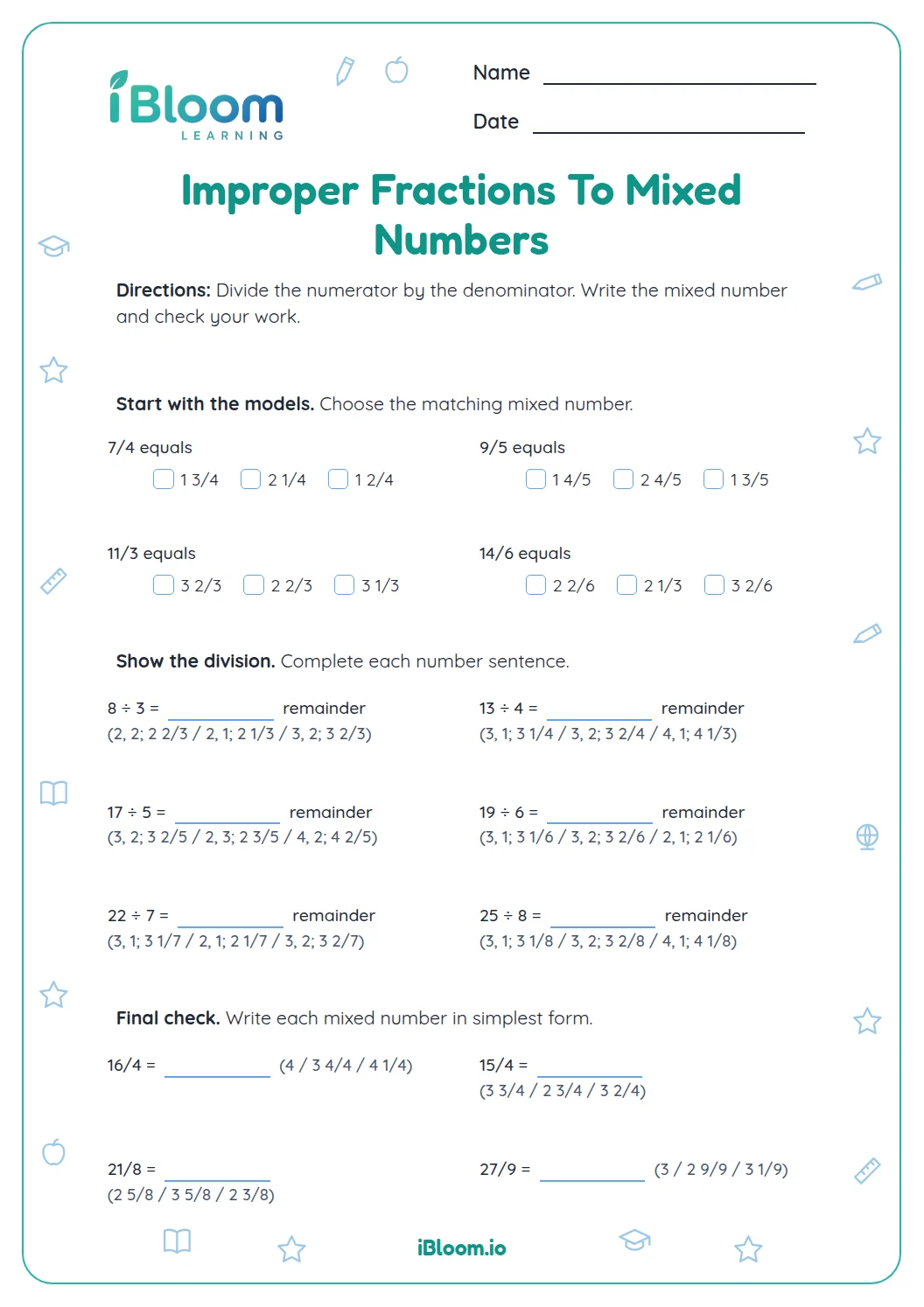
Divide the improper numerator by its denominator. The quotient should match the whole number, and the remainder should match the original numerator. For 17/3, 17 ÷ 3 = 5 R 2, which checks 5 2/3.
How to convert each mixed number
- 1Circle the whole number, numerator, and denominator.
- 2Multiply the whole number by the denominator.
- 3Add the numerator to that product.
- 4Write the sum over the original denominator.
- 5Check that the fraction is greater than one and the denominator stayed the same.
Fraction conversion checks
The mistake
Adding the whole number to the numerator without multiplying first.
The fix
Multiply the whole number by the denominator, then add the numerator.
The mistake
Changing the denominator while converting.
The fix
Keep the original denominator because the size of each fractional part stays the same.
The mistake
Writing the product as the final numerator and forgetting the added numerator.
The fix
Complete both operations before placing the result over the denominator.
What to practice next
Make more practice
Questions parents and teachers ask
What is the first step when converting a mixed number?
Multiply the whole number by the denominator. Then add the numerator and write that sum over the original denominator. For 1 1/2, the calculation is 1 × 2 + 1 = 3, giving 3/2. The answer key also shows the multiplication and addition.
Does the denominator change?
No. The denominator stays the same because the fraction still counts the same-sized parts. In 2 1/3, thirds remain thirds; the whole-number amount is converted into six more thirds and then combined with the original one third. This keeps each fraction part the same size.
How many problems are included?
The worksheet has 16 conversion problems divided into four parts. The first section finds missing numerators, then students show the equation, convert with fewer hints, and check answers by division. In the last part, division links the numerator and denominator to the mixed number.
How can a student check an answer?
Recalculate the numerator by multiplying the whole number by the denominator and adding the original numerator. Confirm that the denominator matches the mixed number and that the improper fraction is greater than one. The quotient and remainder should match the original mixed number.
Are answers in the key?
Yes. A separate answer key lists the improper fraction for every mixed number. Students can compare one part at a time and redo a conversion by writing the multiplication and addition before recording the fraction. It follows the same steps students practiced on the worksheet.