

About this worksheet
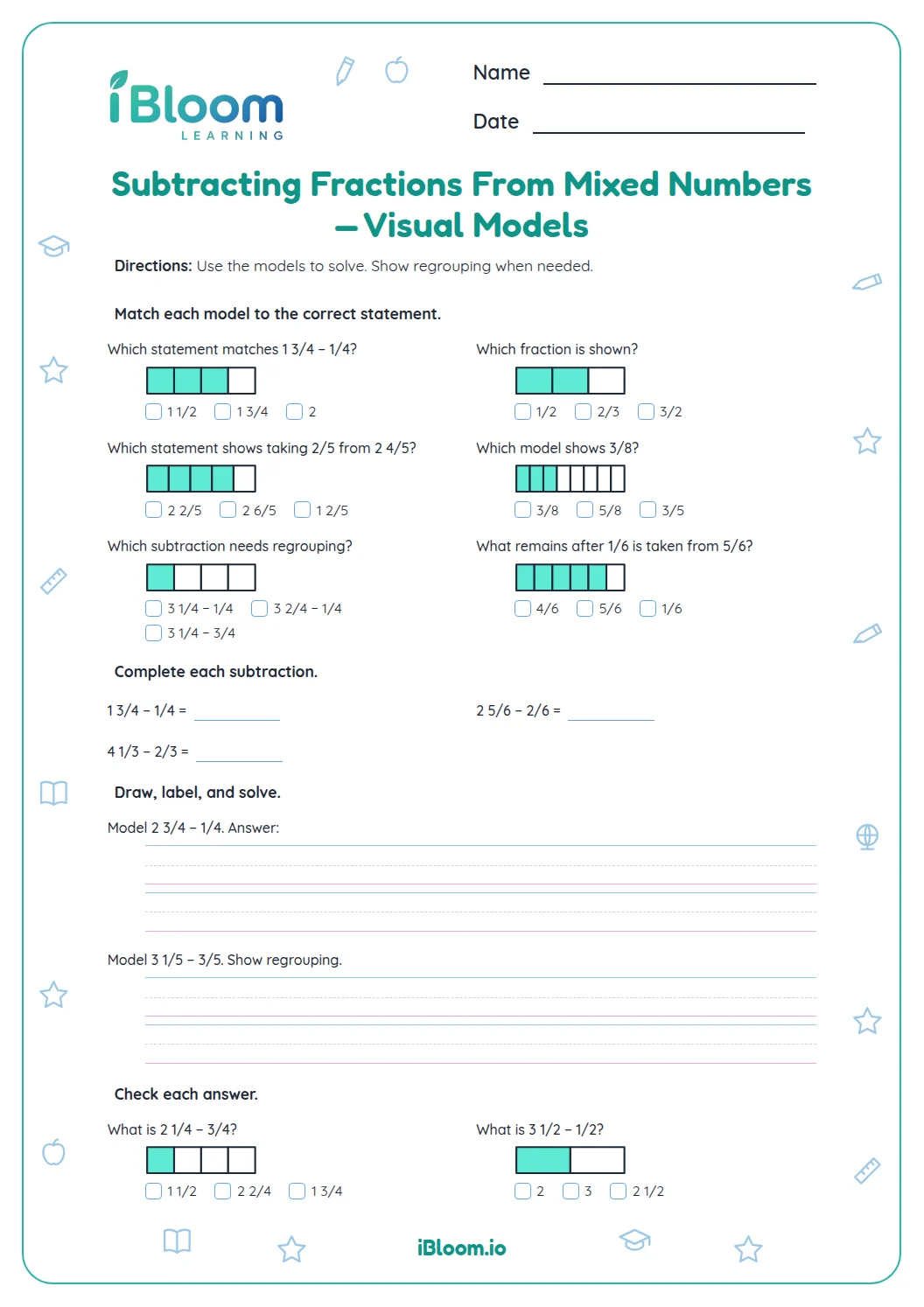
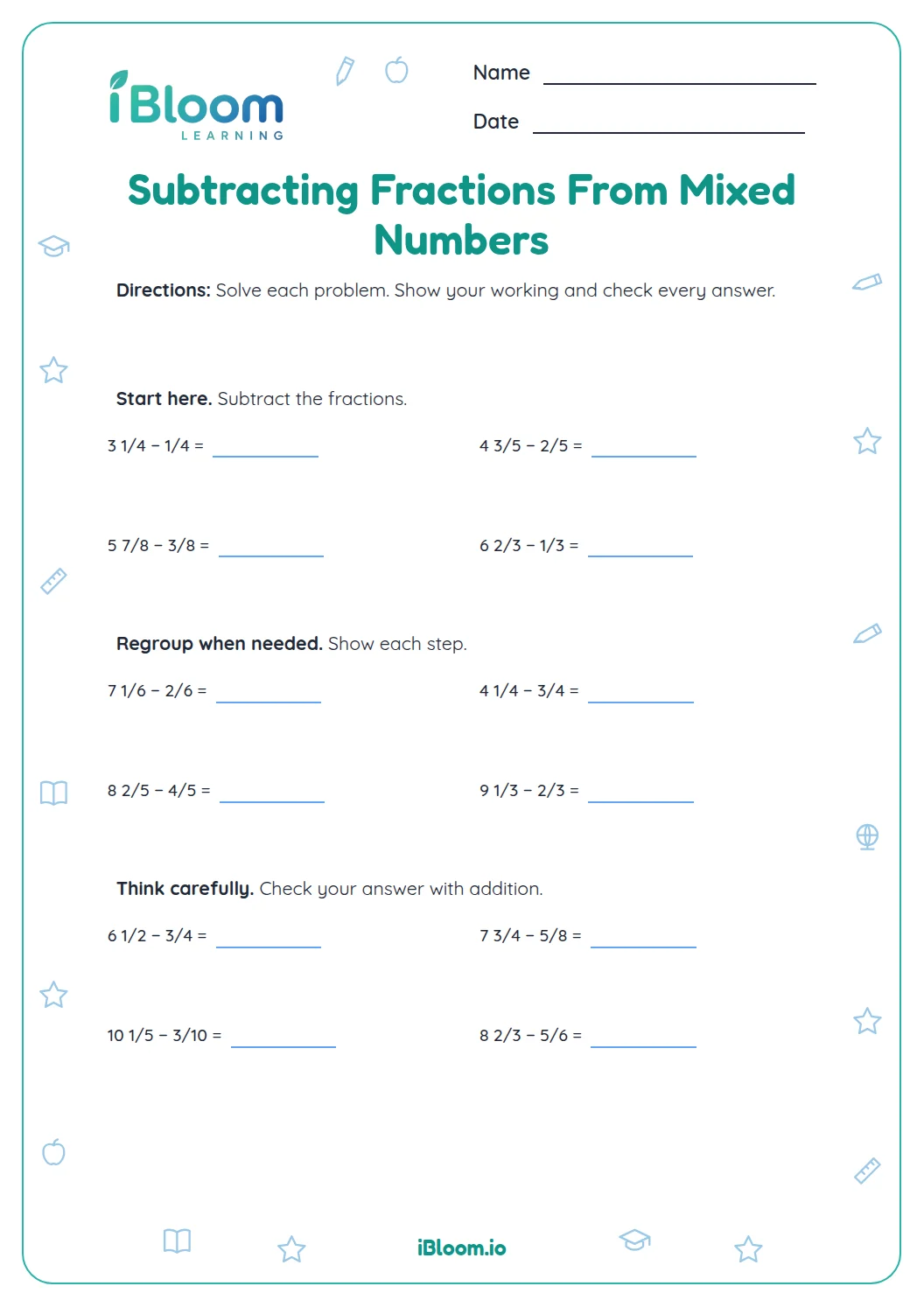
This concept-foundations worksheet practices subtracting a fraction from a whole number. Sixteen questions move from one whole to two and three wholes, then use missing-number equations and a final worded question. Bar and circle fraction models emphasize equal parts as children rename wholes and find what remains. The printable includes three practice pages, a separate key, and denominators of 2, 3, 4, 6, and 8.
Aligned to 4.NF.B.3.a
Why rename a whole before subtracting?
The fraction’s parts must be the same size as the parts being removed. For thirds, rename one whole as 3/3; for fourths, use 4/4. Then subtract the numerator and keep any other complete wholes.
What changes when the starting number is greater than one?
Keep the complete wholes that are not needed for the subtraction. For example, 2 − 3/4 becomes 1 + 4/4 − 3/4, or 1 1/4.
How does 2 − 3/4 become 1 1/4?
Rename one of the two wholes as 4/4. Subtract 3/4 from 4/4 to leave 1/4, then keep the other whole: 1 1/4.
How to use this worksheet
- 1Read the denominator of the fraction being subtracted.
- 2Rename one whole using that many equal parts.
- 3Subtract the numerator from the renamed numerator.
- 4Keep any complete wholes that remain.
- 5Check that the result plus the removed fraction makes the starting whole.
Common mistakes and quick fixes
The mistake
Subtracting the fraction’s numerator from the whole number.
The fix
Rename a whole as an equivalent fraction first, then subtract like-denominator parts.
The mistake
Dropping a complete whole in a problem that starts at 2 or 3.
The fix
Subtract from one whole and keep the other complete wholes.
The mistake
Changing the denominator during subtraction.
The fix
The part size stays the same, so keep the denominator and subtract only numerators.
Common Core alignment
The models connect fraction subtraction to separating equal parts of the same whole.
Use equal-part models to separate a fraction from one or more wholes.
On this sheet: Each problem subtracts equal-sized fractional parts from a whole-number quantity.
Show the official wordingHide the official wording
Understand addition and subtraction of fractions as joining and separating parts referring to the same whole.
What to practice next
Make more practice
Further reading
Questions parents and teachers ask
Why write 1 as 4/4 or 8/8?
A whole contains four fourths or eight eighths. Writing it with the same denominator as the fraction being subtracted makes the parts match. Then subtract the numerators and keep the denominator. The bar models on this sheet show the equal parts that make up each starting whole.
What is 2 − 3/4?
The answer is 1 1/4. Rename one whole as 4/4, subtract 3/4 to leave 1/4, and keep the other whole. The bar model for this problem shows the equal parts used in the subtraction. Adding the removed 3/4 back to 1 1/4 checks the original two wholes.
Which denominators appear?
The worksheet uses halves, thirds, fourths, sixths, and eighths. Those equal-part sizes appear in both the subtraction questions and the fraction models. The separate answer key gives each whole-number and mixed-number result, so learners can check how many complete wholes remain.
How do the missing-number questions work?
Work backward from the equation. For ___ − 1/3 = 1 2/3, add back the third that was removed; the starting amount is 2. The other missing-number items use the same relationship between the start, the amount removed, and the remainder.
How many fraction models are included?
All 16 questions include an equal-part drawing. The drawings show the starting whole or wholes divided into matching parts; the learner still has to decide what remains after the subtraction. The final four items use the models with missing-number equations or a short question.
What does the answer key include?
A separate three-page key lists all 16 results, including the missing values and the answer to the final question. Results greater than one are written as mixed numbers so the complete wholes remain visible. The practice sheet itself also fills three pages in this layout.