


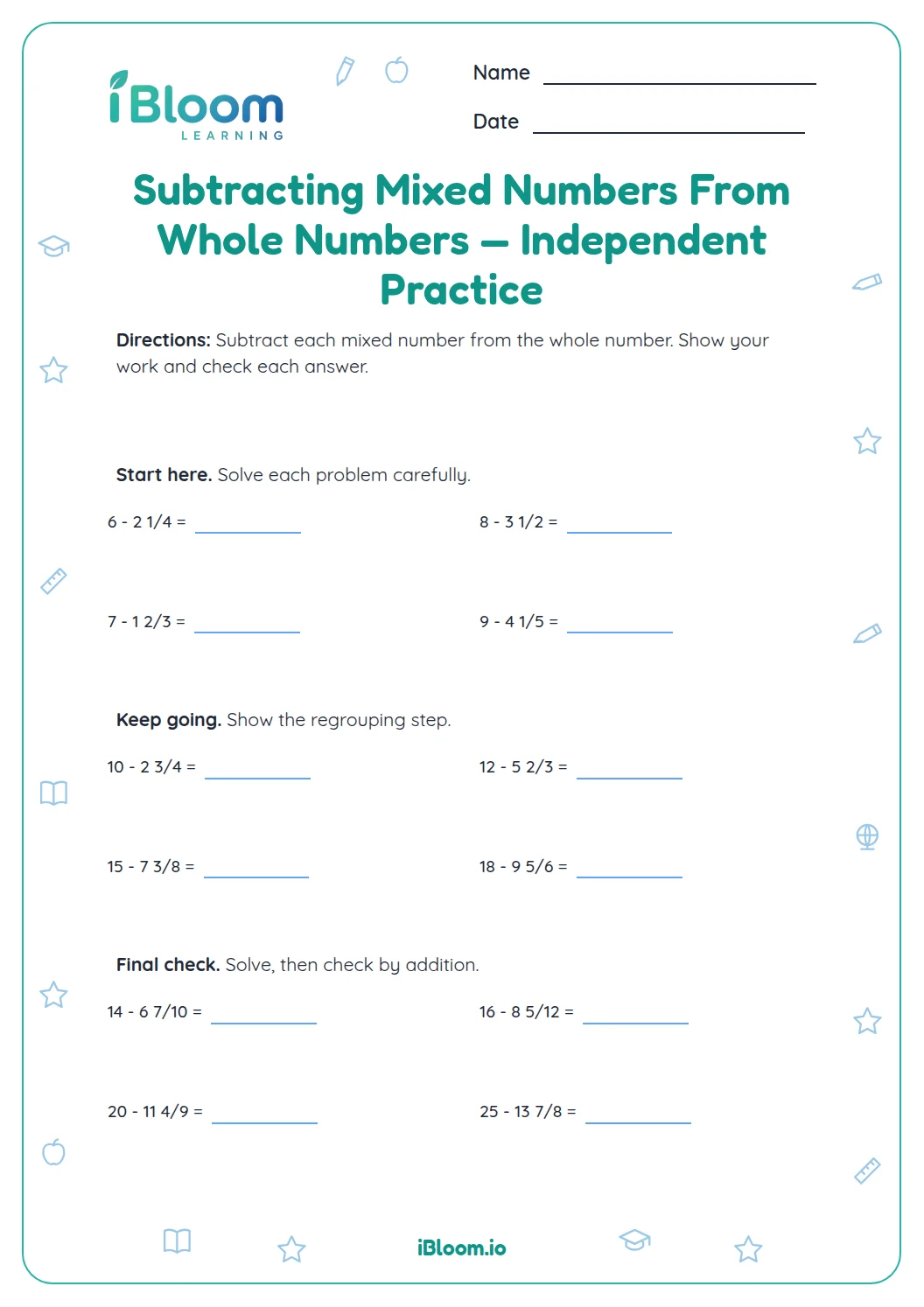
About this worksheet
This free printable worksheet asks children to reason about taking a fraction away from a whole number, such as 2 − 3/4. Instead of eight plain sums, it has missing numbers to find (2 − ___ = 1 1/4), one comparison, two classmates' mistakes to correct and two short pie problems. It practices Common Core 4.NF.B.3 and suits confident Grade 3 students who already know that 1 = 4/4. All fractions are thirds, fourths, sixths or eighths, and a separate answer key is included.
Aligned to 4.NF.B.3.a and 4.NF.B.3.c
How do you take a fraction away from a whole number?
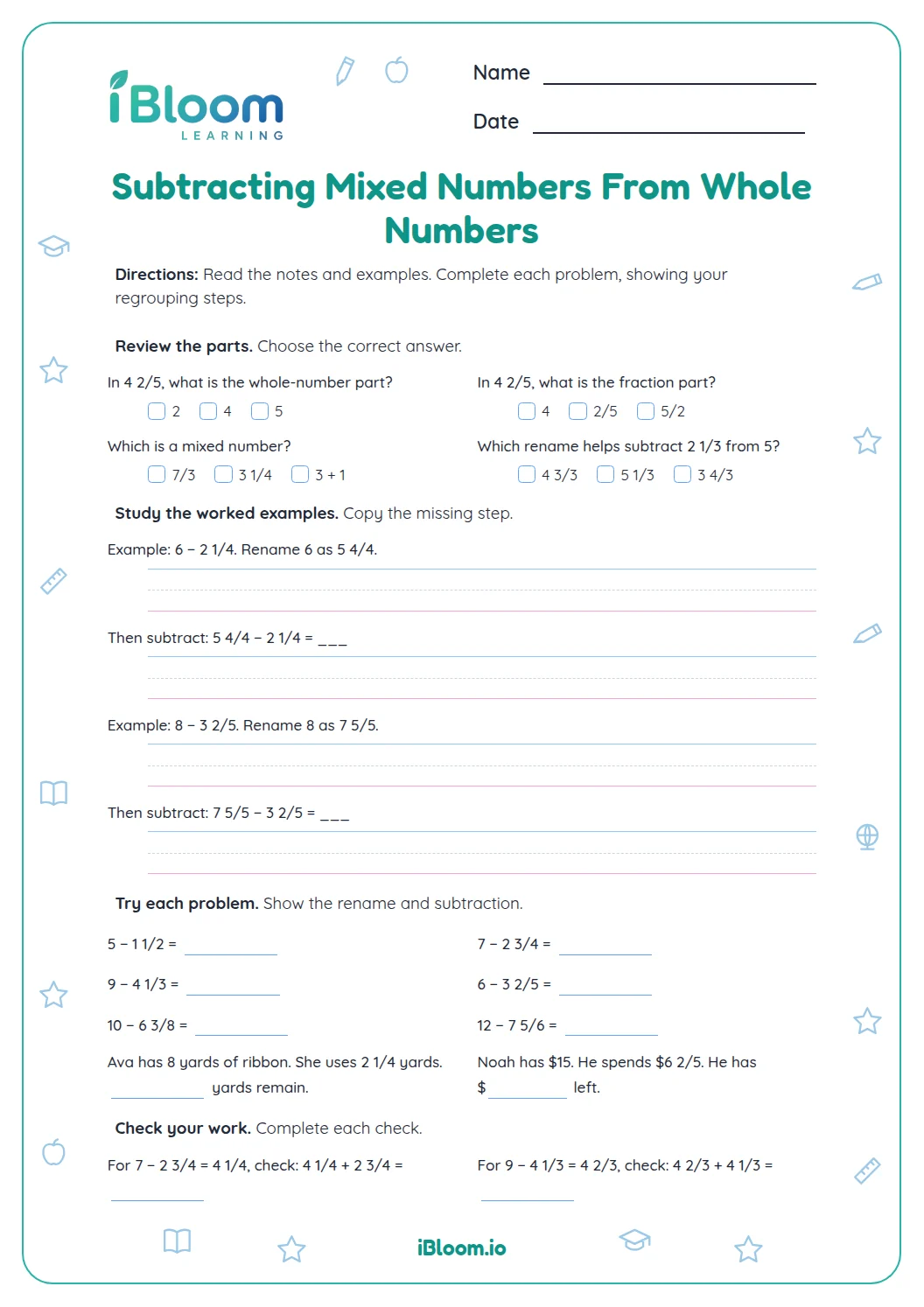
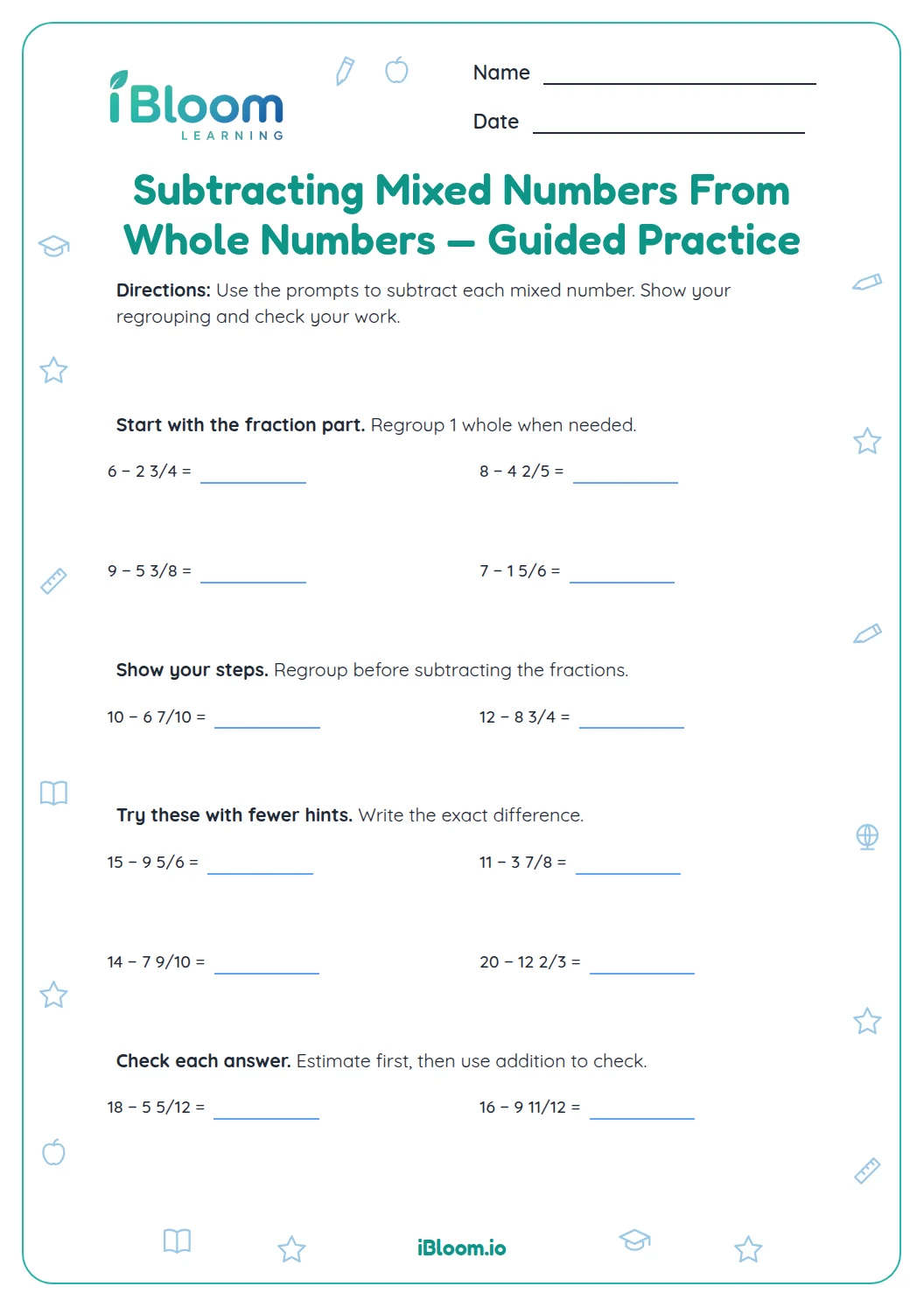
A whole number has no pieces to take away yet, so the first job is to cut one whole into pieces. The fraction tells you the size: for 3/4, cut one whole into fourths. That whole becomes 4/4.
Now subtract in the pieces and keep the other wholes as they are. In question 2 of the sheet, 2 − ___ = 1 1/4, children can reason backward: 2 is 1 and 4/4, and 1 1/4 is 1 and 1/4, so 3/4 is missing.
- 12 − ___ = 1 1/4
- 22 = 1 + 4/4
- 31 1/4 = 1 + 1/4
- 44/4 − 1/4 = 3/4 is missing
- 5Check: 2 − 3/4 = 1 1/4
Why is this a reasoning challenge and not plain practice?
Every question asks children to think about the size of the answer, not only to follow steps. Question 3 hides the whole number (___ − 1/3 = 3 2/3), so children have to add back to find 4. Question 4 asks whether 2 − 1/4 or 2 − 3/4 is bigger. Taking away less leaves more, so the first is greater, and no subtraction is needed.
Part B shows two answers from other children. Mia wrote 1 − 2/3 = 2/3, and Leo wrote 2 − 3/8 = 1 3/8. Spotting what went wrong builds the habit of checking whether an answer makes sense.
What is on this worksheet?
Eight questions on one page, in three parts that grow harder. The whole numbers go from 1 to 4, and every fraction is a third, fourth, sixth or eighth, the same denominators Grade 3 uses.
- Part A, Find and compare: three missing-number sentences and one comparison with >, < or =
- Part B, Find the error: two wrong answers to correct by coloring the right choice
- Part C, Word problems: two pie stories, one of them worked backward, with space to write a number sentence
- Answer key on a separate page
How to use this worksheet at home or in class
- 1Warm up with a paper strip: call it 1 whole, fold it into fourths and say “1 = 4/4.” Tear off 3/4 and ask what is left.
- 2Do question 1 together. Ask: “How many eighths make 1? If 3/8 is left, how many eighths were taken?”
- 3Let your child finish Part A alone. For question 4, ask them to explain the answer before they work anything out.
- 4In Part B, have your child say what Mia and Leo did wrong, not only color the right answer.
- 5For the pie problems, ask for a number sentence first, like 1 − ___ = 1/6 for Jo's pie, then a quick sketch to check it.
- 6Mark the sheet with the answer key and redo any missed question with the paper strip.
Common mistakes and quick fixes
The mistake
Using only the top numbers: writing 3 − 1/4 = 2/4 because 3 − 1 = 2, or copying the fraction, as in Mia's 1 − 2/3 = 2/3.
The fix
Rename the whole first. Write 1 = 3/3 above the problem, then subtract the pieces: 3/3 − 2/3 = 1/3.
The mistake
Forgetting the other wholes: answering 2 − 3/8 with 5/8 instead of 1 5/8.
The fix
Only one whole is cut into pieces. Draw two circles, cut just one into eighths, cross out 3 pieces, then count the whole circle that is left.
The mistake
Keeping the whole number the same: writing 2 − 3/8 = 2 5/8.
The fix
Ask whether the answer should be more or less than 2. Taking anything away from 2 must leave less than 2, so the whole number has to drop to 1.
Common Core alignment
Most US states use the Common Core standards or a close state version. This sheet practices the fraction subtraction standards below.
Subtract fractions as taking away parts of the same whole.
On this sheet: Every question takes fraction parts away from wholes cut into equal pieces.
Show the official wordingHide the official wording
Understand addition and subtraction of fractions as joining and separating parts referring to the same whole.
Add and subtract mixed numbers with like denominators.
On this sheet: Most answers are mixed numbers, and the missing-number questions use addition to check subtraction.
Show the official wordingHide the official wording
Add and subtract mixed numbers with like denominators, e.g., by replacing each mixed number with an equivalent fraction, and/or by using properties of operations and the relationship between addition and subtraction.
What to practice next
Make more practice
Further reading
Questions parents and teachers ask
What should my child know before this worksheet?
Your child should know that a whole number can be written as a fraction, such as 1 = 4/4 or 2 = 6/3 (3.NF.A.3.c). With that idea, taking 3/4 away from 2 becomes taking 3 fourths away from 8 fourths. The sheet then practices subtracting fractions and mixed numbers (4.NF.B.3).
What is the answer to 2 − 3/8?
The answer is 1 5/8. Keep one whole and cut the other into eighths, so 2 becomes 1 and 8/8. Take away 3/8 to leave 5/8, plus the whole you kept. Question 6 on the sheet shows Leo's wrong answer, 1 3/8, for children to correct.
How do children solve a sentence like ___ − 1/3 = 3 2/3?
They undo the subtraction by adding. If taking 1/3 away left 3 2/3, then the starting number is 3 2/3 + 1/3. Two thirds and one third make 3/3, which is one more whole, so the missing number in question 3 is 4.
Can my child answer question 4 without subtracting?
Yes, and that is the point of the question. Both sides start at 2. One side takes away 1/4 and the other takes away 3/4. Taking away less leaves more, so 2 − 1/4 is greater. Children can check by working out 1 3/4 and 1 1/4.
What should a number sentence look like for the word problems?
Start with the whole pie and subtract the part that was eaten. For Kim's pie it is 1 − 3/8 = 5/8. Jo's problem works backward: 1 − ___ = 1/6, so 5/6 was eaten. Writing the sentence before solving shows children which number is missing.
Is there an answer key for this worksheet?
Yes. A separate answer key page shows the missing numbers, the comparison sign, the colored choices for Part B and both word problem answers. Print the worksheet on its own, keep the key for checking, or download both pages as a free PDF from this page.