




About this worksheet
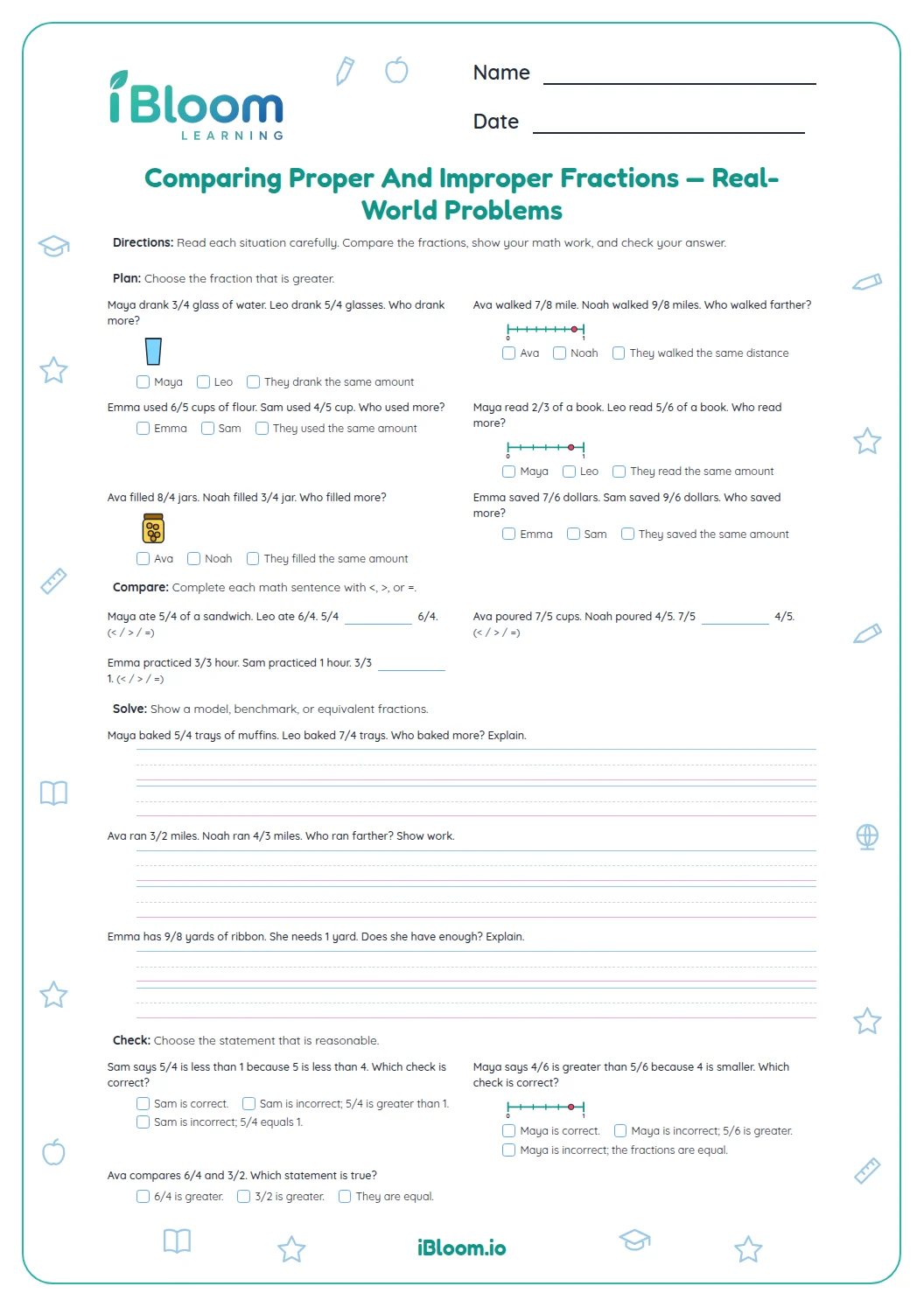
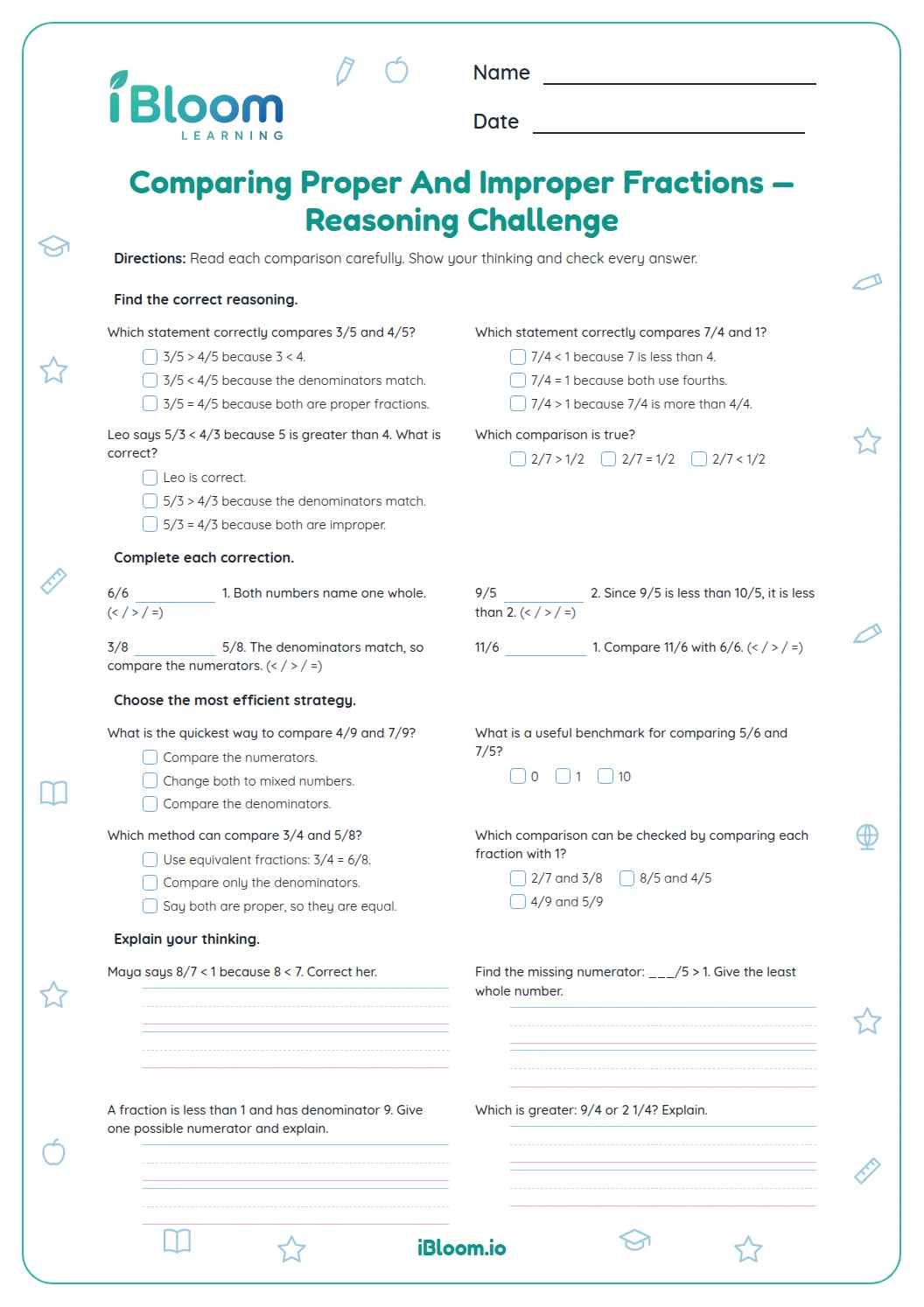
This Grade 3 printable introduces proper and improper fractions with shaded bars, then gives fraction comparisons and a reasoning question. Children identify fractions that are less than or greater than one whole and compare familiar fractions using equal parts and the benchmark of one. The sheet practices comparing fractions and recording the result with >, <, or =, including CCSS 4.NF.A.2. A separate key is provided.
Aligned to 4.NF.A.2
How do fraction bars show amounts over one?
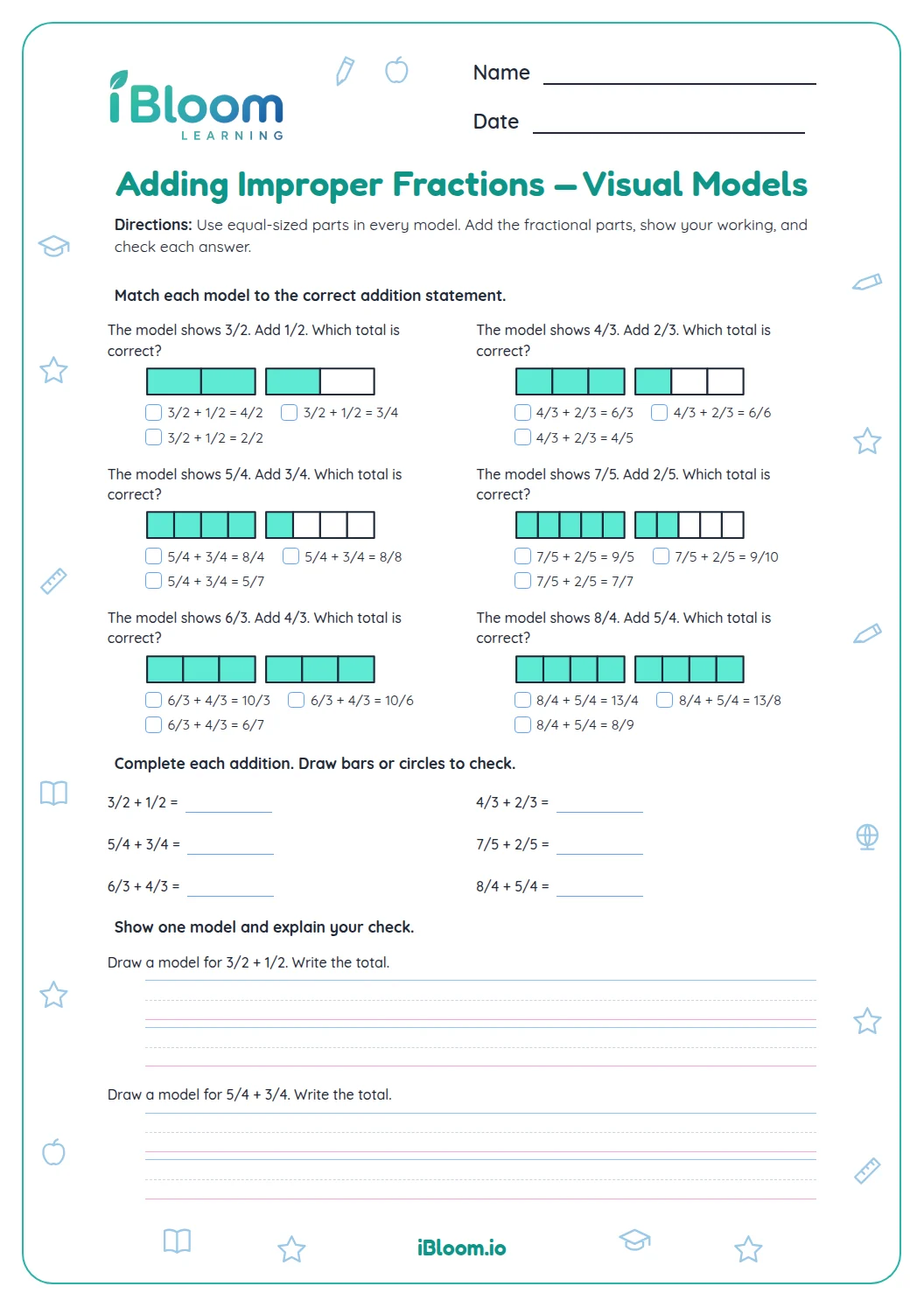
A proper fraction is less than one whole. An improper fraction is equal to or greater than one whole. In a bar split into four equal parts, 6/4 means one full bar and two fourths.
- 1The model shows one whole bar and two of four parts.
- 2There are six fourths altogether: 6/4.
How can you compare two fractions?
When denominators match, compare the number of parts. When they do not match, reason about the size of each part and use familiar benchmarks such as 1/2 or 1. Always compare amounts that refer to the same size whole.
What does this worksheet include?
Four model questions ask children to name the shaded amount. Nine questions compare fractions with >, <, or =, and one uses an equivalent fraction to explain why 3/8 is less than 1/2.
How to use this worksheet
- 1Read the denominator as the number of equal parts in one whole.
- 2Count the numerator to find how many parts are represented.
- 3For an improper fraction, group a full denominator’s worth of parts as one whole.
- 4Compare fractions with common denominators by comparing numerators.
- 5Use familiar benchmarks to check other comparisons.
Common mistakes and quick fixes
The mistake
Calling 5/3 a proper fraction because both numbers are small.
The fix
Check whether the numerator is larger than the denominator; 5 thirds contain one whole and 2 thirds.
The mistake
Assuming a larger denominator means a larger fraction.
The fix
For equal numerators, more pieces mean each piece is smaller.
The mistake
Comparing fractions that refer to differently sized wholes.
The fix
Confirm both fractions describe the same-size whole.
Common Core alignment
This worksheet gives focused practice with the standard below.
Compare fraction sizes and record each comparison with a symbol.
On this sheet: Children compare fractions using equal-part reasoning and familiar benchmarks, with bars to introduce the wholes represented.
Show the official wordingHide the official wording
Compare two fractions with different numerators and different denominators, e.g., by creating common denominators or numerators, or by comparing to a benchmark fraction such as 1/2. Recognize that comparisons are valid only when the two fractions refer to the same whole. Record the results of comparisons with symbols >, =, or <, and justify the conclusions, e.g., by using a visual fraction model.
What to practice next
Make more practice
Further reading
Questions parents and teachers ask
What is a proper fraction?
The sheet practices identifying shaded fractions, including amounts greater than one whole, and comparing proper and improper fractions. Children count equal parts and use the whole-number benchmark to decide which amount is greater. A final item asks them to choose a comparison explanation.
What is an improper fraction?
An improper fraction has a numerator that is at least as large as its denominator. It represents one whole or more. For instance, 5/3 is one whole and 2/3 because 3 thirds make one whole. The examples on the page make this idea concrete and easy to review together.
How do the models help?
Each bar is split into equal parts. Children count the total shaded parts and see how many complete wholes those parts form. The models make it easier to connect a numerator and denominator to the amount represented. The examples on the page make this idea concrete and easy to review together.
How should children compare fractions with different denominators?
They can reason about the size of each part and use familiar benchmarks such as one half or one whole. This worksheet encourages a size-based explanation rather than treating the numerator or denominator alone as the answer. The examples on the page make this idea concrete and easy to review together.
What comparison symbols are used?
Nine comparison items ask children to write >, <, or = between two fractions. A final item uses eighths to compare 3/8 with 1/2: children complete 1/2 = 4/8, making the equal-size parts easier to compare and explaining why three eighths is less.
Does the answer key come with the worksheet?
Yes. A separate key shows the fraction represented by each bar and the comparison symbol for each pair. Children can check the models first, then use the key after completing the page. The examples on the page make this idea concrete and easy to review together.