







About this worksheet
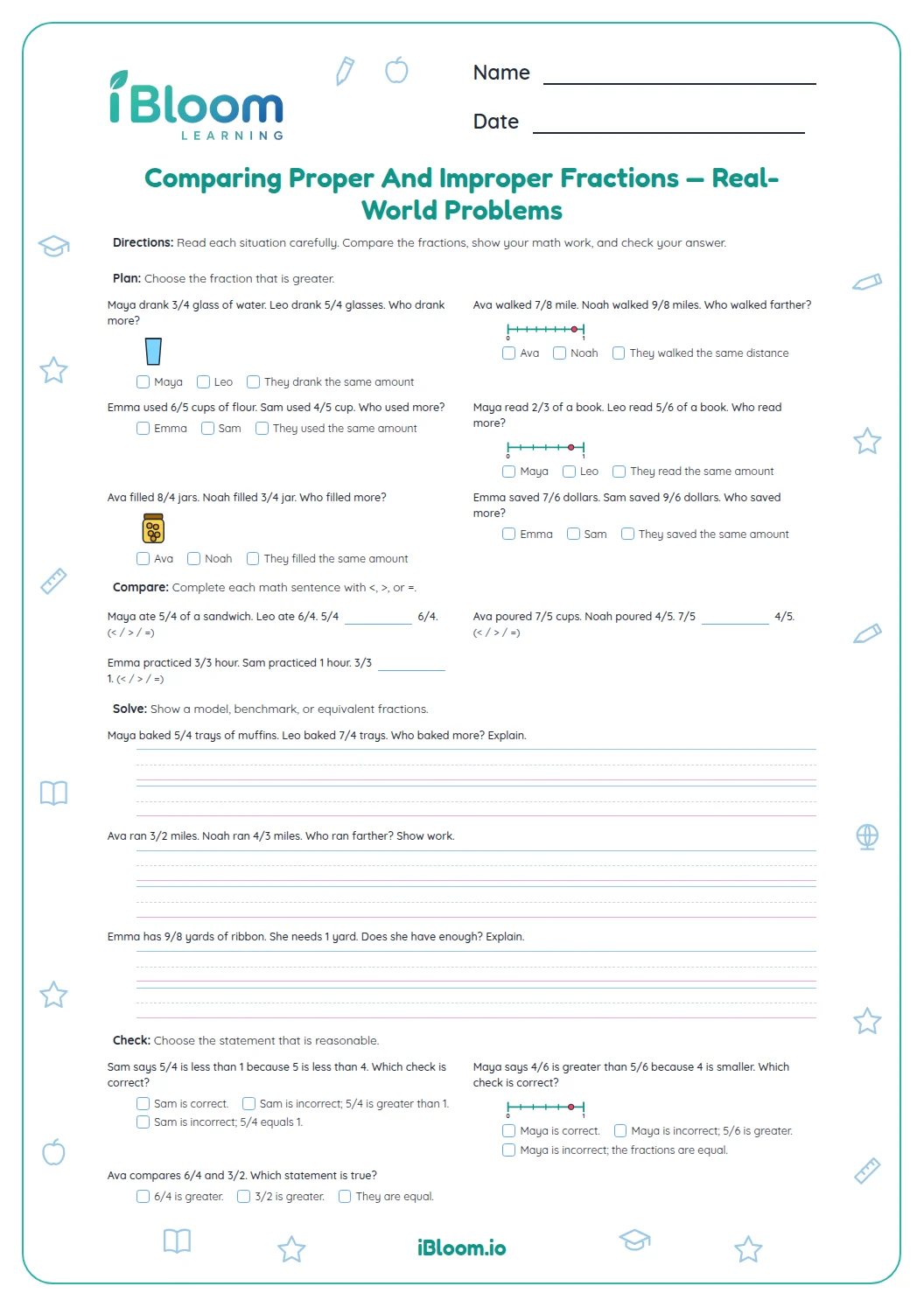
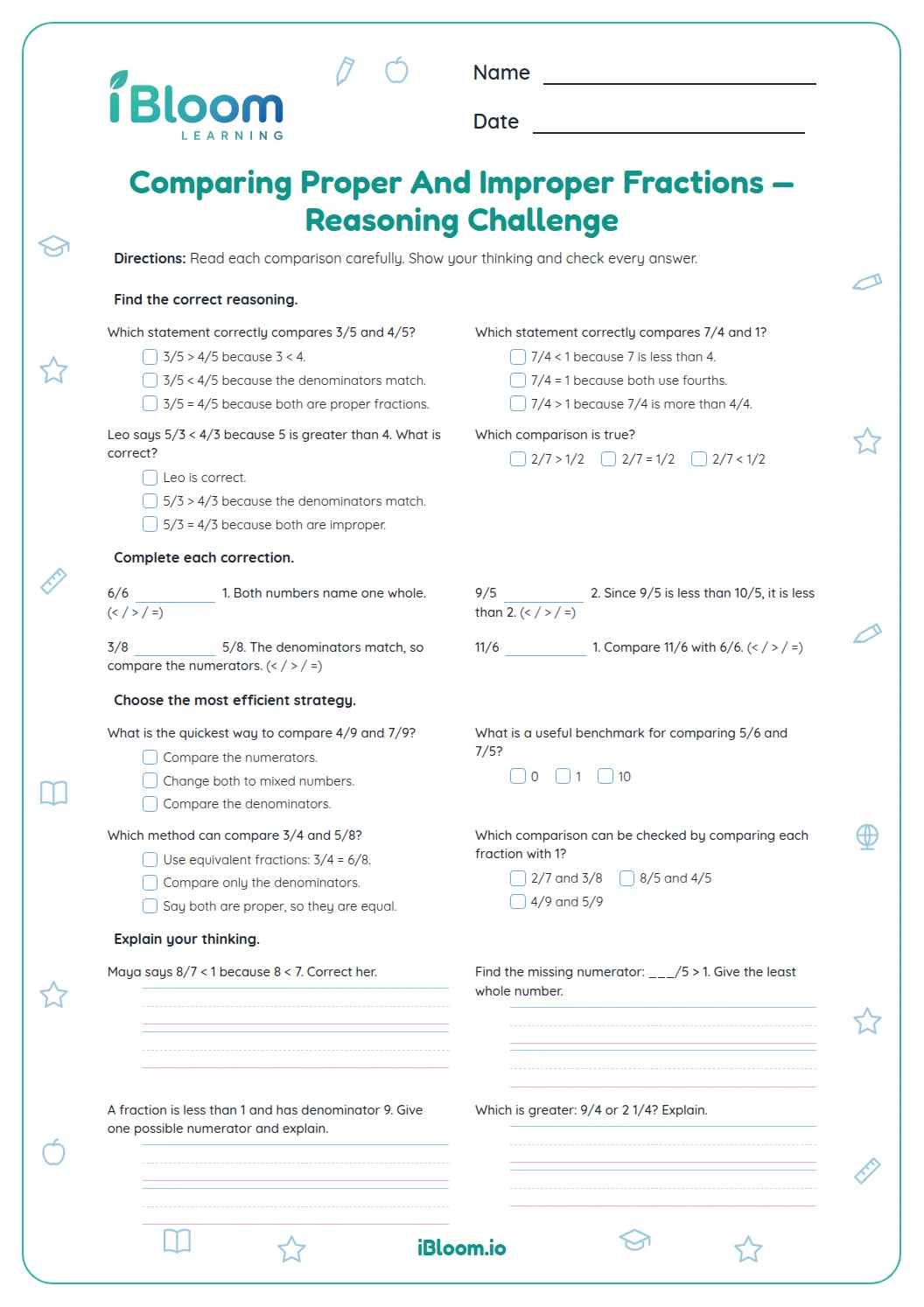
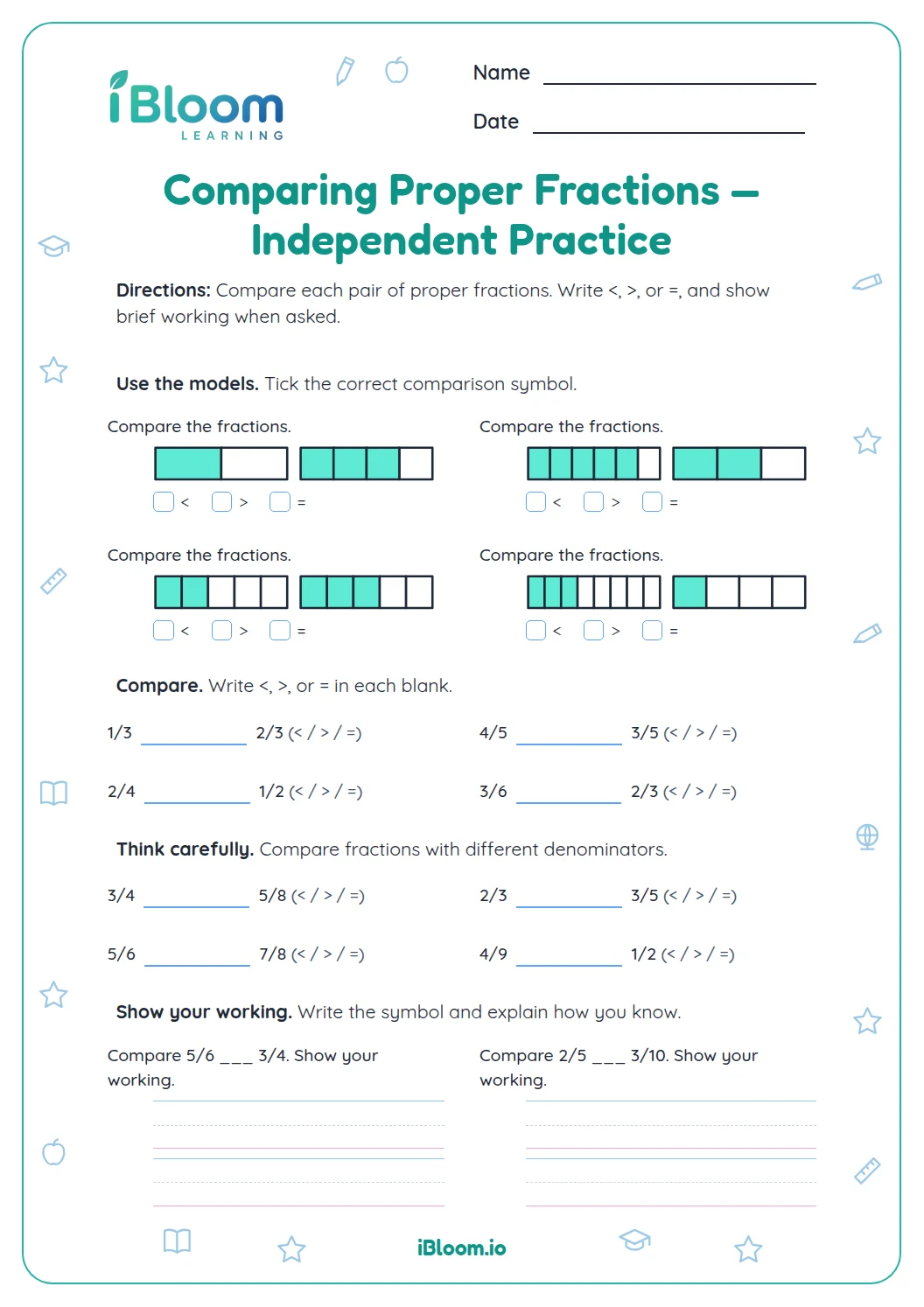
This printable guided-practice sheet is labeled for Grade 3 and builds comparison skills with familiar fractions, including values below, equal to, and above one. Learners complete 16 comparisons using >, <, or =, then check a separate answer key. The questions use denominators 2, 3, 4, 6, and 8 and include equivalent forms and mixed numbers. The comparison work aligns with CCSS 4.NF.A.2.
Aligned to 4.NF.A.2
How do you compare fractions less than one?
If two fractions have the same denominator, compare the numerators: more equal-sized pieces mean a greater amount. When the denominators differ, use a familiar benchmark or picture each fraction as equal parts of the same whole.
- 11/4 ___ 3/4
- 2Both amounts are fourths.
- 3One fourth is less than three fourths.
- 4Write: 1/4 < 3/4
How do you spot an improper fraction?
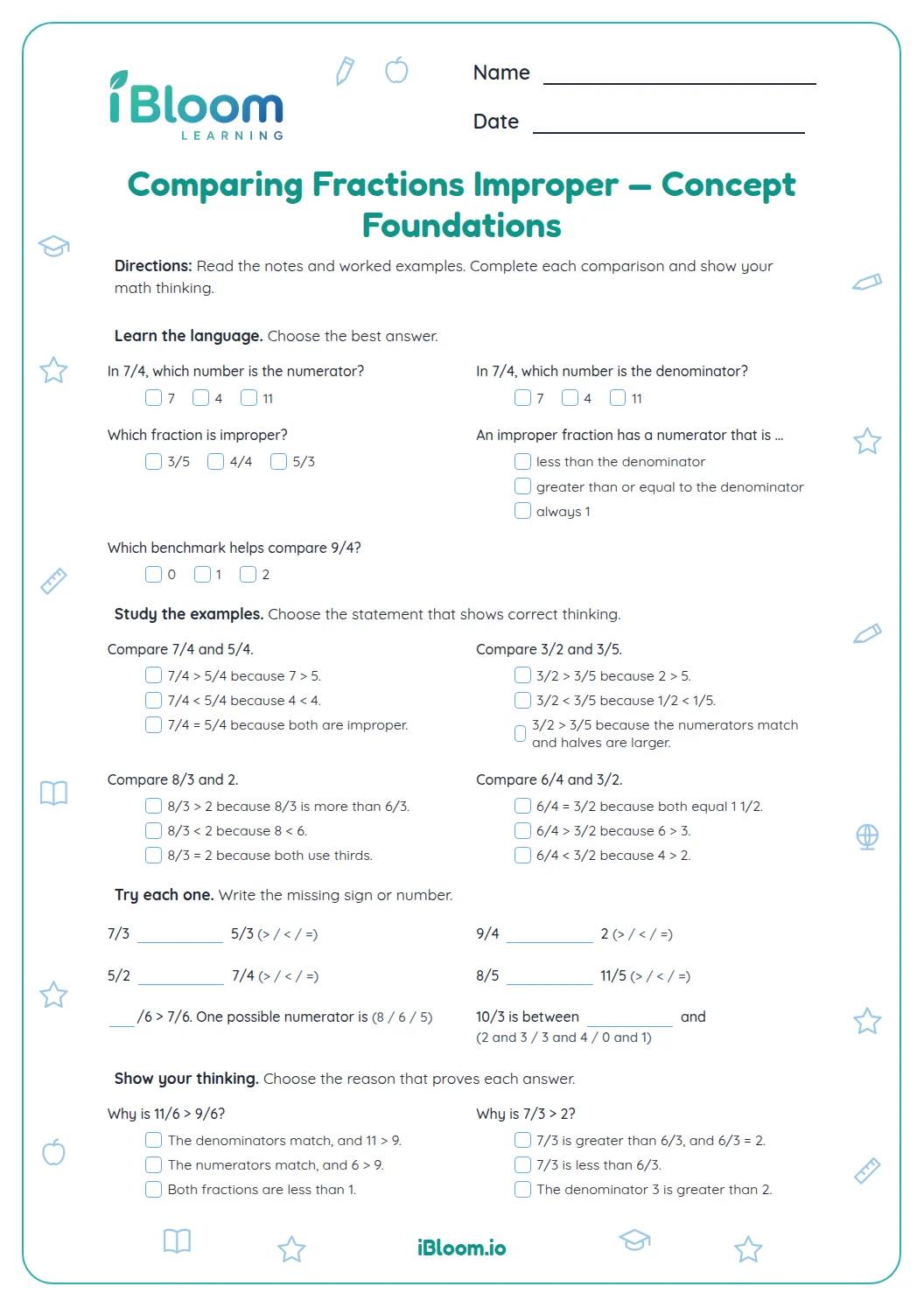
A fraction is equal to one when its numerator matches its denominator. If the numerator is larger, the fraction is greater than one. For example, 5/4 is one whole and one fourth, so it is greater than 1.
How can a benchmark help compare fractions?
A benchmark such as one half or one whole helps compare different fraction values. Count how many equal pieces make one whole, then decide whether the fraction is less than, equal to, or greater than one.
What is included in the guided practice?
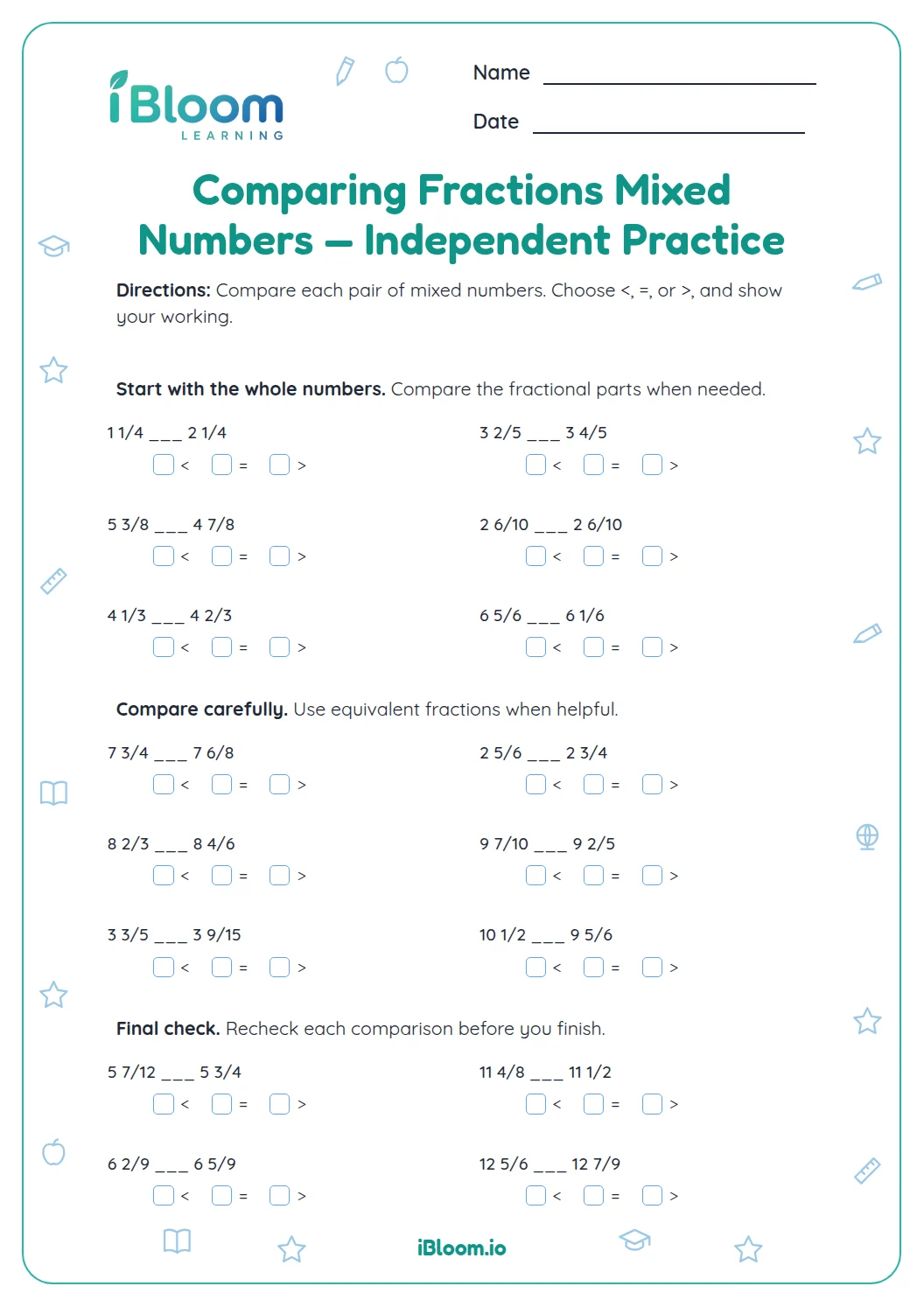
Part A introduces comparisons within one. Part B compares wholes and fractions greater than one, including equivalent forms and mixed numbers. Every question asks for one symbol, and the answer key gives the correct comparison.
How to use this worksheet
- 1Read the denominator to learn the piece size.
- 2Check whether the fraction is below one, equal to one, or above one.
- 3Compare equal-sized pieces or use a benchmark such as 1.
- 4Write one comparison symbol in the blank.
- 5Use the answer key to check the symbol and explain your reasoning.
Common mistakes and quick fixes
The mistake
Thinking a larger denominator always means a larger fraction.
The fix
Compare piece size: when the whole is cut into more pieces, each piece is smaller.
The mistake
Treating every numerator larger than one as greater than one.
The fix
Compare numerator and denominator: 5/8 is still less than one because 5 is less than 8.
The mistake
Comparing two fractions that refer to different whole sizes.
The fix
Make sure both fractions refer to the same size whole before comparing.
Common Core alignment
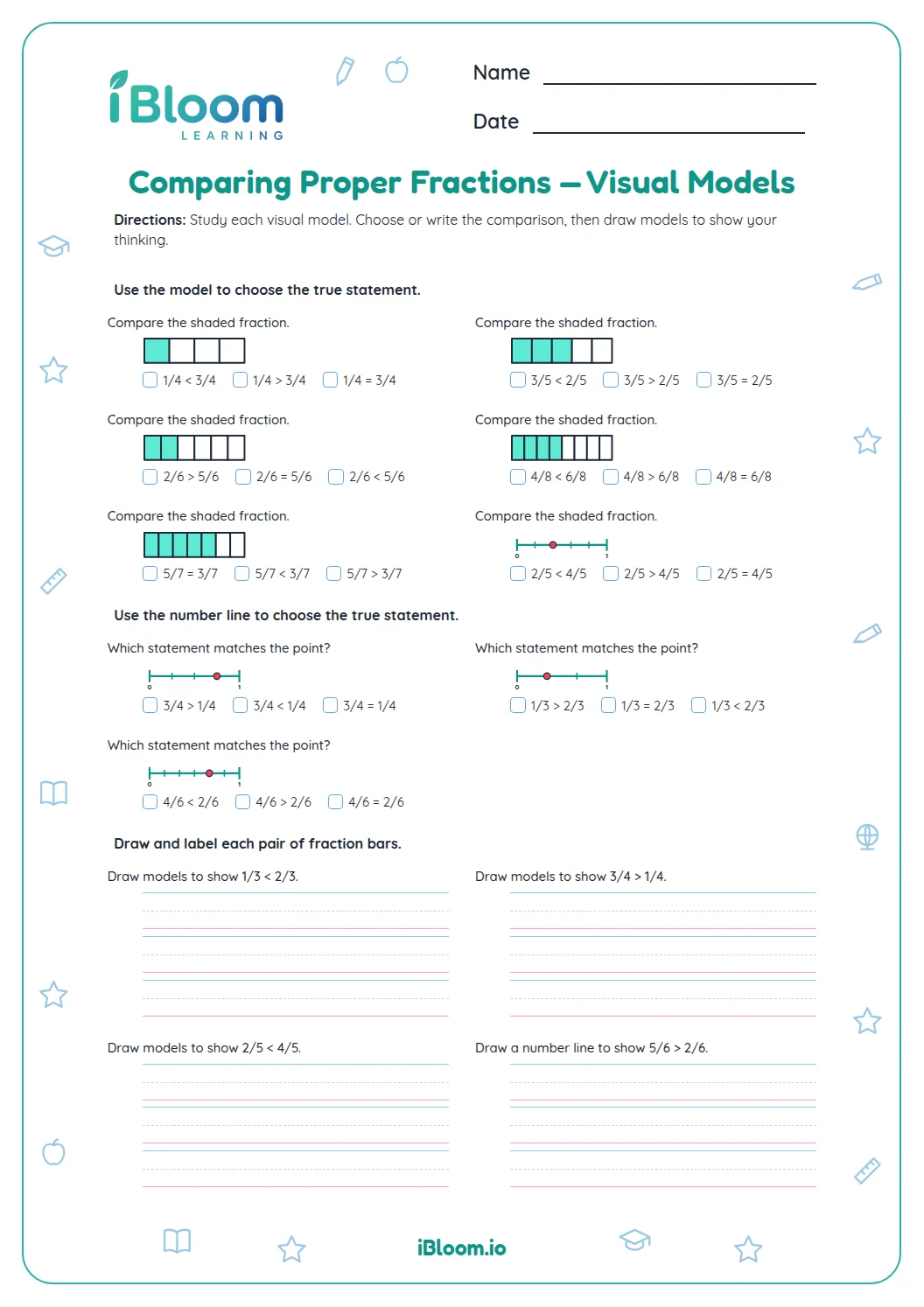
The visual comparisons and symbols connect to fraction comparison work.
Compare fractions using common numerators, denominators, benchmarks, or visual models.
On this sheet: The questions compare proper fractions and fractions equal to or greater than one, recording >, <, or =.
Show the official wordingHide the official wording
Compare two fractions with different numerators and different denominators, e.g., by creating common denominators or numerators, or by comparing to a benchmark fraction such as 1/2. Recognize that comparisons are valid only when the two fractions refer to the same whole. Record the results of comparisons with symbols >, =, or <, and justify the conclusions, e.g., by using a visual fraction model.
What to practice next
Make more practice
Further reading
Questions parents and teachers ask
What is an improper fraction?
An improper fraction has a numerator that is at least as large as its denominator. For instance, 4/4 is one whole and 5/4 is one whole plus one fourth. This sheet includes comparisons below one, at one, and above one.
How many problems are on the worksheet?
There are 16 comparison questions across two worksheet pages. Each asks the learner to write one symbol: greater than, less than, or equal to. A separate answer key gives the correct symbol and supports checking the reasoning. Learners can explain a symbol aloud.
Can a child compare fractions with different denominators?
Yes. The worksheet uses familiar denominators and straightforward values so children can compare the fractions. When denominators differ, use a benchmark such as one half or one whole, or rename fractions with equal-sized parts before deciding which value is greater.
How can a fraction bar model help?
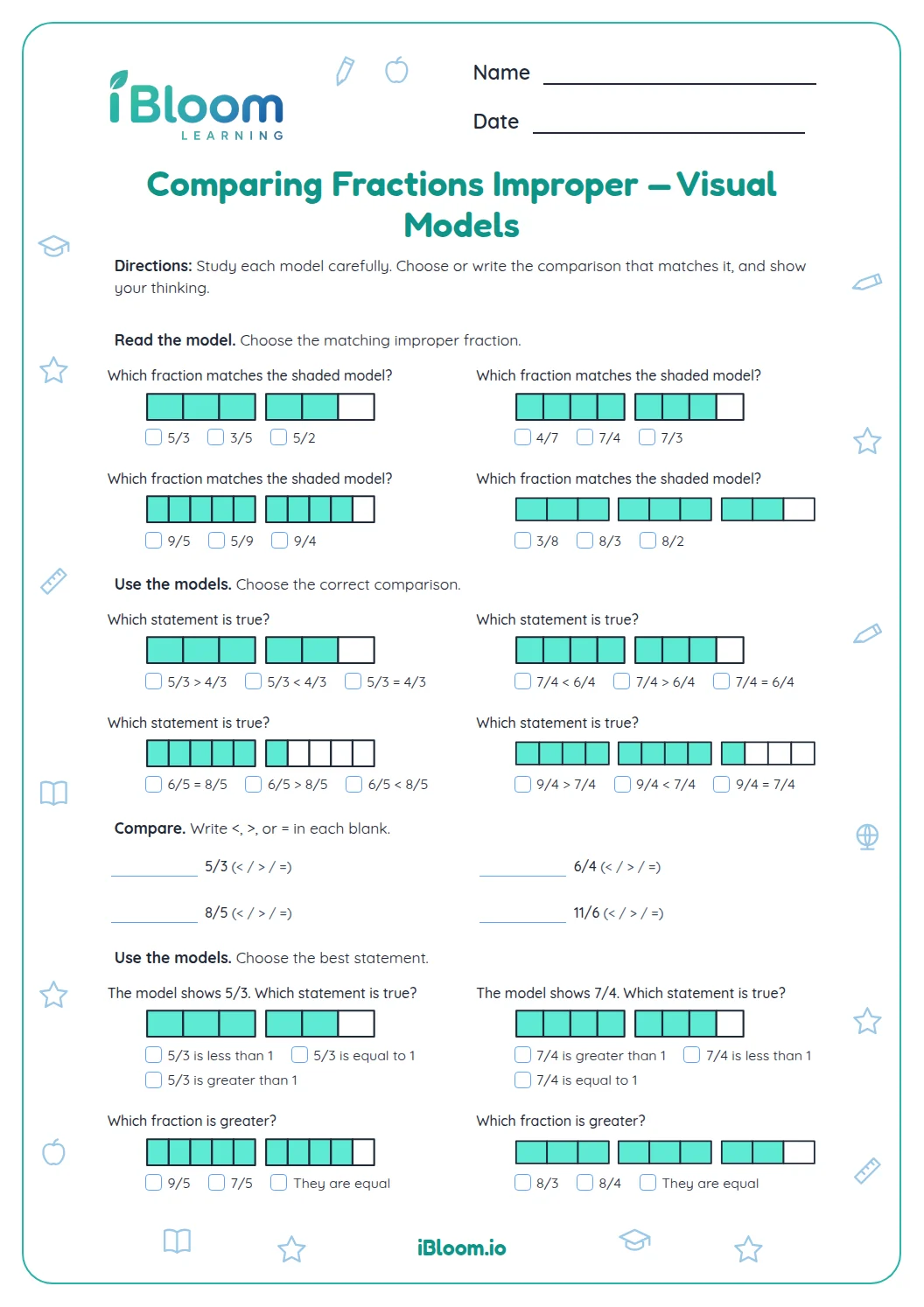
A bar split into equal parts can make the size of a fraction easier to picture. One full bar represents one whole; extra shaded parts show a value above one. The worksheet itself asks learners to compare written fractions, and the written explanation offers models as a way to reason before choosing a symbol.
Why compare a fraction with one whole?
One is a useful benchmark. A numerator smaller than the denominator gives less than one; equal values give one; a larger numerator gives more than one. This makes it easier to compare proper and improper fractions before looking at two values together.
Why does this sheet cite a Grade 4 standard?
The worksheet title names comparing proper and improper fractions, a comparison skill described in CCSS 4.NF.A.2. The practice keeps the fractions familiar and asks for one comparison symbol at a time. The grade label reflects the intended audience, while the alignment names the skill being practiced.