


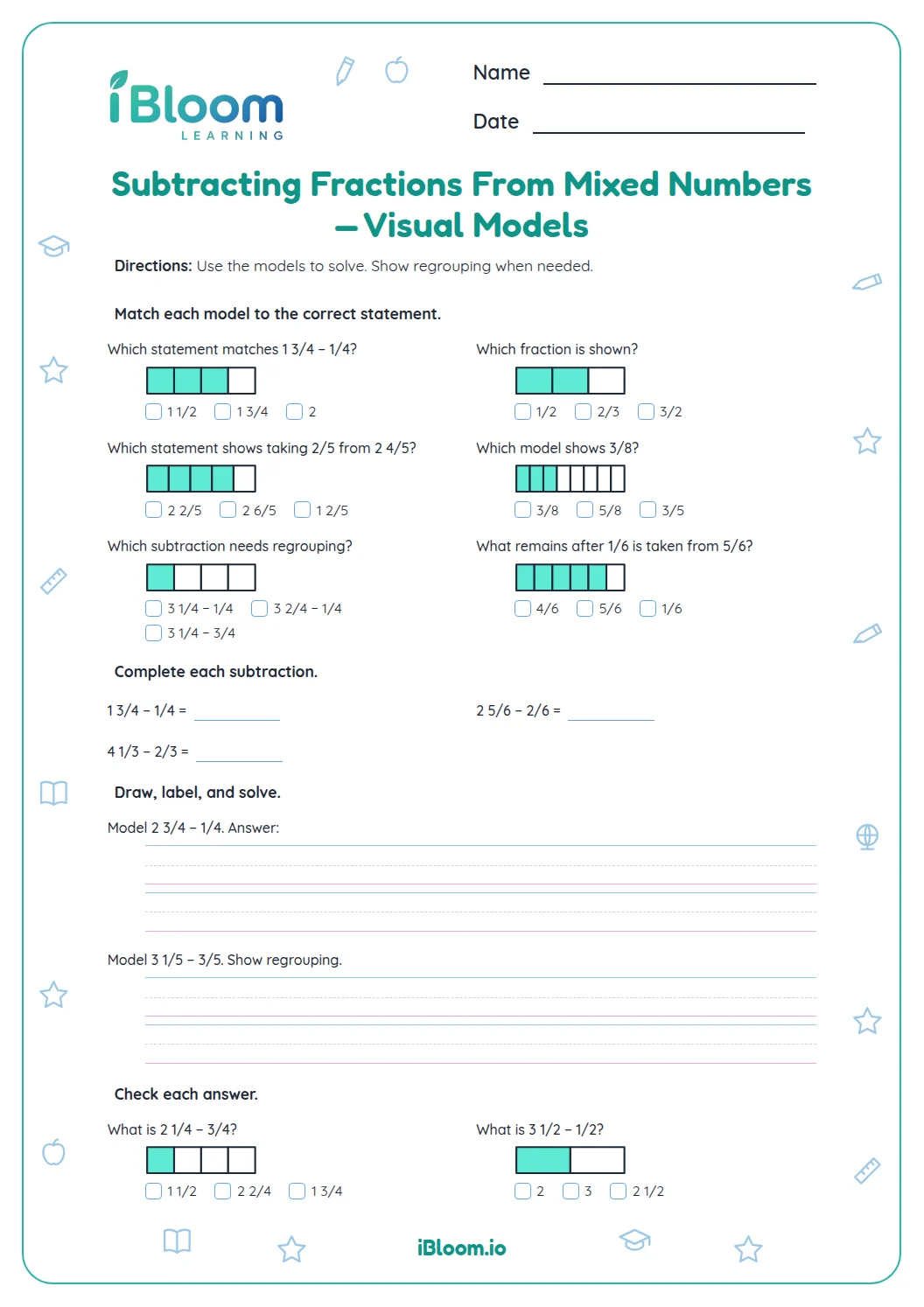
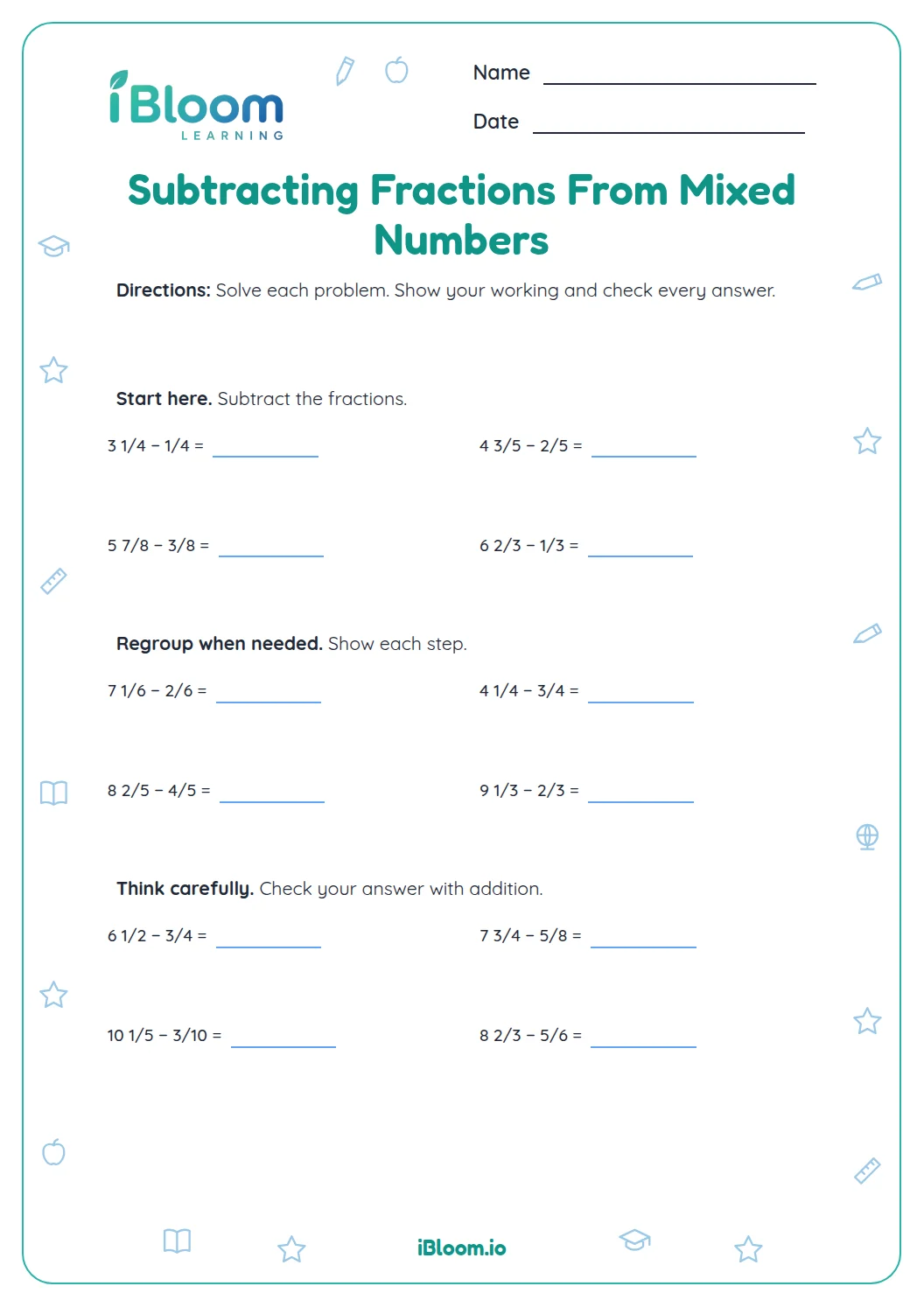
About this worksheet
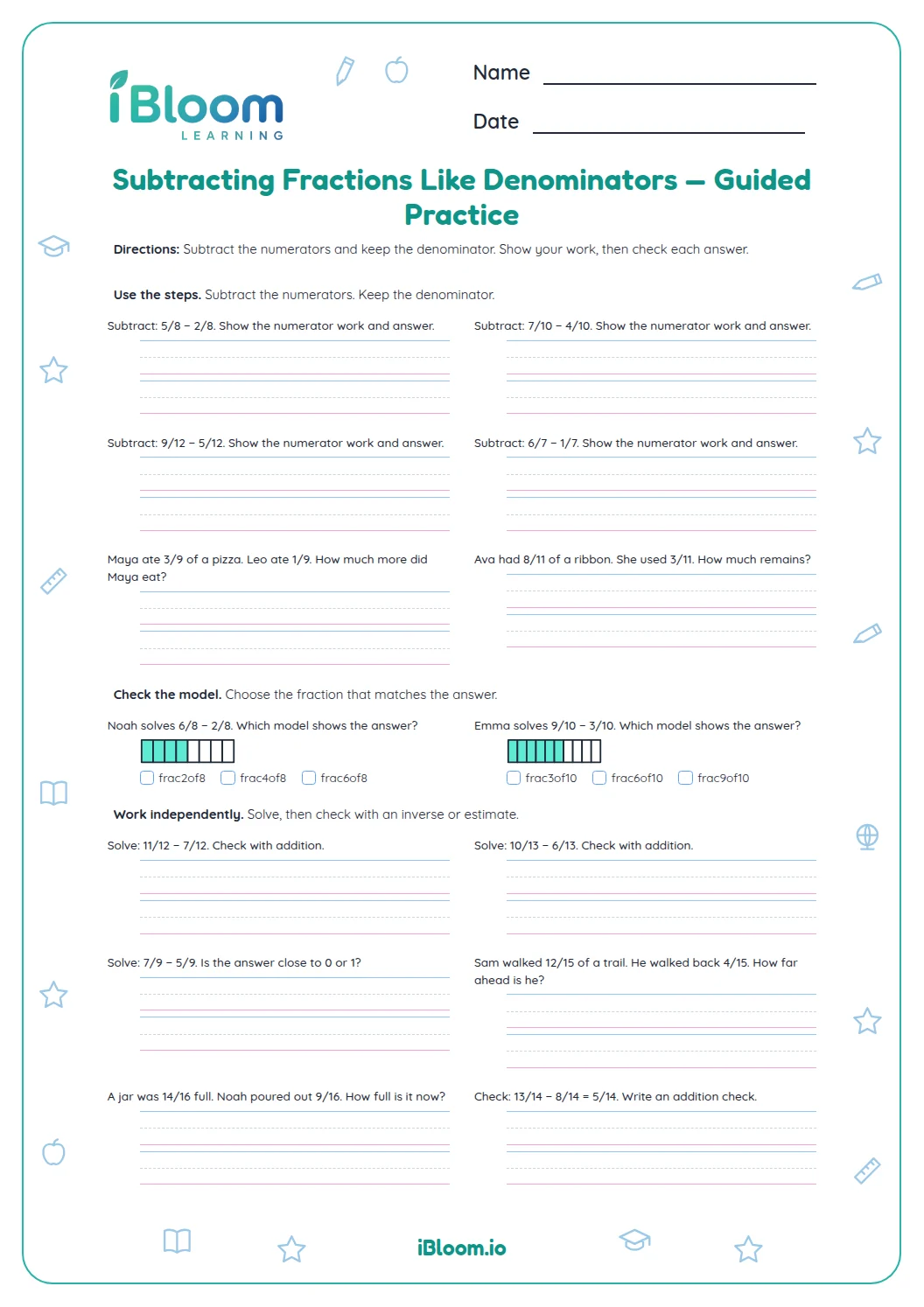
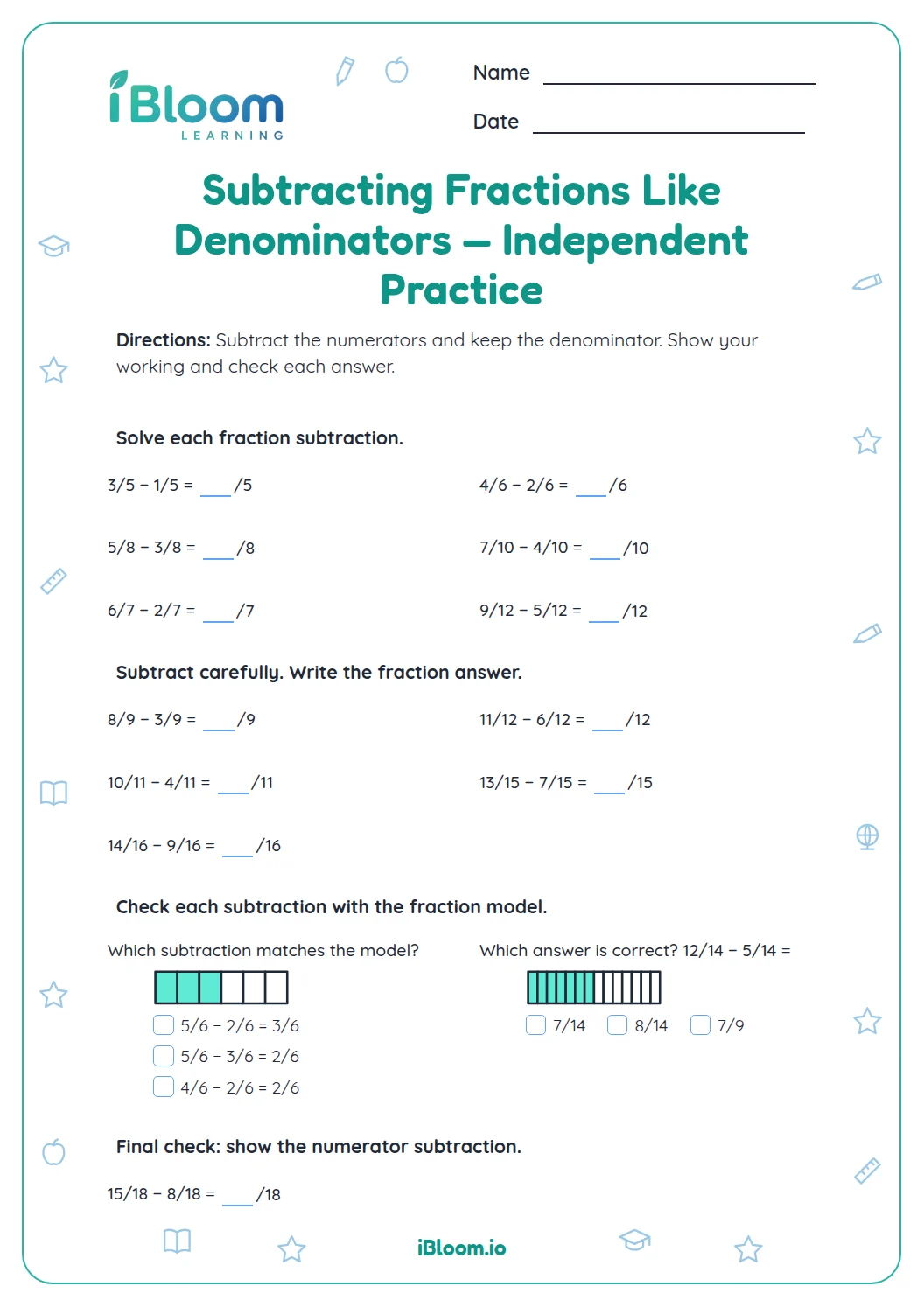
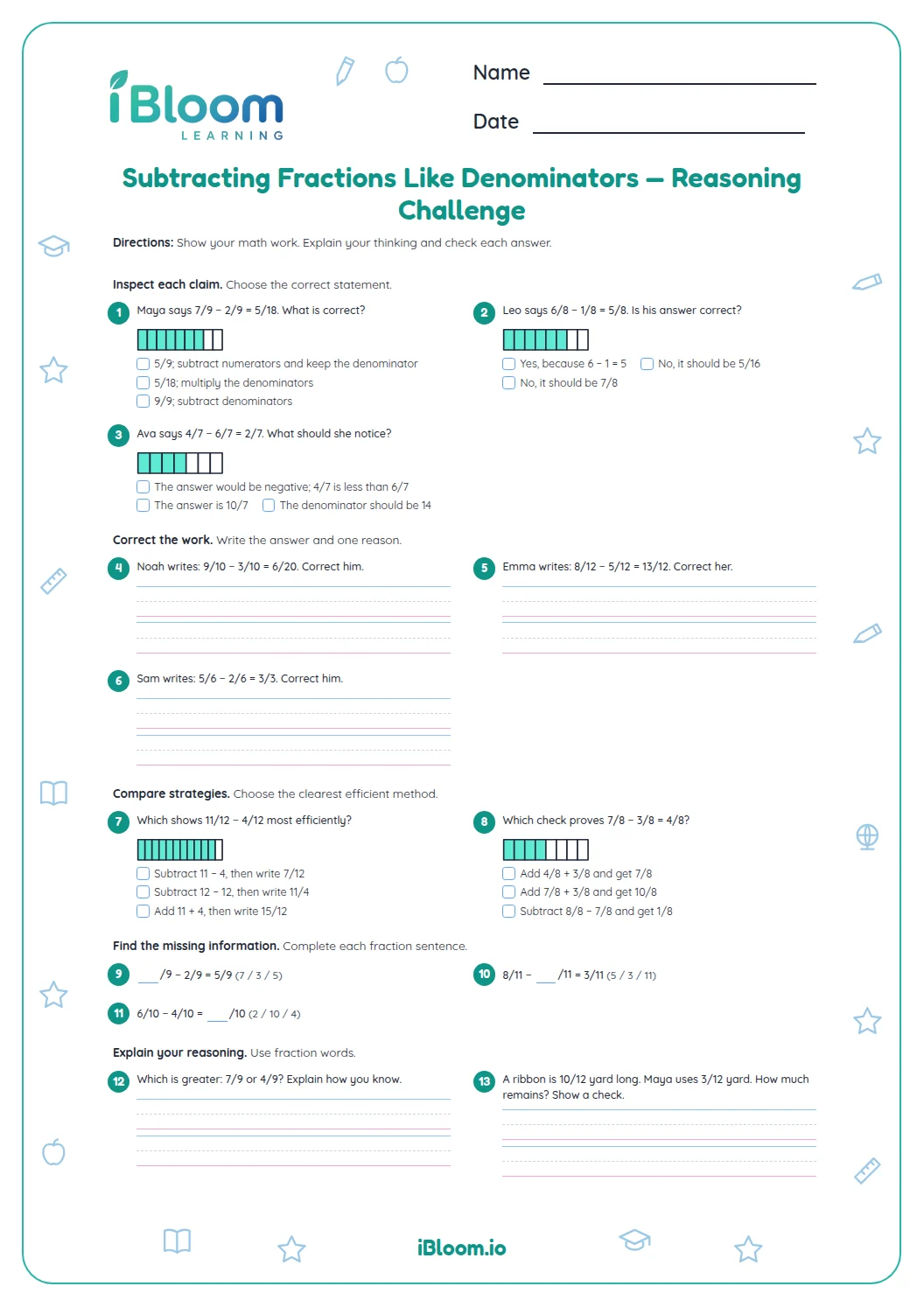
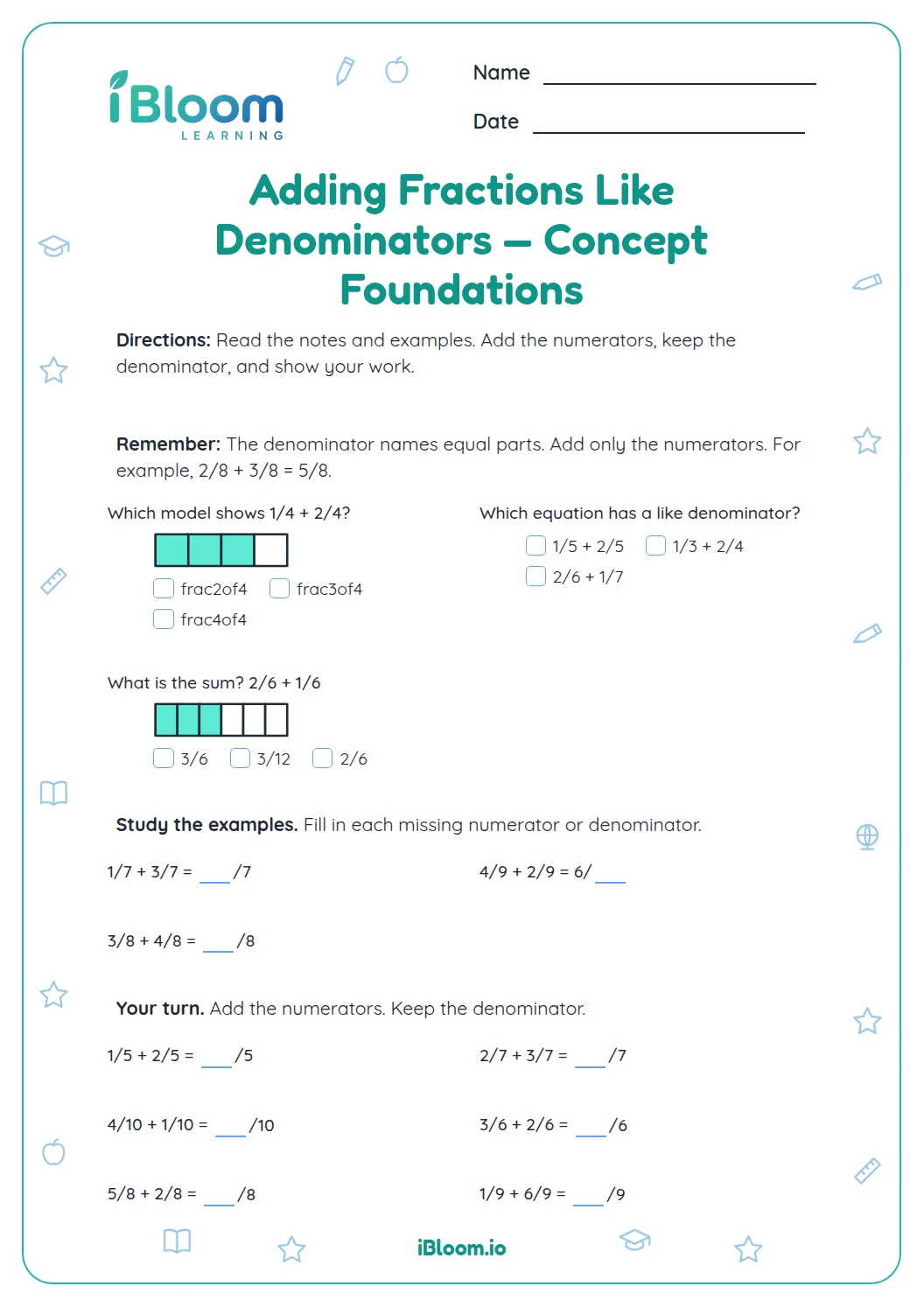
This Grade 3 printable gives focused practice subtracting fractions with like denominators. Four short stories and four number sentences build fluency, followed by six more real-world questions about amounts used or left. Each pair names equal-sized parts of one whole. A separate answer key lists all 14 results.
Aligned to 4.NF.B.3.d
How do you subtract fractions with like denominators?
When denominators match, the fractional pieces have the same size. Subtract the number of pieces and keep the denominator. In question 1, 7/8 − 3/8 = 4/8 yard.
- 17/8 − 3/8
- 27 − 3 = 4
- 34/8 yard remains.
What should a child notice in each story?
In a story, identify the starting amount and the amount used. Subtract the used fraction from the starting fraction; both must refer to the same whole.
How can the answer key help?
The key gives a difference for every question. For stories, check the unit and add the used amount back to see whether you recover the start.
How to work through the sheet
- 1Read the whole story before choosing an operation.
- 2Underline the starting fraction and the fraction taken away.
- 3Subtract the numerators and copy the denominator.
- 4Include the unit named in the story.
- 5Use addition to check: difference plus amount taken away equals the start.
Common mistakes and quick fixes
The mistake
Subtracting the denominators too.
The fix
Keep the denominator because each piece keeps the same size.
The mistake
Subtracting the smaller amount from the larger without reading the story.
The fix
Start with the amount given first, then take away what was used.
The mistake
Leaving out a unit such as yards or liters.
The fix
Add the unit from the question to the answer.
Common Core alignment
This page practices fraction subtraction in equal-sized parts.
Solve story problems that add or subtract fractions with like denominators.
On this sheet: The story questions subtract like-denominator fractions that refer to one whole.
Show the official wordingHide the official wording
Solve word problems involving addition and subtraction of fractions referring to the same whole and having like denominators, e.g., by using visual fraction models and equations to represent the problem.
What to practice next
Make more practice
Further reading
Questions parents and teachers ask
What is a like denominator?
Like denominators are the same bottom number in two fractions. In 7/8 and 3/8, both denominators are 8, so both fractions count eighth-size pieces. The worksheet keeps that piece size the same while children subtract the numerators in stories and number sentences.
How do you subtract fractions with like denominators?
Subtract the numerators and keep the denominator. For example, 7/8 − 3/8 = 4/8. On this sheet, the same step helps find the ribbon left in question 1; adding 3/8 back to 4/8 checks the starting amount and confirms the subtraction for each story.
Should the answer be simplified?
The answer key keeps the denominator used in the question, such as 4/8. An equivalent fraction like 1/2 names the same amount, but this practice focuses on subtracting like denominators. Include the unit when the story asks for yards, liters, or miles.
What should my child look for in a story problem?
Find the amount at the start and the amount used or taken away. Subtract the used fraction from the starting fraction. For example, the book question starts with 8/8 unread and Sam reads 5/8, leaving 3/8 unread. Both fractions name parts of the same whole.
How can we check a subtraction answer?
Add the fraction taken away to the fraction left. In question 1, 4/8 + 3/8 returns to 7/8 yard. If the numerators do not add to the starting numerator, revisit the subtraction; keep the common denominator in the check too.