


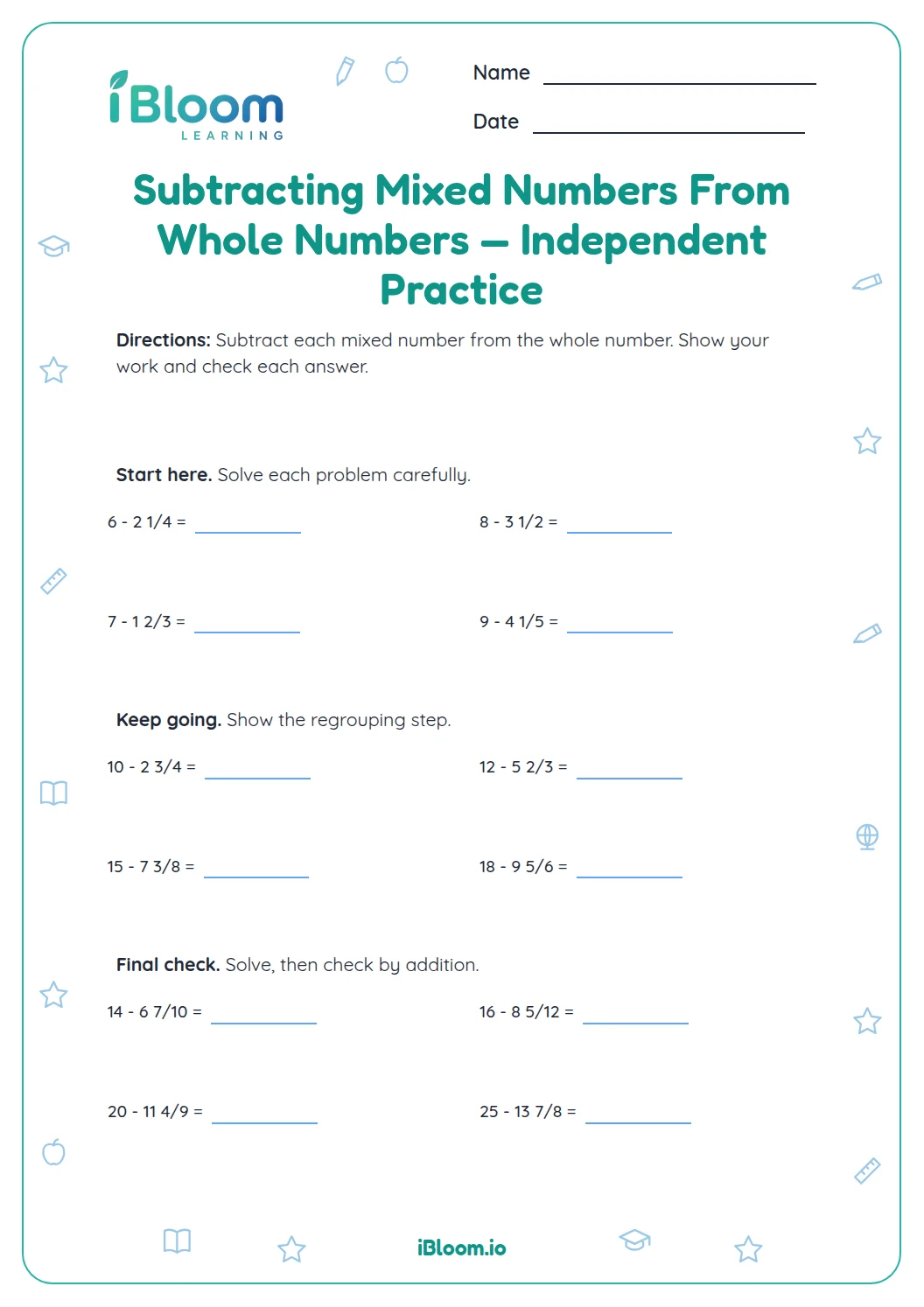
About this worksheet
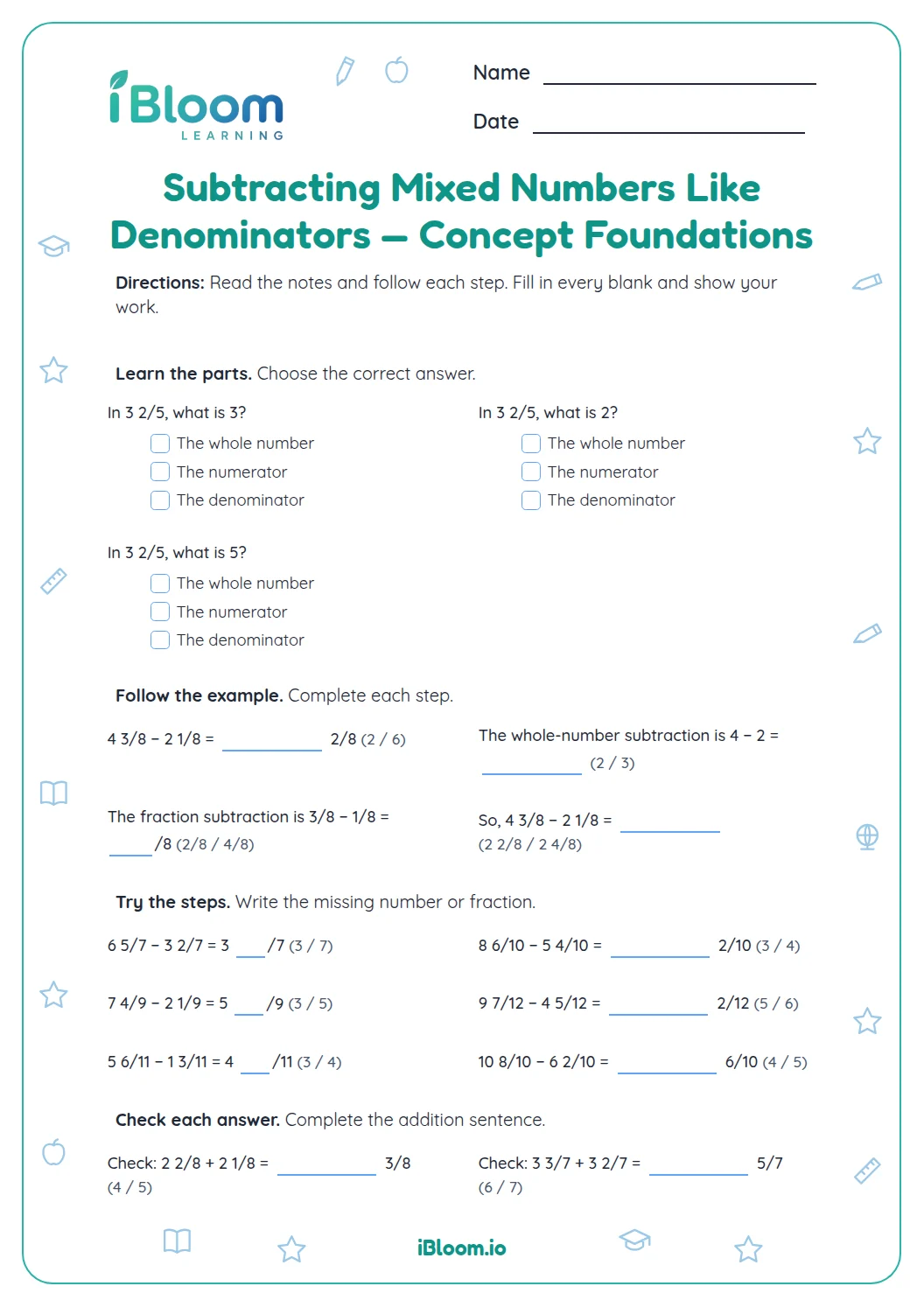
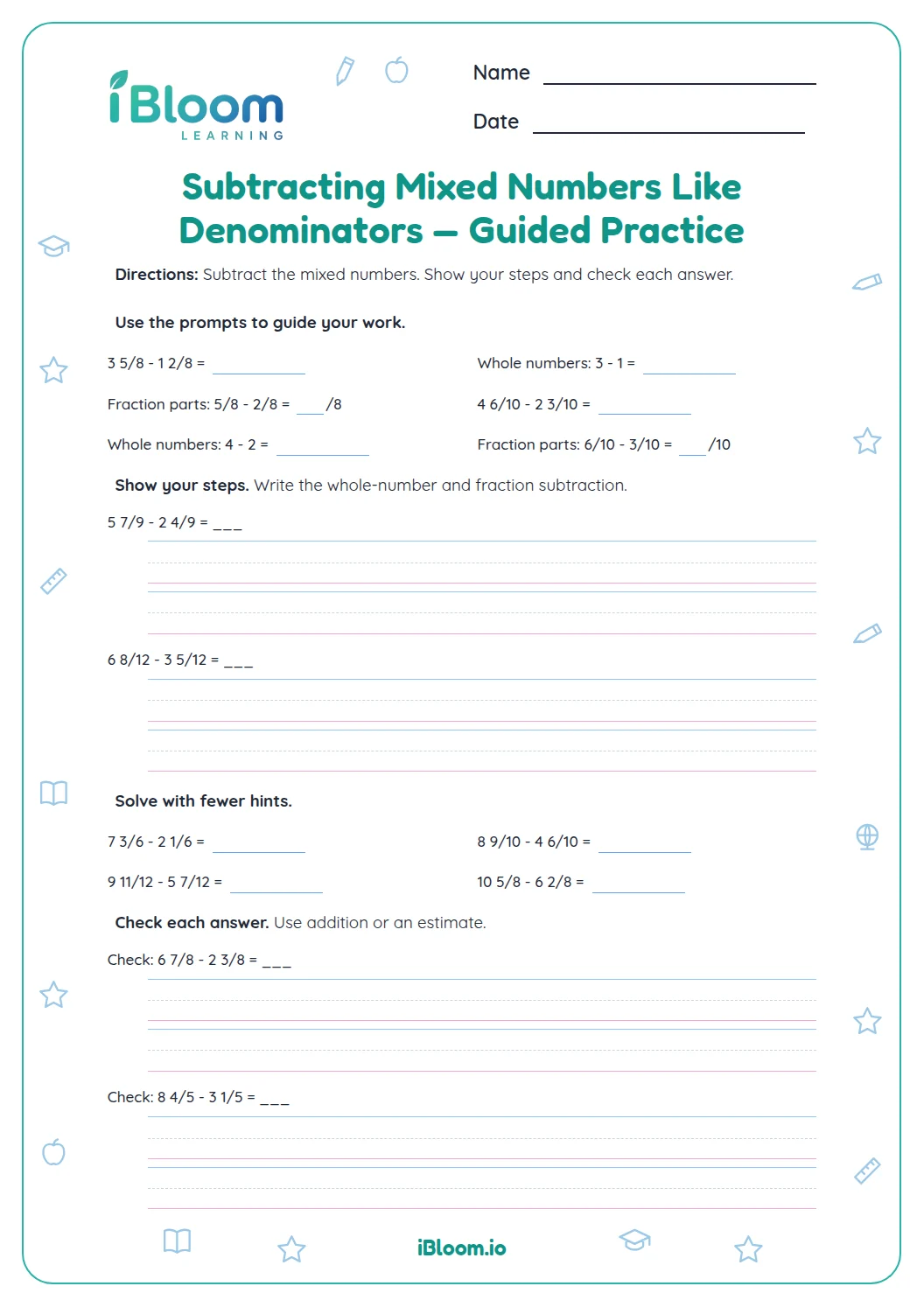
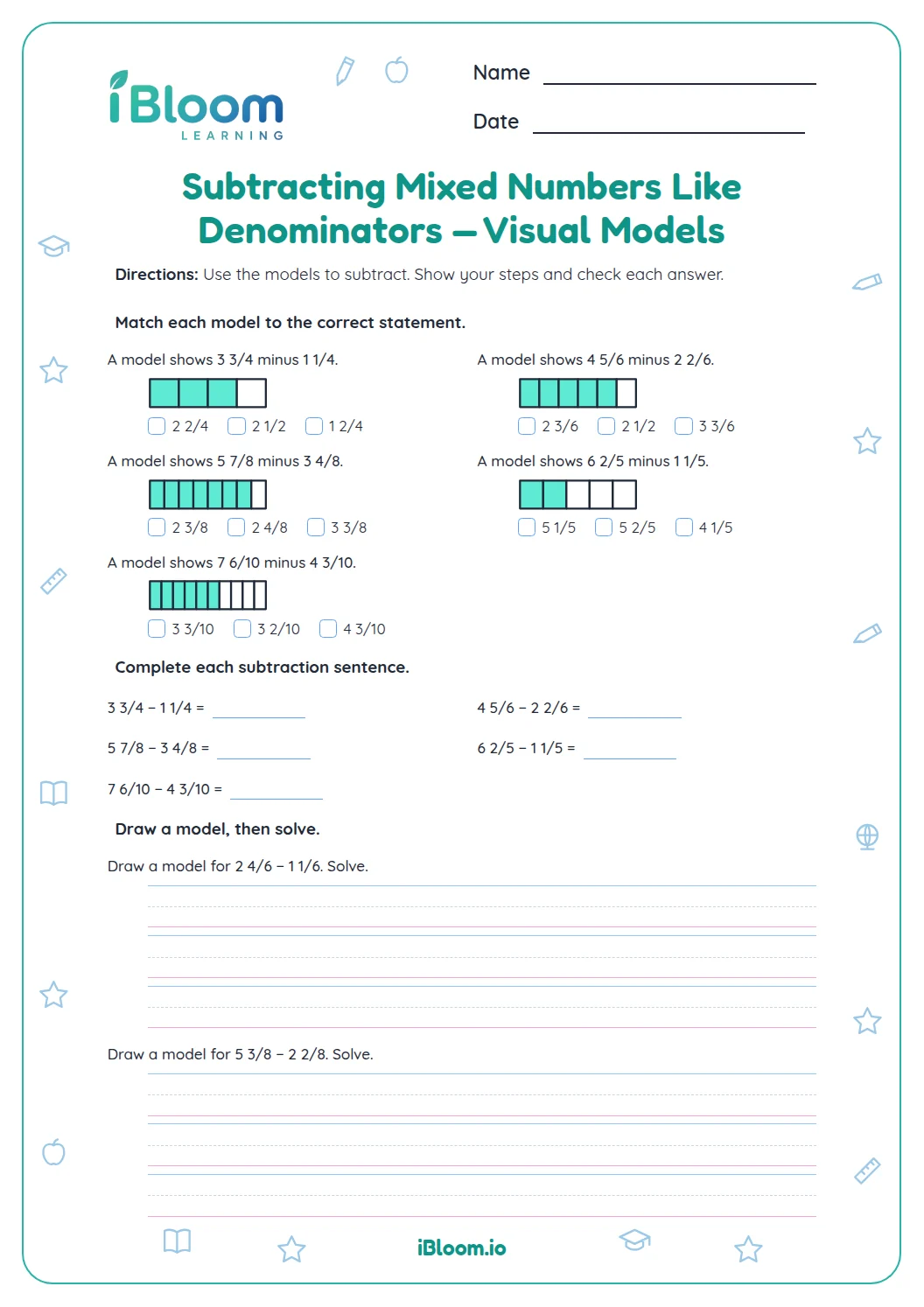
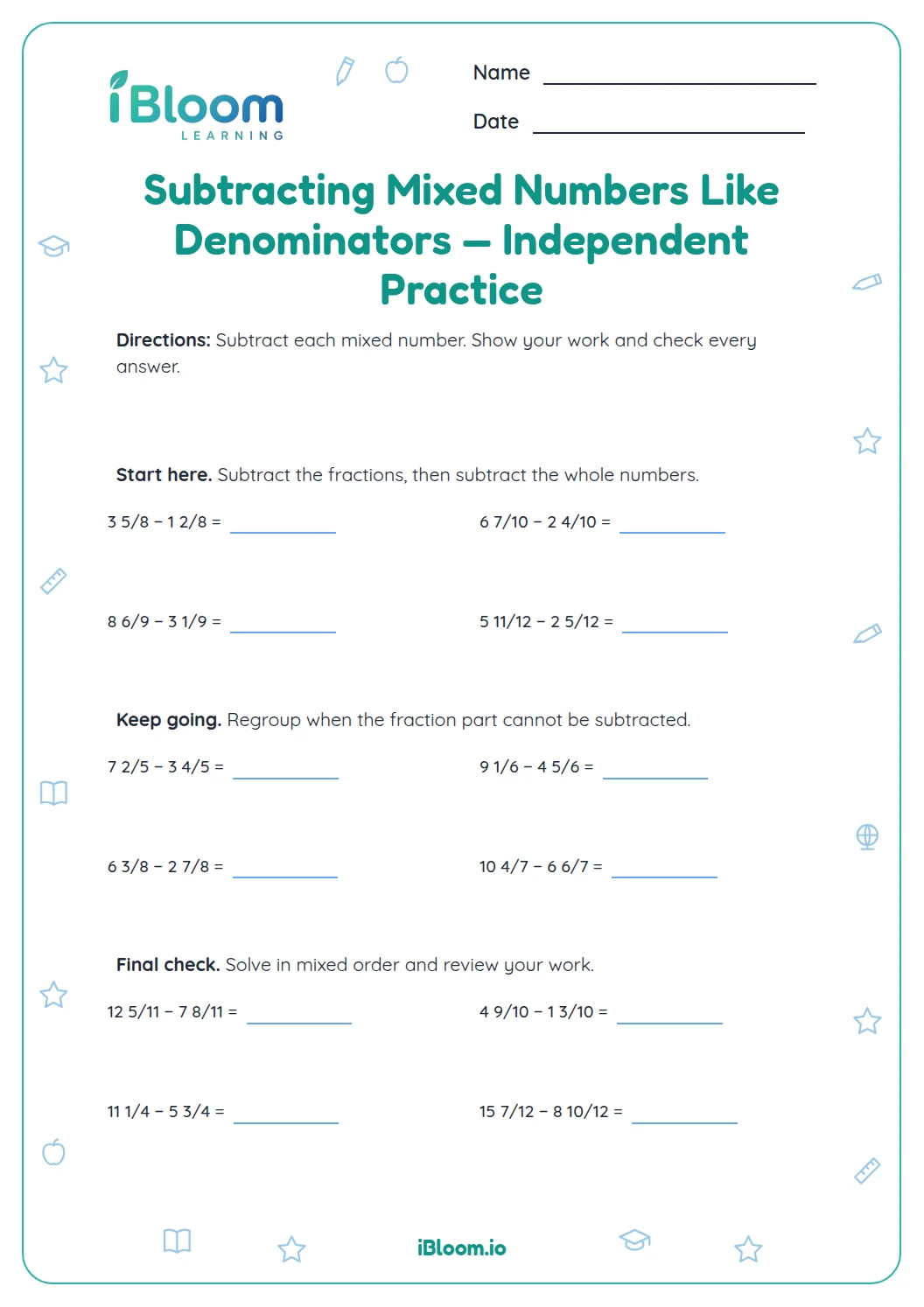
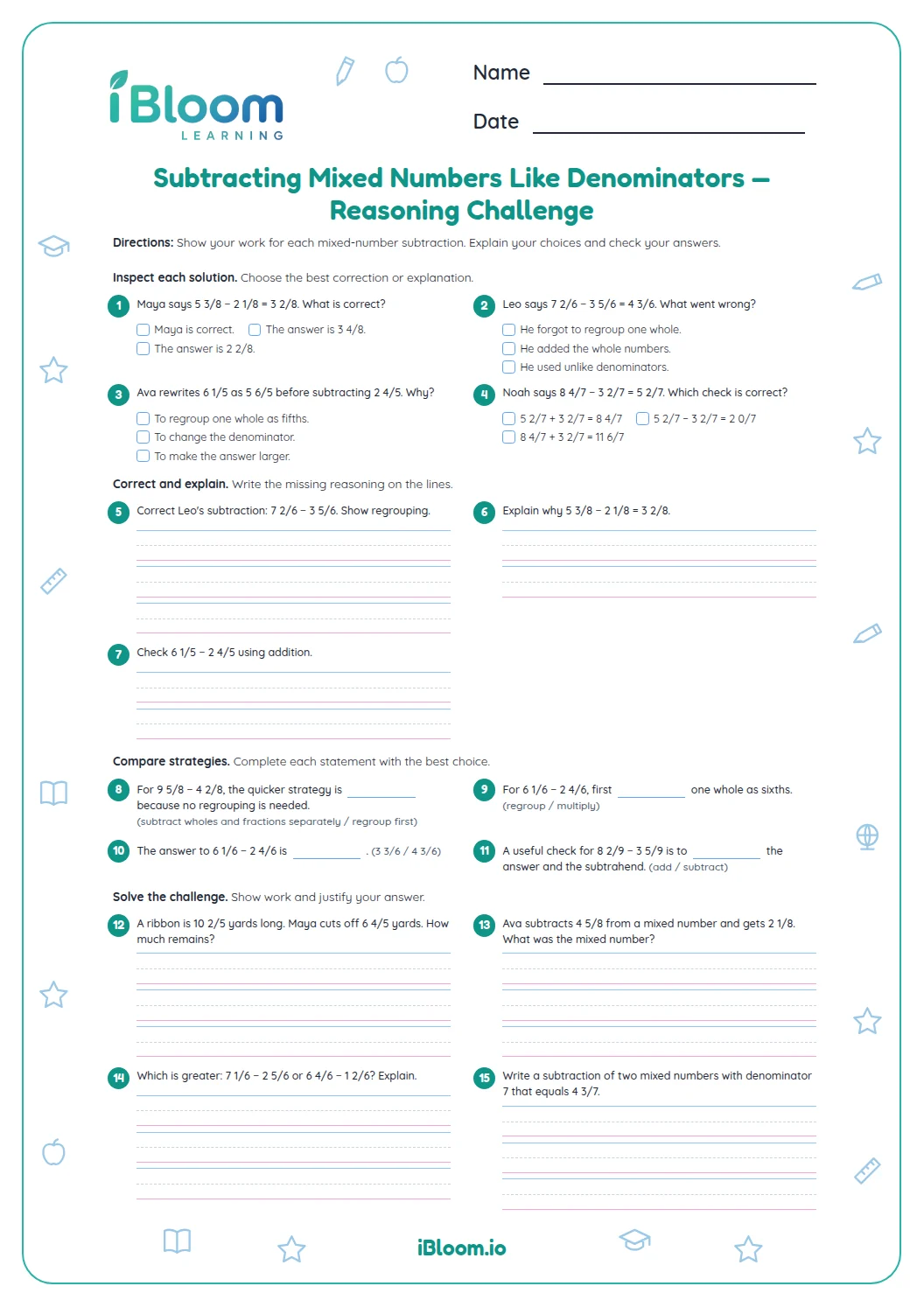
This free printable worksheet has 14 measurement stories on mixed-number subtraction with like denominators, including regrouping, plus an answer key and CCSS 4.NF.B.3 alignment. A separate answer key is included.
Aligned to 4.NF.B.3.c and 4.NF.B.3.d
How do you subtract mixed numbers in a story?
Question 1 asks how much ribbon remains after Maya uses 2 3/8 yards from 4 5/8 yards.
- 14 5/8 yd − 2 3/8 yd
- 22 2/8 yd = 2 1/4 yd
When should you regroup?
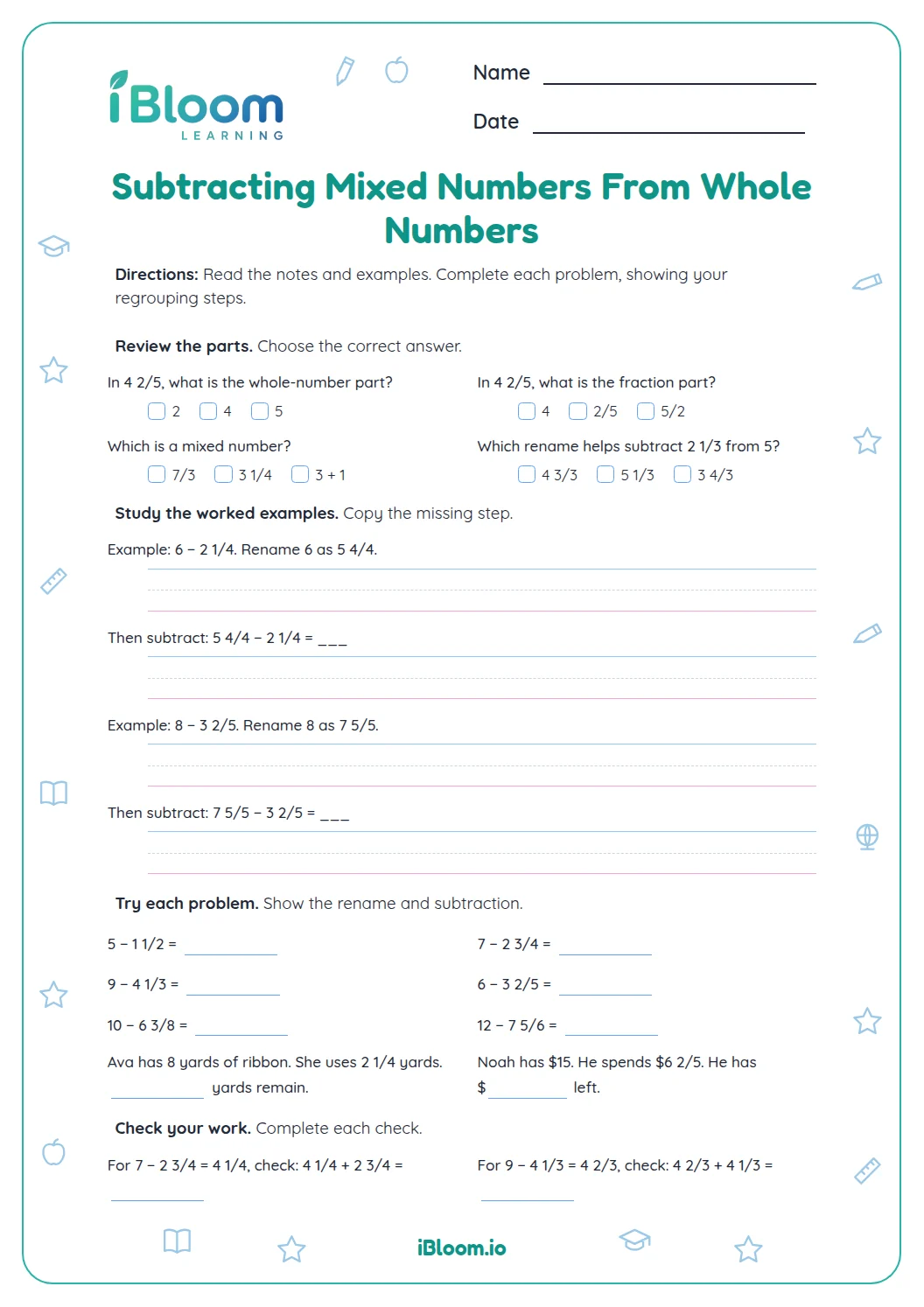
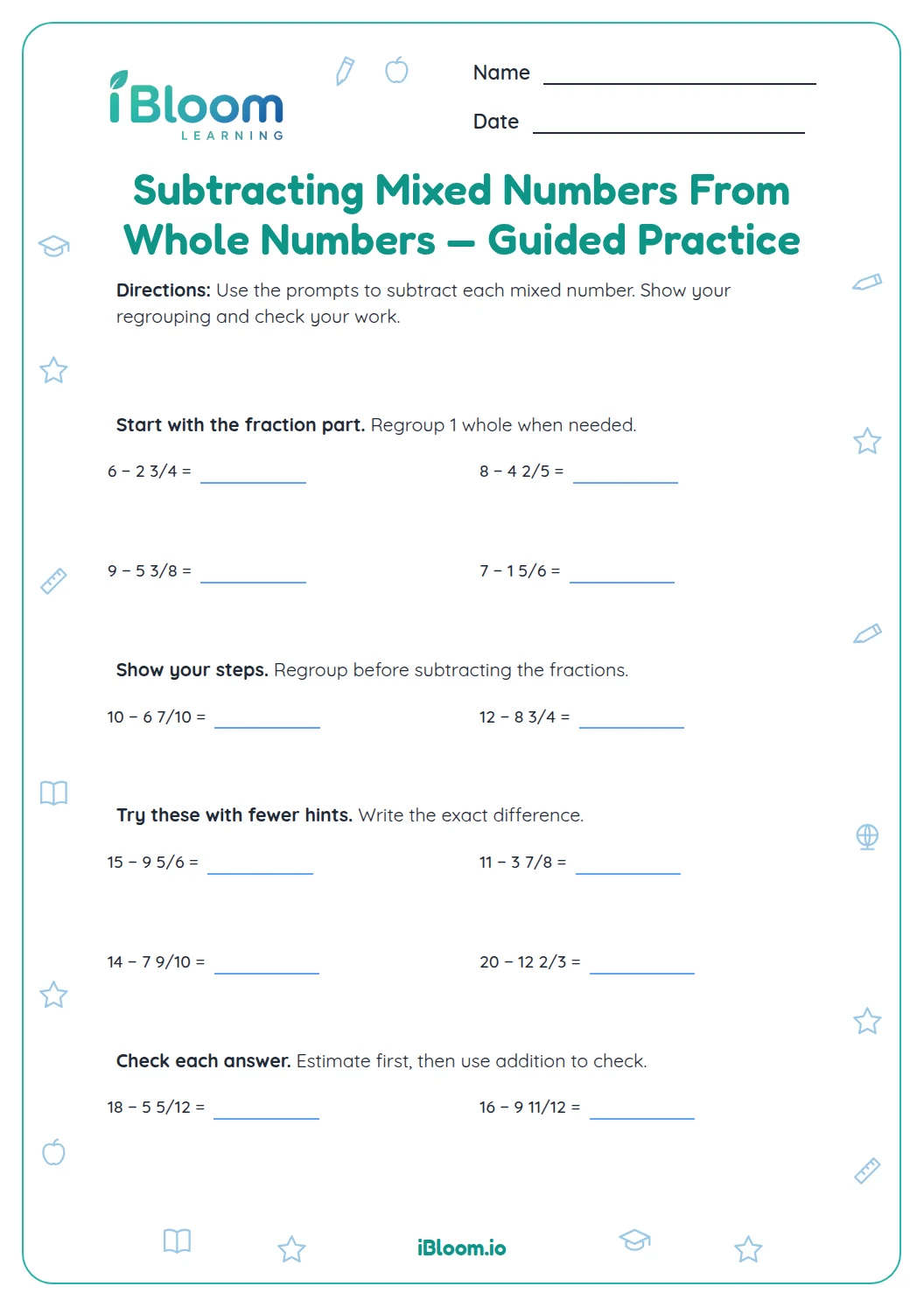
If the fraction being subtracted is larger, rename one whole as equal fractional parts. In question 8, 4 5/8 − 2 7/8 becomes 3 13/8 − 2 7/8, leaving 1 6/8, or 1 3/4 miles.
How do units stay connected to the answer?
Read the unit in the story and use it in the answer. A yard measurement stays in yards; a liquid amount stays in liters, gallons, cups, or quarts.
Solve each measurement story
- 1Find the starting amount and the amount used.
- 2Write the subtraction with matching denominators.
- 3Subtract the fractions and whole numbers.
- 4Regroup one whole as equal parts when needed.
- 5Write the result with the unit and check its size.
Common subtraction slips
The mistake
Subtracting a larger fractional part without regrouping.
The fix
Rename one whole as the denominator number of parts.
The mistake
Changing the denominator in like-denominator subtraction.
The fix
Keep the denominator because the parts stay the same size.
The mistake
Leaving off the measurement unit.
The fix
Use the same unit named in the story.
Common Core alignment
Subtract mixed numbers with like denominators, regrouping when needed.
On this sheet: Subtract mixed numbers with like denominators, including regrouping.
Show the official wordingHide the official wording
Add and subtract mixed numbers with like denominators, e.g., by replacing each mixed number with an equivalent fraction, and/or by using properties of operations and the relationship between addition and subtraction.
Solve real-world fraction subtraction problems with like denominators.
On this sheet: Represent measurement subtraction stories with equations.
Show the official wordingHide the official wording
Solve word problems involving addition and subtraction of fractions referring to the same whole and having like denominators, e.g., by using visual fraction models and equations to represent the problem.
What to practice next
Make more practice
Further reading
Questions parents and teachers ask
What does this mixed-number worksheet practice?
The 14 questions are short measurement stories about ribbon, water, trails, boards, recipes, and other familiar amounts. Students subtract mixed numbers with like denominators, including examples that require regrouping. The separate answer key gives each result with its measurement unit.
When does a student need to regroup?
Regroup when the fraction being subtracted is larger than the starting fraction. For example, question 8 asks about 4 5/8 miles minus 2 7/8 miles. Rename one whole as 8/8, subtract the fractions and whole numbers, then simplify the remaining fraction.
Which denominators appear in the questions?
The questions use sixths and eighths, with the same denominator in each subtraction sentence. Students keep that denominator while subtracting the fractional parts. The answer key accepts simplified results and includes the measurement unit used in each story.
How should students keep track of units?
Read the unit in the story and write that unit with the result. A ribbon answer stays in yards, while a water amount may be in liters, gallons, or quarts. The key includes the matching unit so students can check both the number and label.
How can a student check a subtraction answer?
Check that the result is smaller than the starting amount and that the unit matches the story. When regrouping, rewrite one whole as the same number of fractional parts as the denominator. The answer key provides a result for each of the 14 measurement questions.