


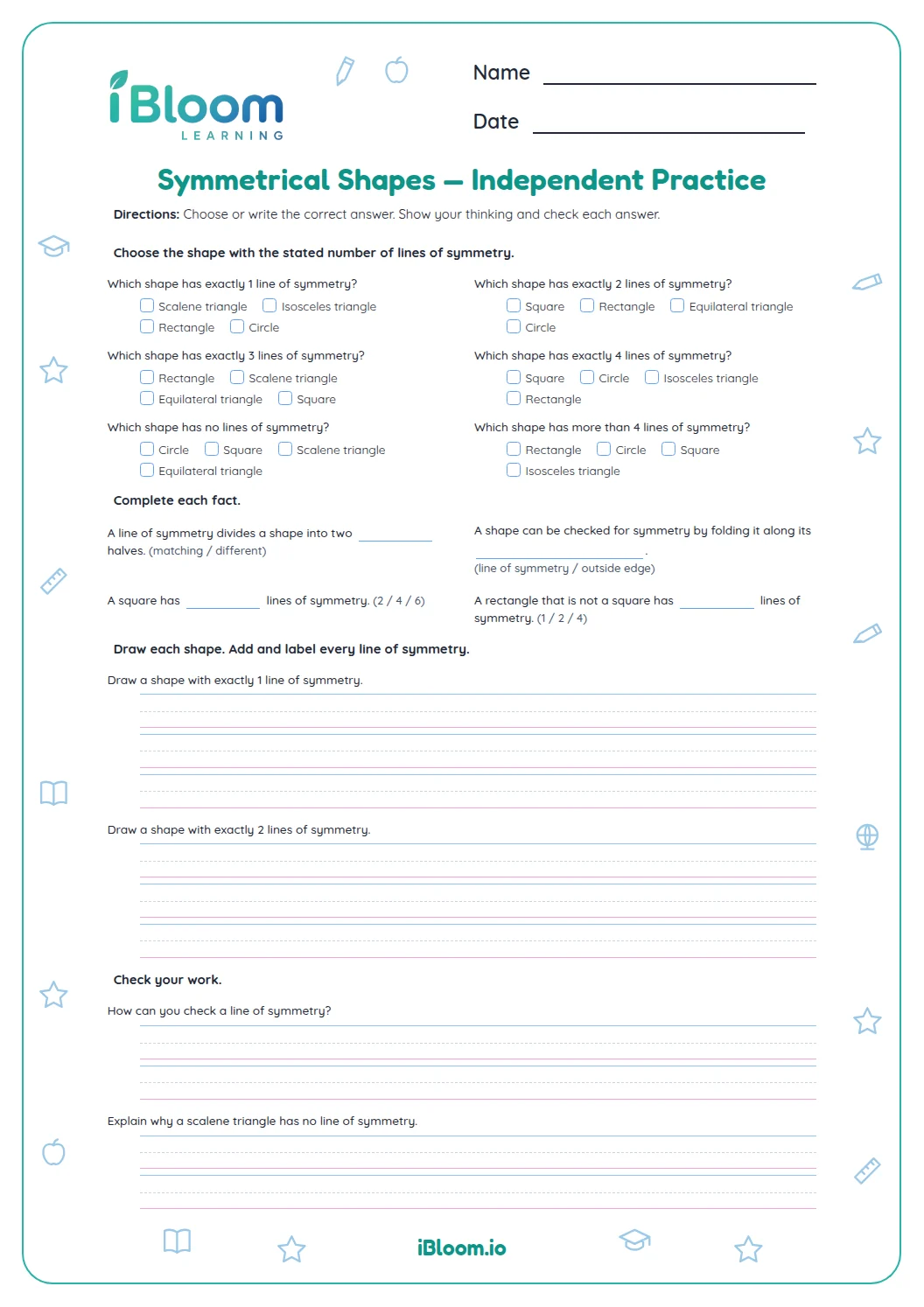
About this worksheet
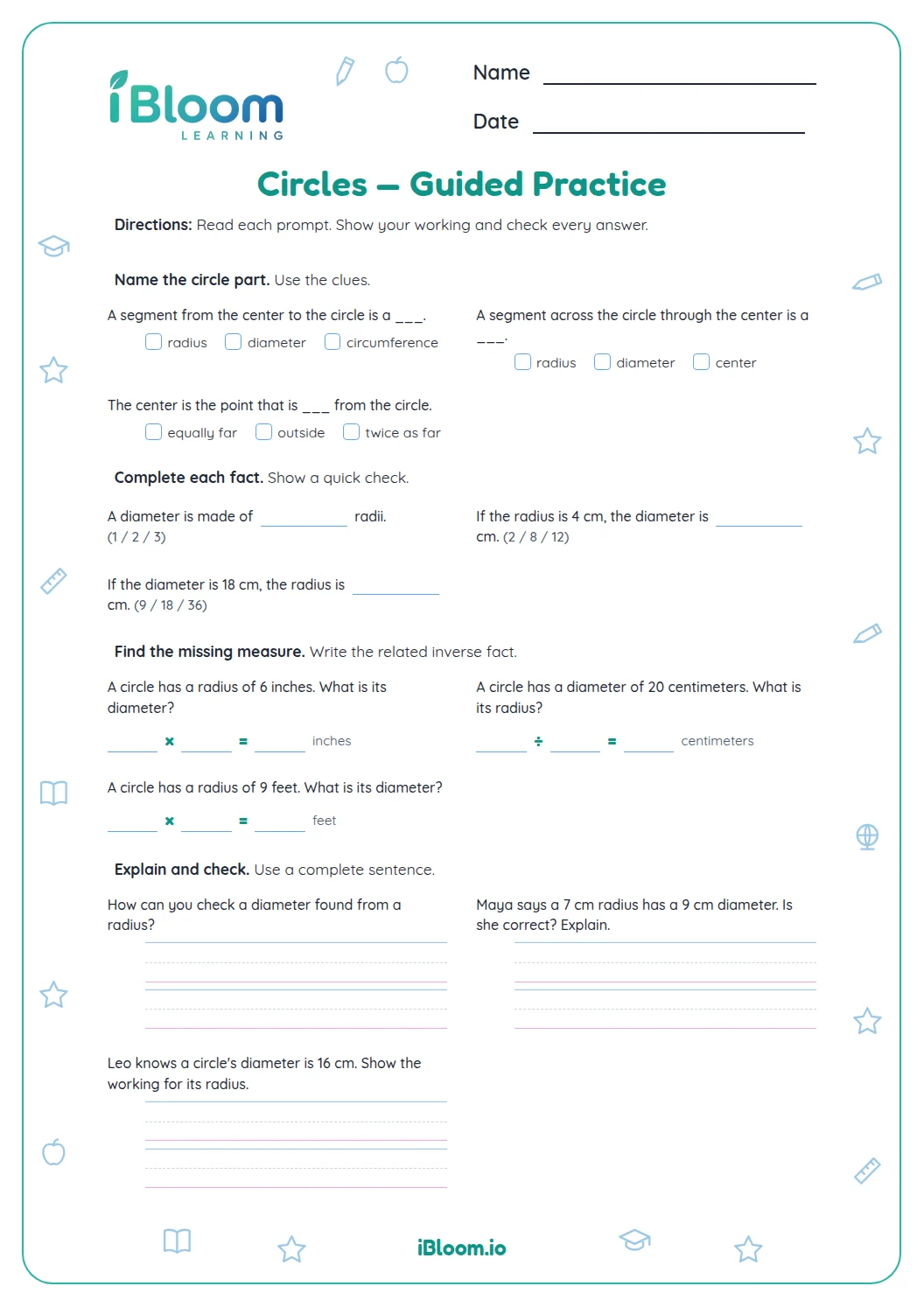
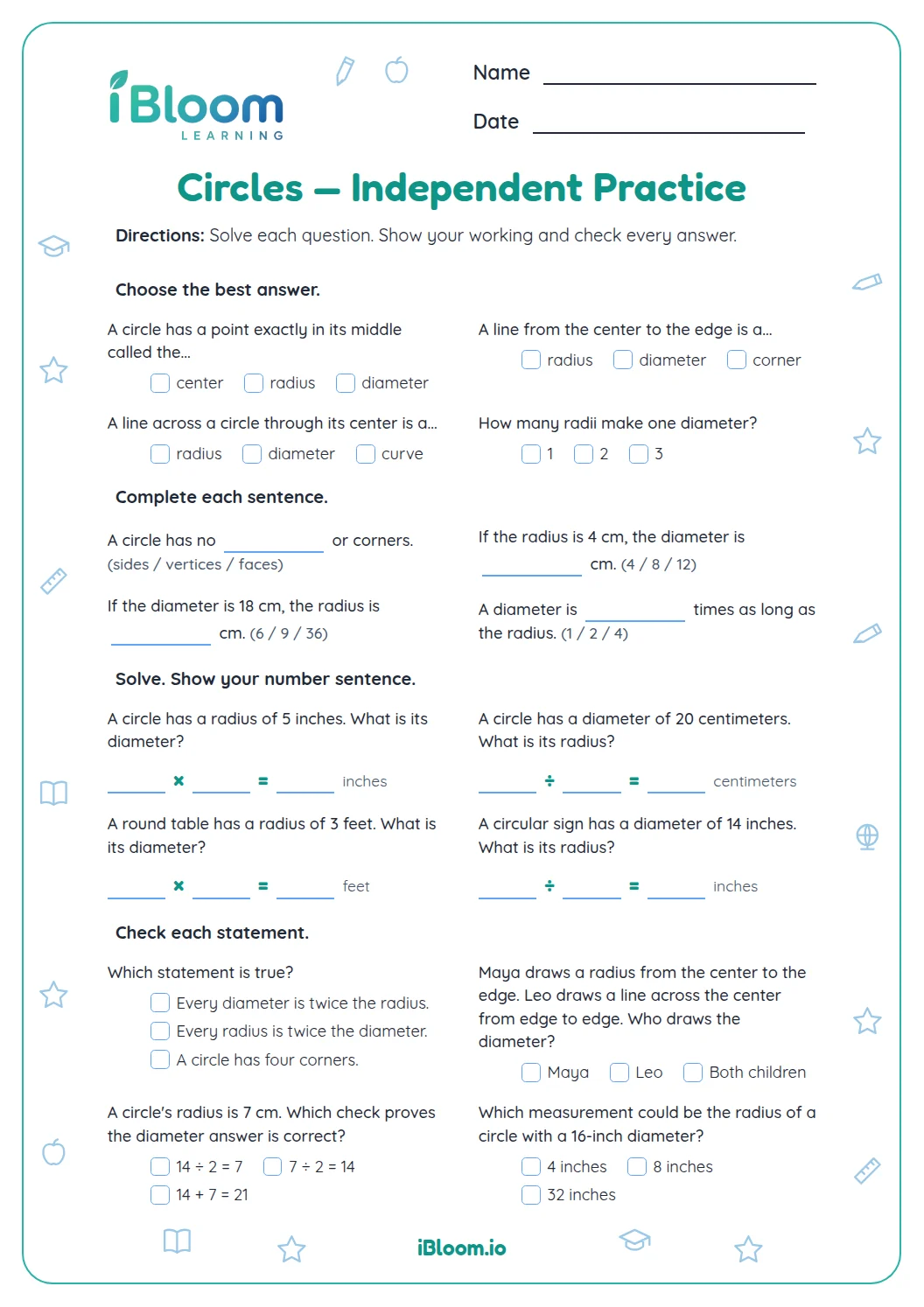
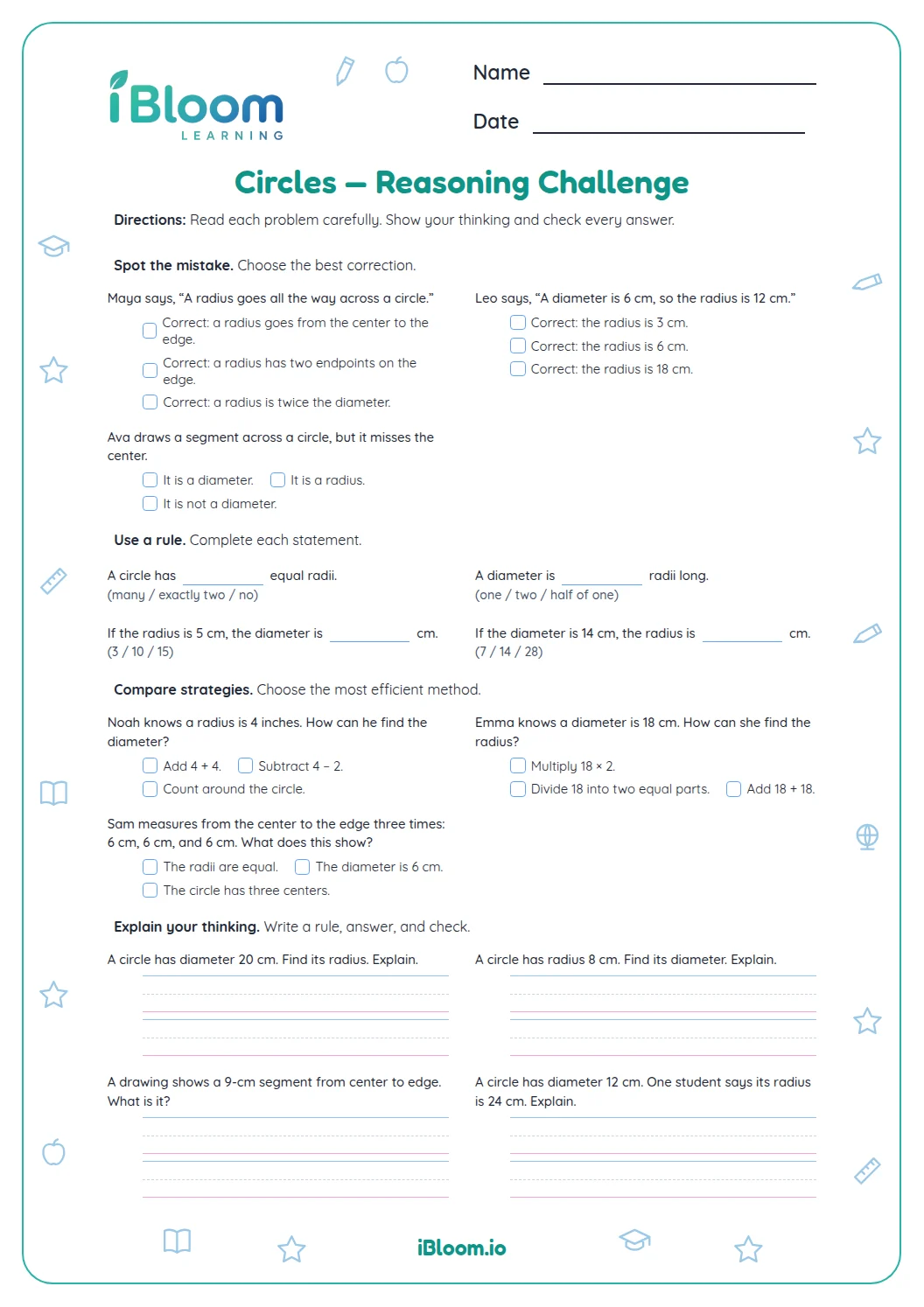
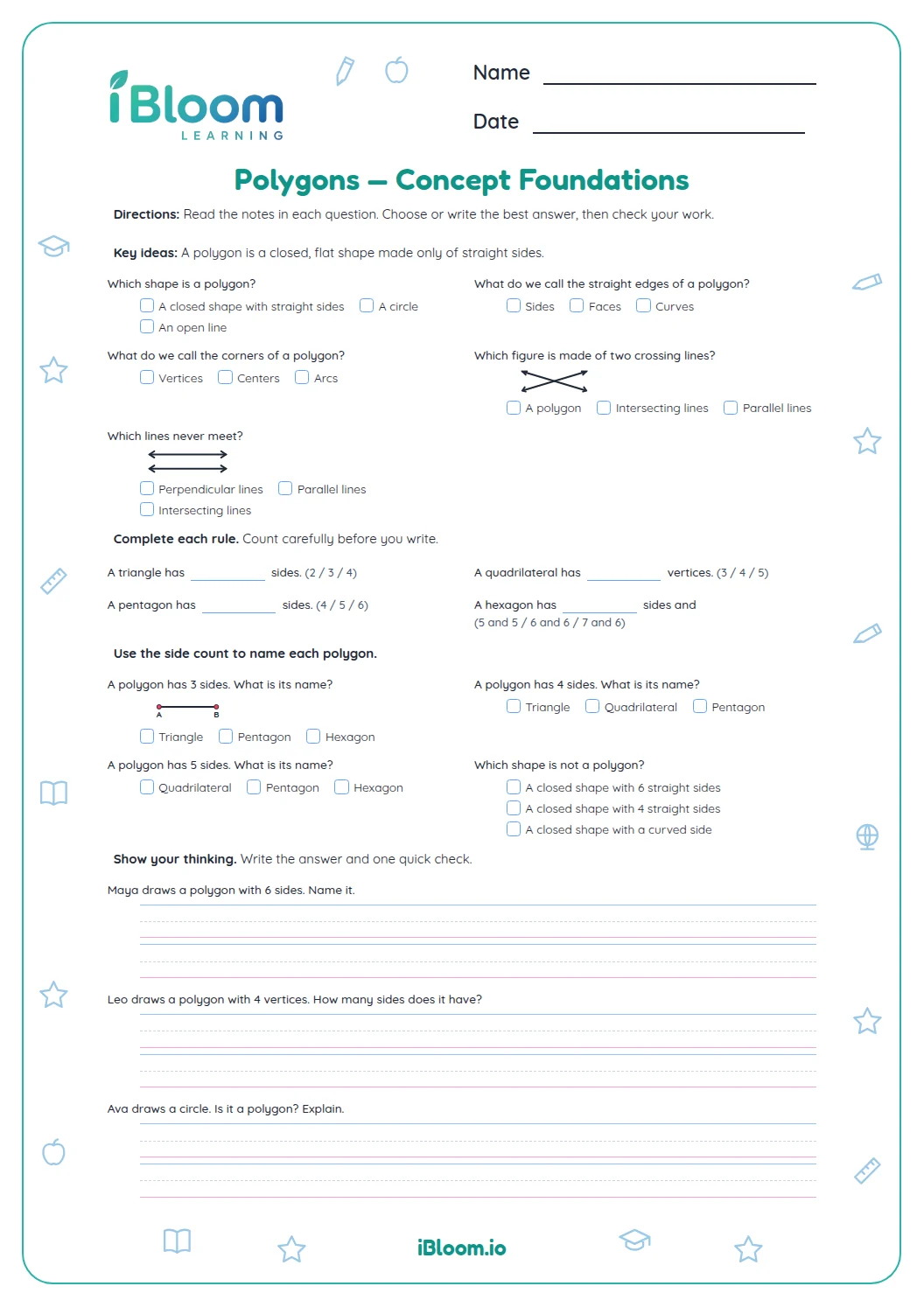
This printable includes a circle drawing with compact questions on circle parts and whole-number radius-diameter relationships. A separate answer key lists the expected terms and measurements.
What can you name in a circle model?
The center is in the middle. A radius runs from the center to the edge. A diameter crosses the center and reaches both edges. Circumference is the curved boundary.
- 1Center to edge
- 2Name that part: radius.
How do radius and diameter compare?
Two radii fit along a diameter. Double the radius to find the diameter; divide the diameter by 2 to find the radius.
How should students use each drawing?
The first question includes a circle drawing. Other prompts describe a circle feature or give a whole-number measurement; students choose the matching term or value.
Use the circle drawings
- 1Look at the circle shown with the question.
- 2Identify its center, edge, radius, or diameter as requested.
- 3For a radius-to-diameter question, double.
- 4For a diameter-to-radius question, divide by 2.
- 5Keep the measurement unit.
Check circle vocabulary
The mistake
Mixing up radius and diameter.
The fix
A radius is half as long as a diameter.
The mistake
Calling the curved edge a radius.
The fix
The edge around the whole circle is its circumference.
The mistake
Using the same operation for both measurements.
The fix
Double to find diameter; halve to find radius.
What to practice next
Make more practice
Questions parents and teachers ask
How many circle questions are included?
The first question includes a circle drawing. The other 13 items ask students to name circle parts or use whole-number radius and diameter measurements. The separate answer key lists the expected terms and values so students can check their choices.
How is a radius different from a diameter?
The first question includes a circle drawing. The other 13 items ask students to name circle parts or use whole-number radius and diameter measurements. The separate answer key lists the expected terms and values so students can check their choices.
How do students find a missing radius or diameter?
The first question includes a circle drawing. The other 13 items ask students to name circle parts or use whole-number radius and diameter measurements. The separate answer key lists the expected terms and values so students can check their choices.
How can students check whether a segment is a diameter?
The first question includes a circle drawing. The other 13 items ask students to name circle parts or use whole-number radius and diameter measurements. The separate answer key lists the expected terms and values so students can check their choices.
Why does a diameter pass through the center?
The first question includes a circle drawing. The other 13 items ask students to name circle parts or use whole-number radius and diameter measurements. The separate answer key lists the expected terms and values so students can check their choices.