
About this worksheet
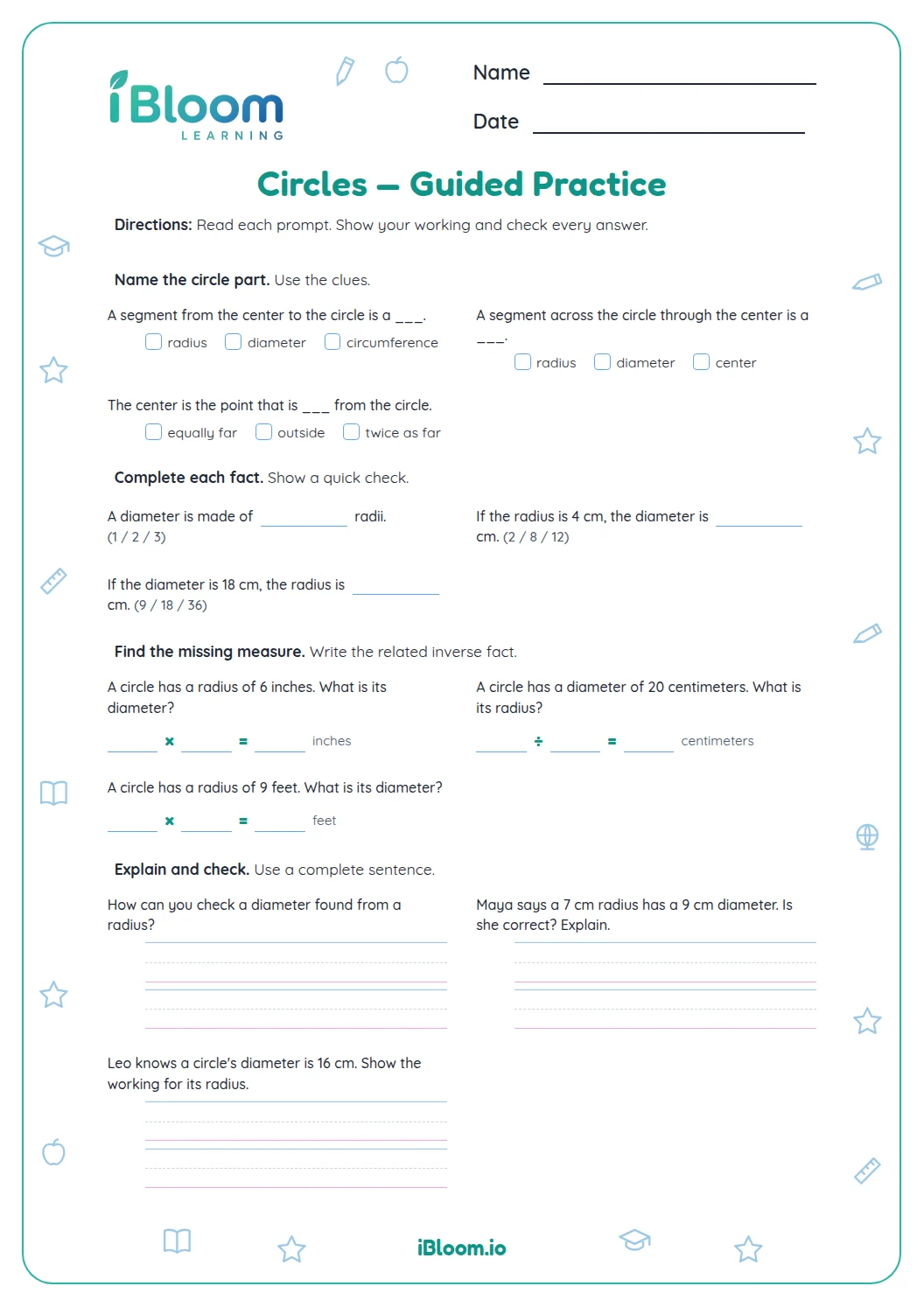
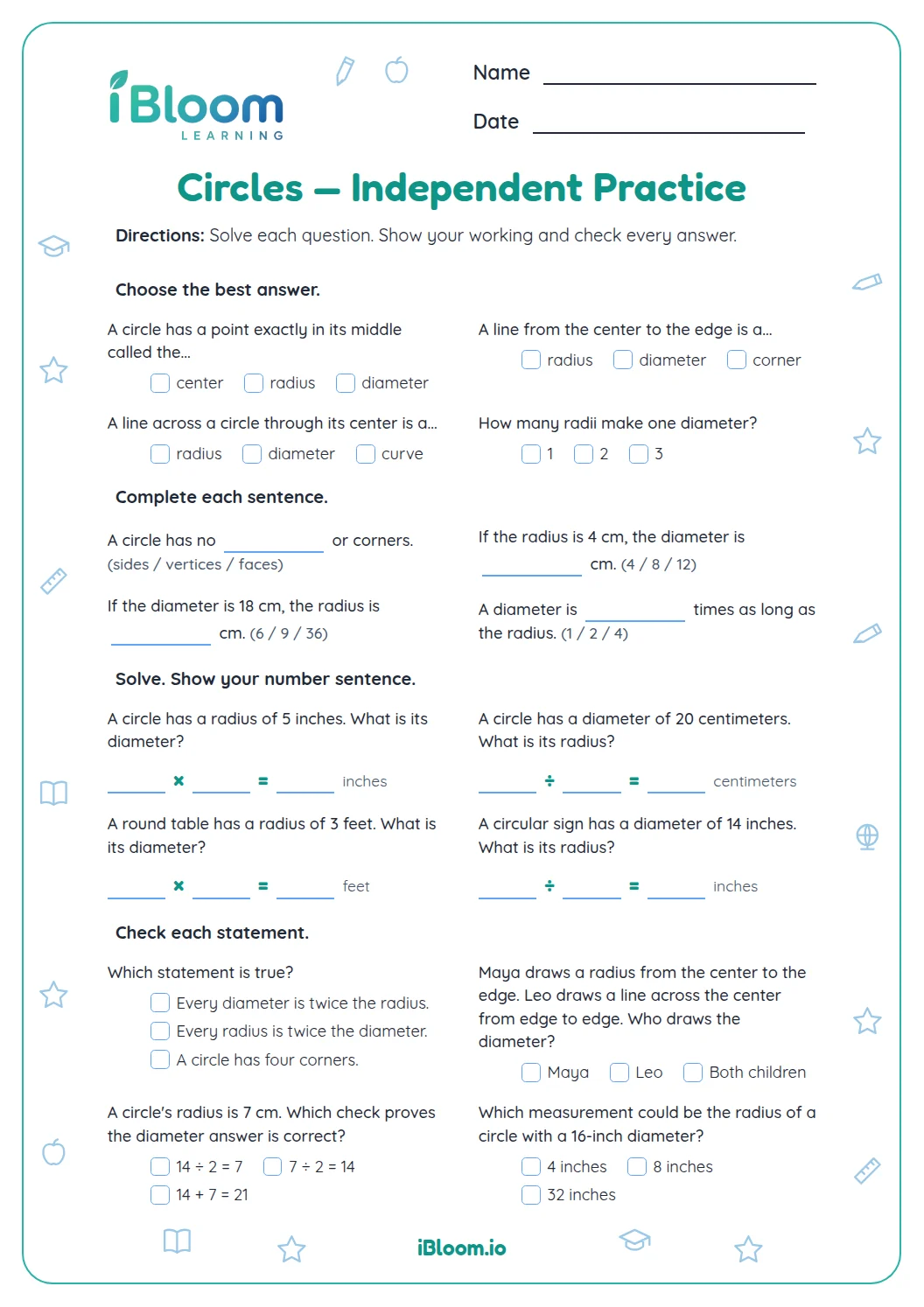
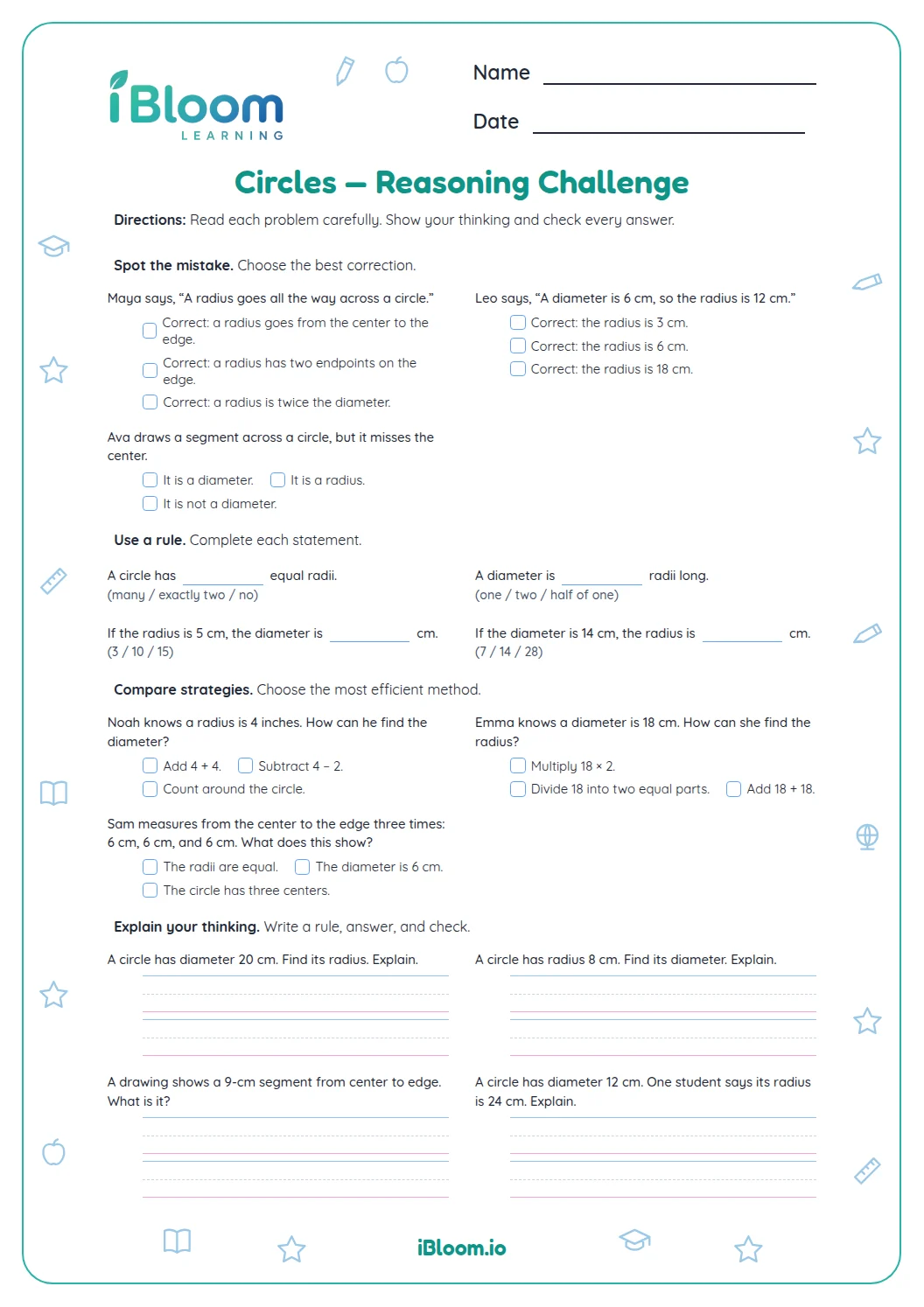
This Grade 3 printable moves from spotting circular objects to using circle vocabulary in context. Children identify everyday circles, review radius and diameter, and solve short problems about a round table, pond, and garden. The two worksheet pages contain 14 questions, followed by a separate two-page answer key with concise responses. The practice keeps the old sheet’s mix of circle recognition, circle parts, and real-world applications while replacing its unrelated arithmetic items.
What circle ideas do children practice?
Part A connects circles to things children may see, including a bicycle wheel, clock, coin, plate, and button. Part B checks that a circle has no straight sides or corners and reviews the radius and diameter.
Part C applies those words in familiar settings. Children double a radius to find a diameter and halve a diameter to find the distance from center to edge.
How do you find a circle’s diameter?
A diameter goes from one edge of a circle to the opposite edge through its center. It is made of two radii, so double the radius.
- 1A round table has a radius of 2 feet. What is its diameter?
- 22 + 2 = 4 feet
How can children check a circle answer?
For a radius-and-diameter problem, check whether the answer is twice the radius or half the diameter as requested. For an object question, reread the description and name the circular object or part that fits it.
How to use this worksheet
- 1Read each object clue and name the circular object it describes.
- 2Review what “radius” and “diameter” mean before Part B.
- 3For a diameter, add two equal radii; for a radius, split the diameter in half.
- 4Complete the remaining object and situation questions.
- 5Check all 14 responses with the separate answer key.
Common slips and quick fixes
The mistake
Calling the radius the full width of a circle.
The fix
A radius reaches from the center to the edge; a diameter crosses the whole circle.
The mistake
Forgetting that a diameter is two radii.
The fix
Double the radius to get the diameter.
The mistake
Halving when the question asks for a diameter.
The fix
Notice which circle part is given and which one is requested.
What to practice next
Make more practice
Questions parents and teachers ask
What is the difference between a radius and a diameter?
A radius runs from the center of a circle to its edge. A diameter runs across the circle through its center, so it is two radii long. Part C asks children to use both relationships in short everyday situations. Children can check a drawing by marking the center and the two endpoints.
How many questions are included?
There are 14 questions across three parts. Children first identify circular objects, then review circle clues and vocabulary, and finally apply radius and diameter ideas to simple real-world situations. The examples include familiar objects as well as short radius and diameter calculations.
Does this worksheet include an answer key?
Yes. A separate two-page answer key follows the two worksheet pages. It lists the expected object names, circle words, and numerical answers so an adult or student can check the work after completing it. Adults can accept equivalent clear wording for object names when the object fits.
What does the worksheet mean by diameter?
The diameter is a straight distance from one side of the circle to the other that passes through the center. If a problem gives the radius, double it to find the diameter. It also asks children to connect the vocabulary to round objects they recognize.
How can I help a child who mixes up the two circle parts?
Sketch a circle and mark its center. Draw one segment from the center to the edge for the radius, then continue through the center to the opposite edge to show a diameter. Ask which segment is twice as long. The short calculations use whole-number distances and do not require a formula for area.