

About this worksheet
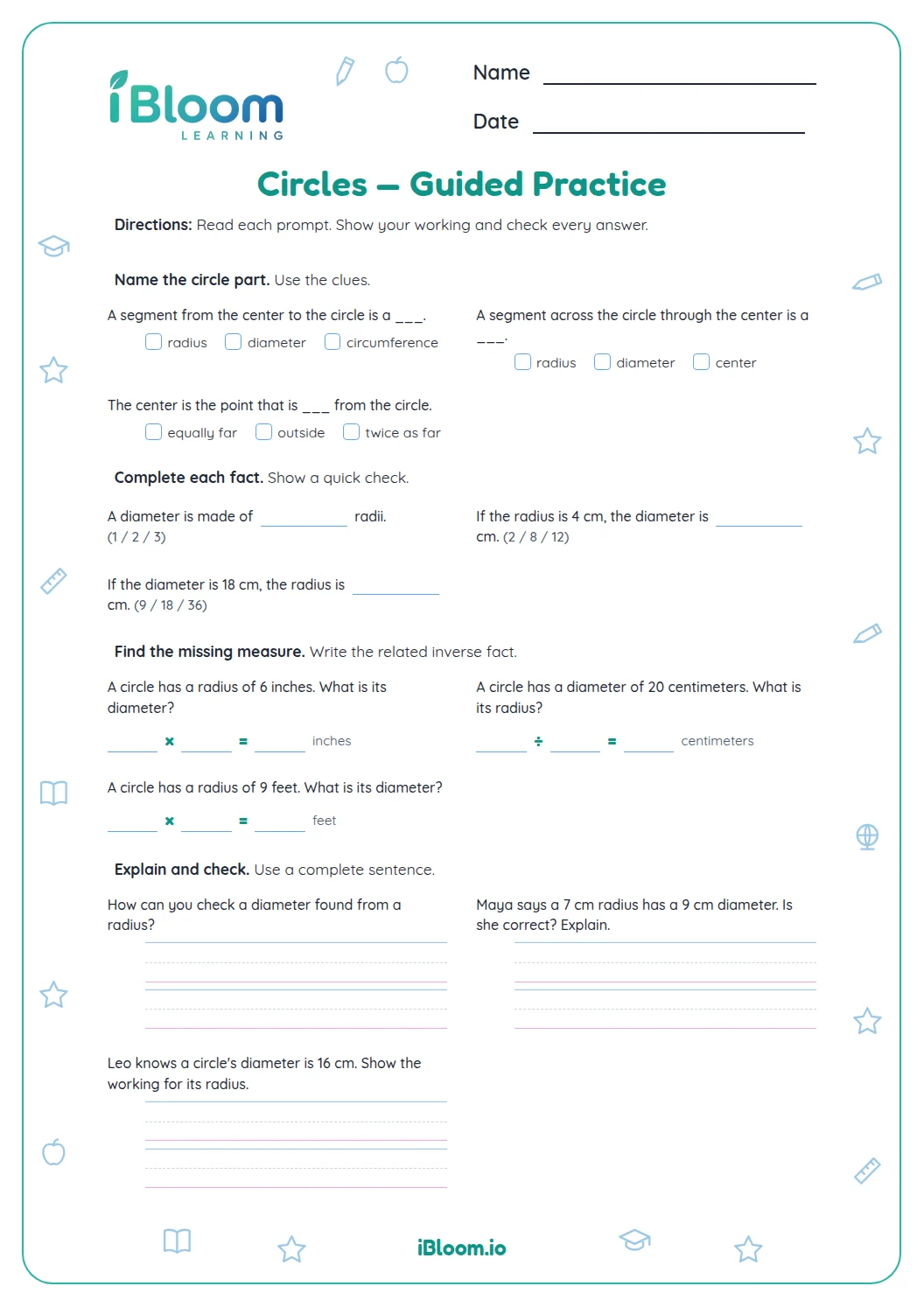
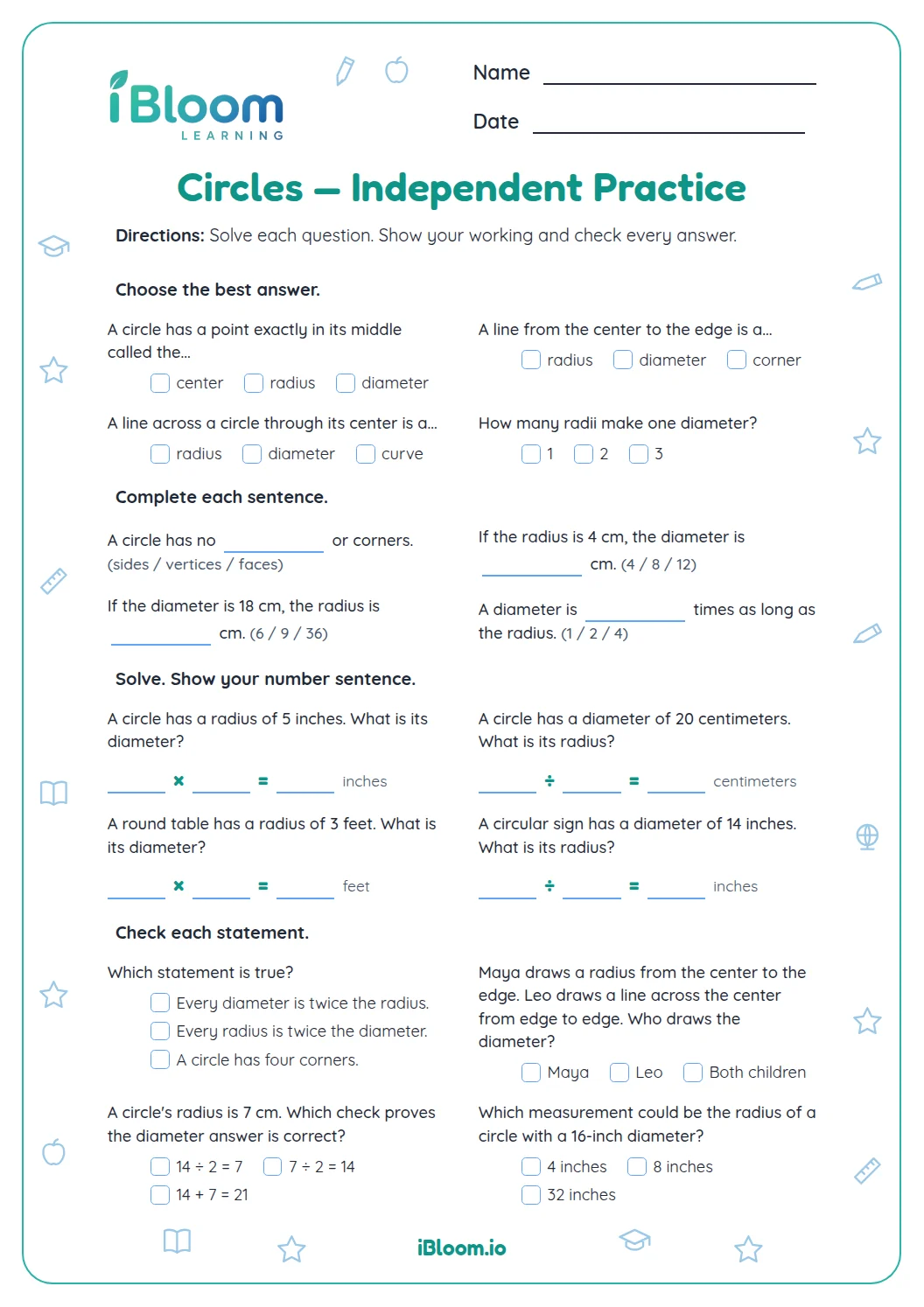
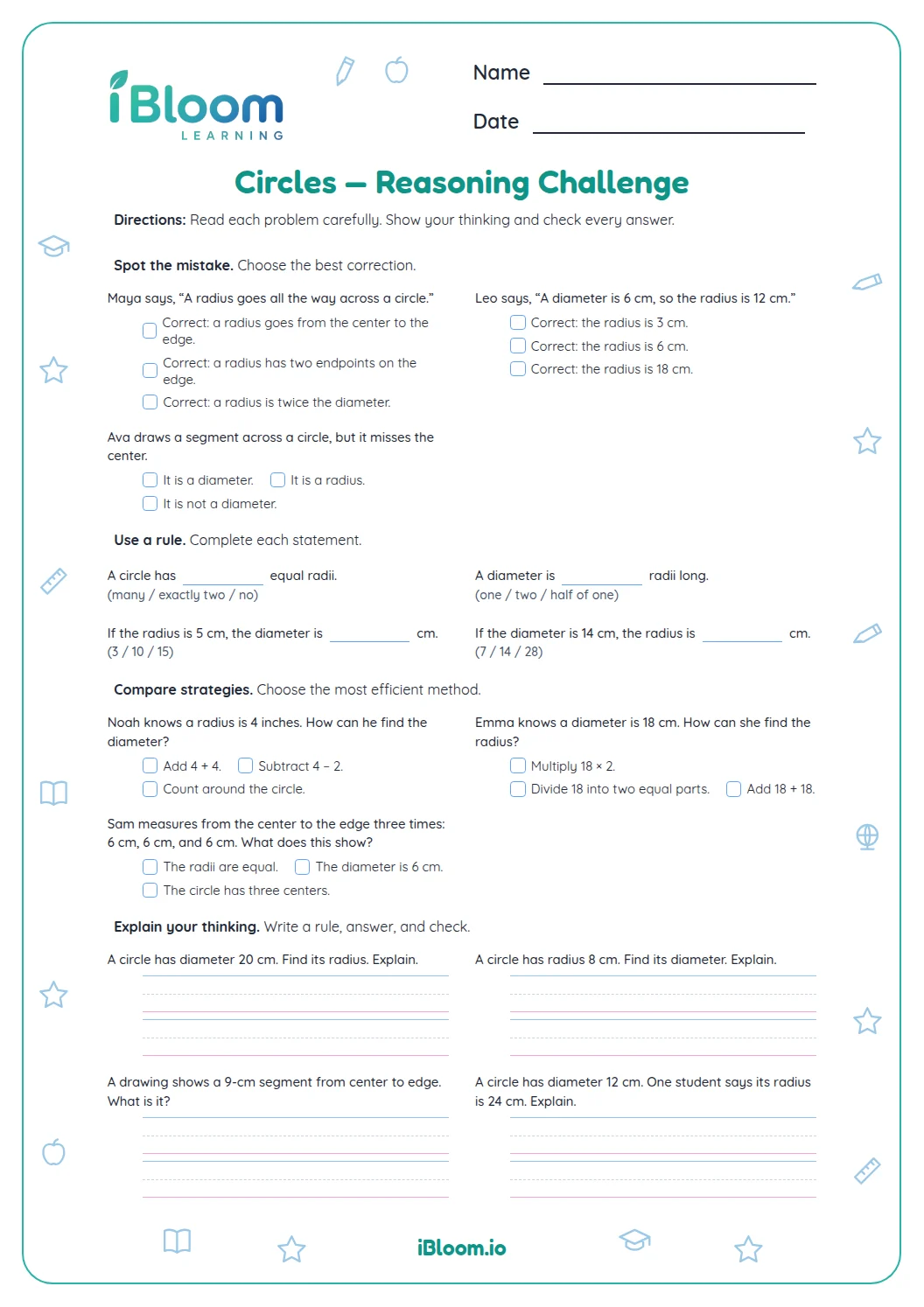
This printable uses two circle drawings and compact circle-part and radius-diameter questions. Students identify key vocabulary and solve whole-number measurements with a separate answer key.
How are the circle parts named?
The center is in the middle. A radius reaches from the center to the edge; a diameter crosses the center from edge to edge. The curved boundary is the circumference. Two questions include circle drawings.
- 1Center to edge
- 2That segment is a radius.
How are radius and diameter related?
A diameter contains two radii, so double a radius to find the diameter. Divide a diameter by 2 to find the radius. Only question 1 includes a circle drawing; the remaining questions state the needed feature or measurement.
How can you check a measurement?
Double the radius, then divide the result by 2. The value should return to the starting radius. Keep the unit named in the question.
Read each circle model
- 1Locate the center of the circle.
- 2Use radius for a center-to-edge distance.
- 3Use diameter for an edge-to-edge segment through the center.
- 4Double a radius to find the diameter.
- 5Halve a diameter to find the radius and keep the unit.
Circle measurement checks
The mistake
Calling a center-to-edge distance a diameter.
The fix
A radius ends at the edge; a diameter crosses the center.
The mistake
Doubling when the radius is requested.
The fix
Divide the diameter by 2 to find one radius.
The mistake
Leaving off the unit.
The fix
Copy the unit from the measurement question.
What to practice next
Make more practice
Questions parents and teachers ask
What does this circle worksheet practice?
Students use the circle drawing in two questions to name circle parts and find whole-number radii or diameters. The 14 questions include the center, radius, diameter, circumference, and doubling or halving measurements. A separate answer key gives each correct term or measurement.
How is a radius different from a diameter?
A radius goes from the center to the circle edge. A diameter crosses the center and reaches both sides, so it is twice as long as a radius. Students use this relationship with whole-number measurements and check their work with the separate key.
What does circumference mean?
Circumference is the curved boundary around a circle. The worksheet shows a circle drawing beside each prompt and asks students to identify this and other circle parts. The answer key lists the expected word or measurement for each of the 14 questions.
How do students find a radius from a diameter?
Divide the diameter by 2 because it is made of two radii. Several questions give a whole-number diameter and ask students to find the radius. Keep the unit from the question, then compare the answer with the key.
How many questions are included?
The worksheet has 14 circle questions, with a circle drawing in the first question. Students identify circle vocabulary and find whole-number radii or diameters. The separate answer key provides the correct term or value for each item so students can check their work.