
About this worksheet
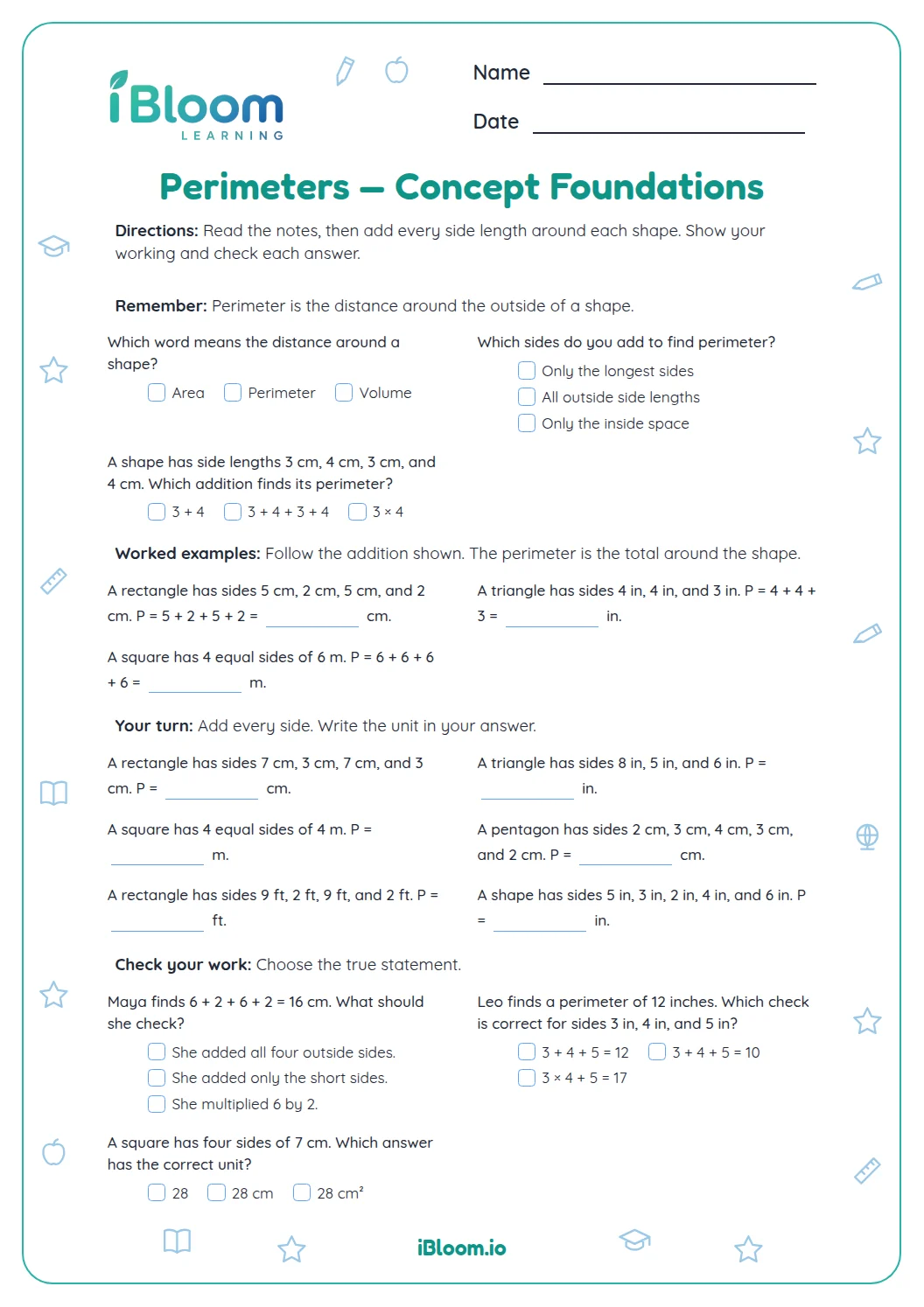
This free printable Grade 3 worksheet uses parallelogram mats, frames, signs, and gardens to practice perimeter. Children first choose useful side information, then calculate the distance around all four sides and find missing lengths. Two final questions ask them to check another child’s answer. The 13 problems practice Common Core 3.MD.D.8 through real-world perimeter calculations. Opposite sides of a parallelogram are equal, so a pair of adjacent lengths supplies all four sides. A separate answer key gives answers in the requested units and sample explanations for the checks.
Aligned to 3.MD.D.8
Which sides count toward perimeter?
Perimeter is the distance around the whole boundary. A parallelogram has two equal pairs of opposite sides. If adjacent sides measure 5 feet and 3 feet, the other two sides measure 5 feet and 3 feet as well.
Children can add the four lengths or double the sum of the adjacent lengths. Both methods must count the entire border.
- 1Adjacent sides: 5 feet and 3 feet.
- 2All four sides: 5 + 3 + 5 + 3 = 16.
- 3The mat’s perimeter is 16 feet.
How do you find a missing side from the perimeter?
Subtract the two known opposite sides from the total perimeter. Question 9 asks for the combined length left over: 26 − 8 − 8 = 10 inches. Question 10 goes one step further and asks for each remaining side.
For question 10, 30 − 9 − 9 = 12 centimeters remain for two equal sides. Each is 6 centimeters. Checking 9 + 6 + 9 + 6 = 30 confirms the result.
What is in the three parts?
Part A has three planning choices about useful measurements and opposite sides. Part B contains eight word problems with working space, including three missing-length problems. Part C asks children to judge a correct perimeter and repair an answer that counts only two sides.
The calculation answers use feet, inches, meters, or centimeters. Read each answer with its unit attached when checking the length of a side or the distance around an object.
How to use this worksheet
- 1Trace the edge of a paper parallelogram and name all four sides.
- 2Read the opposite-side rule and complete the three planning choices.
- 3For each Part B problem, list all four side lengths before adding.
- 4In questions 9 and 10, underline whether the question asks for the total or each side.
- 5Use the key to check units and calculations, then discuss the two claims.
Mistakes to notice and repair
The mistake
Adding only the two given adjacent sides.
The fix
Write each length twice before adding: 5 + 3 + 5 + 3.
The mistake
Giving 12 centimeters for each missing side in question 10.
The fix
Twelve is the combined length of two equal sides; divide it into two groups of 6.
The mistake
Writing square units for a border length.
The fix
Perimeter measures distance, so label the answer with feet, inches, meters, or centimeters.
Common Core alignment
Find parallelogram perimeters and missing side lengths in everyday settings.
On this sheet: Children add all four side lengths and use equal opposite sides to find missing lengths.
Show the official wordingHide the official wording
Solve real world and mathematical problems involving perimeters of polygons, including finding the perimeter given the side lengths, finding an unknown side length, and exhibiting rectangles with the same perimeter and different areas or with the same area and different perimeters.
What to practice next
Make more practice
Further reading
Questions parents and teachers ask
What does adjacent mean in these questions?
Adjacent sides meet at a corner. When a problem gives adjacent sides of a parallelogram, those lengths describe one side from each equal pair. For the mat with 5-foot and 3-foot adjacent sides, the complete list is 5, 3, 5, and 3 feet.
Can my child double the sum instead of adding four sides?
Yes, doubling the sum of adjacent sides gives the same perimeter. For question 4, 5 + 3 = 8 and 8 + 8 = 16 feet. Ask your child to explain that each adjacent length occurs twice, so the shortcut still counts all four sides.
How are questions 9 and 10 different?
Question 9 asks for the combined length of two missing sides, while question 10 asks for each missing side. After subtracting the known sides, the first problem is finished at 10 inches. The second requires sharing the remaining 12 centimeters equally, giving 6 centimeters per side.
Does the sheet include an answer key?
Yes, the separate key gives the three choices, eight word problem answers in the requested units, and two sample explanations. Use it to check both the calculation and what the question asks. A correct total for two sides is different from the correct length of one side.
How can I help a child who keeps forgetting two sides?
Have the child trace a paper parallelogram and say each side length while moving around its edge. Write those four numbers in a row before adding. Question 13 gives a useful example to repair: 4 + 9 counts only half the border, so the perimeter is 26 inches.