




About this worksheet
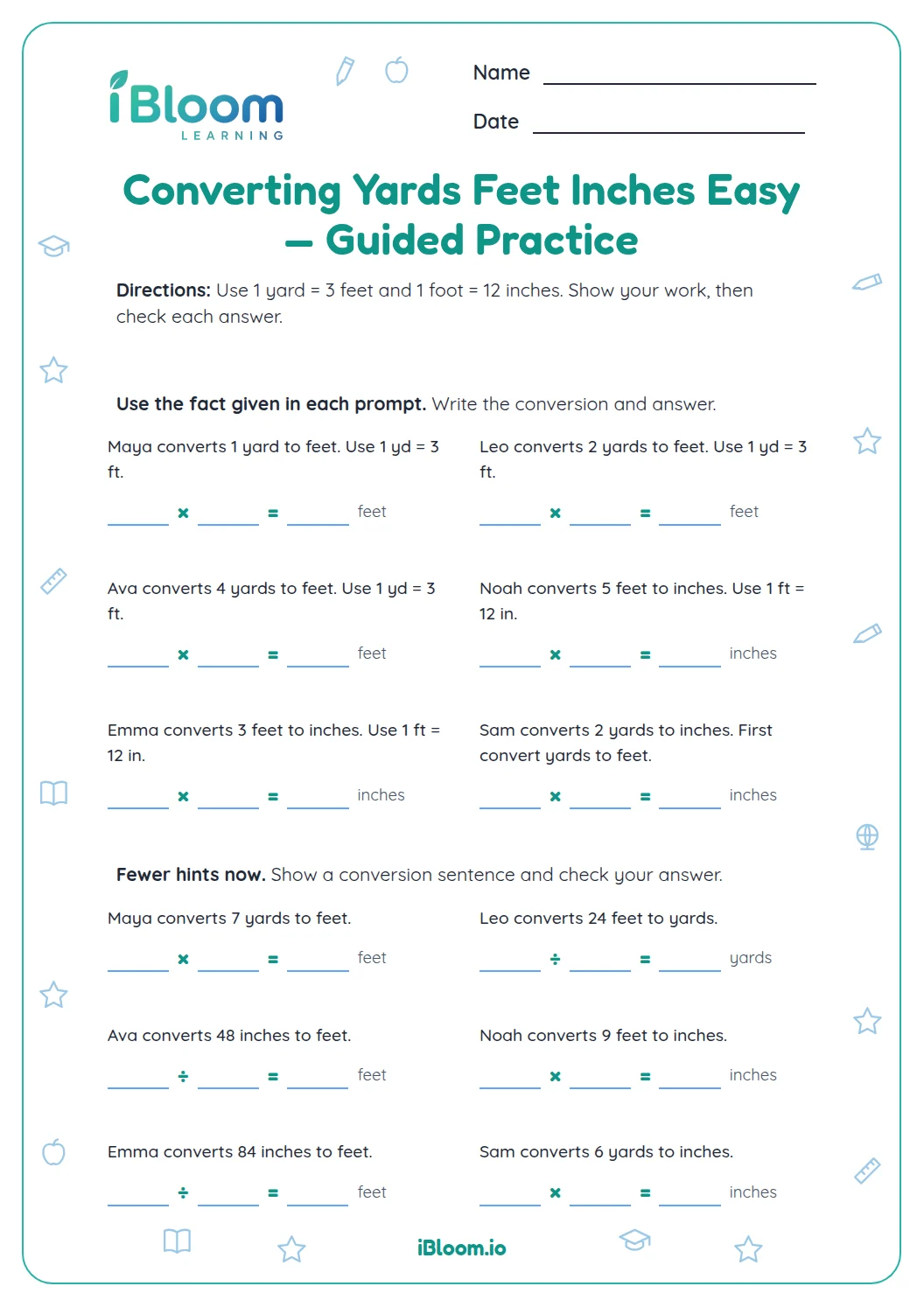
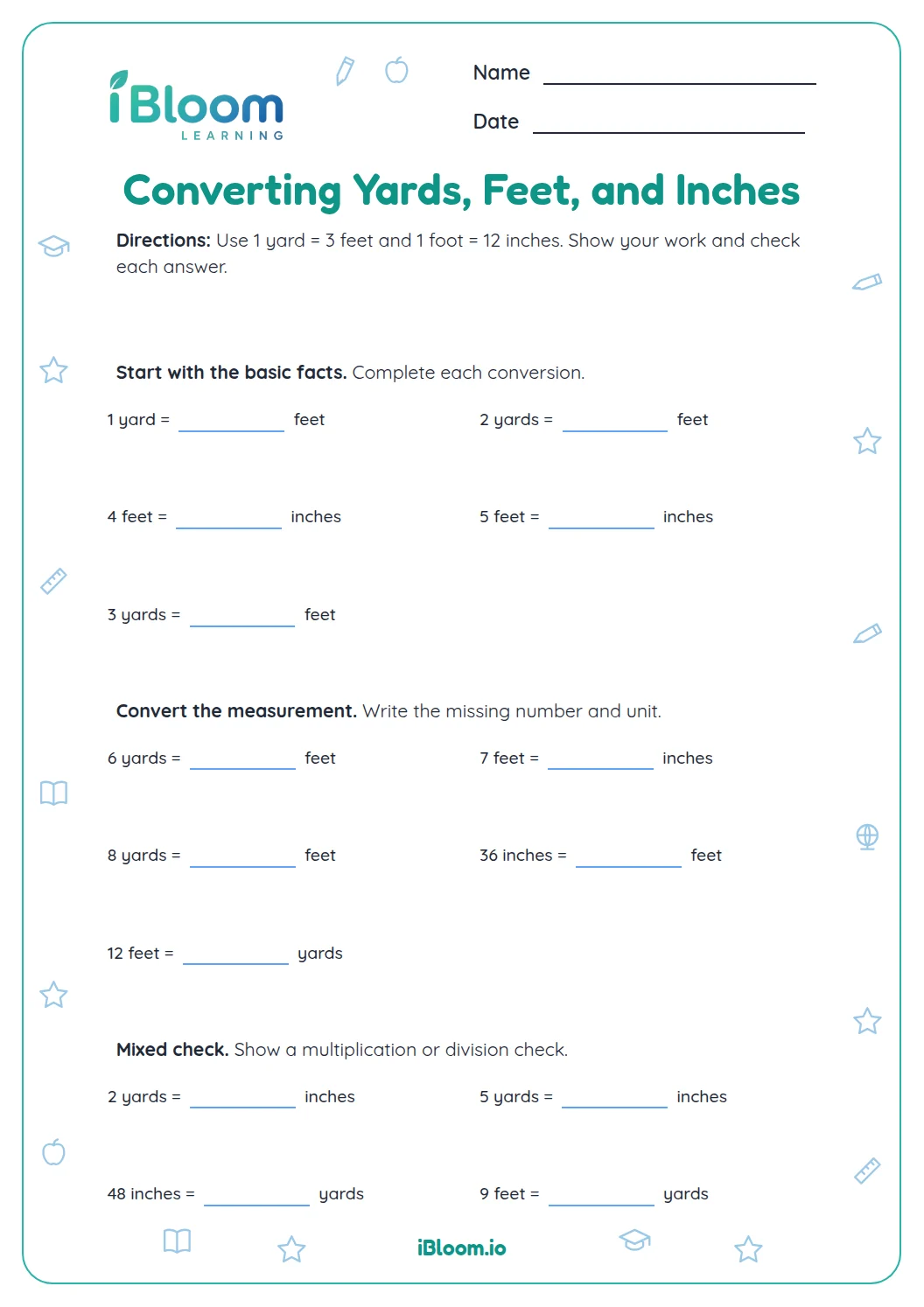
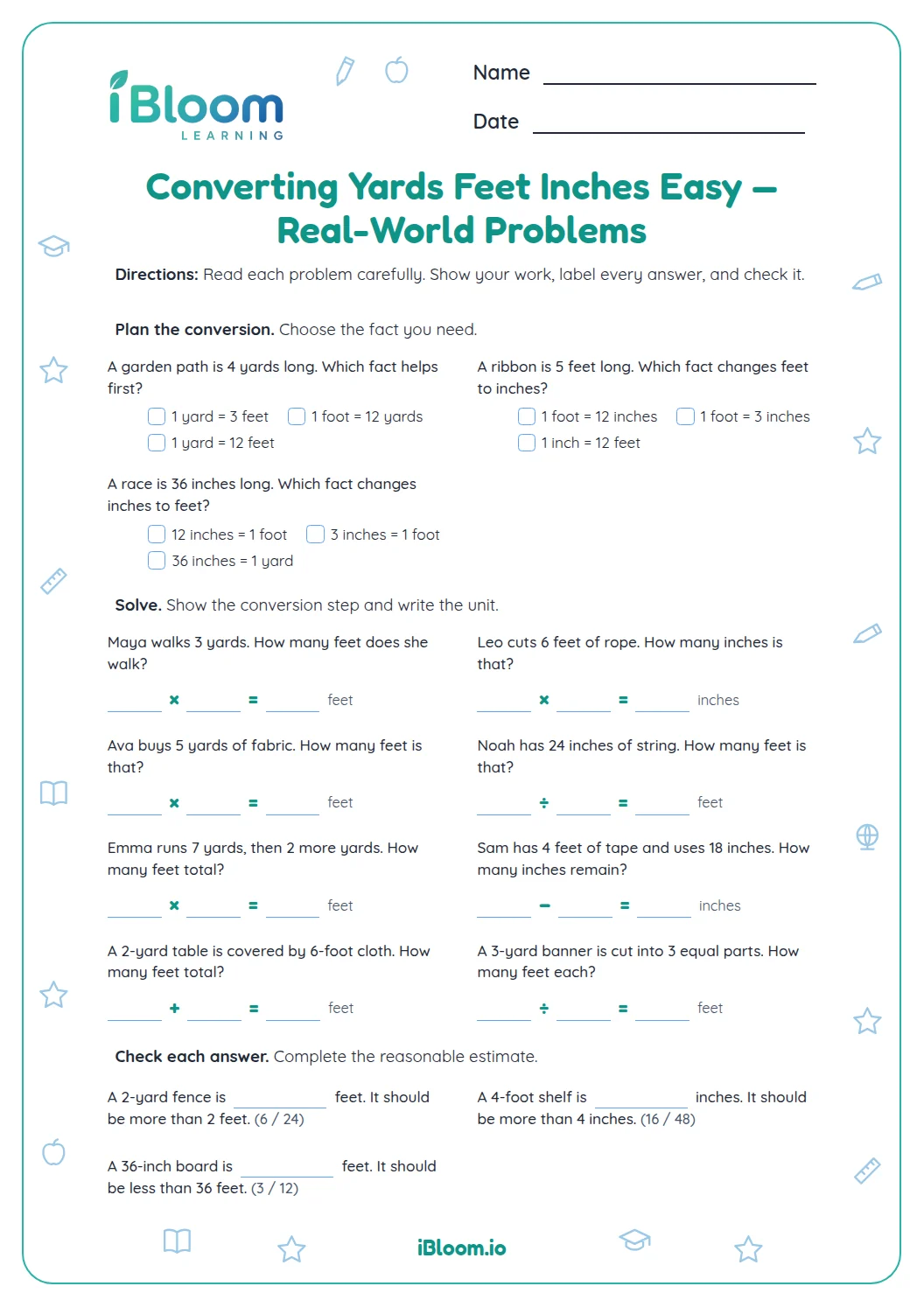
This Grade 3 printable has 16 questions about customary length. Learners convert yards to feet and feet to inches, solve short length situations, compare measurements in a shared unit, and correct two mistaken conversion claims. A separate key includes answers and a sample explanation. The page practices unit relationships and equivalent measurements described in Common Core 4.MD.A.1.
Aligned to 4.MD.A.1
How are yards, feet, and inches related?
Use 1 yard = 3 feet and 1 foot = 12 inches. To change yards to feet, multiply by 3. To change feet to inches, multiply by 12. To move from inches to feet, divide by 12. Keep the unit in each line so the conversion direction stays clear.
- 12 yd = 2 × 3 = 6 ft
- 26 ft + 4 ft = 10 ft
- 3Mia walks 10 ft altogether.
How can the conversions help compare lengths?
Put both lengths in the same unit before comparing. For question 9, 2 yd is 6 ft, which is 1 ft longer than 5 ft. For question 10, convert 3 yd to 9 ft, then subtract the 2 ft Sam cuts off.
What does the final part check?
Two questions ask students to correct a mistaken conversion. The remaining choices revisit equivalent lengths and comparisons. Ask the learner to name the conversion fact used, then check whether the unit in the answer matches the question.
How to use this worksheet
- 1Write the two facts: 1 yd = 3 ft and 1 ft = 12 in.
- 2Choose whether to multiply or divide based on the direction.
- 3Write the number calculation and keep its unit.
- 4Convert both measurements to one unit before comparing.
- 5Check a conversion by reversing it.
Common mistakes and quick fixes
The mistake
Using 12 inches in a yard conversion.
The fix
Use 3 feet per yard; use 12 only for feet and inches.
The mistake
Comparing 2 yards directly with 5 feet.
The fix
Convert 2 yards to 6 feet before comparing.
The mistake
Reporting a number without the requested unit.
The fix
Copy the target unit from the question after calculating.
Common Core alignment
This worksheet gives practice with the stated skill.
Convert between yards, feet, and inches and record equivalent lengths.
On this sheet: The questions convert yards to feet and feet to inches, then apply those relationships in comparisons and length situations.
Show the official wordingHide the official wording
Know relative sizes of measurement units within one system of units including km, m, cm; kg, g; lb, oz.; l, ml; hr, min, sec. Within a single system of measurement, express measurements in a larger unit in terms of a smaller unit. Record measurement equivalents in a two-column table. For example, know that 1 ft is 12 times as long as 1 in. Express the length of a 4 ft snake as 48 in. Generate a conversion table for feet and inches listing the number pairs (1, 12), (2, 24), (3, 36), ...
What to practice next
Make more practice
Further reading
Questions parents and teachers ask
How many feet are in a yard?
There are 3 feet in 1 yard. Multiply the number of yards by 3 to change yards to feet. For example, question 1 changes 2 yards into 6 feet. The sheet also uses the fact that 1 foot equals 12 inches.
How many inches are in a foot?
There are 12 inches in 1 foot. Multiply feet by 12 to find inches, or divide inches by 12 to find feet when the amount divides evenly. The worksheet includes both directions, along with problems that combine or compare lengths.
What does the reasoning section include?
It asks learners to combine lengths, compare two measurements after converting them to the same unit, find a remaining length, and explain an equivalent conversion. Each answer should include a suitable unit. The final part also asks students to correct two mistaken conversion claims.
Does the printable come with an answer key?
Yes. The separate key gives the converted values, comparison results, and a sample number sentence for the explanation. Students can complete one part at a time and check the key after showing their calculations. Ask them to name the conversion fact they used.
What is a helpful way to compare yards and feet?
Convert the yards to feet first, because the other length is already in feet. For question 9, 2 yards becomes 6 feet, so it is 1 foot longer than 5 feet. Keeping both lengths in the same unit makes the comparison direct.