


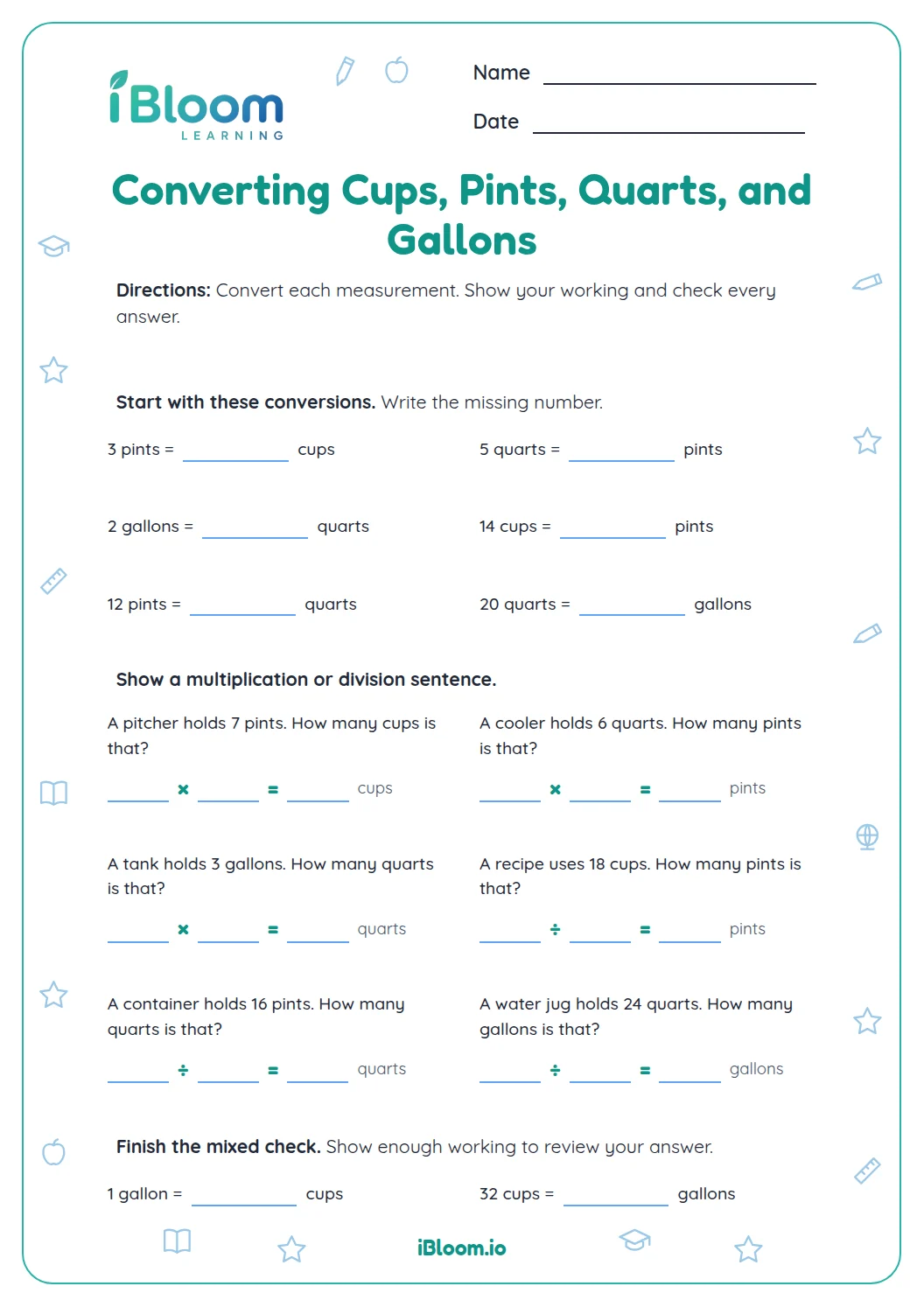
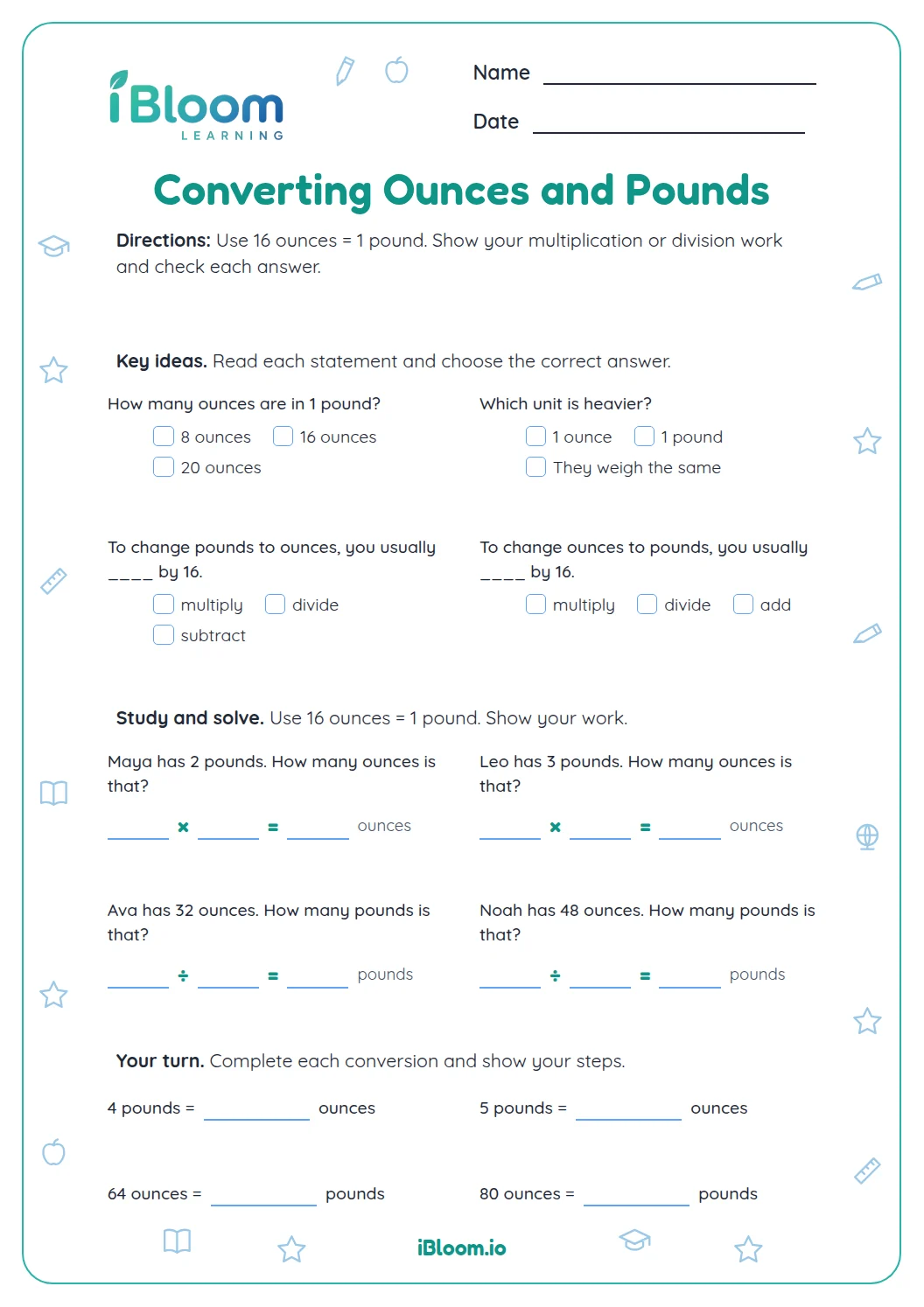
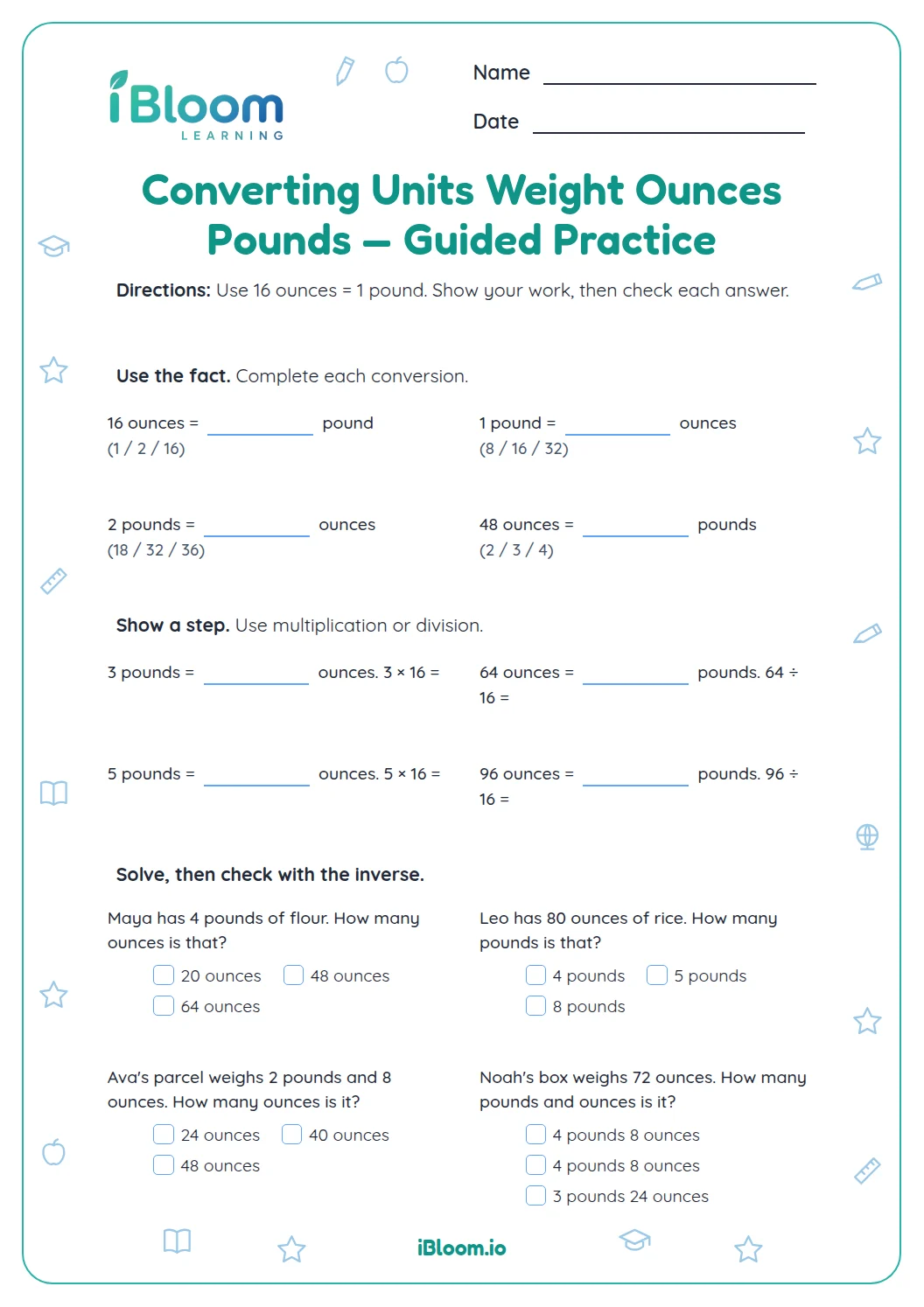
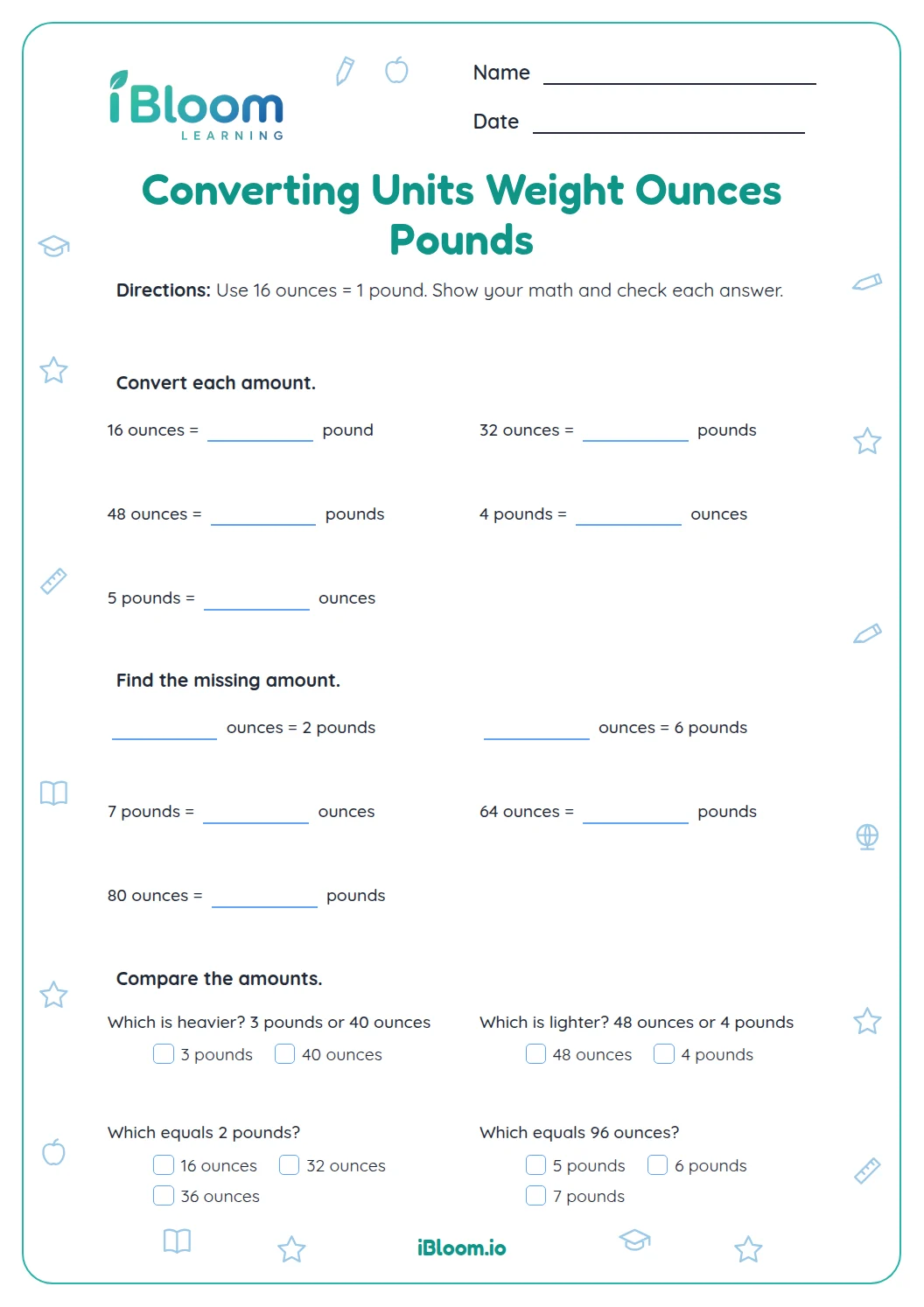


About this worksheet
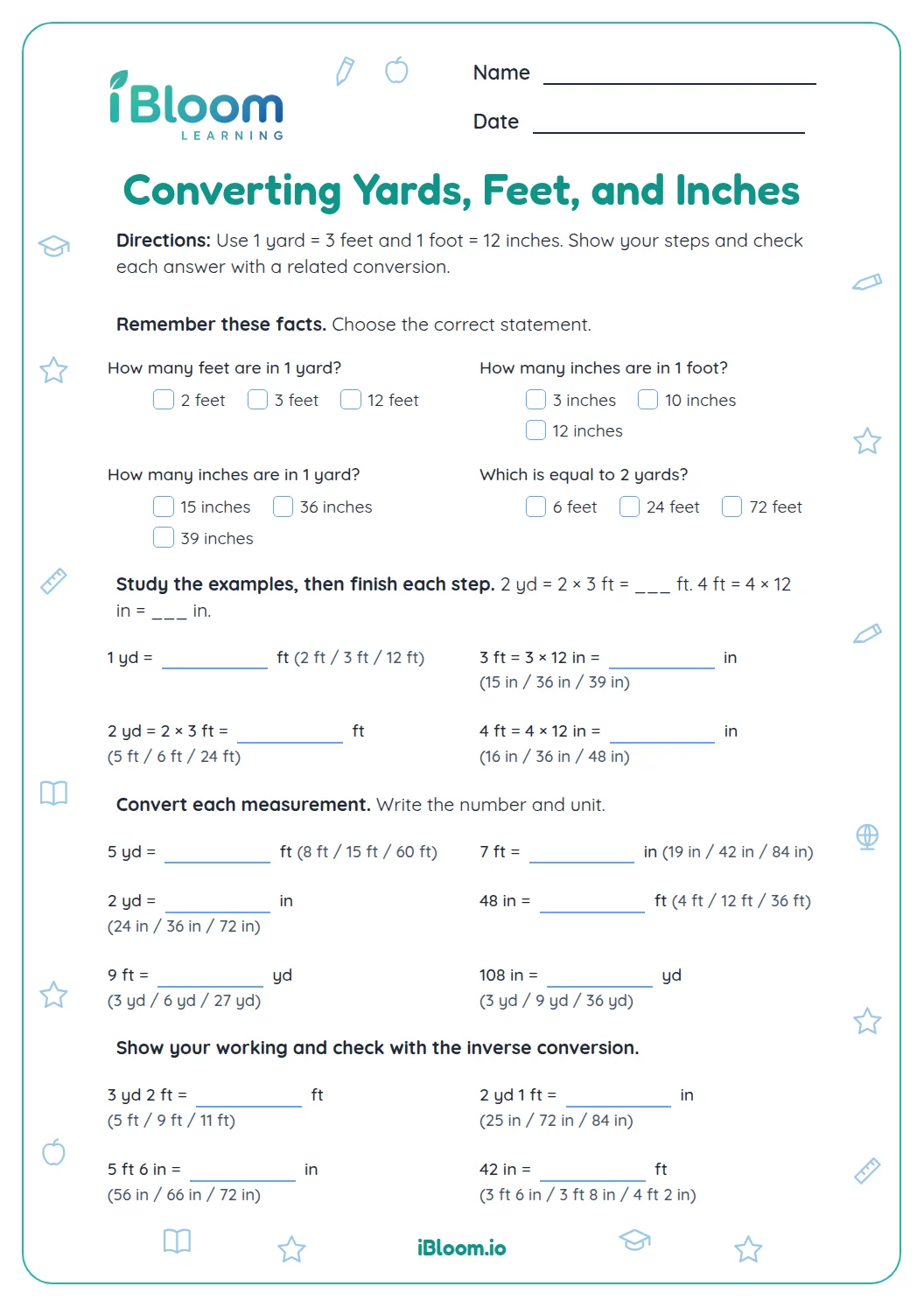
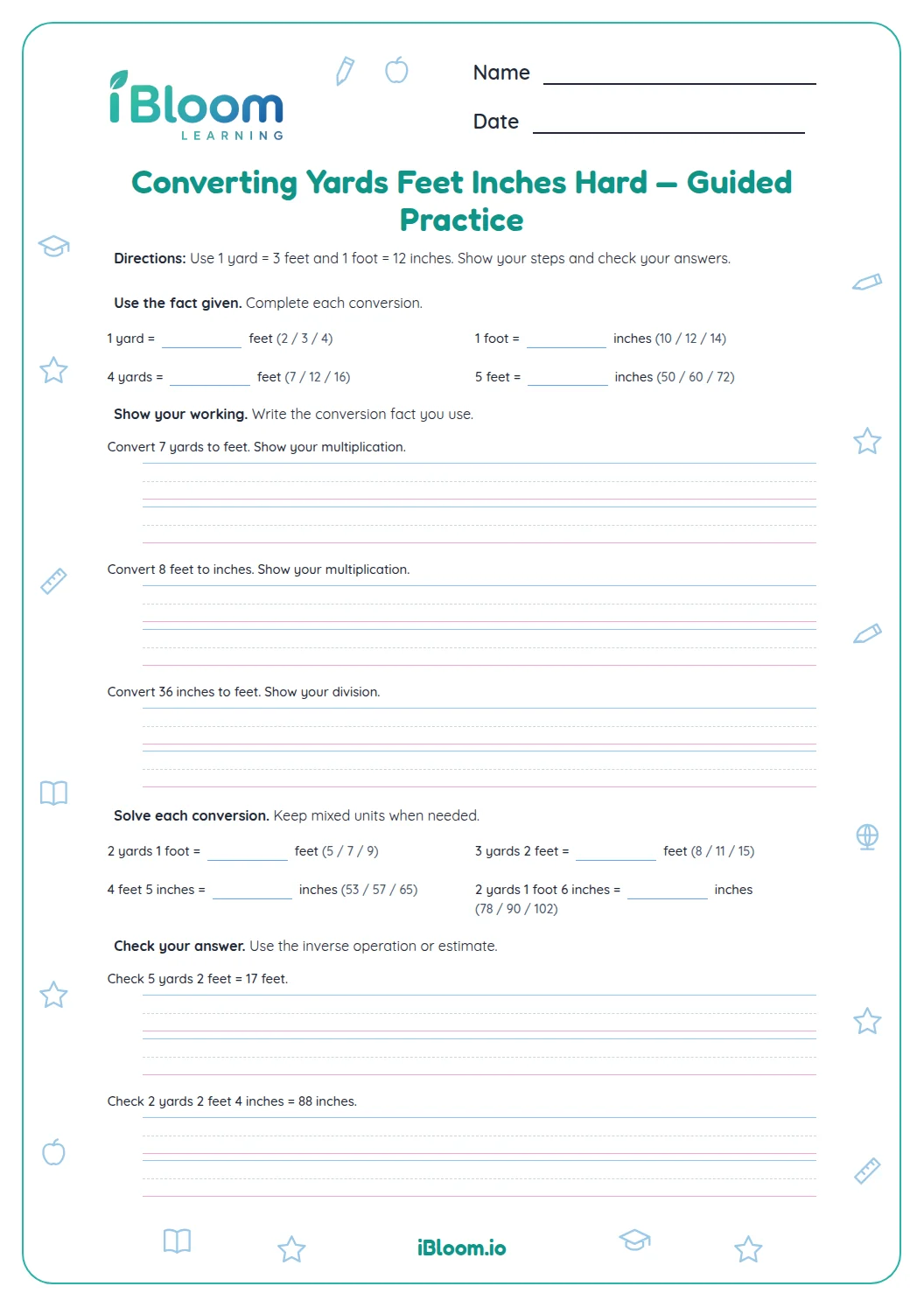
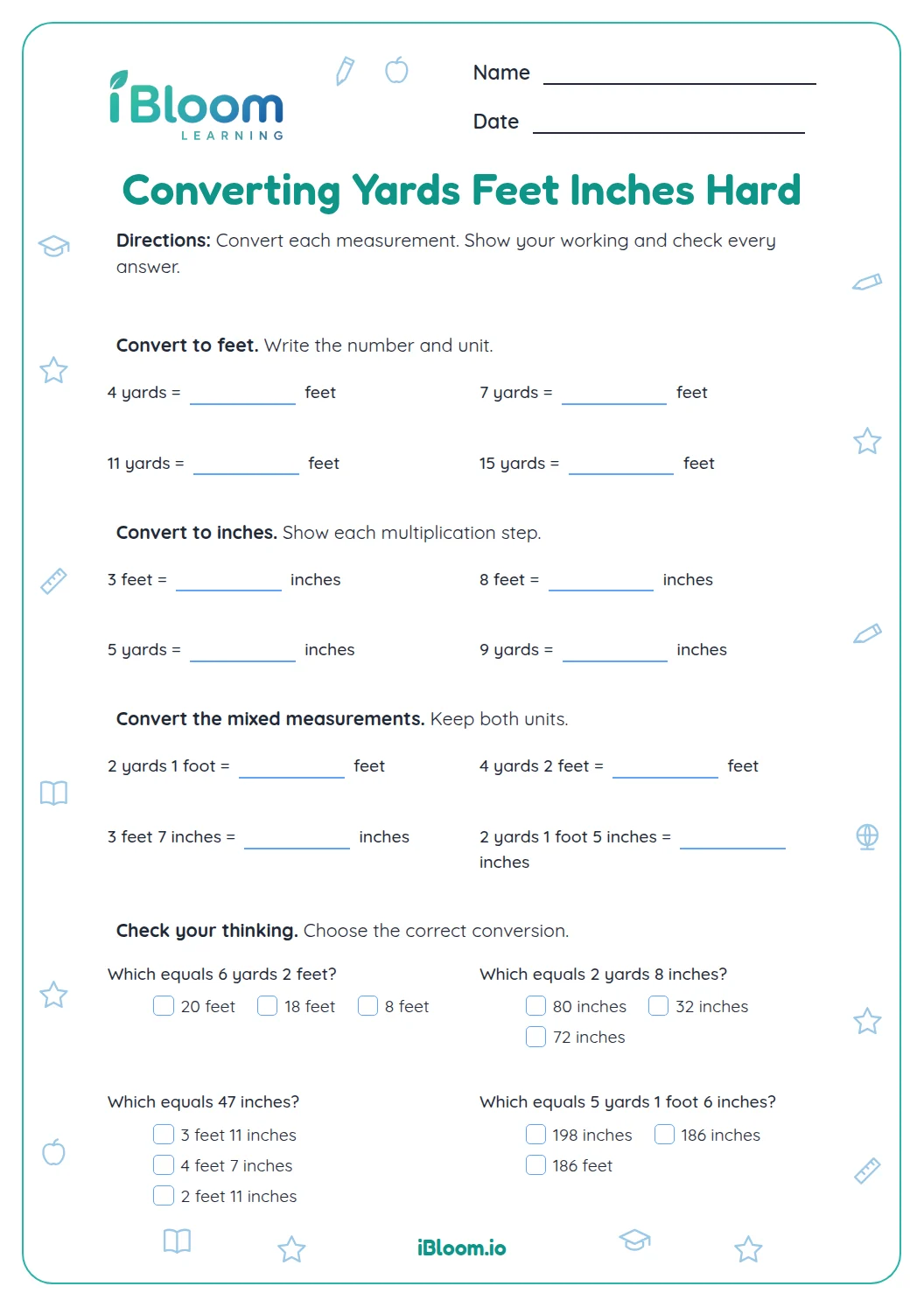
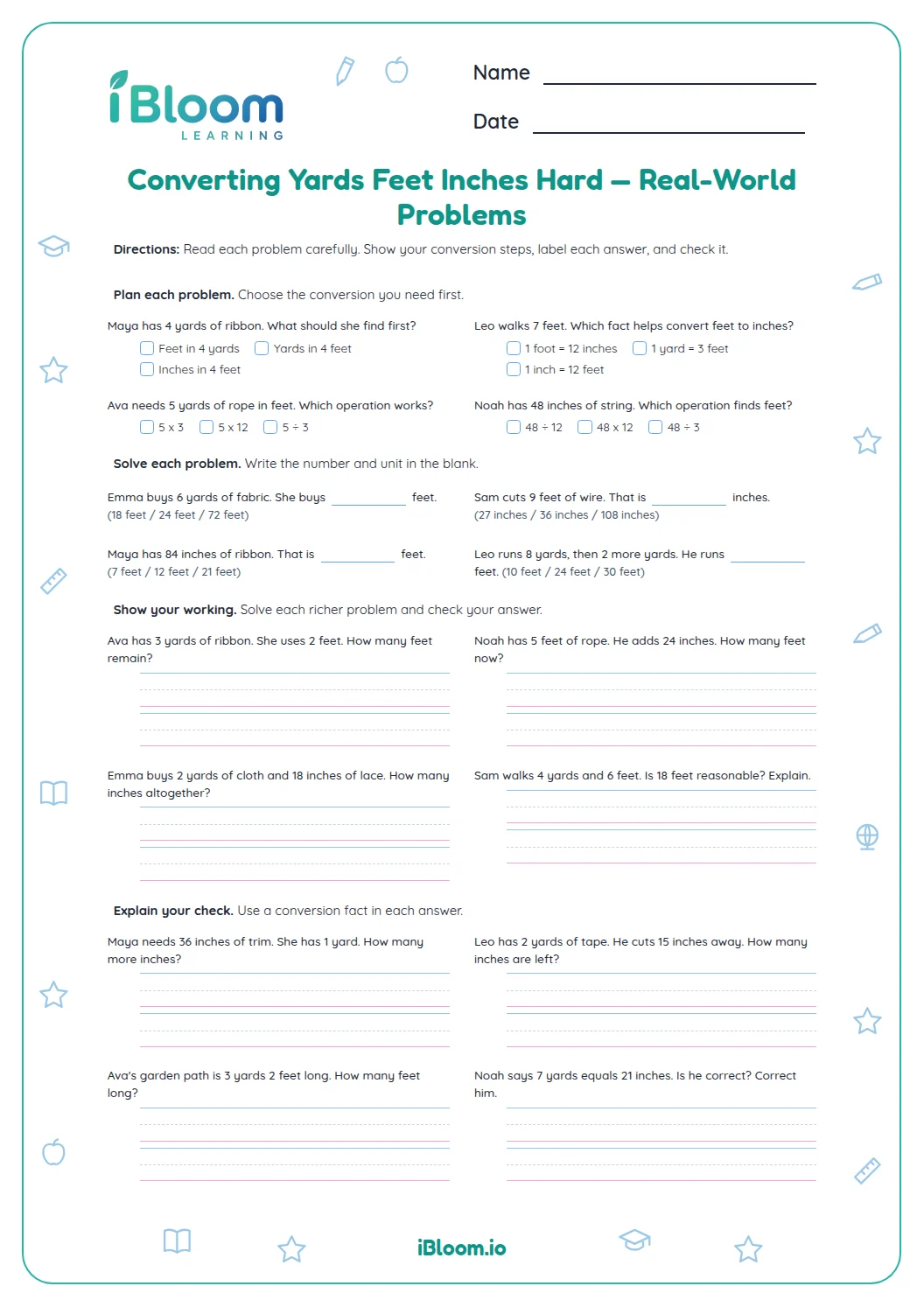
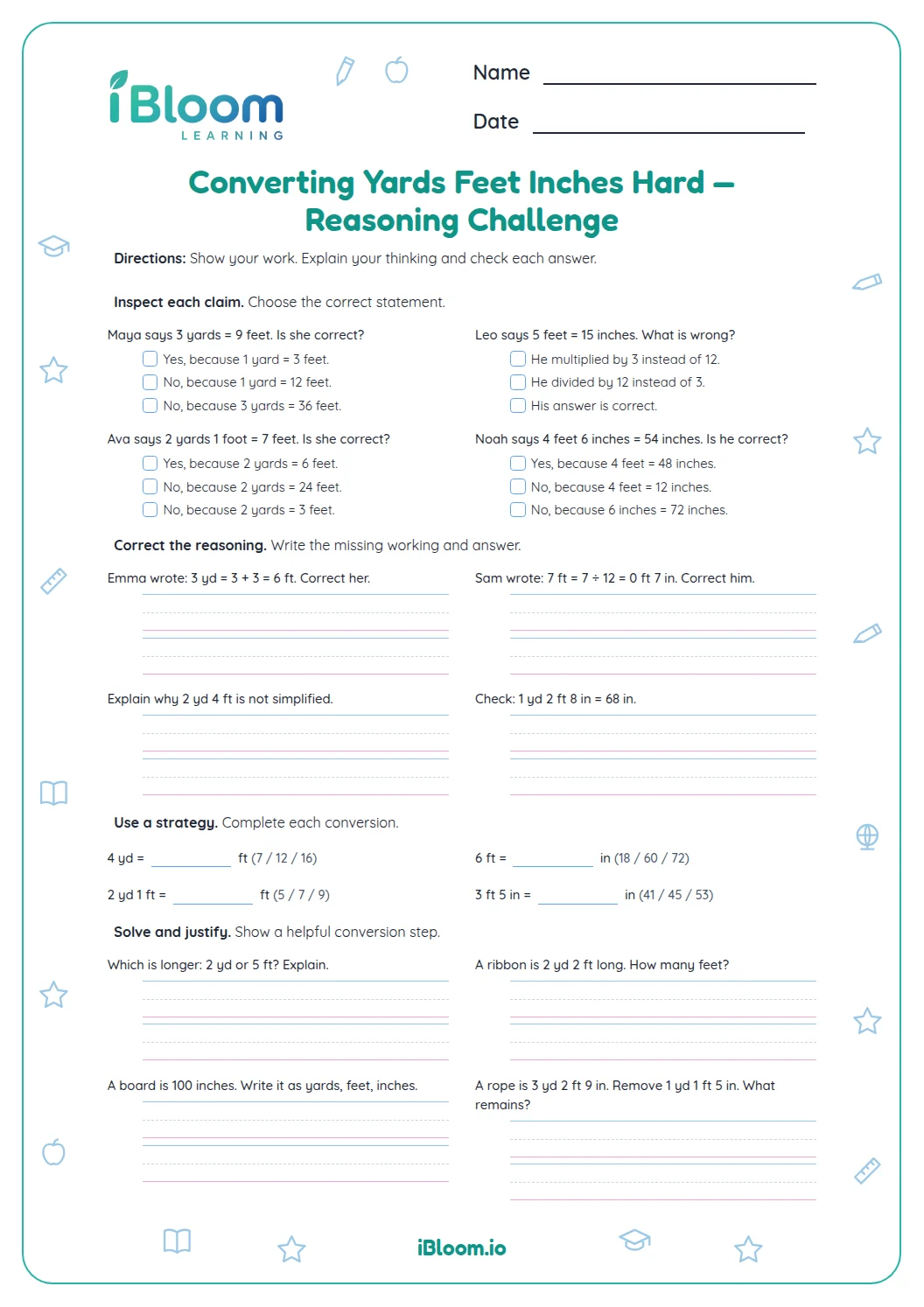
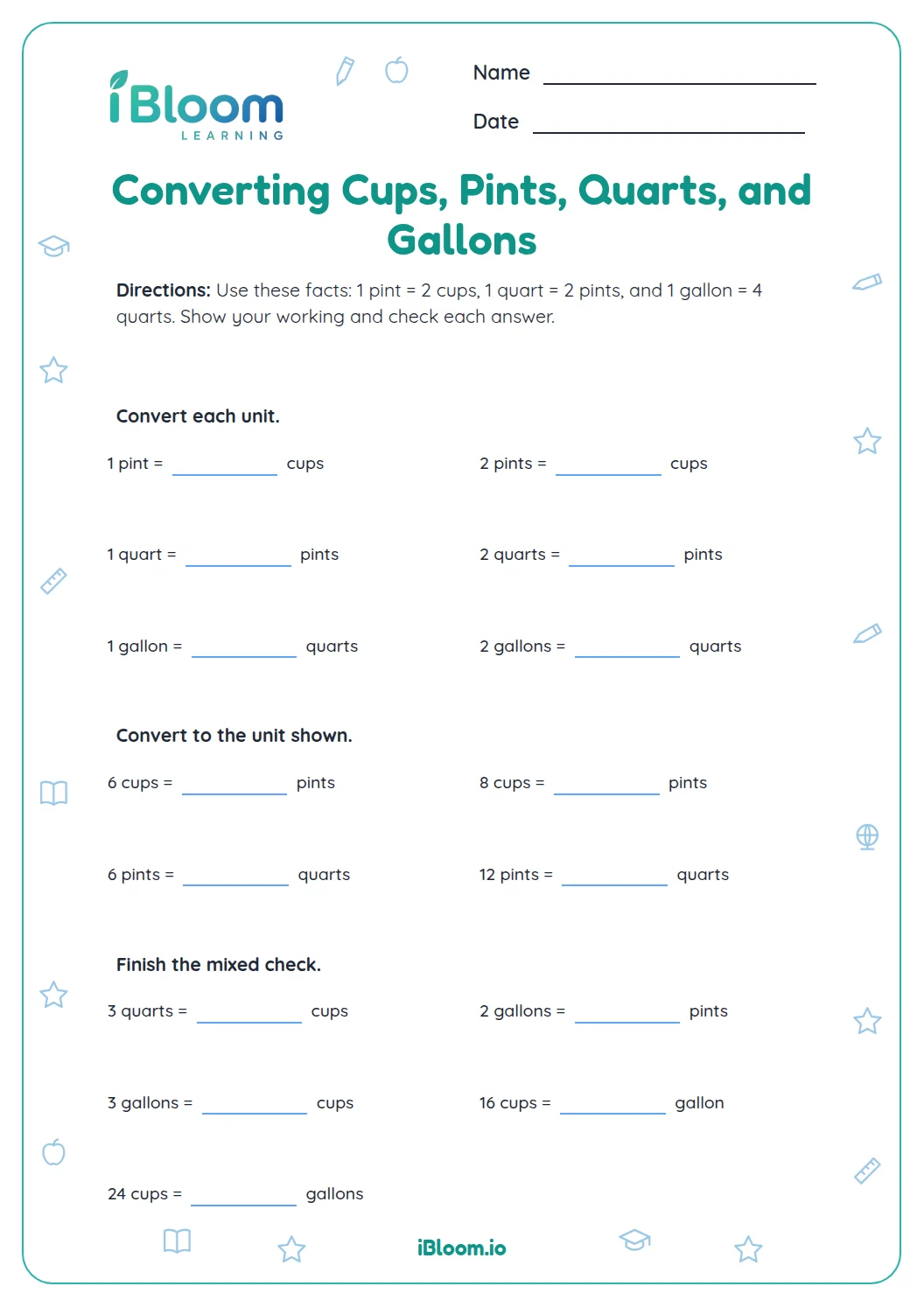
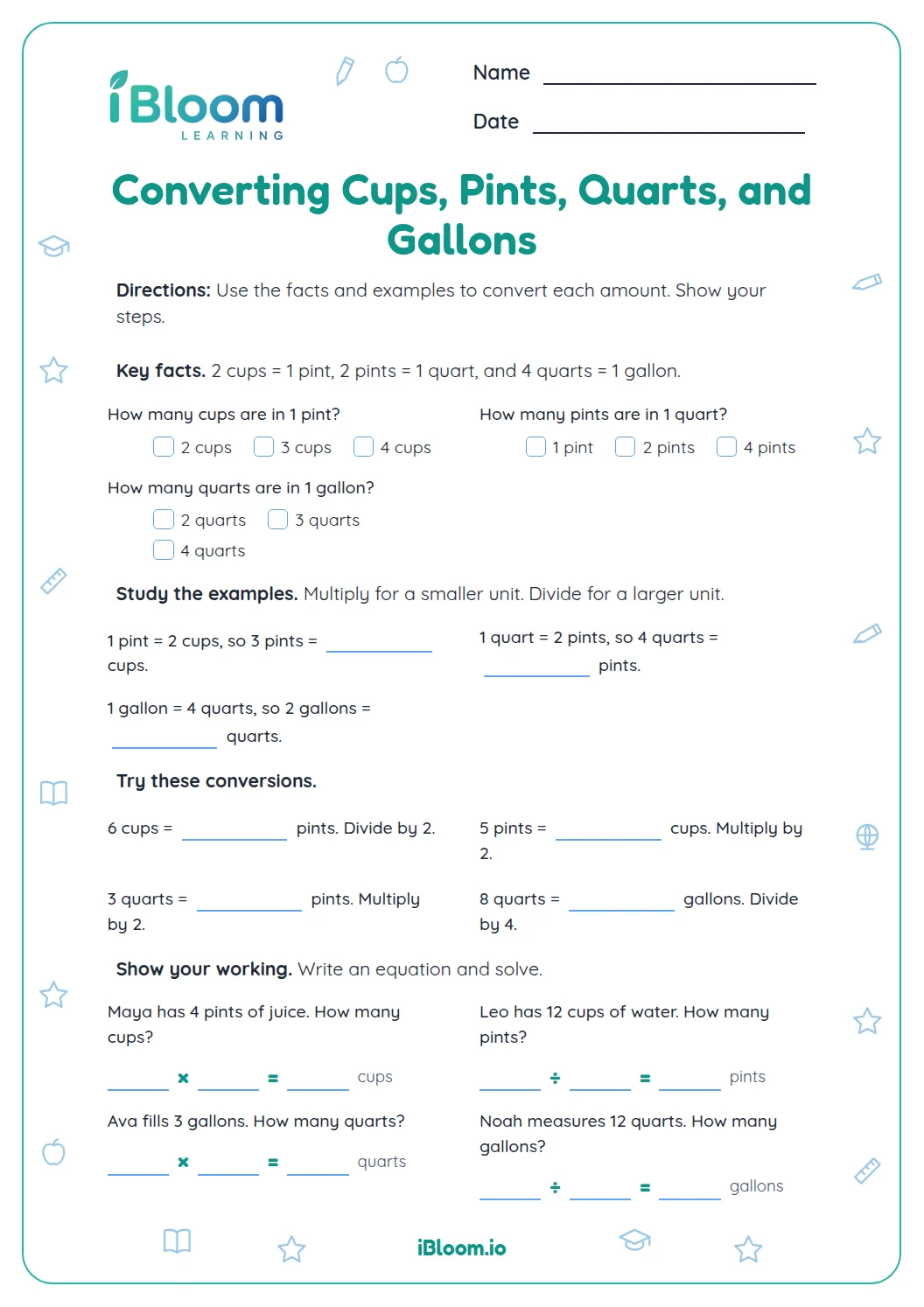
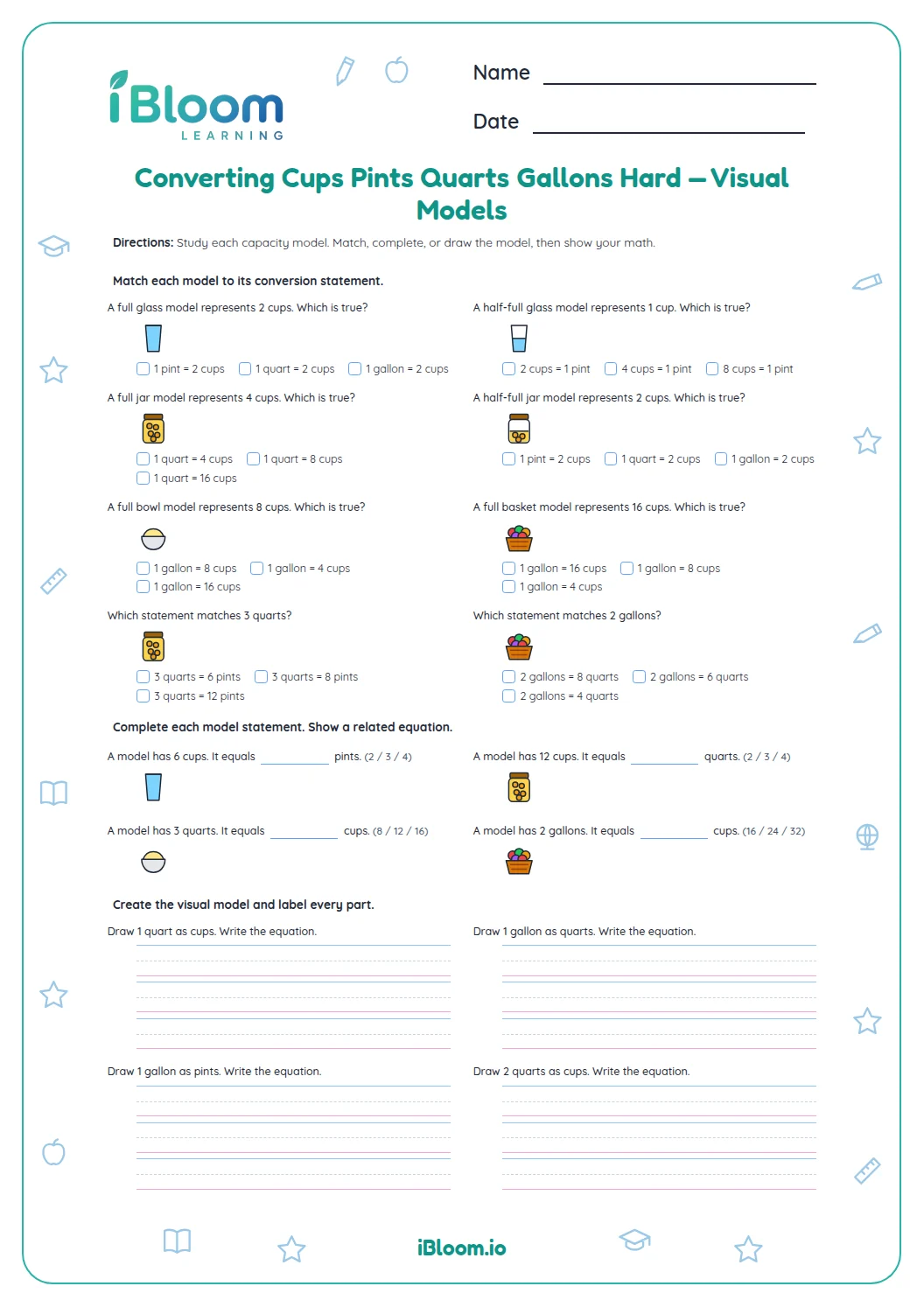
This Grade 3 printable practices the named customary-length conversions with visual reference tables. Eight items complete yard-to-foot or foot-to-inch equivalences; eight more apply the facts to conversions among yards, feet, and inches. Children use 1 yard = 3 feet and 1 foot = 12 inches, then label each result with its unit. The answer key provides all 16 results. The work practices relative sizes of units within one system (CCSS 4.MD.A.1).
Aligned to 4.MD.A.1
Which length facts connect the units?
One yard equals 3 feet, and one foot equals 12 inches. The tables keep those equivalences visible while learners multiply or divide to convert lengths.
When should you multiply or divide?
Multiply when converting a larger unit count into smaller units: 5 yards is 5 groups of 3 feet. Divide when regrouping smaller units into larger ones, such as 18 feet into yards.
- 15 yards × 3 feet per yard
- 25 × 3 = 15
- 3Answer: 15 feet
How can you choose the conversion operation?
Ask whether the new unit is smaller or larger. One yard contains three feet and one foot contains twelve inches, so converting into smaller units uses multiplication; regrouping into larger units uses division.
How to use this worksheet
- 1Read the unit fact in the table.
- 2Decide whether the conversion makes more or fewer units.
- 3Multiply or divide using the matching equivalence.
- 4Write the answer with the requested unit.
- 5Check that the number of smaller units grows.
Common mistakes and quick fixes
The mistake
Multiplying by 12 when converting yards to feet.
The fix
For yards to feet, multiply by 3; reserve the factor 12 for feet to inches.
The mistake
Dividing when converting yards into feet instead of multiplying.
The fix
Yards to feet means more smaller units, so multiply by 3 rather than divide.
The mistake
Writing the right number with the wrong unit.
The fix
Write the requested unit beside the number, then reread the prompt to confirm it matches.
Common Core alignment
Know relative sizes of measurement units within one system of units.
On this sheet: Know relative sizes of measurement units within one system of units.
Show the official wordingHide the official wording
Know relative sizes of measurement units within one system of units.
What to practice next
Make more practice
Further reading
Questions parents and teachers ask
Which unit facts appear in the models?
The tables use 1 yard = 3 feet and 1 foot = 12 inches. Children can use these equalities to find equivalent lengths and to decide whether to multiply or divide. The first fact applies to yards and feet, while the second relates feet and inches.
How many questions are on the worksheet?
There are 16 questions: eight table equivalences and eight conversion problems with reference tables. The items practice conversions among yards, feet, and inches. A table blank asks for an equivalent amount, and the later items use the same relationships in problems.
How do the tables support the conversions?
Each table keeps the relevant equivalence visible while a child works. For example, the yard-to-foot fact shows that every yard contains three feet, so five yards equal five groups of three feet. Seeing the fact beside the question can reduce the need to memorize both conversion relationships at once.
Should each answer include a unit?
Yes. Write the requested unit with the number, such as 15 feet or 60 inches. The unit identifies what the converted number counts. The answer unit should be feet, yards, or inches according to the question wording. For example, feet are smaller than yards, so the count of feet is larger.
How can a child check if the result is reasonable?
Converting to a smaller unit should increase the number of units: yards to feet and feet to inches both produce larger counts. Converting feet to yards produces fewer units. The conversion should also preserve the same length. This direction check helps catch using the correct factor in the wrong conversion.
What does the answer key show?
The key gives an equivalent length for each table blank and a unit-labeled result for each conversion problem. It can be used to check both the calculation and the unit. Compare the key result with the unit relationship as well as the arithmetic.