






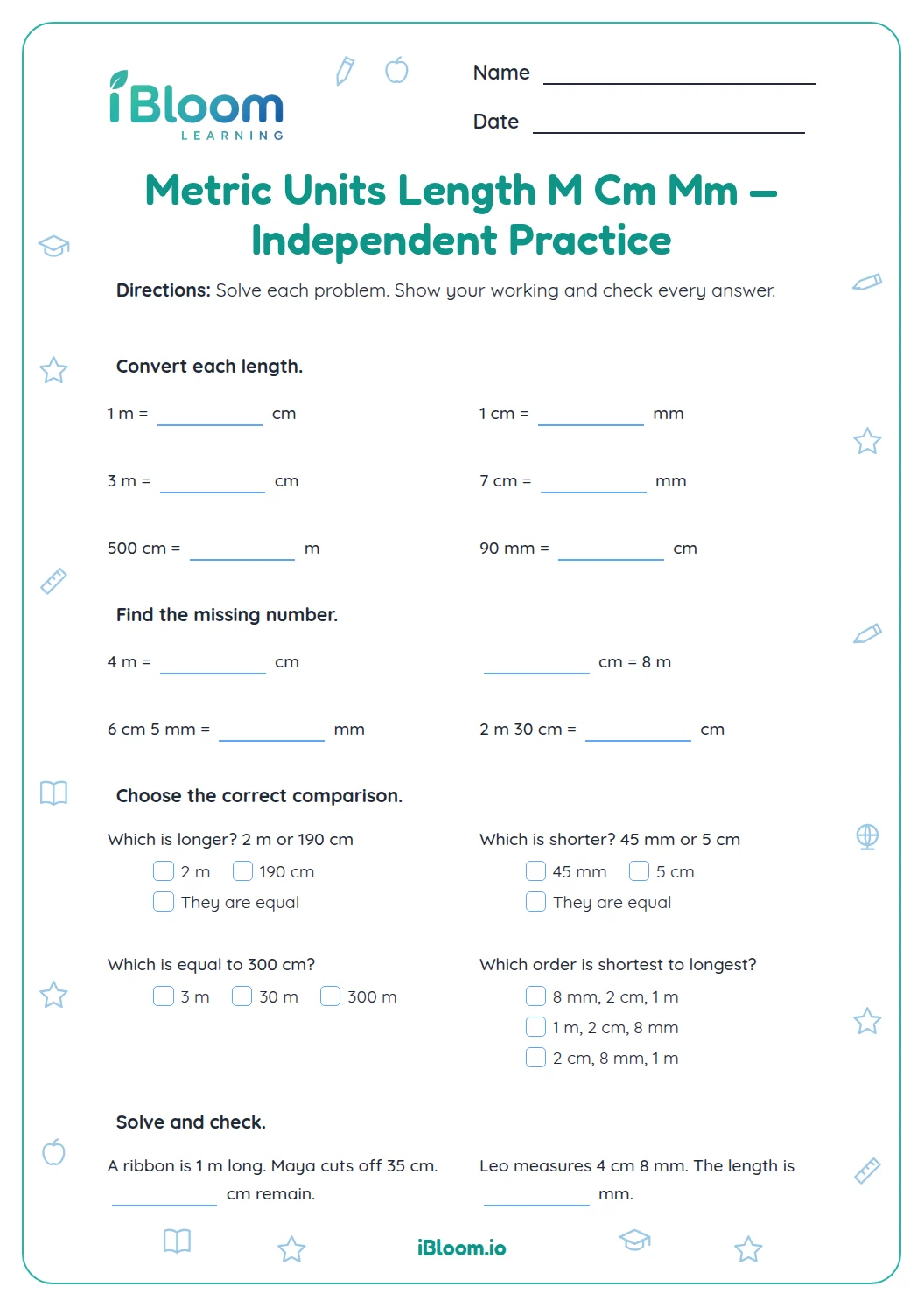
About this worksheet
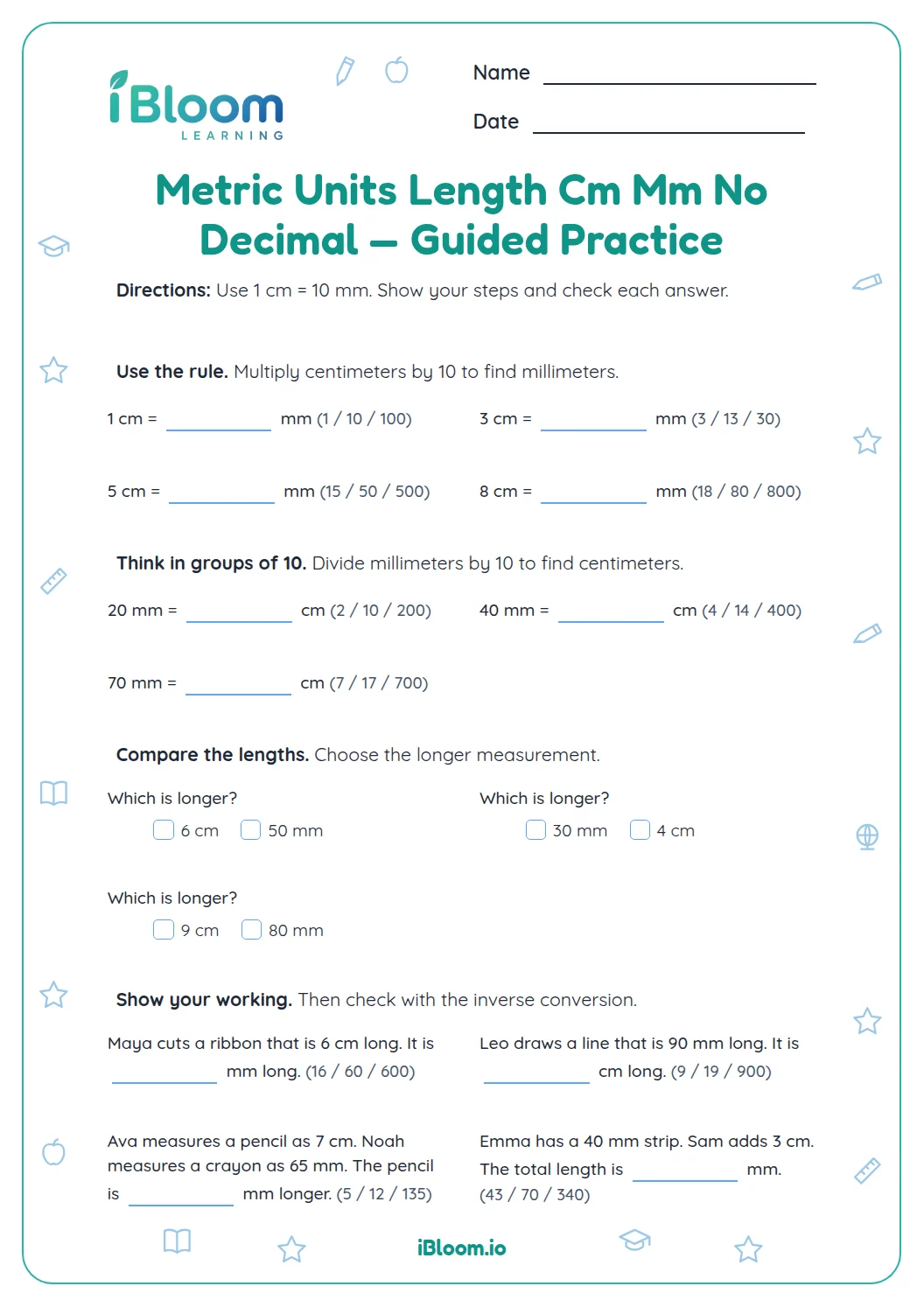
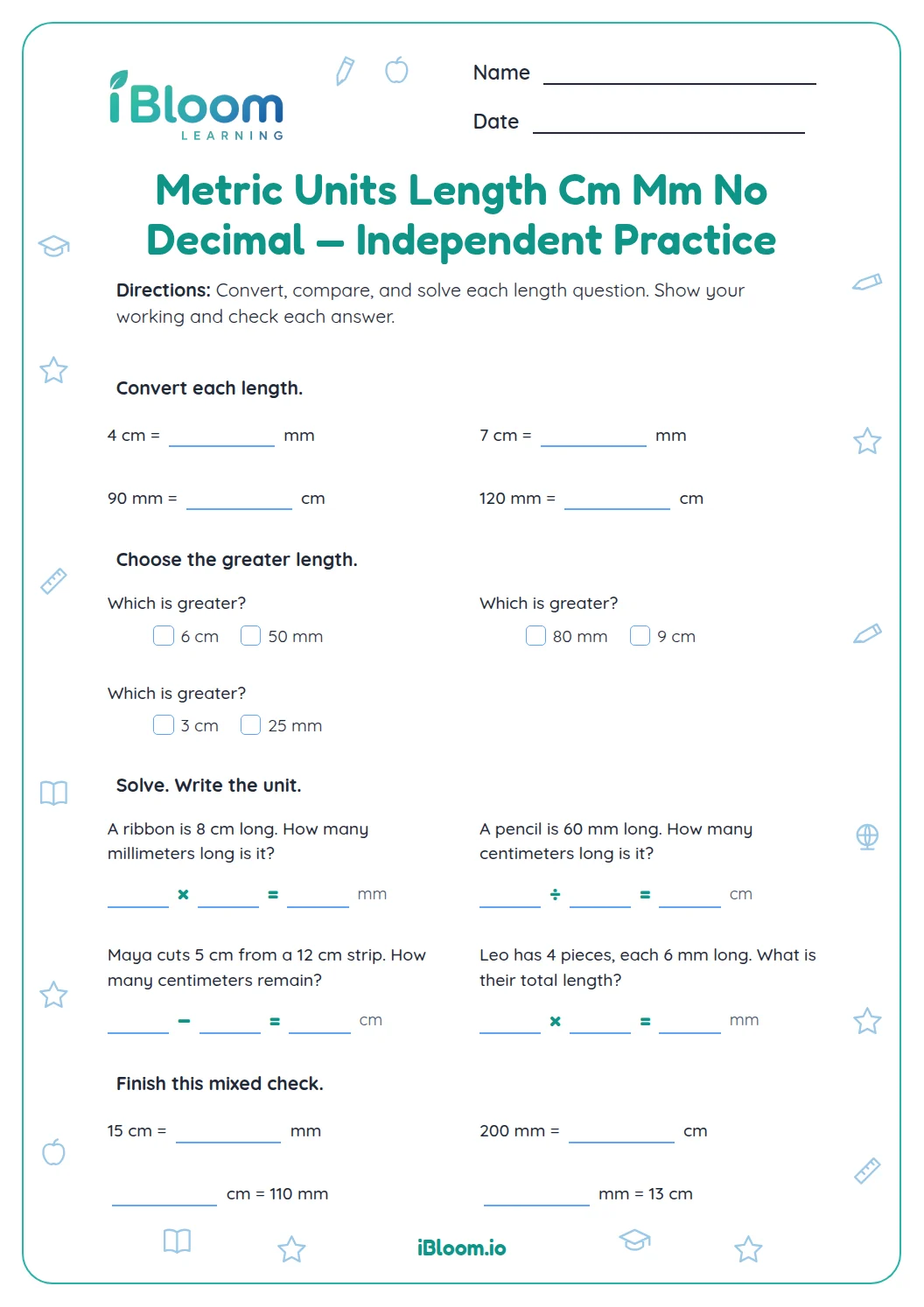
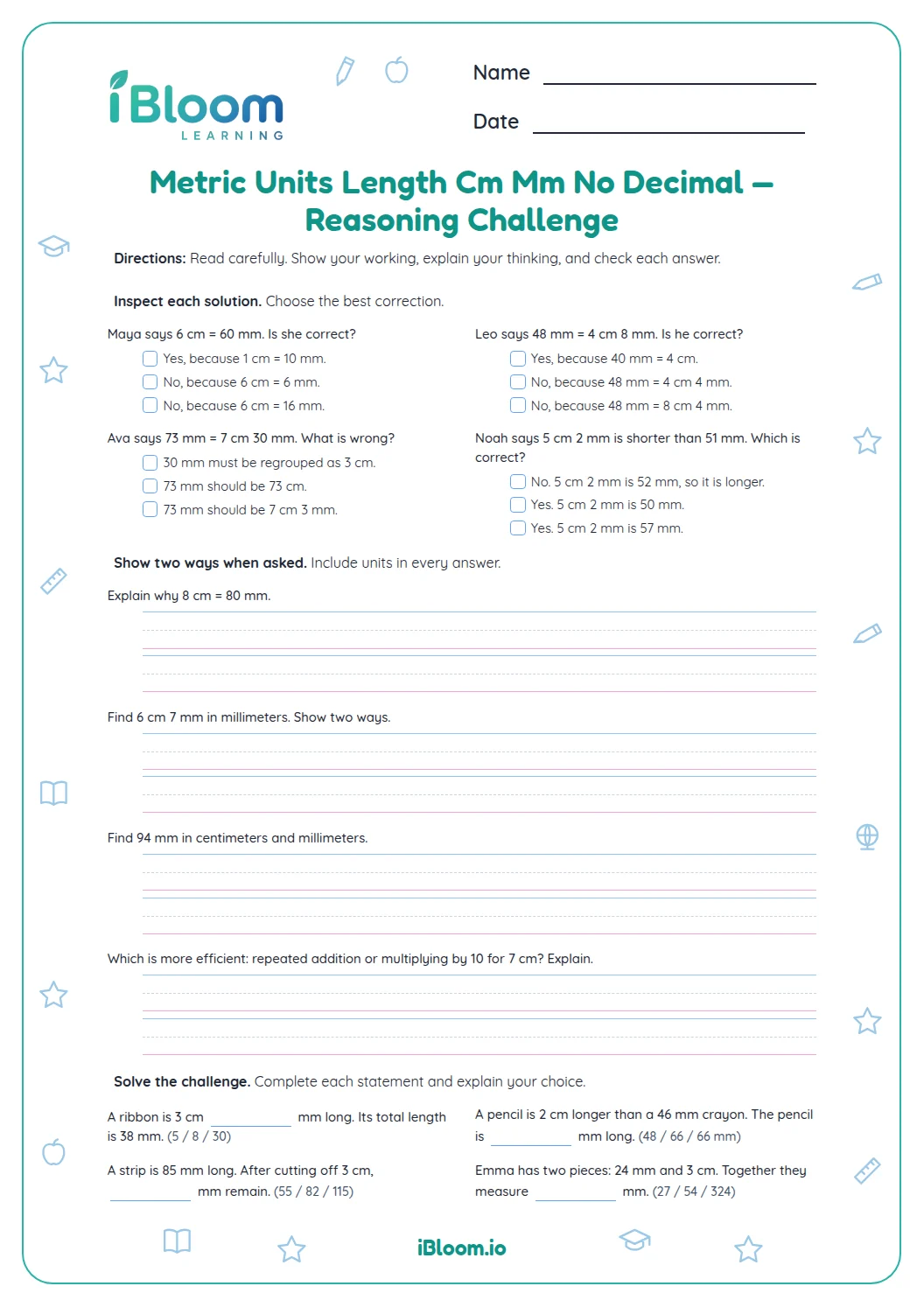
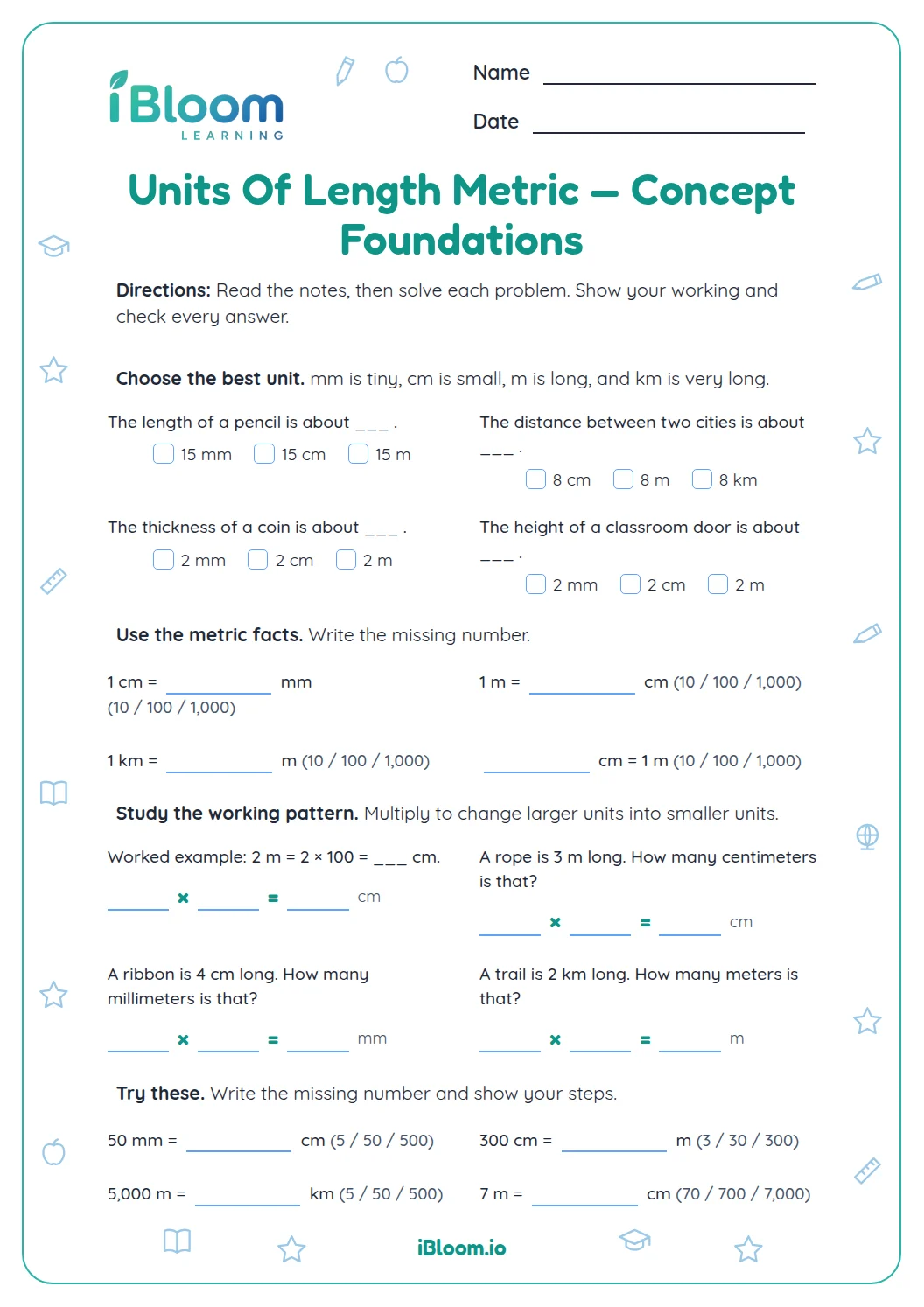
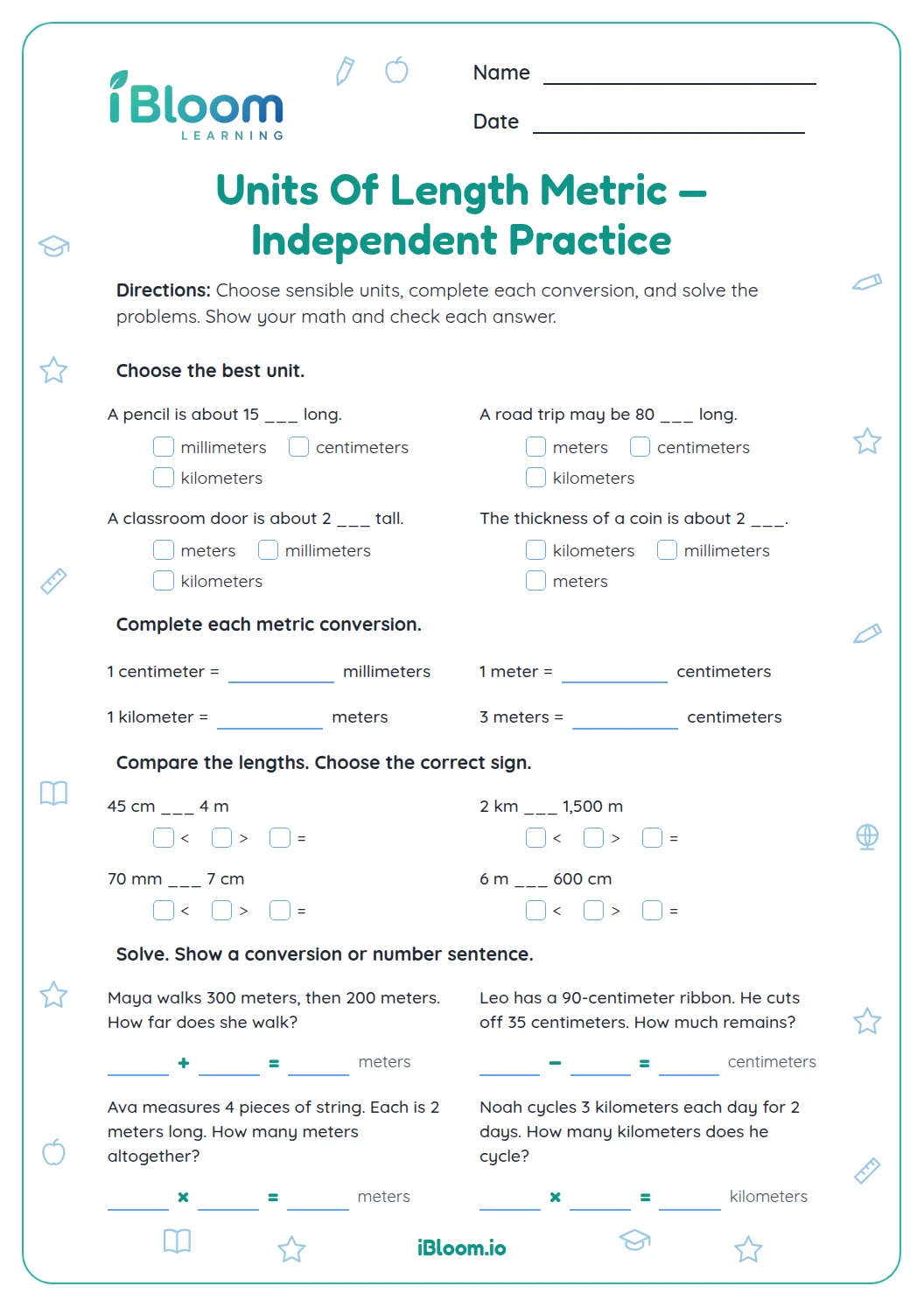
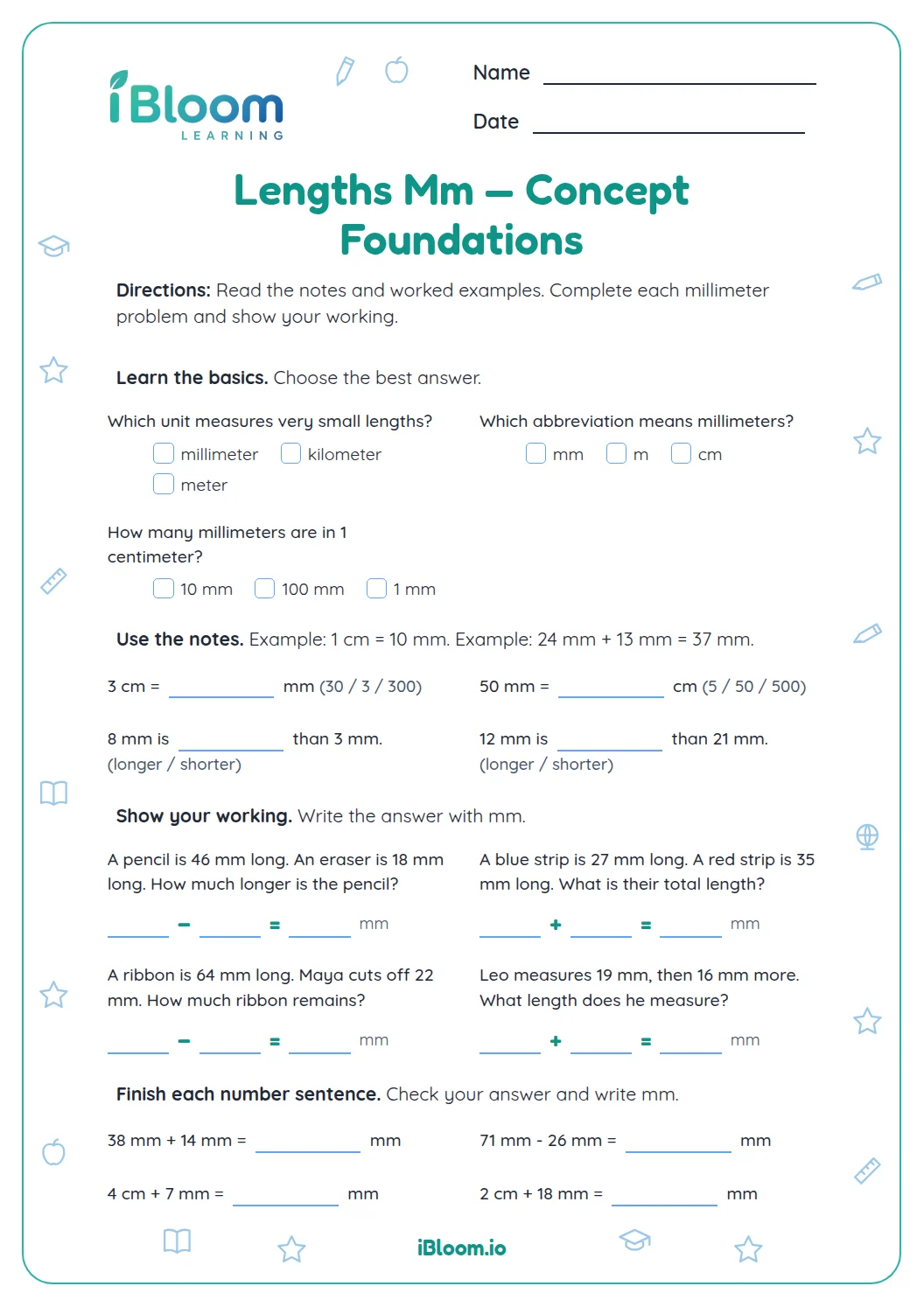
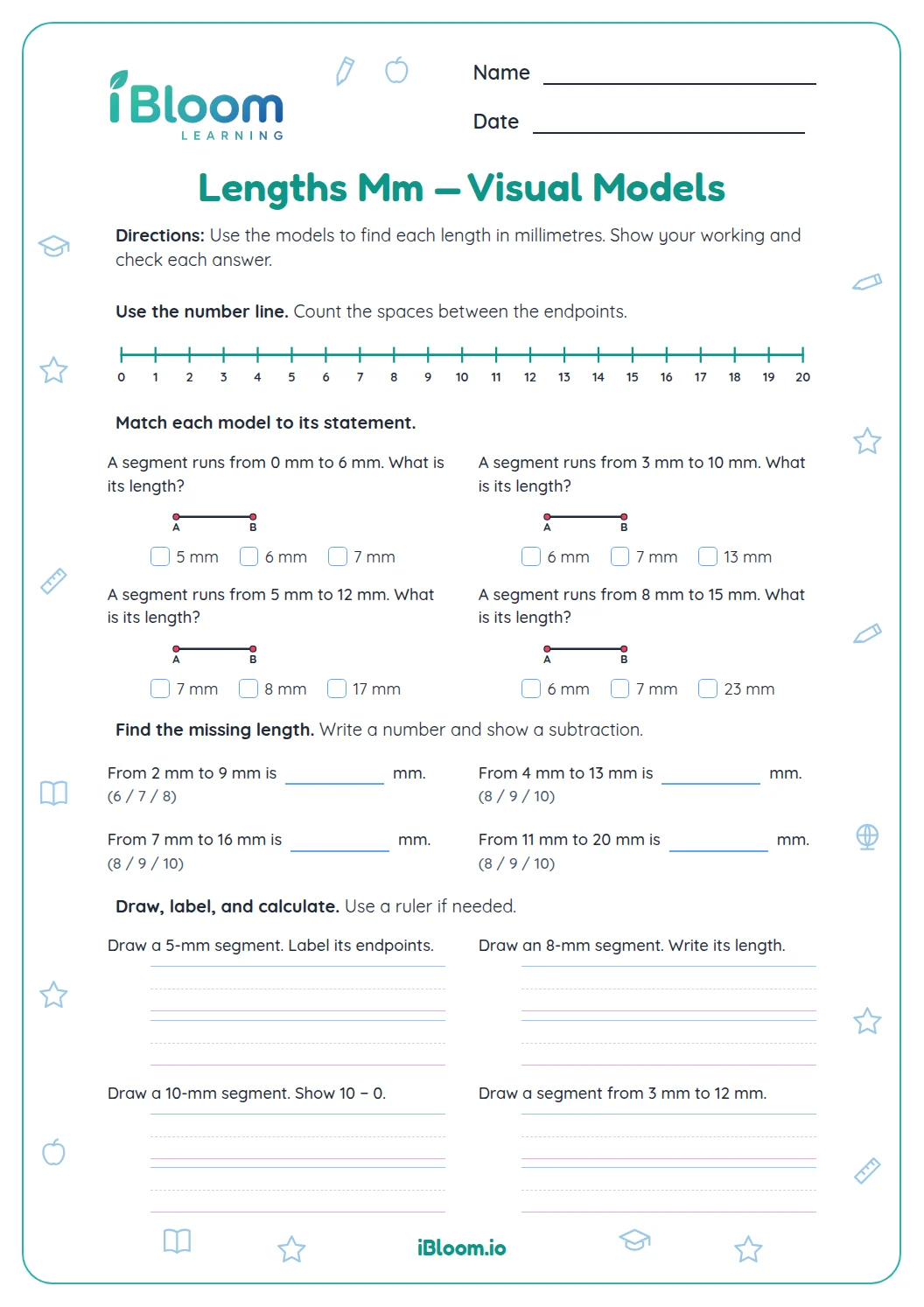
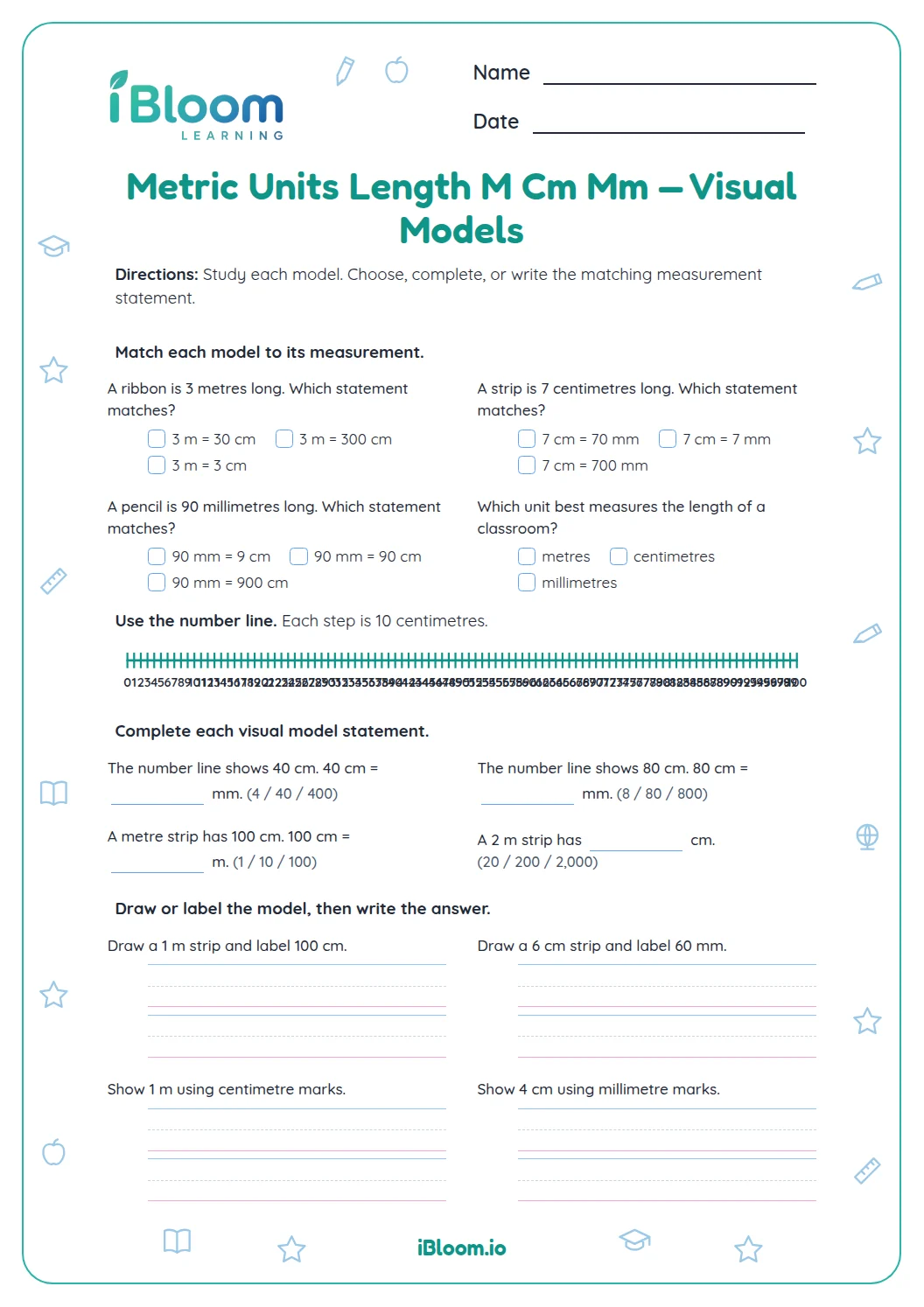
This free Grade 3 worksheet uses craft sticks, ribbons, cards and a model path to practice the relationship between centimeters and millimeters. Its fourteen questions move from choosing a sensible unit and renaming one length to comparing two lengths and solving joining, cutting and sharing situations. Children use 1 cm = 10 mm, convert to a common unit and record a whole-number answer with its unit. The work practices CCSS 4.MD.A.1, expressing measurements within one system of units. The comparison and calculation parts provide space for number sentences, and the separate answer key lists the requested lengths.
Aligned to 4.MD.A.1
Why does converting to millimeters give a larger number?
A millimeter is a smaller unit than a centimeter. It takes ten millimeters to cover the same length as one centimeter. An 8 cm craft stick is therefore 80 mm long; the stick stays the same length while the count of units changes.
How do children compare 9 cm and 70 mm?
Question 7 asks how much longer the red ribbon is than the blue ribbon. Comparing the numbers 9 and 70 directly would ignore their units. Rename the red ribbon first, then subtract lengths measured in millimeters.
- 1Red ribbon: 9 cm = 90 mm
- 2Blue ribbon: 70 mm
- 390 mm − 70 mm = 20 mm
- 4The red ribbon is 20 mm longer.
How are the three parts organized?
Part A has two unit choices and four conversions in everyday settings. Part B has four difference questions, each with centimeters and millimeters together. Part C has four problems about joining strips, cutting ribbon, finishing a path and sharing a cord.
For the cord problem, children may halve 16 cm first to get 8 cm, then convert to 80 mm. They may also convert to 160 mm and halve that. Both routes preserve the same length relationship.
How to use this worksheet
- 1Read the reminder that 1 cm equals 10 mm.
- 2Underline the unit requested in each question.
- 3Rename lengths in one common unit and write the conversion.
- 4Choose the operation from the situation: combine, compare, take away or share equally.
- 5Write the answer with cm or mm, then check it against the original length.
Mistakes to discuss
The mistake
Subtracting 70 from 9 because the units were skipped.
The fix
Convert 9 cm to 90 mm before subtracting 70 mm.
The mistake
Dividing by ten when changing centimeters to millimeters.
The fix
Picture ten little millimeters in each centimeter; count ten for every centimeter.
The mistake
Giving the correct number with the wrong unit.
The fix
Reread the requested unit and say the whole answer aloud, such as 80 millimeters.
Common Core alignment
Use the relationship 1 cm = 10 mm to express lengths in a common unit.
On this sheet: Children express centimeter lengths in millimeters to solve everyday length problems.
Show the official wordingHide the official wording
Know relative sizes of measurement units within one system of units including km, m, cm; kg, g; lb, oz.; l, ml; hr, min, sec. Within a single system of measurement, express measurements in a larger unit in terms of a smaller unit. Record measurement equivalents in a two-column table. For example, know that 1 ft is 12 times as long as 1 in. Express the length of a 4 ft snake as 48 in. Generate a conversion table for feet and inches listing the number pairs (1, 12), (2, 24), (3, 36), …
What to practice next
Make more practice
Further reading
Questions parents and teachers ask
Do children need a ruler for this worksheet?
No, every length needed to solve the problems is given in the text. A centimeter ruler can still help explain the relationship: find the ten millimeter spaces within one centimeter. After that demonstration, children use the stated lengths and conversion reminder to work through the fourteen problems.
Are any decimal answers required?
No, all the measurements and answers use whole numbers. The conversions from millimeters to centimeters use multiples of ten, such as 60 mm and 150 mm. The calculation questions request millimeters, so children can convert first and then calculate without introducing a decimal measurement.
Why is question 7 answered with 20 mm?
The red ribbon is 9 cm, which equals 90 mm, and the blue ribbon is 70 mm. Subtracting 70 mm from 90 mm gives 20 mm. The word longer asks for the difference between the lengths, rather than their combined length or either individual measurement.
Can my child solve the cord question in a different order?
Yes, either order works when the conversion and equal sharing are both done correctly. Your child can halve 16 cm to get 8 cm and then rename it as 80 mm. Alternatively, convert 16 cm to 160 mm first and divide that length into two equal pieces.
What does the answer key include?
The key supplies cm and mm for the two unit choices, completes four conversion blanks and gives the final lengths for eight calculation problems. Check the child’s number sentences too: the work should show a suitable conversion and the operation needed for each situation.