
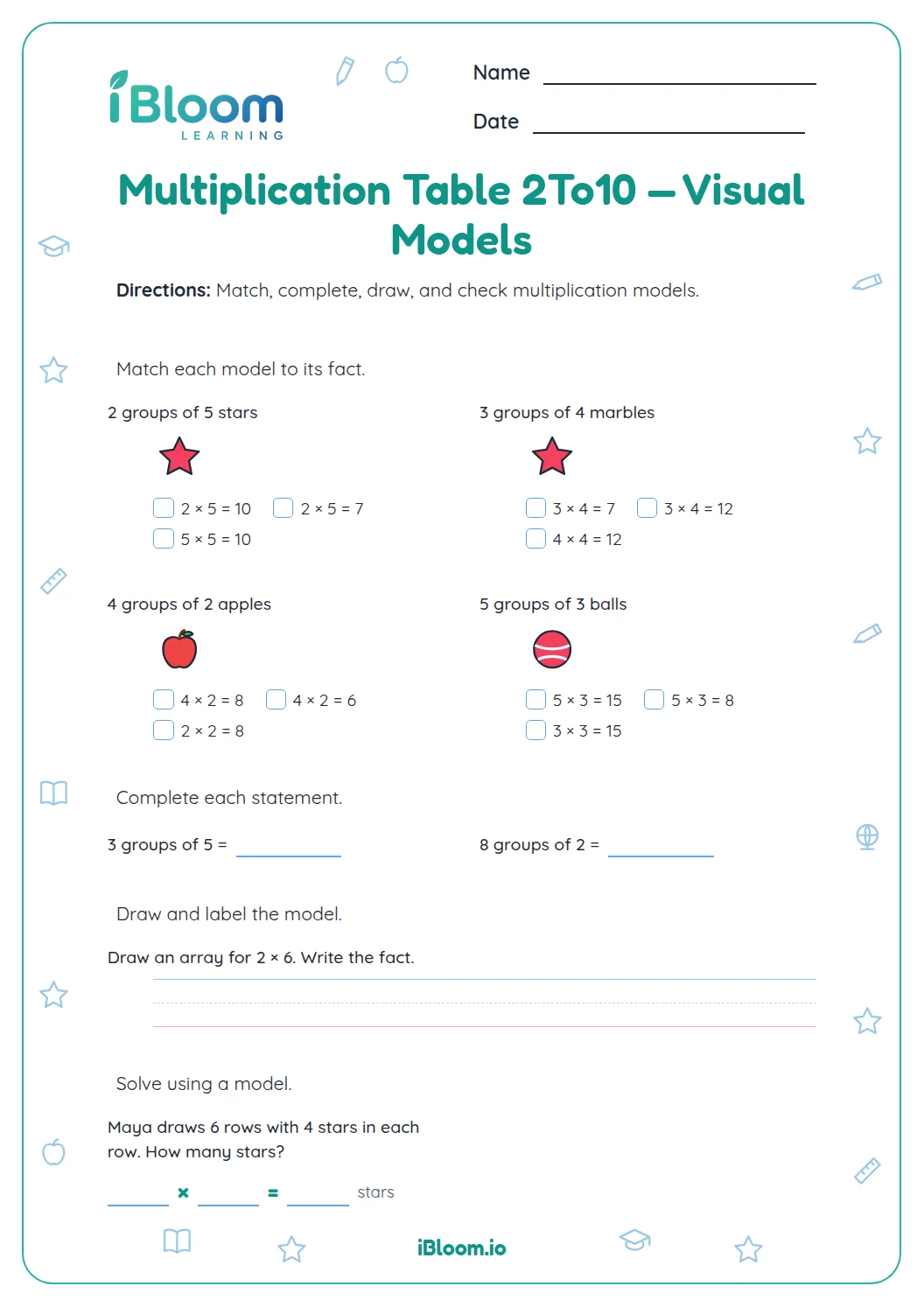
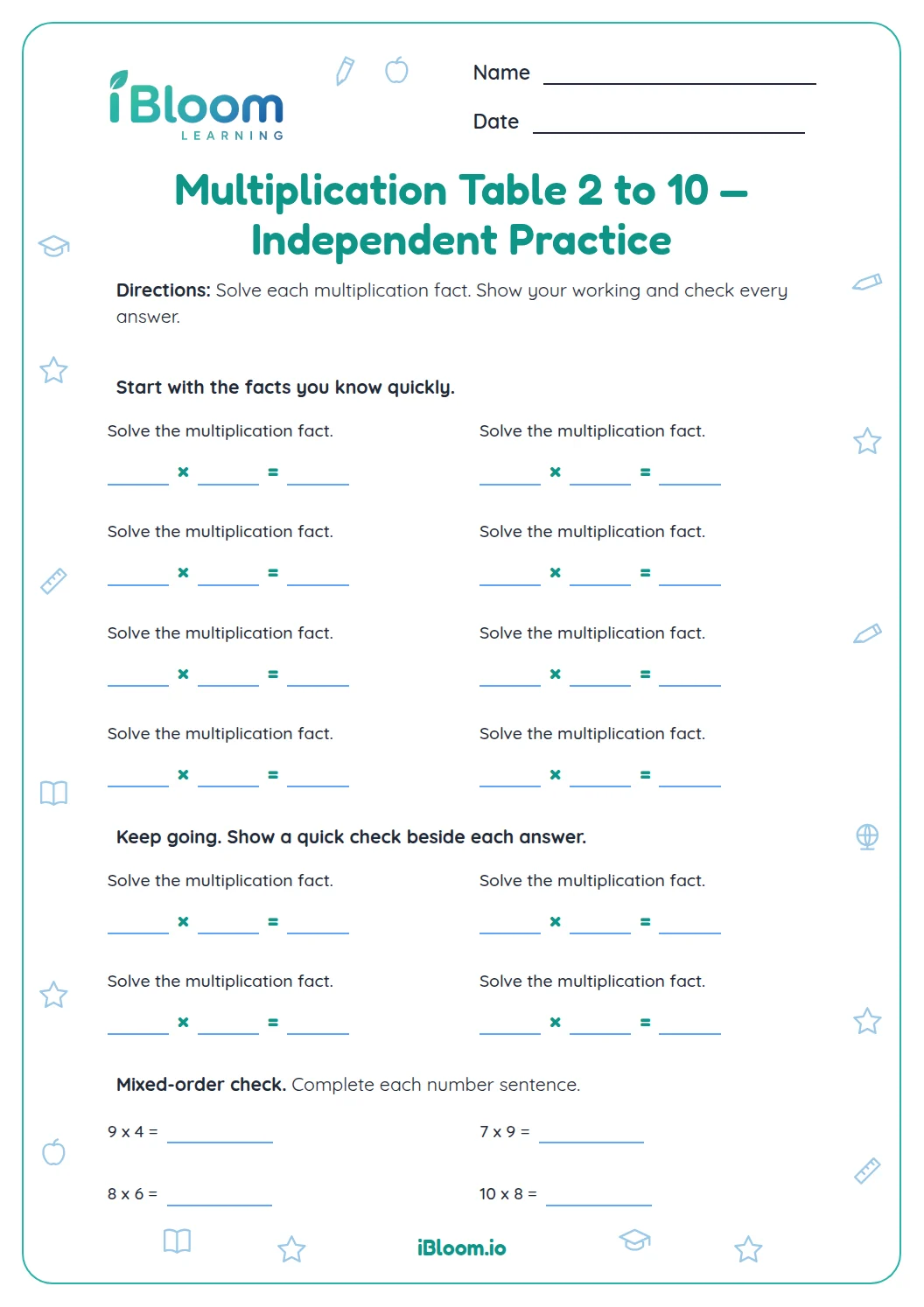
About this worksheet
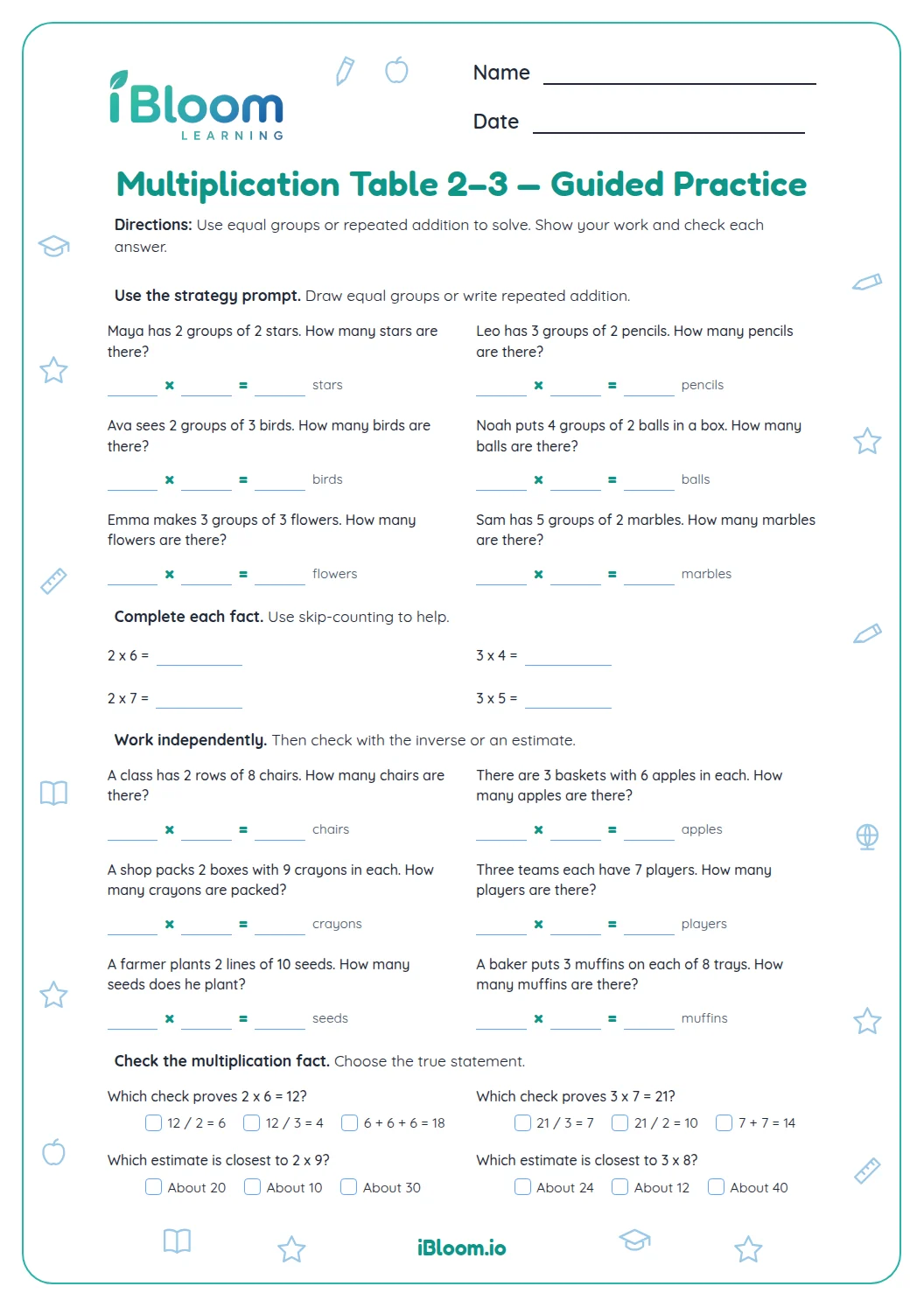
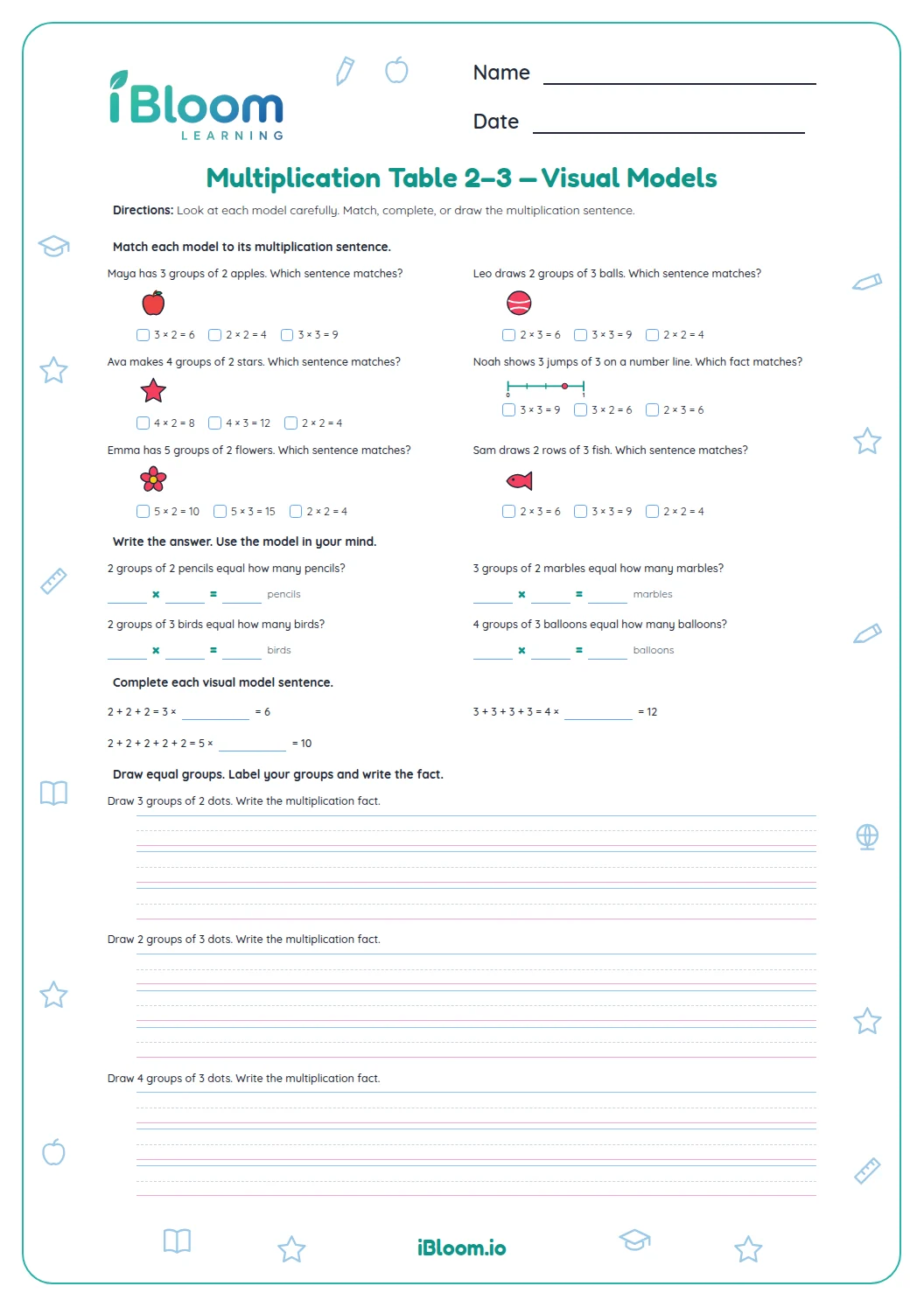
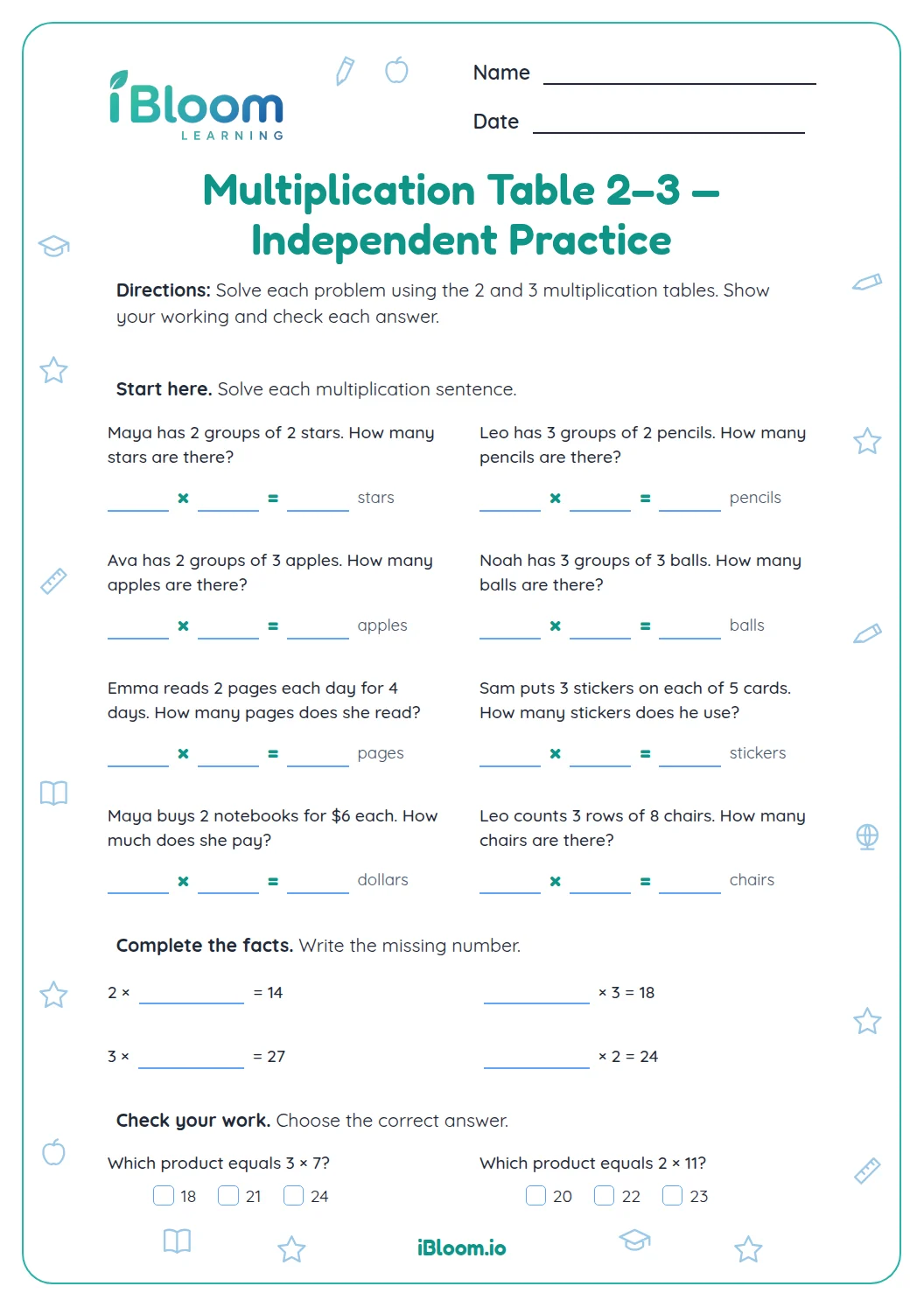
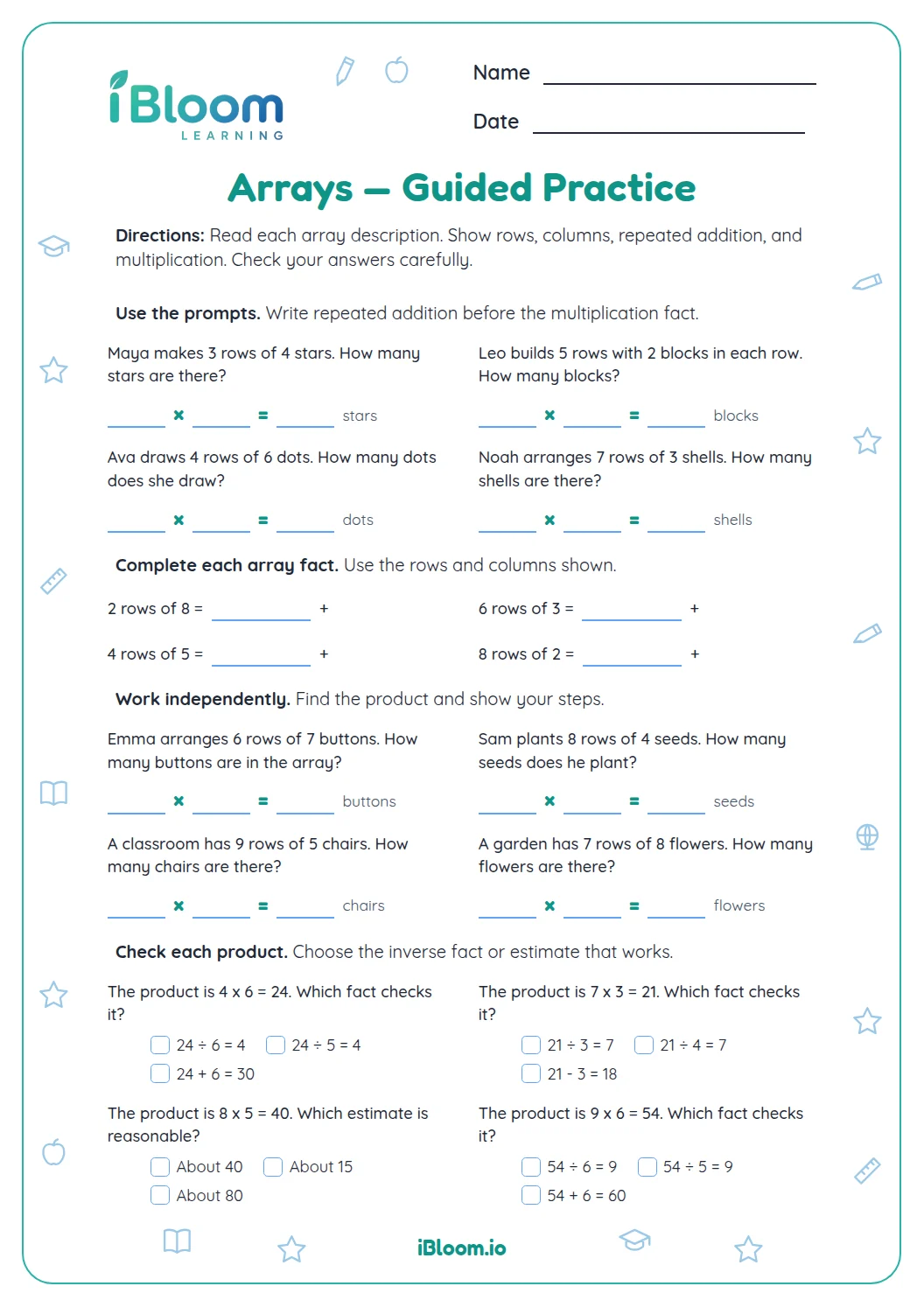
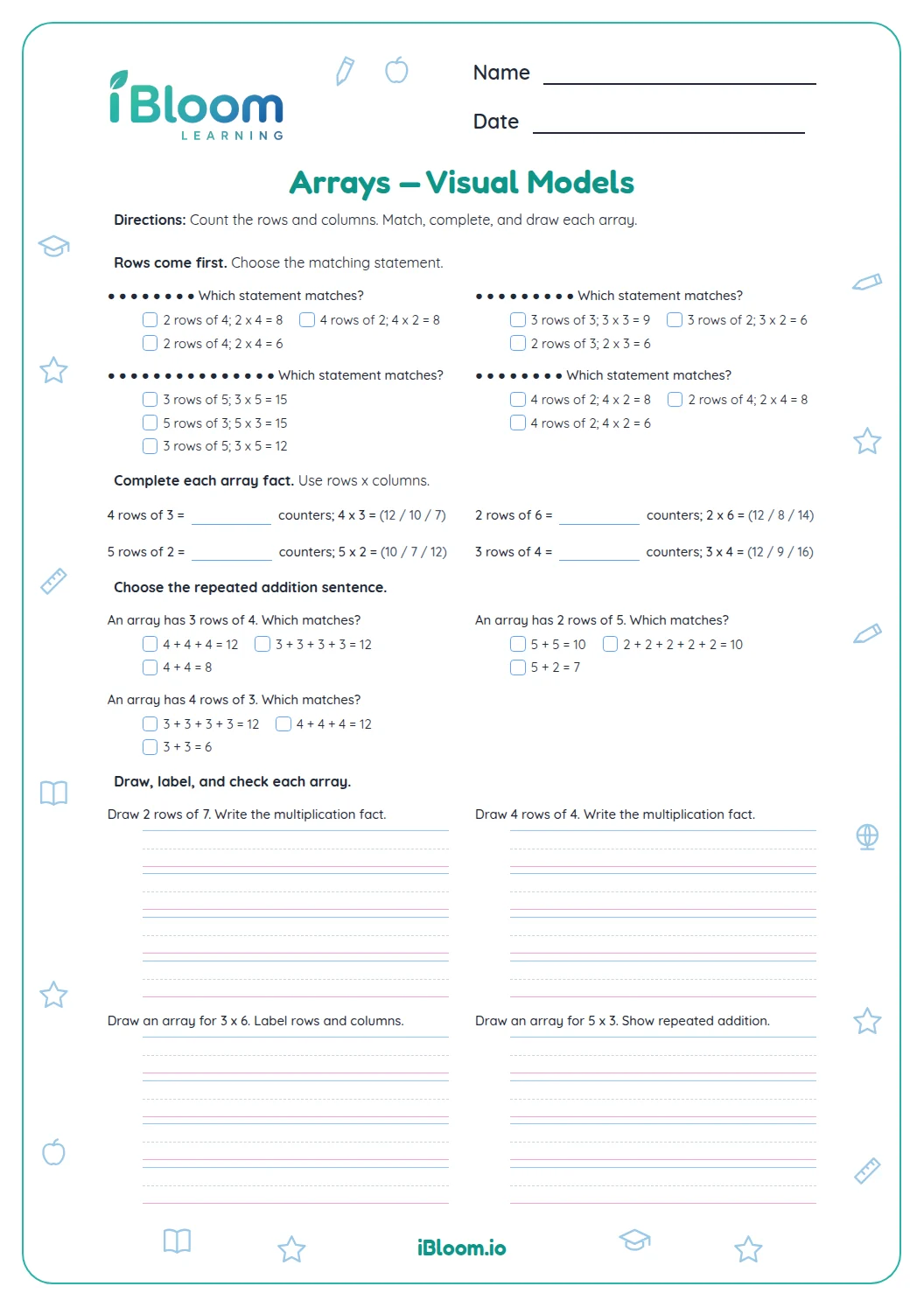
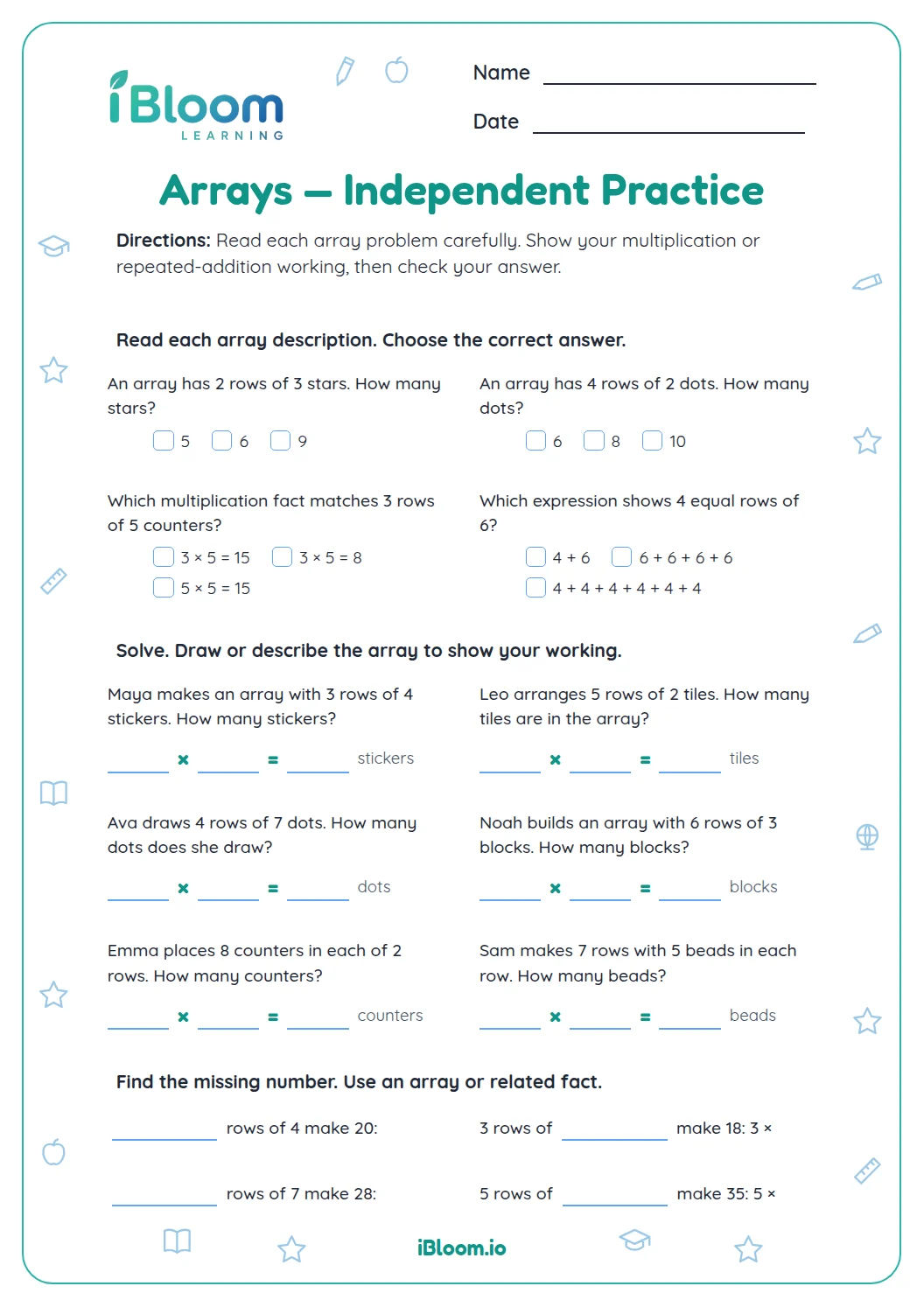
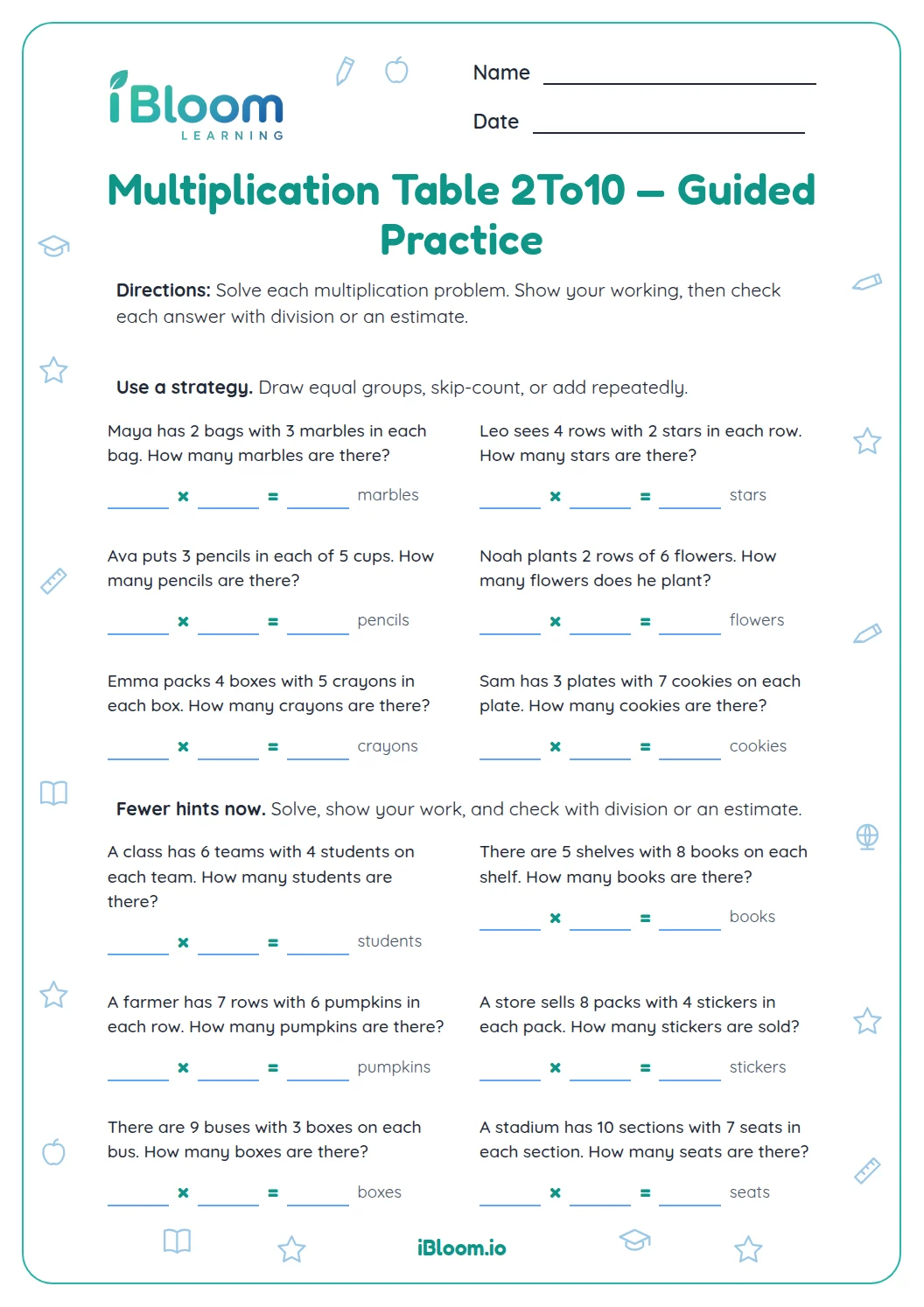
Solve real-world multiplication stories using the 2 and 3 tables. Each question describes equal groups, pairs, rows, or sharing so students can write a multiplication equation before finding the total or group size.
Aligned to 3.OA.A.3
Turn a story into a multiplication equation
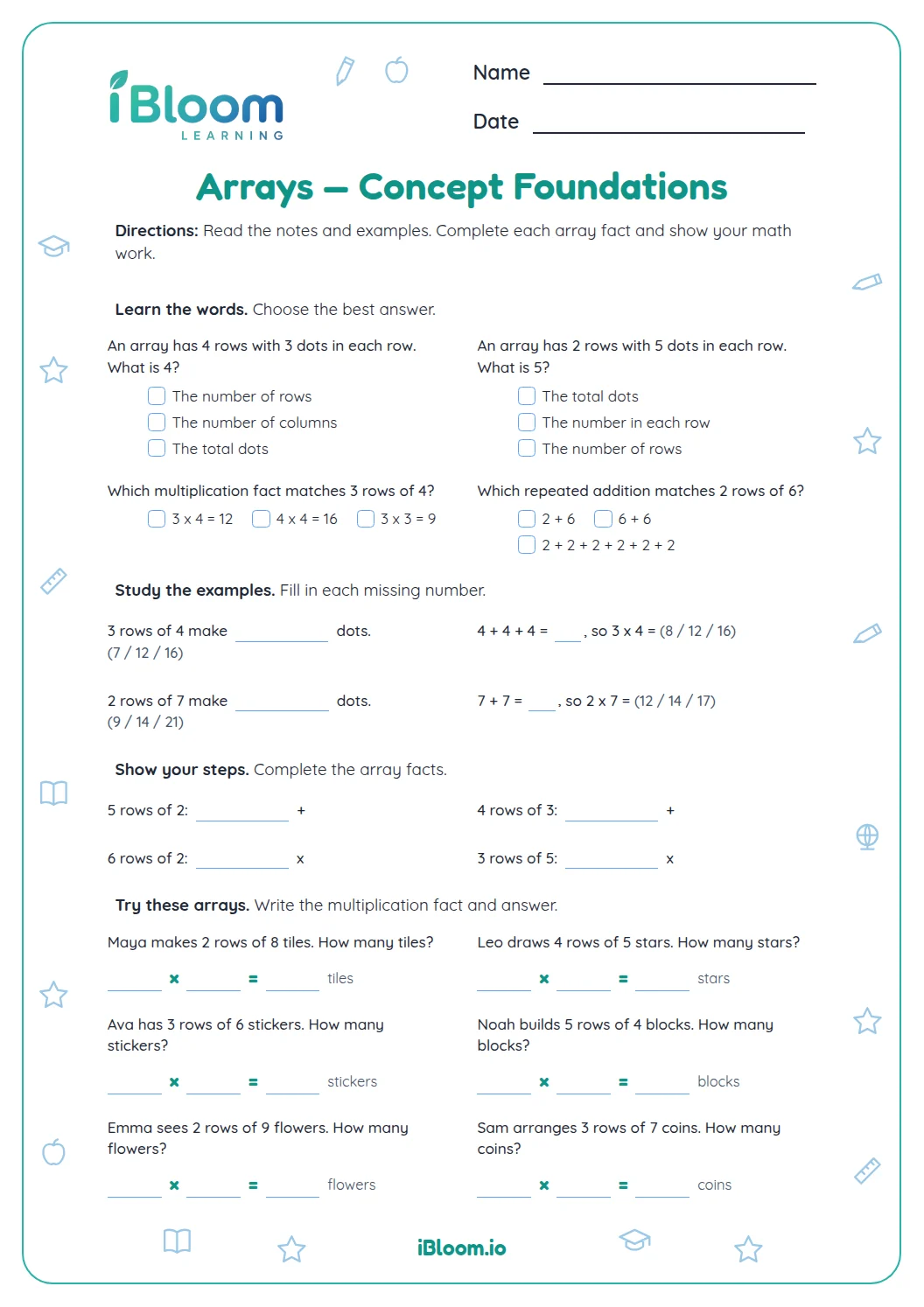
Look for two quantities: how many equal groups, and how many items are in each group. Multiply them to find the total. A shelf with 3 rows of 4 books is 3 × 4 = 12 books.
Some problems describe pairs or ask how many are in each equal share. Read what the unknown represents before choosing an equation.
- 13 rows × 4 books in each row
- 23 × 4 = 12
- 3There are 12 books.
What stories will you solve?
The stories use rows, teams, bags, pairs, trays, and equal groups. Products stay within 30, and each total can be found with a fact from the 2 or 3 times table.
- Part A: equal groups and rows
- Part B: pairs and repeated groups
- Part C: mixed multiplication contexts
- Write a multiplication equation and answer for each story
A routine for word problems
- 1Underline how many groups there are.
- 2Circle the number in each group.
- 3Write groups × items per group.
- 4Answer with the unit or object named in the story.
- 5For equal sharing, use division to find how many each group gets.
Common word-problem mistakes
The mistake
Adding the group size and the number of groups.
The fix
If the groups are equal, multiplication finds the total.
The mistake
Giving the total when the question asks for each group.
The fix
Read the question at the end and label what your answer counts.
Common Core alignment
This worksheet practices CCSS 3.OA.A.3 with equal-group and array stories using the 2 and 3 tables.
Solve equal-group multiplication and division problems within 100.
On this sheet: The stories model equal groups and arrays with products within 100.
Show the official wordingHide the official wording
Use multiplication and division within 100 to solve word problems in situations involving equal groups, arrays, and measurement quantities, e.g., by using drawings and equations with a symbol for the unknown number to represent the problem.
What to practice next
Make more practice
Further reading
Questions parents and teachers ask
Which multiplication facts appear on the page?
All 16 stories use equal groups, pairs, or rows built around the 2 and 3 multiplication tables. Products stay within 30. Children can write an equation such as 3 × 4 = 12, then label the total with the object named in the story.
How do I turn equal groups into multiplication?
Identify the number of groups and the number in each group, then multiply. Three rows with four books in each row can be written as 3 × 4 = 12. The factors describe the row count and the books per row; the product counts all books.
Does the worksheet include division?
The revised worksheet keeps the focus on multiplication stories. Each prompt asks students to write a multiplication equation and find a total, using equal groups, pairs, or rows. This keeps the section directions consistent and the practice centered on the 2 and 3 tables.
What should the answer include?
Write the total and identify what it counts, such as 12 books or 8 flags. The worksheet provides a space for a multiplication equation and an answer label. Check that the factors match the story and that the product is a reasonable total.
Is an answer key included?
Yes. The separate answer key shows an equation and labeled product for each story. It accepts equivalent factor orders when they describe the same groups, such as 2 × 3 and 3 × 2, as long as the product and context are correct.