



About this worksheet
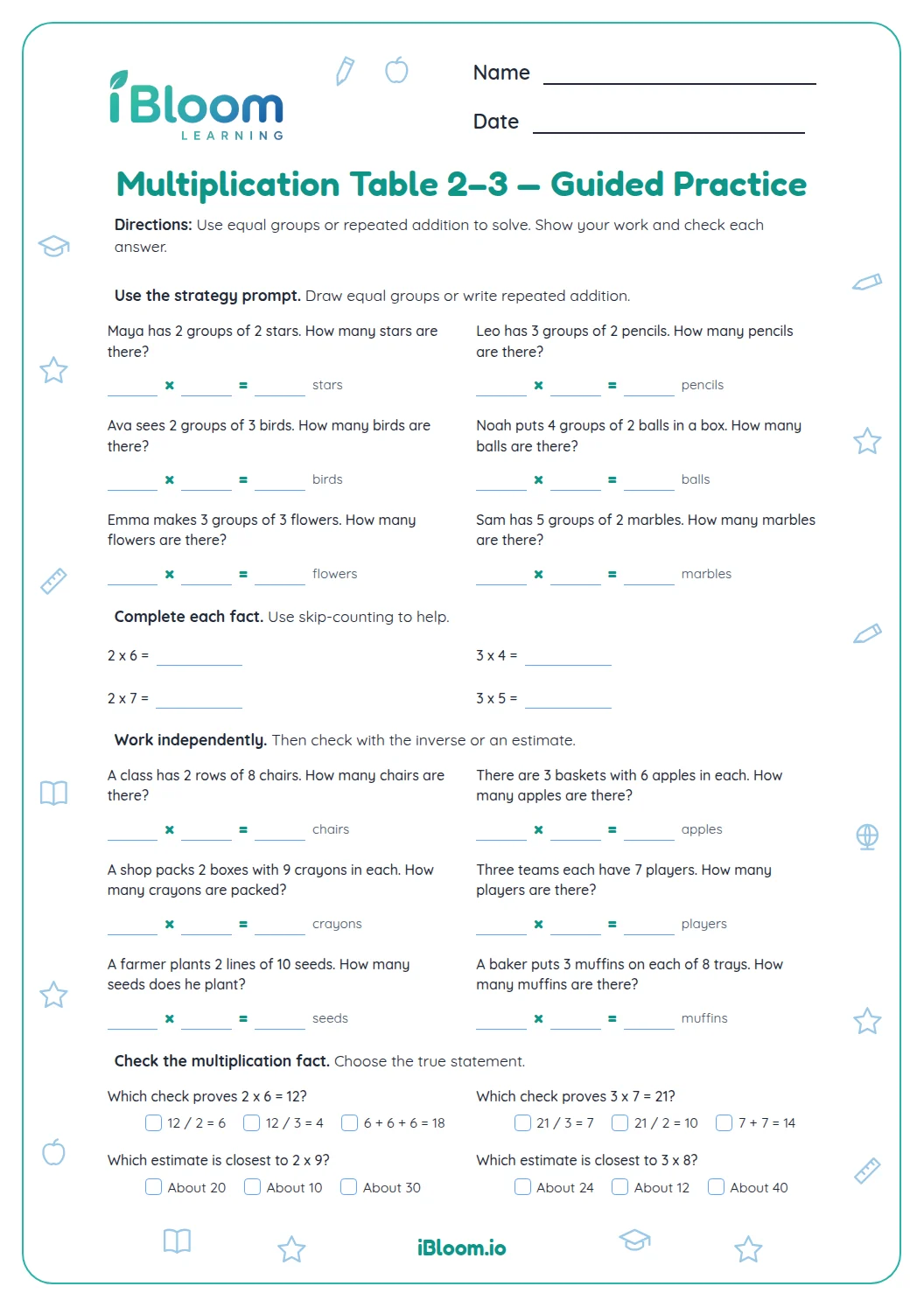
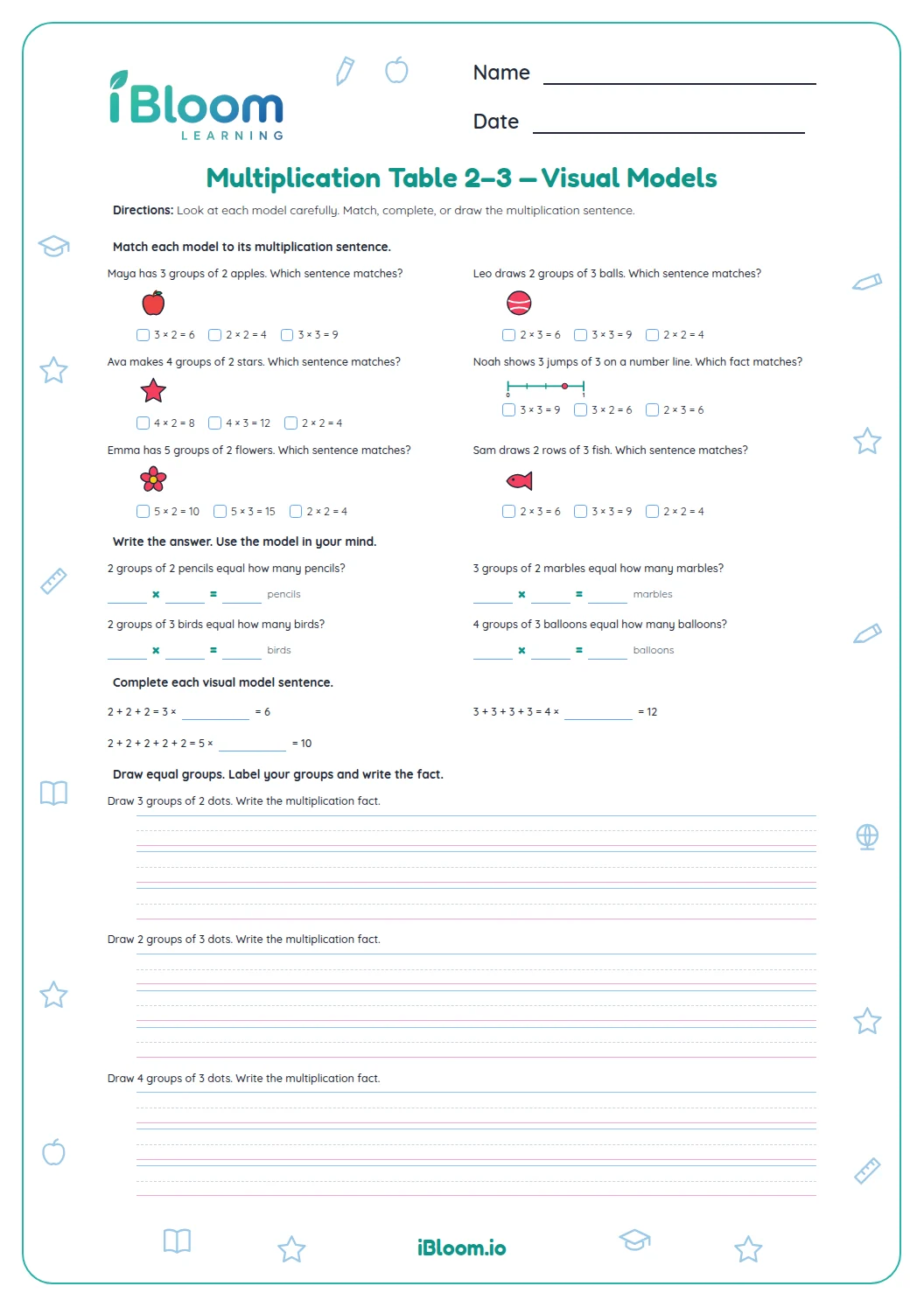
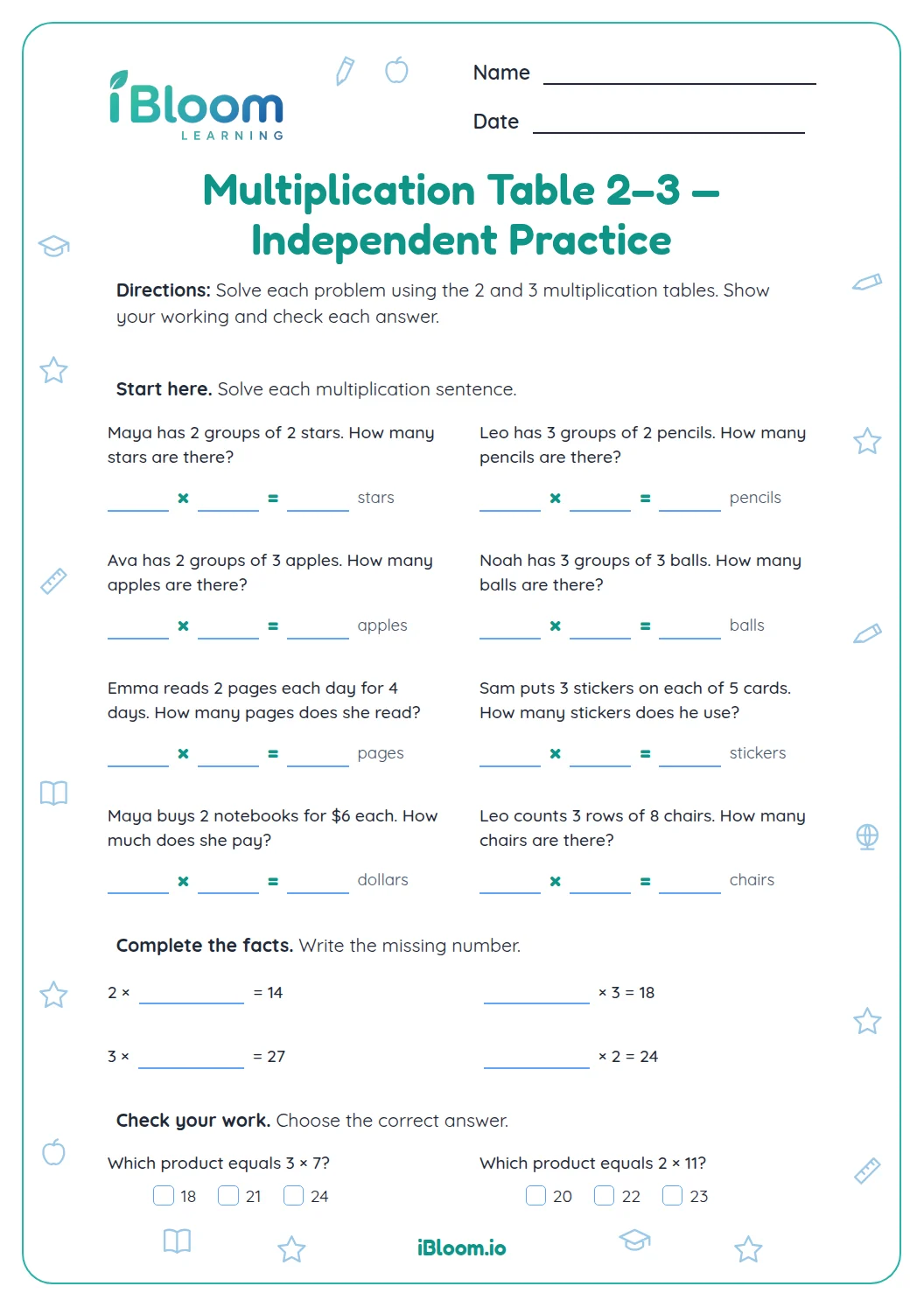
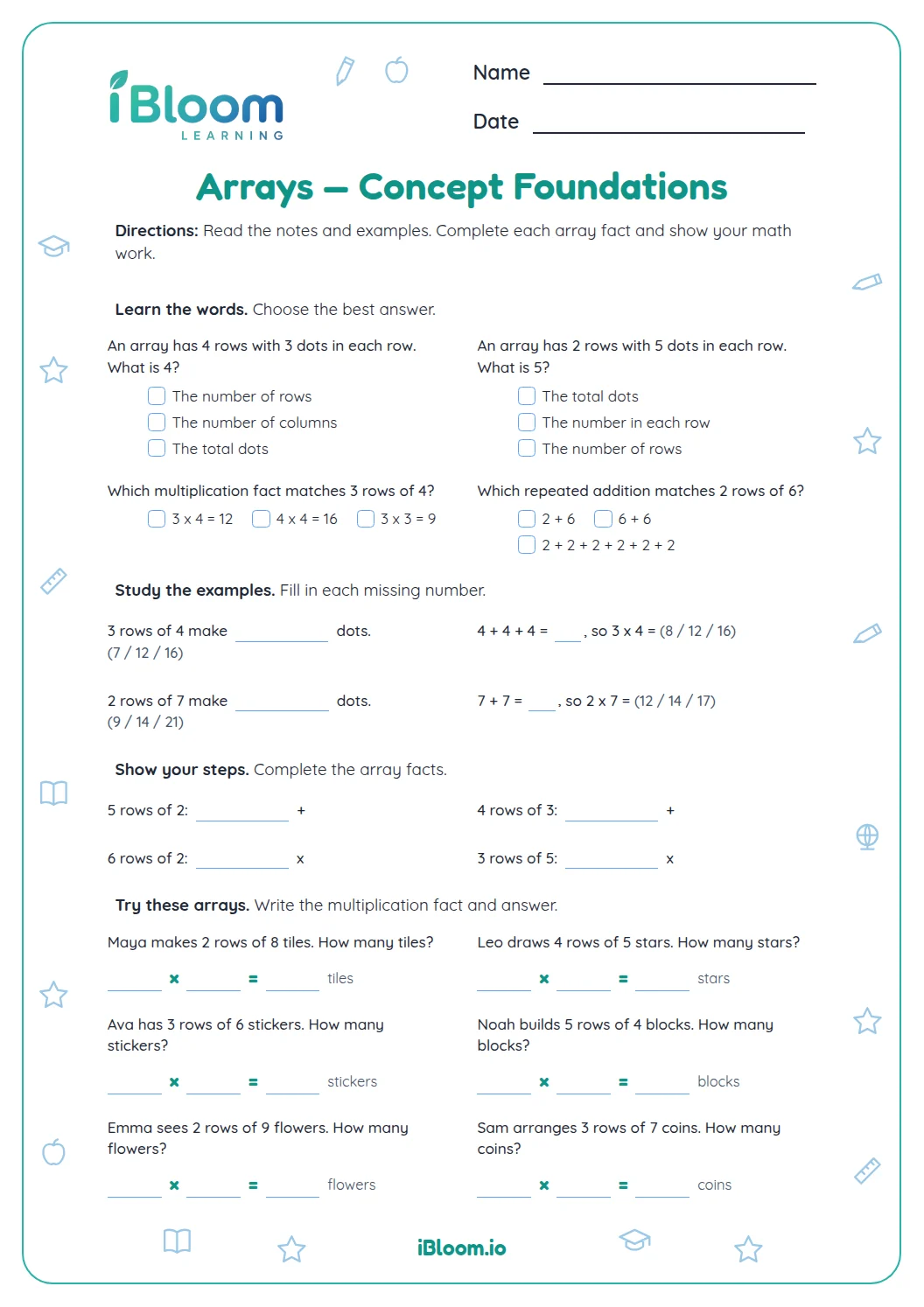
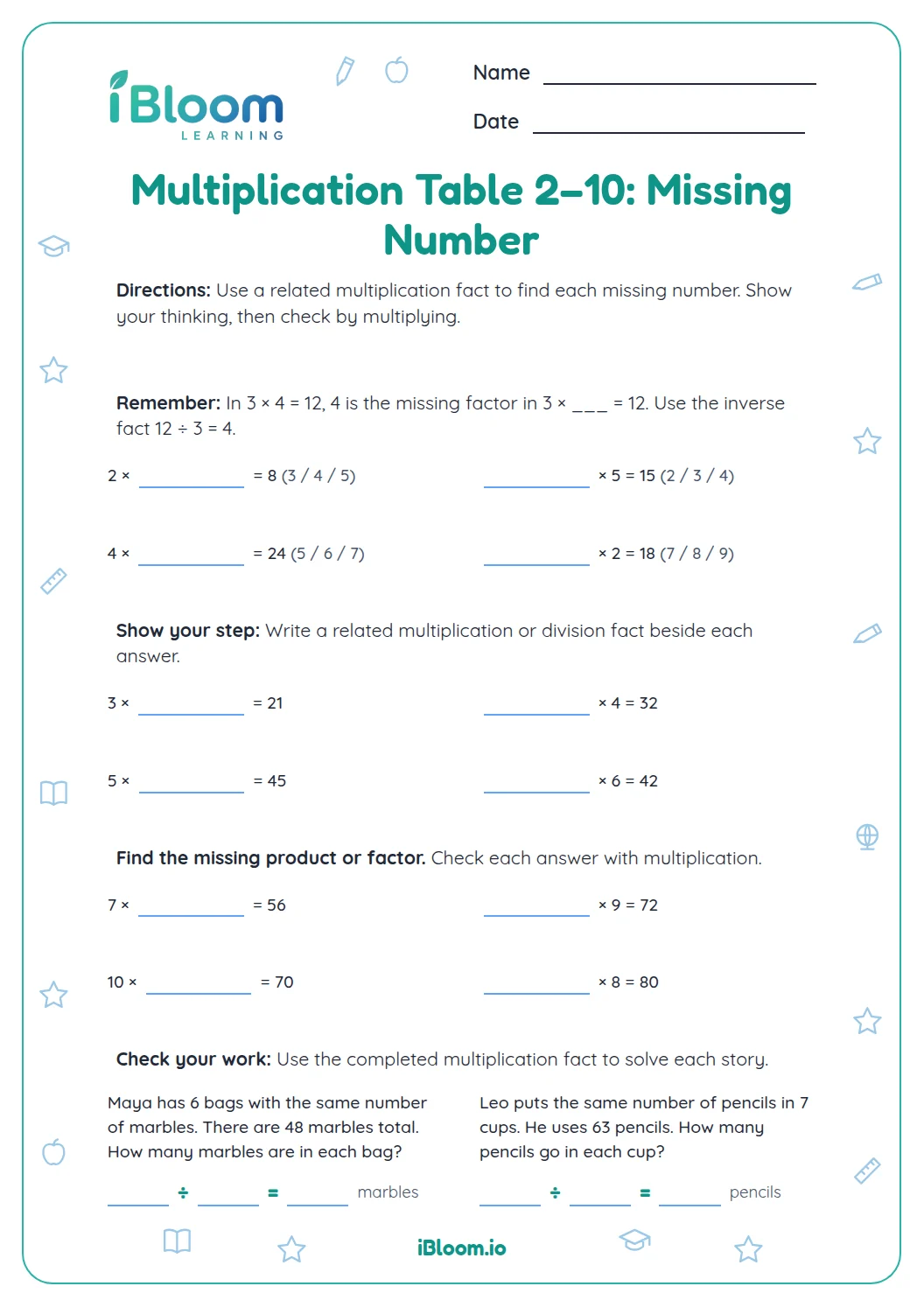
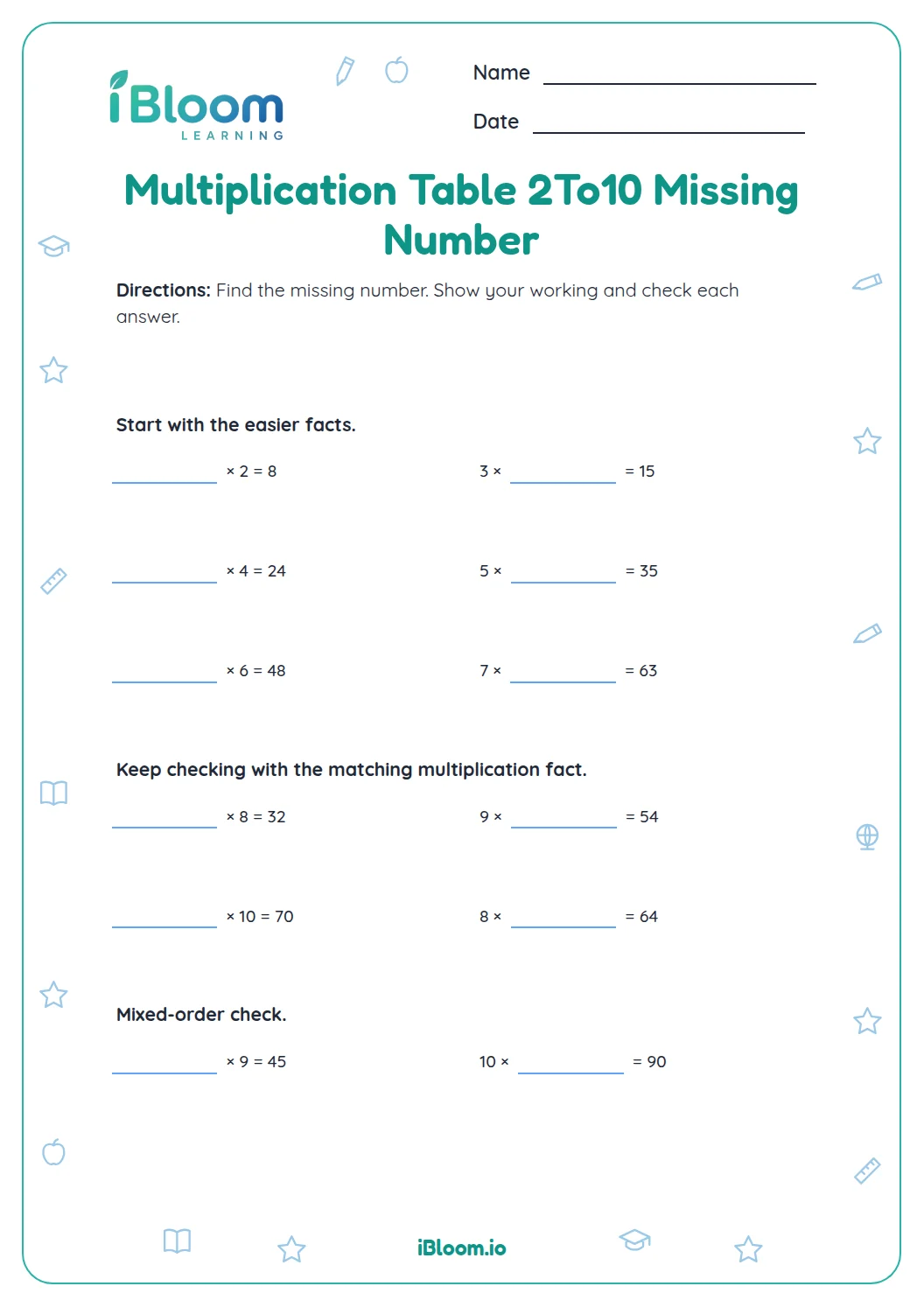
This Grade 3 printable offers 14 questions on the 2 and 3 multiplication tables. Children find missing factors, compare products, solve equal-group situations, and check multiplication reasoning. The set practices multiplication and related division facts within 100, aligned with CCSS 3.OA.C.7.
Aligned to 3.OA.C.7
How can a child reason about a missing factor?
Think of the factor as the number of equal groups. In question 3, 2 × ___ = 18 asks how many groups of two make 18. Skip-count by twos or divide 18 into pairs; nine groups make 18.
A related division fact checks the result: 18 ÷ 2 = 9.
- 12 × ___ = 18
- 2Count by twos to 18.
- 3There are 9 groups.
- 4Check: 2 × 9 = 18.
How do equal products help with reasoning?
Different multiplication facts can have the same product. For example, 2 × 9 and 3 × 6 both make 18. Compare the totals instead of assuming the same product must come from the same factors.
What kinds of questions are included?
Fourteen items move from direct facts to product comparisons, equal-group situations, and reasoning. Every fact uses 2 or 3, with products within 100.
- Part A: facts and missing factors.
- Part B: product comparisons.
- Part C: equal-group stories and reasoning.
How to use this worksheet
- 1Read the factors before calculating.
- 2For a missing factor, ask how many groups make the product.
- 3Use skip counting or a quick array sketch to check a fact.
- 4For a story, identify the number in each group and the number of groups.
- 5Check division answers with multiplication.
Common mistakes and quick fixes
The mistake
Using addition instead of equal groups, such as 3 + 7.
The fix
Count 3 groups of 7: 7, 14, 21.
The mistake
Stopping at the number of groups in a sharing problem.
The fix
Read whether the question asks for group size or number of groups.
The mistake
Changing factors when comparing products.
The fix
Calculate each product, then compare the totals.
Curriculum alignment
This worksheet practices the skills described in the standards below.
Use multiplication facts and related division facts.
On this sheet: Children reason with multiplication facts and inverse checks for factors 2 and 3.
Show the official wordingHide the official wording
Fluently multiply and divide within 100, using strategies such as the relationship between multiplication and division (e.g., knowing that 8 × 5 = 40, one knows 40 ÷ 5 = 8) or properties of operations. By the end of Grade 3, know from memory all products of two one-digit numbers.
What to practice next
Make more practice
Further reading
Questions parents and teachers ask
What facts does the worksheet use?
It focuses on multiplication facts with factors 2 and 3, and every product is within 100. Some questions use related division facts to check how many equal groups there are or how many items go in each group.
How can my child find a missing factor?
Ask how many groups of the known factor make the product. For 2 × ___ = 18, count by twos to 18; nine groups are needed. Then check that 2 × 9 equals 18.
Does the sheet include word problems?
Yes. Several short stories describe equal groups or equal sharing, such as markers in boxes and apples in baskets. Children can write an equation in the provided work area before giving the answer.
How does the sheet connect multiplication and division?
Some questions ask about equal sharing or groups, and another asks children to choose a division fact related to multiplication. For example, 2 × 9 = 18 connects to 18 ÷ 2 = 9.
Is an answer key included?
Yes. The separate answer key lists products, missing factors, choices, and story answers. Children can work through all 14 questions before using it to check. A parent can also ask how a related fact confirms an answer.