



About this worksheet
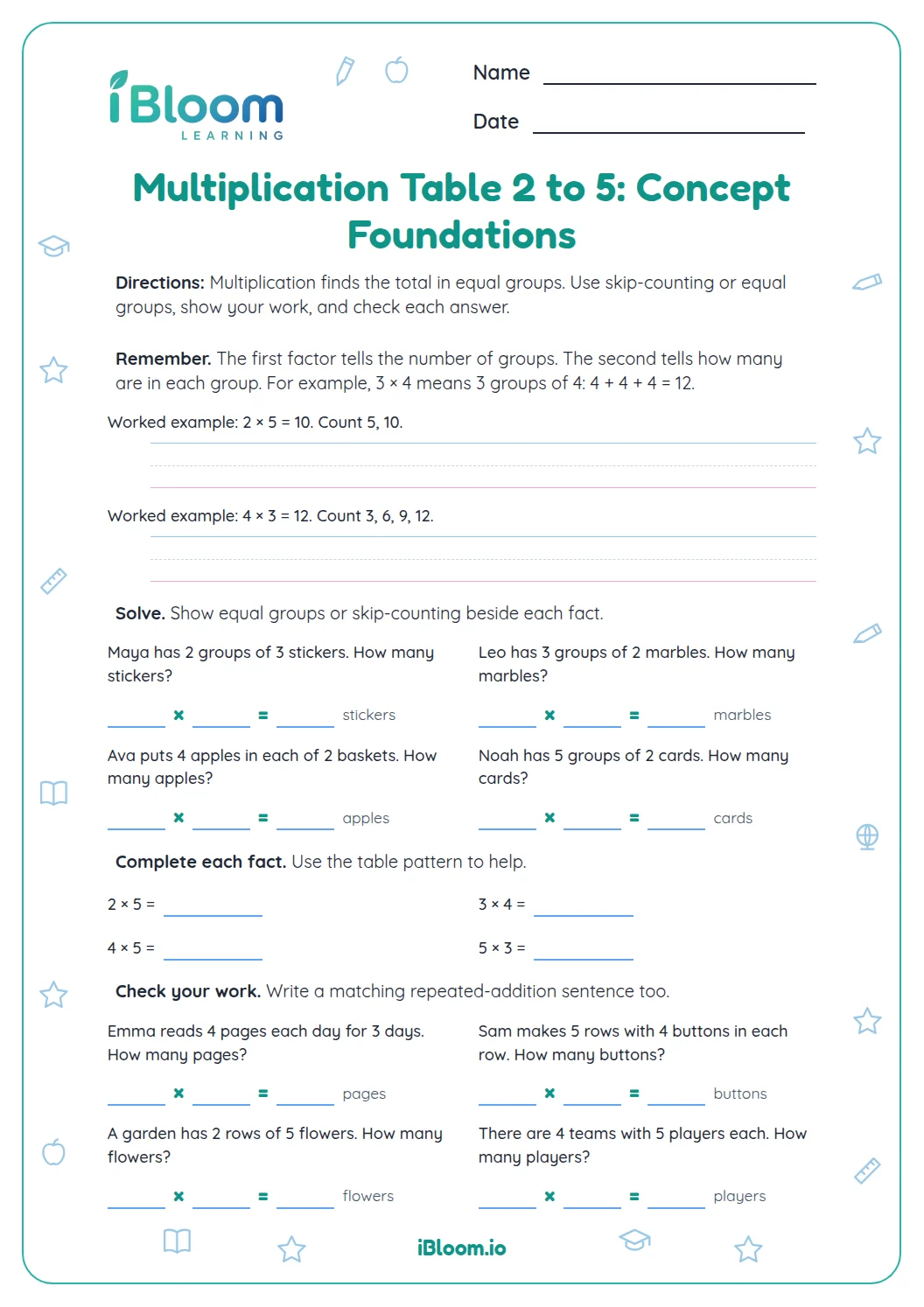
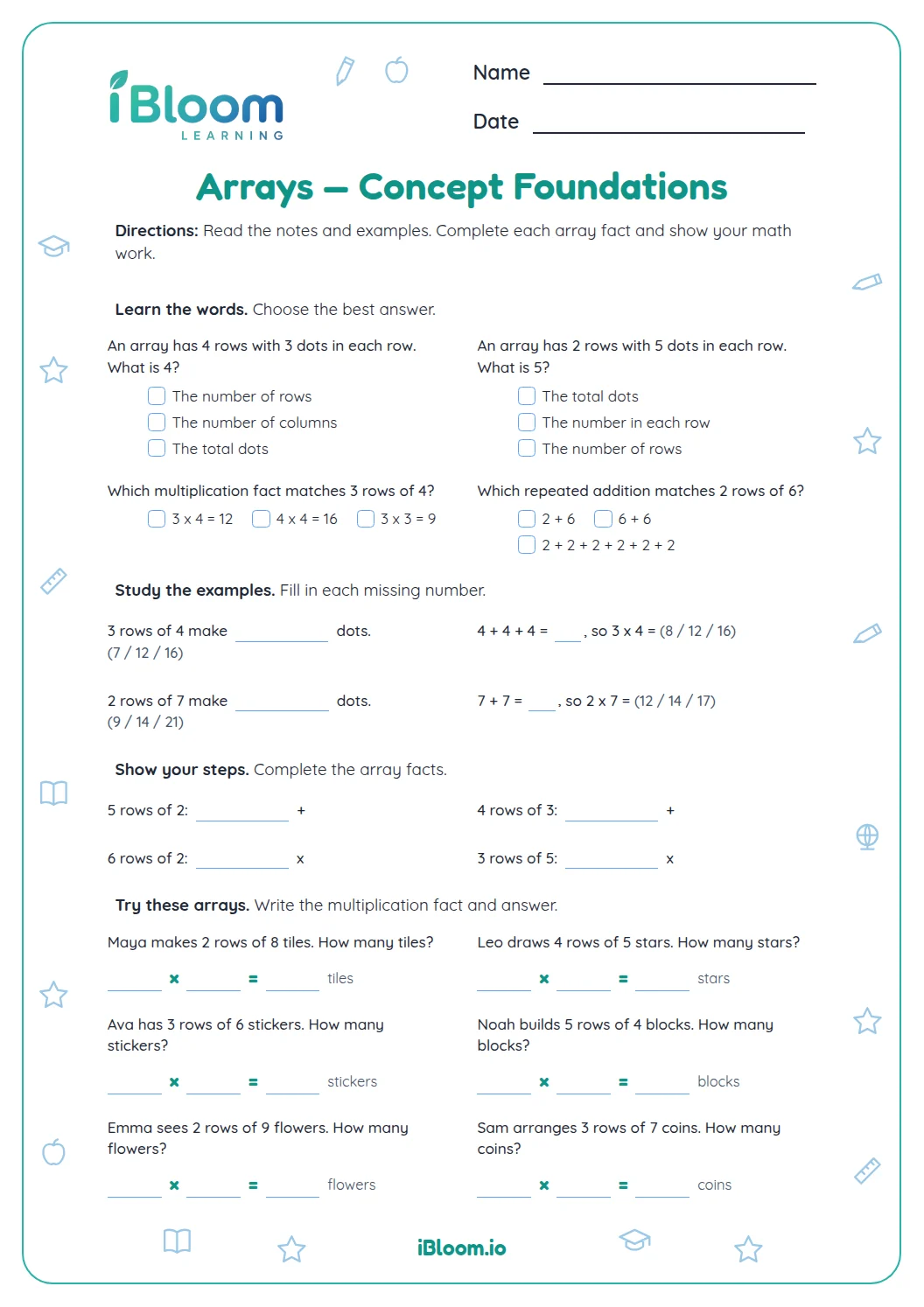
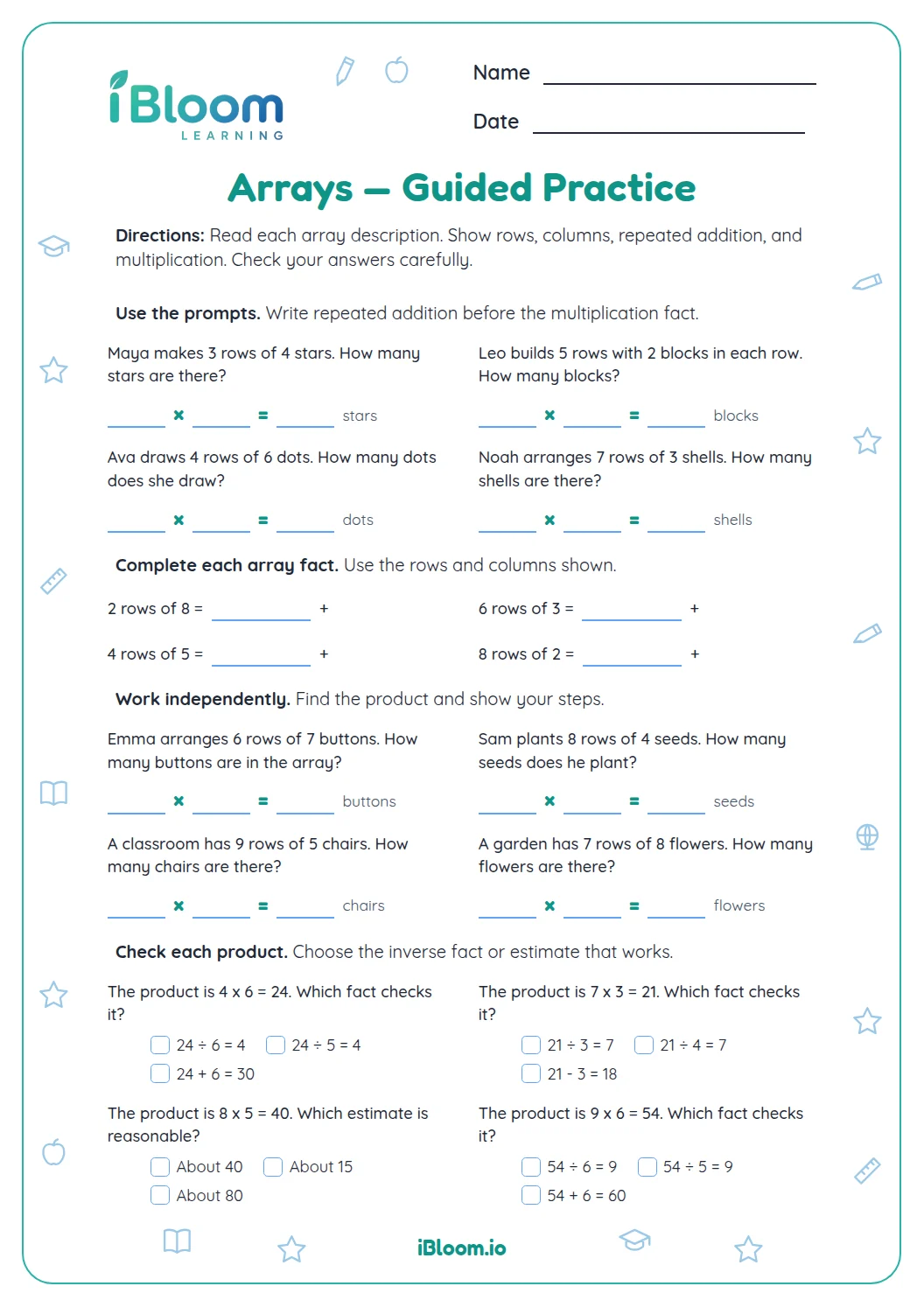
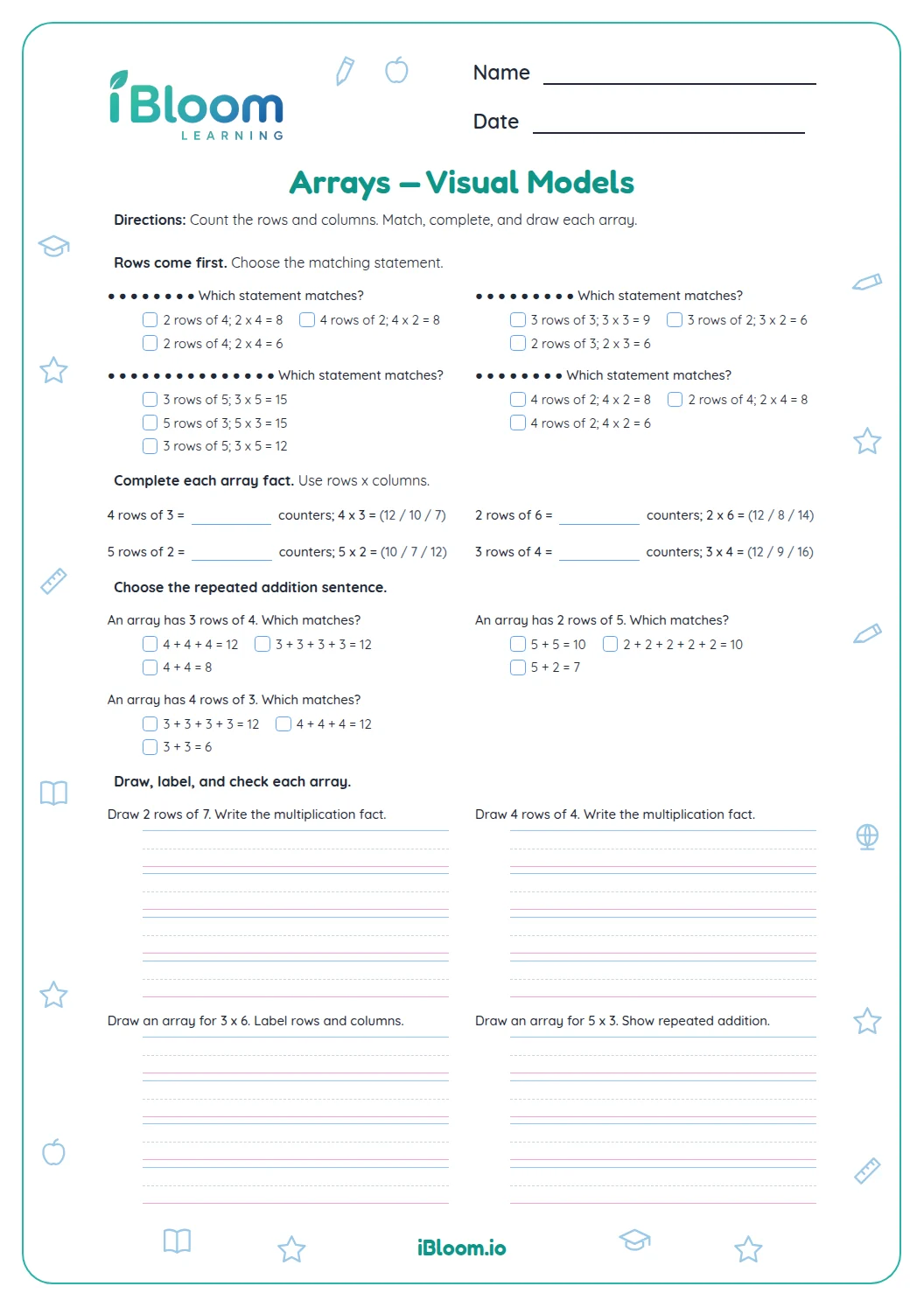
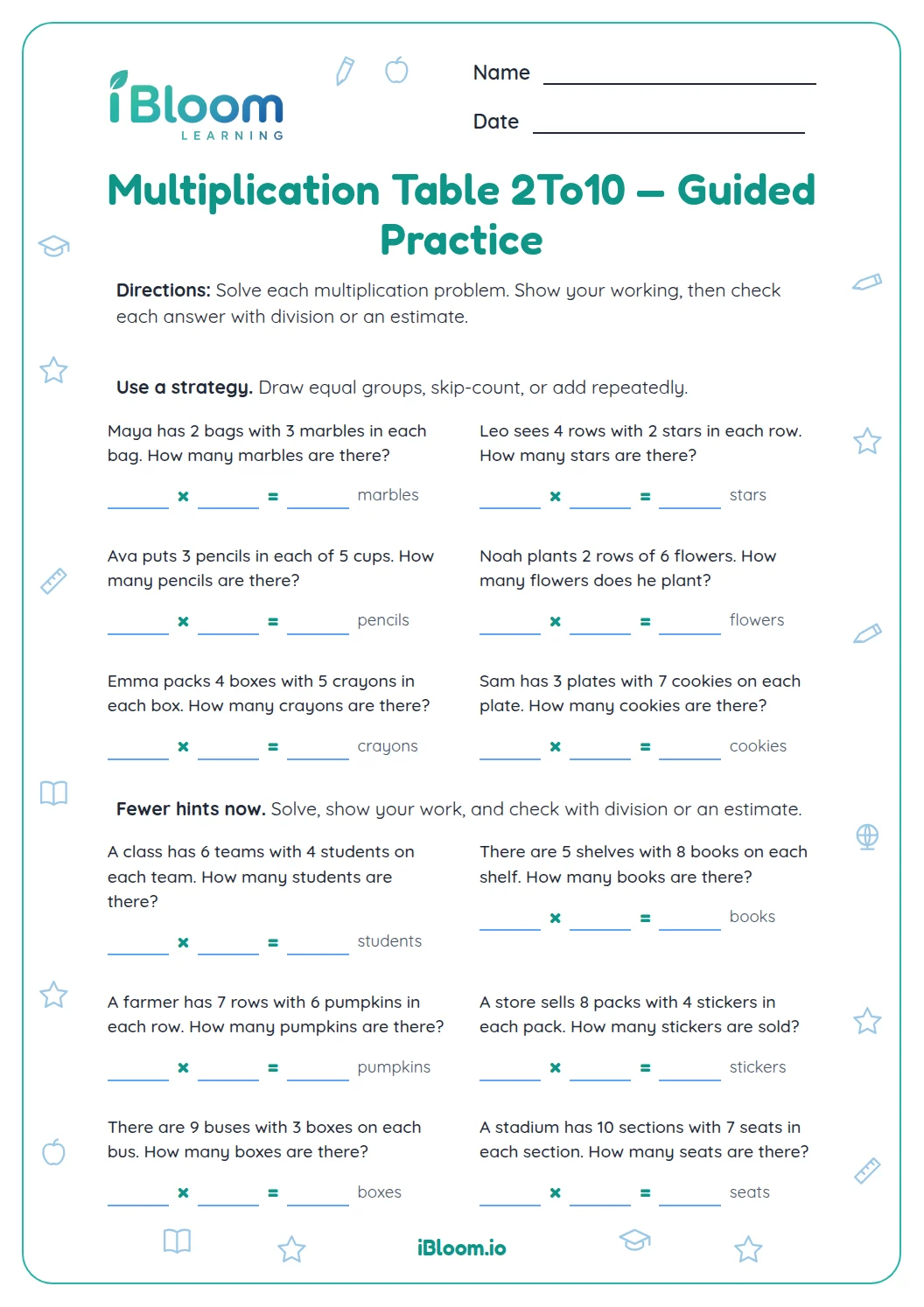
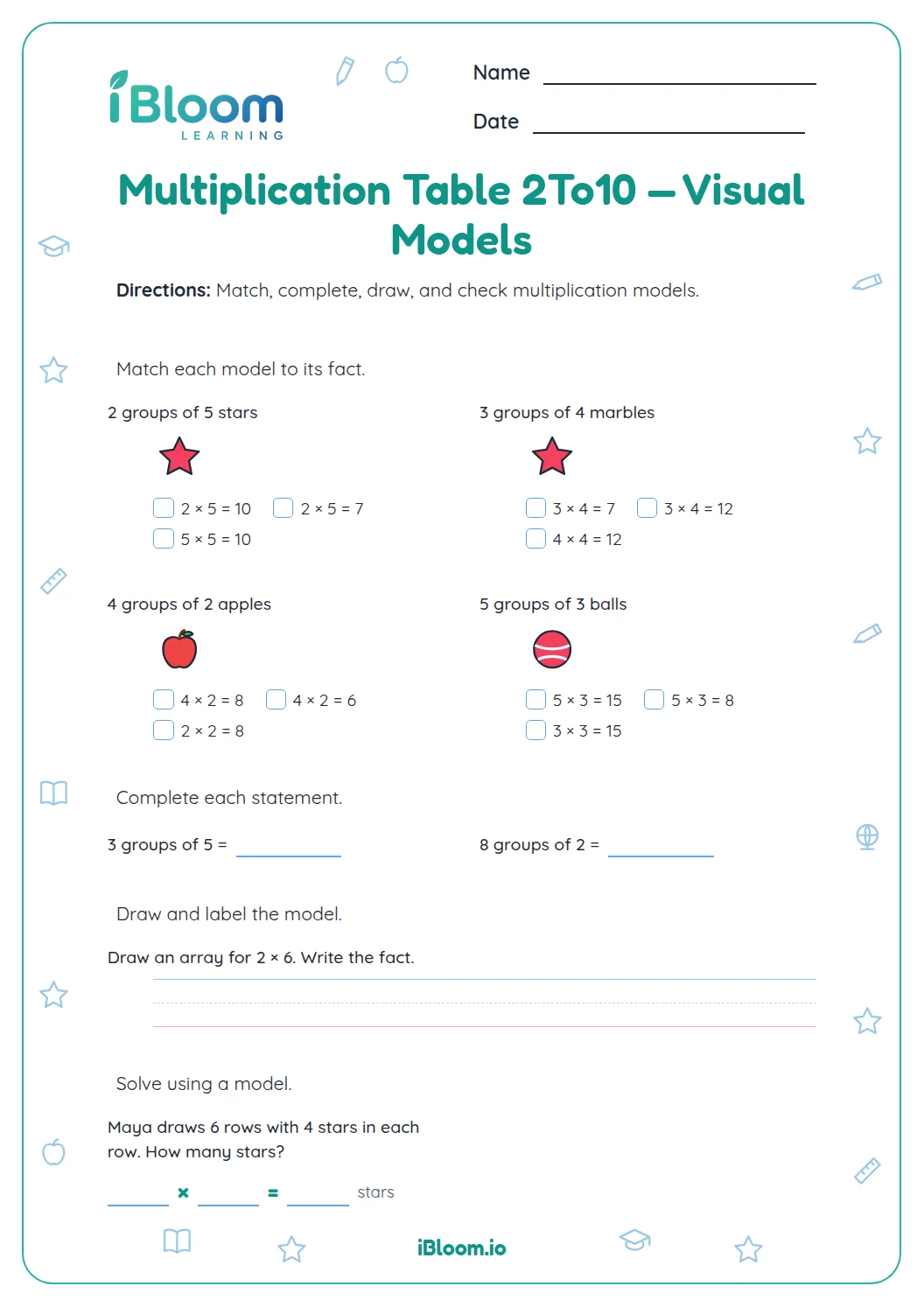
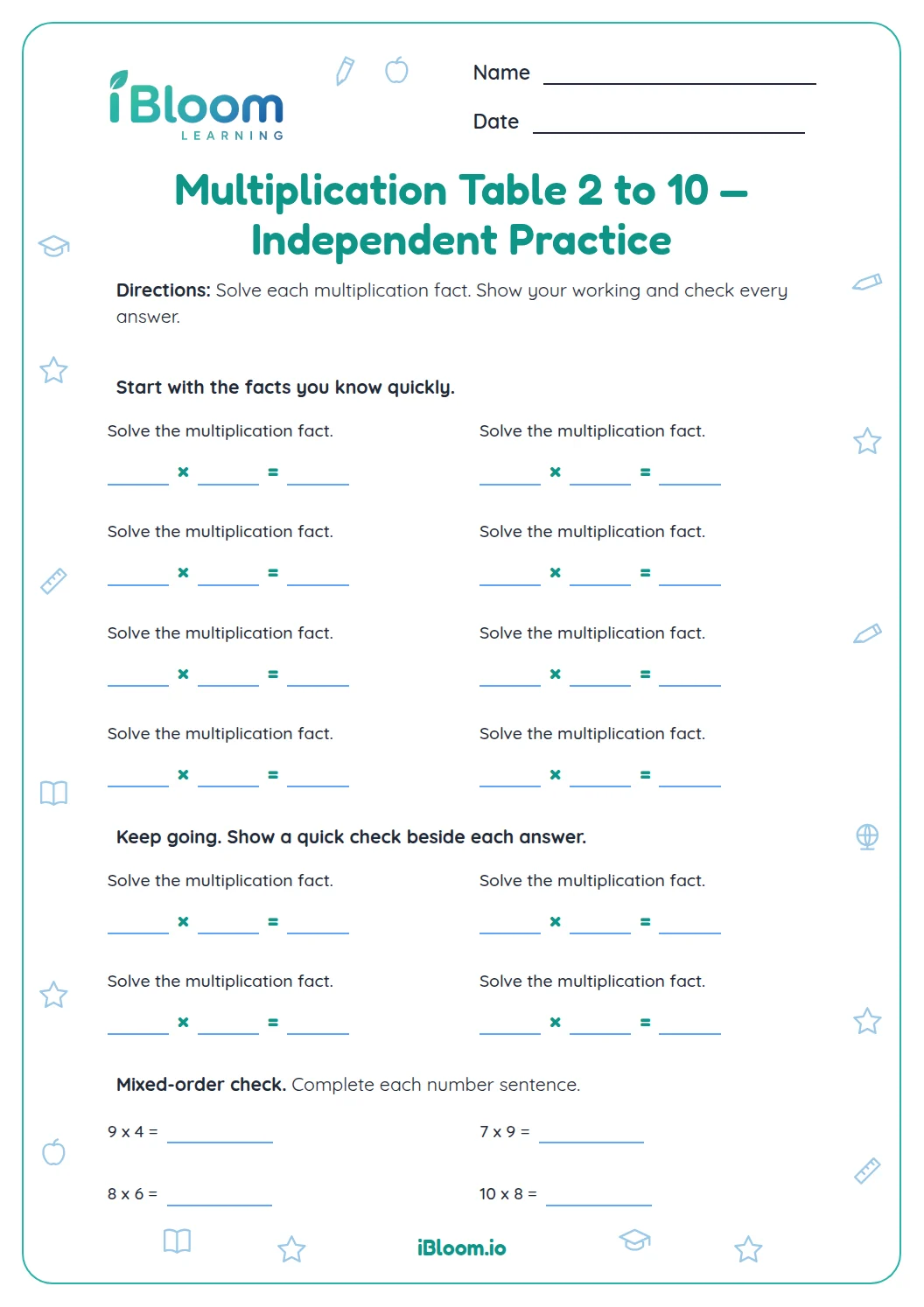
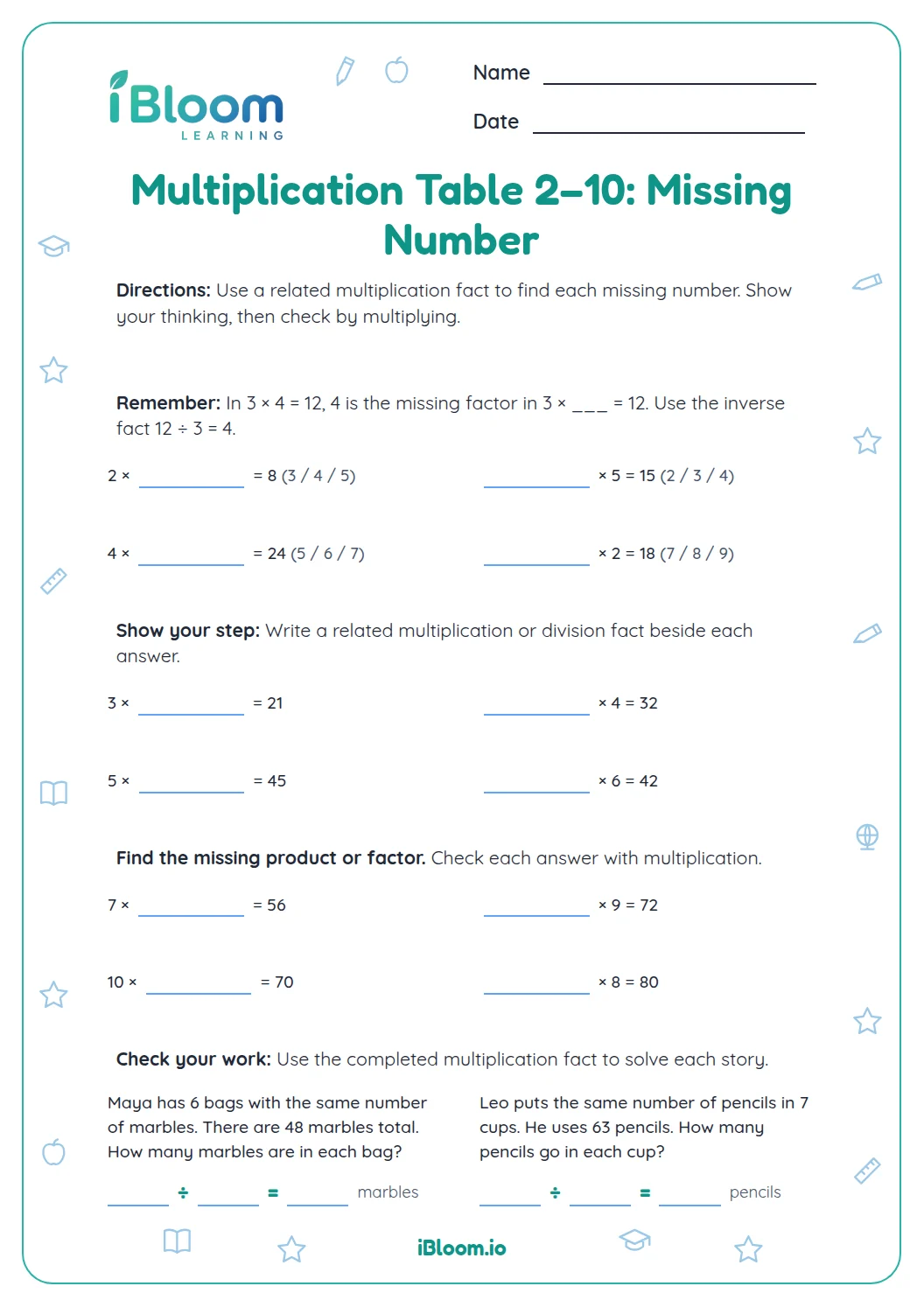
This Grade 3 worksheet gives 14 questions on multiplication tables 2 through 5. Learners solve facts, connect a product to equal groups, find missing factors, and use the facts in short stories. The final choice question reviews products. A separate key supports practice with CCSS 3.OA.C.7.
Aligned to 3.OA.C.7
How do equal groups show a product?
A multiplication fact counts equal groups. Five groups of two contain ten objects, so 5 × 2 = 10. Skip-counting by the number in each group gives the same total.
The worksheet begins with facts for 2, 3, 4 and 5, then connects the equations to group situations.
- 15 groups of 2 make ___.
- 2Count by 2 five times: 2, 4, 6, 8, 10.
- 3Answer: 10.
How do you find a missing factor?
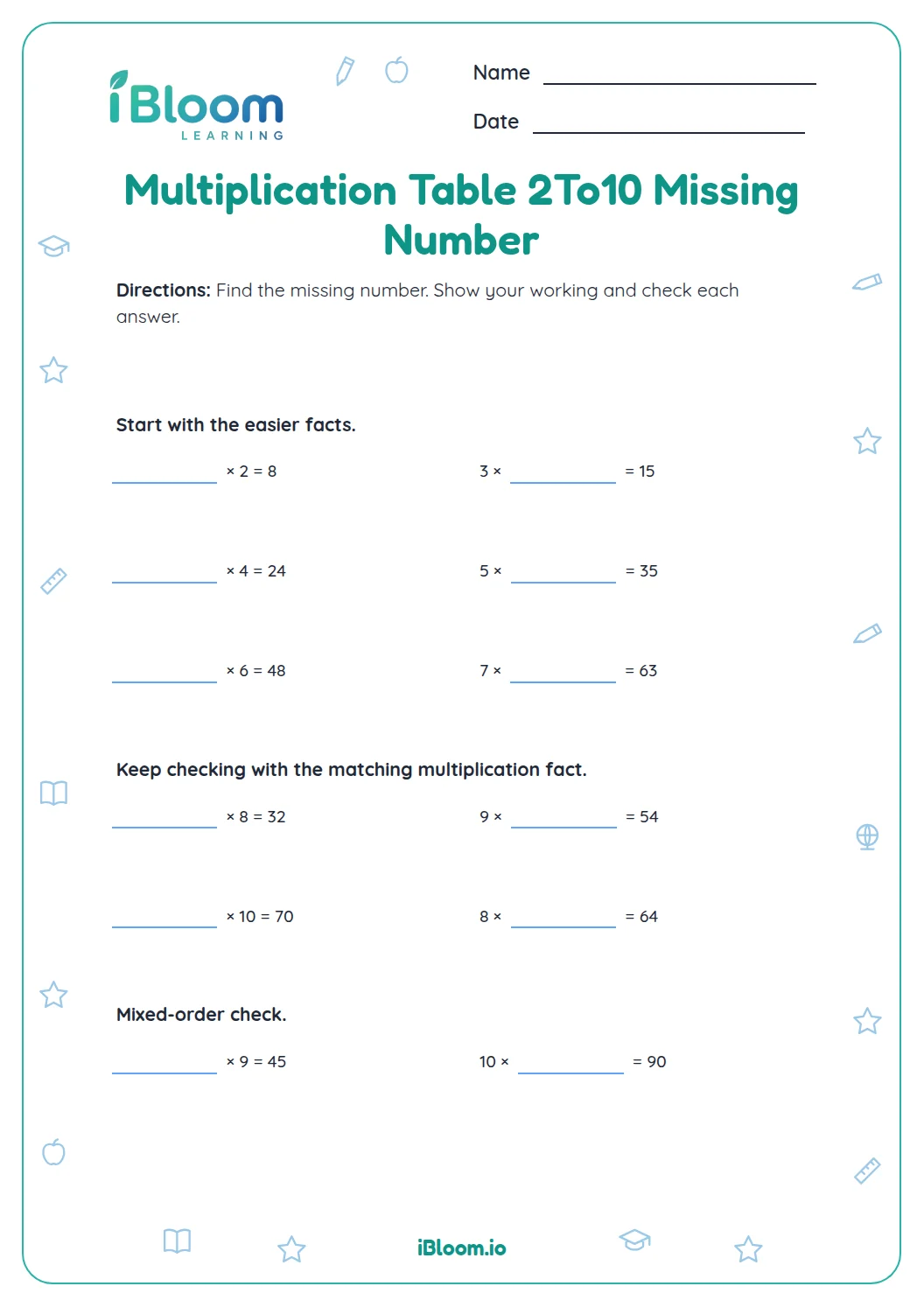
Use the product and the known factor to identify how many groups are needed. In 3 × ___ = 12, four groups of three make twelve, so the missing factor is 4.
How do multiplication facts help in stories?
Look for the number of groups and the amount in each group. Five bags with four apples each represent 5 × 4, or 20 apples. The units in the answer should match the story.
How to use this worksheet
- 1Read the fact and name the two factors.
- 2Skip-count by one factor or use a known related fact.
- 3For a missing factor, ask how many equal groups make the product.
- 4In each story, identify the number of groups and objects in each group.
- 5Use the answer key after finishing to check products and units.
Common mistakes and quick fixes
The mistake
Treating 5 groups of 2 as 5 + 2.
The fix
Count two objects in each of five groups: 2, 4, 6, 8, 10.
The mistake
Switching the number of groups and the amount in each group in a story.
The fix
Underline the group count and the number in each group, then write one multiplication equation.
The mistake
Writing the known factor as the missing factor.
The fix
Check by multiplying both factors; their product must equal the number on the other side.
Curriculum alignment
Multiplication facts and equal-group problems build fluency within 100.
Use related multiplication facts and equal groups to find products within 100.
On this sheet: Learners solve multiplication facts, missing factors and equal-group stories.
Show the official wordingHide the official wording
Fluently multiply and divide within 100, using strategies such as the relationship between multiplication and division (e.g., knowing that 8 × 5 = 40, one knows 40 ÷ 5 = 8) or properties of operations. By the end of Grade 3, know from memory all products of two one-digit numbers.
What to practice next
Make more practice
Further reading
Questions parents and teachers ask
Which multiplication facts does the worksheet practice?
The questions use factors 2, 3, 4 and 5. Learners solve direct facts, connect equal groups to products, find missing factors, and answer short stories using these tables. The direct facts stay within tables 2, 3, 4 and 5.
How do I explain equal groups?
Equal groups have the same number of objects in each group. Five groups with two objects each can be counted as 2, 4, 6, 8, 10, which shows why 5 × 2 = 10. The group prompt converts five groups of two into the product 10.
How can a child solve a missing-factor problem?
Use the known factor and count equal groups until reaching the product. For 3 × ___ = 12, four groups of three make 12, so the missing factor is 4. The missing-factor equation can be checked by multiplying 3 by 4.
How many questions and pages are included?
There are 14 questions in four parts, with two worksheet pages and a separate answer-key page. The questions move from facts to group connections, stories, and a final check. The three stories each describe equal groups and request a labeled total.
Does the worksheet include story problems?
Yes. Three short stories describe bags of apples, rows of cones, and tables of chairs. For each, identify the equal groups, write or use a multiplication fact, and include the matching unit. The final choice has one product of 12 among the three facts.