



About this worksheet
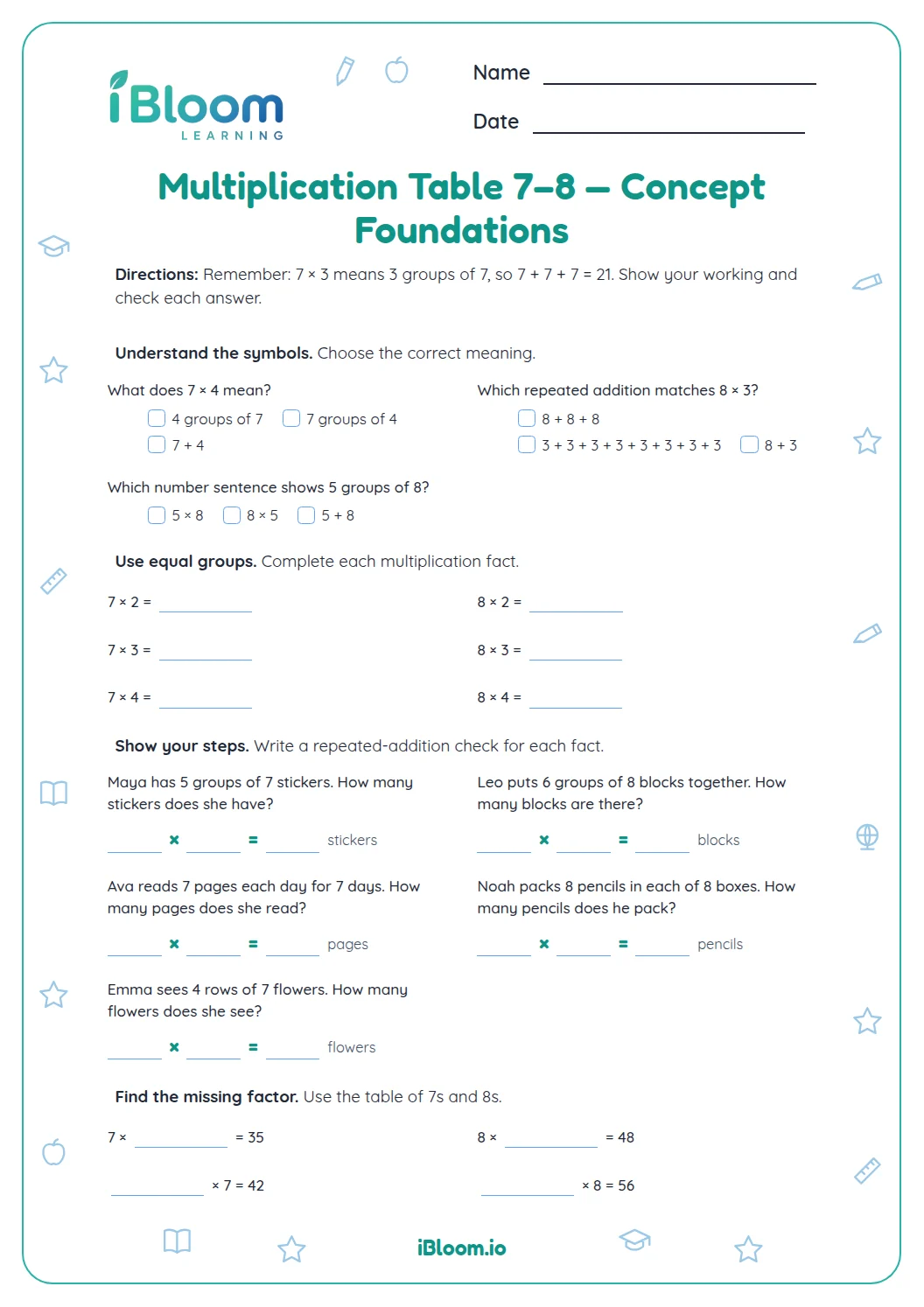
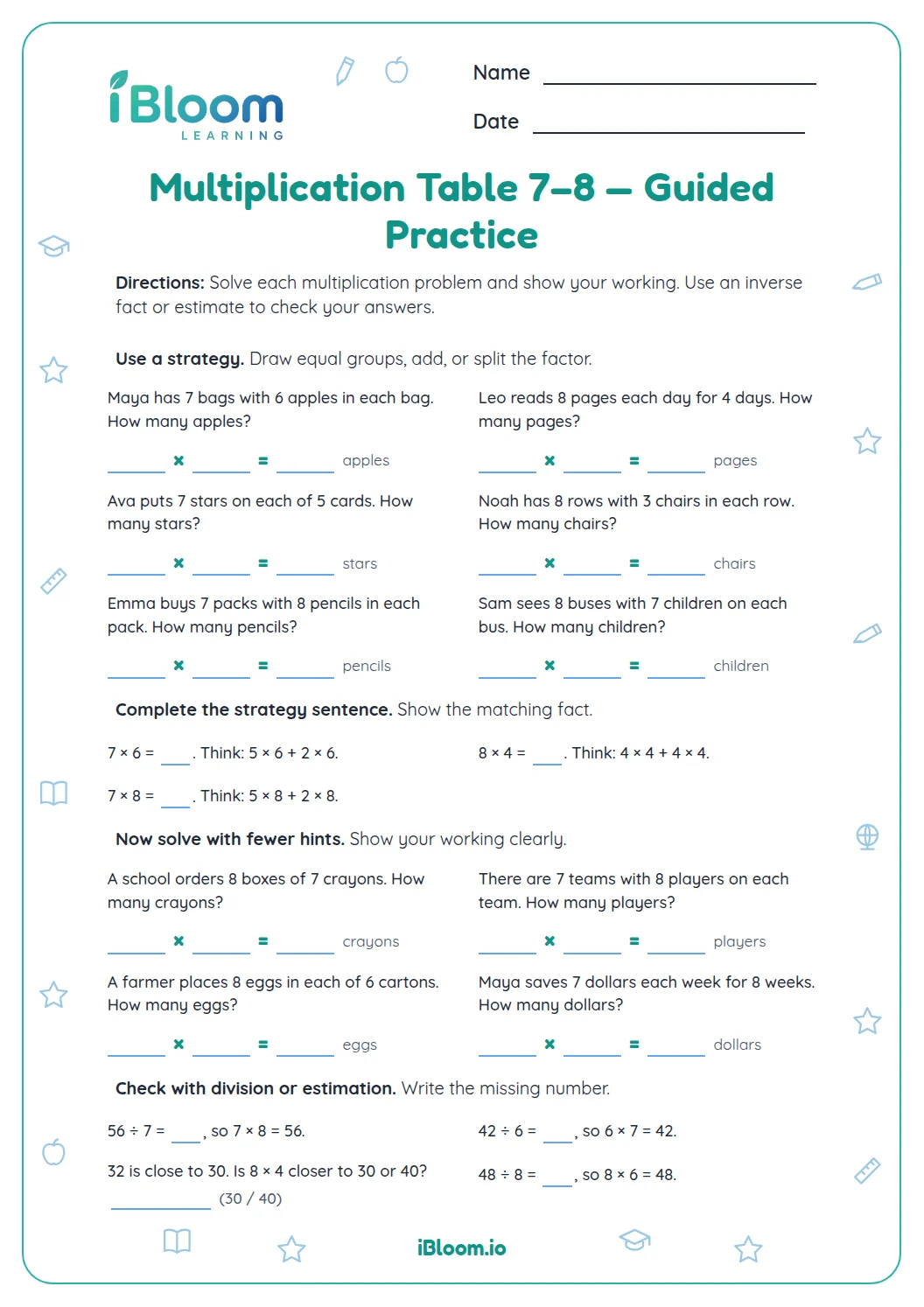
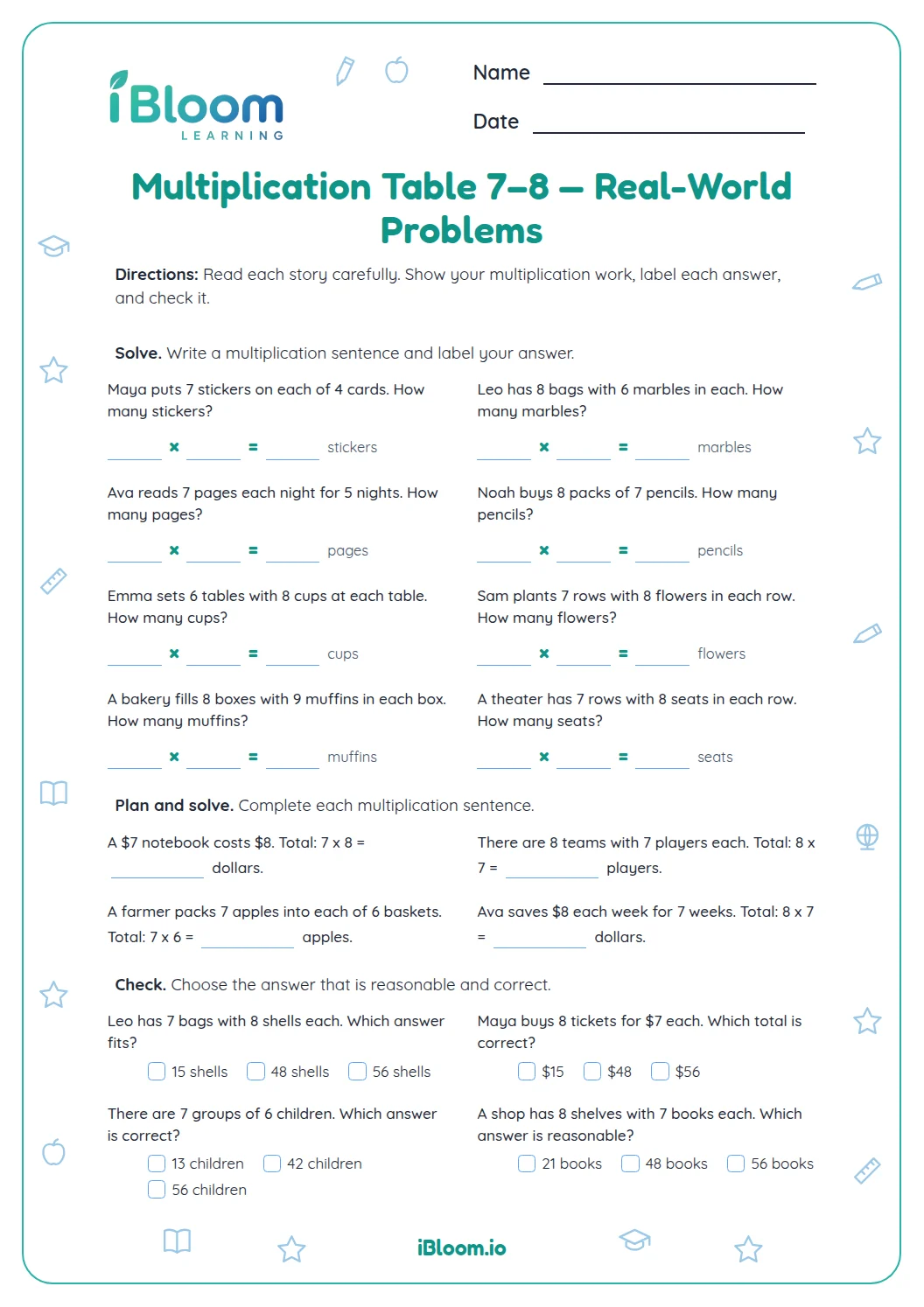
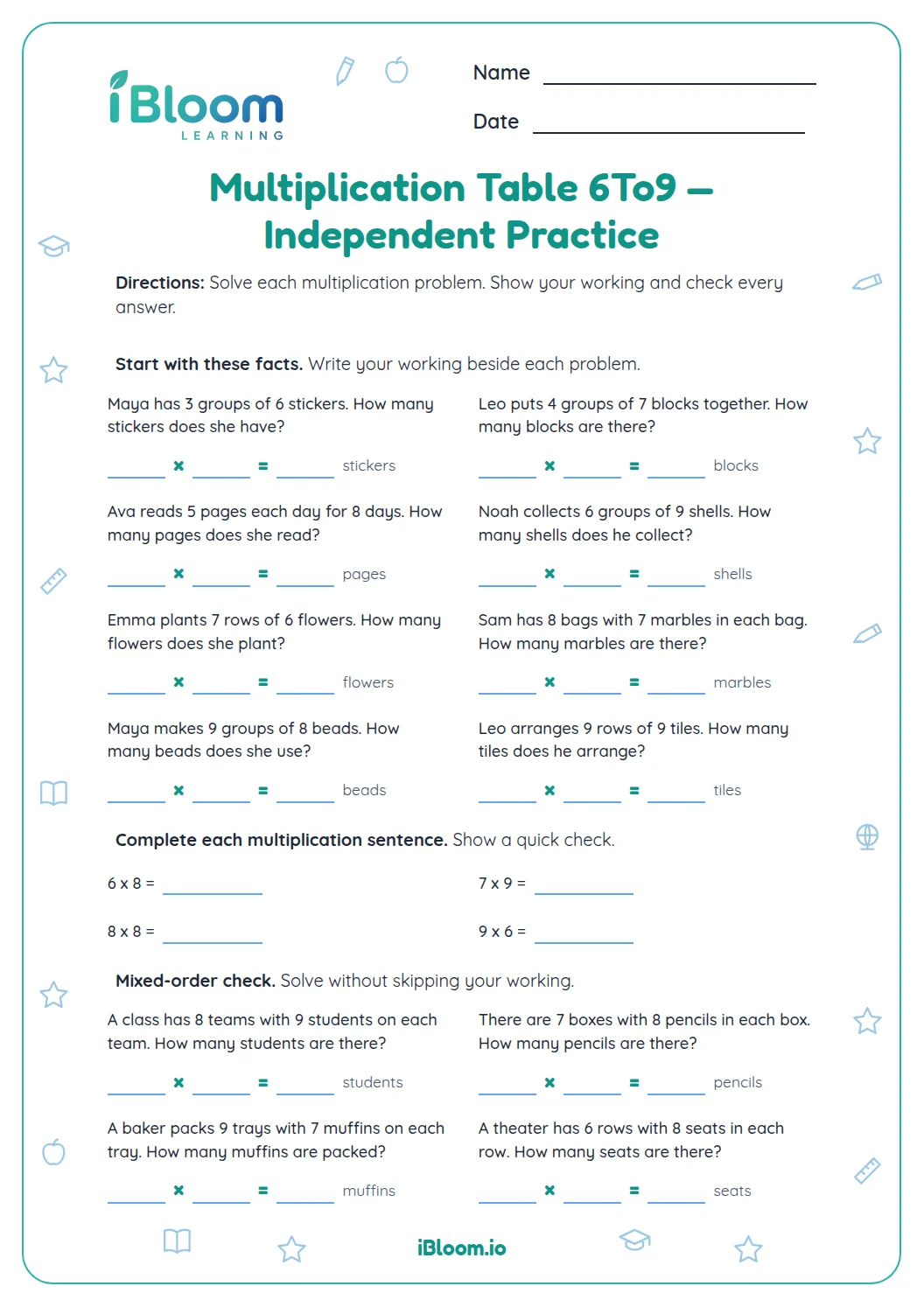
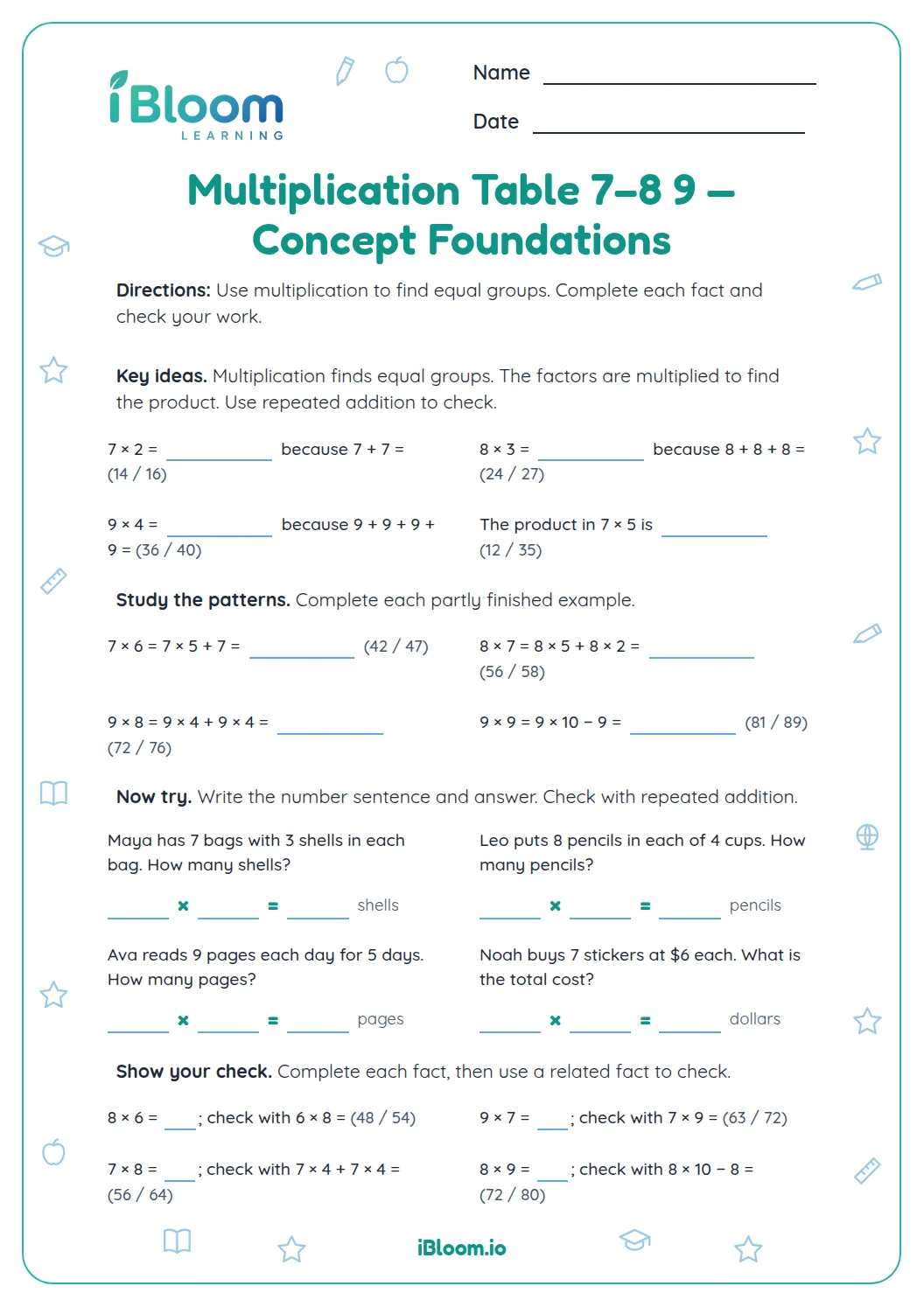
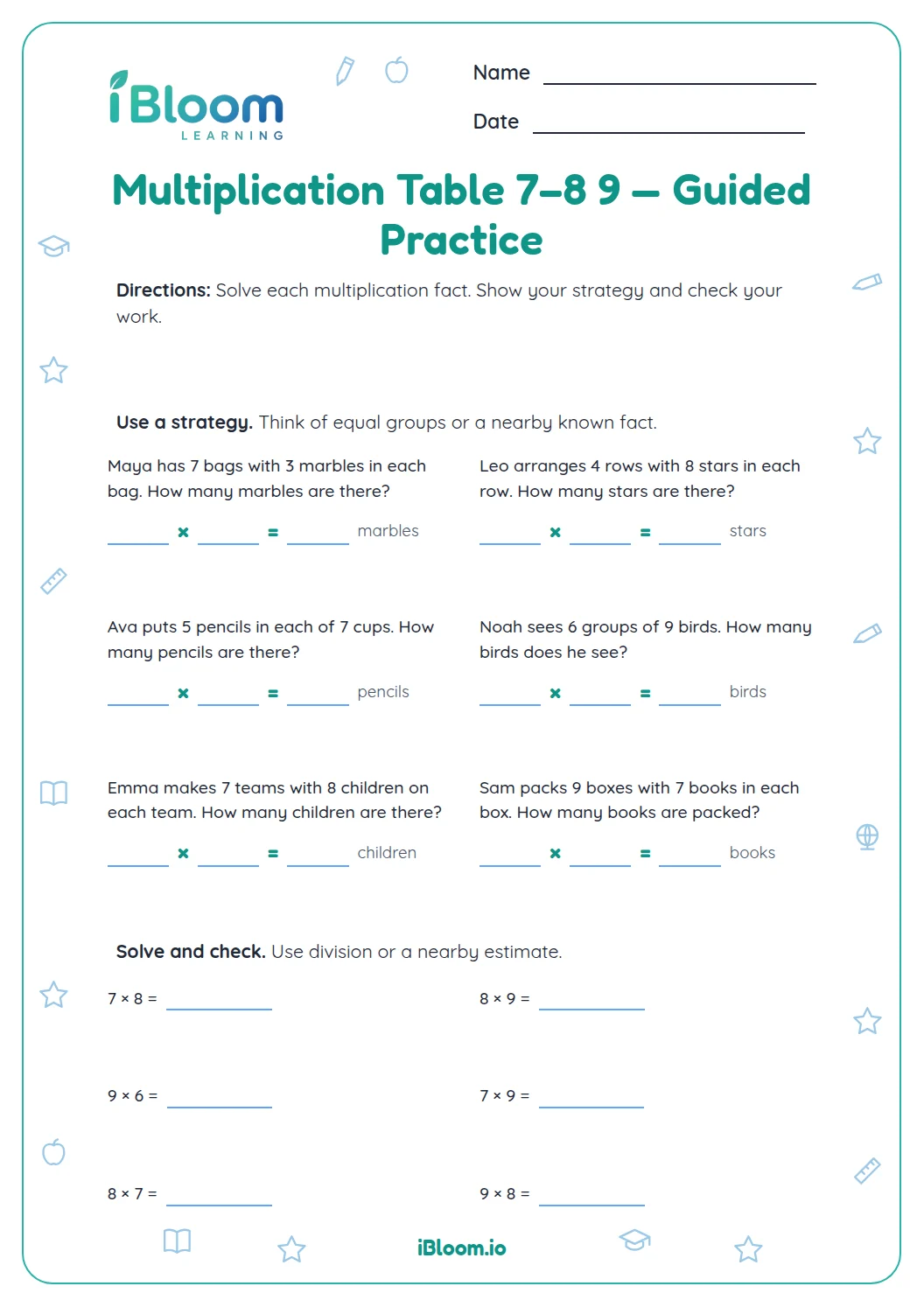
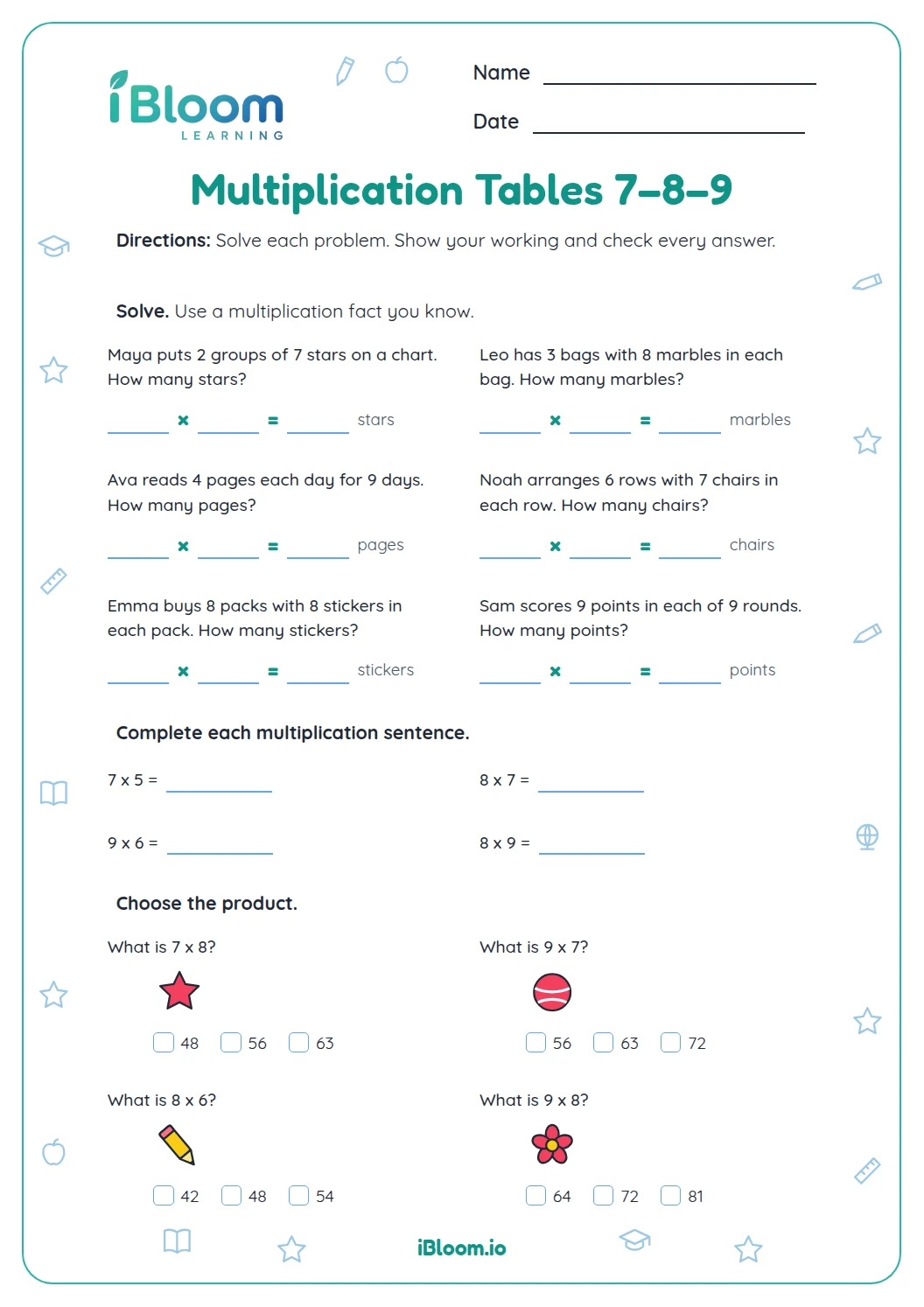
This free printable worksheet gives Grade 3 students independent practice with the 7 and 8 multiplication tables. Six quick equations build fact recall, five missing-factor equations connect multiplication facts to unknowns, and five short stories apply the same facts to equal groups. Every product is 100 or less. The page practices CCSS 3.OA.C.7, which asks students to multiply fluently within 100 and know one-digit products from memory. A separate answer key is included for checking work.
Aligned to 3.OA.C.7
How can a known fact help with a new one?
Multiplication facts connect to one another. If 7 × 6 = 42 is familiar, reversing the factors gives 6 × 7 = 42. A nearby fact can help too: 8 × 7 is one more group of 8 than 8 × 6.
Question 4 asks for 8 × 7. Since 8 × 6 = 48, add one more group of 8: 48 + 8 = 56. Check by reversing the factors: 7 × 8 is also 56.
- 18 × 7 = 8 × 6 + 8
- 248 + 8 = 56
- 3So 8 × 7 = 56
- 4Check: 7 × 8 = 56
How do you find a missing factor?
A missing factor asks which number belongs in a multiplication fact. For 7 × ___ = 35, think of the 7s: 7, 14, 21, 28, 35. The fifth group reaches 35, so the missing factor is 5.
You can also use the related division fact. Since 35 ÷ 7 = 5, the equation 7 × 5 = 35 is true.
- 17 × ___ = 35
- 235 ÷ 7 = 5
- 37 × 5 = 35
- 4The missing factor is 5
How do multiplication facts solve equal-group stories?
Look for the number of equal groups and the number in each group. In the crate story, 6 crates hold 7 bottles each, so multiply 6 × 7. The total is 42 bottles.
The stories use rows, tables, nights, trays, and crates. Write a multiplication equation before solving so the two factors match the situation.
What is included on the practice pages?
The worksheet has 16 questions in three parts. Part A is a quick fact check, Part B finds missing factors, and Part C applies 7 and 8 facts to equal groups. The answer key is printed on its own page.
- Part A: six products using 7s and 8s
- Part B: five equations with one missing factor
- Part C: five short equal-group stories with working space
How can a student work through the page?
- 1Start with Part A and answer the facts you know right away.
- 2For a tricky fact, build from a nearby fact, such as 8 × 6 to find 8 × 7.
- 3In Part B, ask which factor times the known factor equals the product.
- 4Read each Part C story and identify the number of groups and items in each group.
- 5Write the multiplication equation in the work area, then calculate the product.
- 6Use the answer key to check each answer and revisit any fact that needs practice.
Common multiplication mistakes and quick fixes
The mistake
Adding the factors, such as 7 + 8, instead of multiplying them.
The fix
Think of equal groups: 7 × 8 means 8 groups of 7, or 56 altogether.
The mistake
Reversing the numbers in a story and losing what each factor represents.
The fix
Label the factors in words first: number of groups × items in each group.
The mistake
Stopping at a nearby fact, such as using 8 × 6 = 48 for 8 × 7.
The fix
Compare the facts. The 7-group fact needs one more group of 8, so add 8 to 48.
Common Core alignment
This independent practice focuses on multiplication fact fluency in Grade 3.
Recall and use 7 and 8 multiplication facts with products within 100.
On this sheet: The fact equations and missing-factor questions practice products of one-digit factors within 100.
Show the official wordingHide the official wording
Fluently multiply and divide within 100, using strategies such as the relationship between multiplication and division (e.g., knowing that 8 × 5 = 40, one knows 40 ÷ 5 = 8) or properties of operations. By the end of Grade 3, know from memory all products of two one-digit numbers.
What to practice next
Make more practice
Further reading
Questions parents and teachers ask
How many questions are on this worksheet?
There are 16 questions across three parts. Students answer six direct multiplication facts, find five missing factors, and solve five equal-group stories. The separate key has the answers for all three parts, so a parent or teacher can check the page after the student finishes.
Which times tables does the page cover?
The worksheet focuses on the 7 and 8 times tables. Direct facts include products such as 7 × 9 and 8 × 8, while missing-factor equations and stories give students additional ways to use those facts and strengthen recall.
How can a child solve 8 × 7 if they do not remember it?
Build from a fact that is known. Since 8 × 6 = 48, one more group of 8 makes 8 × 7 = 48 + 8 = 56. The student can check the result by reversing the factors: 7 × 8 also equals 56.
What is a missing factor?
A missing factor is the number that completes a multiplication equation. In 7 × ___ = 35, the question is “7 times what equals 35?” Since 35 ÷ 7 = 5, the missing factor is 5. Part B offers five equations like this.
How should students approach the story problems?
First identify how many equal groups there are and how many items belong in each group. Multiply those two numbers, then write the total with the item named in the story. For example, 6 crates with 7 bottles in each crate hold 42 bottles.
Does the worksheet include an answer key?
Yes. The answer key is a separate printable page and includes the products, missing factors, and totals for the story problems. Students can complete the worksheet first, then use the key with an adult to check their answers and practice any facts they missed.