


About this worksheet
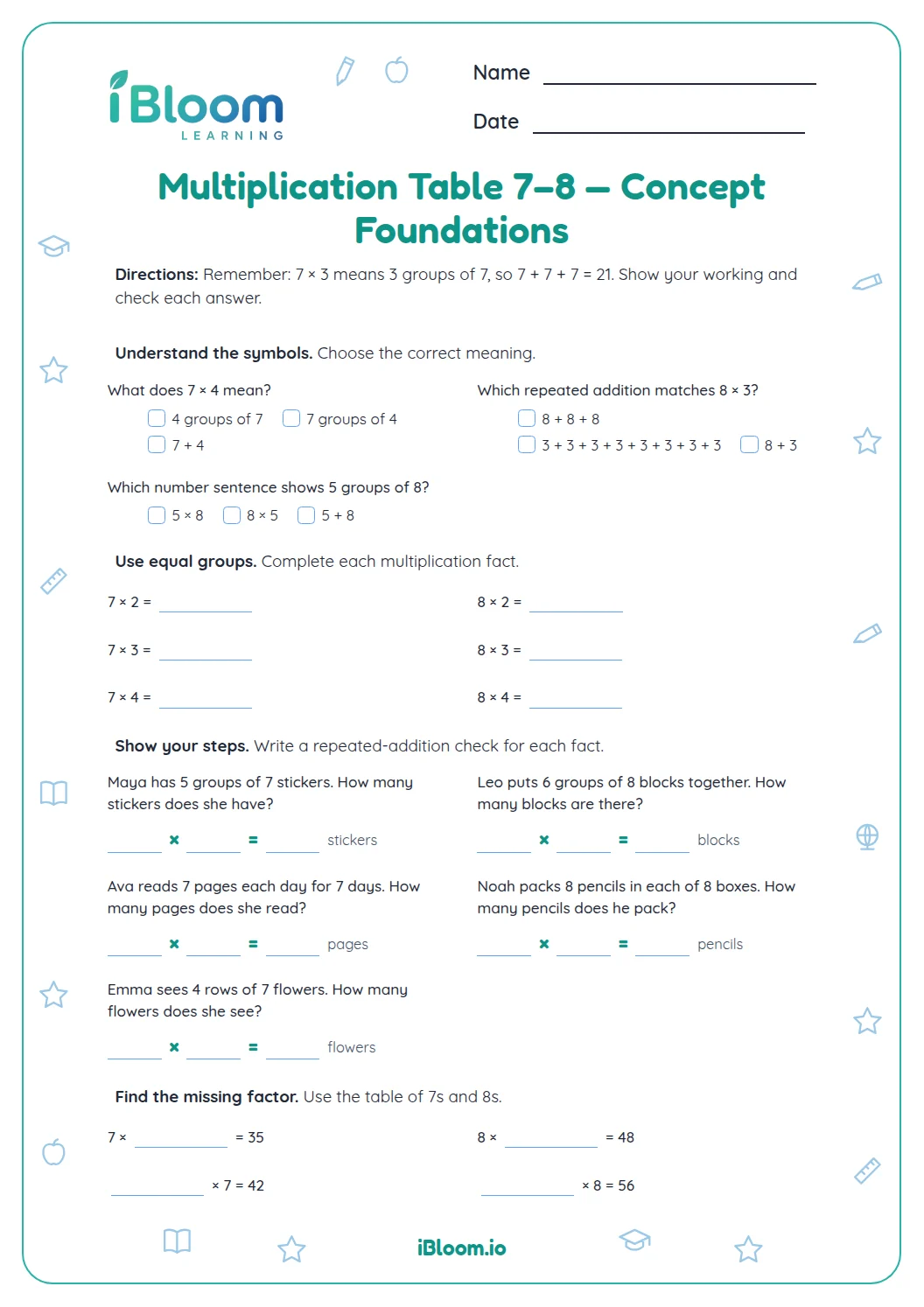
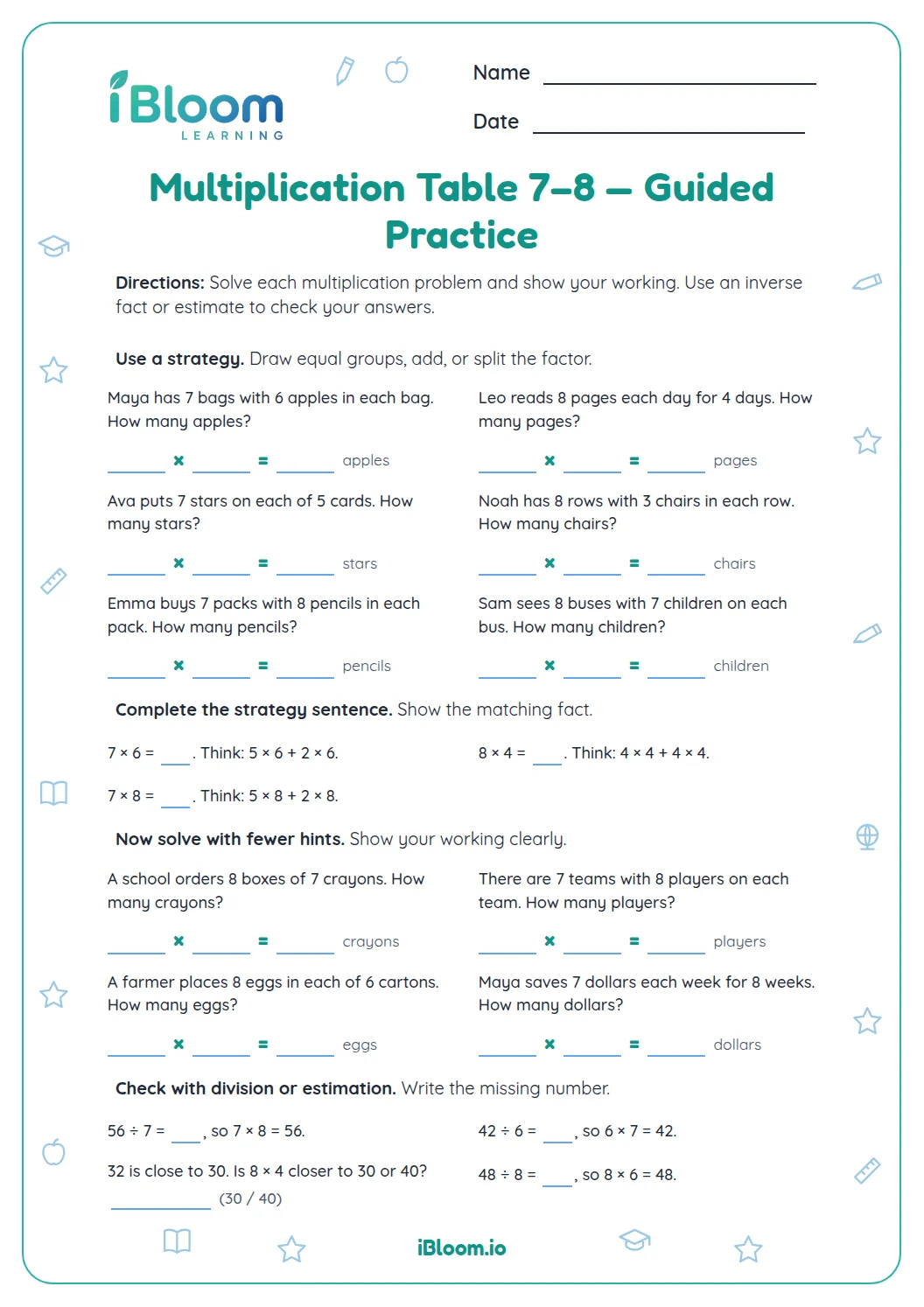
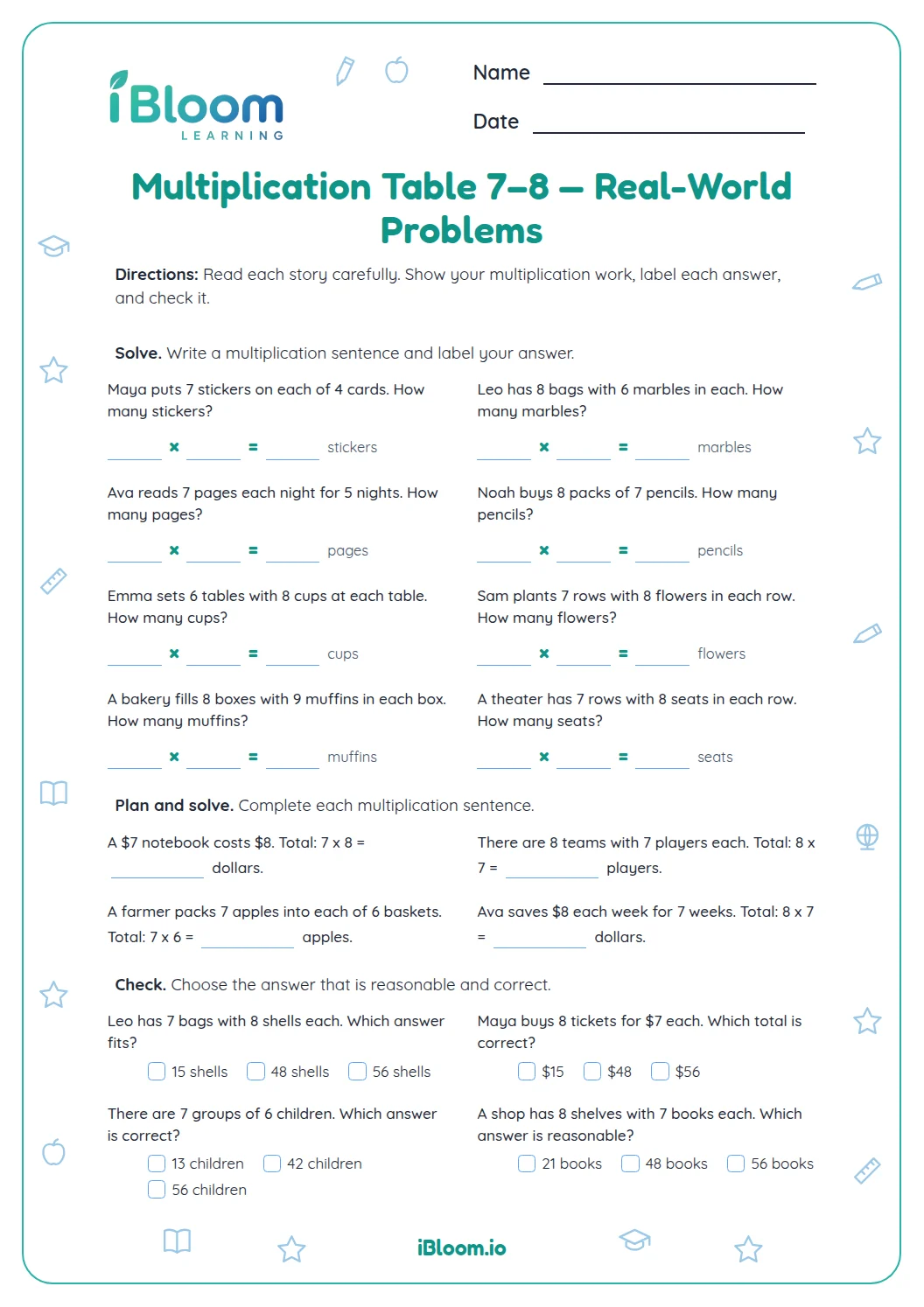
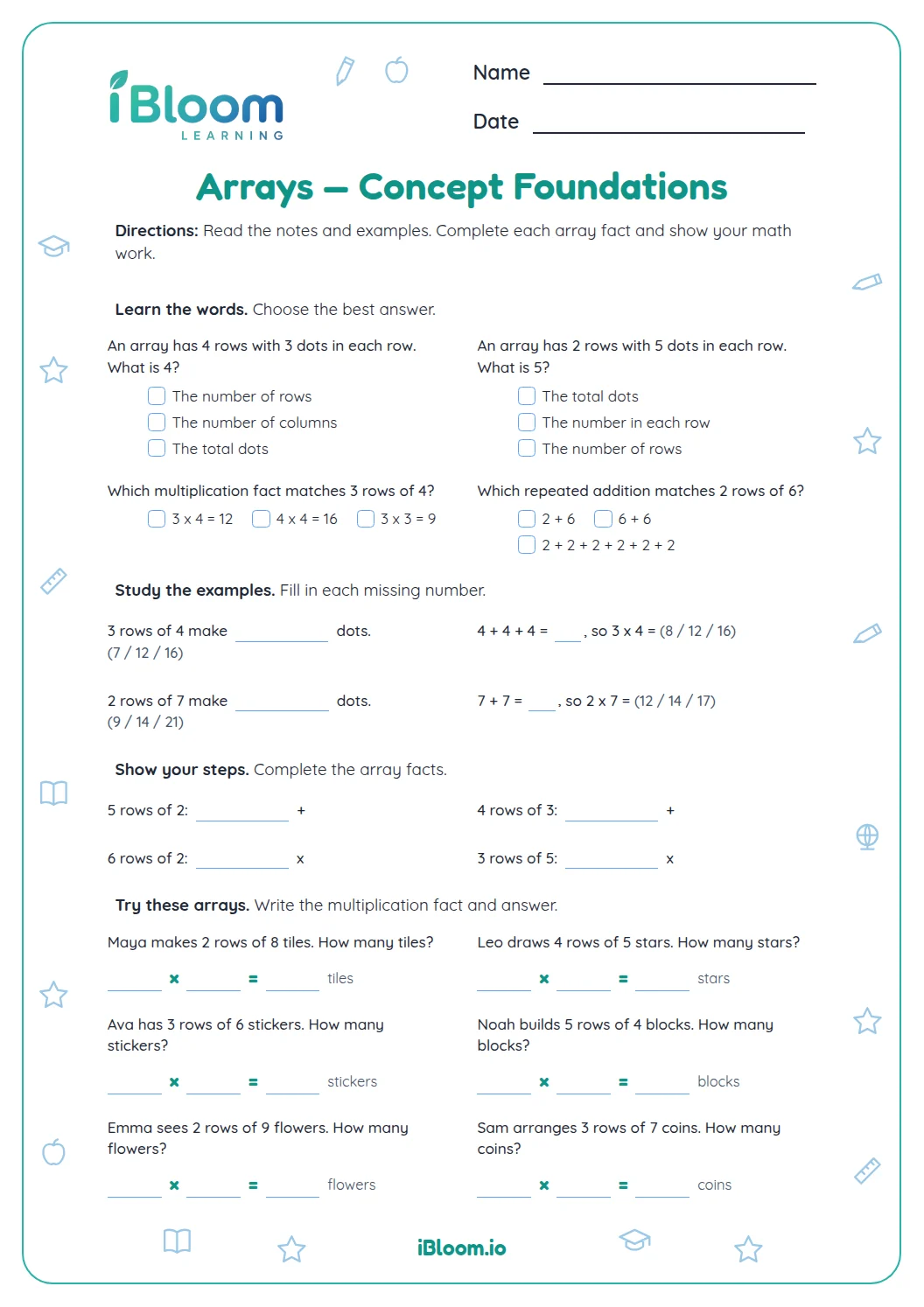
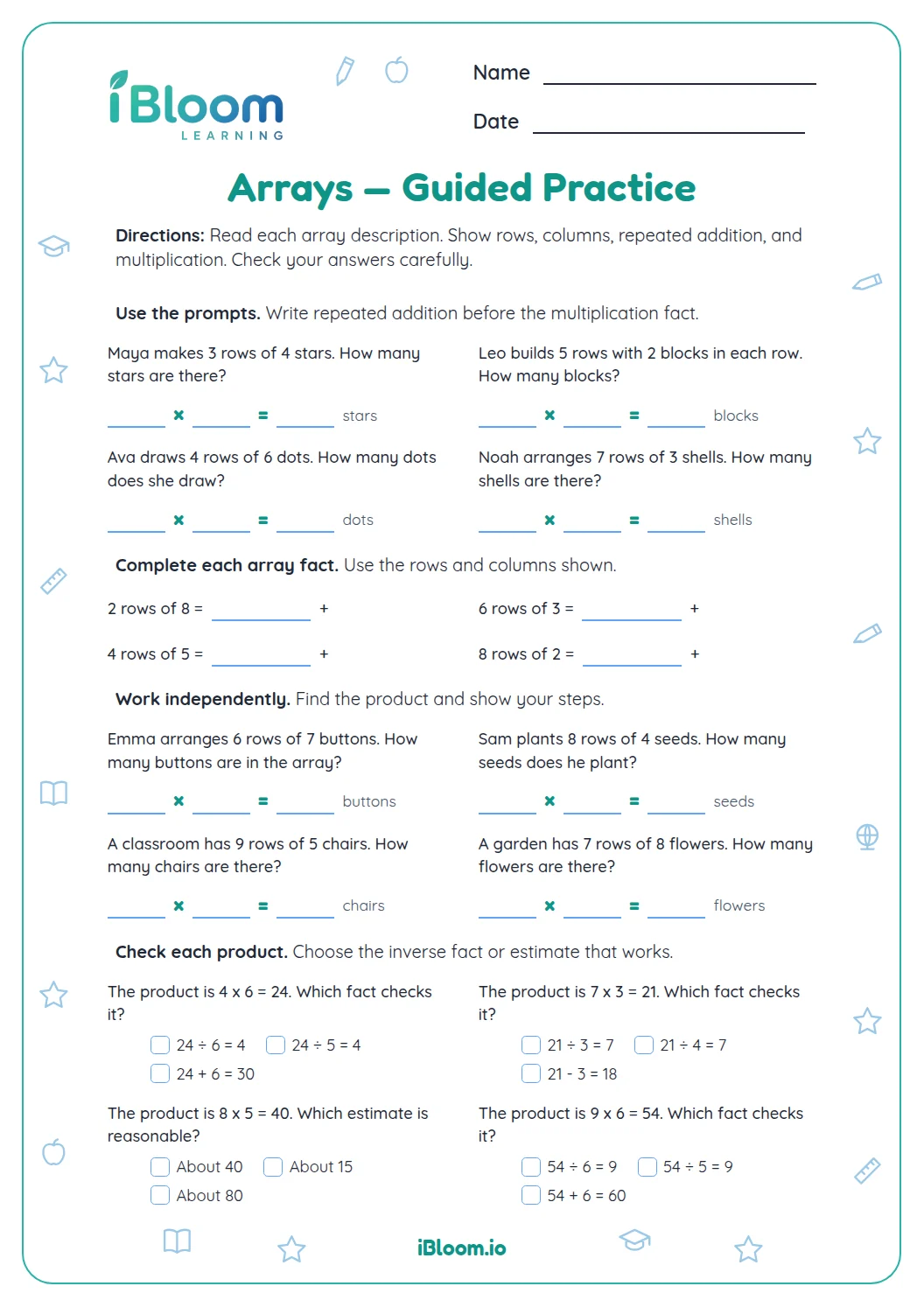
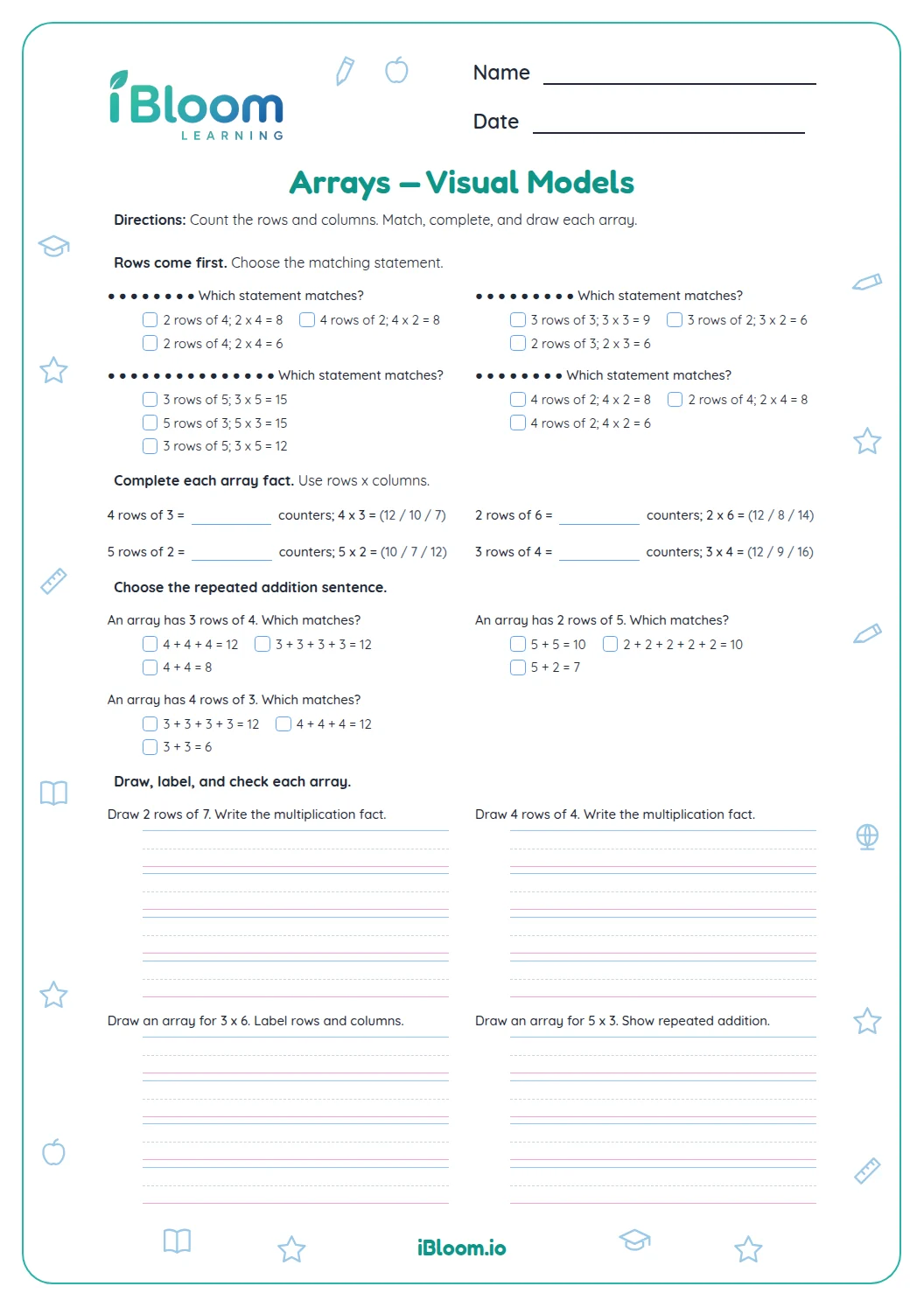
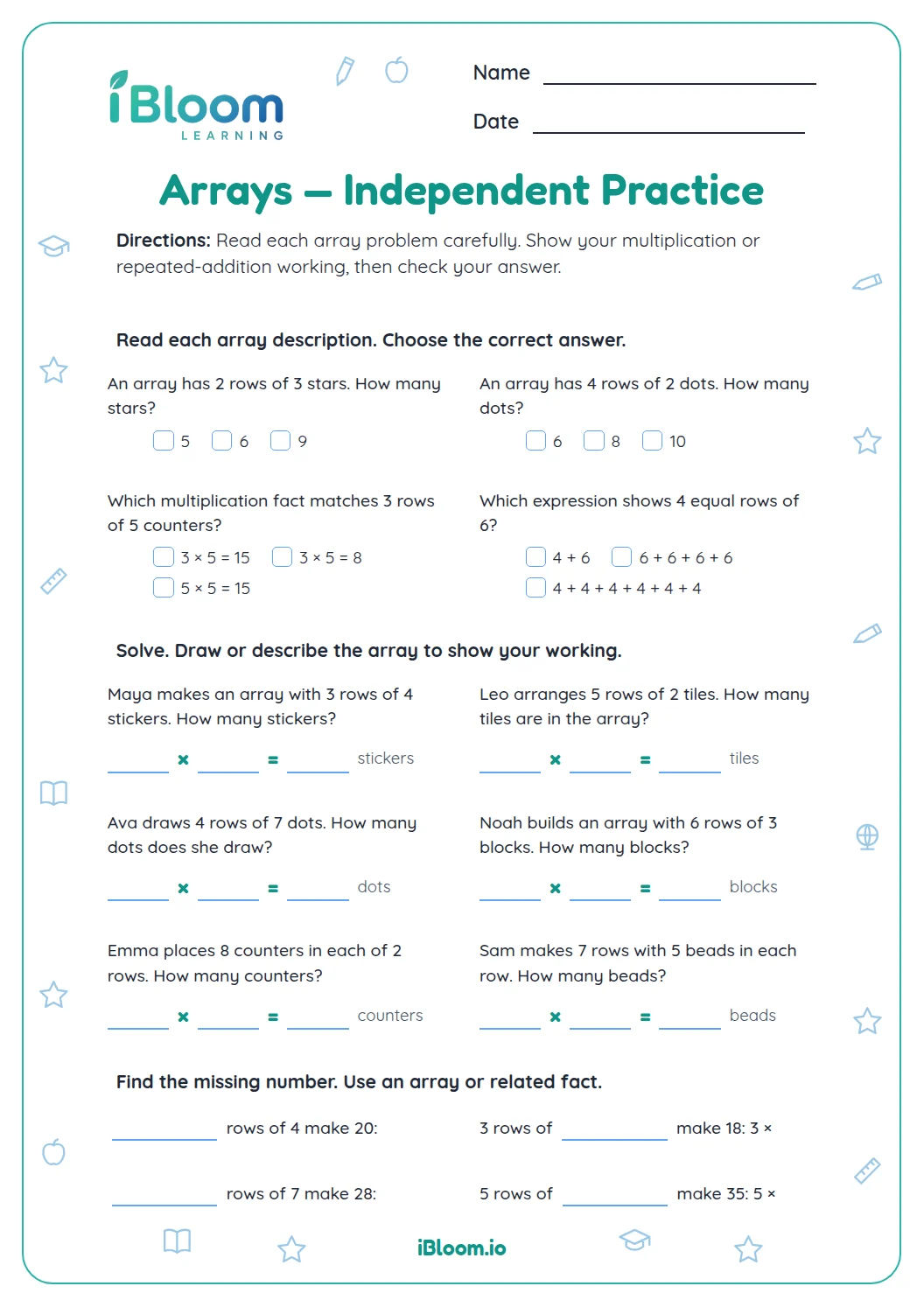
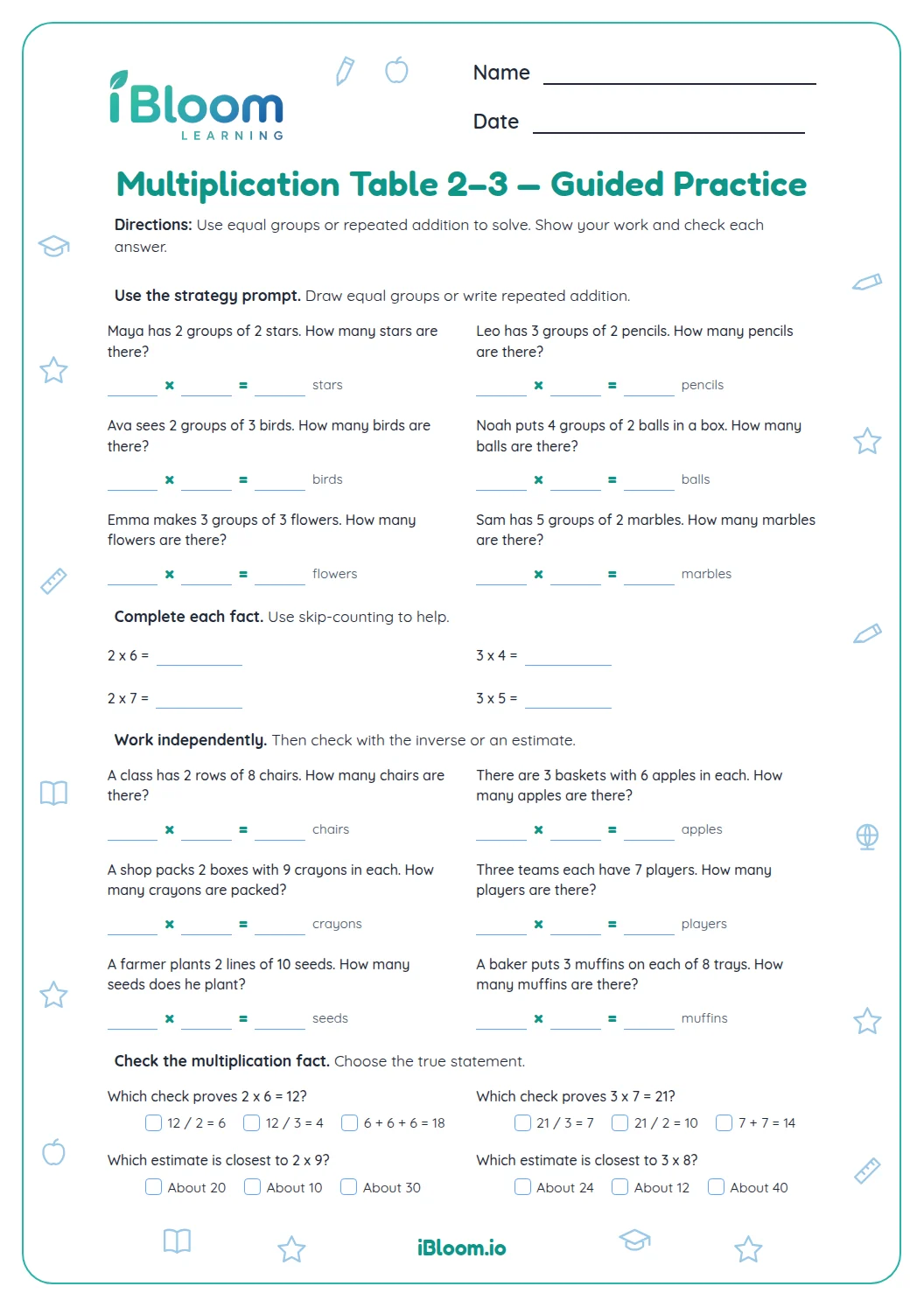
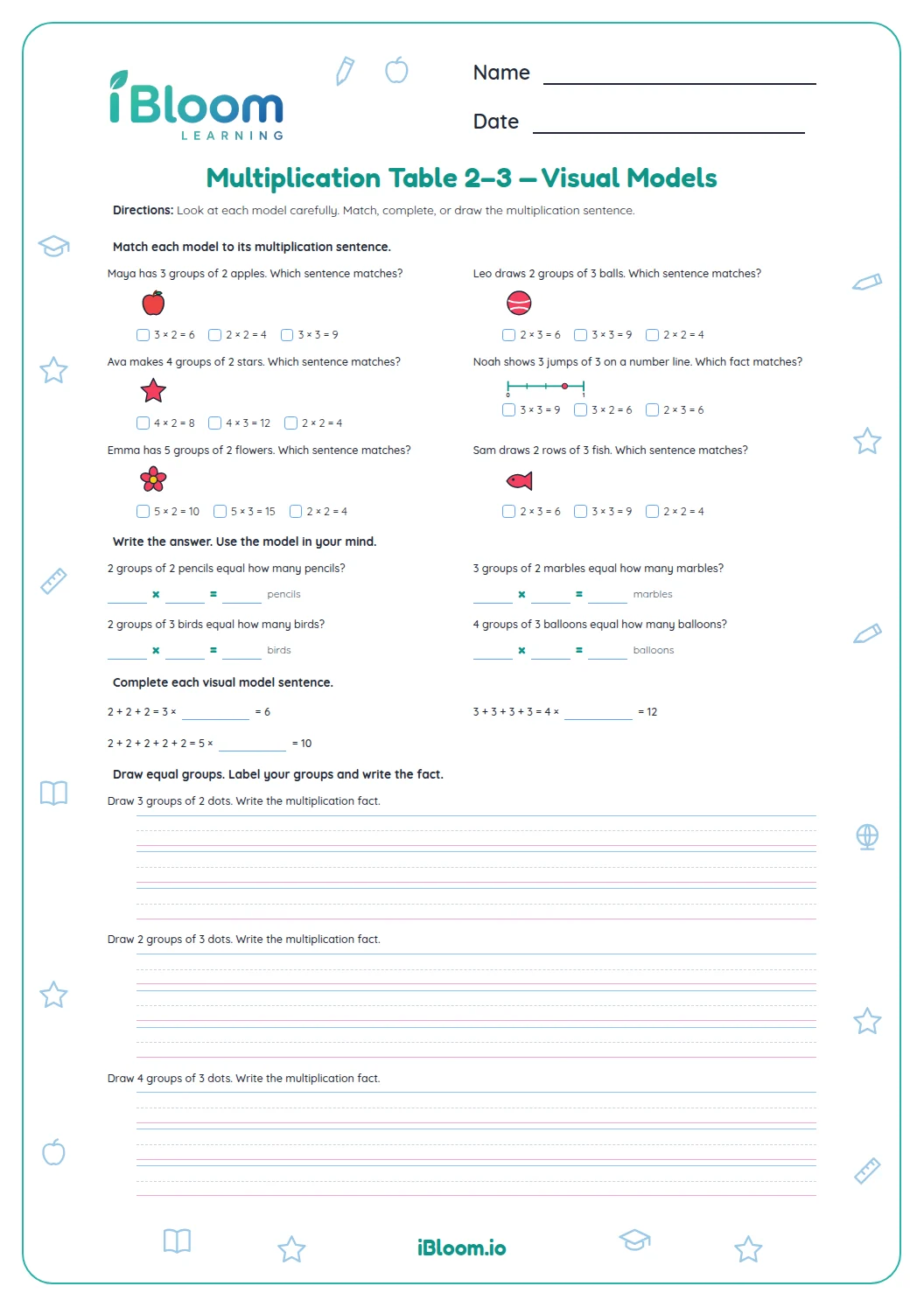
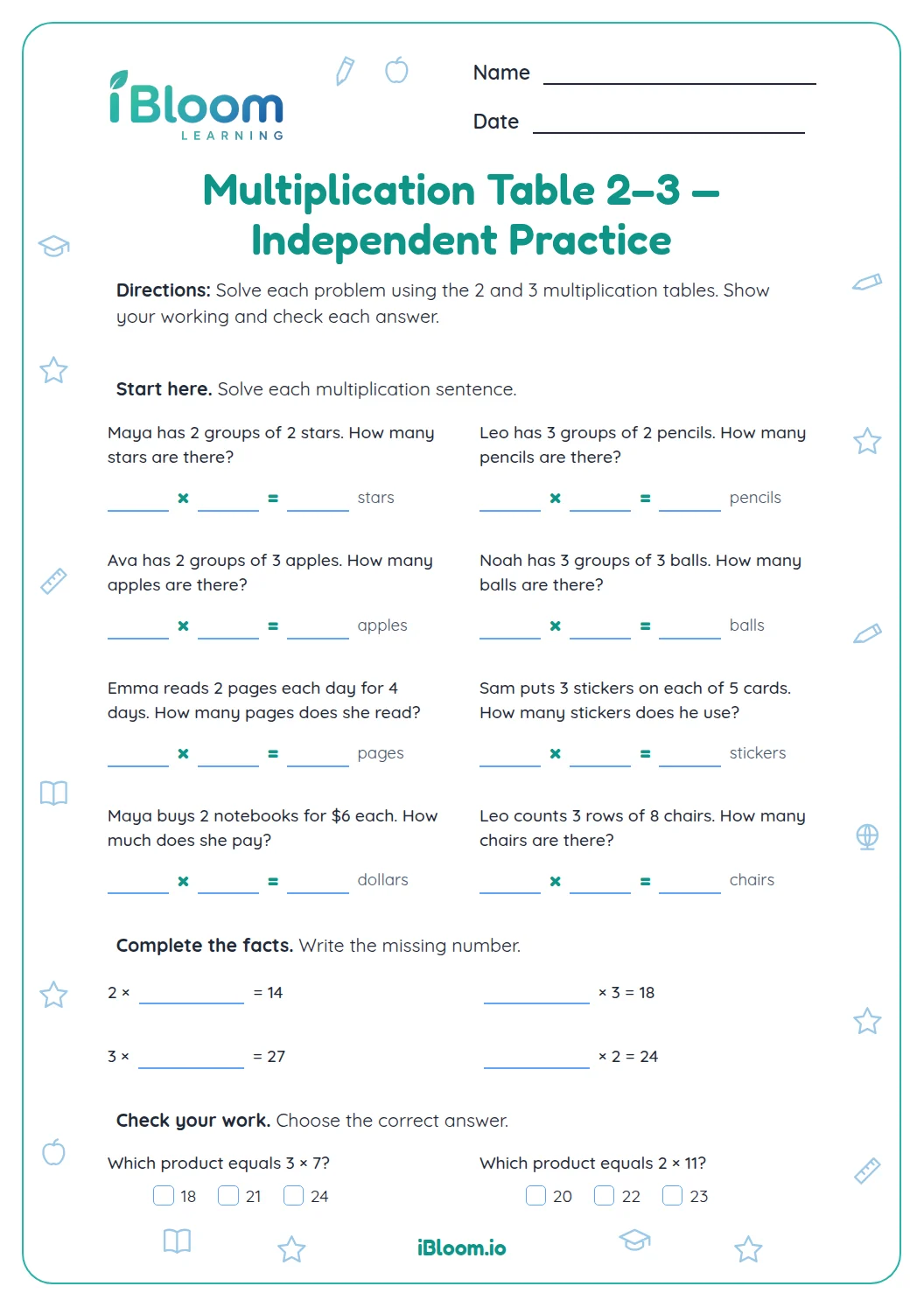
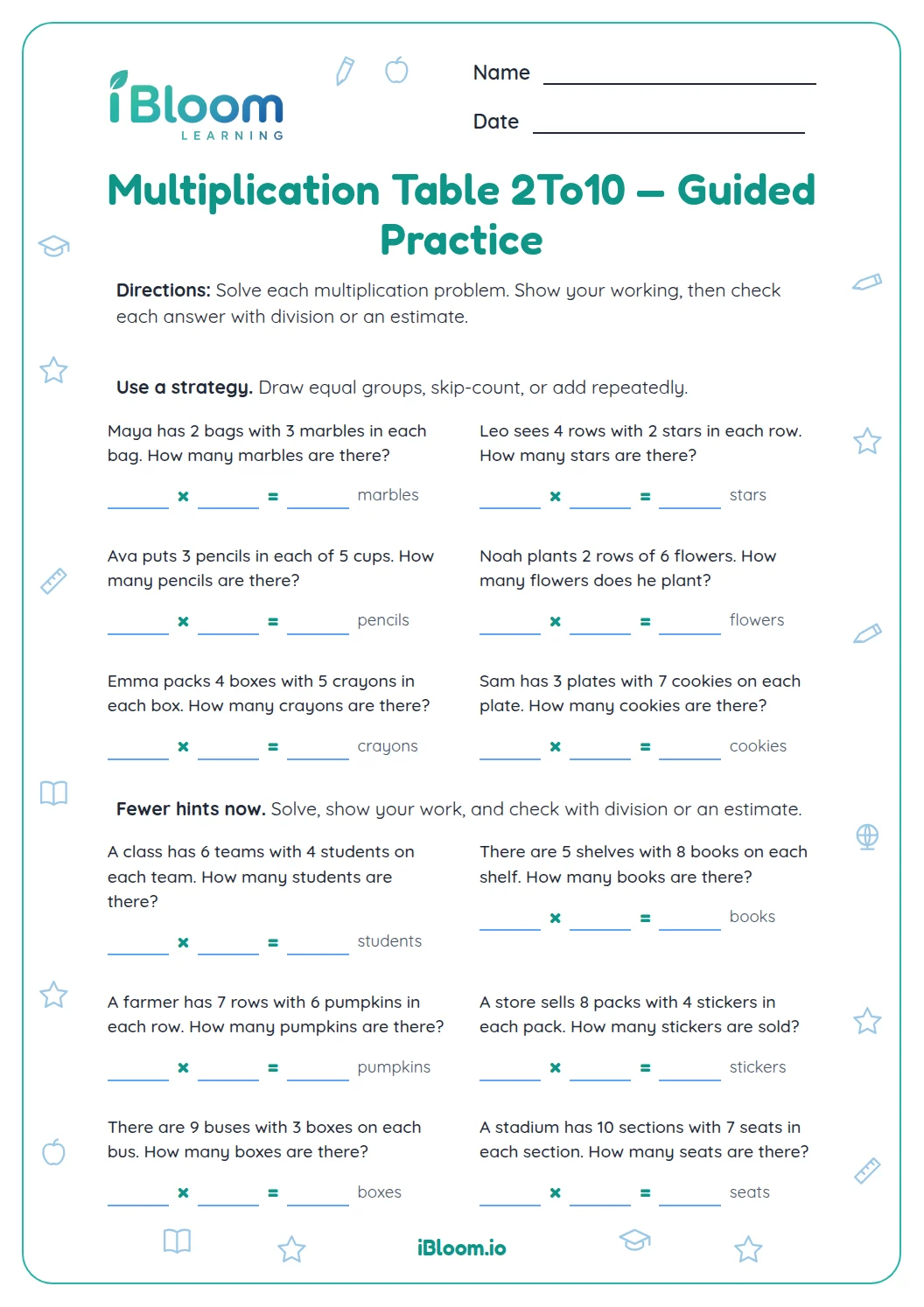
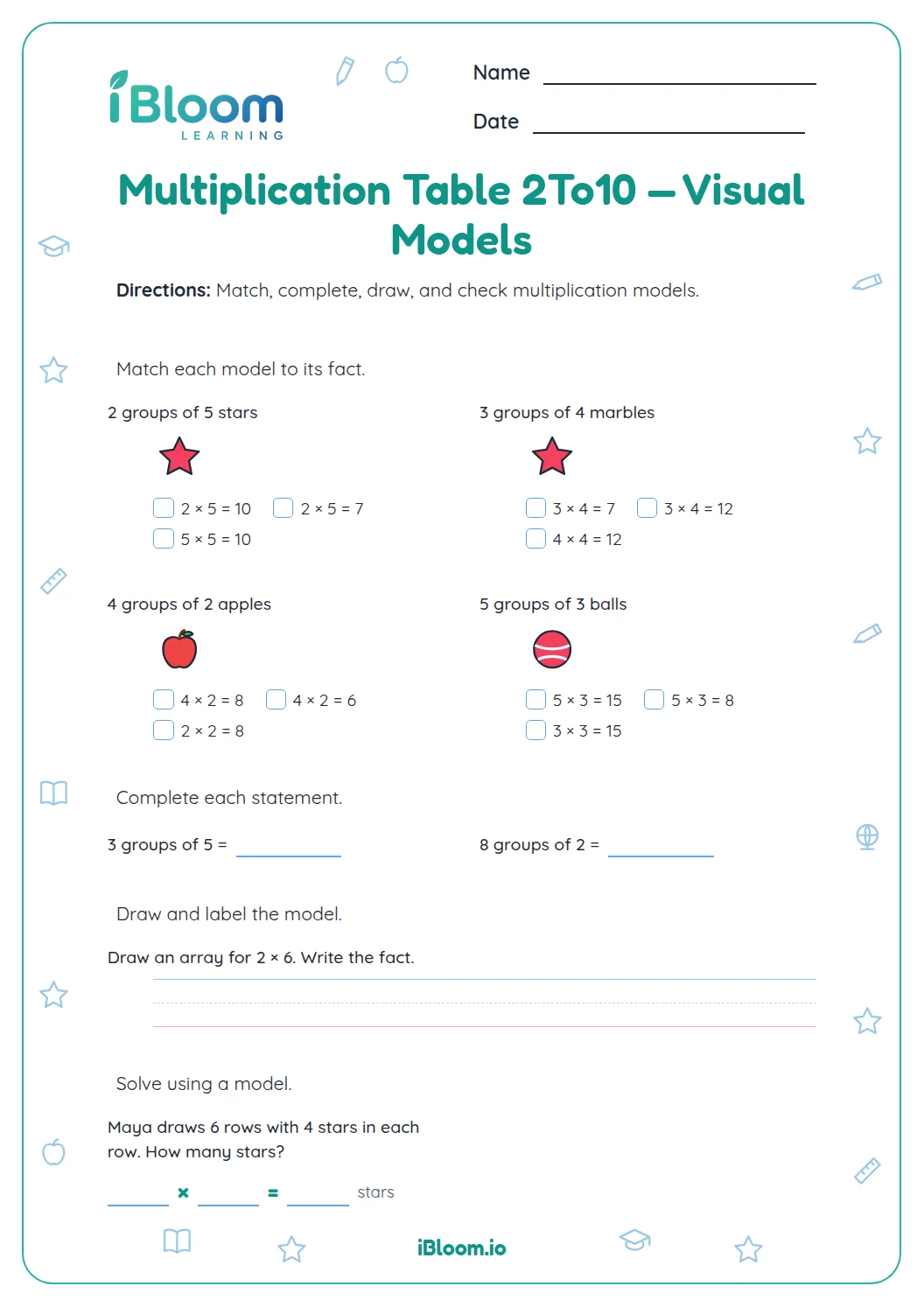
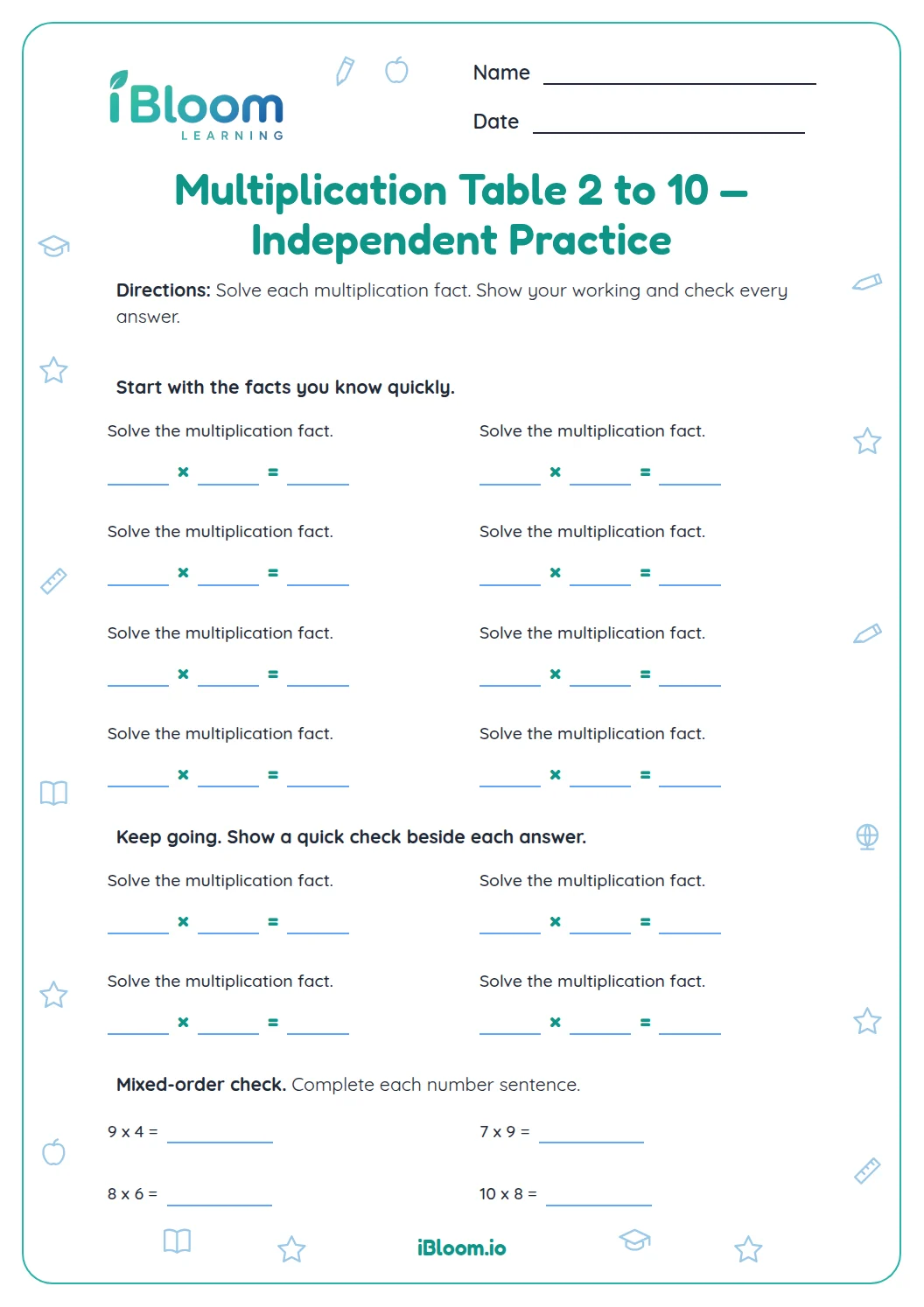
This Grade 3 printable practices the full 7 and 8 multiplication tables. Six arrays show equal rows with 2, 4, or 6 objects in each row; fourteen number sentences cover the remaining factors from 1 through 10. Children can count groups, skip-count, or use a known product to complete each fact. The arrays connect products with equal groups, as described in Common Core 3.OA.A.1.
Aligned to 3.OA.A.1
How do you read an array as equal groups?
Count the number of objects in one row, then count the rows. For 7 rows of 4, add 4 seven times or use 7 × 4 to find 28.
- 17 rows of 4 stars
- 27 × 4 = 28
- 3There are 28 stars in all.
How can a known fact help with a new product?
Connect repeated addition with a fact you know. For 8 groups of 6, you can use 8 × 5 = 40 and add one more group of 6 to get 48.
What will the worksheet ask?
The six arrays model 7 or 8 equal rows with 2, 4, or 6 objects in each. The remaining questions complete both multiplication tables for every factor from 1 through 10.
How to use this worksheet
- 1Read the number of rows and objects in each array.
- 2Count equal groups to find the product.
- 3For a number sentence, identify the two factors.
- 4Skip-count or use a related fact to find the missing product.
- 5Check each answer with the answer key.
Common mistakes and quick fixes
The mistake
Switching the factors and miscounting rows.
The fix
Point to the rows as you count; the prompt states the row count.
The mistake
Counting only one row.
The fix
Multiply the number in a row by the number of rows.
The mistake
Skipping a group when skip-counting.
The fix
Touch each row once and say the next multiple aloud.
Common Core alignment
The arrays connect multiplication facts to equal groups.
Interpret a product as equal groups, such as 7 rows of 4 objects.
On this sheet: Each array models equal groups with 7 or 8 rows and asks children to find the total.
Show the official wordingHide the official wording
Interpret products of whole numbers, e.g., interpret 5 × 7 as the total number of objects in 5 groups of 7 objects each. For example, describe a context in which a total number of objects can be expressed as 5 × 7.
What to practice next
Make more practice
Further reading
Questions parents and teachers ask
Which facts are included?
The worksheet includes every fact in the 7 and 8 times tables from factor 1 through factor 10. Six problems use arrays, and fourteen give a multiplication sentence with a missing product. Writing the factors beside the product can make the relationship easier to see.
How do arrays show multiplication?
An array organizes objects into equal rows and columns. Count the objects in each row and how many rows there are; for example, seven rows of four stars show 7 × 4 = 28. Writing the factors beside the product can make the relationship easier to see.
Can children use skip-counting?
Yes. For 8 × 5, a child can count by fives eight times or use a familiar fact to find the product. Skip-counting one group at a time is also a useful way to check. Writing the factors beside the product can make the relationship easier to see.
Does the answer key show array totals?
Yes. The separate key lists the product for each of the six arrays and each number sentence. Children can check a product by counting rows or by repeating the same addition. Writing the factors beside the product can make the relationship easier to see.
How many questions are on the page?
There are 20 questions: six array products and fourteen missing-product facts. Together they practice both tables from ×1 to ×10. Writing the factors beside the product can make the relationship easier to see. Writing the factors beside the product can make the relationship easier to see.