




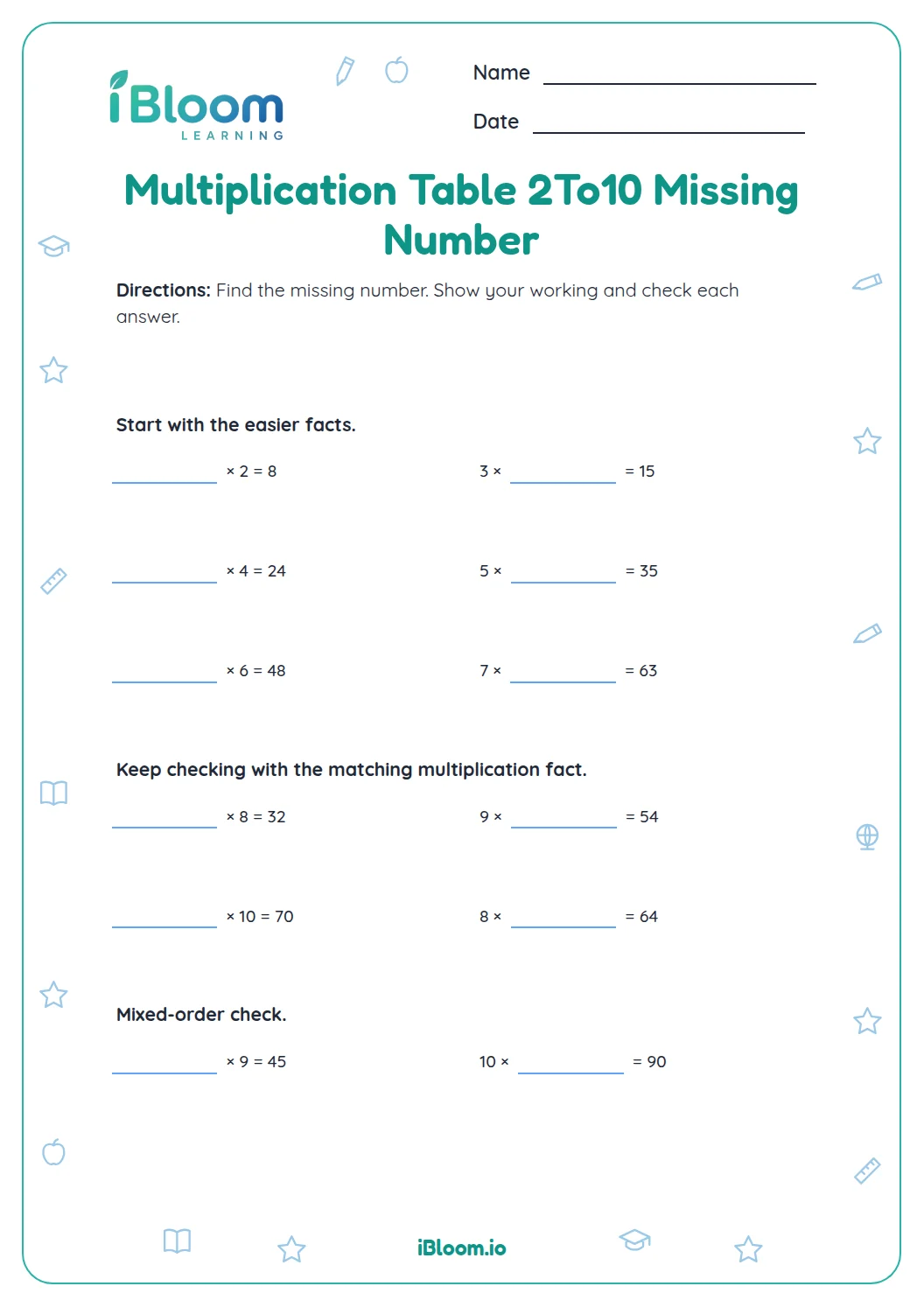
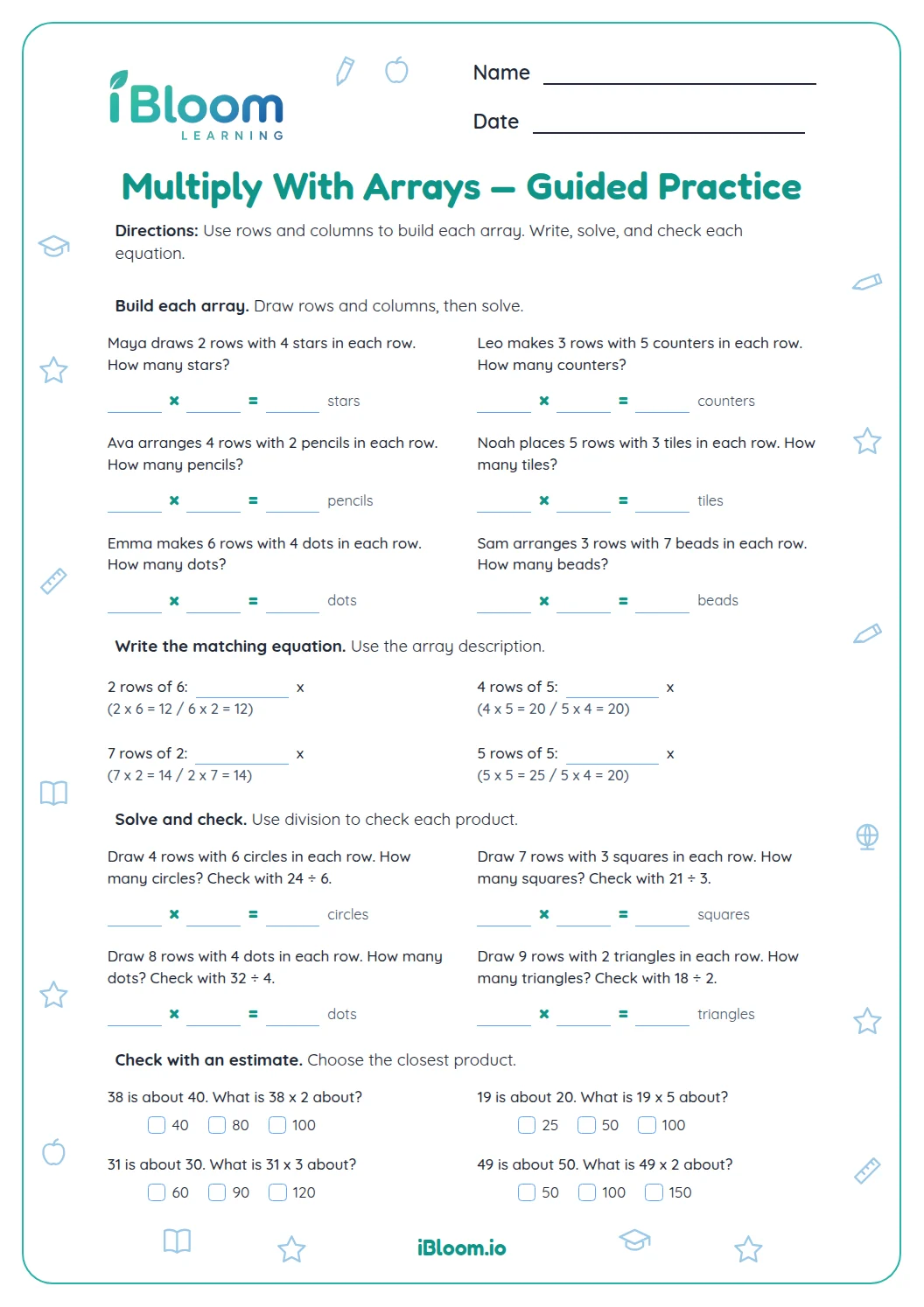
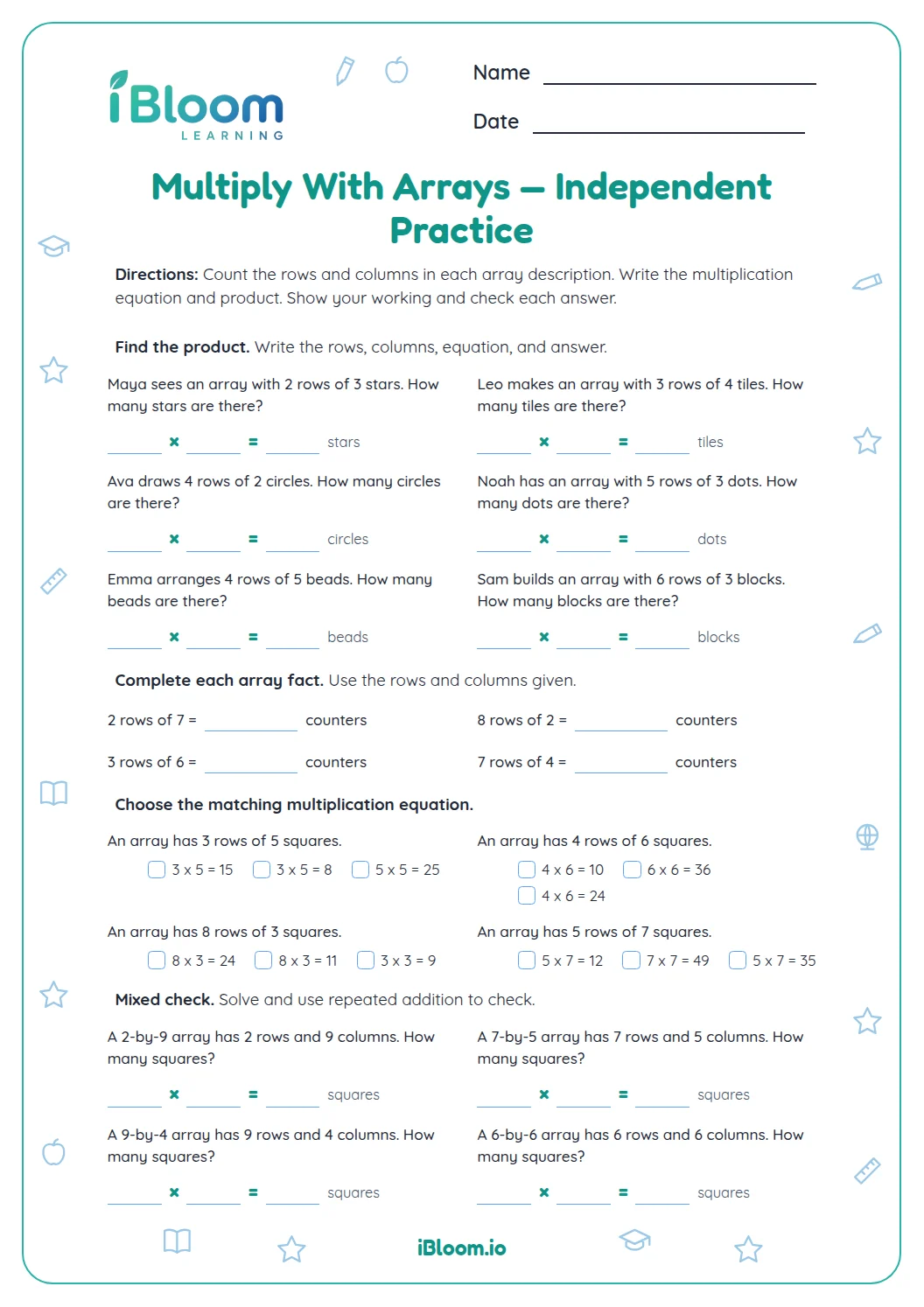
About this worksheet
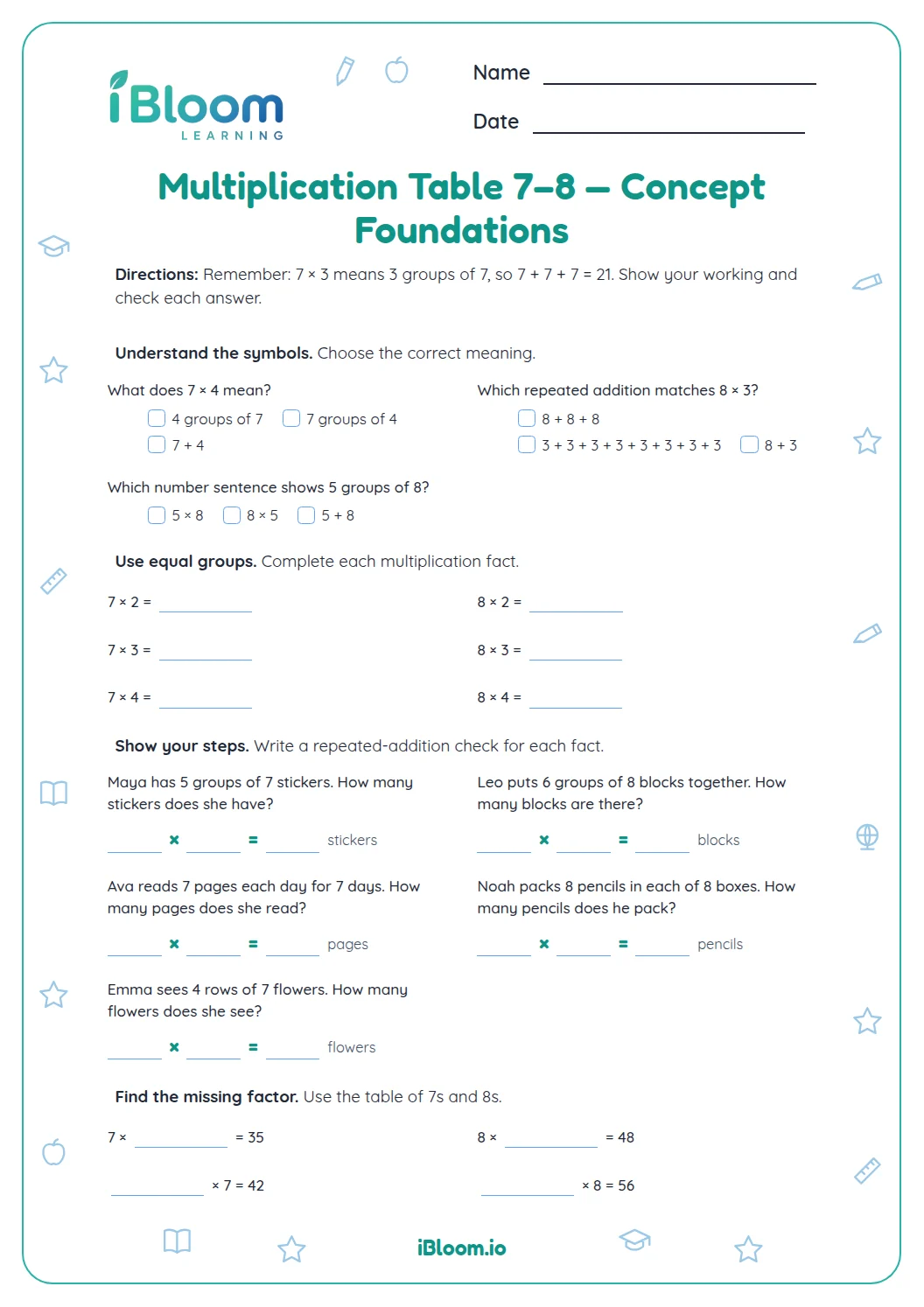
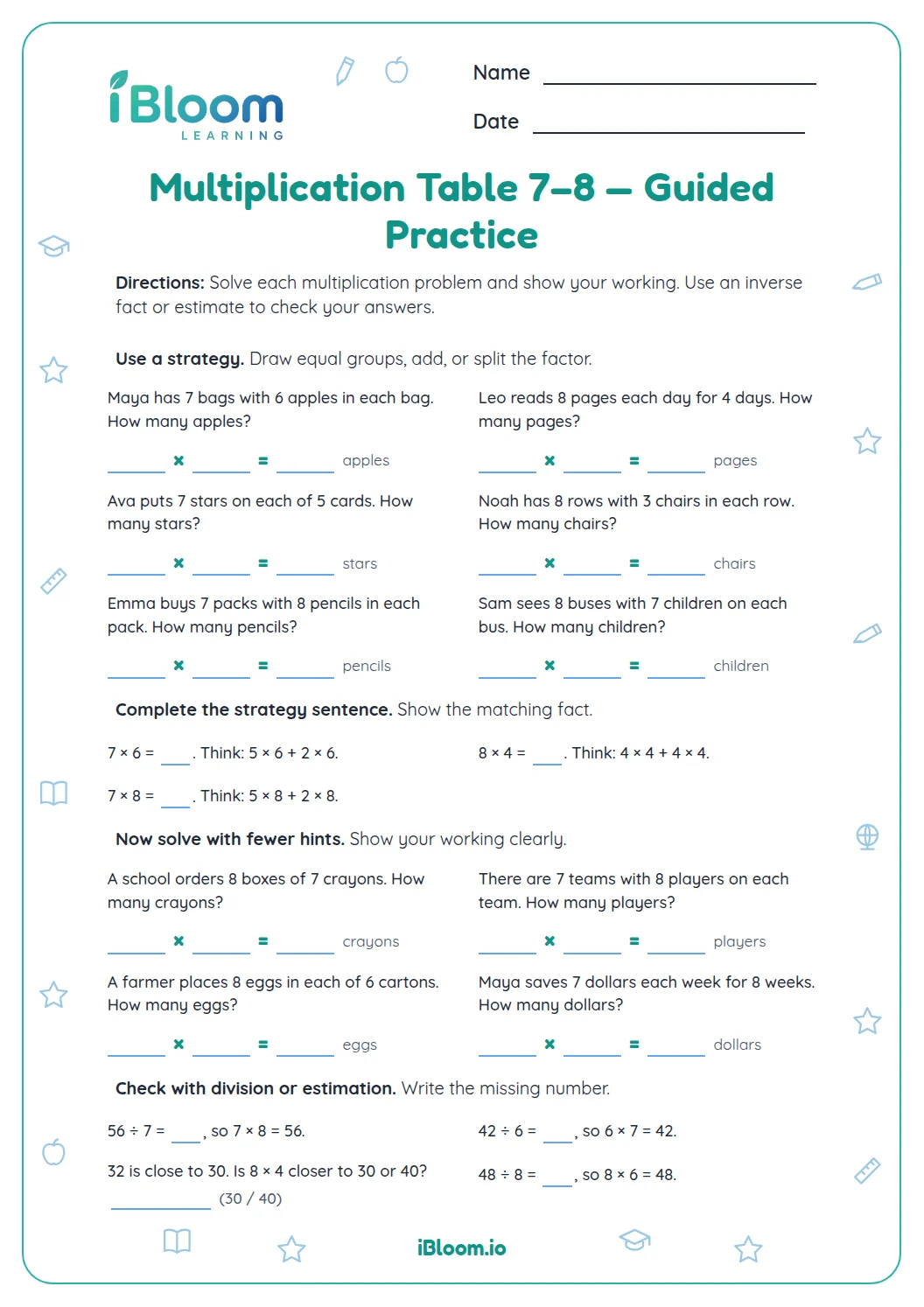
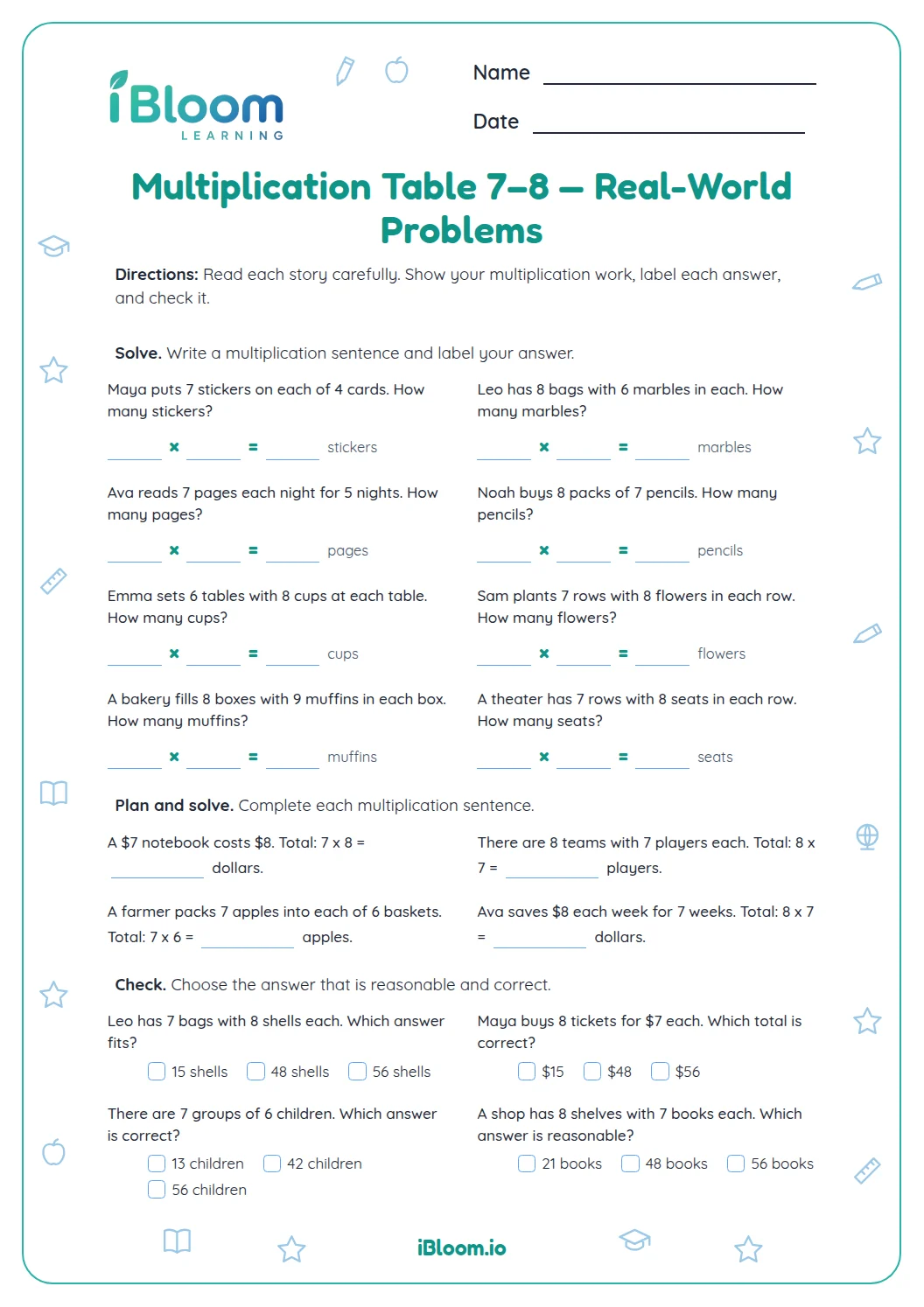
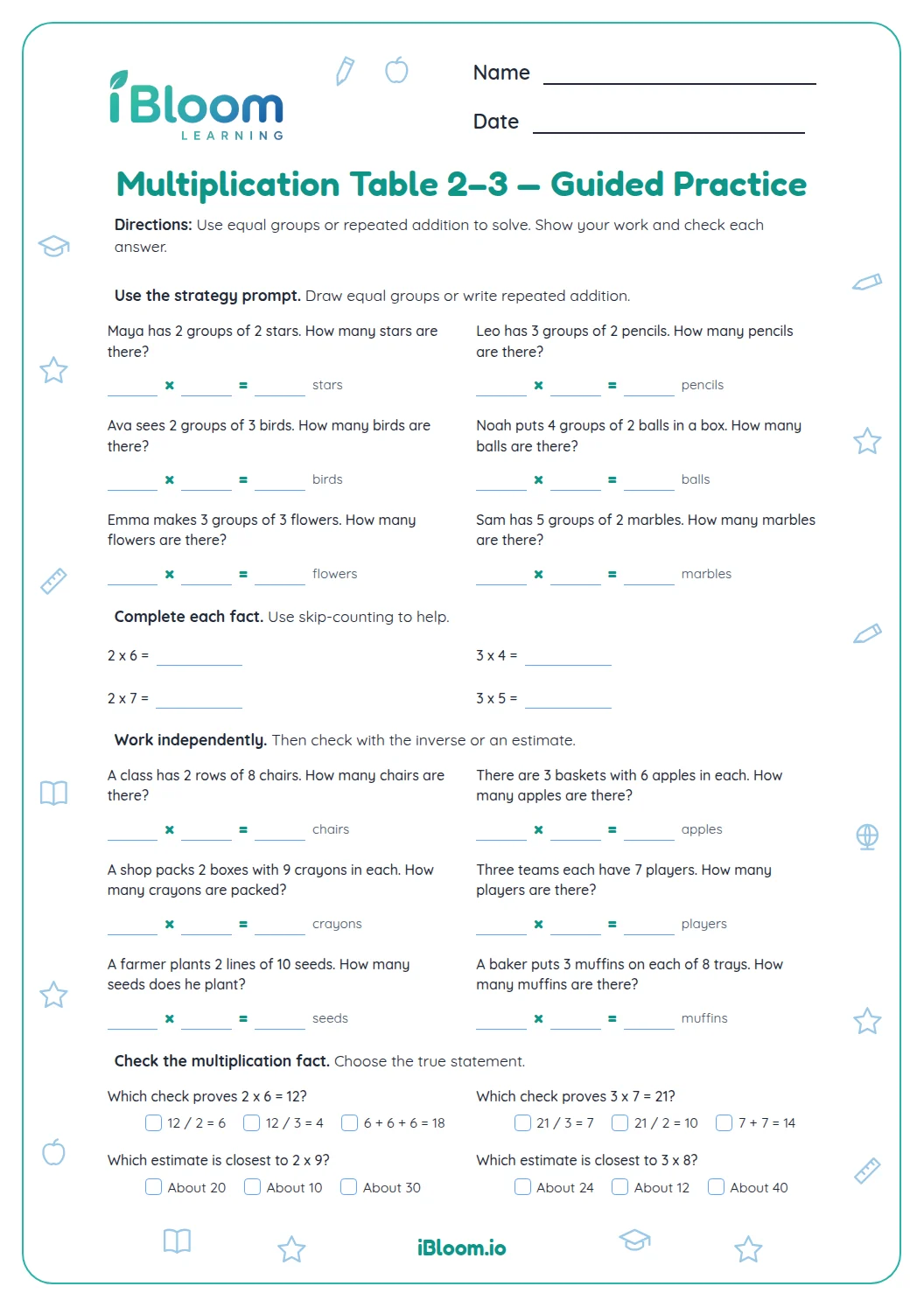
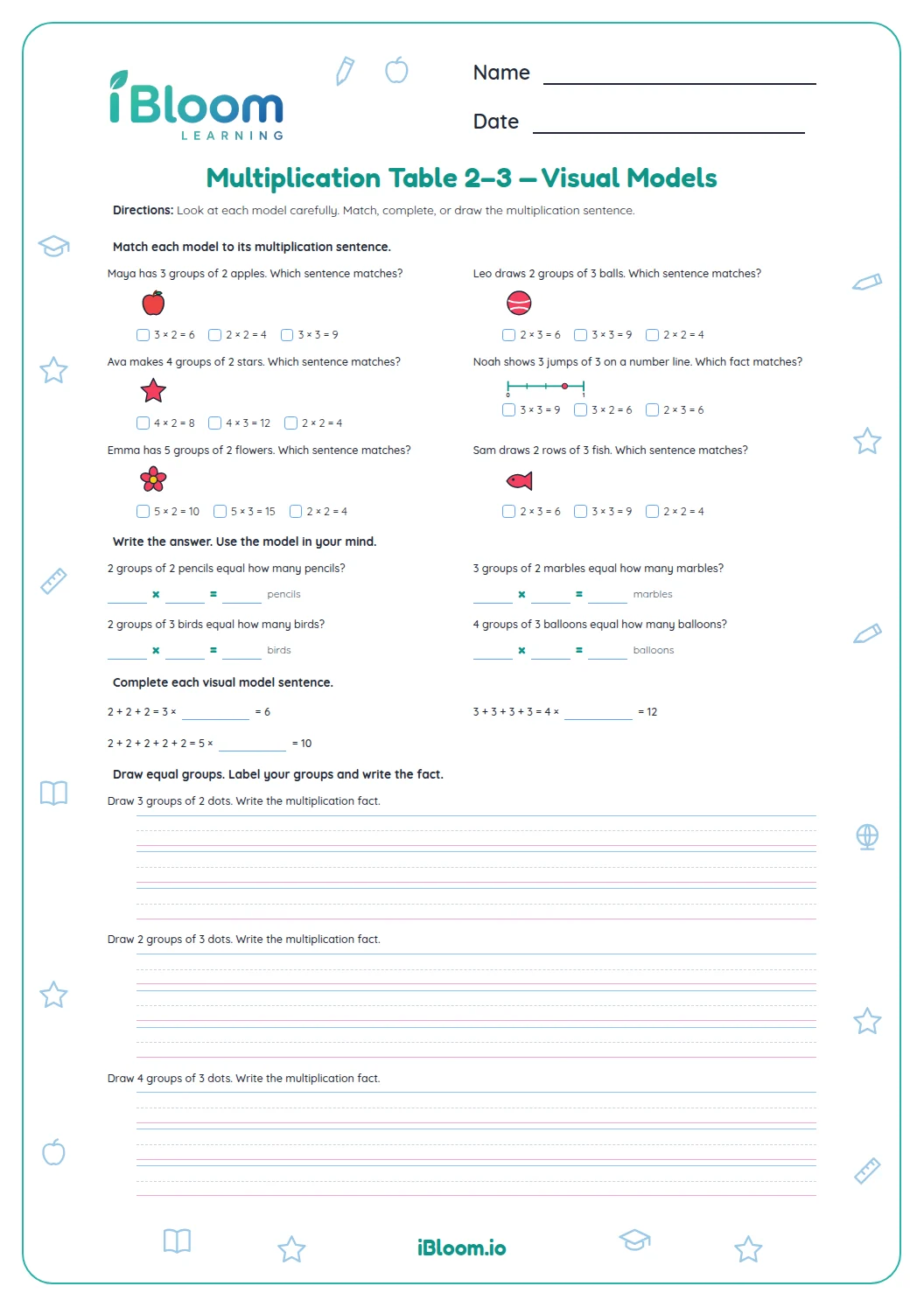
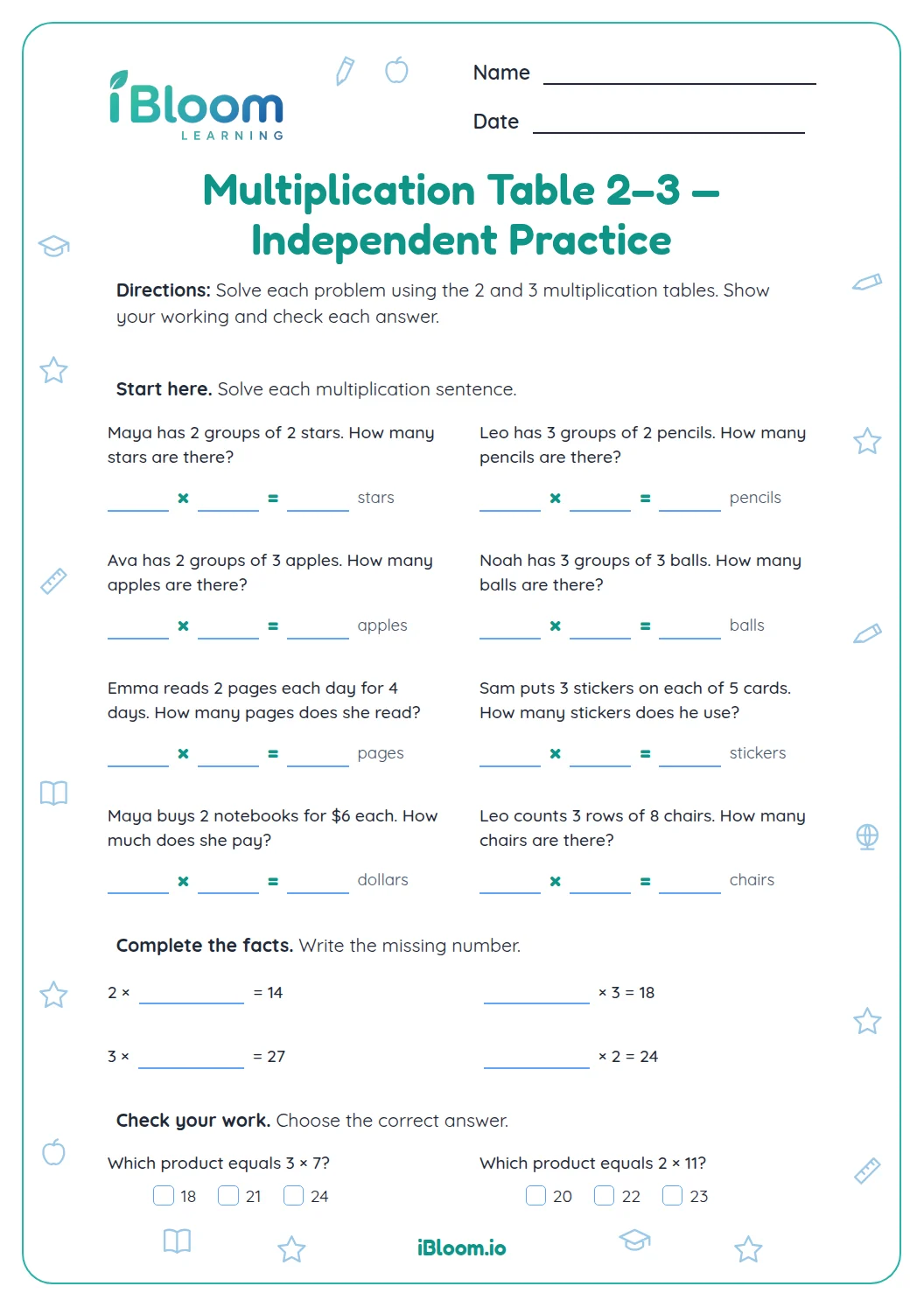
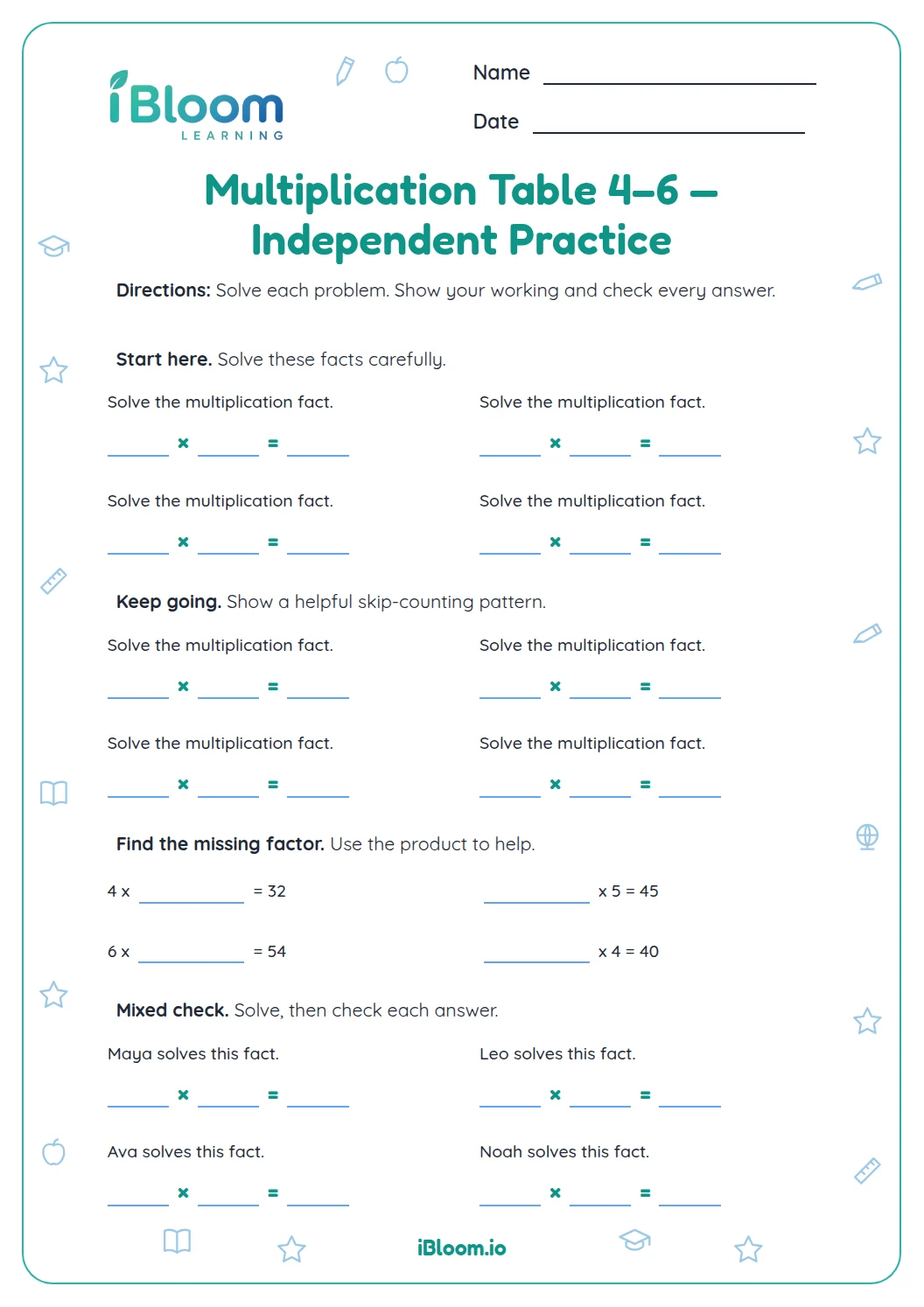
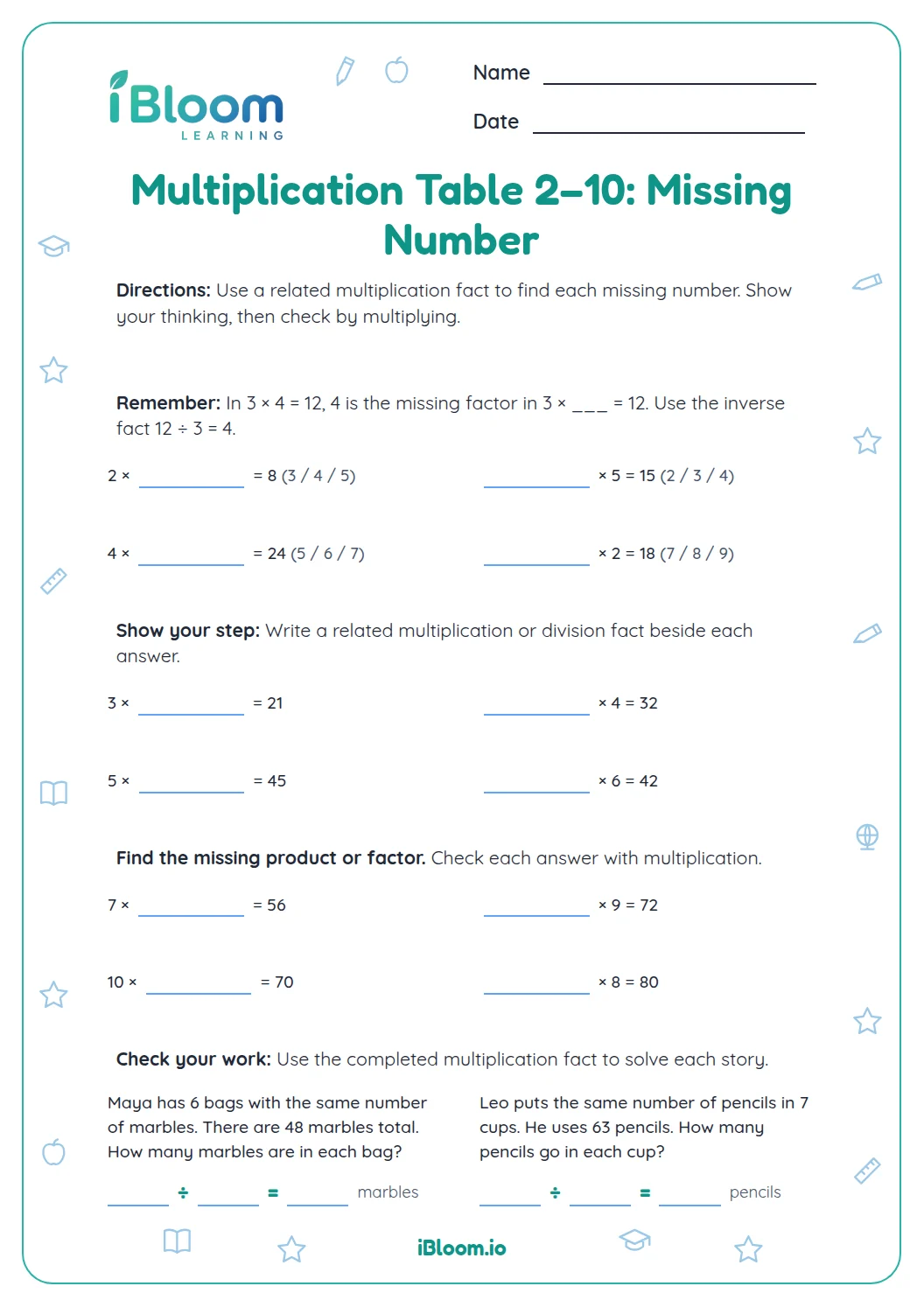
This Grade 3 multiplication worksheet focuses on the 7 and 8 facts through reasoning rather than a list of repeated equations. Children correct claims, recognize multiplication strategies, complete products and missing factors, and use facts in equal-group situations. The 16 questions connect arrays and groups to products such as 7 × 8 and 8 × 9. A separate answer key supports quick checking of every choice, number sentence, and unit-labeled result.
Aligned to 3.OA.C.7
How can a known fact help with a 7 or 8 fact?
Break a tricky fact into a fact you know. For 8 × 7, use 4 × 7 = 28 and double 28. For 7 × 9, use 7 × 10 = 70 and subtract one group of 7. These strategies keep the factors visible.
- 18 × 7
- 24 × 7 = 28
- 3Double 28: 28 + 28 = 56
- 4So 8 × 7 = 56
How do you check a multiplication claim?
Ask what the equation means, then calculate or use a related fact. Eight groups of four means 8 × 4, not 8 + 4. The commutative property lets you switch the factors, so 8 × 6 and 6 × 8 have the same product.
How do multiplication facts help solve group problems?
Find the number of equal groups and the number in each group. Multiply to get the total. If the total and group size are known, division can find the number of groups, as in question 16: 56 cards divided into stacks of 8 makes 7 stacks.
How to use this worksheet
- 1Read each multiplication claim and test the factors.
- 2Use a known 7 or 8 fact to check the choices.
- 3For missing factors, ask what number multiplied by the known factor gives the product.
- 4In a story problem, identify groups and items per group.
- 5Write an equation and include the requested unit in the answer.
Common mistakes and quick fixes
The mistake
Adding the factors instead of multiplying them.
The fix
Translate 8 × 4 as 8 equal groups of 4, then find the total.
The mistake
Adding 7 instead of subtracting it from 7 × 10 to find 7 × 9.
The fix
Nine groups are one group fewer than ten, so subtract one 7.
The mistake
Reversing the number of groups and the group size in a story.
The fix
Multiplication gives the same product either way, but label what each factor means before writing the equation.
Common Core alignment
Students use multiplication facts and related operations to solve within 100.
Use facts and strategies to multiply and divide within 100.
On this sheet: Questions practice 7 and 8 facts, related missing factors, and equal-group problems.
Show the official wordingHide the official wording
Fluently multiply and divide within 100, using strategies such as the relationship between multiplication and division (e.g., knowing that 8 × 5 = 40, one knows 40 ÷ 5 = 8) or properties of operations. By the end of Grade 3, know from memory all products of two one-digit numbers.
What to practice next
Make more practice
Further reading
Questions parents and teachers ask
How can I remember 8 × 7?
One strategy is to double 4 × 7. Since 4 × 7 = 28, double 28 to get 56. Question 5 asks students to choose that strategy, and question 9 checks the related missing factor for 8 × 7.
How do I find 7 × 9 without counting by sevens?
Use 7 × 10 = 70, then subtract one group of 7 because 9 is one less than 10. That gives 70 − 7 = 63. Question 3 asks children to identify this correction to an incorrect claim.
What does the commutative property mean?
The order of the factors can switch without changing the product. For example, 8 × 6 and 6 × 8 both equal 48. Question 4 asks students to recognize the matching pair of multiplication expressions, rather than an addition fact or a different product.
How should a child solve the equal-group stories?
Identify how many groups there are and how many items are in each group, then multiply. Seven rows with 8 muffins in each row is 7 × 8 = 56 muffins. Question 16 reverses the setup and asks how many groups of 8 fit in 56.
Why does the worksheet include multiplication errors?
Correcting a claim makes students explain what the factors mean and whether the product is reasonable. For instance, 8 × 4 means eight groups of four, so it cannot equal 8 + 4. The answer choices give a clear correction to each claim.
Is there an answer key for all 16 questions?
Yes. The separate key lists each correct choice, missing factor, and product, plus the results for the four equal-group situations. Story answers include units such as muffins, laps, shells, and stacks. This lets a student check both the computation and what the number counts.