


About this worksheet
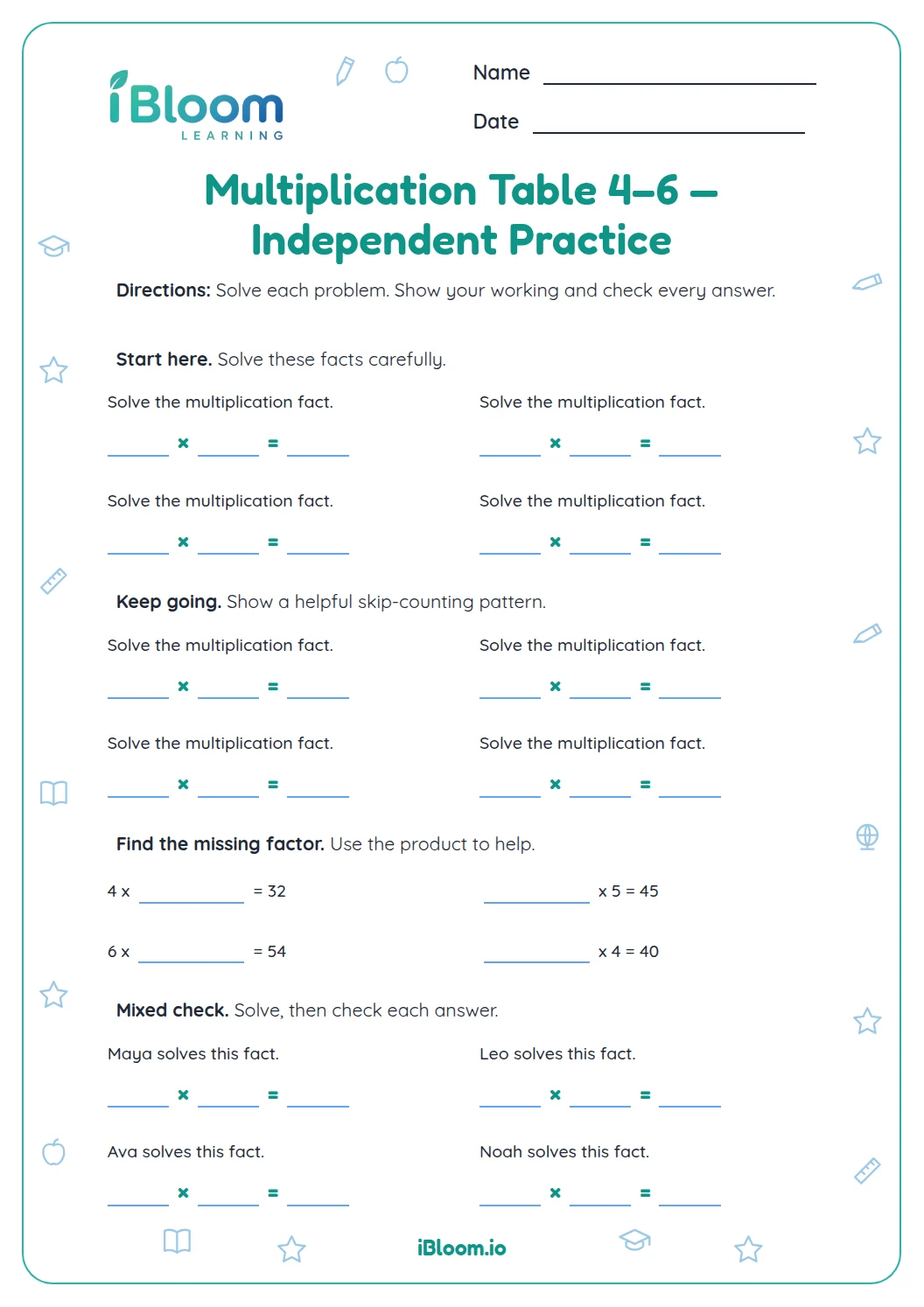
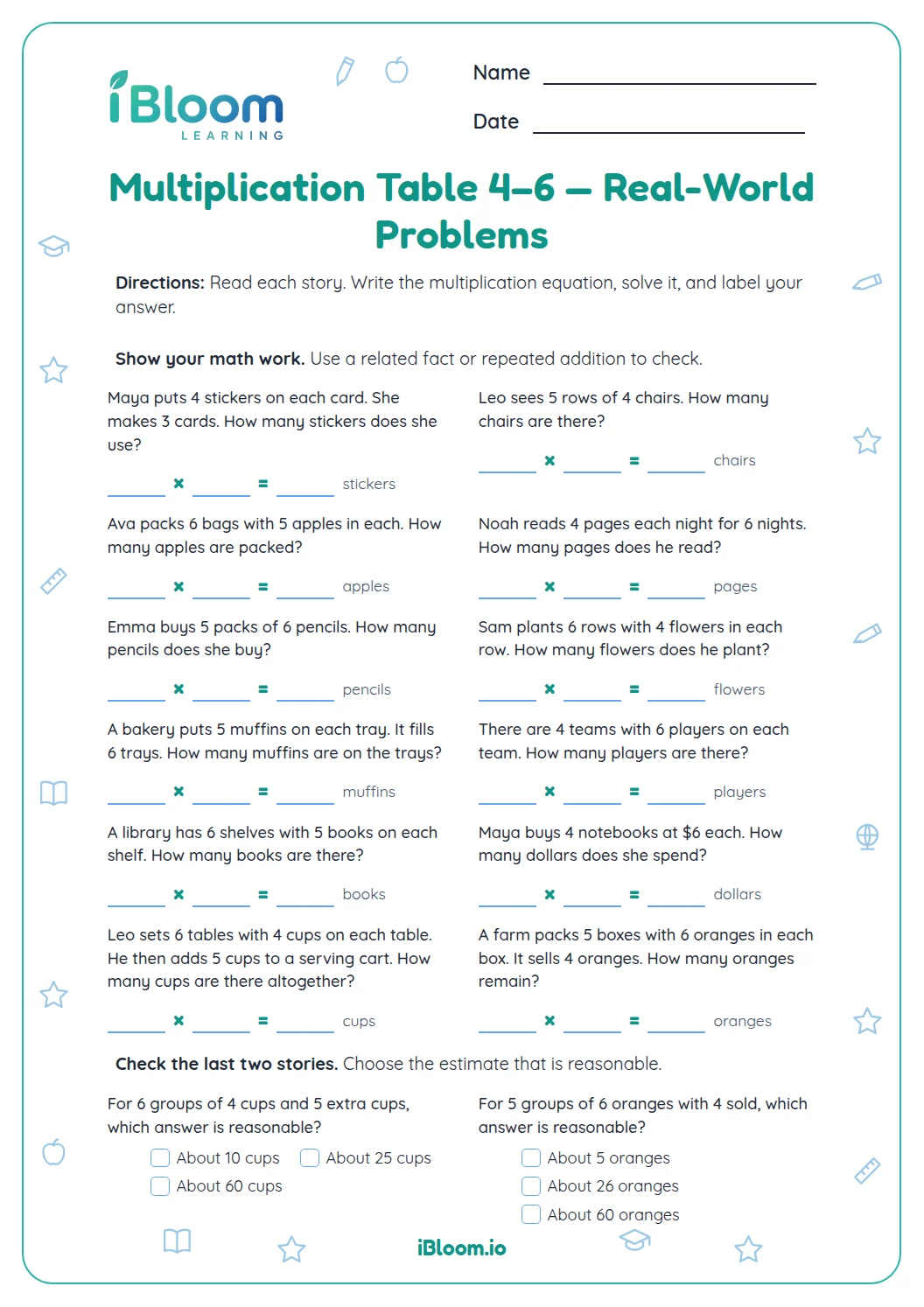
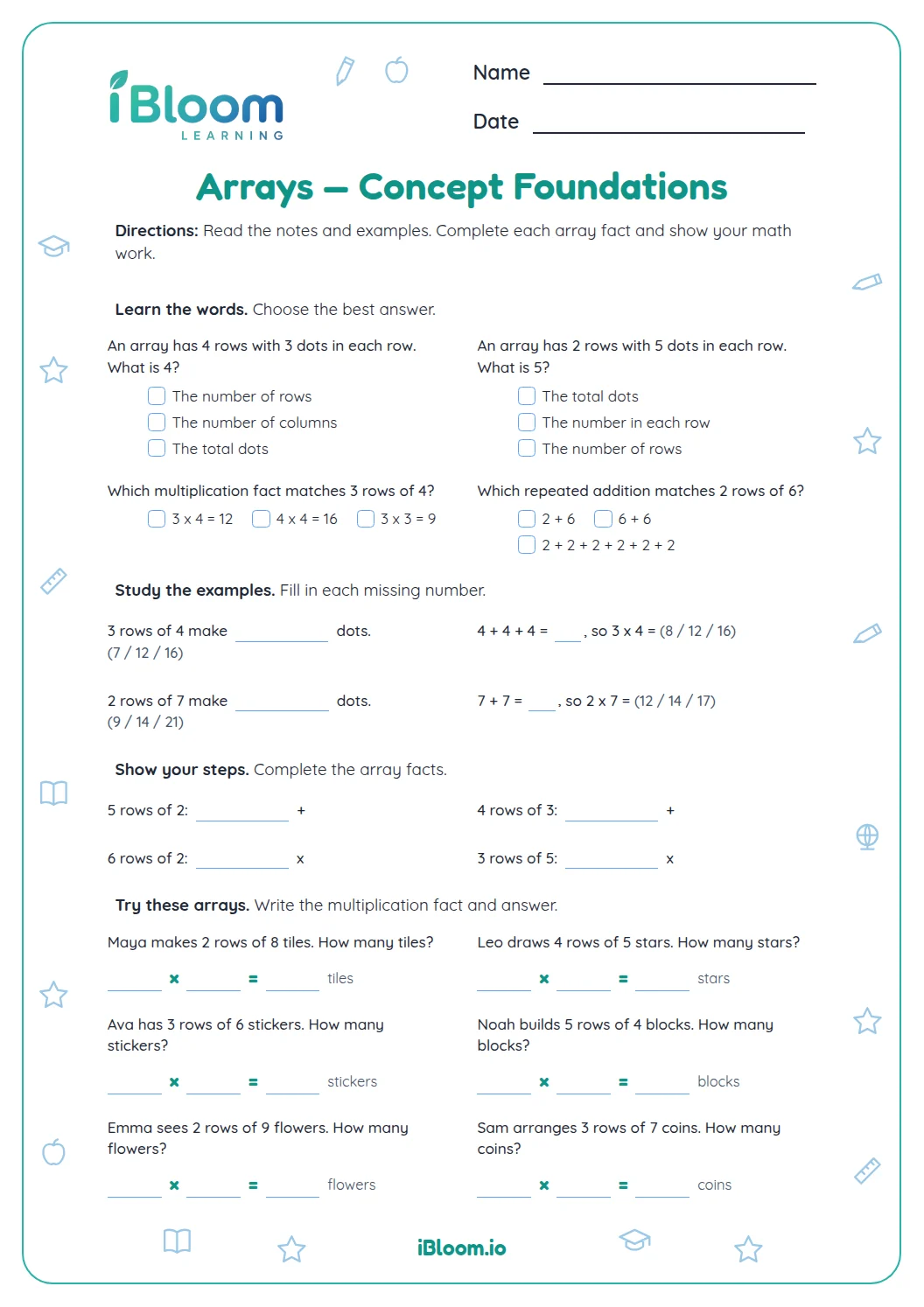
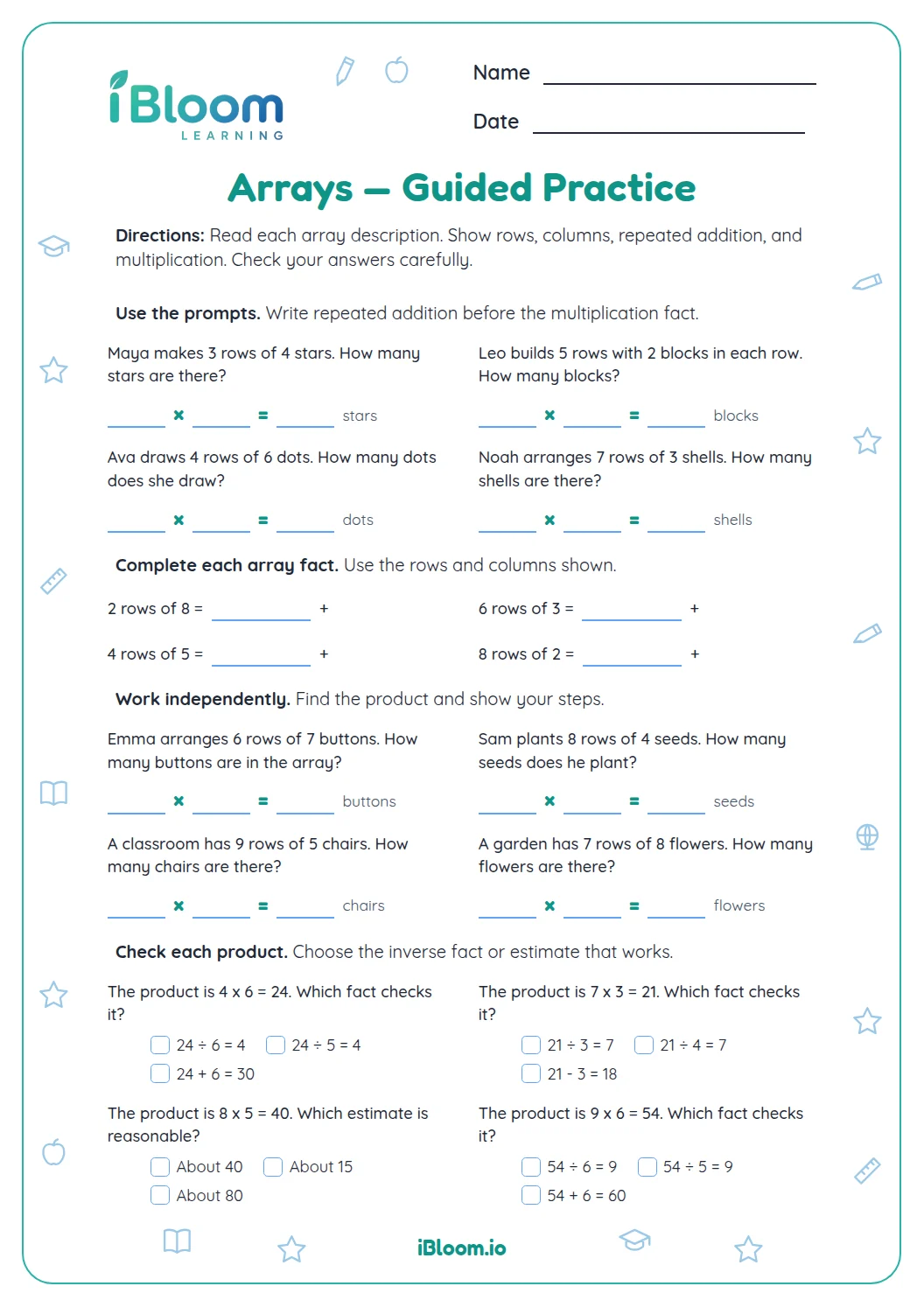
This Grade 3 worksheet builds 4, 5, and 6 multiplication facts from equal groups. Students read three arrays and complete factor equations, solve four product facts, and finish with seven equations that each have a missing factor. The 14 questions move from visual models to independent facts and use the answer key for checking. The work practices CCSS 3.OA.A.1 and 3.OA.C.7.
Aligned to 3.OA.A.1 and 3.OA.C.7
How does an array show multiplication?
Part A uses three arrays to complete factor equations. Part B has four product equations, followed by seven missing-factor equations in Part C.
- 1The array has 4 rows and 3 columns.
- 2Complete ___ × 3 = 12.
- 3The missing factor is 4.
How can a known fact help with another fact?
Students can use groups, skip-counting, or a fact they already know. For example, 6 groups of 5 can be counted by fives. Part B mixes those equal-group questions with direct facts so students move from a model toward efficient recall.
What does a missing factor ask?
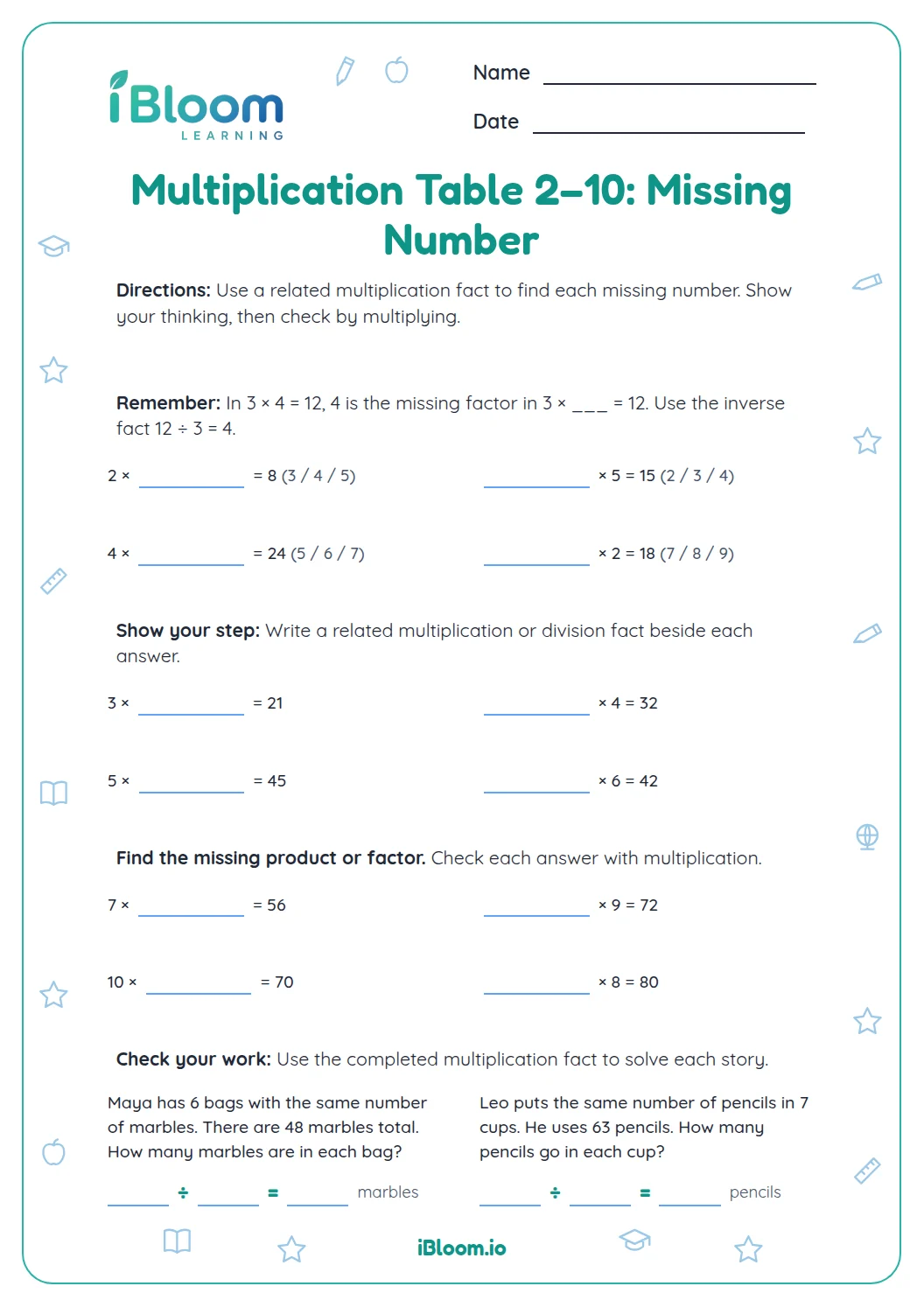
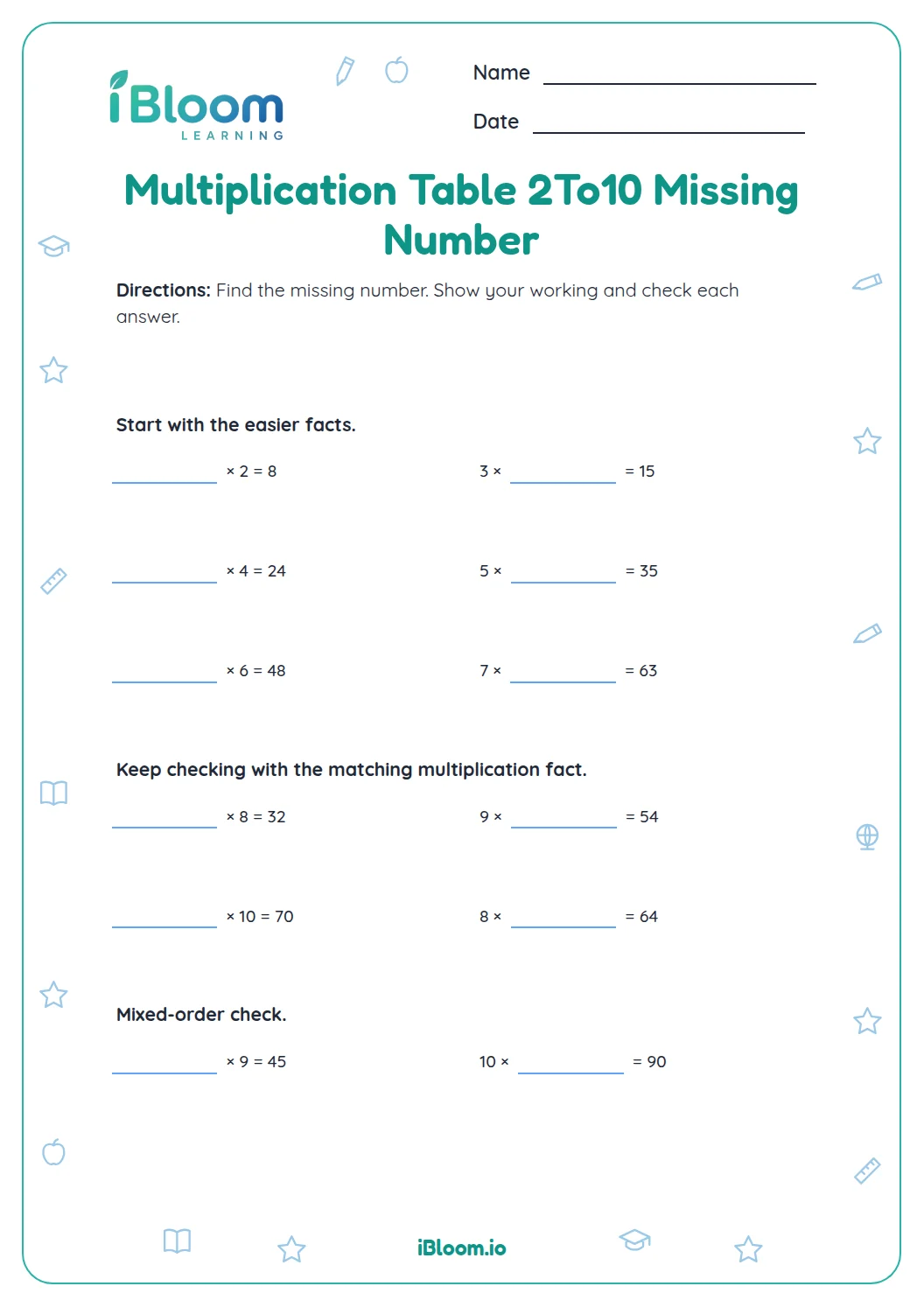
Part C contains seven equations with one factor missing. Use the known factor and product to find the number that makes each equation true.
- 16 × ___ = 54
- 2Ask how many groups of 6 make 54.
- 3The missing factor is 9.
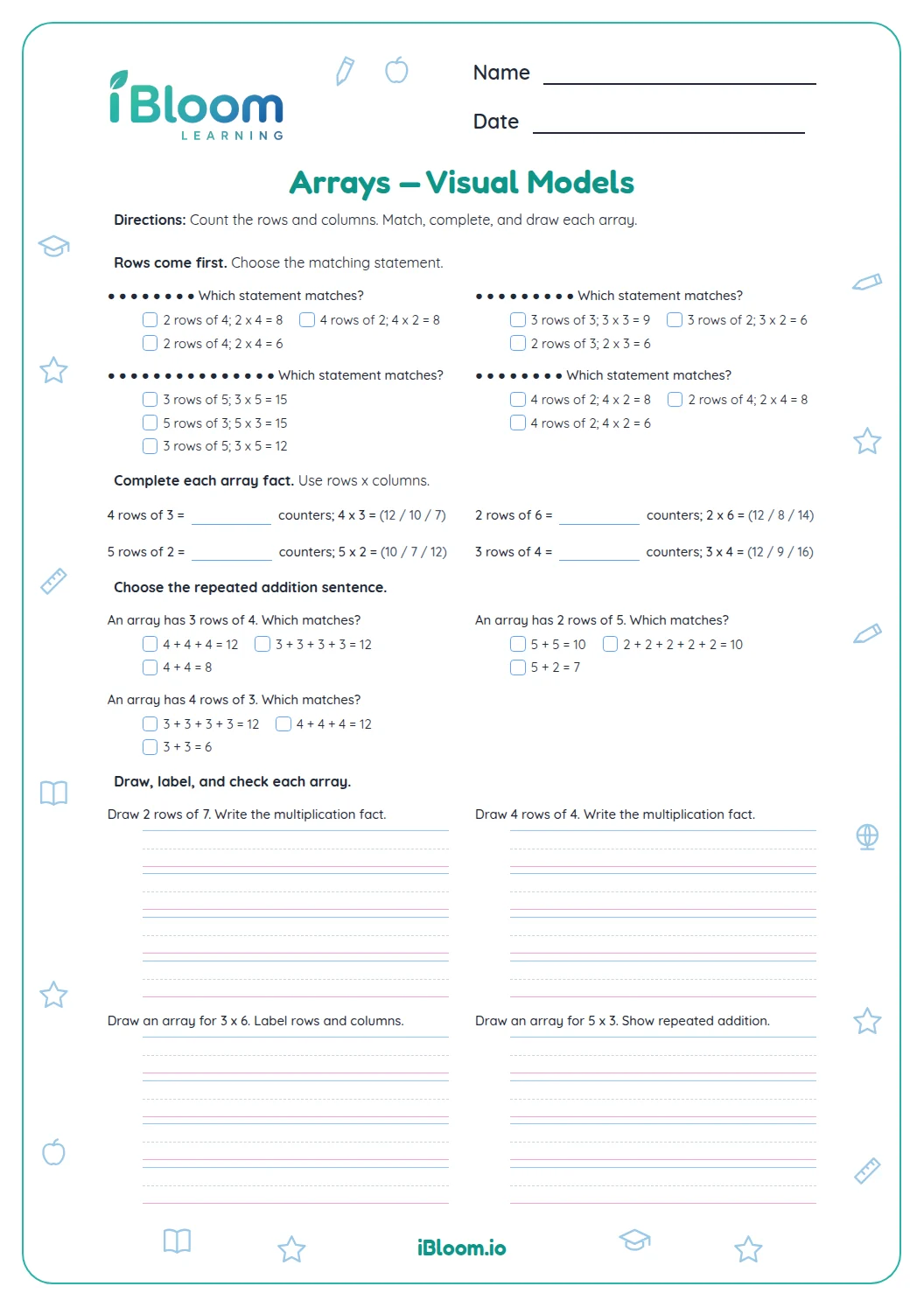
- Part A: write facts represented by arrays
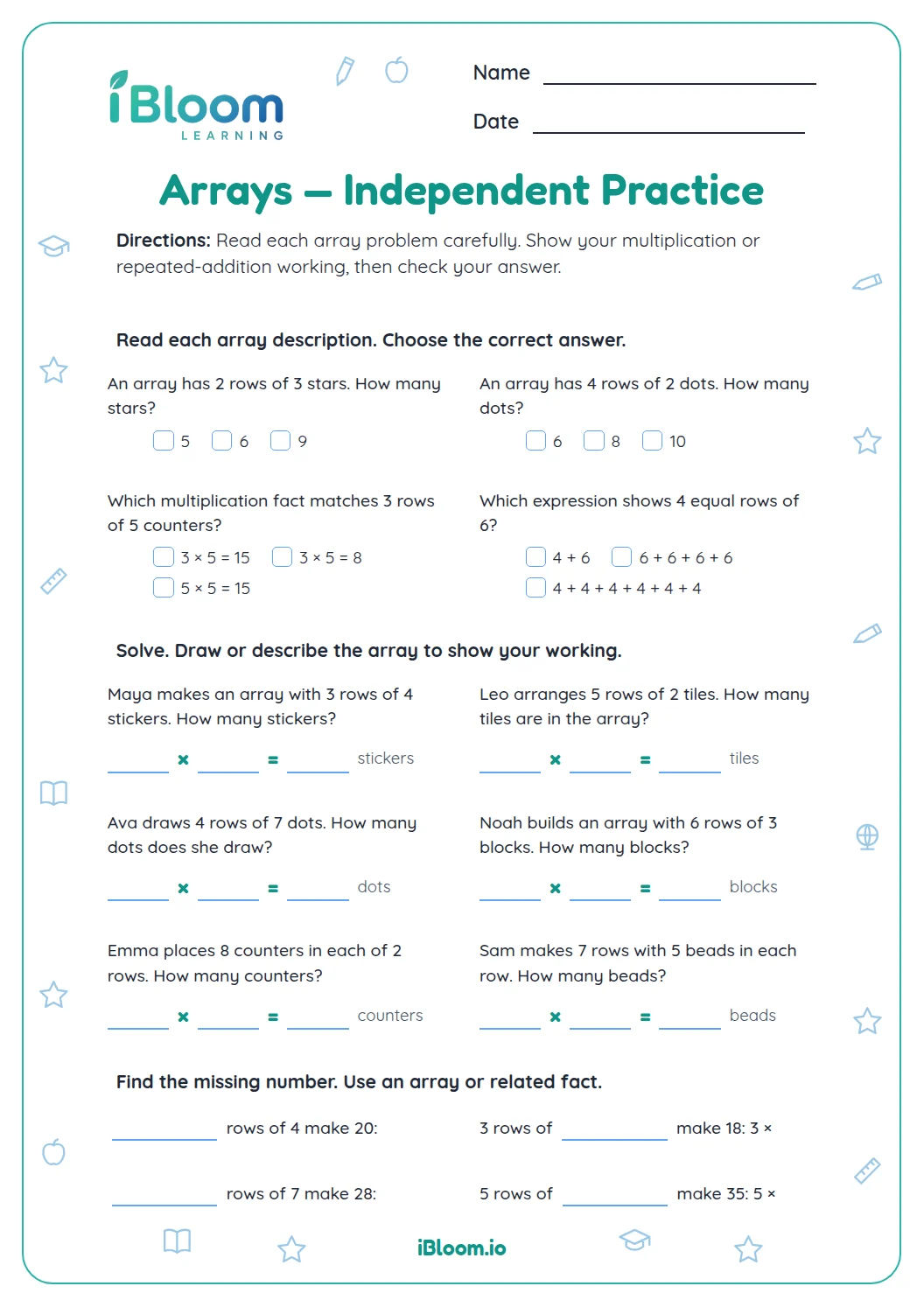
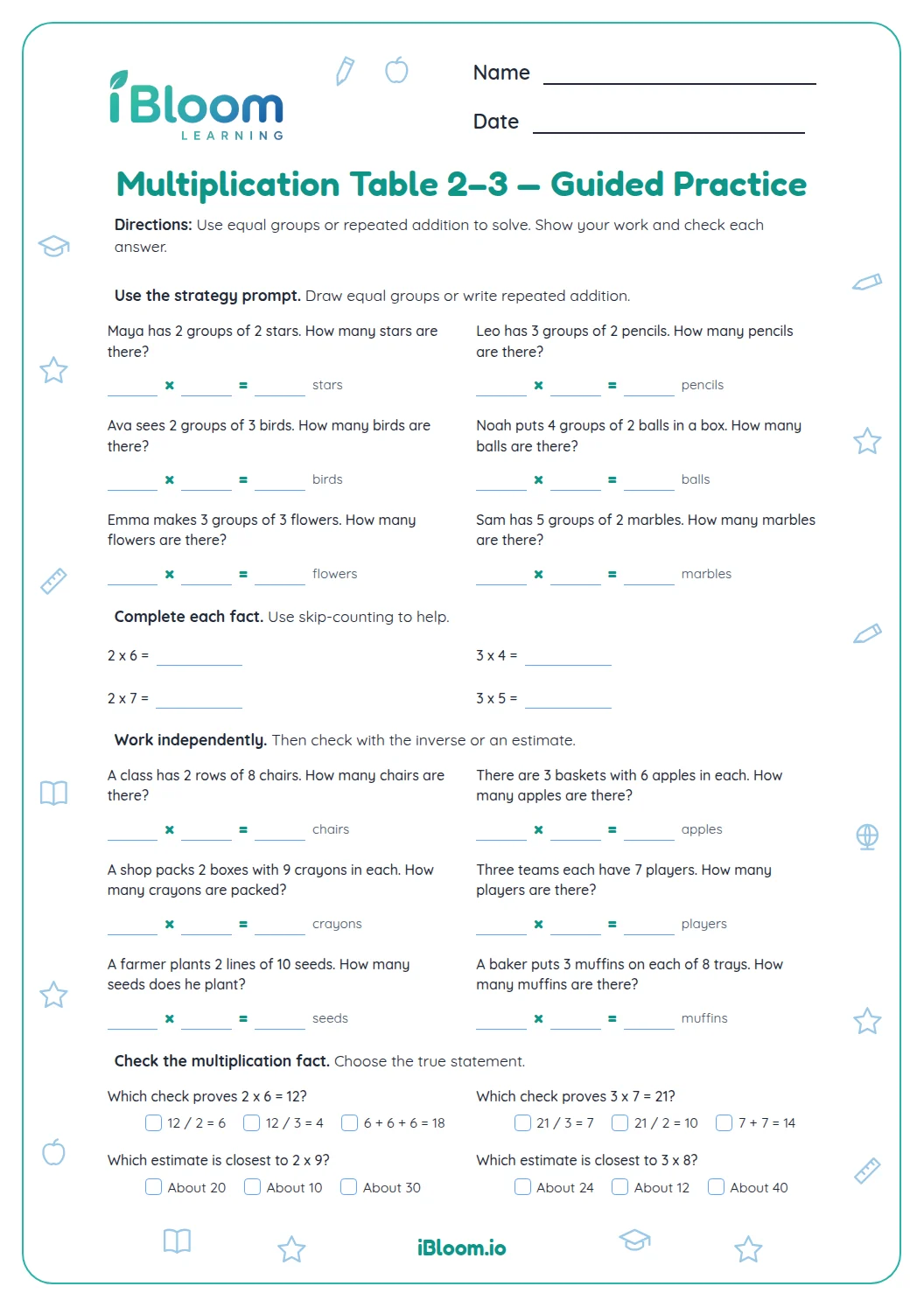
- Part B: solve equal-group and product questions
- Part C: find a missing factor or product
How to use this worksheet
- 1For each array, count its rows and objects in each row.
- 2Say the multiplication expression aloud before finding the total.
- 3Use skip-counting or a familiar table fact if needed.
- 4For a missing factor, ask what number completes the known product.
- 5Check that the factors multiply to the answer.
Common mistakes and quick fixes
The mistake
Switching the row count and number in each row in the written equation.
The fix
Name groups first: rows are groups, objects across each row are in each group.
The mistake
Adding the two factors instead of finding the total in equal groups.
The fix
Count by one factor once for every group, or use repeated addition.
The mistake
Treating the blank in a factor problem as the product.
The fix
Multiply the known factor by a candidate and check the given total.
Common Core alignment
These standards describe the writing or math work practiced on this page.
Interpret each product as equal groups and a total.
On this sheet: Array and group prompts connect multiplication expressions to equal groups.
Show the official wordingHide the official wording
Interpret products of whole numbers, e.g., interpret 5 × 7 as the total number of objects in 5 groups of 7 objects each. For example, describe a context in which a total number of objects can be expressed as 5 × 7.
Recall and use one-digit multiplication facts, including facts with 4, 5, and 6.
On this sheet: Students solve and retrieve facts in the 4, 5, and 6 multiplication tables.
Show the official wordingHide the official wording
Fluently multiply and divide within 100, using strategies such as the relationship between multiplication and division (e.g., knowing that 8 × 5 = 40, one knows 40 ÷ 5 = 8) or properties of operations. By the end of Grade 3, know from memory all products of two one-digit numbers.
What to practice next
Make more practice
Further reading
Questions parents and teachers ask
Which facts are on this worksheet?
The worksheet uses one-digit multiplication facts from the 4, 5, and 6 tables. Students begin with three arrays, solve product questions, and then find a missing factor in each of seven equations. The answer key lists all results.
How do arrays help with multiplication?
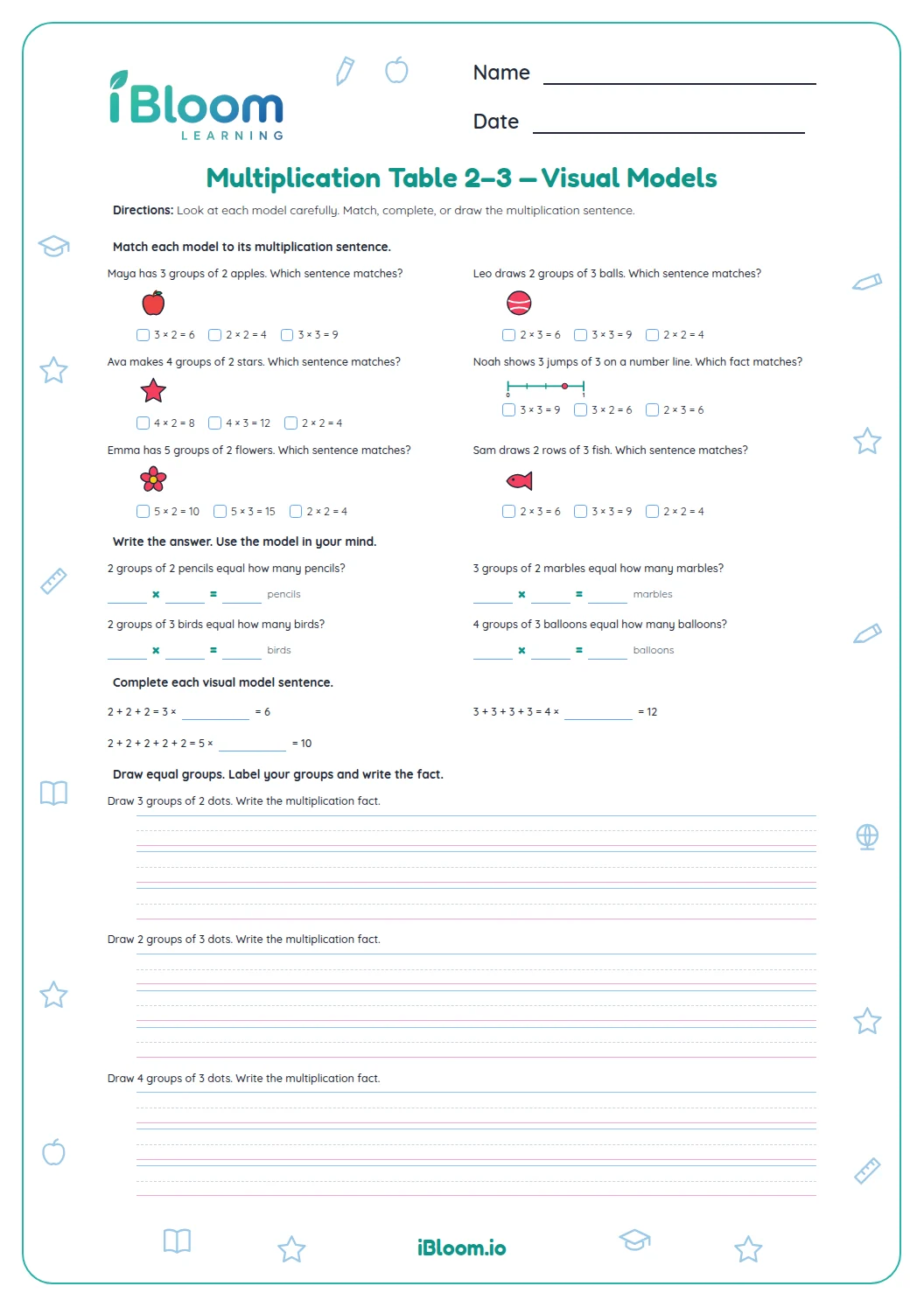
Arrays make equal groups visible. Their rows and columns show the factors, and the full group shows the product. In Part A, learners use each printed apple array to complete a factor equation, linking the model to a multiplication fact.
What is a missing factor?
In a fact such as 6 × ___ = 54, the blank stands for the number that makes the equation true. Students can use a known table fact, skip-count, or divide the total into equal groups. The answer key shows the missing factor for each equation.
Should students memorize every answer?
Fact recall is useful, and the page also gives students a model for making sense of a product. If a fact is not known yet, they can use equal groups or a related fact to find it, then check the multiplication. The worksheet moves from arrays toward direct fact questions.
How long does the worksheet take?
About 15 minutes is a reasonable estimate for all 14 questions. Arrays take longer because students write the multiplication relationship as well as the total. A child who is still building fact fluency can complete one part at a time and check each answer with the key.
What should we practice after the 4–6 tables?
The Arrays page reinforces the visual model, while the 2–10 table worksheet broadens fact recall. Missing-number multiplication equations add unknown factors. Those options let families continue with the representation or move toward more independent fact practice. A short practice round is enough.