



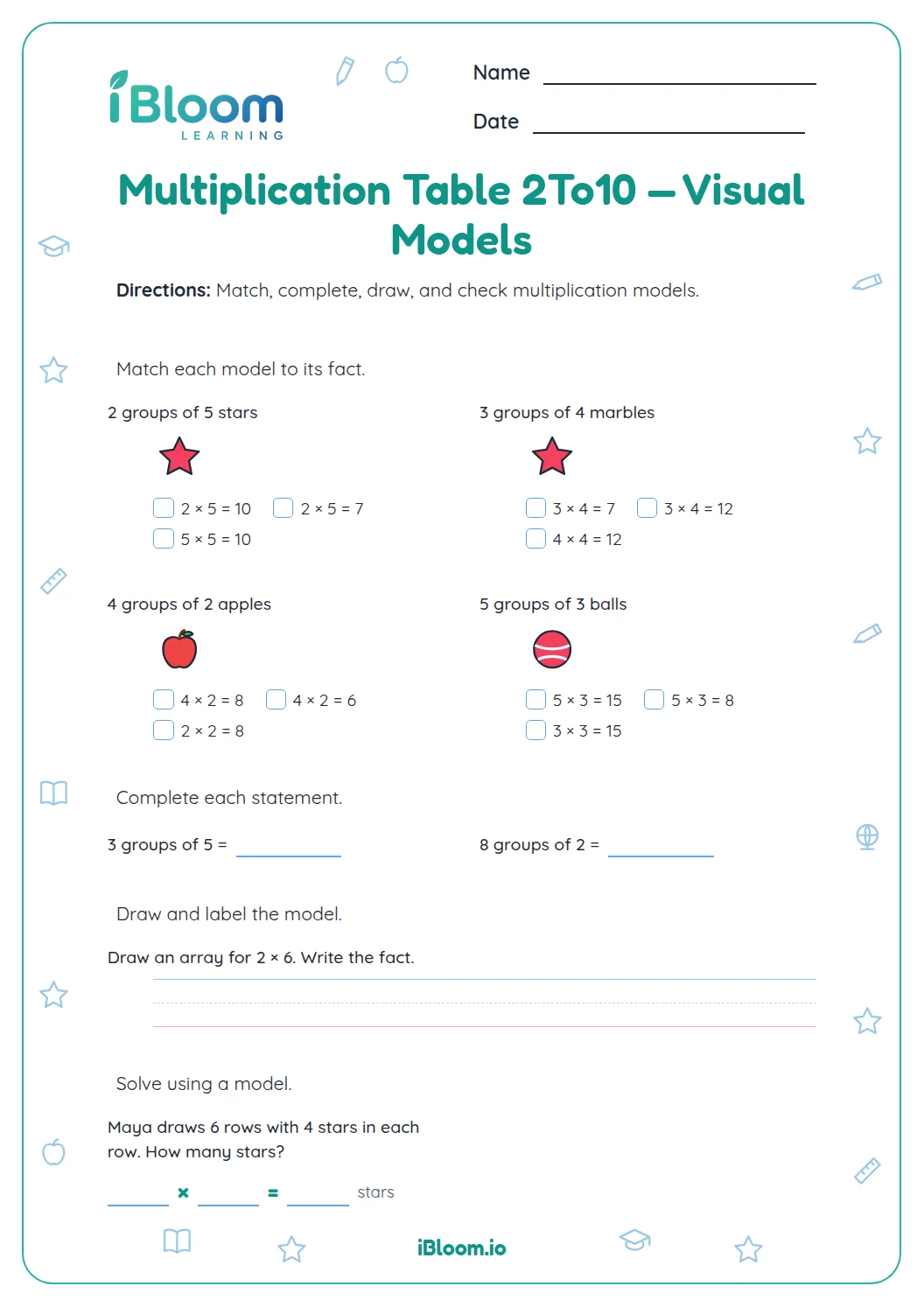
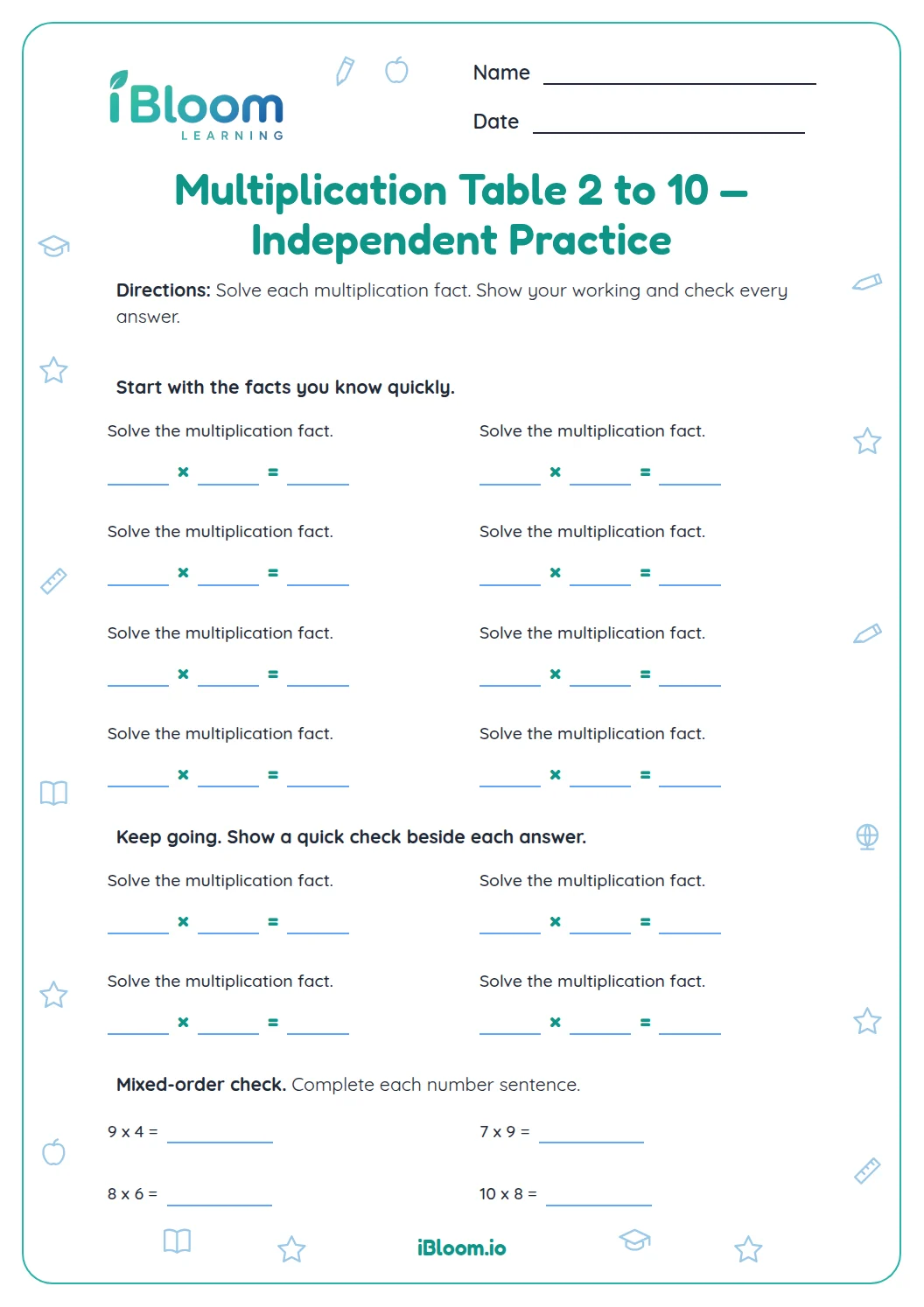
About this worksheet
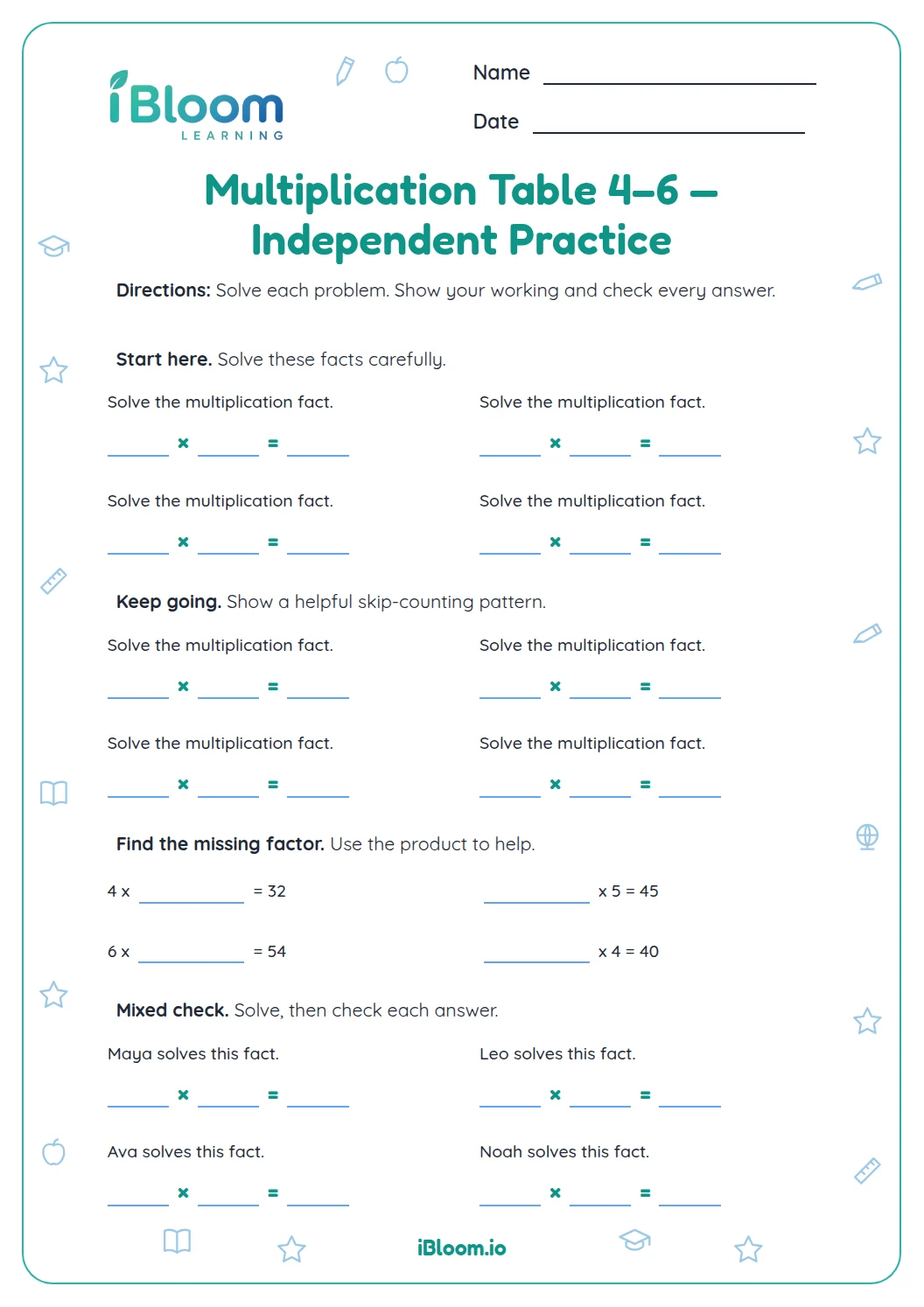
This Grade 3 worksheet gives learners 18 questions using multiplication facts for 4, 5, and 6. Practice includes comparing products, finding missing factors, correcting a mistaken fact, using a nearby known fact, and solving equal-group problems. The separate answer key supports checking and review.
Aligned to 3.OA.C.7
How can a known fact help?
A nearby product can help find a new one. For example, 5 × 9 is 45, so 6 × 9 is one more group of 9: 45 + 9 = 54.
How do equal groups connect to facts?
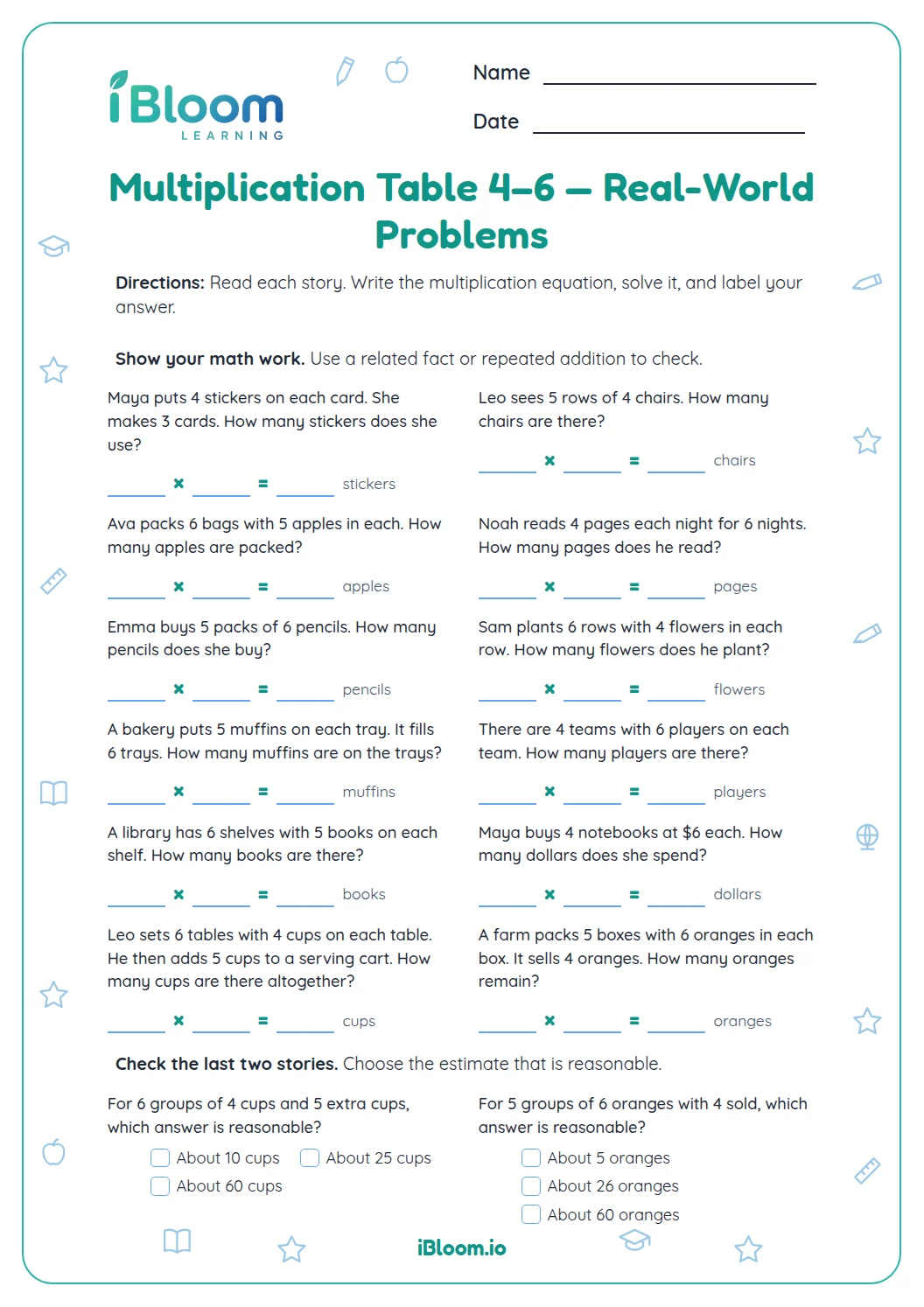
Four rows of eight muffins make 4 × 8, or 32 muffins. Identify the number of groups and the amount in each group before choosing a multiplication fact.
How to use this worksheet
- 1Recall or build the 4, 5, and 6 fact.
- 2For comparisons, find both products before choosing.
- 3For a missing factor, ask which fact has the given product.
- 4Check a mistaken fact with a known product.
- 5Translate equal groups into factors, then solve.
- 6Review all answers with the key.
Check the facts
The mistake
Using addition instead of equal groups.
The fix
Write the number of groups times the amount in each.
The mistake
Comparing factors instead of products.
The fix
Find both products, then compare.
The mistake
Changing the wrong factor in a nearby-fact strategy.
The fix
Keep one factor fixed and adjust by one group.
Common Core alignment
This worksheet practices the following Common Core skill.
Fluently multiply and divide within 100 using strategies such as known facts and properties.
On this sheet: Fluently multiply and divide within 100 using strategies such as known facts and properties. is practiced in the worksheet.
Show the official wordingHide the official wording
Fluently multiply and divide within 100, using strategies such as the relationship between multiplication and division (e.g., knowing that 8 × 5 = 40, one knows 40 ÷ 5 = 8) or properties of operations. By the end of Grade 3, know from memory all products of two one-digit numbers.
What to practice next
Make more practice
Further reading
Questions parents and teachers ask
Which facts appear?
The questions focus on factors 4, 5, and 6. They include direct products, missing factors, comparisons, and equal-group situations. Ask the learner to point to the relevant sentence or number relationship before checking the key; that makes the reasoning visible and helps distinguish a supported answer from a guess.
Are there word problems?
Yes. Several questions describe equal groups, such as rows of muffins or teams with the same number of players. Translate the groups into a multiplication fact. Ask the learner to point to the relevant sentence or number relationship before checking the key; that makes the reasoning visible and helps distinguish a supported answer from a guess.
How many questions are there?
There are 18 questions across fact recall, reasoning, and applications. The answer key lists each response in order. Ask the learner to point to the relevant sentence or number relationship before checking the key; that makes the reasoning visible and helps distinguish a supported answer from a guess.
How can a nearby fact help?
Use a product you know, then add or subtract one group. For example, 6 × 9 is one group of 9 more than 5 × 9. Ask the learner to point to the relevant sentence or number relationship before checking the key; that makes the reasoning visible and helps distinguish a supported answer from a guess.
Does it include an answer key?
Yes. A separate answer key gives the fact, comparison, or product for each question so learners can check their work. Ask the learner to point to the relevant sentence or number relationship before checking the key; that makes the reasoning visible and helps distinguish a supported answer from a guess.