




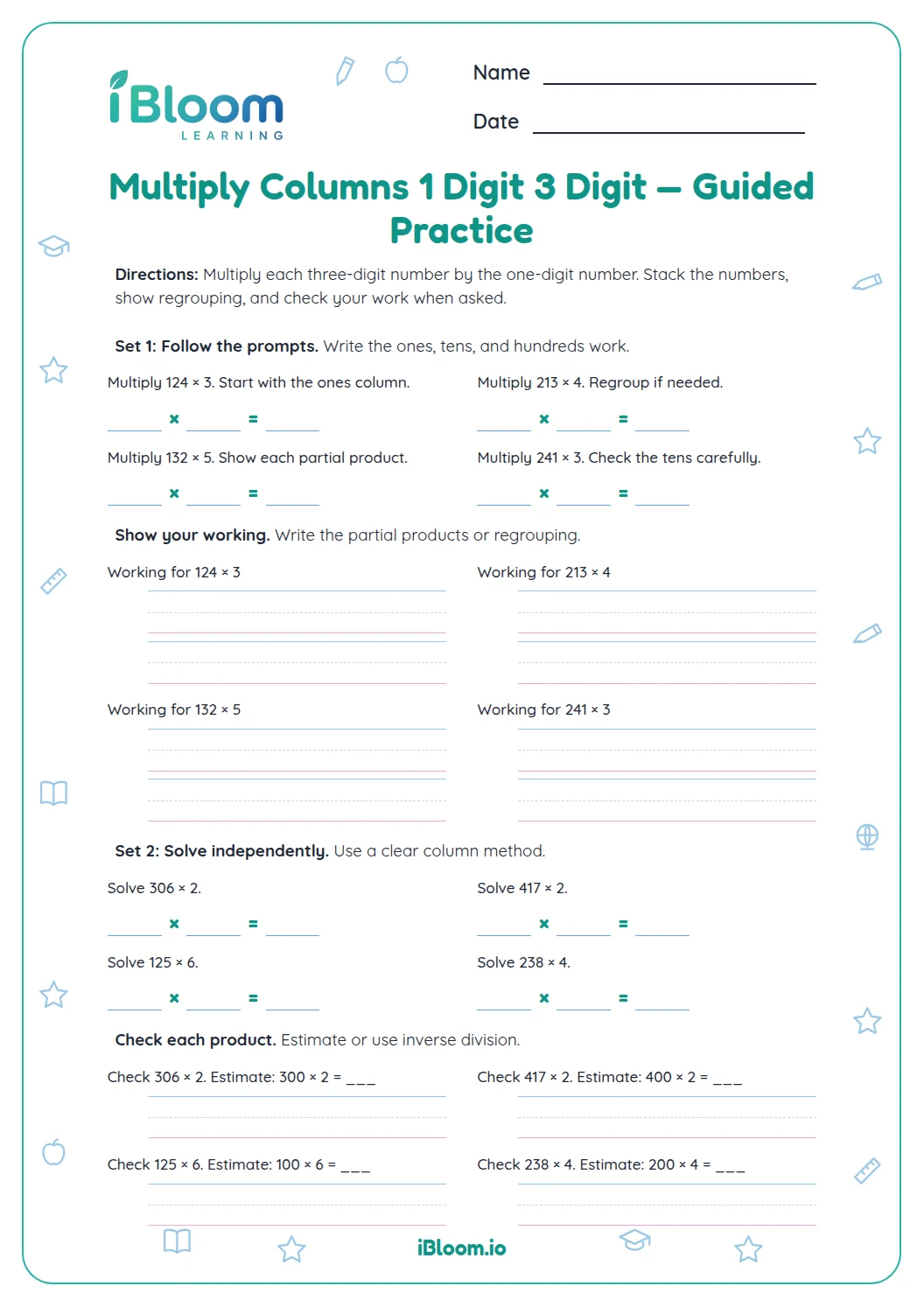

About this worksheet
This free printable Grade 3 worksheet connects two-digit multiplication in columns to the value of each digit. Part A has four tens products. Part B has four choices about splitting numbers, combining partial products, aligning digits and regrouping. Part C asks children to set up and solve four products in columns using the working space. The 14 questions support Common Core 3.NBT.A.3 and 3.OA.B.5 by connecting multiples of ten and properties of operations to multiplication. A separate answer key lets you check the choices and products while reviewing the child’s written method.
Aligned to 3.NBT.A.3 and 3.OA.B.5
Why begin with multiples of ten?
The 2 in 23 represents 20. Multiplying that part by 3 gives 60. Part A keeps the numbers in whole tens so children can use a known fact, such as 2 × 3, and explain the value of its digits.
How do partial products explain the column method?
Question 5 breaks 23 into 20 and 3. Question 6 then combines the two products. Ask children to say what each product counts before moving to the compact written method.
- 123 × 3 = (20 × 3) + (3 × 3)
- 220 × 3 = 60; 3 × 3 = 9
- 360 + 9 = 69
- 4In columns, 9 goes in the ones place and 6 in the tens place.
When do children regroup?
In 24 × 3, the ones product is 12. Write 2 ones and carry 1 ten. Multiply 2 tens by 3 to get 6 tens, then add the carried ten to make 7 tens. The result is 72.
The four Part C calculations begin with 21 × 4 and 32 × 3, then move to 24 × 3 and 46 × 2. Check that children align the factors before multiplying and record the regrouped ten when needed.
Teach the connection before the shortcut
- 1Read 20 as two tens and solve the first tens product together.
- 2Complete Part A using the matching one-digit facts.
- 3For question 5, point to the tens and ones in 23.
- 4Discuss why 12 ones in question 8 become 1 ten and 2 ones.
- 5Have children arrange and solve the Part C products in columns.
- 6Check the key and use partial products to verify any uncertain result.
Place-value mistakes to catch
The mistake
Treating the 2 in 23 as two ones.
The fix
Expand 23 as 20 + 3 and label the 20 as two tens.
The mistake
Putting the one-digit factor under the tens digit.
The fix
Align the one-digit factor with the ones digit before starting.
The mistake
Forgetting the carried ten in 24 × 3.
The fix
Write a small 1 above the tens place and add it after multiplying the tens.
Common Core alignment
Multiply tens by a one-digit number before combining tens and ones.
On this sheet: Part A practices tens products used in two-digit multiplication.
Show the official wordingHide the official wording
Multiply one-digit whole numbers by multiples of 10 in the range 10-90 (e.g., 9 × 80, 5 × 60) using strategies based on place value and properties of operations.
Break a factor into tens and ones and add the partial products.
On this sheet: Children connect multiplication of each place-value part to the full product.
Show the official wordingHide the official wording
Apply properties of operations as strategies to multiply and divide.
What to practice next
Make more practice
Further reading
Questions parents and teachers ask
Does my child write the problems in columns?
Yes, Part C asks children to arrange six multiplication problems in columns in the working space. Place the one-digit factor beneath the ones digit of the two-digit factor. The earlier parts explain the tens products and regrouping that make this written method work.
Which problems need regrouping?
The Part C problems 24 × 3, 46 × 2 and 27 × 4 need regrouping from the ones place. Their ones products are 12. In each case, record 2 ones and carry 1 ten, then include that ten when calculating the tens part of the product.
Why does the sheet include 20 × 3?
That product supplies the tens part of 23 × 3, which appears in Part B. Children can think of 20 × 3 as three groups of two tens. This makes 60 meaningful and helps them explain why the tens digit cannot be treated as a single one.
Can children use partial products to check their work?
Yes, partial products are a useful check for every Part C calculation. For 46 × 2, multiply 40 by 2 to get 80 and 6 by 2 to get 12. Add those results to get 92, then compare with the answer from the column method.
How should I use the answer key?
Use the key to check all 14 responses, then look at the child’s working for the six column calculations. A correct product alone does not reveal the method. Ask the child to explain the value of a carried digit or show the matching tens-and-ones sum.