





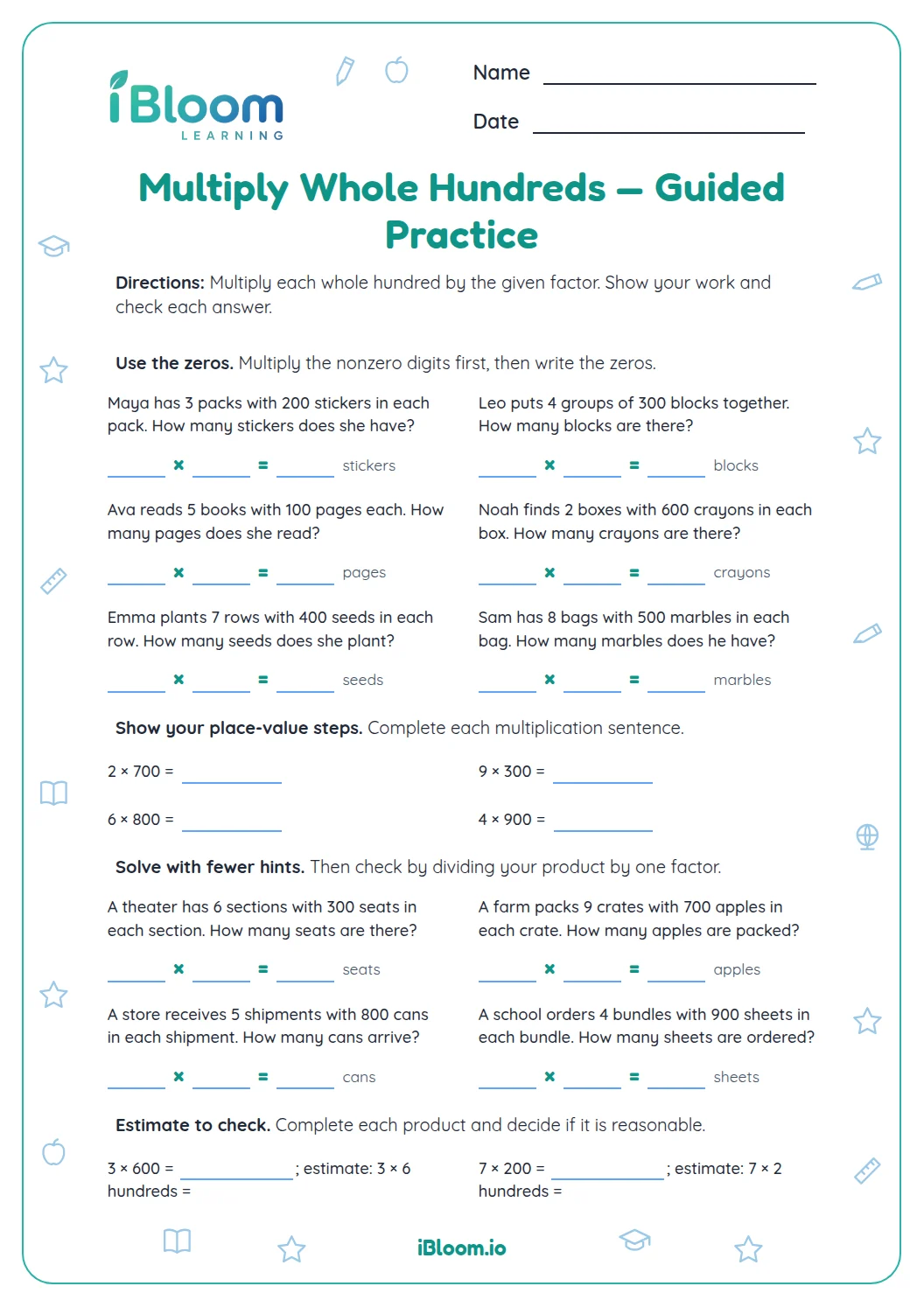
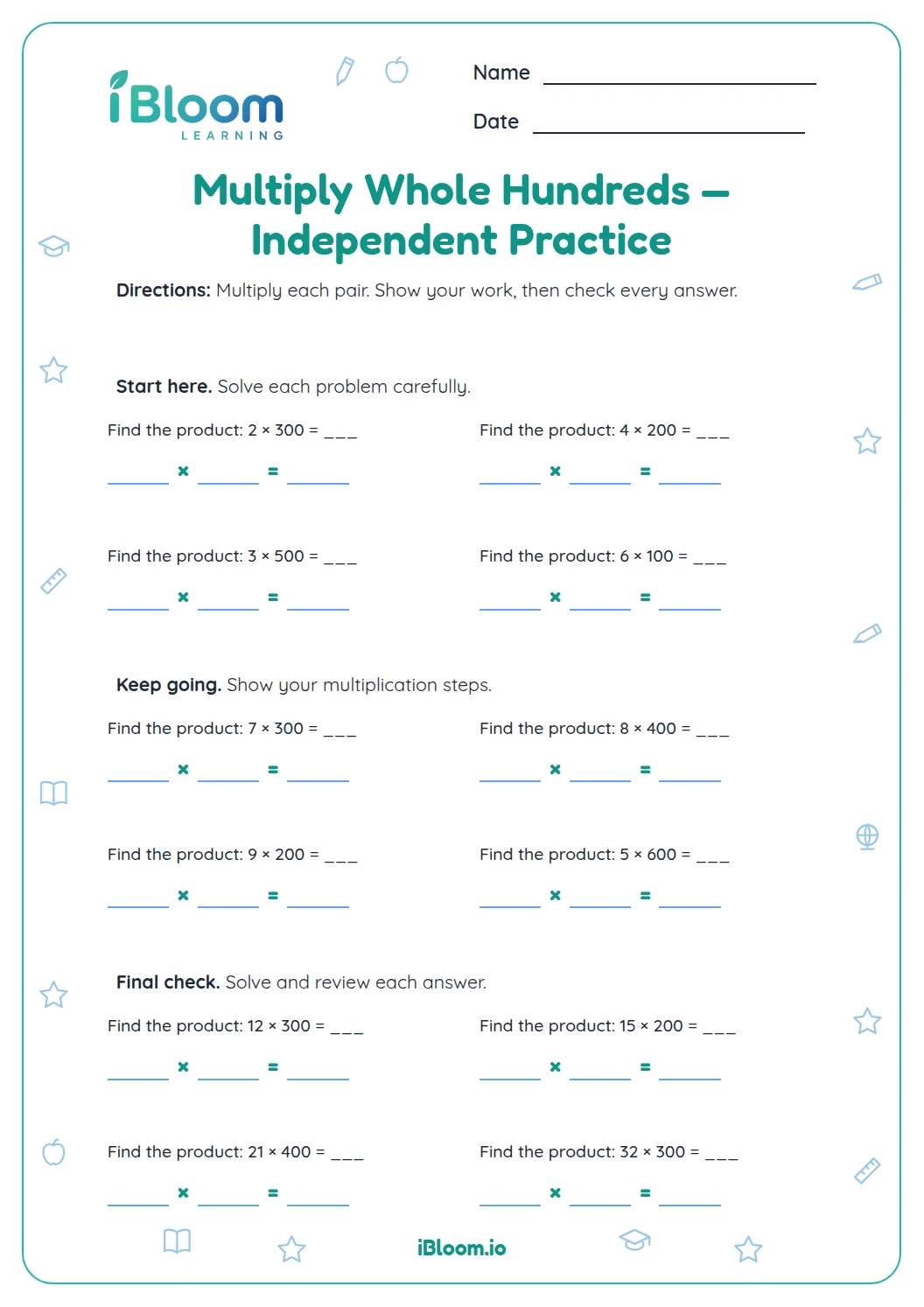


About this worksheet
This free two-page worksheet gives Grade 3 children independent practice multiplying a three-digit number by a one-digit number, such as 248 × 3. Part A has four problems with no regrouping, Part B has four where tens and hundreds carry, Part C asks children to write four problems in columns with room to work, and Part D asks them to fix two friends' answers that each lost a carry. It practices Common Core 4.NBT.B.5, multiplying up to four digits by one digit using place value. A separate answer key gives every product.
Aligned to 4.NBT.B.5
How does column multiplication work?
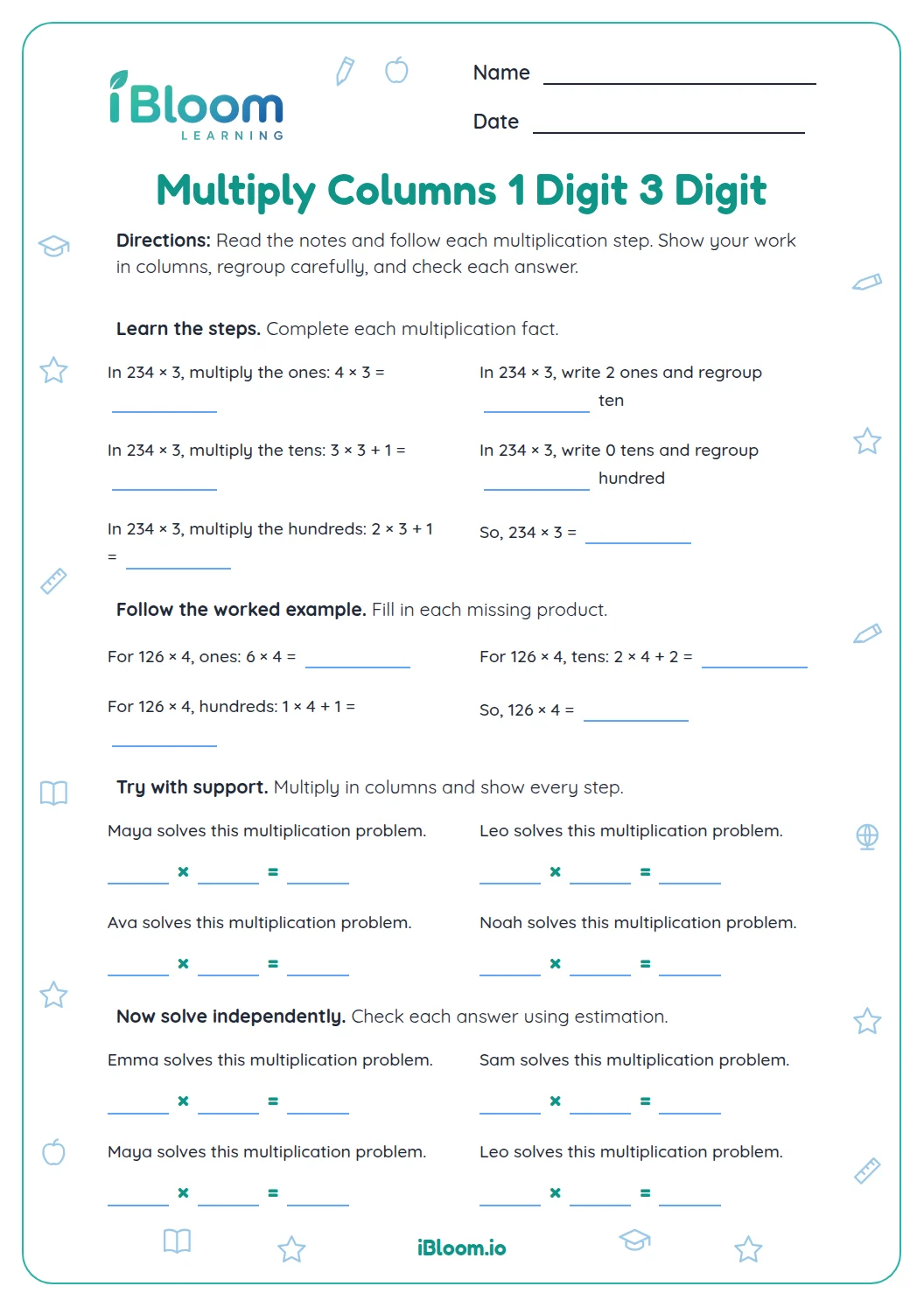
In column multiplication, the one-digit number multiplies each digit of the three-digit number in turn, starting at the ones. Each digit stands for a different amount, so 248 is really 200 + 40 + 8. Multiplying by 3 means finding 3 × 8, then 3 × 40, then 3 × 200, and adding them.
The carrying step is a shortcut for that adding. When a product is 10 or more, the extra tens are written small above the next column and added after that digit is multiplied.
How do you carry in 248 × 3?
Work from the right. In the ones place, 8 × 3 = 24, which is 2 tens and 4 ones. Write 4 and carry the 2 tens. In the tens place, 4 × 3 = 12, and adding the carried 2 gives 14 tens, which is 1 hundred and 4 tens. Write 4 and carry the 1 hundred. In the hundreds place, 2 × 3 = 6, and adding the carried 1 gives 7.
- 1248 × 3
- 2Ones: 8 × 3 = 24, write 4 and carry 2
- 3Tens: 4 × 3 = 12, plus 2 is 14, write 4 and carry 1
- 4Hundreds: 2 × 3 = 6, plus 1 is 7
- 5Answer: 744
What is on this worksheet?
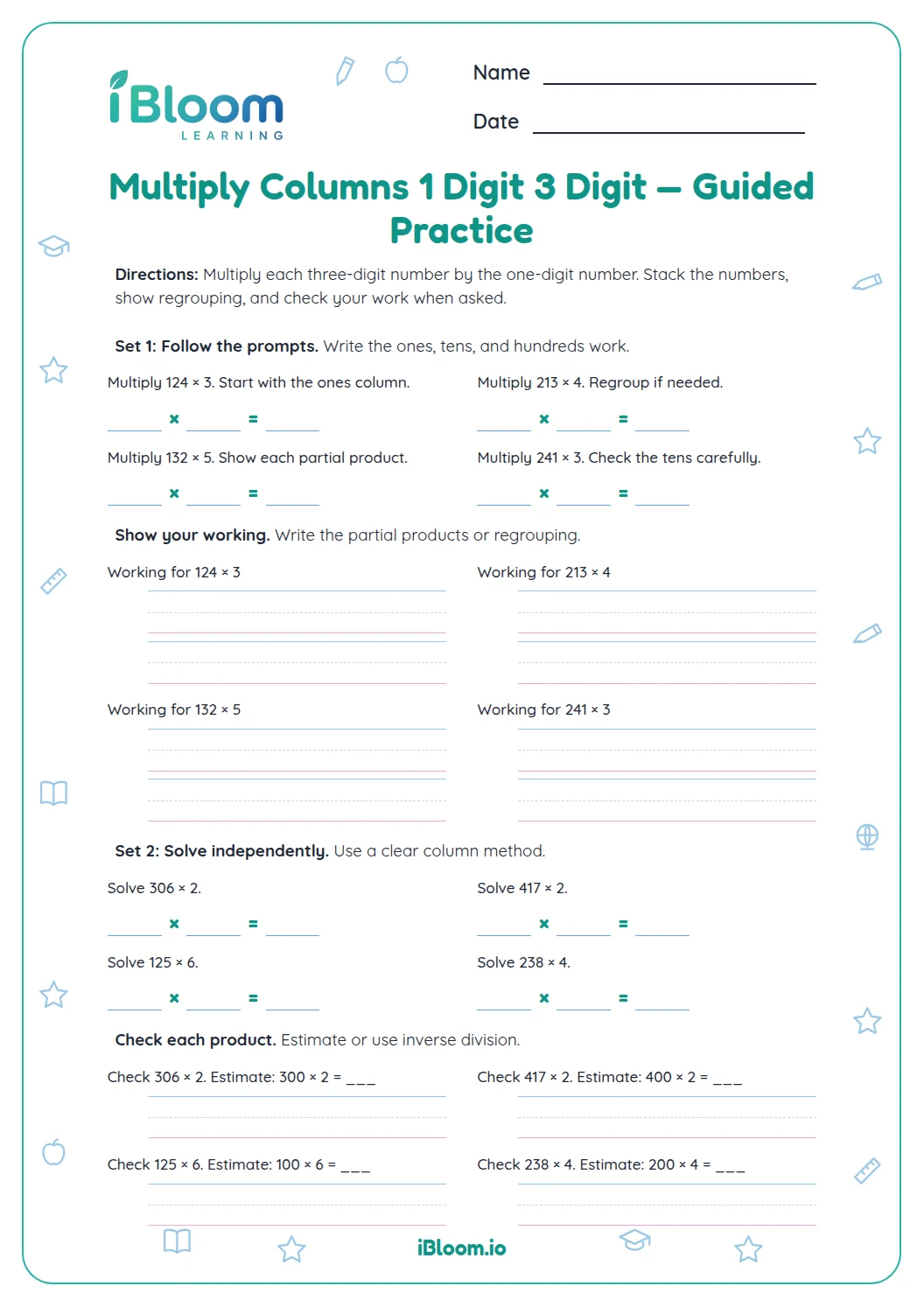
The sheet builds in steps. Part A has no carrying, so children can focus on multiplying each place in order. Part B adds carrying in the ones, the tens or both, and 509 × 7 has a zero in the tens place, where the carried 6 is all that is written. Part C gives a box of working space for each problem. Part D shows two wrong products, each made by forgetting one carry.
- Part A: 102 × 3, 121 × 2, 213 × 3, 321 × 3
- Part B: 134 × 4, 248 × 3, 362 × 4, 509 × 7
- Part C: 316 × 3, 407 × 6, 583 × 5, 256 × 8, with room to work
- Part D: 2 products to check, 148 × 6 and 235 × 3
How can children check a product?
Round the three-digit number to the nearest ten and multiply. For 362 × 4, 360 × 4 is 1,440, so 1,448 is close and 1,048 or 1,848 is not. A quick estimate catches many forgotten carries.
How to use this worksheet at home or in class
- 1Start with 102 × 3 in Part A. Ask your child to say what each digit is worth, then multiply each place.
- 2Let your child finish Part A on their own.
- 3Do question 6 together using the worked example, writing the small carry numbers above the next column.
- 4In Part C, have your child copy each problem into columns with the one-digit number under the ones place.
- 5For Part D, ask your child to redo the problem in columns and find the place where the friend dropped a carry.
- 6Check with the answer key, and estimate by rounding to the nearest ten.
Common mistakes and quick fixes
The mistake
Forgetting to add the carried number, as in 148 × 6 = 688 instead of 888.
The fix
Write the carry small above the next column right away. Cross it off after adding it so it cannot be forgotten.
The mistake
Adding the carry before multiplying, so the tens step in 248 × 3 becomes (4 + 2) × 3 = 18.
The fix
Multiply the digit first, then add the carried number. In 248 × 3, the tens step is 4 × 3 = 12, and then 12 + 2 = 14.
The mistake
Skipping the tens place when its digit is 0, so 407 × 6 comes out as 242 instead of 2,442.
The fix
Multiply the zero like any other digit: 0 × 6 = 0, plus the carried 4 is 4, so write 4 in the tens place.
Common Core alignment
Most US states use the Common Core Math standards or a close state version, so this sheet fits multiplication practice in most classrooms.
Multiply a number of up to four digits by one digit, using place value.
On this sheet: Every problem multiplies a three-digit number by a one-digit number using place value, with carrying in Parts B to D.
Show the official wordingHide the official wording
Multiply a whole number of up to four digits by a one-digit whole number, and multiply two two-digit numbers, using strategies based on place value and the properties of operations. Illustrate and explain the calculation by using equations, rectangular arrays, and/or area models.
What to practice next
Make more practice
Further reading
Questions parents and teachers ask
How do you multiply a 3-digit number by a 1-digit number?
Multiply the one-digit number by the ones, tens and hundreds digits in turn, carrying any extra tens to the next place. For 362 × 4, 2 × 4 = 8, then 6 × 4 = 24 (write 4, carry 2), then 3 × 4 = 12 plus 2 is 14. The product is 1,448.
What are the answers to Part B?
The four products are 536, 744, 1,448 and 3,563. Each needs carrying: 4 × 4 = 16, 8 × 3 = 24, 6 × 4 = 24 in the tens place, and 9 × 7 = 63. In 509 × 7, the zero in the tens place just takes the carried 6.
Which standard does this sheet practice?
It practices Common Core 4.NBT.B.5: multiplying a whole number of up to four digits by a one-digit number using place value. Every problem here is a three-digit number times one digit, worked in columns with carrying. Children who know their times tables up to 9 × 9 have every fact they need.
What is the mistake in Part D?
Each friend forgot one carry. In 148 × 6, the tens make 28, so 2 carries to the hundreds: 1 × 6 + 2 = 8, giving 888, not 688. In 235 × 3, the tens make 3 × 3 + 1 = 10, so 1 carries: 2 × 3 + 1 = 7, giving 705, not 605.
Should my child use the standard algorithm or place-value strategies?
Either works for these problems. Some children prefer to break 248 into 200 + 40 + 8, multiply each part by 3, and add. The column method is a shorter form of that. Part C leaves room for either approach, and the answer key shows only the final products.
Is there an answer key, and how long does the sheet take?
Yes. The answer key is two separate pages with the product for all 14 questions. Most children finish in about 15 to 20 minutes. Part C takes the longest, because children rewrite each problem in columns and show their carries in the working space.