





About this worksheet
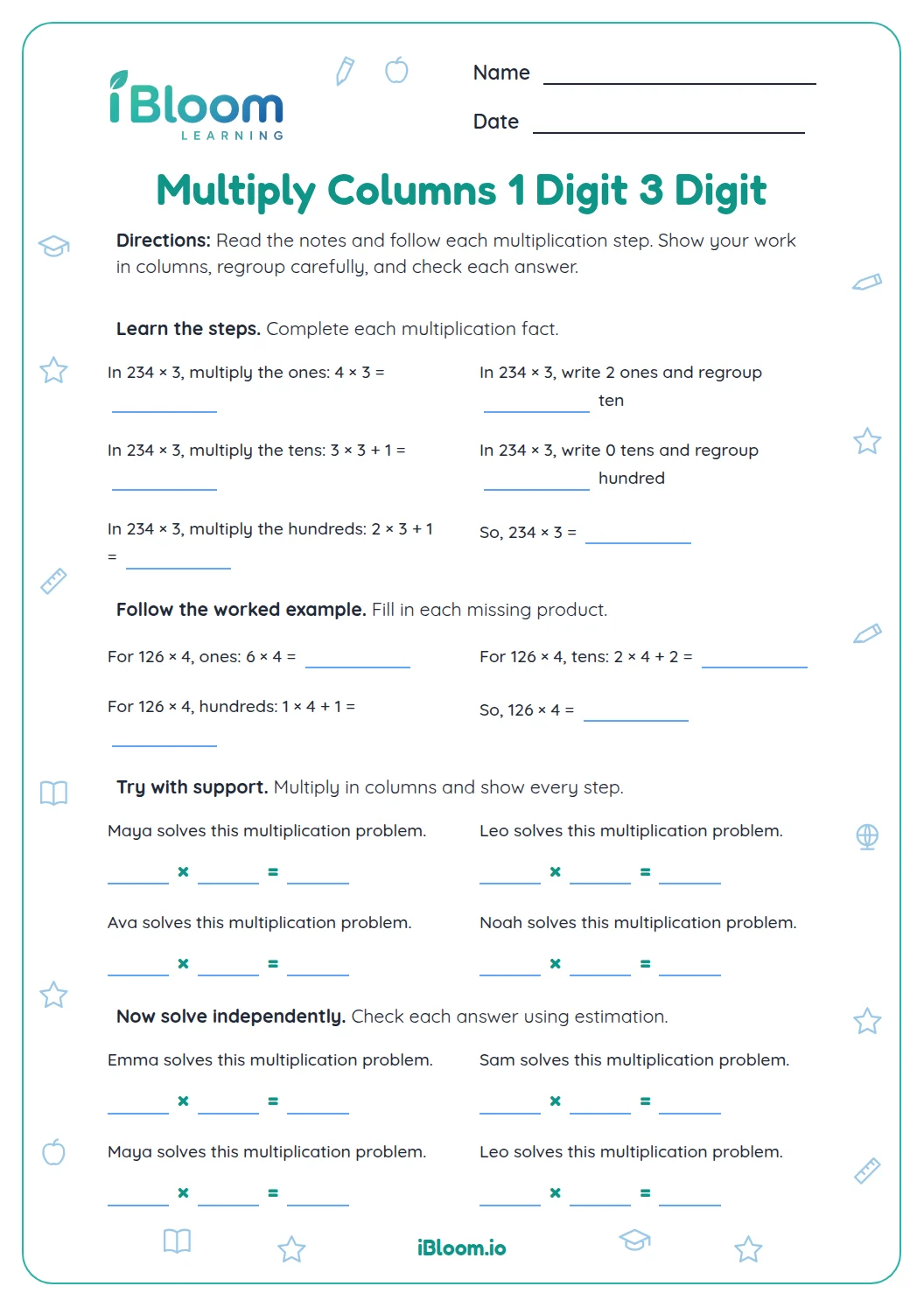
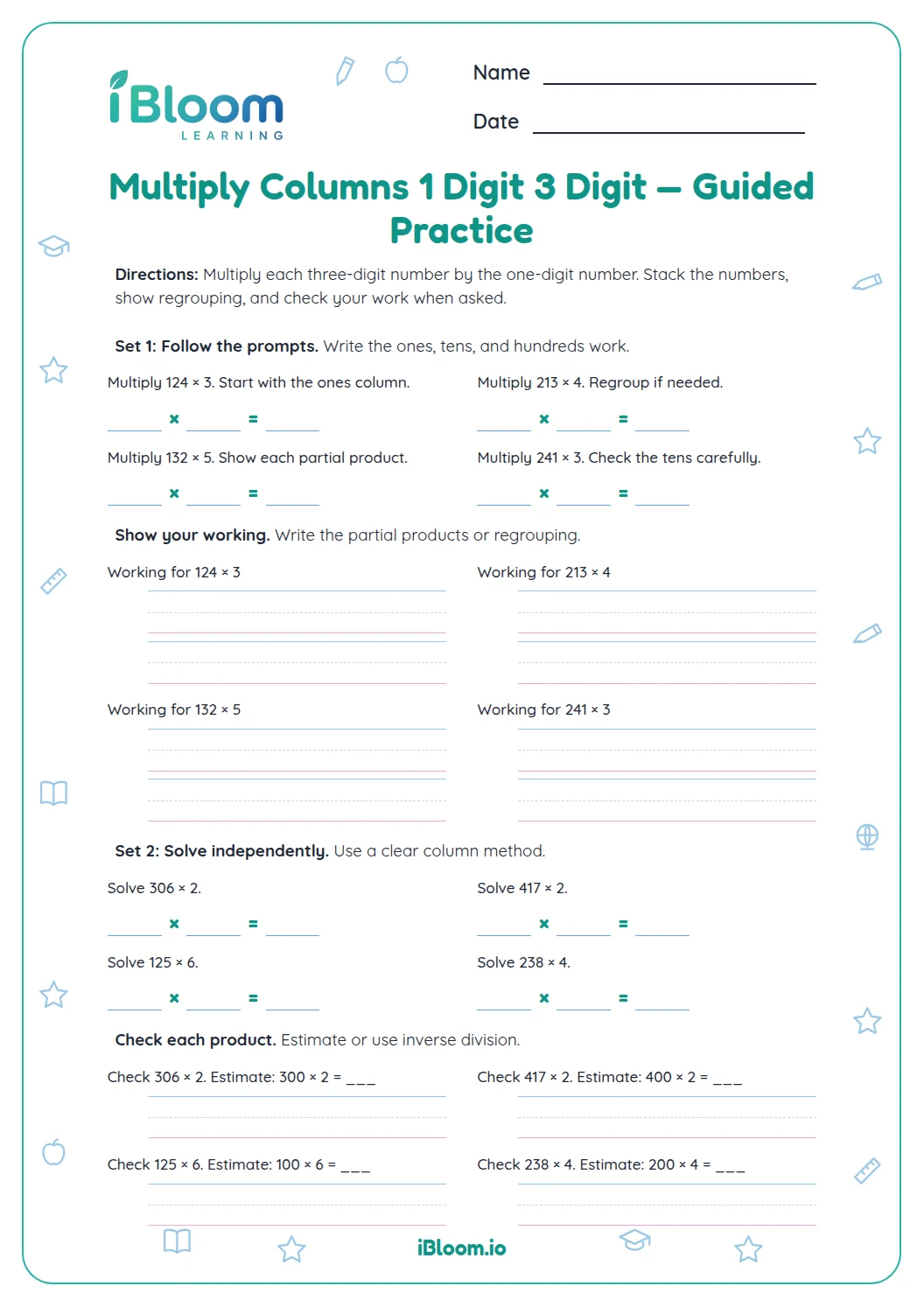
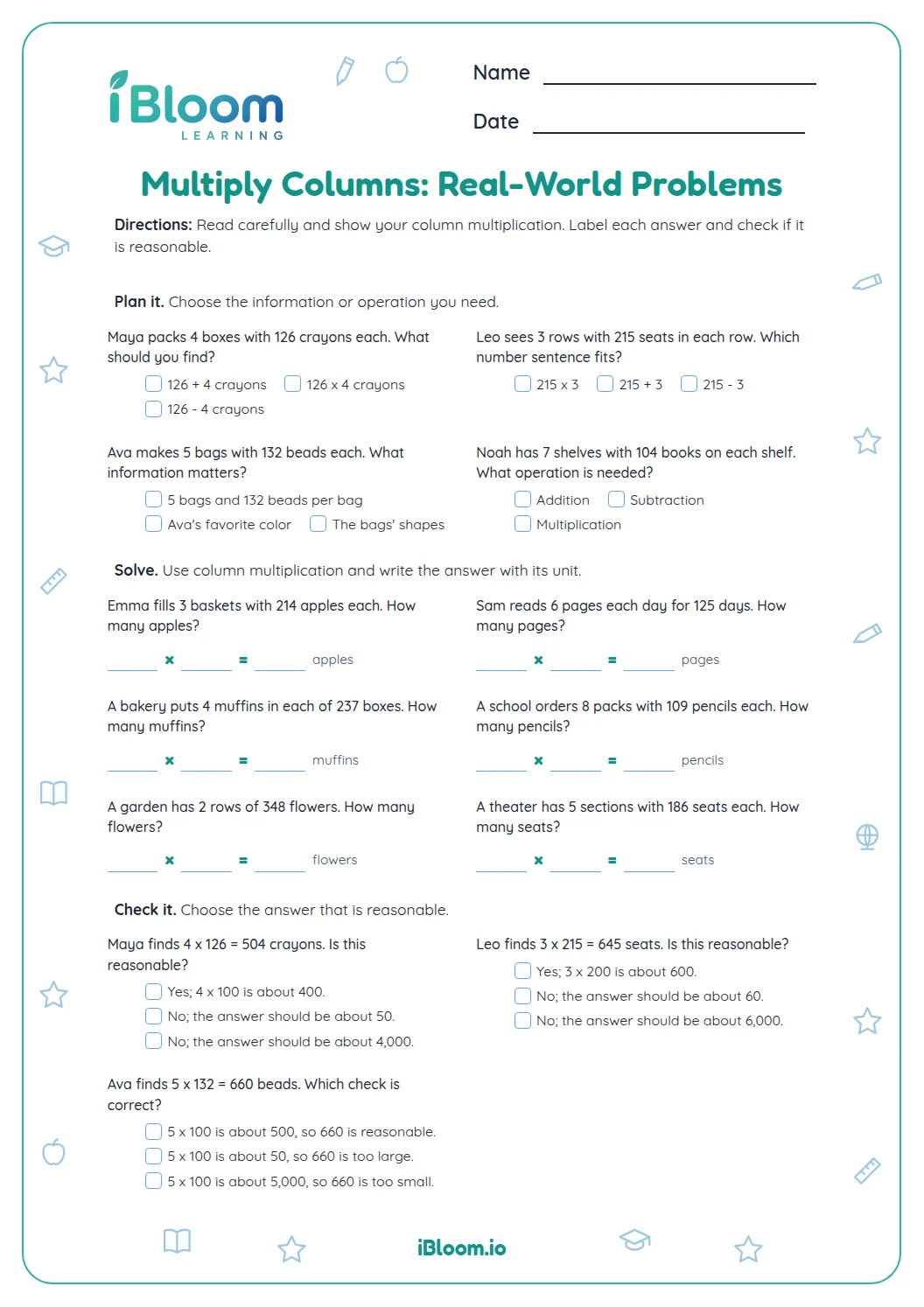
This printable reasoning challenge gives Grade 3 learners practice multiplying three-digit numbers by one-digit numbers. Children work with regrouping across place values, use a missing factor and compare products before solving four short contexts. An answer key is included. The examples keep products below 1,000 so students can focus on the multiplication method and the size of each product.
Aligned to 4.NBT.B.5
How can you multiply by place value?
Break the three-digit number into hundreds, tens and ones. For 124 × 3, calculate 100 × 3, 20 × 3 and 4 × 3, then add 300 + 60 + 12. Regroup 12 ones as 1 ten and 2 ones to get 372.
The worksheet includes products with zero in a place as well as products that require regrouping. Keeping each partial product aligned helps prevent a ten or hundred from landing in the wrong column.
- 1124 × 3
- 24 × 3 = 12
- 320 × 3 = 60
- 4100 × 3 = 300
- 5300 + 60 + 12 = 372
How can an estimate check the answer?
Round the three-digit factor to a nearby ten or hundred and multiply that estimate. For 132 × 7, use about 130 × 7 = 910. An exact answer near 900 makes sense; an answer such as 92 would signal a place-value error.
Questions 9 and 10 ask learners to compare product size and explain a claim. The final problems then apply the same multiplication to equal groups.
What is included in the challenge?
There are 14 questions in four parts: computation, missing-factor reasoning, product comparisons and short word problems. Each story describes equal groups so multiplication represents the situation.
How to use this worksheet
- 1Estimate the product before computing.
- 2Multiply the ones digit and regroup if the partial product is 10 or more.
- 3Multiply the tens, then the hundreds.
- 4Add the partial products, keeping place values aligned.
- 5Check that the answer is close to your estimate.
Common mistakes and quick fixes
Curriculum alignment
Use place-value strategies to multiply a multi-digit number by a one-digit number.
On this sheet: The computation items multiply three-digit numbers by one-digit numbers using place-value steps.
Show the official wordingHide the official wording
Multiply a whole number of up to four digits by a one-digit whole number, and multiply two two-digit numbers, using strategies based on place value and the properties of operations. Illustrate and explain the calculation by using equations, rectangular arrays, and/or area models.
What to practice next
Make more practice
Further reading
Questions parents and teachers ask
What does regrouping mean when multiplying?
Regrouping combines equal units into the next place. If 4 × 3 gives 12 ones, write 2 in the ones place and carry 1 ten to the tens. On this sheet, the child uses that idea while multiplying three-digit numbers by one-digit numbers.
How can I help with a zero in the tens place?
Keep the zero as a placeholder so the other digits stay in the right places. For 305 × 3, multiply 300 by 3 and 5 by 3; there are no tens to add. The result is 900 + 15, or 915.
Why estimate before multiplying?
An estimate gives a useful size check. For 132 × 7, rounding 132 to 130 gives about 910. If the written product is much smaller, the child can check whether a partial product or regrouped digit was missed.
How many questions are included?
There are 14 questions: six multiplication calculations, two missing-factor problems, one estimate-based error check, one product comparison and four equal-group stories. The separate key gives the numerical answers and a sample response for the explanation item. Ask the learner to use an estimate as a second check, too.
What multiplication skill comes next?
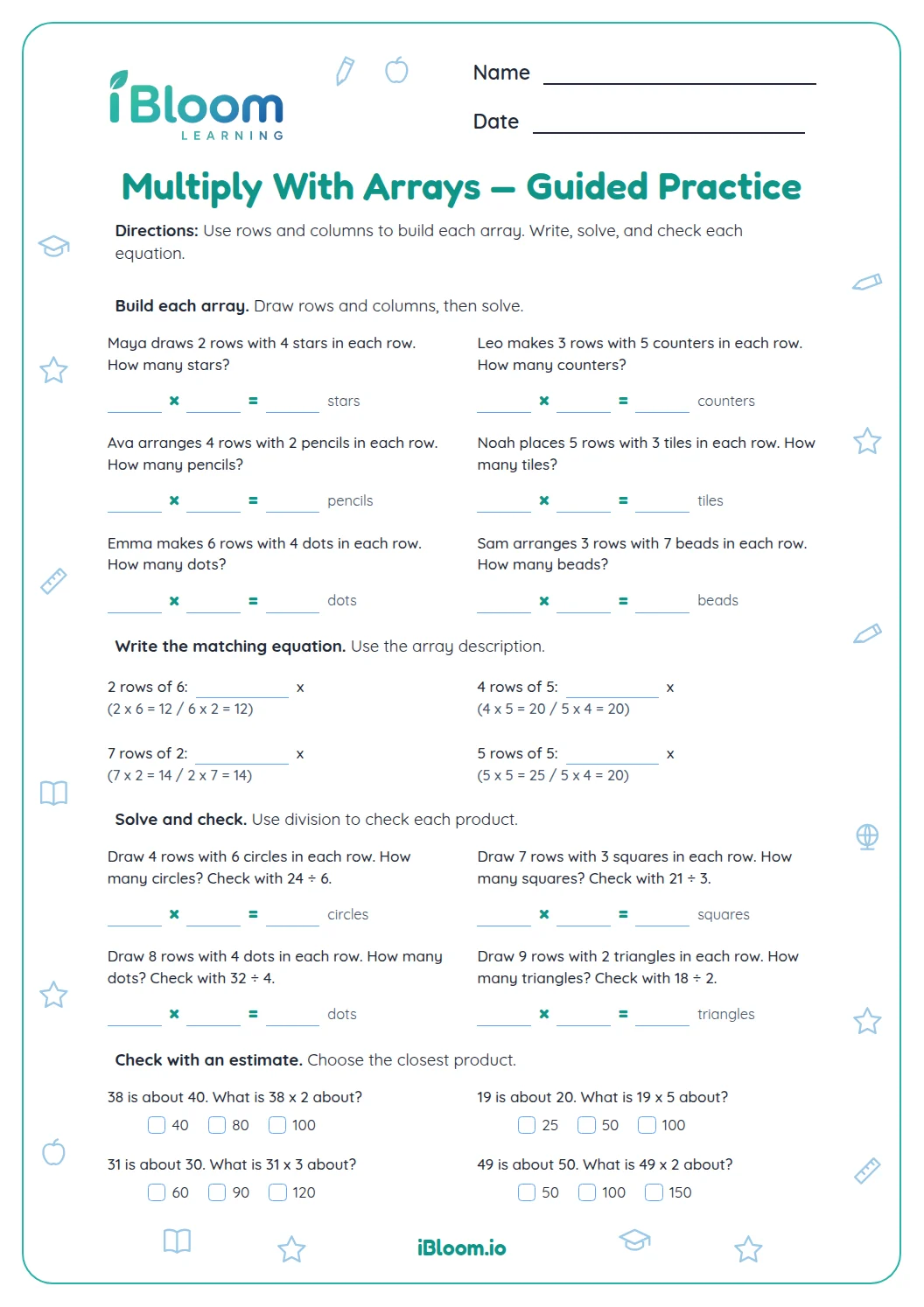
After multiplying three-digit numbers by one-digit numbers, learners can practice larger factors or connect multiplication to arrays and area models. The linked pages below focus on arrays, multiplication facts and four-digit factors. The next page also extends the written method to the thousands place.