





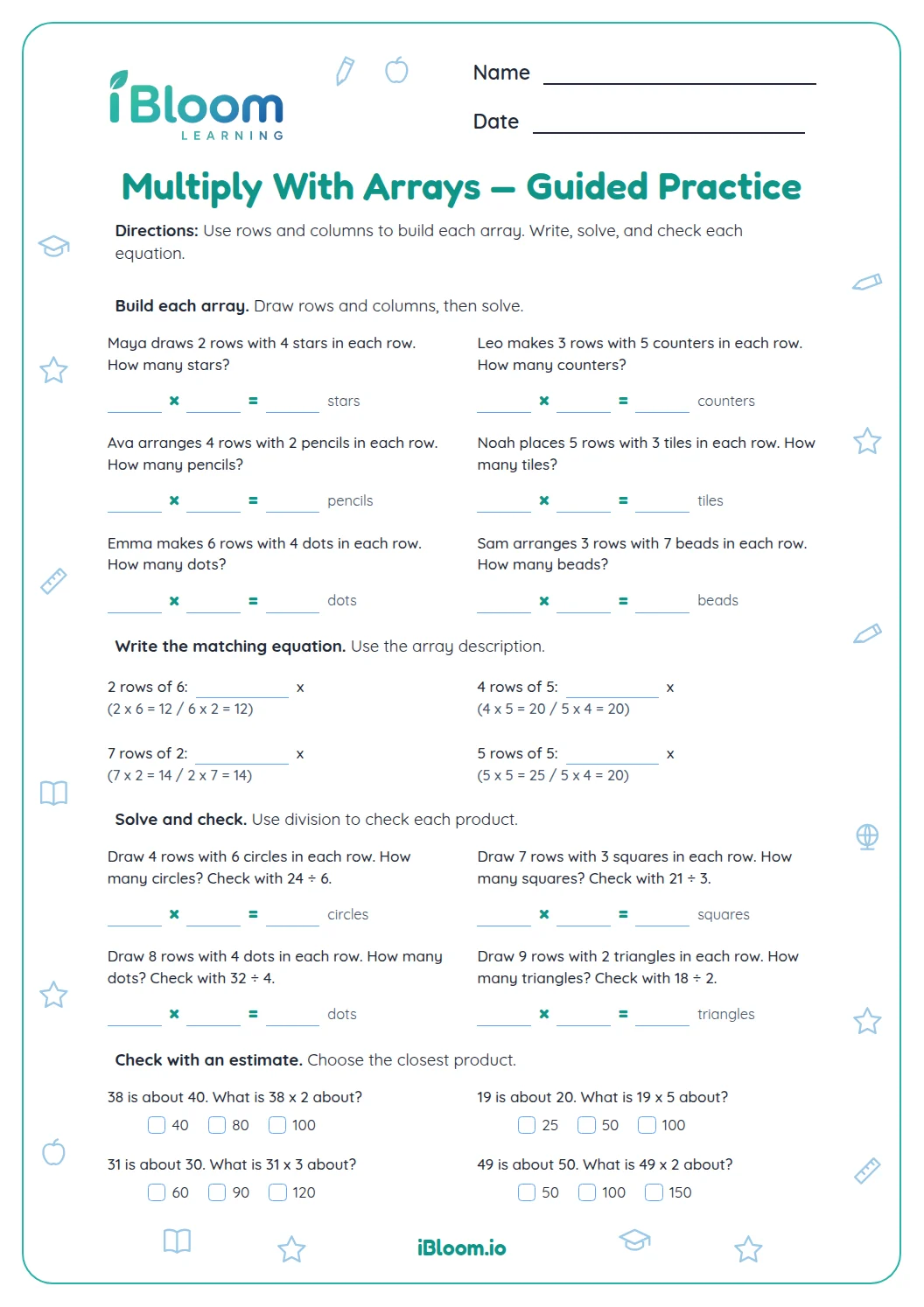
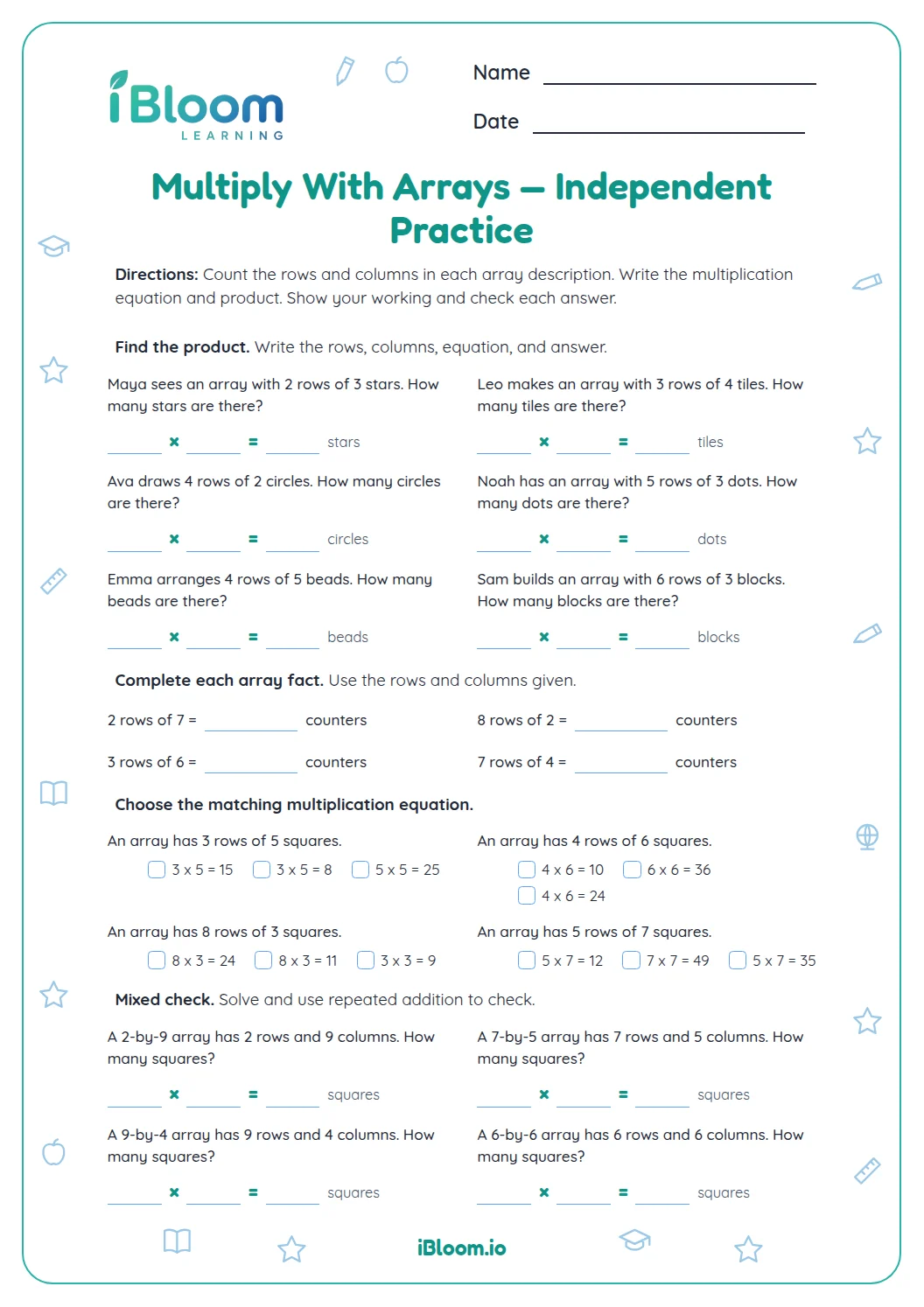
About this worksheet
This Grade 3 multiplication worksheet shows equal groups of apples, with each apple standing for a stated number of hundreds. Learners count the groups, multiply by each group’s value, and find 16 products. The answer key lists each total.
Aligned to 3.OA.A.1
How does an array show multiplication?
Each apple stands for the amount named in the question. In question 1, two equal groups of 300 make 600. Count the groups, then multiply the number of groups by the value in each group.
- 1There are 2 groups of 300.
- 22 × 300 = 600.
- 3The total is 600.
How do you multiply a number of hundreds?
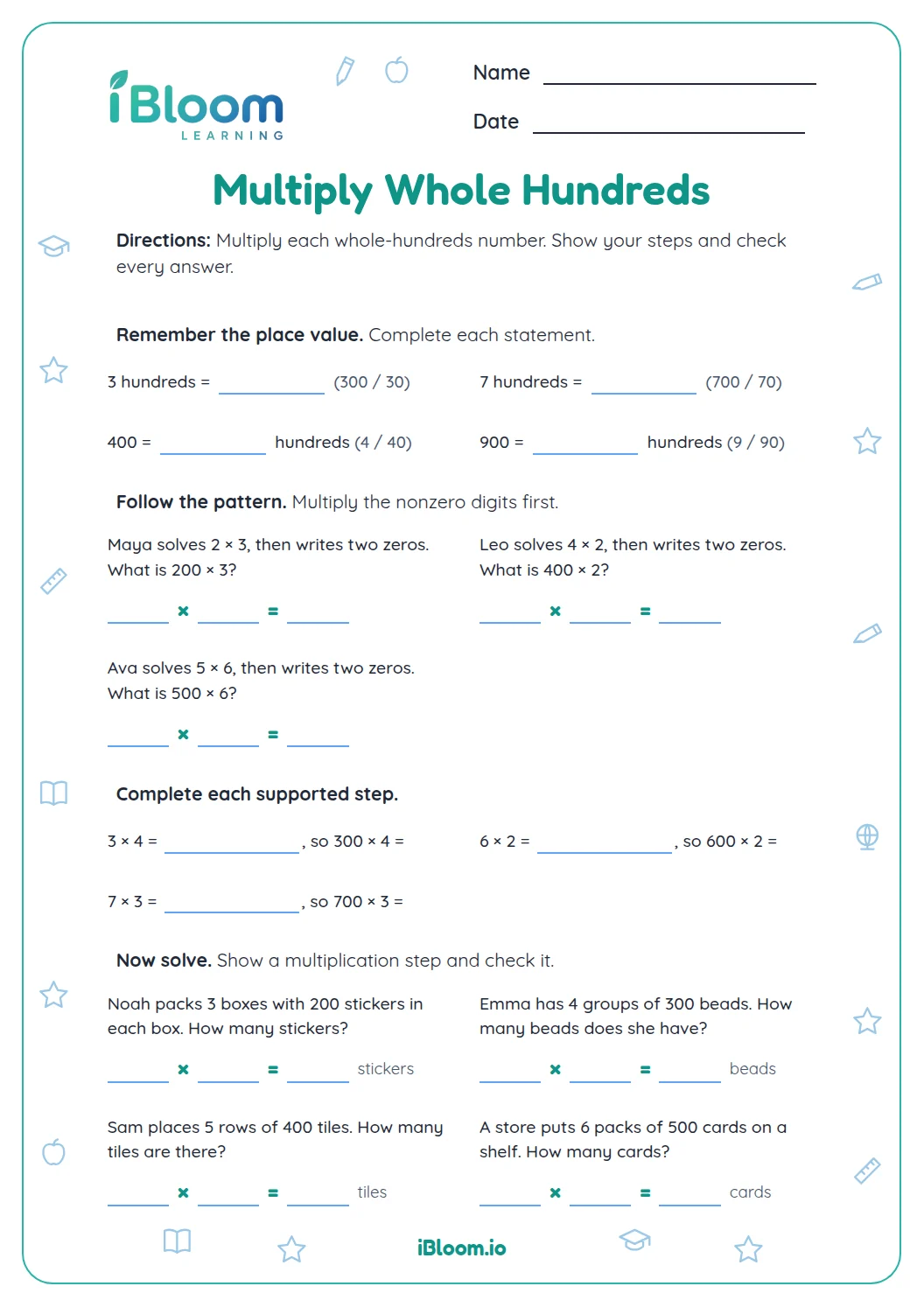
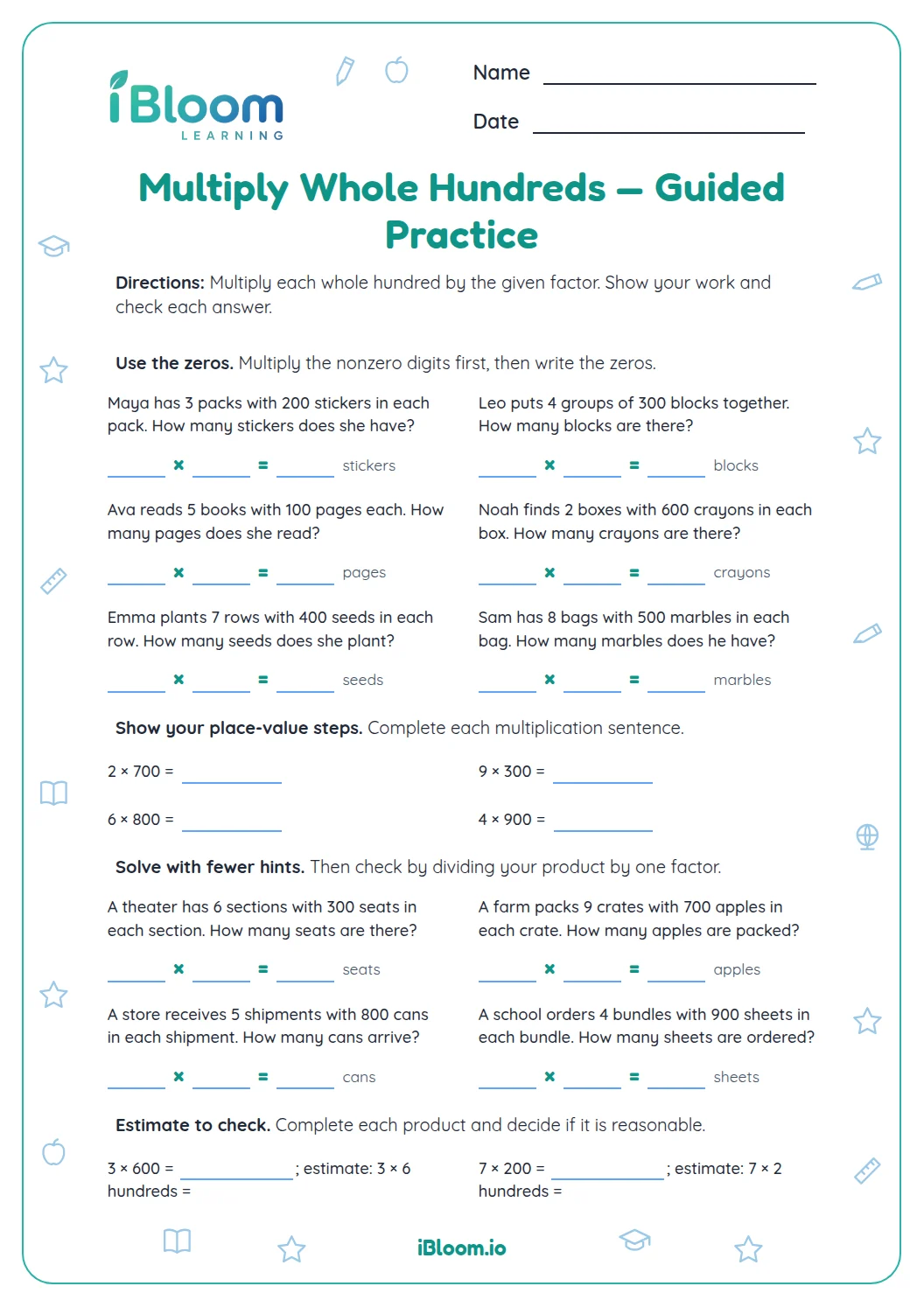
Use the same equal-group idea for a multiplication fact. Question 8 has 3 groups of 400, so 3 × 400 = 1,200. Multiply the one-digit group count by the hundreds in each group.
- 13 groups of 400
- 23 × 400 = 1,200
- 3The total is 1,200.
How can you check the product?
First multiply the group count by the hundreds in one group. Then attach the hundred value: 4 groups of 3 hundreds make 12 hundreds, or 1,200. Check that your product names the total items, not only the number of groups.
How to read the arrays
- 1Count the equal groups shown by the apples.
- 2Read the hundreds value for each group.
- 3Multiply the group count by that value.
- 4For an equation, use the same group reasoning.
- 5Check each product with the answer key.
Common whole-hundreds mistakes
The mistake
Writing only the number of apples.
The fix
Multiply the count by the value each apple represents.
The mistake
Ignoring the value assigned to each group.
The fix
Use the hundreds amount stated in the model or equation.
The mistake
Writing the group count instead of the total.
The fix
Check that your product includes all the hundreds in every group.
Common Core alignment
The questions practice 3.OA.A.1 by applying the target skill in each item.
Interpret multiplication as equal groups and find the total.
On this sheet: Arrays show equal groups of hundreds and connect the groups to a multiplication product.
Show the official wordingHide the official wording
Interpret products of whole numbers, e.g., interpret 5 × 7 as the total number of objects in 5 groups of 7 objects each.
What to practice next
Make more practice
Further reading
Questions parents and teachers ask
What does each apple represent in the models?
In the first seven questions, each apple stands for the amount named in its prompt. Learners count equal groups and multiply by the value of one apple. The next seven questions ask for products directly. The answer key gives all 14 totals.
How many questions are on this worksheet?
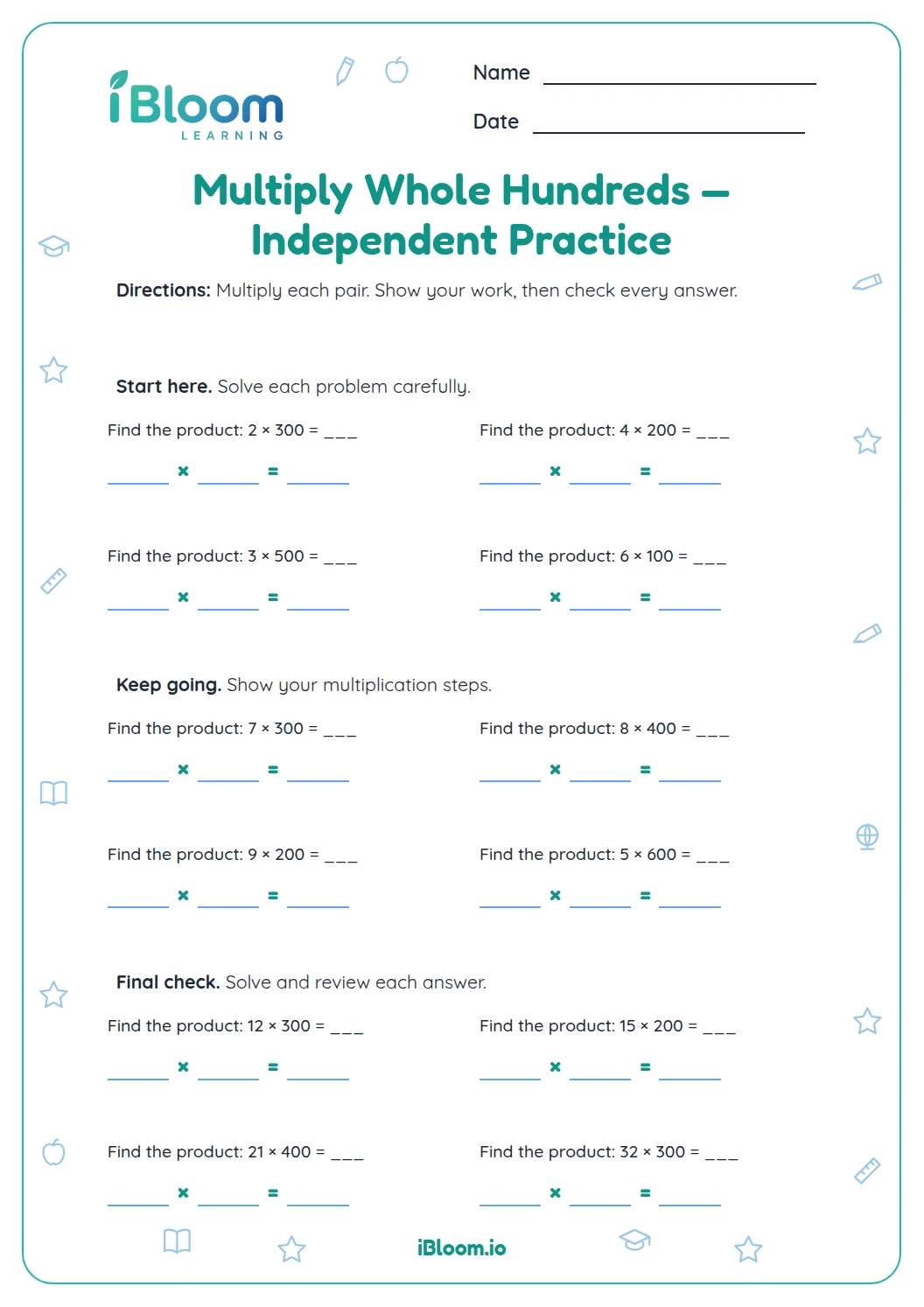
There are 14 questions: seven picture models of equal groups and seven multiplication equations. Each asks learners to multiply a one-digit group count by a whole-hundreds amount. The answer key lists every product and supports a quick independent check.
How do arrays help multiply whole hundreds?
Count the equal groups and multiply by the value of one group. For example, two groups of 300 total 600. The picture models help learners see the equal groups before recording a multiplication product, while the key confirms the total.
Does the answer key show the calculations?
The key lists the product for all 14 questions. For a picture item, count the groups and multiply by the amount each apple represents. For an equation, the same equal-group reasoning checks the result and confirms the whole-hundreds total for the problem.
What if a learner counts every picture one by one?
Ask the learner to identify the number of groups and the value in each group, then multiply. For four groups of 300, calculate 4 × 300 = 1,200. The answer key provides the total for every model and equation.