







About this worksheet
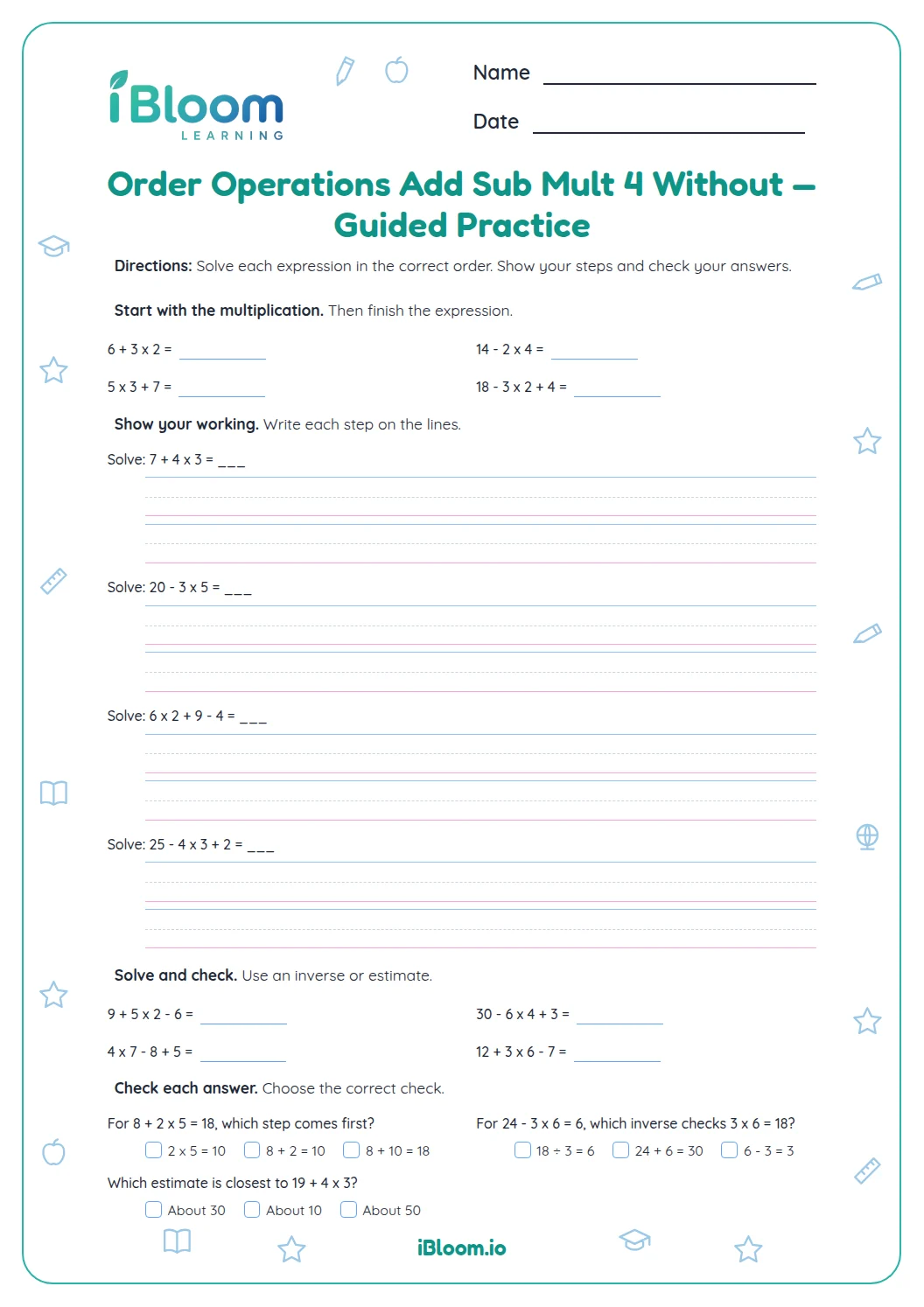
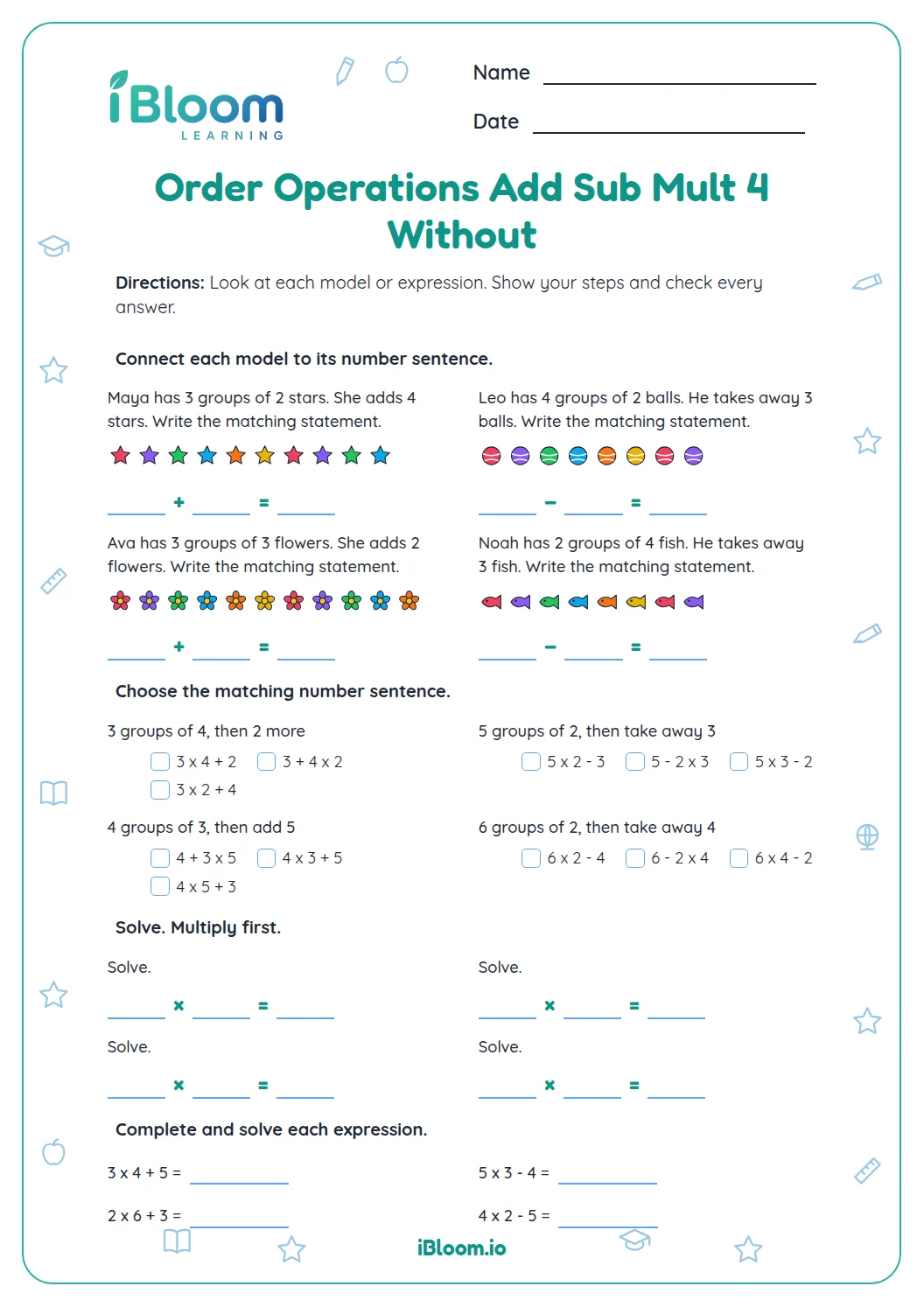
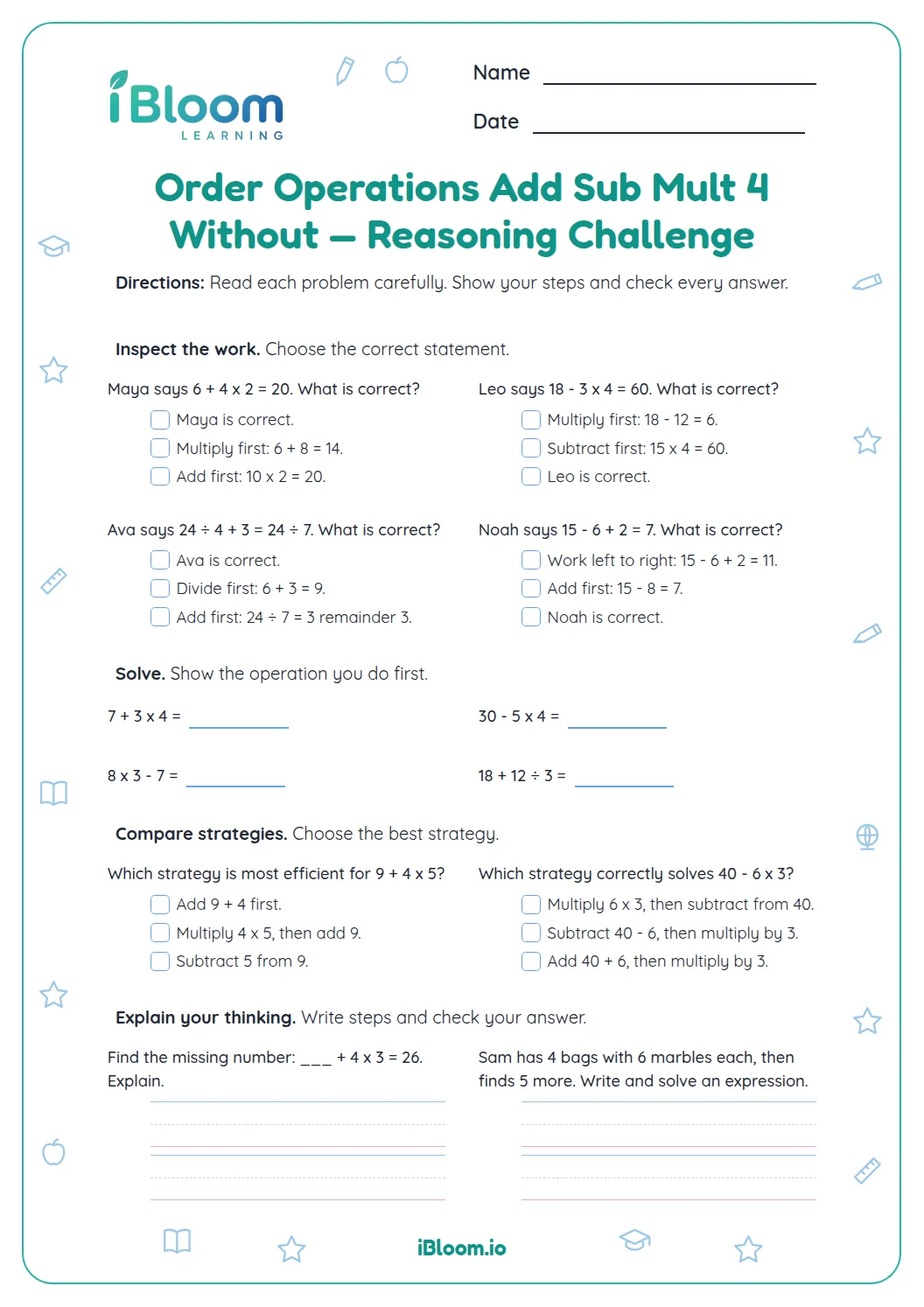
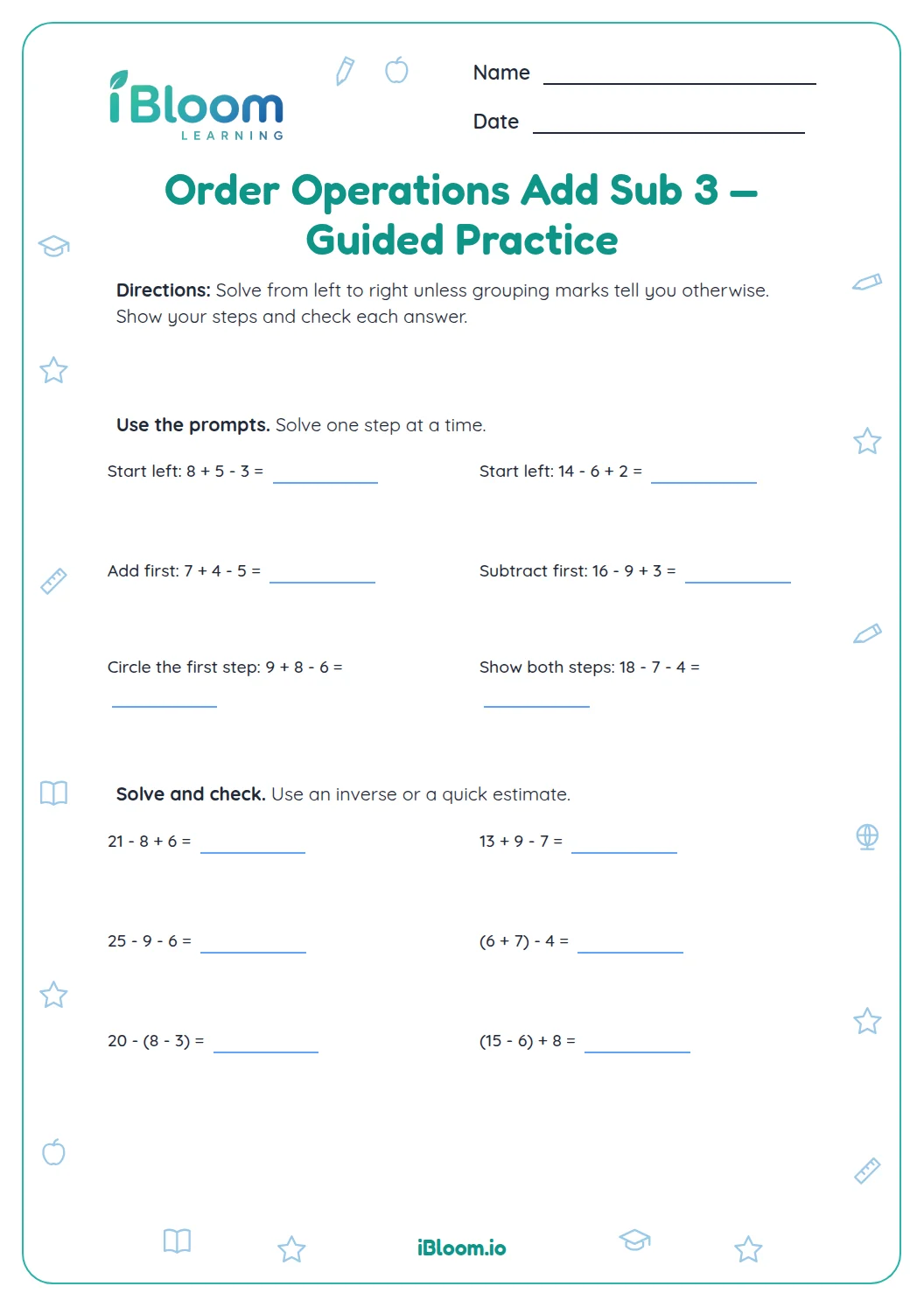
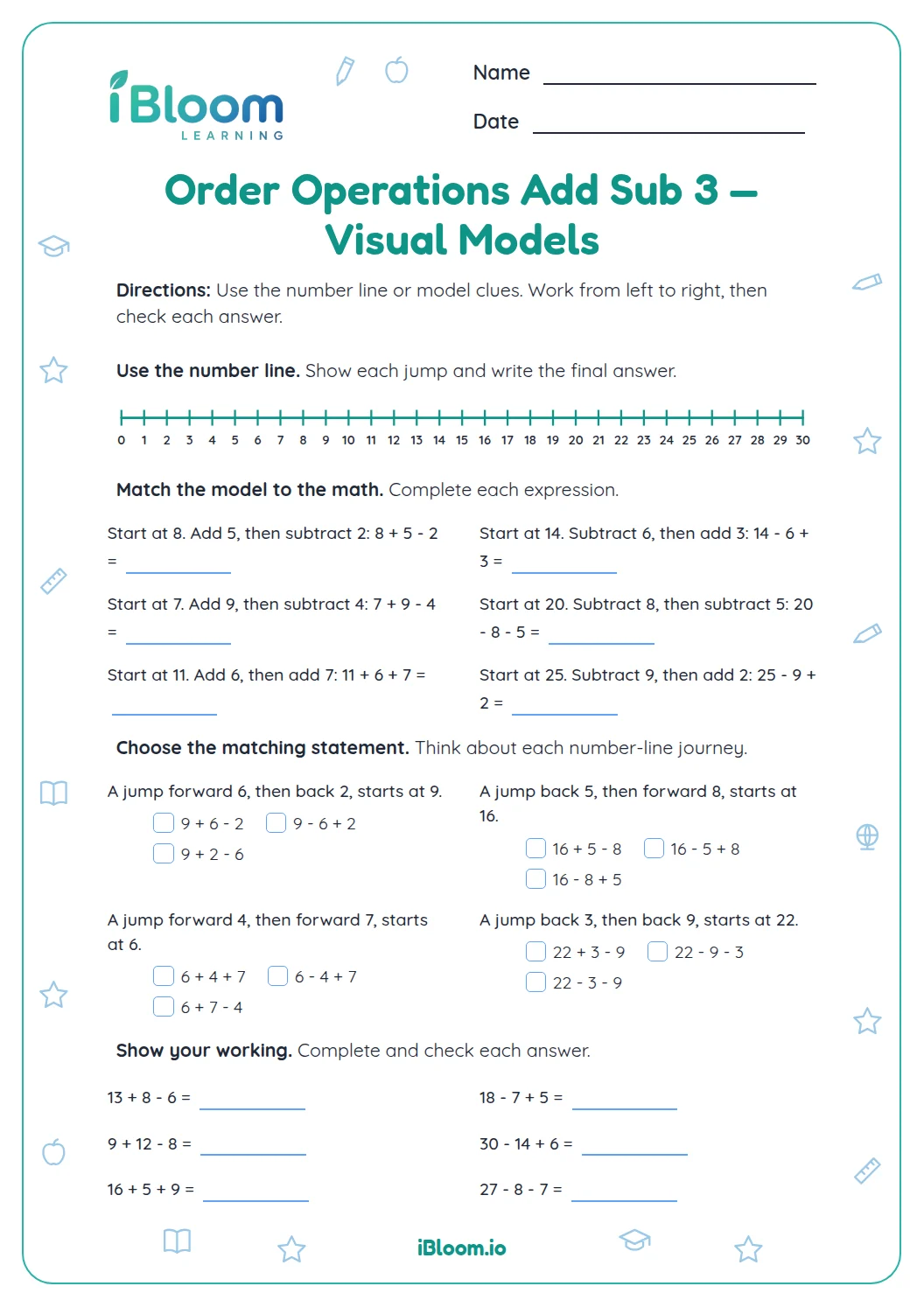
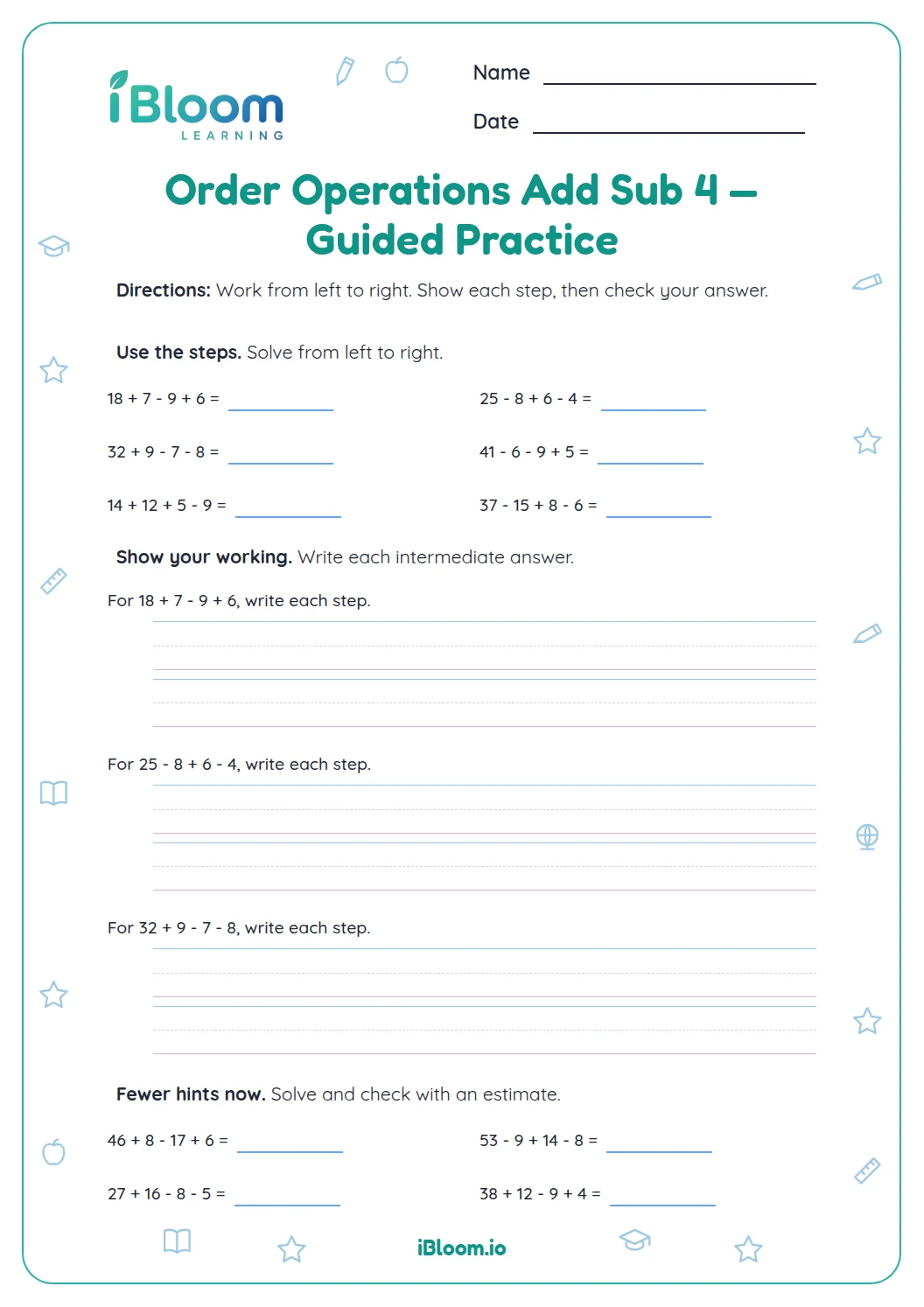
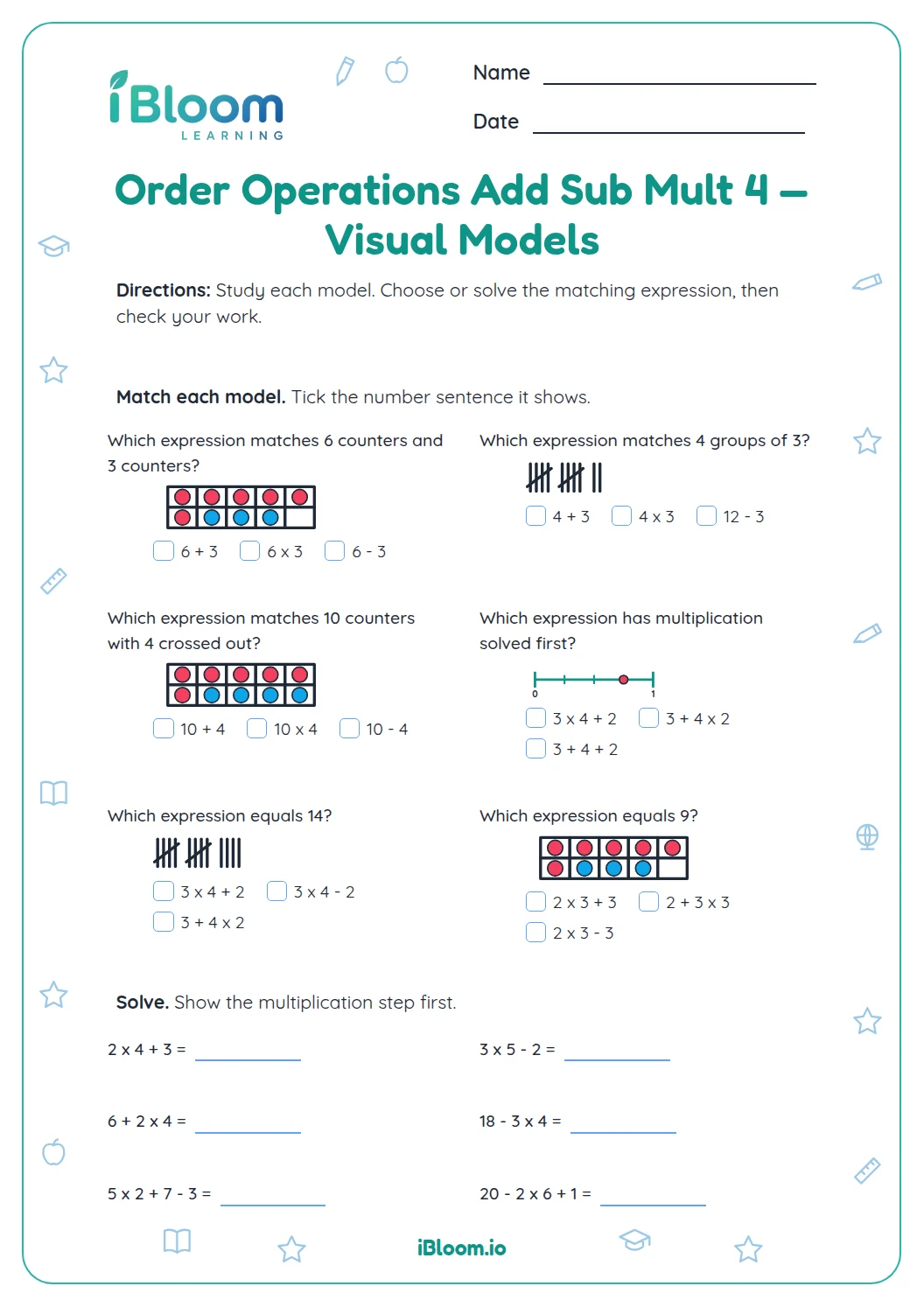
This Grade 3 worksheet gives students 16 number sentences to evaluate. Some expressions use parentheses to group an addition or subtraction step; others ask students to multiply or divide before adding or subtracting. The answer key lists each result so children can check the order of their steps.
What should students calculate first?
In 3 + 4 × 5, multiply 4 × 5 first to get 20, then add 3. The expression equals 23. When parentheses group a sum, as in (3 + 4) × 5, add inside them first to get 35.
How do parentheses change an expression?
Parentheses mark the numbers to calculate together first. For example, 24 − 3 × 6 equals 6 because multiplication comes first; (24 − 3) × 2 equals 42 because the subtraction is grouped.
How can students check each result?
Write one step at a time and keep the operations in the original expression visible. After finding a result, substitute it into the last step and check the arithmetic independently.
How to work through the page
- 1Find any parentheses and evaluate inside them first.
- 2Without parentheses, multiply before adding or subtracting.
- 3Use a known multiplication fact to check each product.
- 4Finish the remaining addition or subtraction.
- 5Compare an expression with its paired example to notice the effect of parentheses.
- 6Check the arithmetic one operation at a time.
Common slips and fixes
The mistake
Adding from left to right before multiplying
The fix
Pause at multiplication or division and complete that step first.
The mistake
Ignoring parentheses
The fix
Treat the grouped expression as one value before continuing.
The mistake
Choosing an answer without checking the arithmetic
The fix
Recalculate each fact, then complete the final addition or subtraction.
What to practice next
Make more practice
Questions parents and teachers ask
What does order of operations mean on this sheet?
It means evaluating an expression in a consistent order. Calculate inside parentheses first, then multiplication, then addition or subtraction. The worksheet uses these operations so students can practice deciding which step comes next. Students can check each step against the examples.
How many expressions are included?
There are 16 number sentences across the worksheet pages, followed by an answer key. The expressions include parentheses and multiplication or division alongside addition or subtraction. Several paired items make it possible to compare how grouping changes a result. Review the expressions in sequence.
Why can parentheses change an answer?
Parentheses tell the reader to calculate the grouped part first. In 24 − 3 × 6, multiplication happens first. In (24 − 3) × 2, the subtraction happens first because it is inside parentheses, so the two expressions have different results.
Should students show their steps?
Yes. Even when the worksheet has short answer spaces, students can work each operation in order on scratch paper. Keeping the steps visible makes it easier to find an arithmetic error or notice that multiplication or division should come before addition or subtraction.
How can a student check a multiplication step?
Use a related multiplication fact to verify the product. For example, if an expression includes 36 − 4 × 5, check that 4 × 5 equals 20 before subtracting. Then complete the remaining operation and compare the final result with the answer key.