






About this worksheet
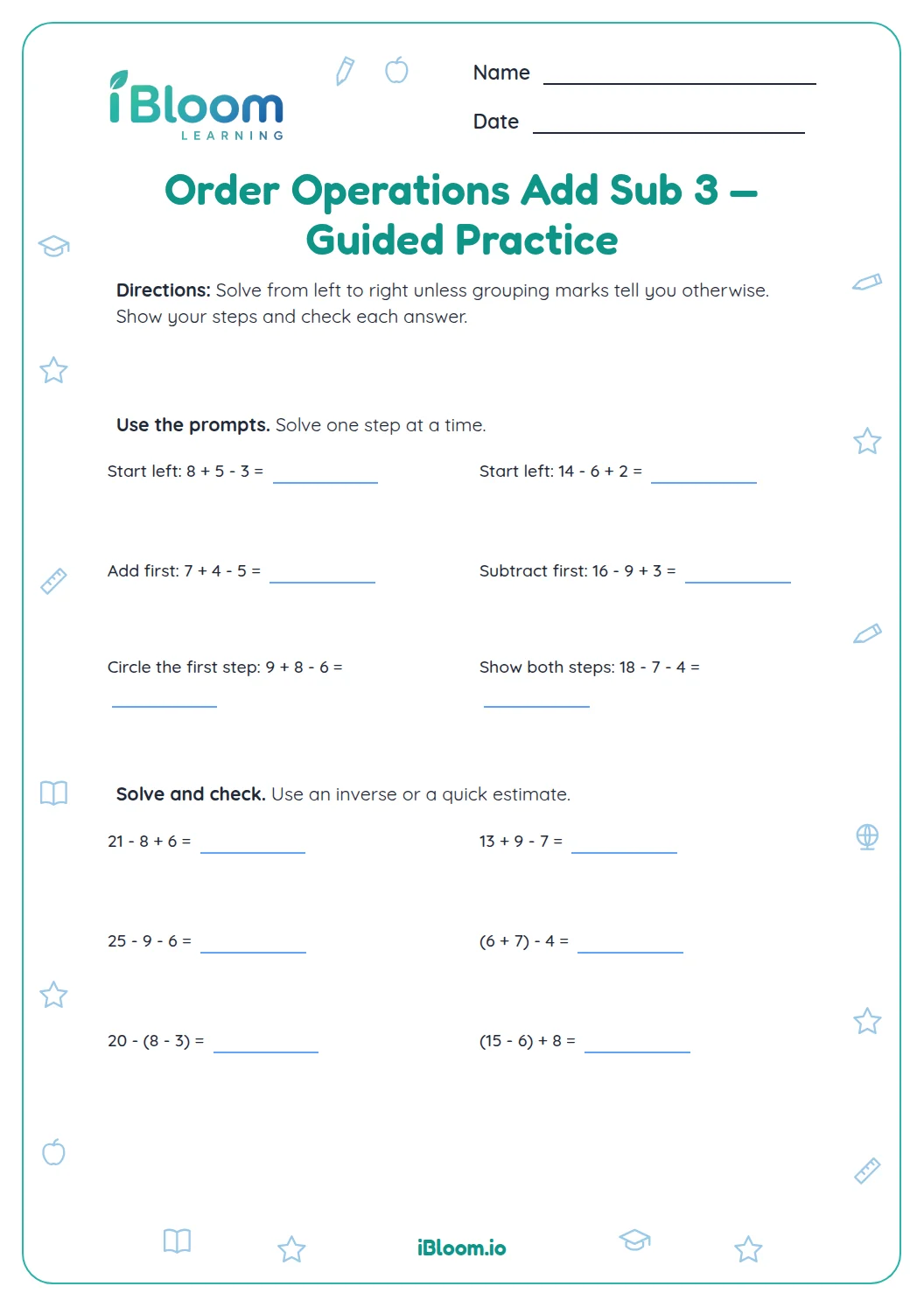
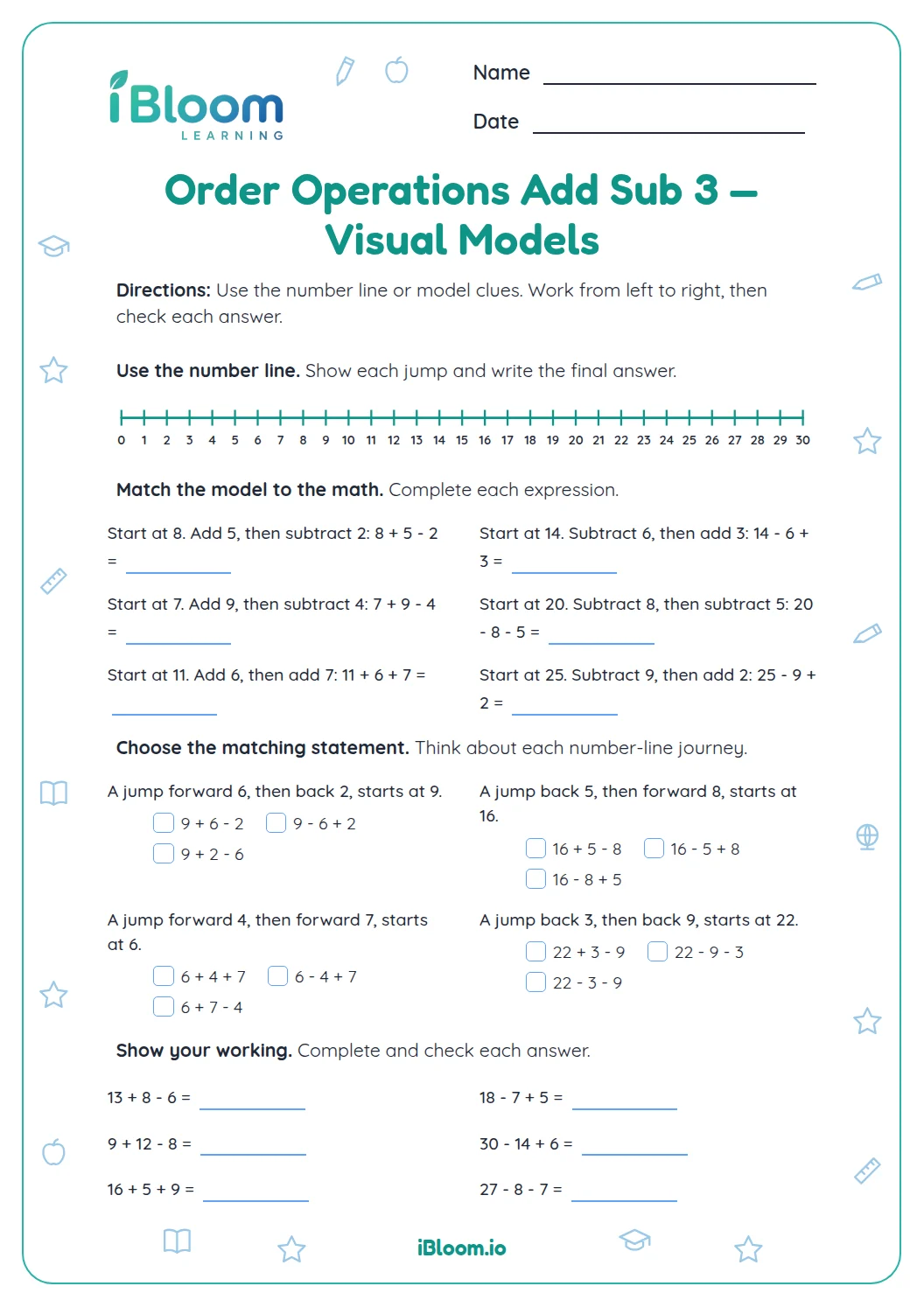
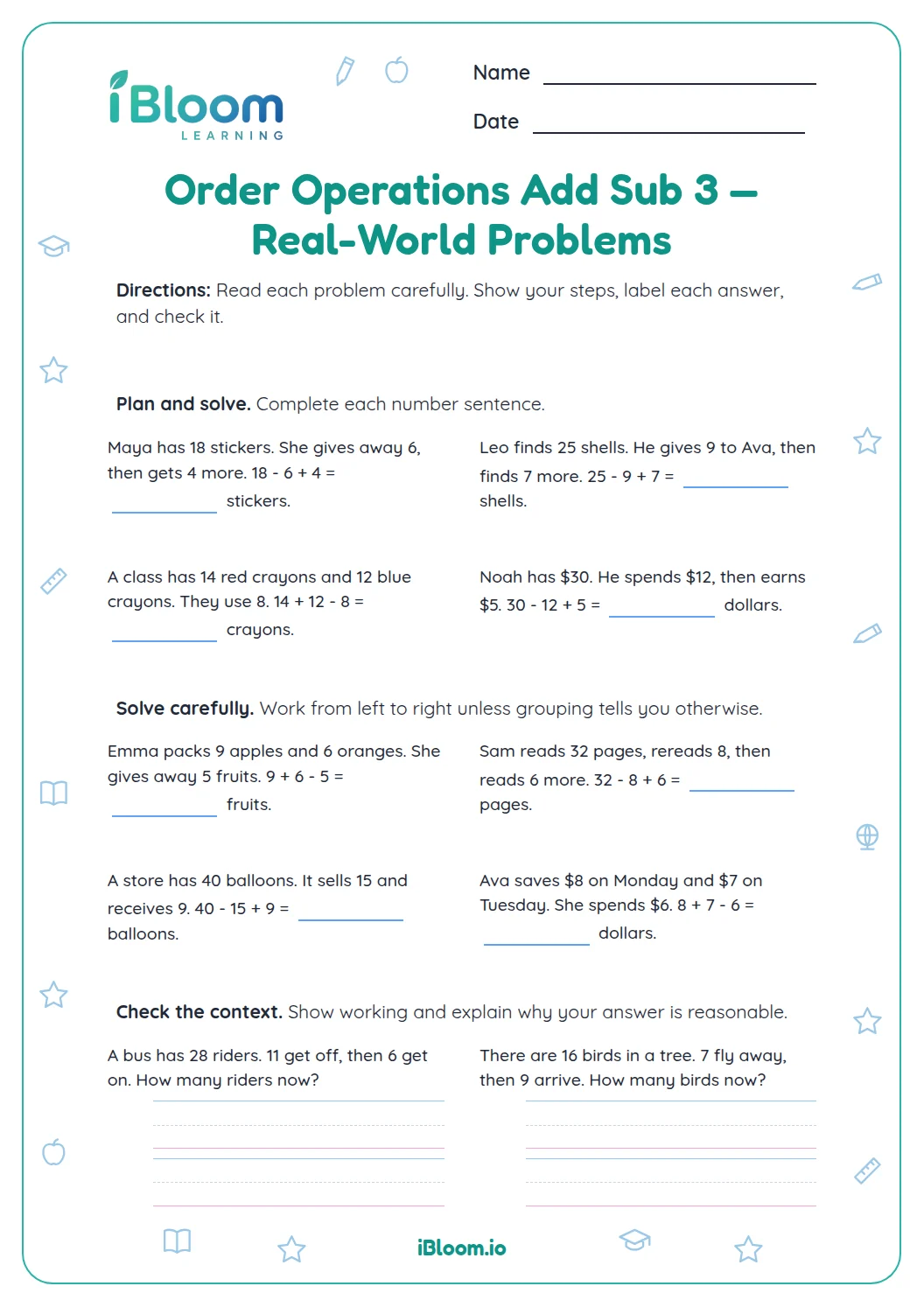
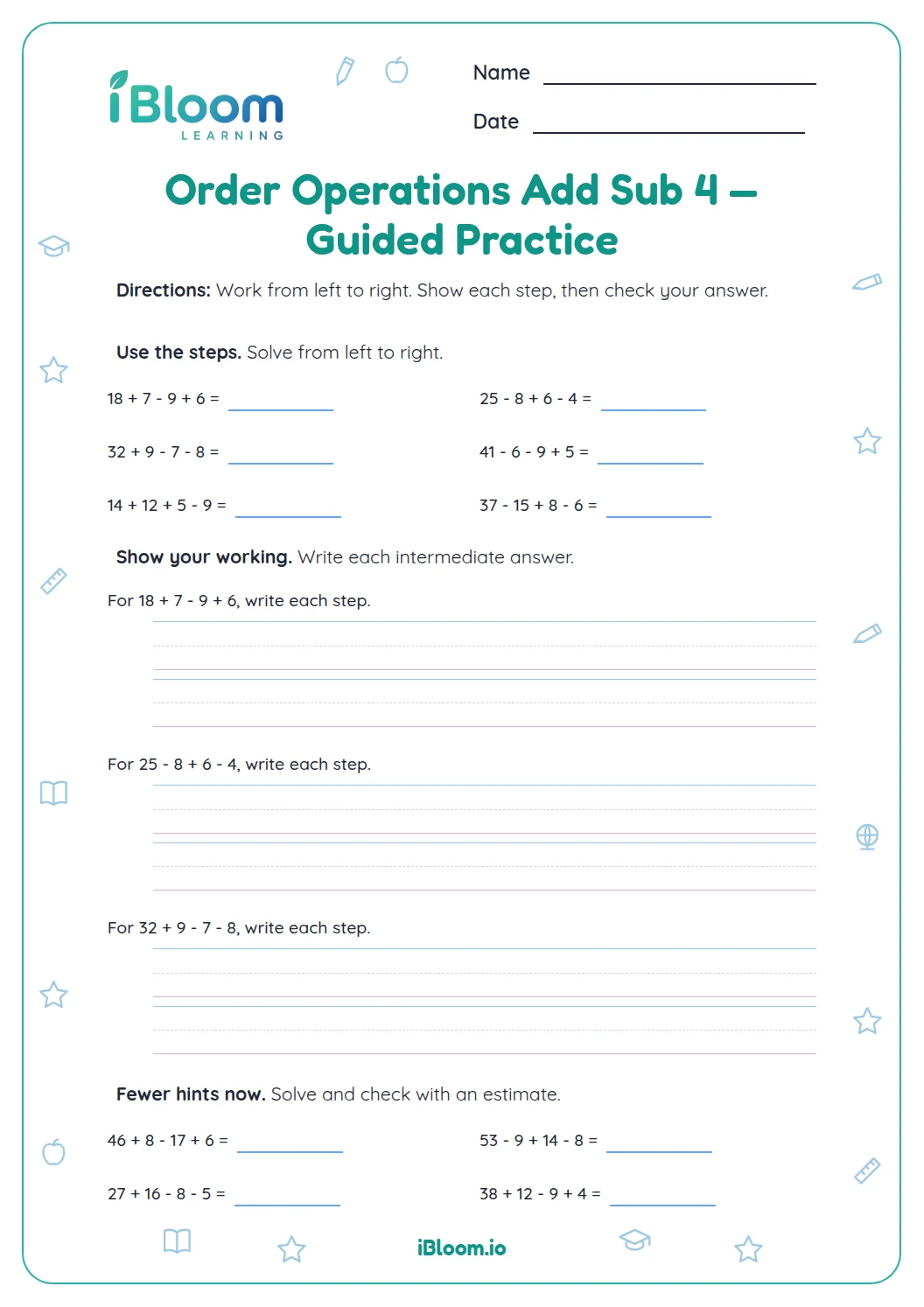
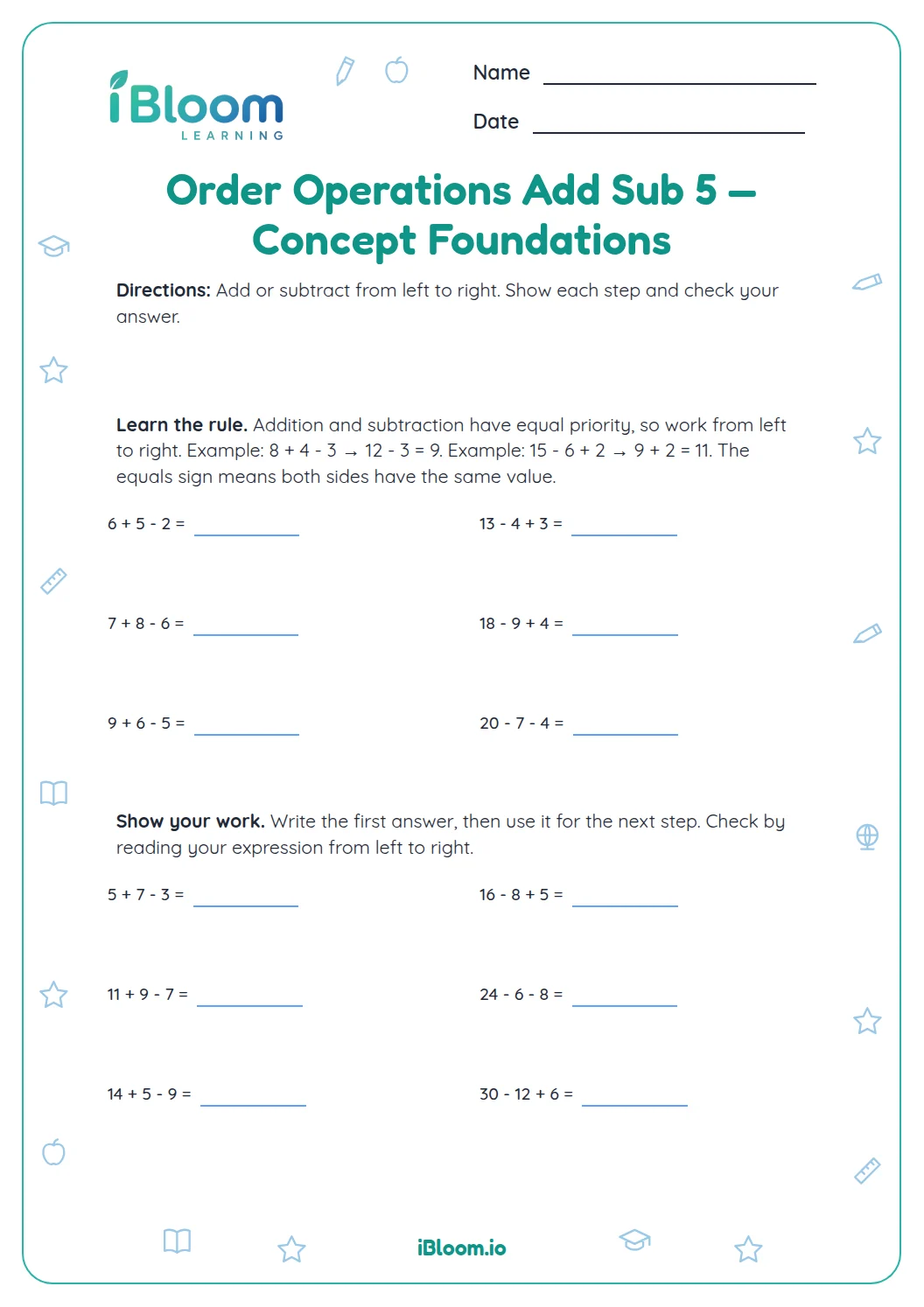
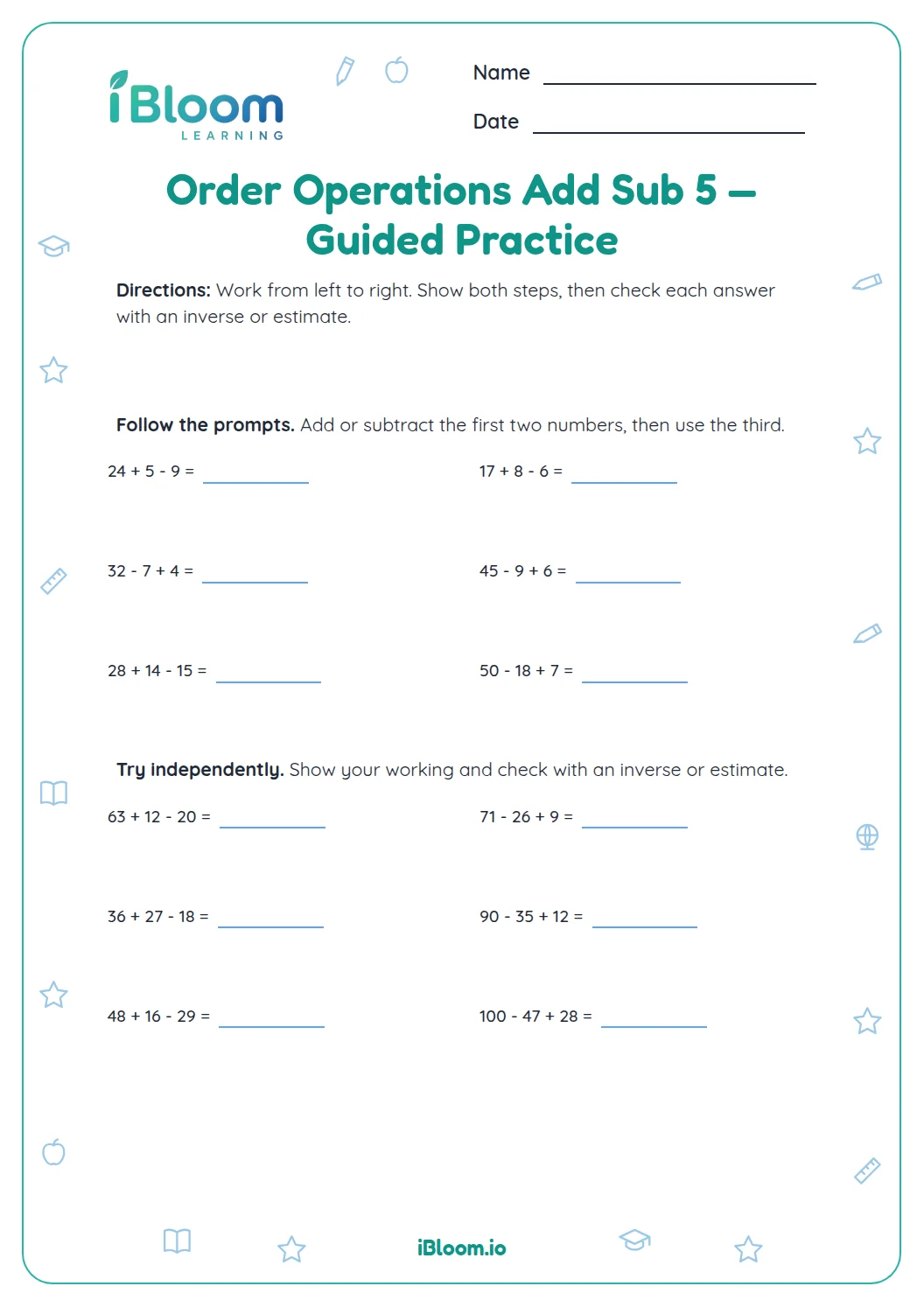
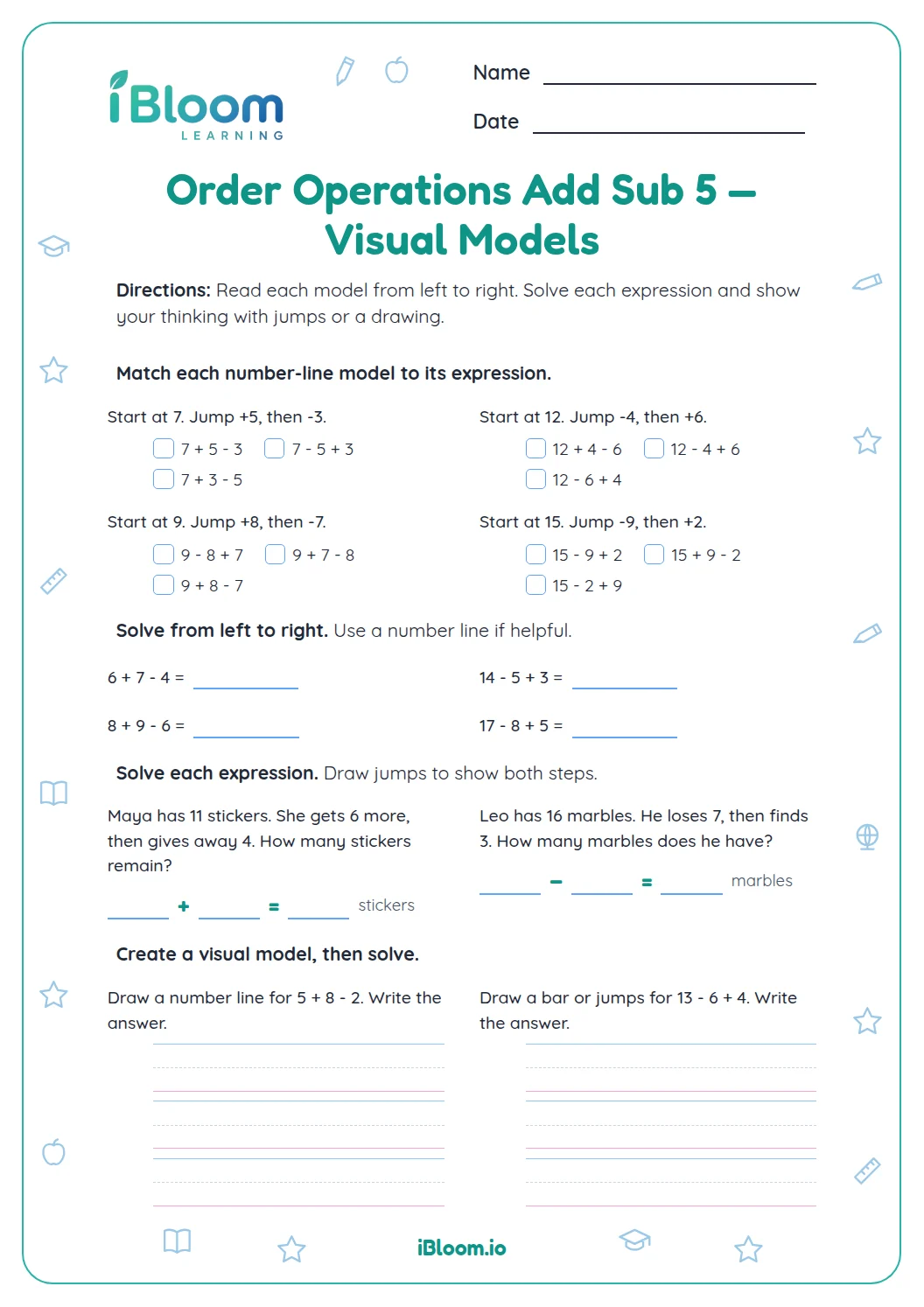
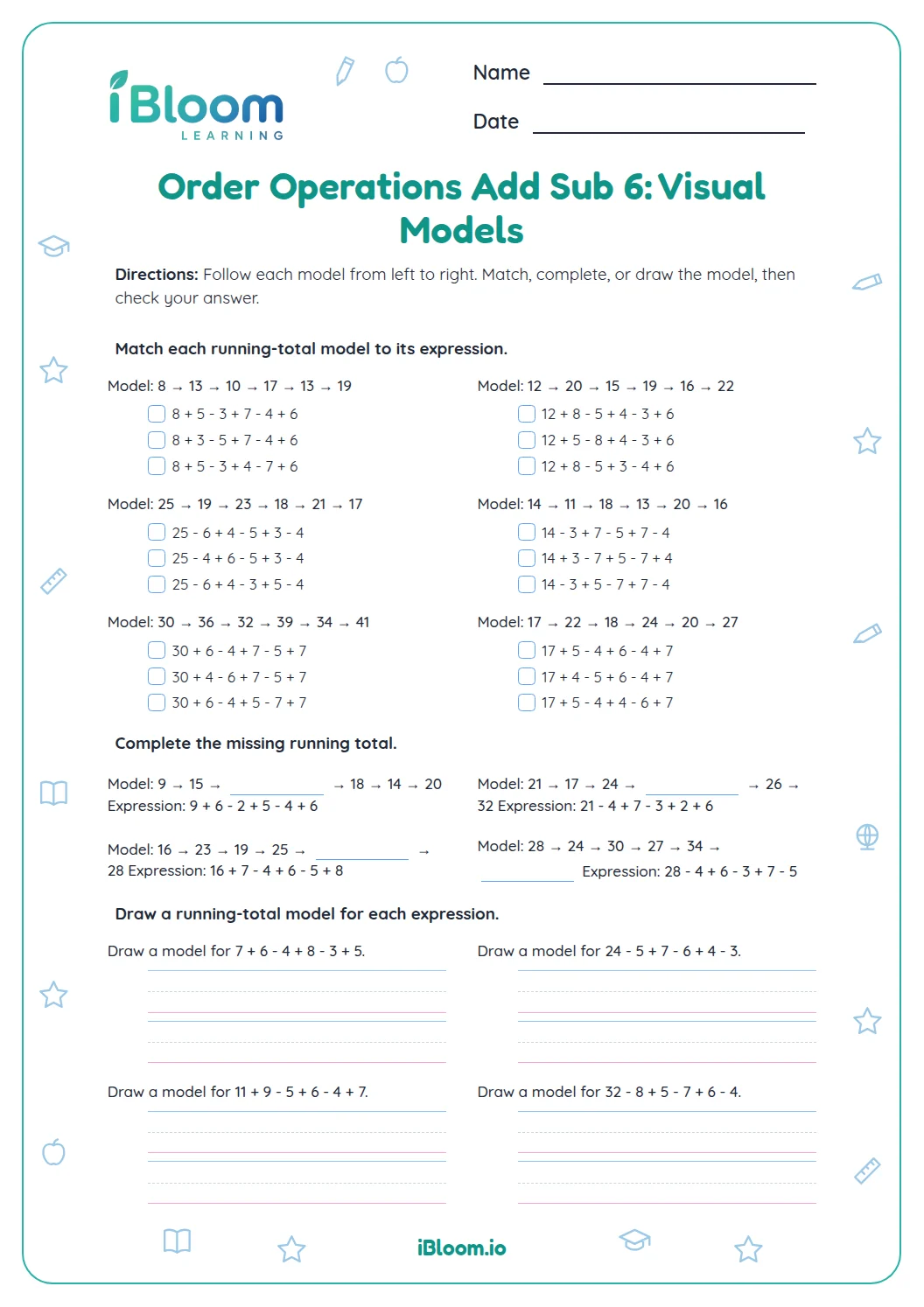
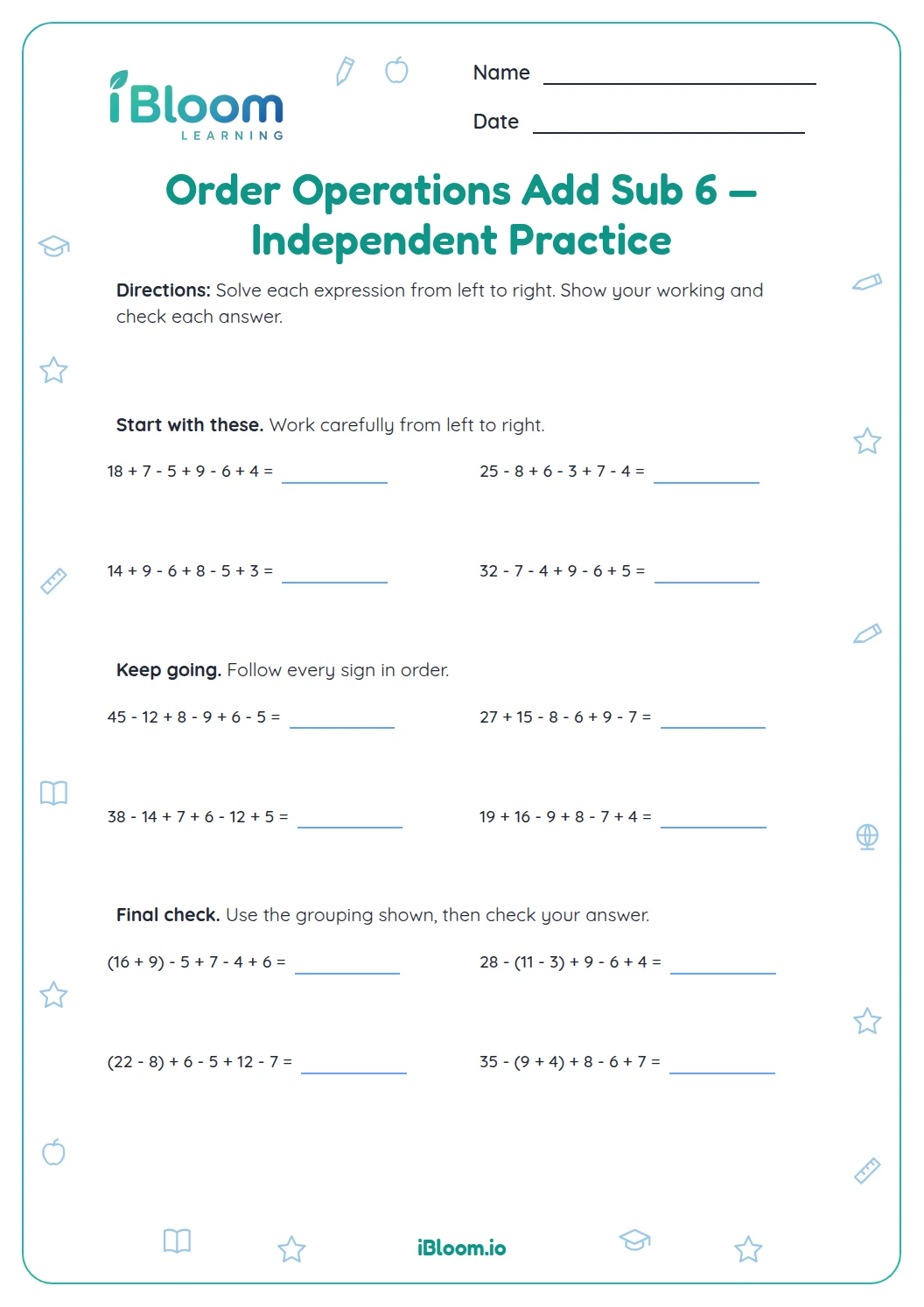
This free printable worksheet gives Grade 3 students independent practice with the order of operations in expressions that use only addition and subtraction. In Part A, children work three-number expressions from left to right. In Part B, they handle four-number chains. In Part C, they solve the parentheses first. Part D has two word problems where children write a number sentence and solve it. It supports Common Core 3.OA.D.8, solving two-step problems and doing the operations in the conventional order. An answer key shows every result.
Aligned to 3.OA.D.8
What is on this order of operations worksheet?
The numbers stay small, all within 40, so children can put their attention on the order of the steps instead of on regrouping. Every answer is a whole number, and none of the steps goes below zero.
The four parts build in order. Part A has three-number expressions, Part B has four-number chains, and Part C adds parentheses. Part D asks children to write a number sentence for a story and solve it.
- Part A: left to right with three numbers (questions 1 to 4)
- Part B: left to right with four numbers (questions 5 to 8)
- Part C: parentheses first (questions 9 to 12)
- Part D: two word problems with working space (questions 13 and 14)
Why do addition and subtraction go from left to right?
Addition and subtraction have the same rank, so neither one goes first. A child reads the expression like a sentence and does each step as it comes. Doing a plus before a minus that comes earlier can give a wrong answer.
Questions 3 and 9 use the same three numbers on purpose. Working them side by side lets children see the order rule at work with no other differences.
- 13) 15 − 6 + 4
- 2Step 1: 15 − 6 = 9
- 3Step 2: 9 + 4 = 13 → 13
What do parentheses change?
Parentheses mean “do this first.” In Part C, children solve the numbers inside the parentheses, write the result, and then finish the rest from left to right.
Question 9 is 15 − (6 + 4). The parentheses turn 6 + 4 into 10 first, so the answer is 5. In question 3, without parentheses, the same numbers give 13. That difference is the main idea of the page.
- 111) 24 − (8 − 3) + 2
- 2Step 1 (parentheses): 8 − 3 = 5
- 3Step 2: 24 − 5 = 19
- 4Step 3: 19 + 2 = 21 → 21
How do the word problems use the order of operations?
A two-step story often becomes an expression with more than one operation. In question 13, Mia gives some stickers away and then gets some more, so the steps happen in the order of the story. In question 14, Dan gives to two people, so the two gifts can be added first inside parentheses.
Asking children to write a number sentence before solving shows whether they understood the story. Two correct answers can have different number sentences, so look at the sentence as well as the answer.
How to use this worksheet at home or in class
- 1Read the Part A heading aloud and remind your child to start at the left, not with the plus sign.
- 2Do question 1 together. Write each step on its own line, such as 9 + 6 = 15, then 15 − 8 = 7.
- 3Let your child finish Parts A and B alone, then check with the key before starting Part C.
- 4For Part C, have your child circle the parentheses first and write the result above them.
- 5Compare questions 3 and 9 side by side, and ask why the answers are different.
- 6Have your child say the story for each word problem aloud before writing the number sentence.
Common mistakes and quick fixes
The mistake
Adding first in an expression like 15 − 6 + 4, which gives 15 − 10 = 5 instead of 13.
The fix
Remind your child that plus and minus take turns in order. Have them cover everything except the first two numbers and the sign, solve that, and then bring in the next number.
The mistake
Ignoring parentheses in 24 − (8 − 3) + 2 and working 24 − 8 first.
The fix
Have your child circle the parentheses before they start. Whatever is inside the circle is solved first, and the answer replaces it.
The mistake
Writing only the answer to a word problem and skipping the number sentence.
The fix
Ask your child to write the numbers in the order of the story, with a sign between them, before solving. For question 14, that is 30 − 8 − 5, or 30 − (8 + 5) to group the two gifts.
Common Core alignment
Most US states teach Grade 3 math with the Common Core standards or a close state version. This standard covers the two-step problems, and the conventional order of operations, that this page practices.
Solve two-step problems by doing the operations in the correct order.
On this sheet: Every expression takes two or three steps done in the correct order, and Part D turns two-step stories into number sentences.
Show the official wordingHide the official wording
Solve two-step word problems using the four operations. Represent these problems using equations with a letter standing for the unknown quantity. Assess the reasonableness of answers using mental computation and estimation strategies including rounding.
What to practice next
Make more practice
Further reading
Questions parents and teachers ask
Do addition and subtraction really go left to right?
Yes. Addition and subtraction have the same rank, so you work them in the order they appear, from left to right. In question 6, 27 − 9 + 6 − 8, the steps are 27 − 9 = 18, then 18 + 6 = 24, then 24 − 8 = 16. Adding first would give a different, wrong answer.
What do parentheses mean in a math problem?
Parentheses tell you to do that part first. Whatever is inside is worked out, and its answer takes the place of the whole group. In question 9, 15 − (6 + 4), the group 6 + 4 becomes 10, and then 15 − 10 gives 5. Without parentheses, the answer would be different.
Why are questions 3 and 9 almost the same?
They use the same numbers and signs: 15 − 6 + 4 in question 3, and 15 − (6 + 4) in question 9. The only change is the parentheses, and the answers are 13 and 5. Putting them in different parts of the sheet lets children see for themselves that parentheses can change an answer.
Is this worksheet too hard for Grade 3?
No. The numbers stay within 40 and every answer is a whole number, so children can keep their attention on the order of the steps. Part C asks the most, because the parentheses change which step comes first. If your child gets stuck, work question 9 together and write each step on its own line.
Why are there word problems on a page of expressions?
Stories show why the order matters. In question 14, Dan gives away 8 marbles and then 5 more, so the number sentence 30 − (8 + 5) groups the two gifts. Asking for the number sentence first shows whether your child understood the story, not only how to calculate.
What should my child do after this worksheet?
Ask your child to write their own expression with three numbers and one pair of parentheses, then solve it two ways: with the parentheses and without them. After that, the Add and Subtract 4 and Add and Subtract 5 worksheets bring in longer expressions, and the multiplication versions add one more operation.