



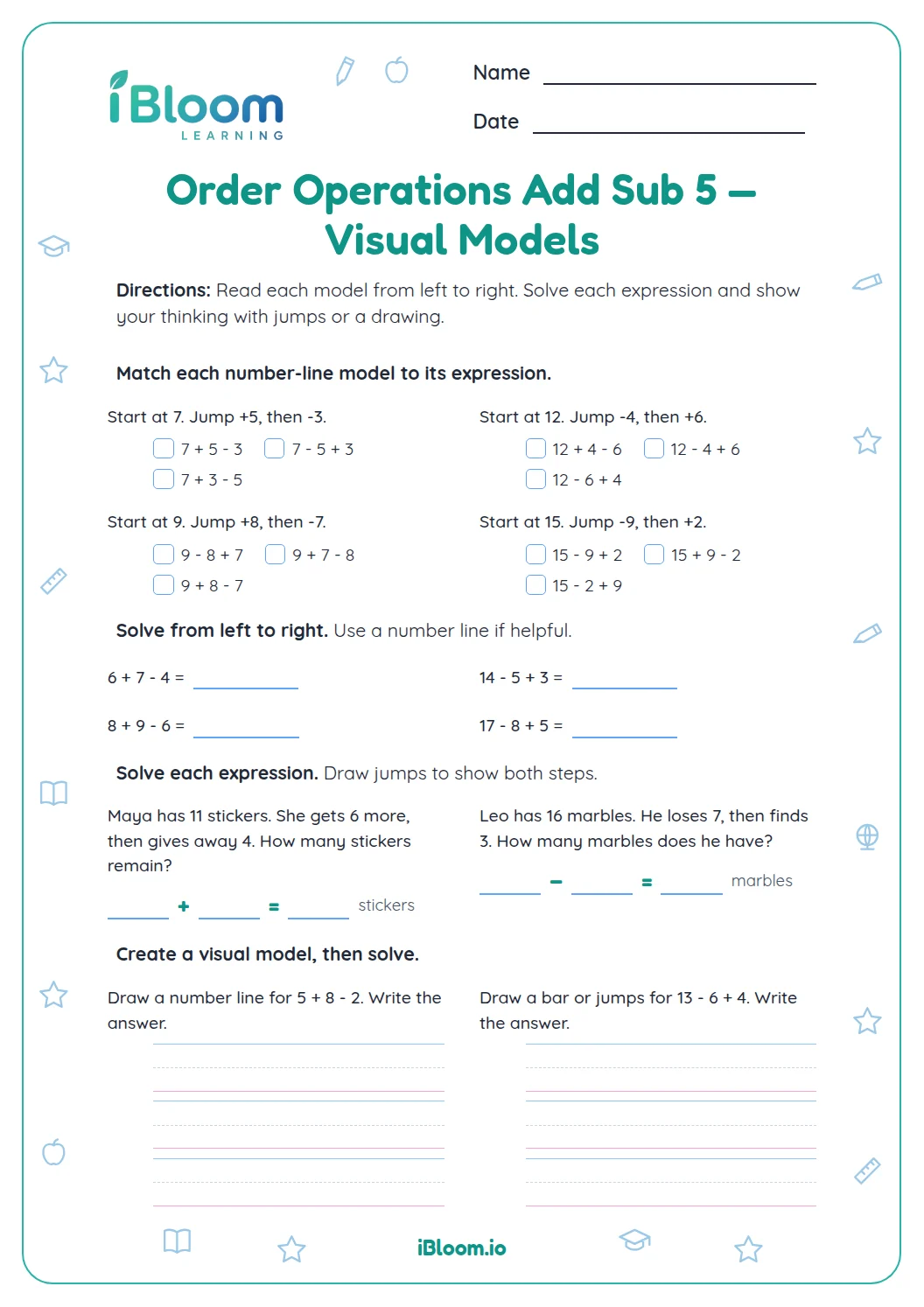
About this worksheet
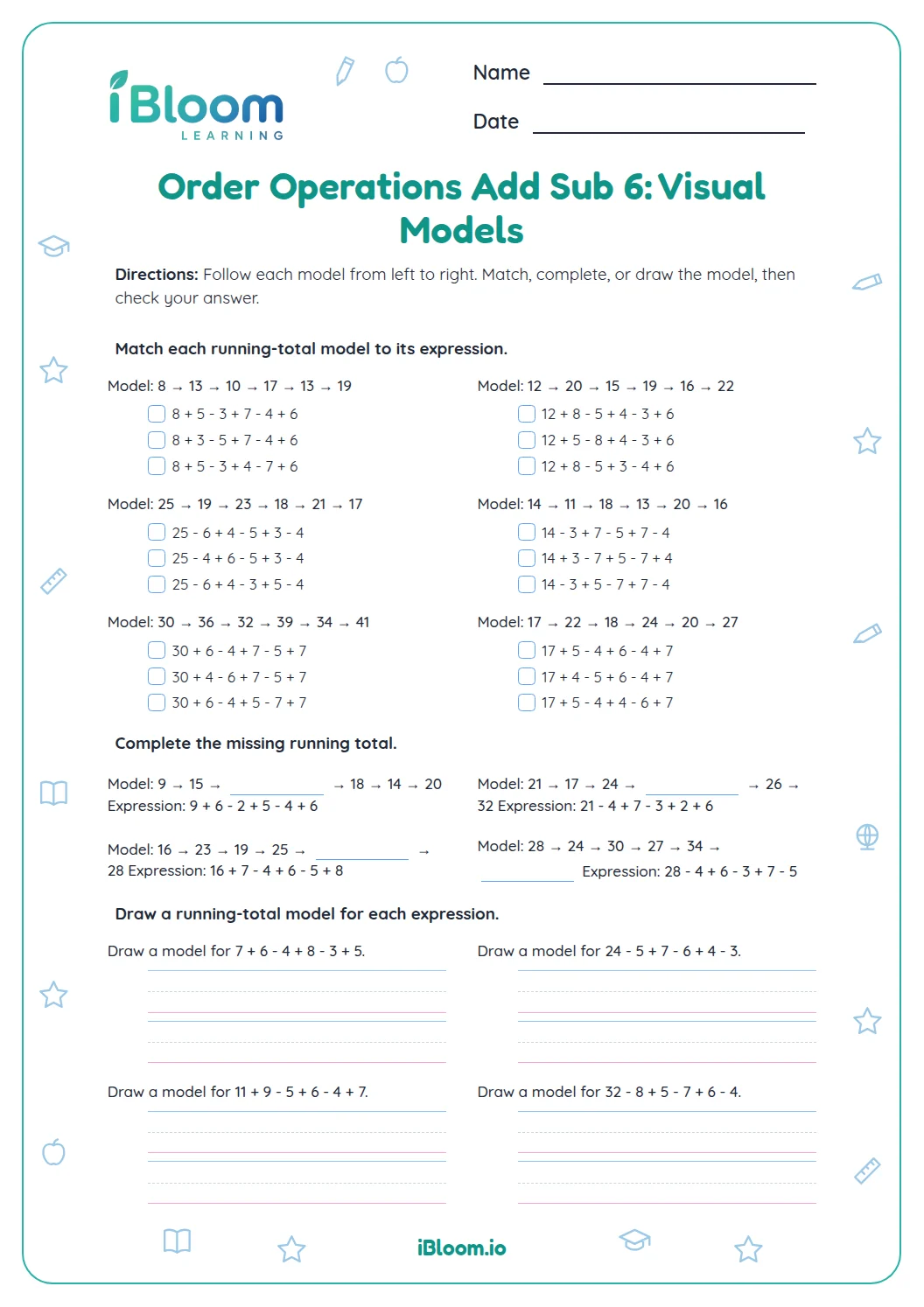
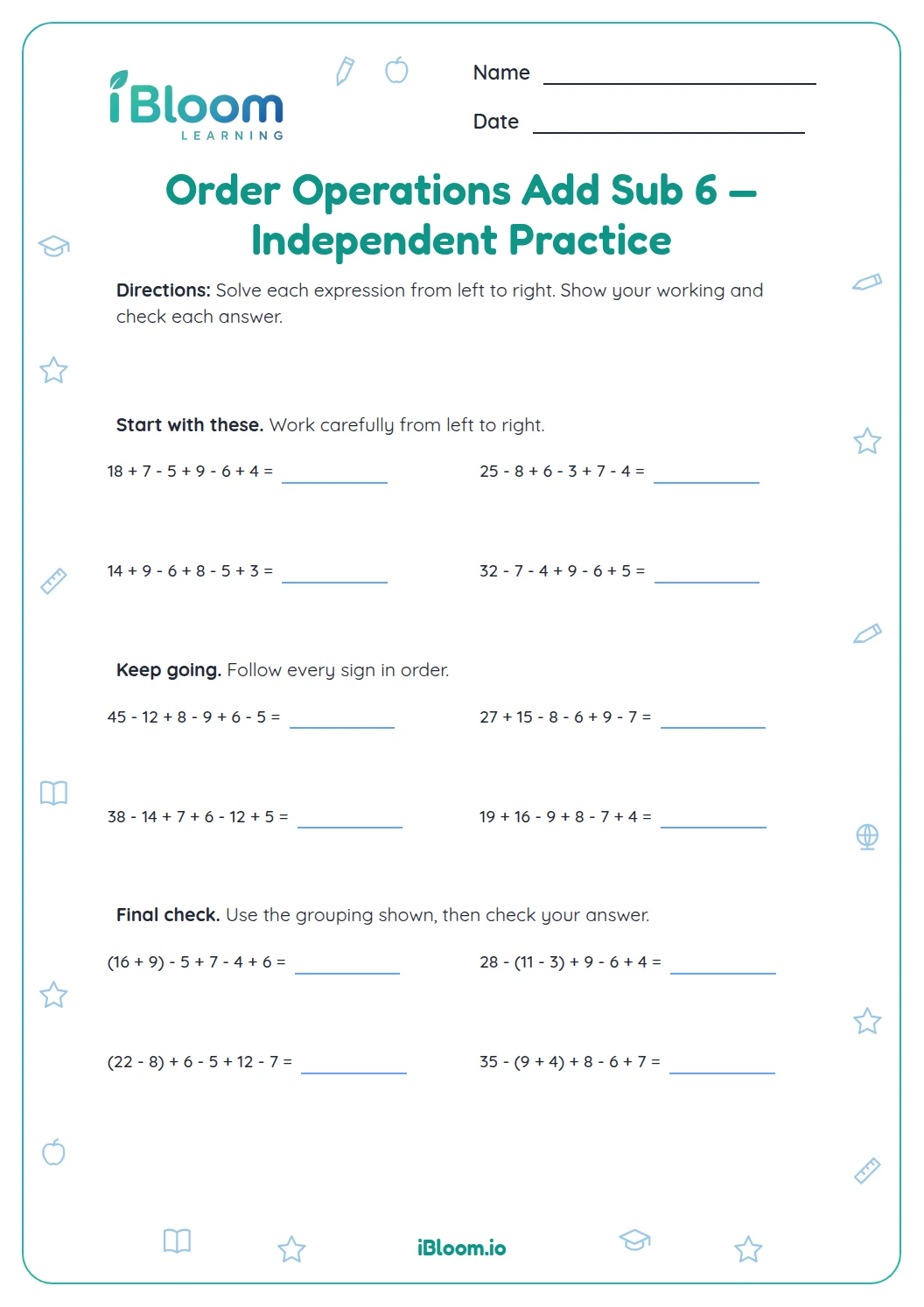
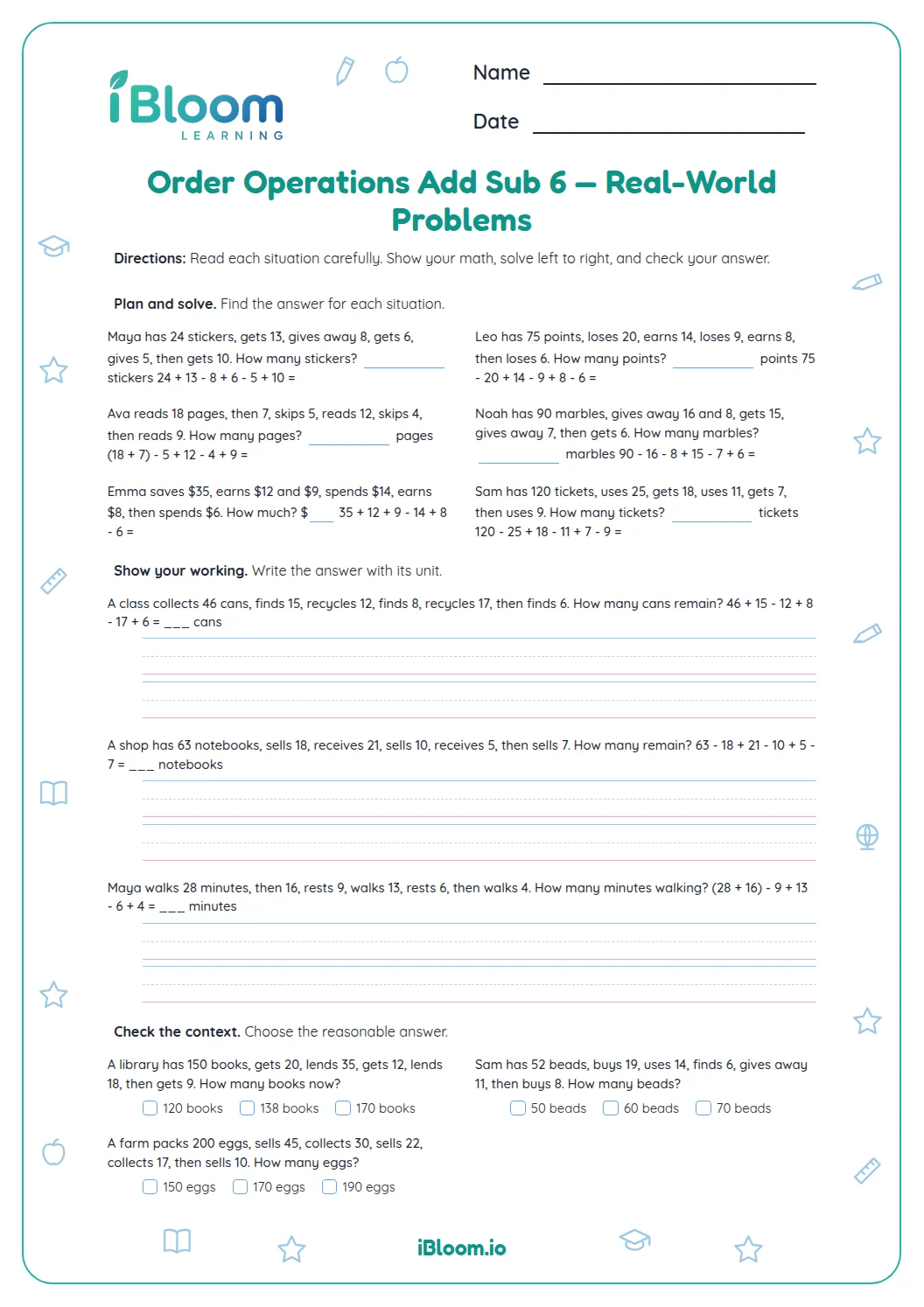
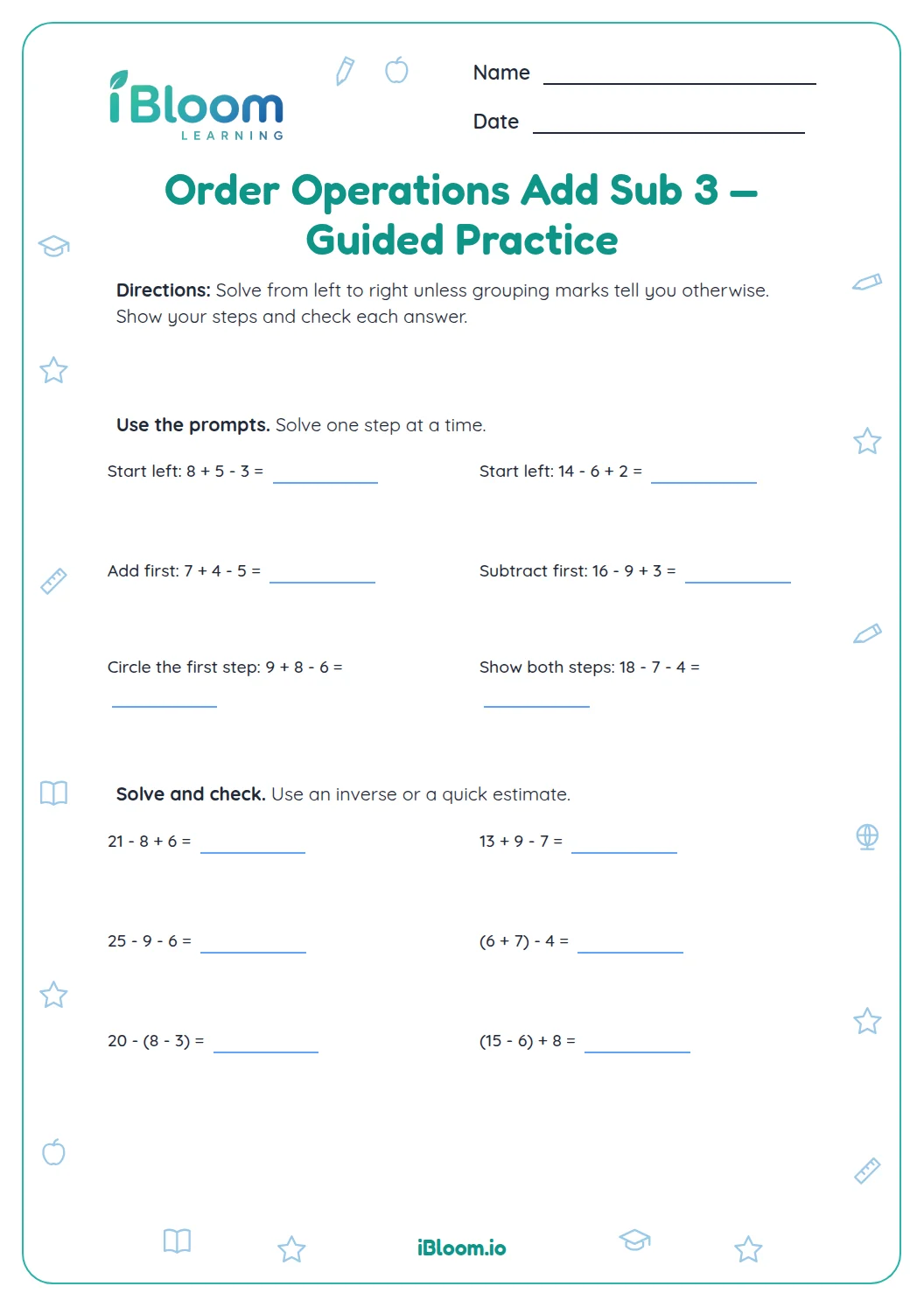
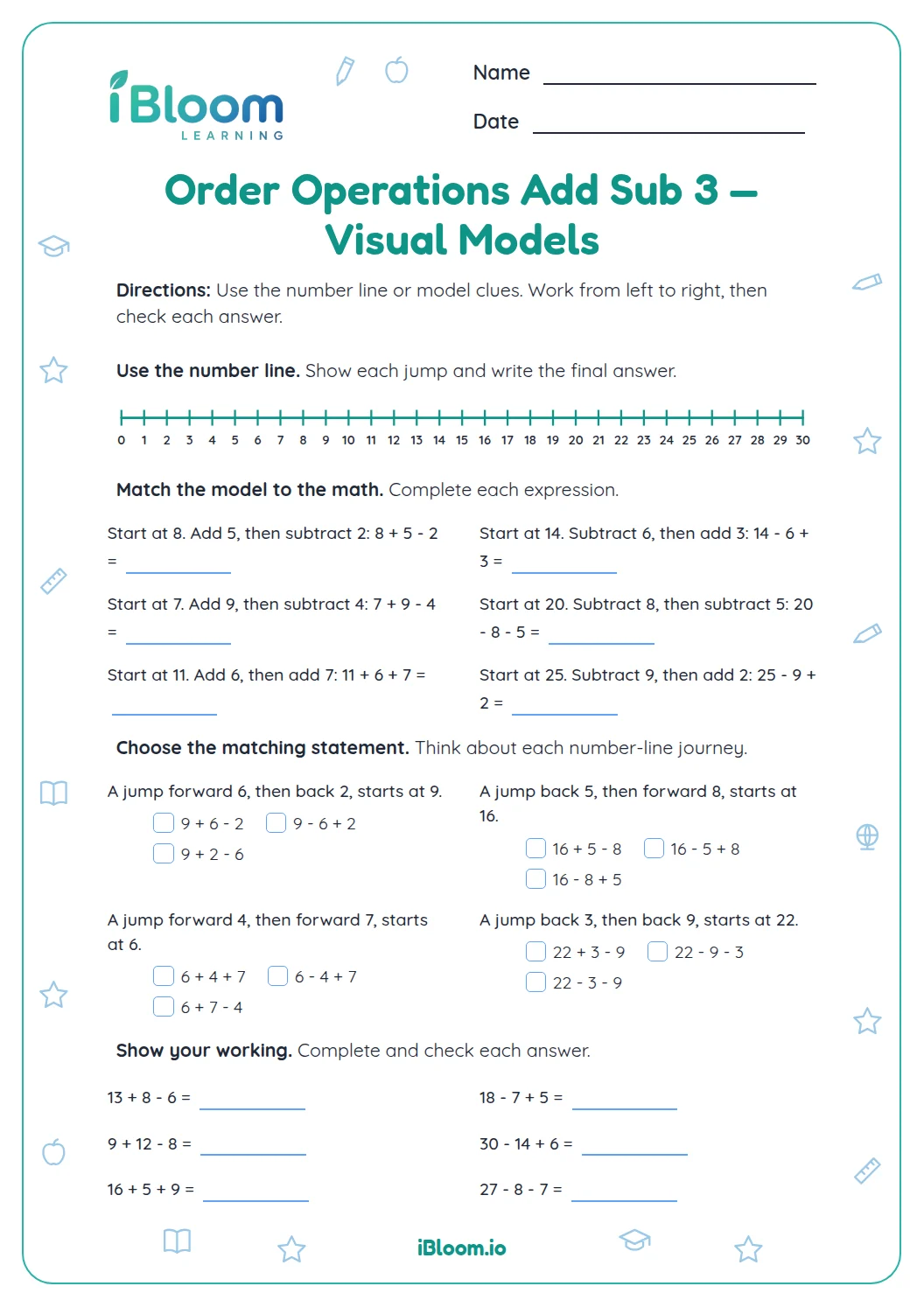
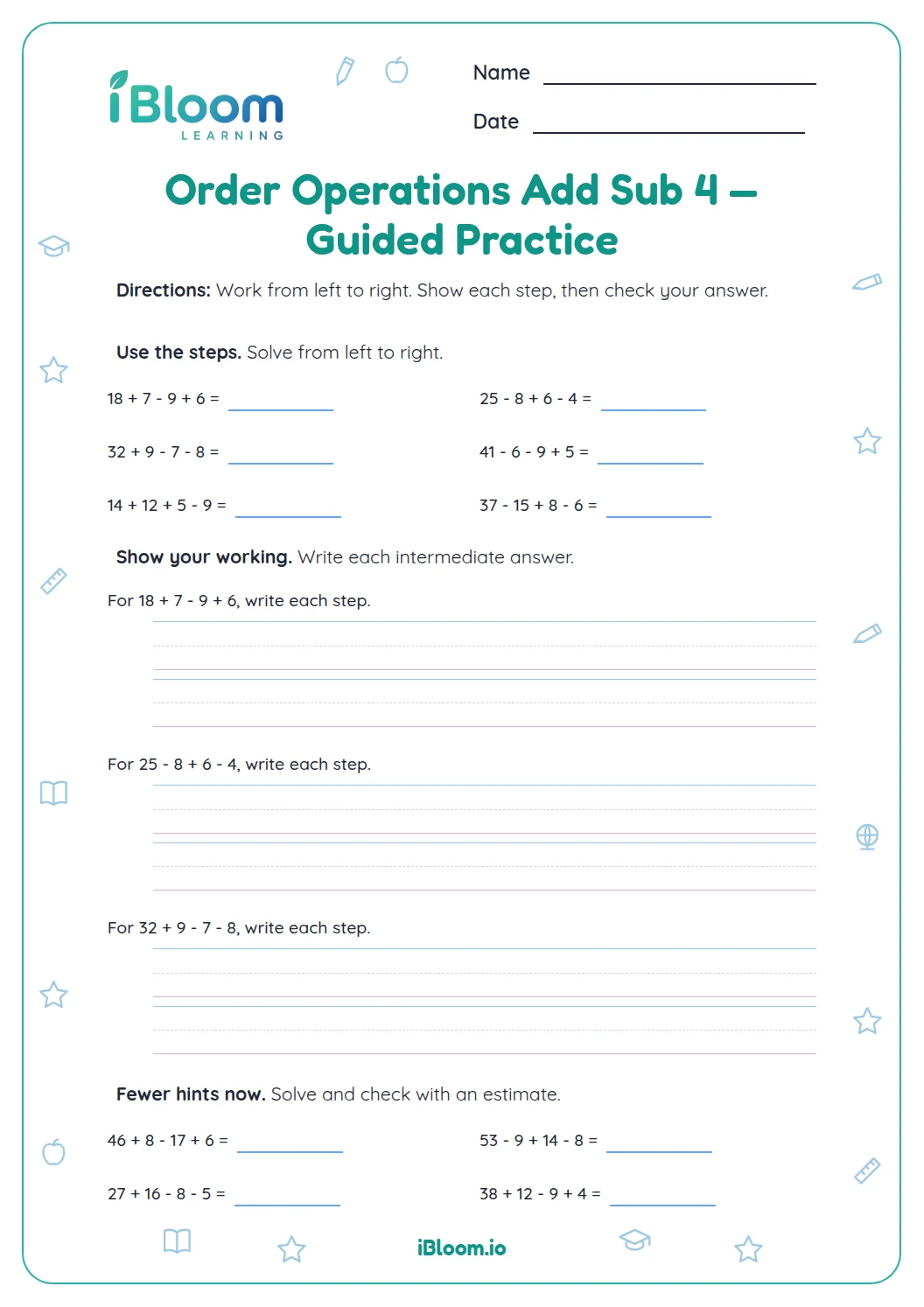
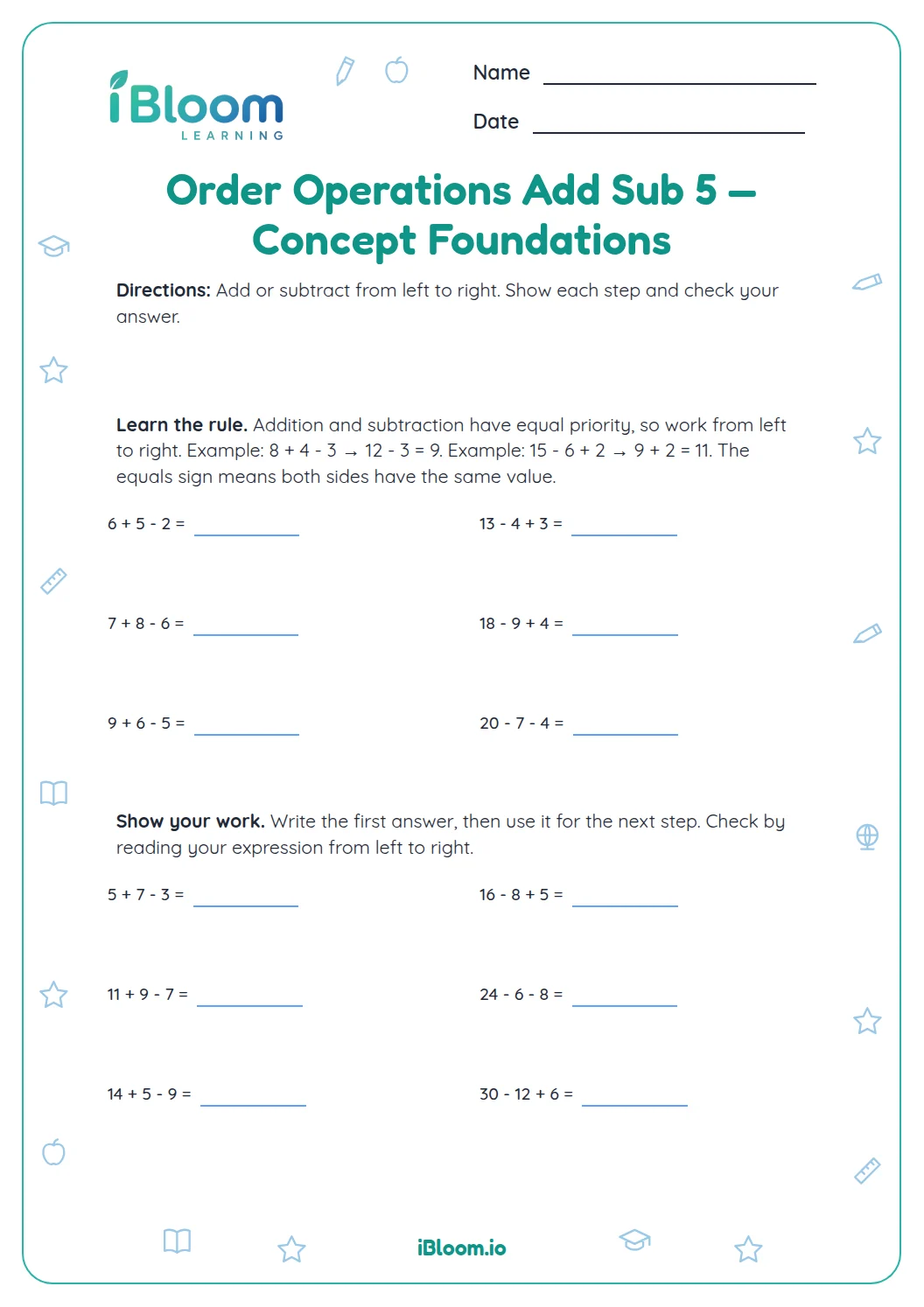
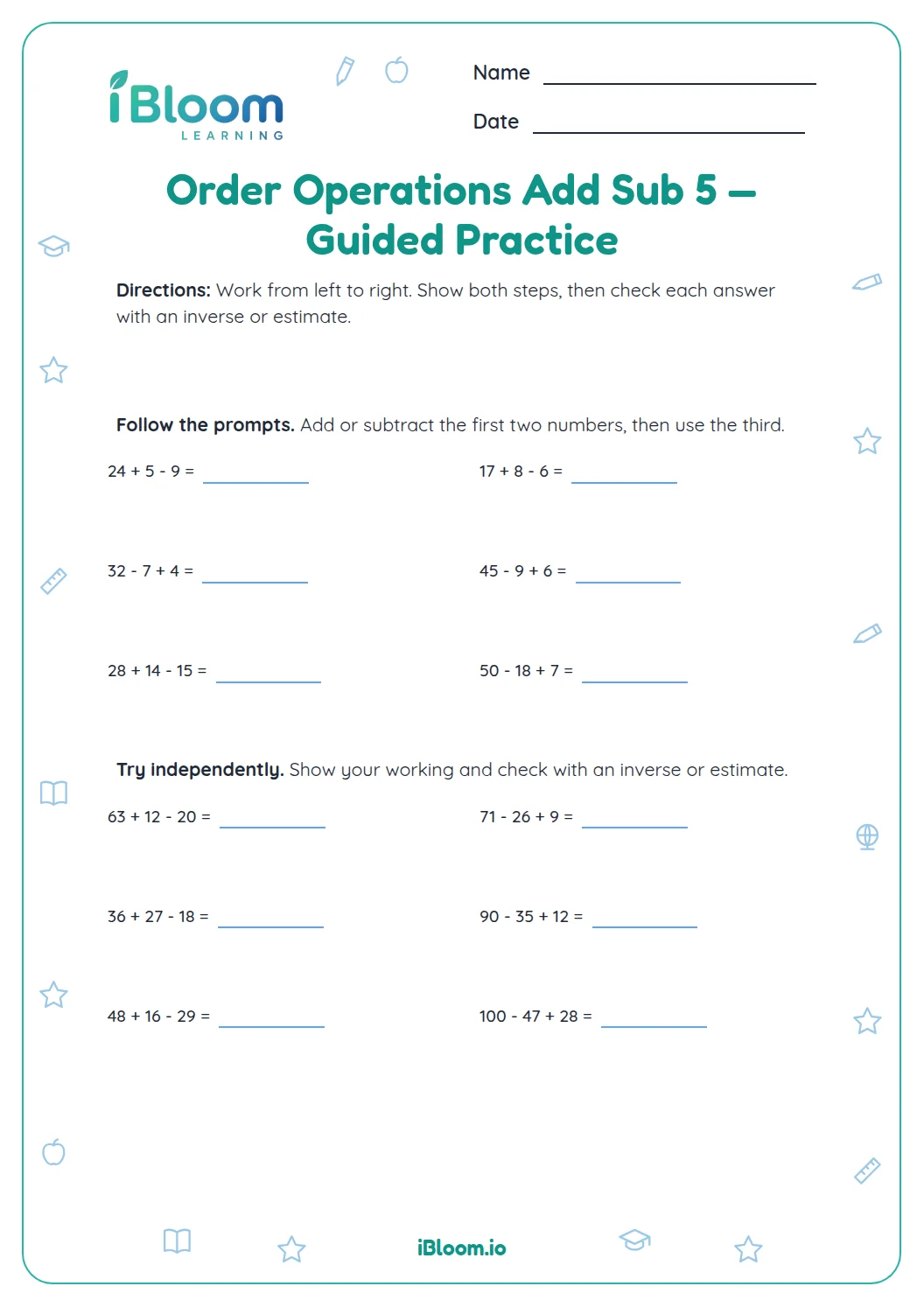
This Grade 3 printable builds the order-of-operations foundation shown in the original sheet: addition and subtraction have equal priority, so students work from left to right, and parentheses are evaluated first when present. It includes 20 six-number expressions with working space. A separate answer key follows the worksheet, so students can check each step and final result.
Do addition and subtraction have different priority?
No. Addition and subtraction have equal priority. When an expression has only those operations, begin at the left and evaluate each operation in the order it appears. Do not add all the positive numbers first and subtract afterward.
What changes when parentheses appear?
Evaluate the grouped expression first. Then use the left-to-right rule on the remaining addition and subtraction. For question 9, 14 + (8 − 3) + 10 − 2 + 1 becomes 14 + 5 + 10 − 2 + 1, then continues from left to right.
- 114 + (8 − 3) + 10 − 2 + 1
- 2Parentheses: 8 − 3 = 5
- 3Continue left to right: 14 + 5 + 10 − 2 + 1 = 28
How can a student check the result?
Write one intermediate result at a time and keep the remaining signs in order. Substitute the result of a parenthesis back into the expression, then continue. A final pass from the beginning helps catch a skipped sign or operation.
How to use this worksheet
- 1Scan the expression for parentheses.
- 2If there are parentheses, evaluate that group first.
- 3Start at the left with the remaining addition and subtraction.
- 4Record one step at a time, carrying the next sign with its number.
- 5Recheck the expression from the beginning and compare with the key.
Common mistakes and quick fixes
The mistake
Adding every positive number before subtracting.
The fix
Addition and subtraction share priority, so move left to right.
The mistake
Continuing outside the parentheses before evaluating the group.
The fix
Replace the parenthetical expression with its value first.
The mistake
Losing the sign before a number after one step.
The fix
Copy the remaining expression and cross off only the operation you completed.
What to practice next
Make more practice
Questions parents and teachers ask
What does left to right mean here?
It means solve each addition or subtraction operation in the order it appears, starting at the left. Since addition and subtraction have equal priority, the student should not collect all addition first and subtraction second. Part A practices this rule with expressions that have no parentheses.
Should parentheses always be solved first?
Yes. Work out the numbers inside the parentheses before continuing with the rest of the expression. For example, in question 9, solve 8 − 3 first, then continue through the remaining addition and subtraction from left to right. Check that the group is simplified before continuing through the remaining signs.
How many expressions are on the worksheet?
There are 20 expressions. The first eight use addition and subtraction without parentheses. The remaining twelve include parentheses or additional left-to-right review. A separate answer key follows the worksheet. Students can write one step at a time in the work area provided, then verify the result from the beginning.
Why not add first and subtract afterward?
Addition and subtraction have the same priority, so their order is determined by where they appear. Changing the order can change the result. Writing one operation per step makes the sequence clear and helps students notice whether they skipped a sign.
How can I help a student check a missed answer?
Ask the student to point to the first operation they solved and compare it with the expression. If parentheses appear, check that group first. Then redo the remaining operations from the left, keeping the signs visible, and compare the final result with the key.