
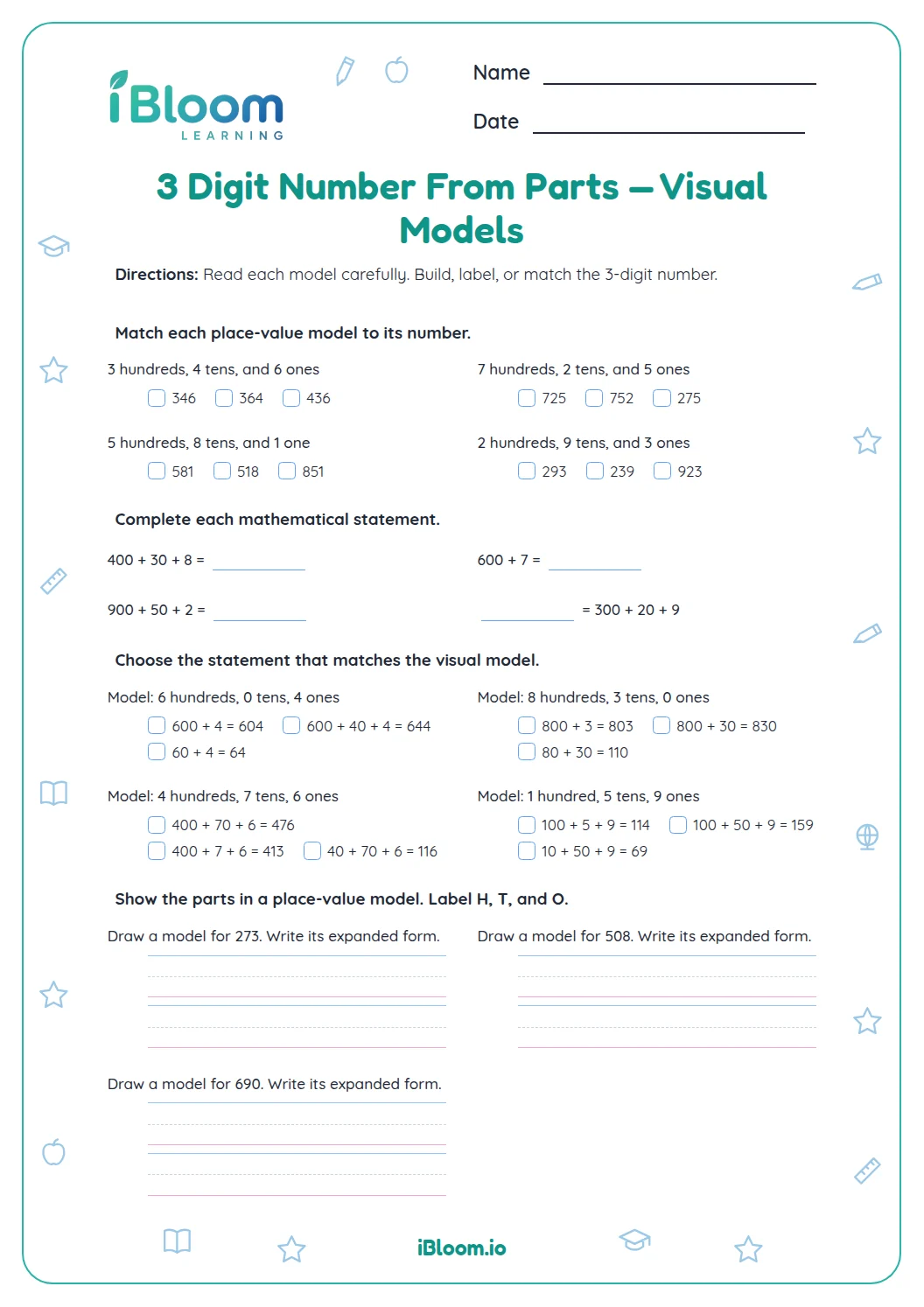
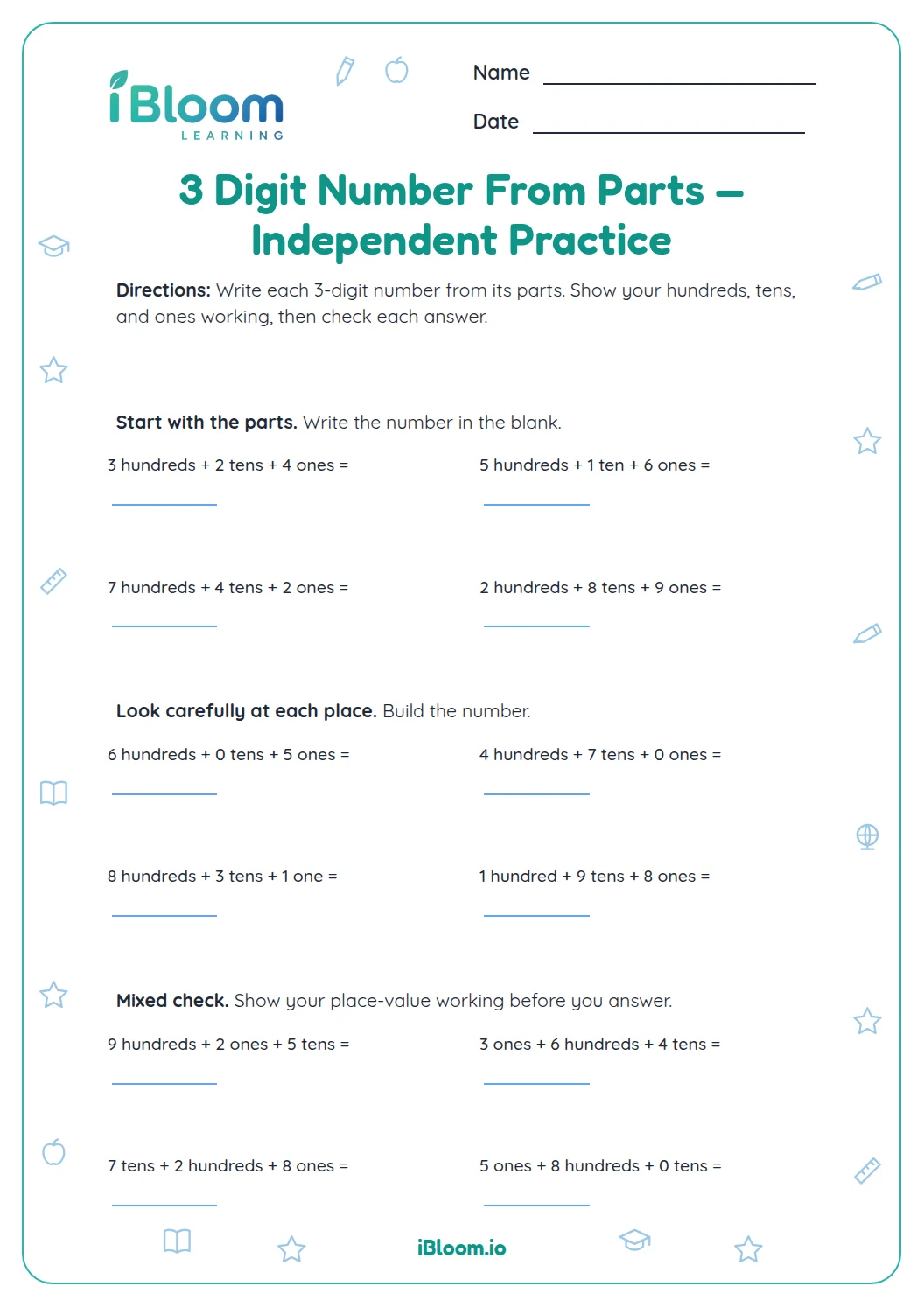
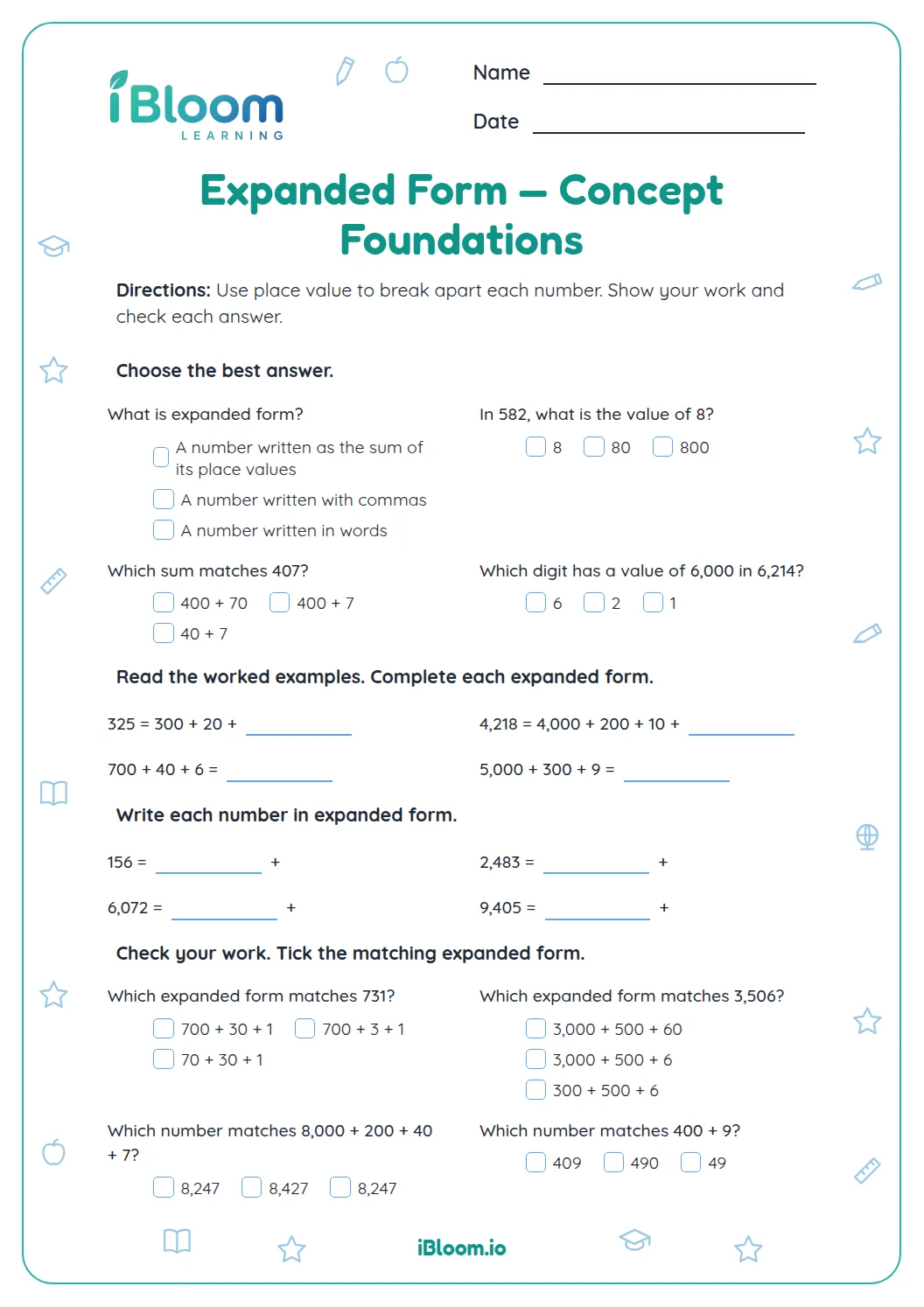
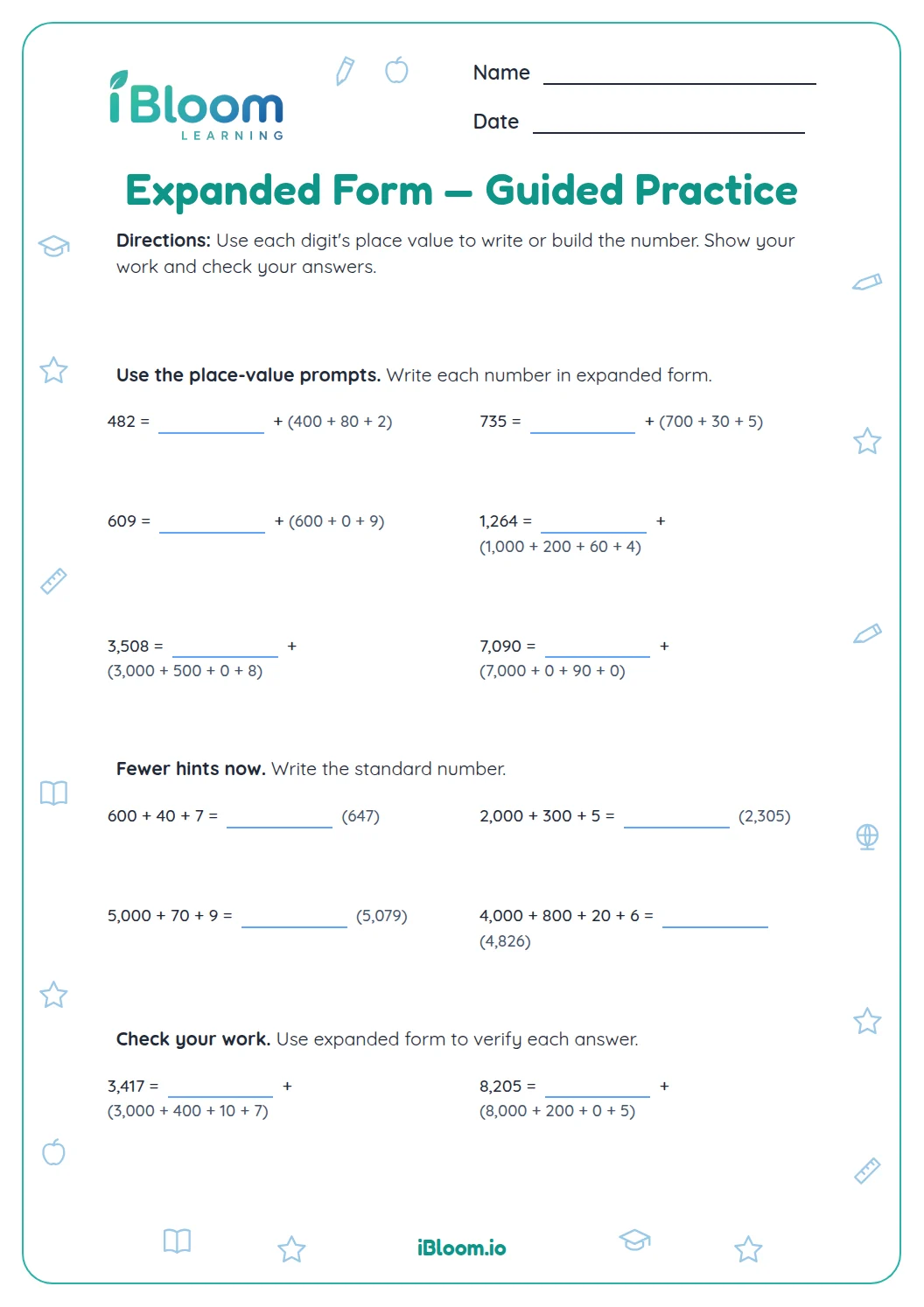


About this worksheet
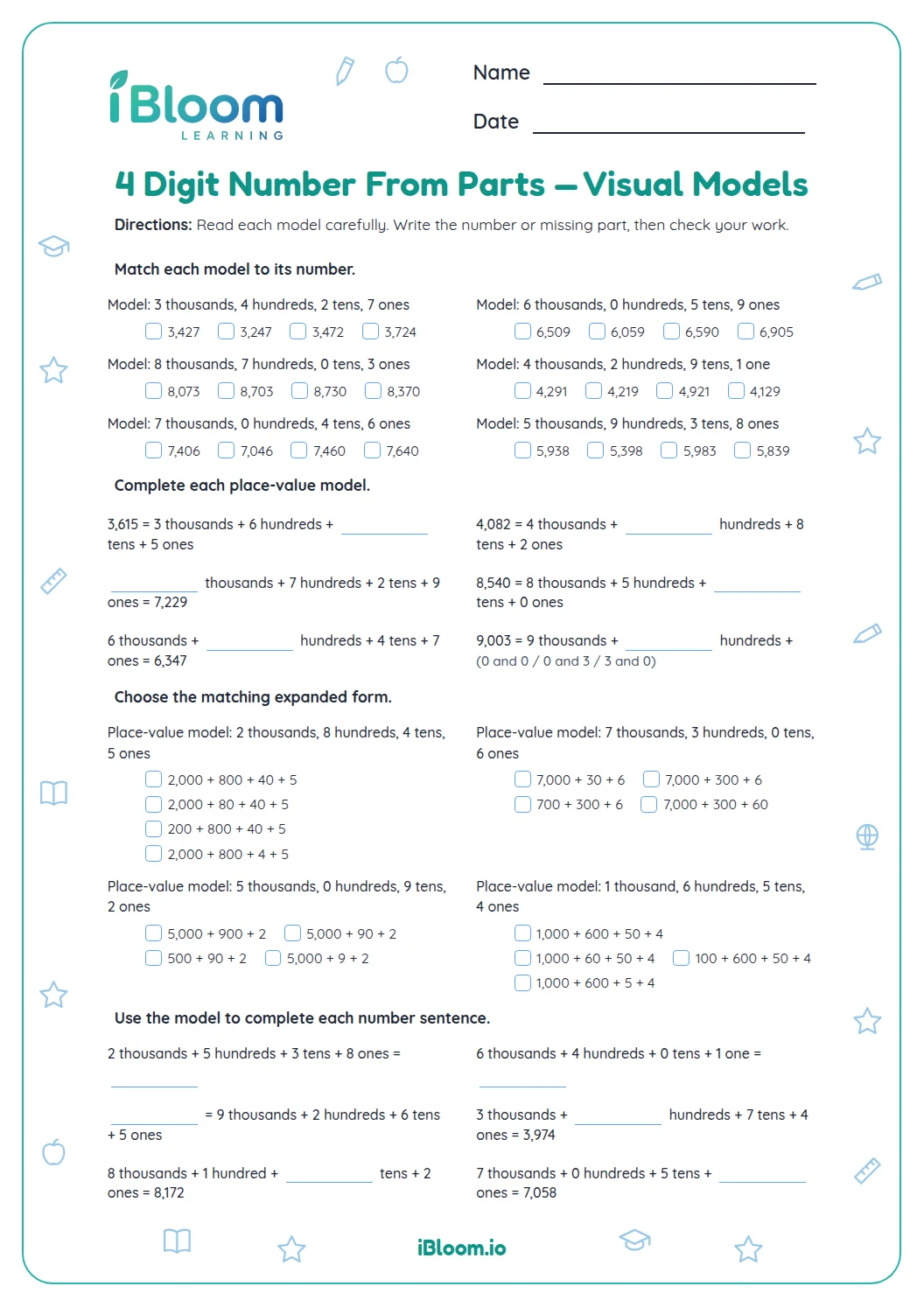
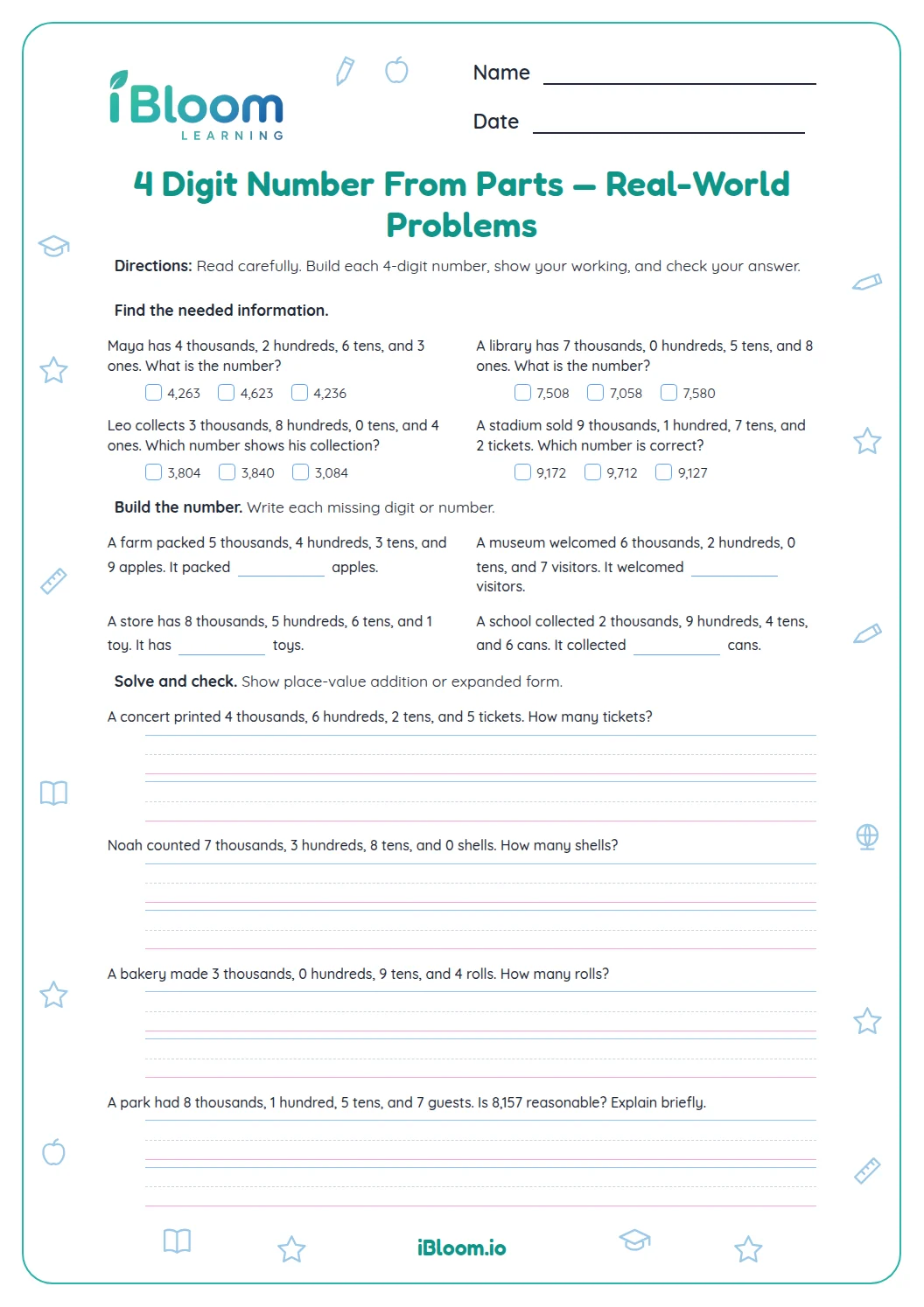
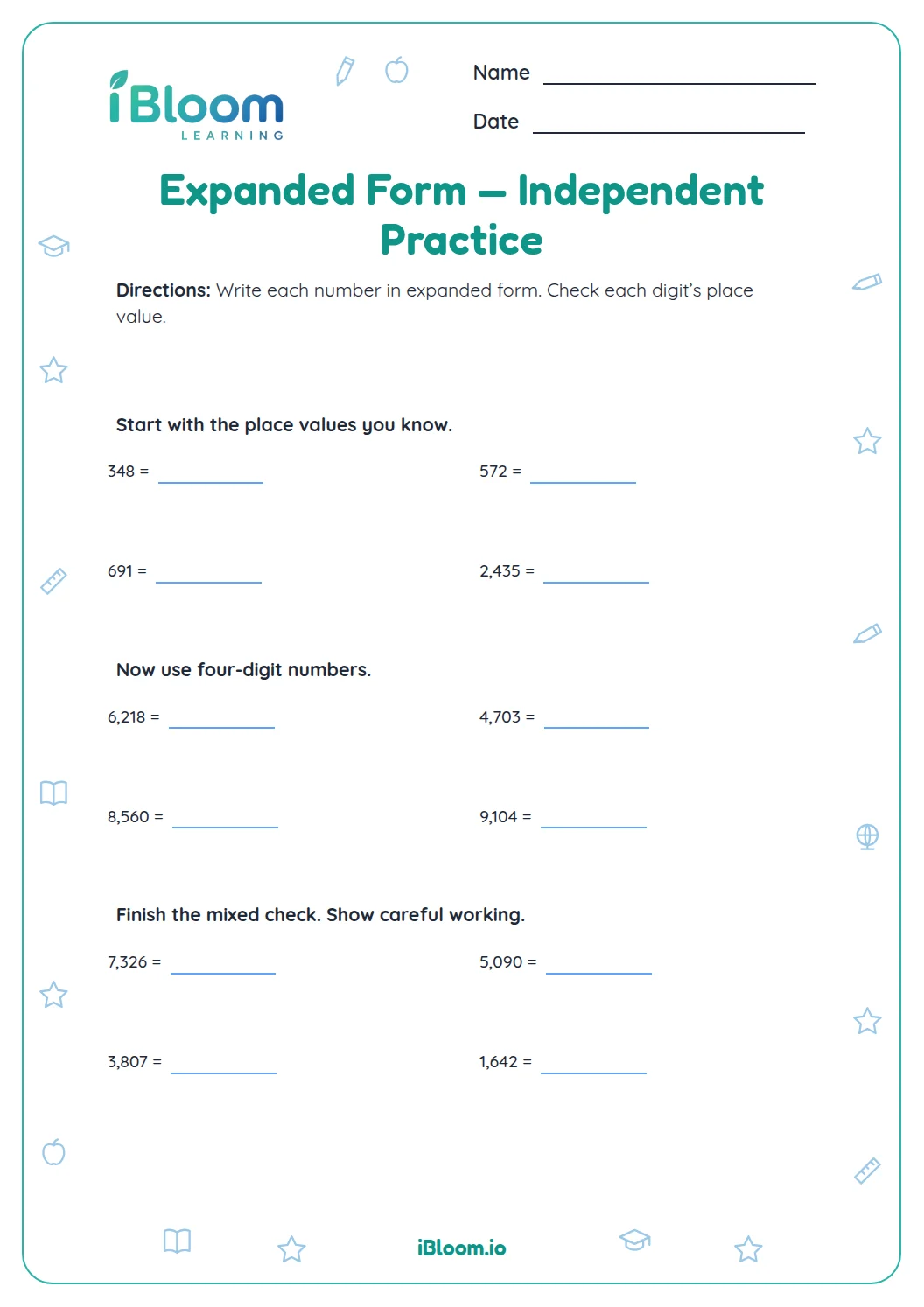
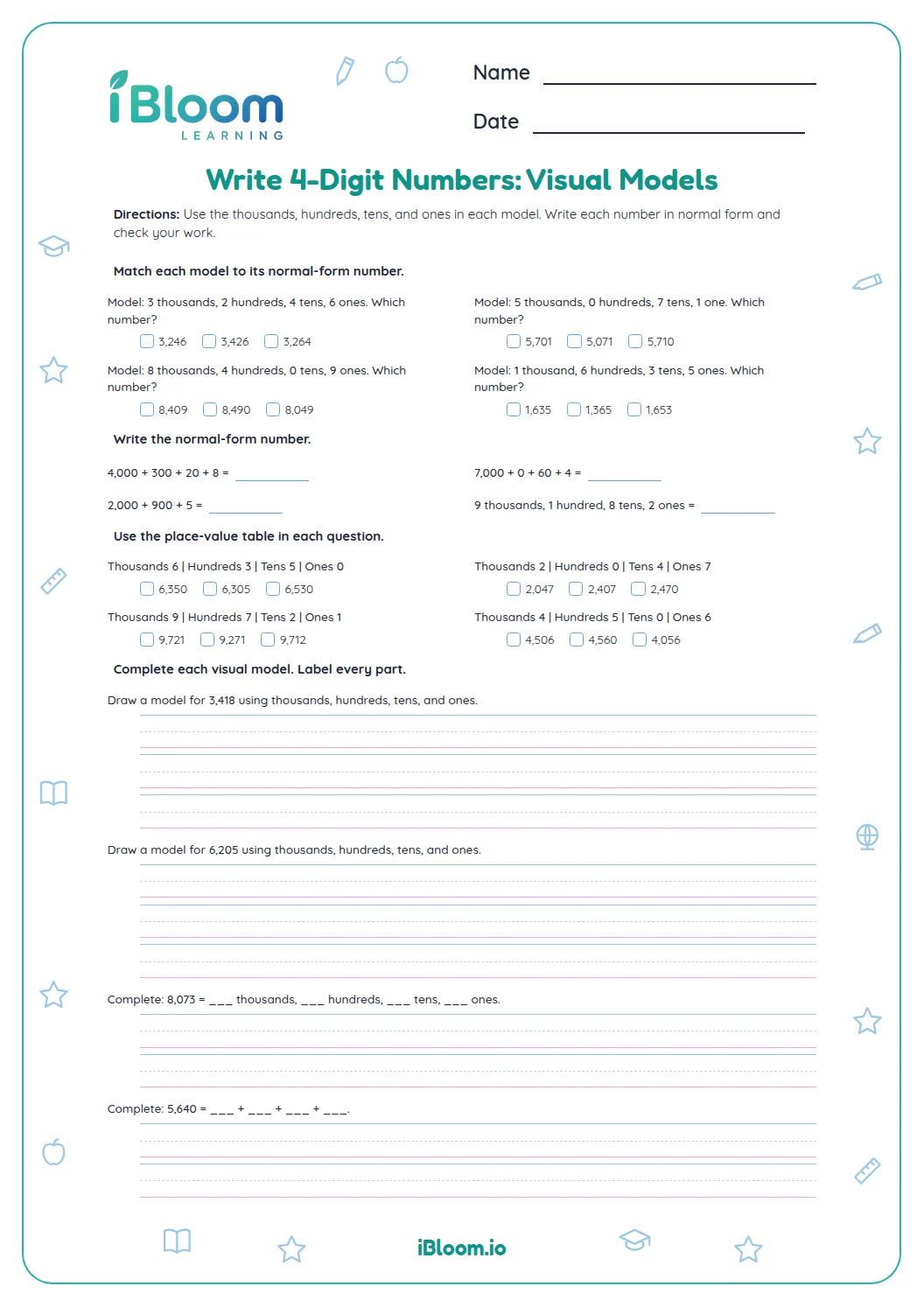
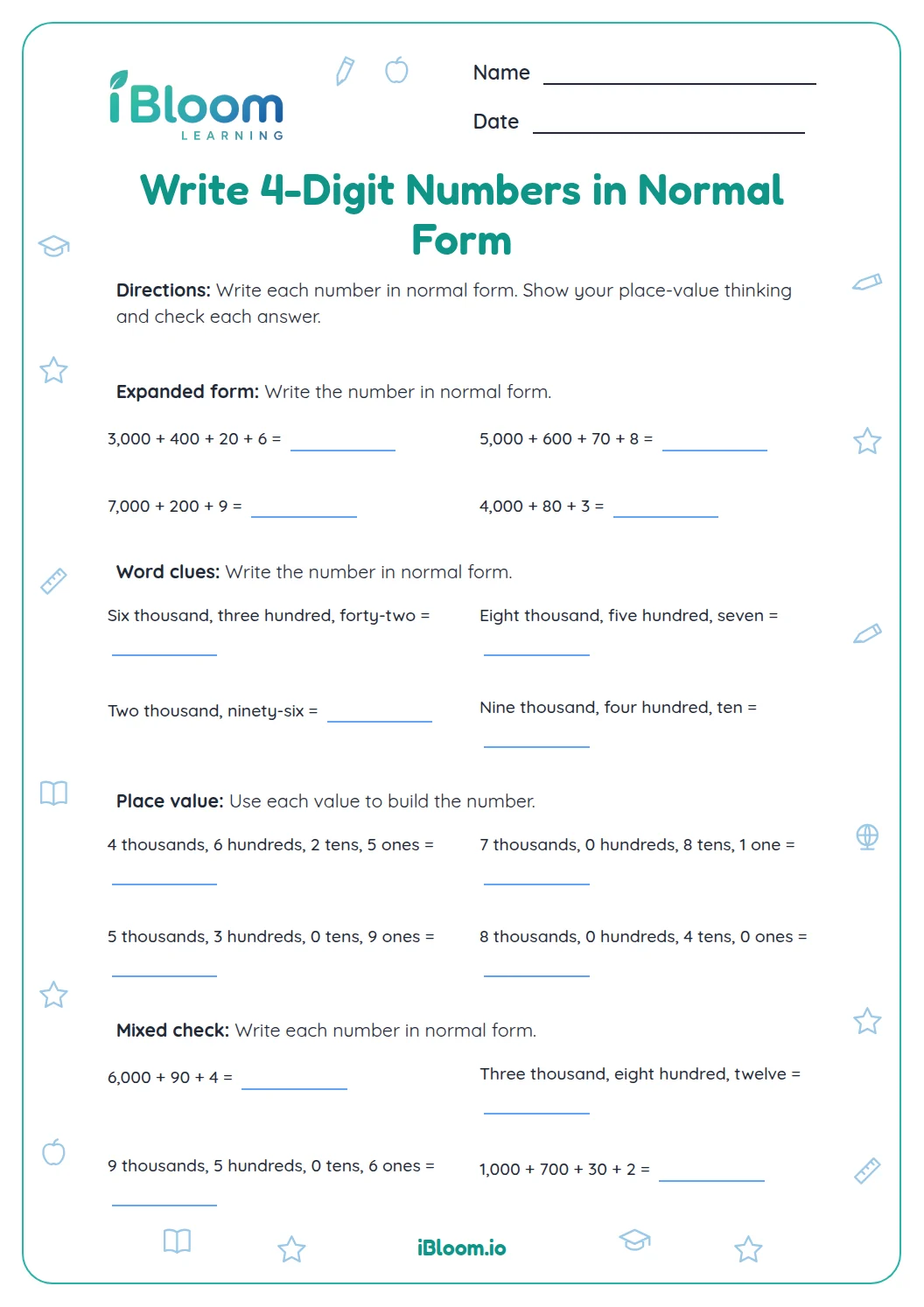
This Grade 3 worksheet practices building four-digit numbers from place-value parts. Students combine thousands, hundreds, tens and ones, then write expanded sums in standard form. Several questions leave a place empty, so children must use zero as a placeholder. The separate key lists all 16 four-digit answers.
Aligned to 4.NBT.A.2
What is on this four-digit number worksheet?
Part A builds numbers from place-value names. Part B turns expanded sums into standard form. Part C practices sums with a zero-valued place.
Each question asks for one four-digit number. Use a zero wherever a place has no value, then check the number against the answer key.
- Part A: 4 numbers described by place value
- Part B: 6 expanded-form sums
- Part C: 6 sums with zero placeholders
- All 16 answers are four-digit numbers
How do you combine place-value parts?
Read the places from left to right: thousands, hundreds, tens, ones. Put each digit in its matching place. For example, 5 thousands, 0 hundreds, 3 tens and 8 ones make 5,038.
A zero holds an empty place. Leaving it out changes where the other digits belong, so check each place before writing the finished number.
What does a zero placeholder do?
A zero keeps an empty place visible so digits to its right stay in their correct positions. Read each place in order before writing the standard-form number.
In q12, 5,000 + 0 + 30 + 8 makes 5,038. The zero holds the hundreds place.
- 15,000 + 0 + 30 + 8 = 5,038
- 2Zero holds the empty hundreds place.
Build each number carefully
- 1Name the places in order: thousands, hundreds, tens, ones.
- 2Put each part in its matching place-value position.
- 3Use zero when a place has no hundreds, tens or ones.
- 4Read the finished number aloud to check its size.
- 5Use the separate answer key after completing all three parts.
Common place-value mistakes
The mistake
Writing 538 for 5 thousands, 0 hundreds, 3 tens and 8 ones.
The fix
Keep the empty hundreds place with a zero: 5,038.
The mistake
Treating 7 hundreds as a 7 in the tens place.
The fix
Write the place names above the digits before composing the number.
The mistake
Reading 4,602 as 4,62.
The fix
Use zero as the tens placeholder so the hundreds and ones stay in the correct places.
Common Core alignment
Students read and write four-digit numbers in expanded and standard forms.
Write each four-digit number in standard form from its place-value parts.
On this sheet: Students compose four-digit numbers from place-value descriptions and expanded form.
Show the official wordingHide the official wording
Read and write multi-digit whole numbers using base-ten numerals, number names, and expanded form. Compare two multi-digit numbers based on meanings of the digits in each place, using >, =, and < symbols to record the results of comparisons.
What to practice next
Make more practice
Further reading
Questions parents and teachers ask
Why does a four-digit number need a zero placeholder?
A zero keeps the other digits in their correct places. In 5,038, there are no hundreds, but the zero holds that place so the 3 stays in the tens place. Keeping each place visible protects the value of every digit.
How should students use the place-value clues?
Read the places from thousands to ones and write each named digit in order. For example, 7 thousands, 2 hundreds, 5 tens and 4 ones make 7,254. Check that each place appears once in the finished number. Then read the result aloud to verify it.
Is this a Grade 3 or Grade 4 skill?
The page is labeled Grade 3 and practices forming four-digit numbers from place-value parts and expanded form. For each item, write the thousands, hundreds, tens and ones digits in order, including zero when a place is empty. Then read the number to check its value.
What does expanded form mean?
Expanded form writes a number as the sum of its place values. For example, 3,427 can be written as 3,000 + 400 + 20 + 7. Add the parts to check that they make the same standard-form number at the end.
Why does a four-digit number sometimes include zero?
Zero marks a place with no value so the other digits remain in their correct positions. In 5,038, the zero holds the hundreds place while 3 stays in the tens place. Keep all four places in order when composing the number from its parts.