





About this worksheet
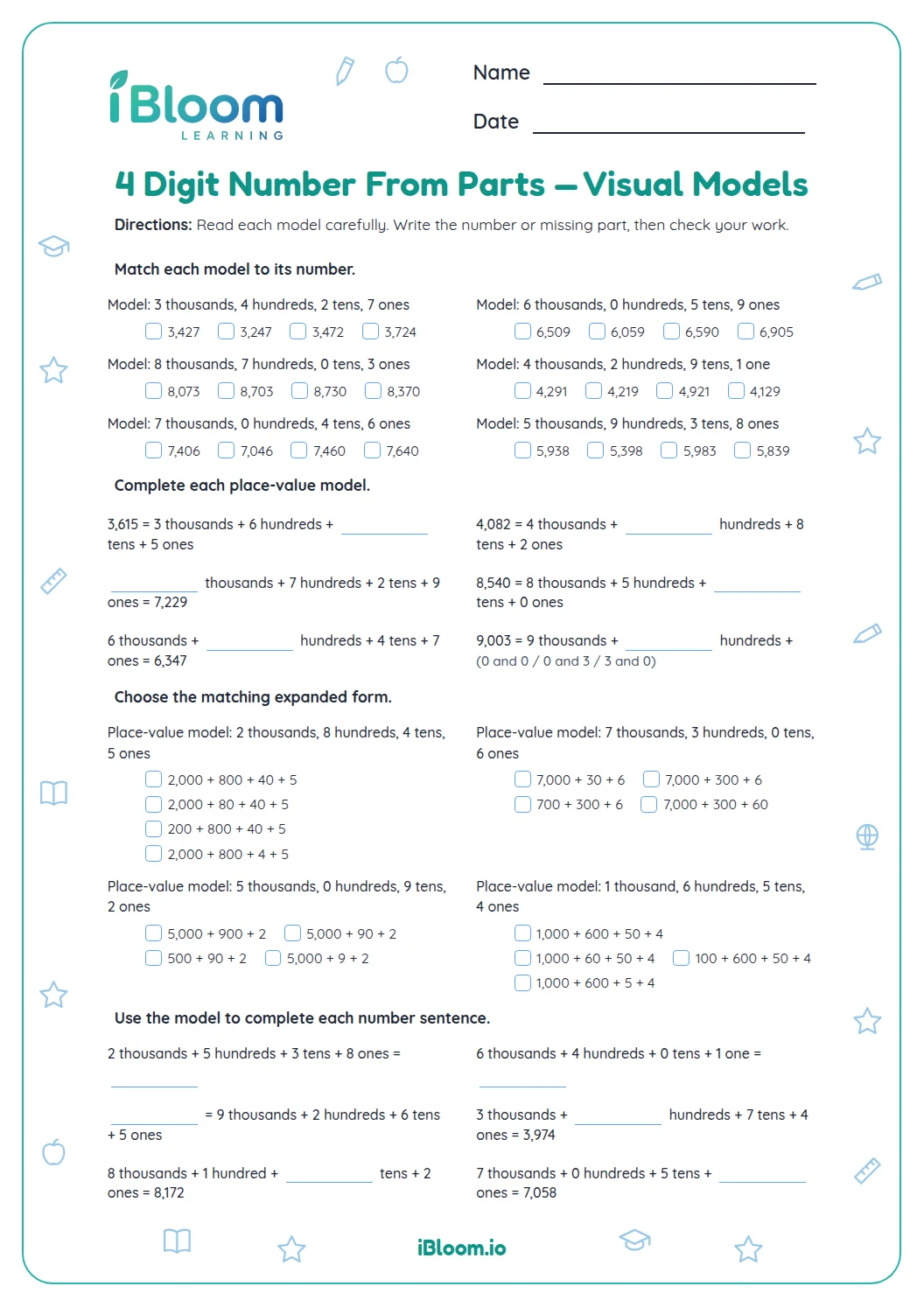
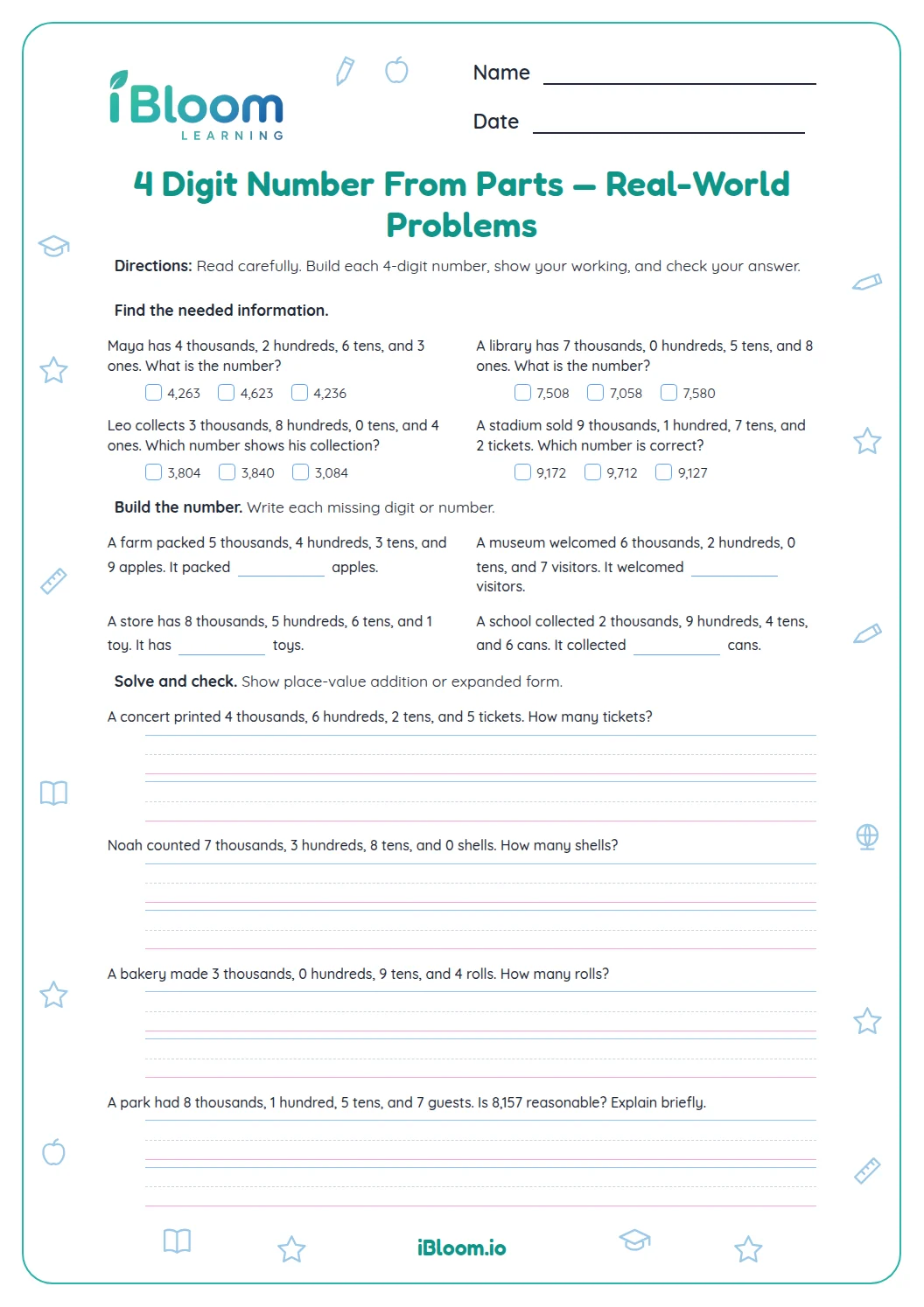
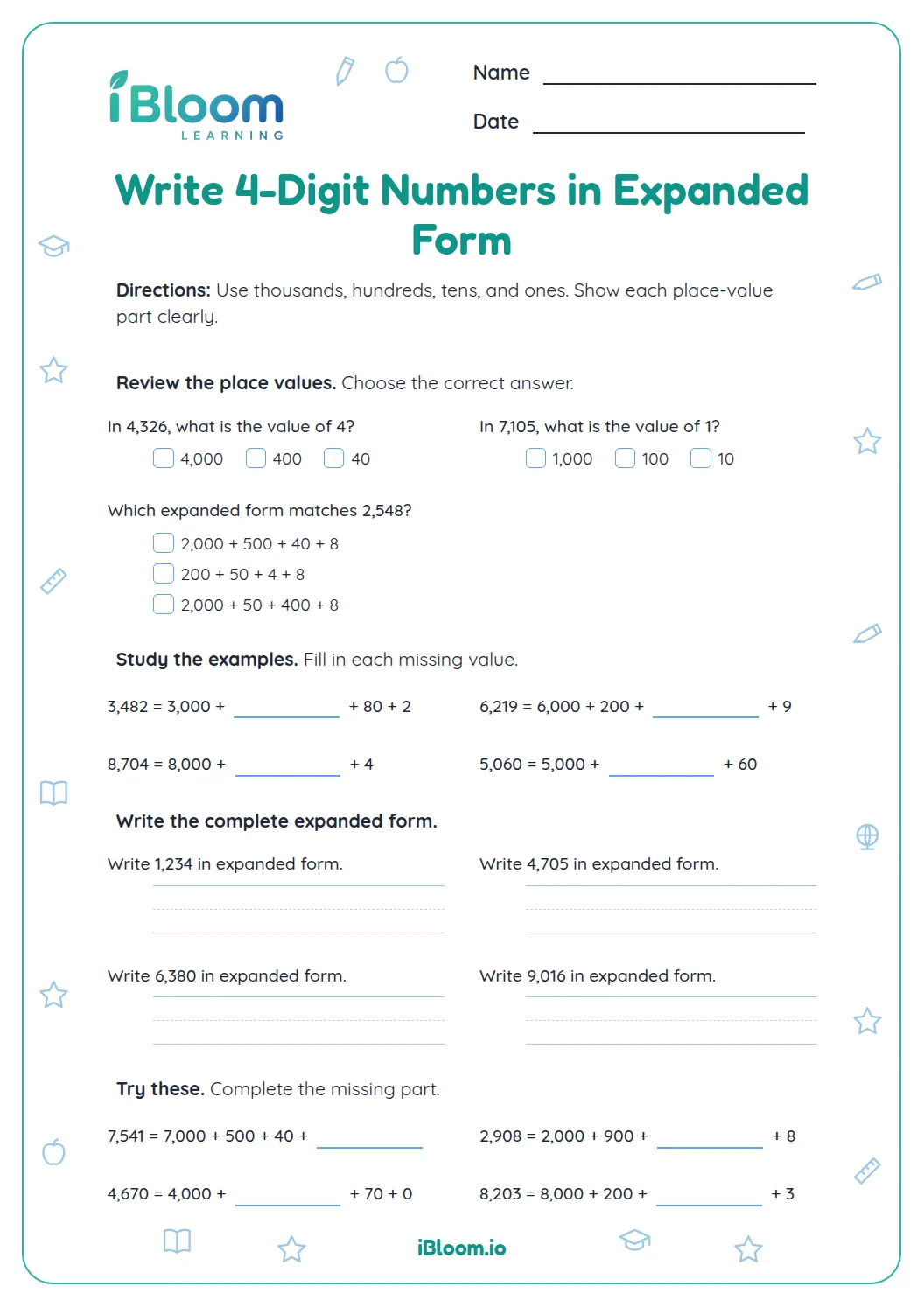
This free printable worksheet helps Grade 3 children build 4-digit numbers from their parts, such as 3,000 + 400 + 20 + 6 = 3,426. The support fades as the sheet goes on: Part A shows every part to add, Part B gives the parts in words (7 thousands, 2 hundreds, 4 tens and 3 ones), and Part C hides one part so children have to find it. Part D has two word problems, about stickers and fair tickets. It practices Common Core 4.NBT.A.2, reading and writing multi-digit numbers in expanded form, and includes zeros in the tens and hundreds places. A separate answer key is included.
Aligned to 4.NBT.A.2
What does it mean to build a number from its parts?
A 4-digit number is made of up to four parts: thousands, hundreds, tens and ones. The number 3,426 is 3,000 + 400 + 20 + 6. Children who can take a number apart and put it back together understand what each digit is worth, not only where it sits.
Building from parts is the same skill as writing a number in expanded form, working in the other direction. It helps with comparing, rounding and, later, adding and subtracting large numbers.
- 19 thousands, 0 hundreds, 6 tens, 2 ones
- 29,000 + 0 + 60 + 2
- 3Thousands digit 9, hundreds digit 0, tens digit 6, ones digit 2
- 4Answer: 9,062
Why are zeros the tricky part?
When a place has no parts, a zero has to hold that place, or the other digits slide over. In 5,000 + 700 + 8, there are no tens. A child who writes 578 has dropped the zero, so the 5 slides down from thousands to hundreds. Writing the number into four boxes marked Th, H, T and O, and putting 0 where there is nothing, stops the slide.
The sheet puts zeros in the hundreds place (2,094, 9,062, 4,079 and 3,068), in the tens place (5,708, 8,607 and 1,805) and in a missing-part question (7,305 = 7,000 + 300 + ___ + 5), so children meet them in more than one position.
How does the guided practice fade its support?
Part A gives all the parts with plus signs, so children only add. Part B gives the parts as words in place-value order, so children turn the words into digits. Part C hides one part and shows the rest, so children work out which place is missing and what it is worth. Part D asks them to use the skill in a story.
Each part asks for a little more thinking than the last. A child who is confident in Part A can move through quickly, and a child who needs more time in Part B can use a place-value chart.
What is on this worksheet?
Fifteen questions in four parts, using numbers from 1,000 to 9,999. Eight of the numbers children build or complete have a zero digit, so they practice holding an empty place again and again.
- Part A, Add the parts: five sums like 6,000 + 300 + 50 + 1
- Part B, Read the parts: four place-value descriptions in words to write as numbers
- Part C, Find the missing part: four expanded forms with one blank, including a missing thousand and a missing 0
- Part D, Word problems: stickers in boxes and packs, and tickets sold at a school fair
- Answer key on two separate pages
How to use this worksheet at home or in class
- 1Draw a place-value chart with four columns (thousands, hundreds, tens, ones) on scrap paper, and build 3,426 in it together.
- 2Do question 1 aloud. Ask which digit goes in each column, then write 3,426.
- 3Let your child finish Part A alone. If a zero is needed, ask which column is empty.
- 4For Part B, have your child fill the place-value chart for each description before writing the number.
- 5For Part C, ask which place has the blank before they write anything. Check by adding the parts back together.
- 6Mark with the answer key. For a missed question, rebuild the number in the chart and compare it with the answer.
Common mistakes and quick fixes
The mistake
Leaving out the zero: writing 5,000 + 700 + 8 as 578 or 57,008.
The fix
Use the four-column chart. Put 5 in thousands, 7 in hundreds, 0 in tens and 8 in ones, then read it across: 5,708.
The mistake
Adding only the leading digits, so 6,000 + 300 + 50 + 1 becomes 6 + 3 + 5 + 1 = 15.
The fix
Say each part aloud (six thousand, three hundred, fifty, one) and write each part in its own column before adding across.
The mistake
Writing the missing part as a single digit in Part C, such as 6 instead of 600 in 4,682 = 4,000 + ___ + 80 + 2.
The fix
Say the place aloud: "hundreds, so 6 hundreds." A part has to match the place it fills, so the blank is worth 600, not 6.
Common Core alignment
Most US states use the Common Core standards or a close state version. This sheet practices the place-value standard below.
Read and write multi-digit numbers in standard and expanded form.
On this sheet: Every question builds a 4-digit number from its thousands, hundreds, tens and ones, or finds a missing part of its expanded form.
Show the official wordingHide the official wording
Read and write multi-digit whole numbers using base-ten numerals, number names, and expanded form. Compare two multi-digit numbers based on meanings of the digits in each place, using >, =, and < symbols to record the results of comparisons.
What to practice next
Make more practice
Further reading
Questions parents and teachers ask
What should my child know before this worksheet?
Your child should be able to read and write 3-digit numbers and know that 10 ones make a ten and 10 tens make a hundred. Knowing that 10 hundreds make a thousand helps with Part A. A place-value chart on scrap paper supports any child who needs it.
Why does question 8 have a zero in it?
Question 8 reads 9 thousands, 0 hundreds, 6 tens and 2 ones, so the hundreds place is empty. A zero holds that place and the number is 9,062. Without the zero, the number would read 962, which is a much smaller number.
What is the answer to 7,305 = 7,000 + 300 + ___ + 5?
The answer is 0. The number 7,305 has 7 thousands, 3 hundreds, 0 tens and 5 ones. Since there are no tens, the missing part is 0. Some children expect every blank to hold a bigger number, so this question shows that zero can be one of the parts too.
How is this different from an expanded form worksheet?
Expanded form takes a number apart: 4,682 becomes 4,000 + 600 + 80 + 2. This sheet mostly goes the other way, putting parts together to make a number. Part C blends both by giving a number and hiding one of its parts. Both directions build the same place-value sense.
Can my child use base-ten blocks or a chart with this sheet?
Yes, and that is a good use of the guided format. Blocks or a drawn place-value chart help children see that 3,000 is three thousand and not just three. Ask your child to build the number with blocks or a drawn chart, then write it as a number.
Is there an answer key for this worksheet?
Yes. Two separate answer key pages show every number and missing part, including the zeros and the units in the word problems. Print the worksheet pages for your child and keep the key for checking, or use it to rebuild any missed number together in a place-value chart.