


About this worksheet
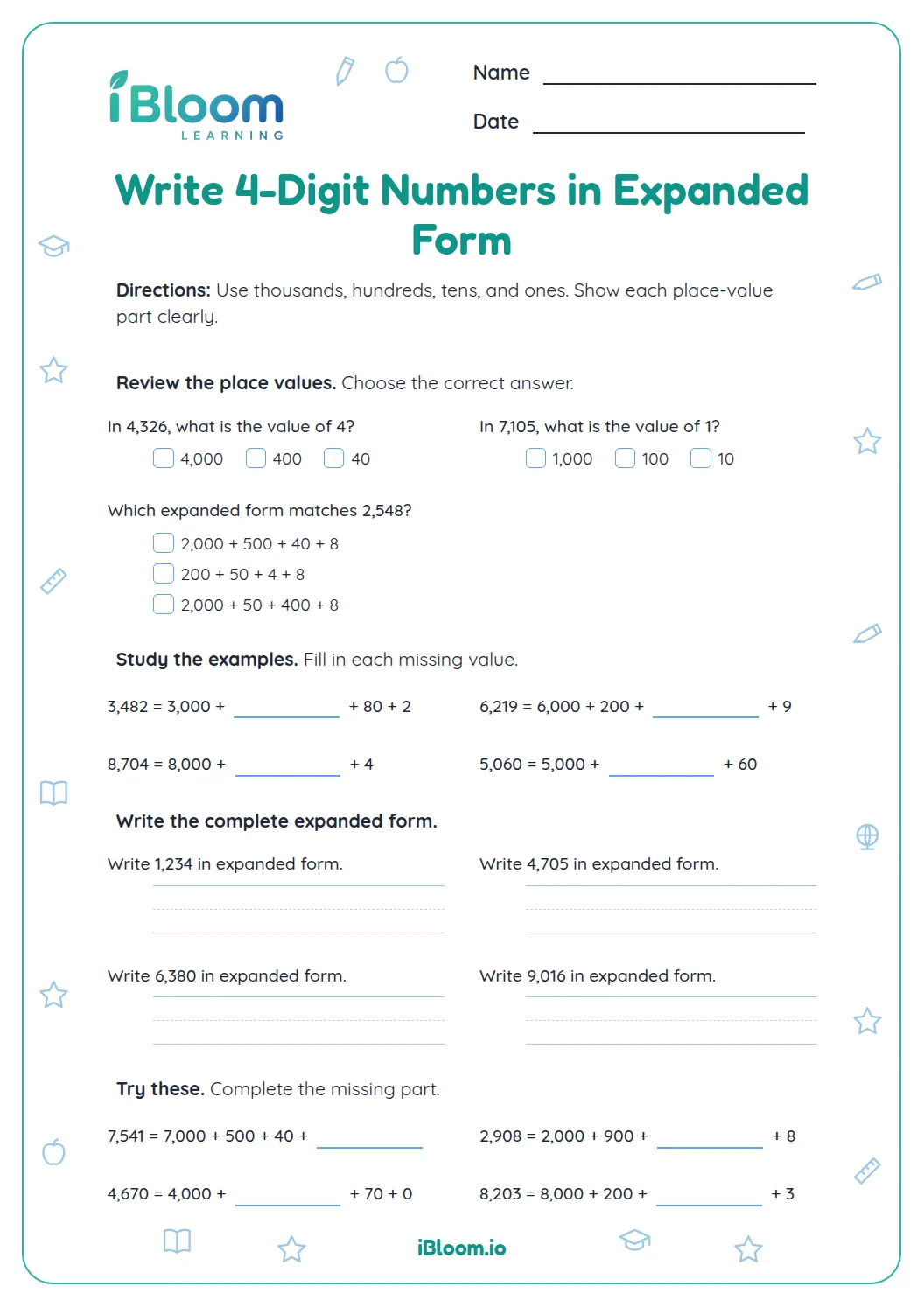
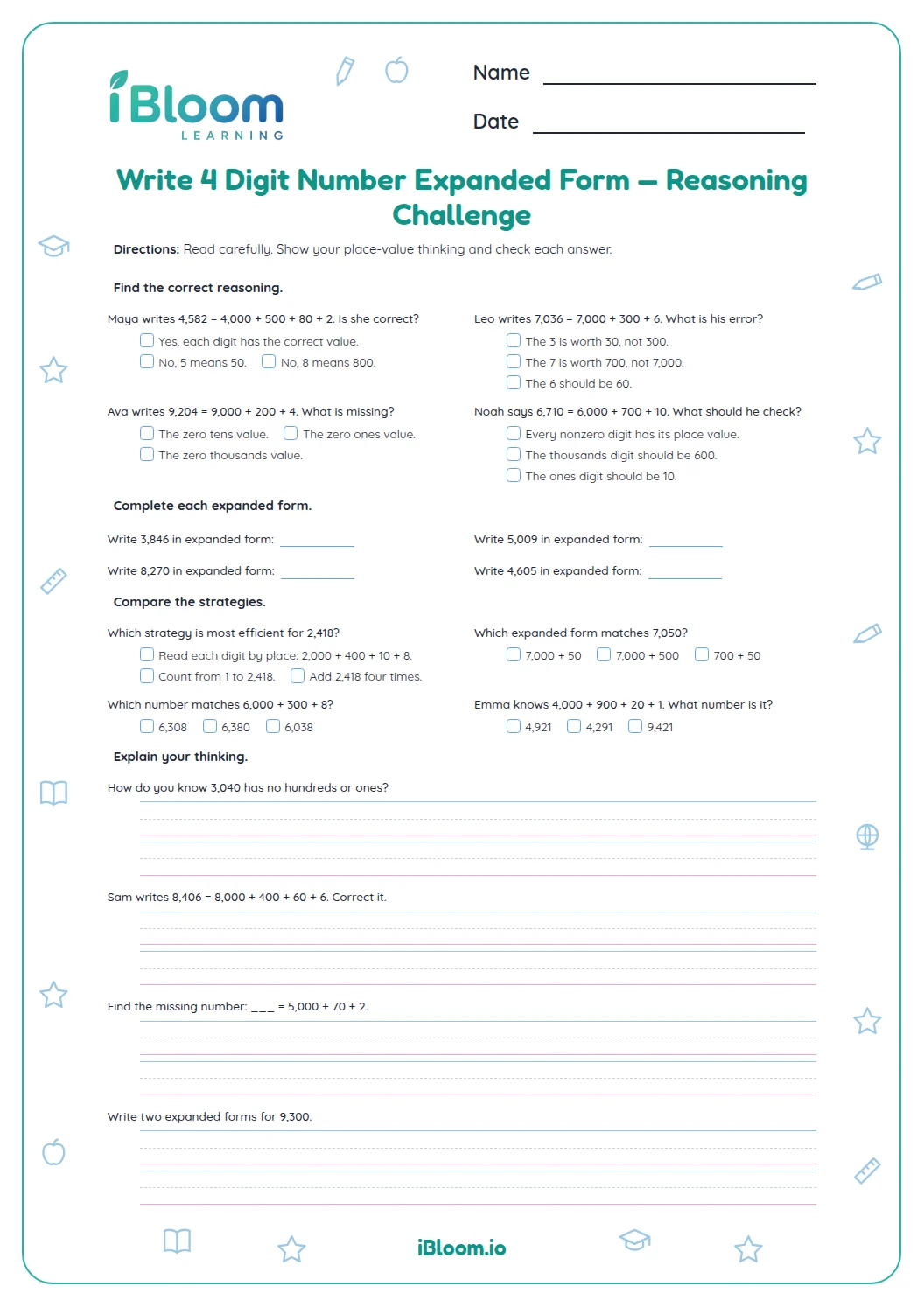
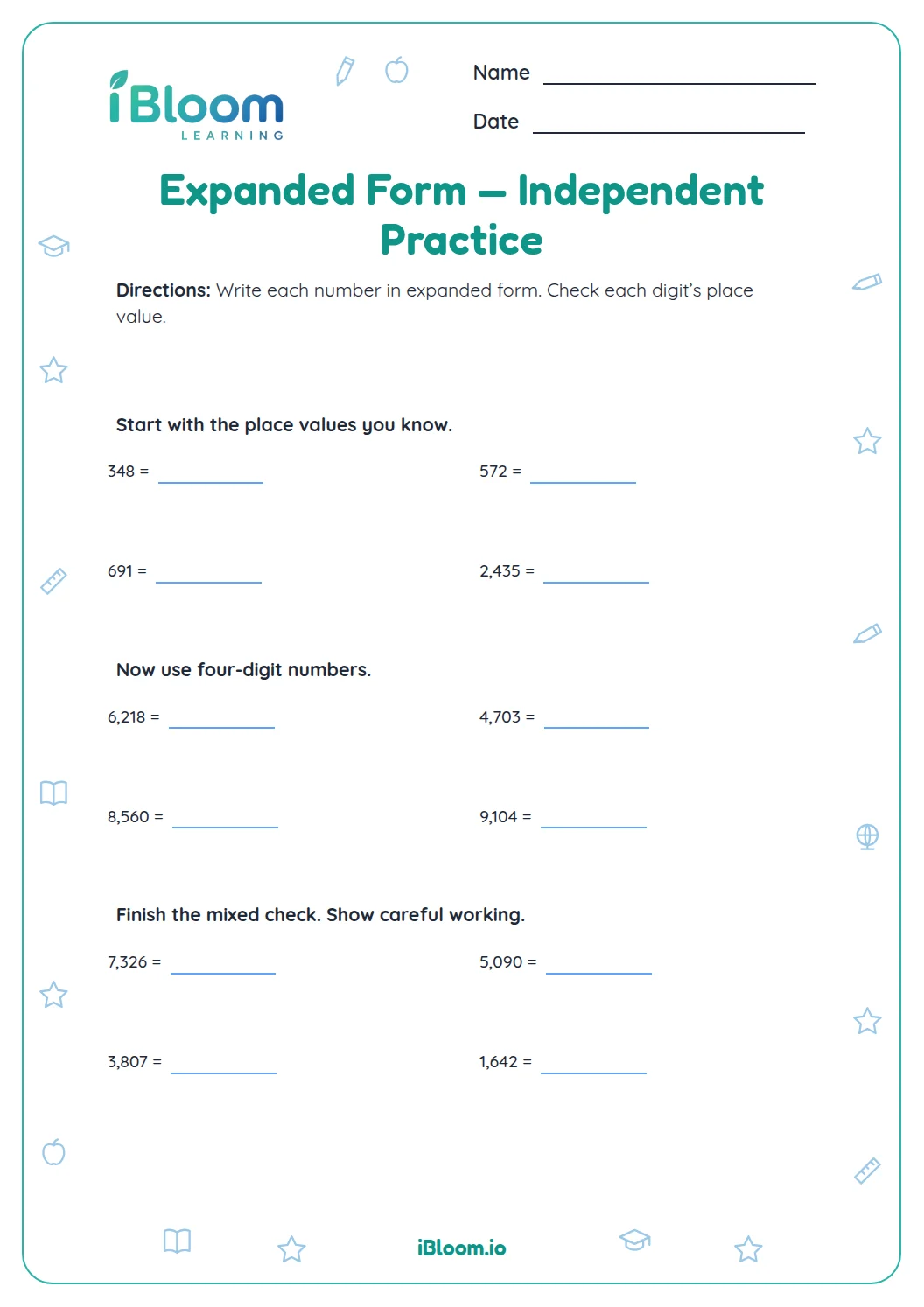
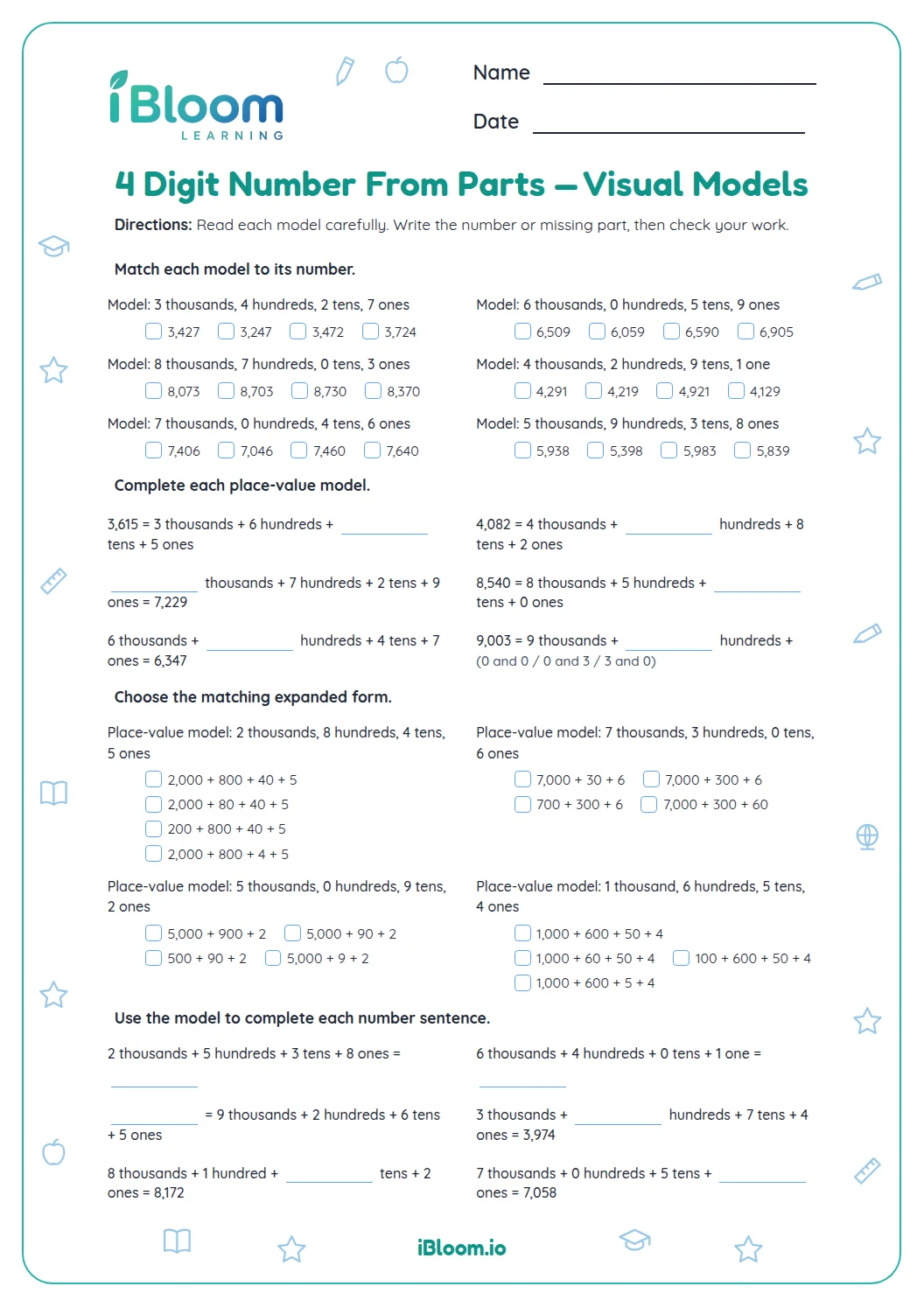
This Grade 3 printable focuses on writing four-digit numbers in expanded form. Children expand standard numerals, combine place-value sums into standard form, and apply the idea to a short context and explanation. The 16 questions include zeros in different places so learners must attend to each digit’s value. The answer key includes sample reasoning. The skill aligns to Common Core 4.NBT.A.2.
Aligned to 4.NBT.A.2
How do I expand a four-digit number?
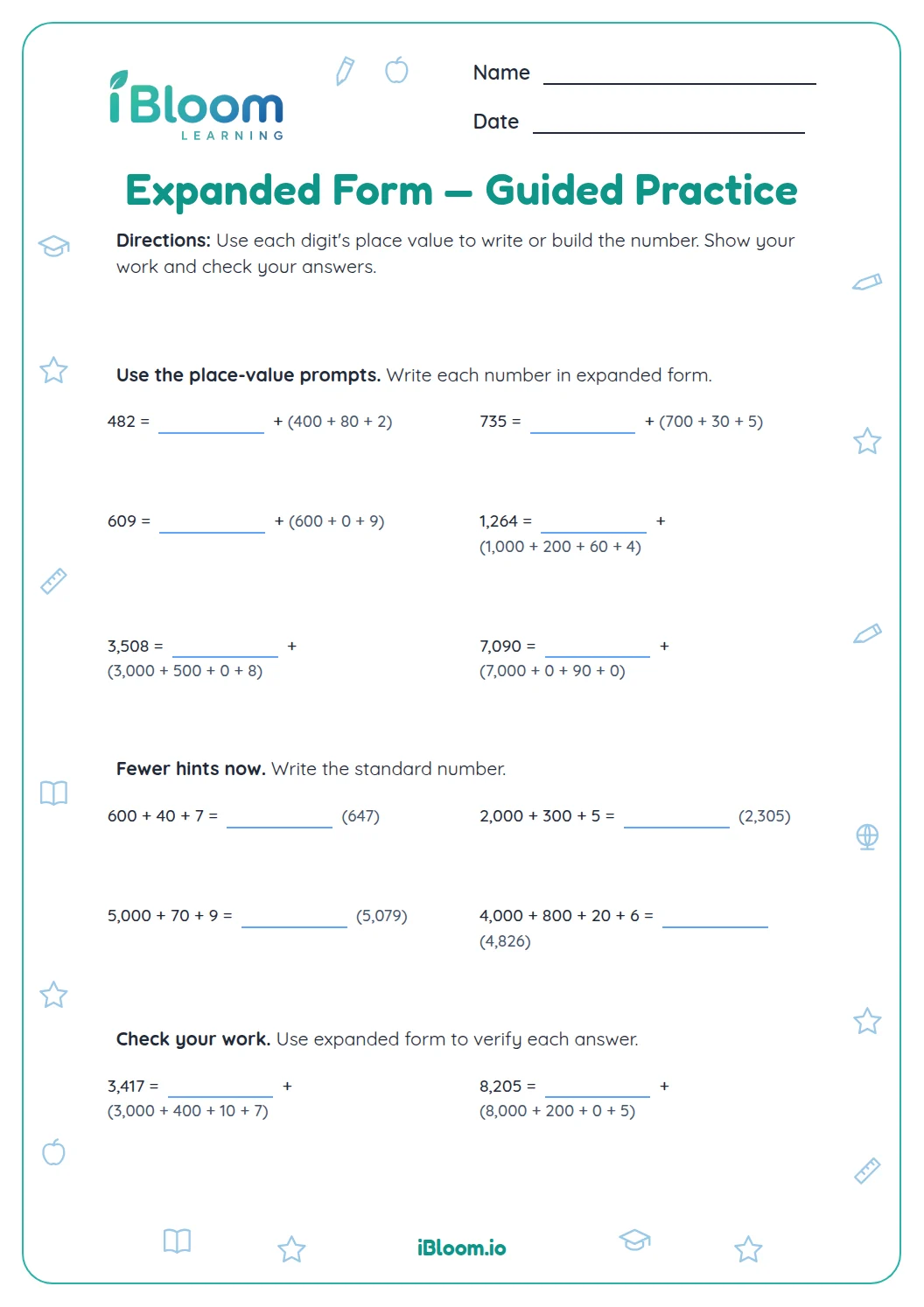
Part A asks for the value of each nonzero digit. Write the thousands, hundreds, tens, and ones as addends.
- 14,582
- 24 thousands = 4,000
- 35 hundreds = 500
- 48 tens = 80; 2 ones = 2
- 5Expanded form: 4,000 + 500 + 80 + 2
How do place-value parts make a number?
For Part B, combine the addends and put each digit in its matching place. Keep a zero when a place has no value.
How do I check a zero place?
Part C applies place value to four-digit numbers, including a zero place and a common expanded-form error.
How can I use this worksheet?
- 1Mark the thousands, hundreds, tens, and ones places.
- 2Multiply each digit by its place value in your head.
- 3Write the nonzero place values as addends.
- 4When building a number, keep zero places in the numeral.
- 5Read the number back to check each digit’s position.
What should I check as I work?
The mistake
Using a digit instead of its value
The fix
A 5 in the tens place is 50. Name the place first, then write the digit’s value.
The mistake
Dropping a zero place in standard form
The fix
A missing hundreds or tens value still needs its place in the numeral. Use a zero placeholder.
The mistake
Adding place values incorrectly
The fix
Check that each addend matches one digit and that their sum returns to the original number.
Common Core alignment
Expanded notation makes the value of each digit visible.
Read and write multi-digit numbers in expanded form.
On this sheet: The worksheet writes four-digit numbers in expanded notation and builds standard form from place values.
Show the official wordingHide the official wording
Read and write multi-digit whole numbers using base-ten numerals, number names, and expanded form. Compare two multi-digit numbers based on meanings of the digits in each place, using >, =, and < symbols to record the results of comparisons.
What to practice next
Make more practice
Further reading
Questions parents and teachers ask
What does expanded form show?
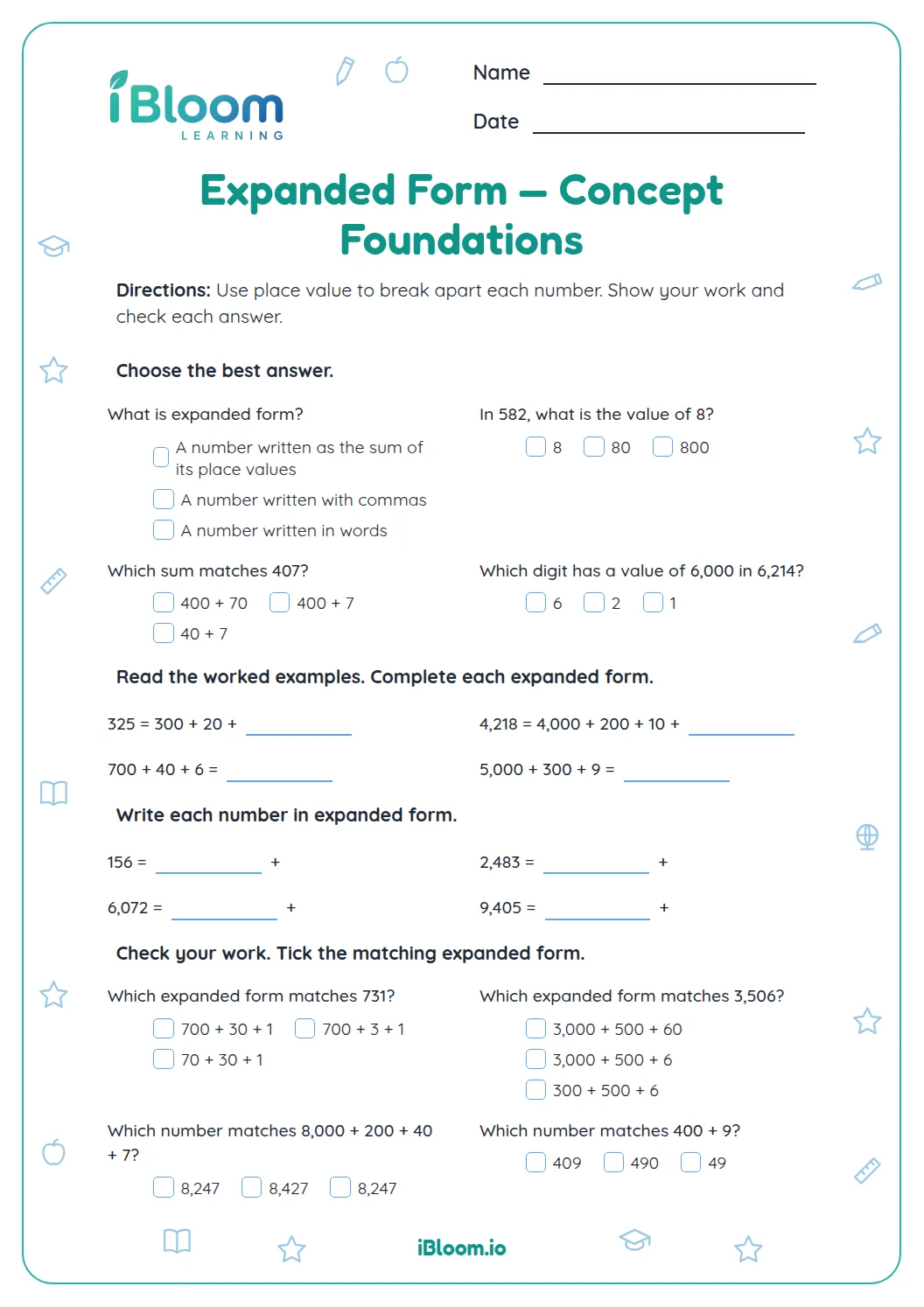
Expanded form writes a number as the sum of the values of its digits. For example, 4,582 is 4,000 + 500 + 80 + 2. A zero place contributes no value, so it may be left out of the sum.
How many questions are on this worksheet?
There are 16 questions in three parts: eight expanded-form items, four standard-form items, and four place-value applications. Each uses a four-digit number, and the separate answer key lists numeric answers and sample explanations. Practice includes zero in a place and checking an incorrect decomposition.
How should a child handle a zero digit?
A zero in a place contributes zero to the number. In 4,309, the tens digit is 0, so its expanded form has no tens addend; it is 4,000 + 300 + 9. One question asks children to identify that zero value directly.
What is the difference between standard and expanded form?
Expanded form writes a number as the sum of its place values. For example, 4,582 is 4,000 + 500 + 80 + 2. This worksheet practices both expanding four-digit numbers and rebuilding standard form from addends. Children also apply place value to a short context.
Why are the numbers four digits long?
Every number-building and expanded-form item uses a four-digit number, matching the skill named in the worksheet title. This gives practice identifying thousands, hundreds, tens, and ones, including places with a zero. This check keeps the digit aligned with the correct place in the number.
Is an answer key provided?
Yes. A separate answer key provides the expanded expressions, the standard-form numbers, and sample responses for the place-value reasoning questions. Equivalent expressions that show the same digit values are acceptable. This check keeps the digit aligned with the correct place in the number.