




About this worksheet
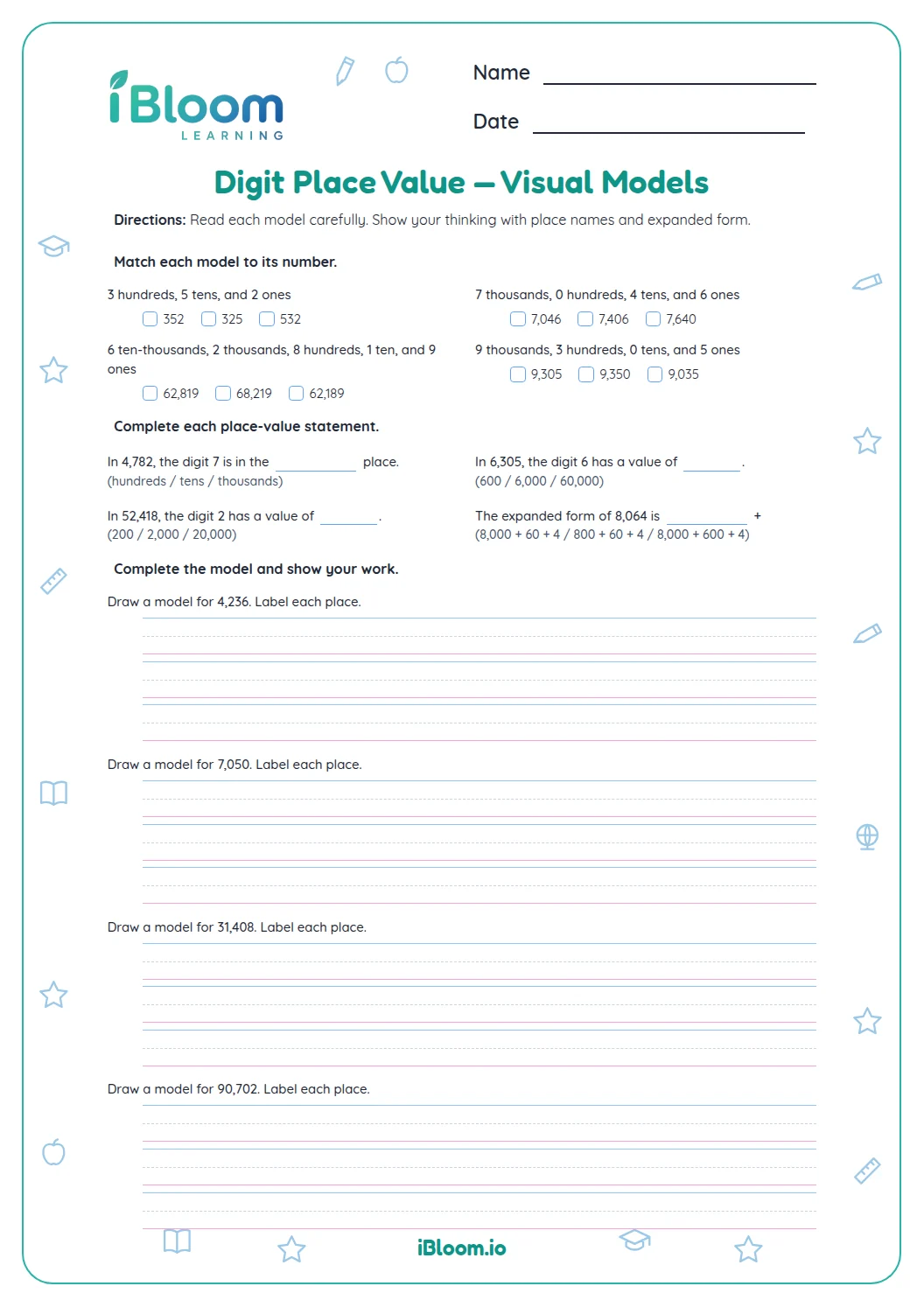
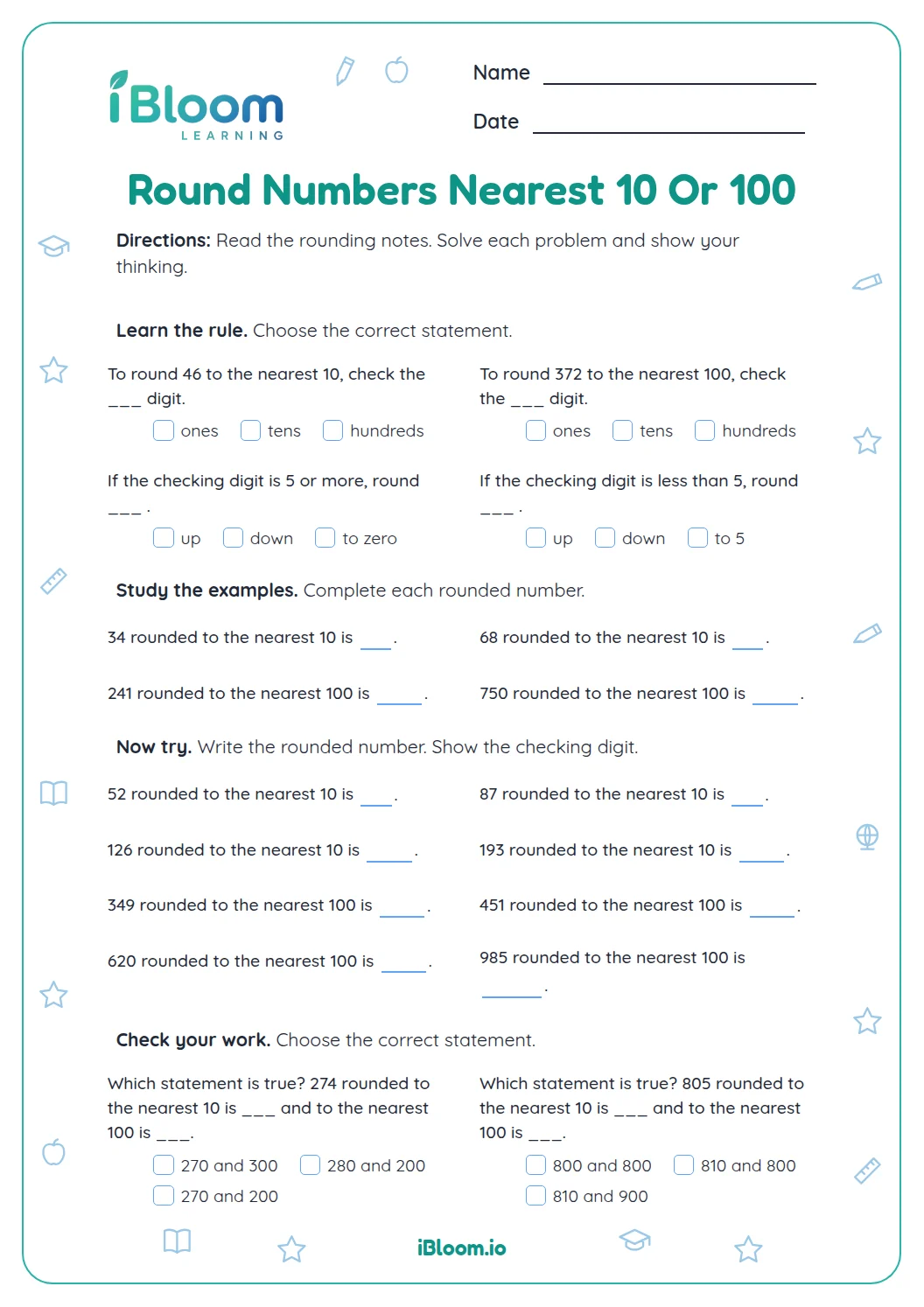
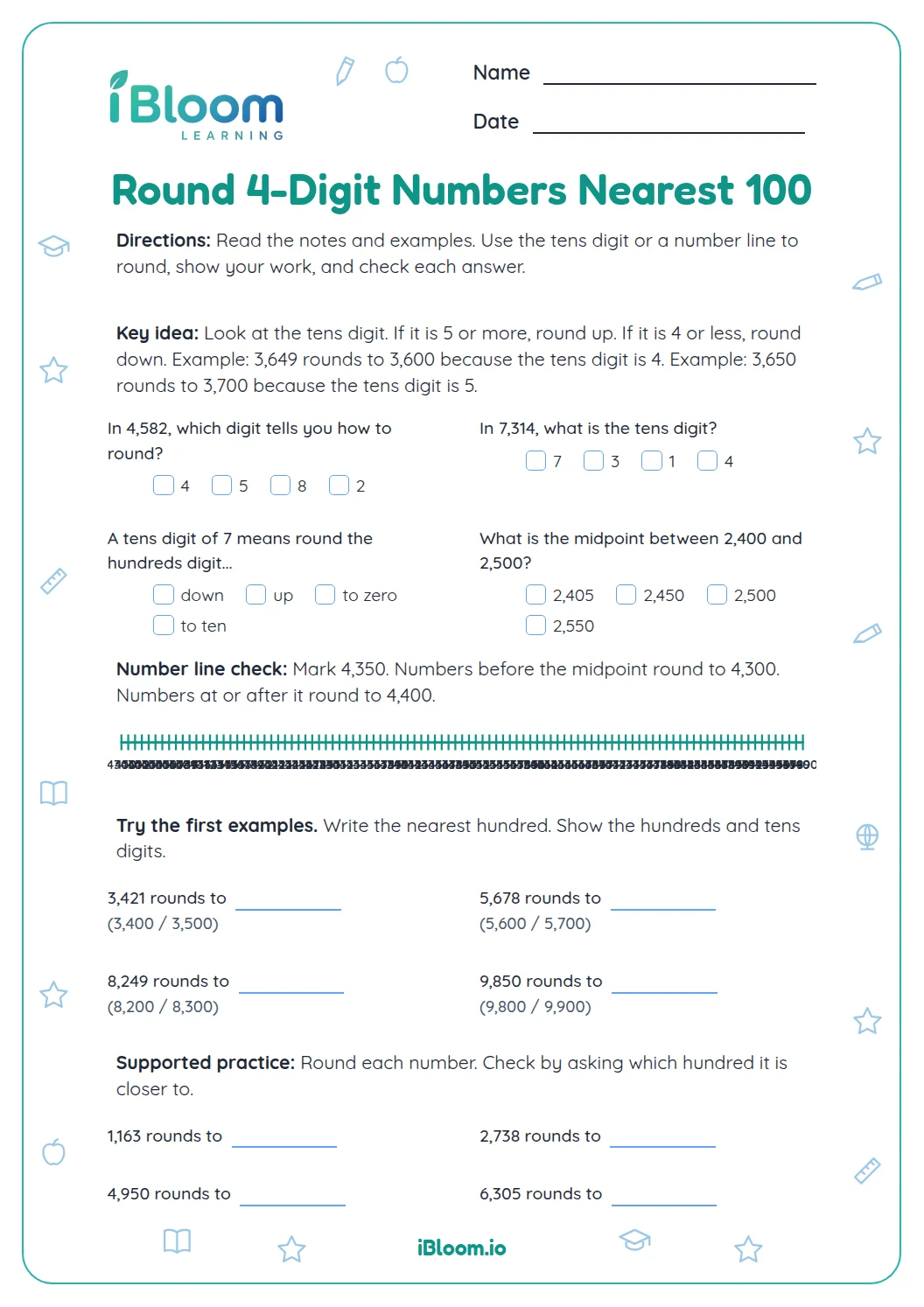
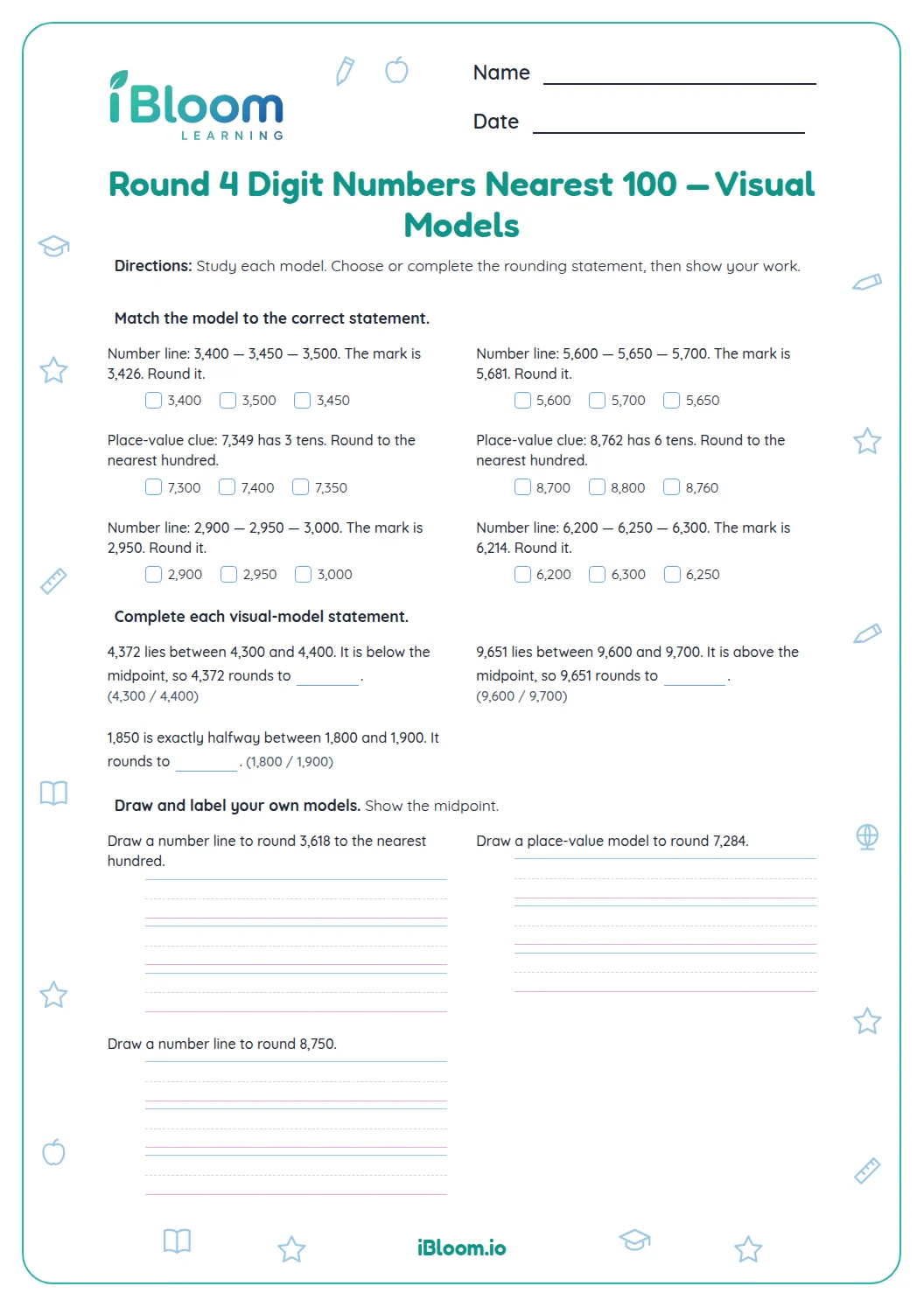
This free printable Grade 3 math worksheet uses six number lines to make rounding to the nearest hundred visible, followed by two questions without a model. Each line spans two consecutive hundreds in ten equal jumps. Part A has four multiple-choice items; Part B has two modeled blanks, including 850 halfway between 800 and 900. Part C asks students to round 249 and 950 independently. The sheet practices CCSS 3.NBT.A.1, using place value to round whole numbers, and includes a separate answer key.
Aligned to 3.NBT.A.1
How should a child read these number lines?
Each line covers a distance of 100 in ten equal jumps, so each jump is worth 10. Only the endpoints are labeled. Counting five jumps from the left endpoint locates the midpoint, which ends in 50.
The dots are placed at the exact numbers named in the prompts. A number such as 143 sits between the 140 and 150 ticks; it does not have to land on a tick to be located on the line.
Why does 143 round to 100?
Question 1 places 143 between 100 and 200. The halfway value is 150, and 143 is to its left. It is 43 away from 100 and 57 away from 200, so 100 is the closer hundred.
Use the same test for 268: its midpoint is 250, and the dot is to the right. The nearer endpoint is 300. Ask the child to point along the shorter distance before choosing an answer.
- 1Endpoints: 100 and 200
- 2Midpoint: 150
- 3143 < 150, so the dot is on the 100 side.
- 4143 rounds to 100.
What changes when the dot is exactly halfway?
Question 6 uses 850, exactly 50 from both 800 and 900. For this whole-number rounding convention, a halfway value rounds to the greater hundred, so the answer is 900.
Part B removes the choices but keeps the visual support. Question 5 places 775 between 700 and 800, followed by the tie at 850. This lets students first apply distance and then use the halfway rule.
Part C checks whether students can apply the same rule without a printed line. The tens digit in 249 is 4, so it rounds to 200. The number 950 is halfway between 900 and 1,000, so it rounds to 1,000.
Use the midpoint to make each decision
- 1Read the two endpoint labels and name the hundreds between which the number falls.
- 2Count five jumps from the left endpoint and say the midpoint aloud.
- 3Compare the dot with that midpoint and trace the distance to the nearer endpoint.
- 4Choose an answer in Part A and write a rounded value in Part B.
- 5For 850, check that both distances are 50. Then round 249 and 950 in Part C using the tens digit, and check all eight answers.
Rounding mistakes to work through
The mistake
Rounding 451 down because its ones digit is 1.
The fix
Use 450 as the midpoint: 451 lies just to its right, so it rounds to 500.
The mistake
Treating each tick as one unit.
The fix
There are ten equal jumps across 100, so each jump is 10. Five jumps locate the midpoint.
The mistake
Rounding 850 to 800 because both hundreds are equally close.
The fix
The distances tie. Apply the stated convention: halfway rounds to the greater hundred, 900.
Common Core alignment
Use place value and number lines to round three-digit numbers to the nearest hundred.
On this sheet: Six items connect rounding with scaled number lines; two more apply place-value reasoning independently.
Show the official wordingHide the official wording
Use place value understanding to round whole numbers to the nearest 10 or 100.
What to practice next
Make more practice
Further reading
Questions parents and teachers ask
Are the dots already placed on the number lines?
Yes, the first six questions mark each number with a dot on a scaled line. Children use its position to decide which hundred is closer. The unlabeled inner ticks help them locate the midpoint. The final two questions ask children to round without a printed model.
Why is the dot for 143 between two ticks?
The ticks are ten units apart, so 143 belongs between 140 and 150. This is an intentional part of the model. Have your child name those nearby tens, then compare the dot with 150. It is still on the side closer to 100.
What are the eight rounded answers?
In order, the answers are 100, 300, 500, 600, 800, 900, 200 and 1,000. The key shows all eight answers, with the six number-line models repeated. When checking, ask your child to name each midpoint, especially for 451, 850, 249 and 950.
How should I explain the halfway example, 850?
Explain that 850 is equally far from 800 and 900, so distance alone gives a tie. The rounding rule used here chooses the greater hundred at the halfway point. Count five ten-unit jumps in either direction to confirm the tie before writing 900.
Can we connect the pictures to the tens-digit rule?
Yes, use the models to explain why the tens digit helps. Values before the midpoint have a tens digit from 0 through 4; values at or after it have 5 through 9. Compare 621 and 775, then check their positions on the lines.