



About this worksheet
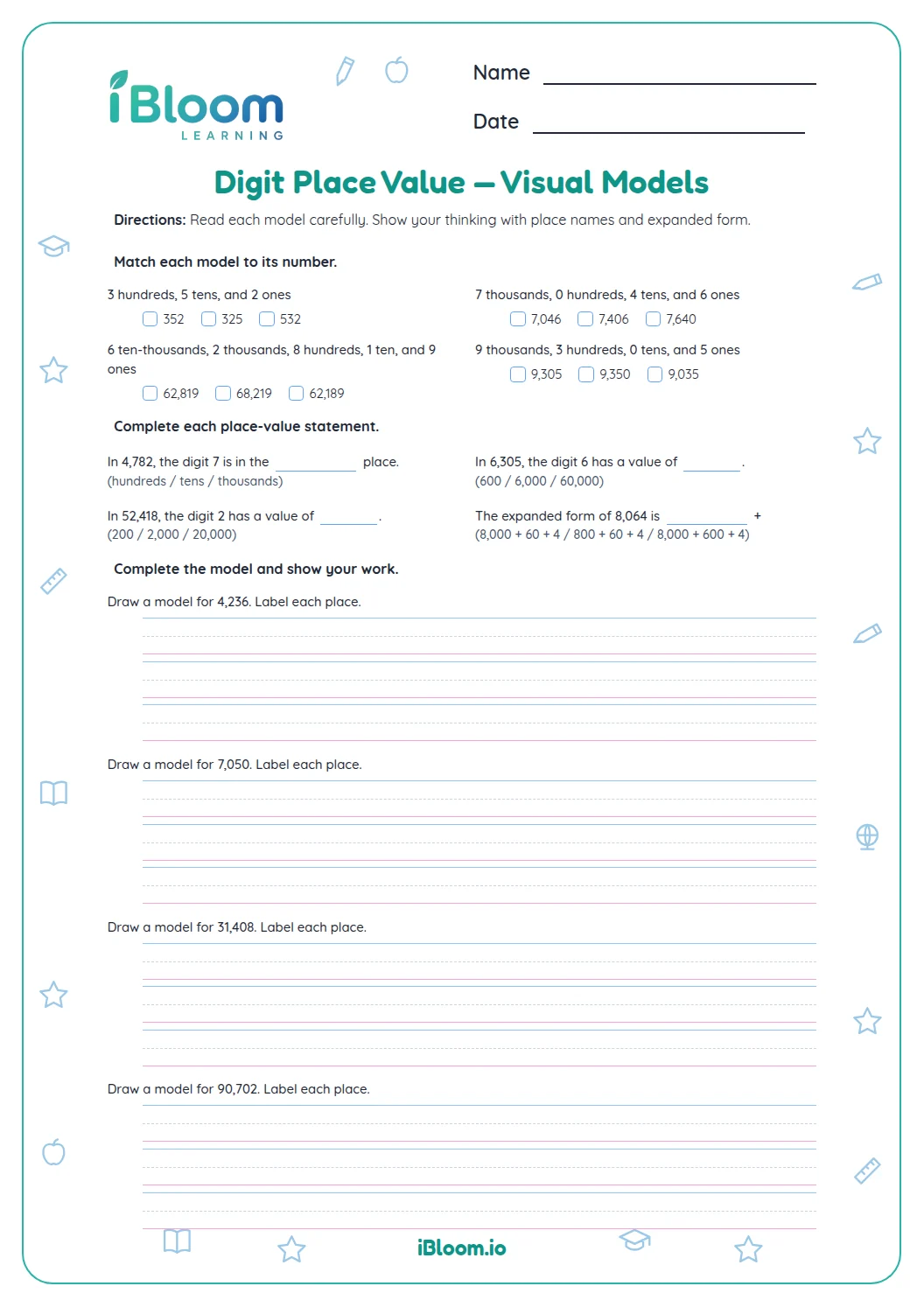
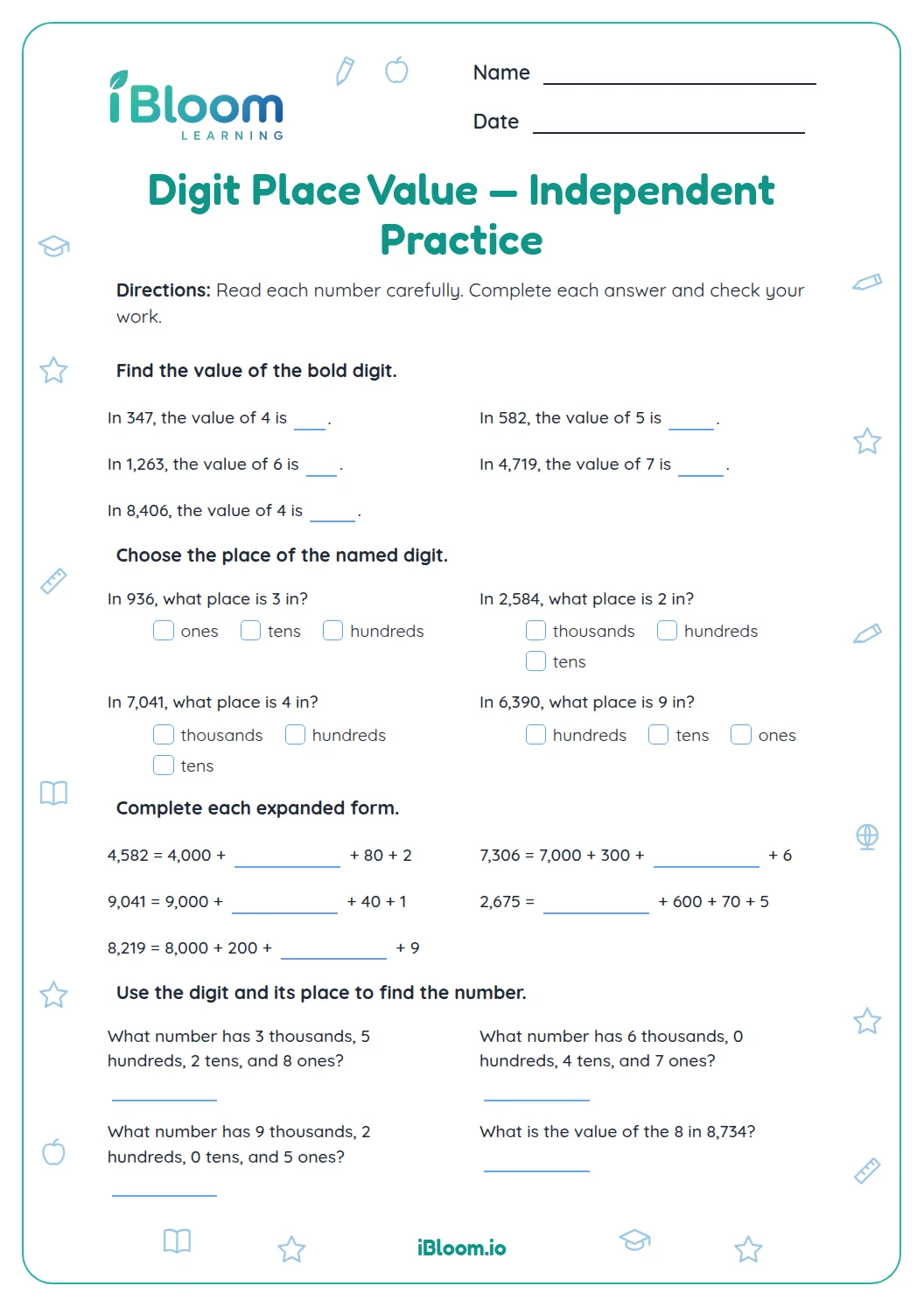
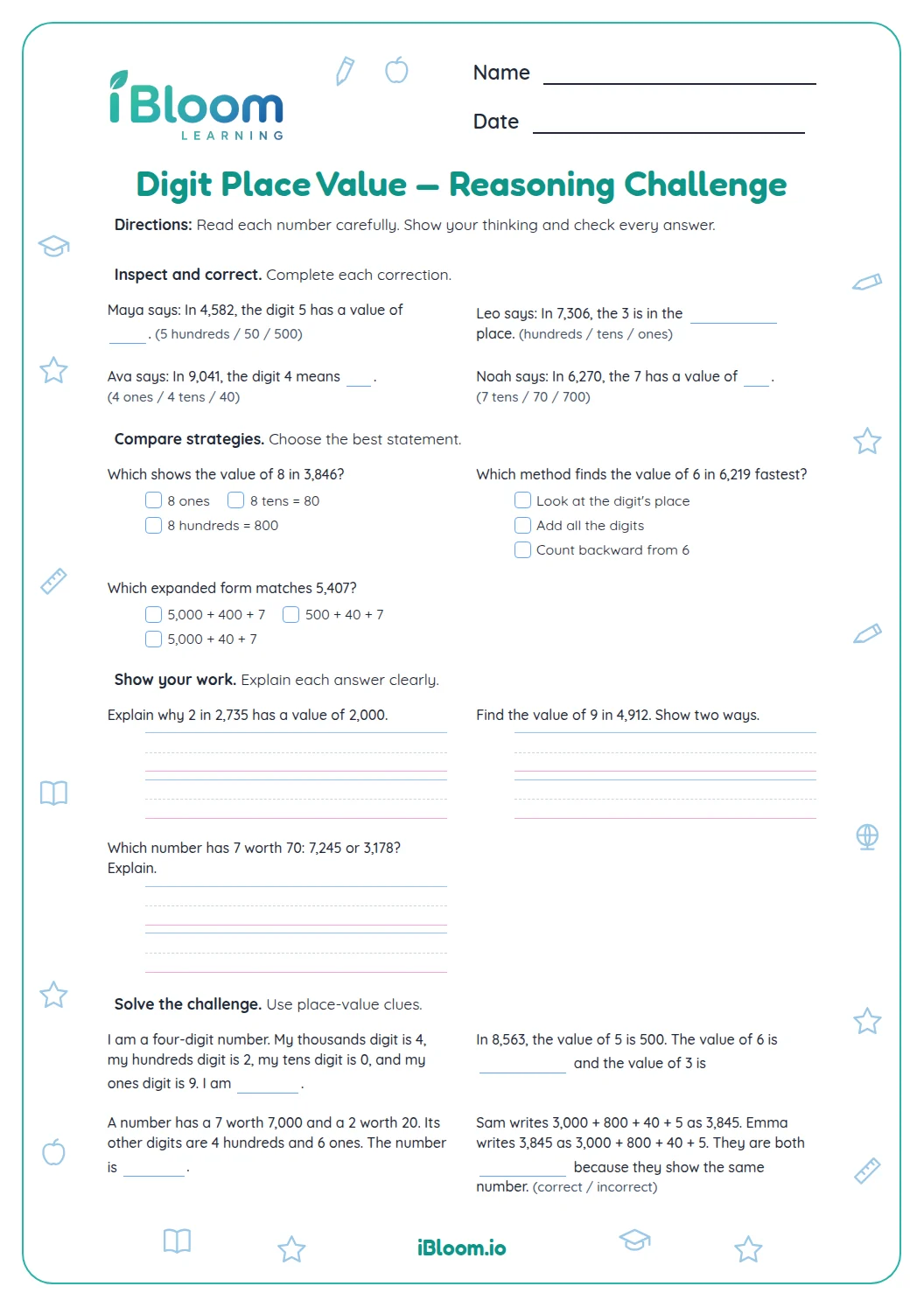
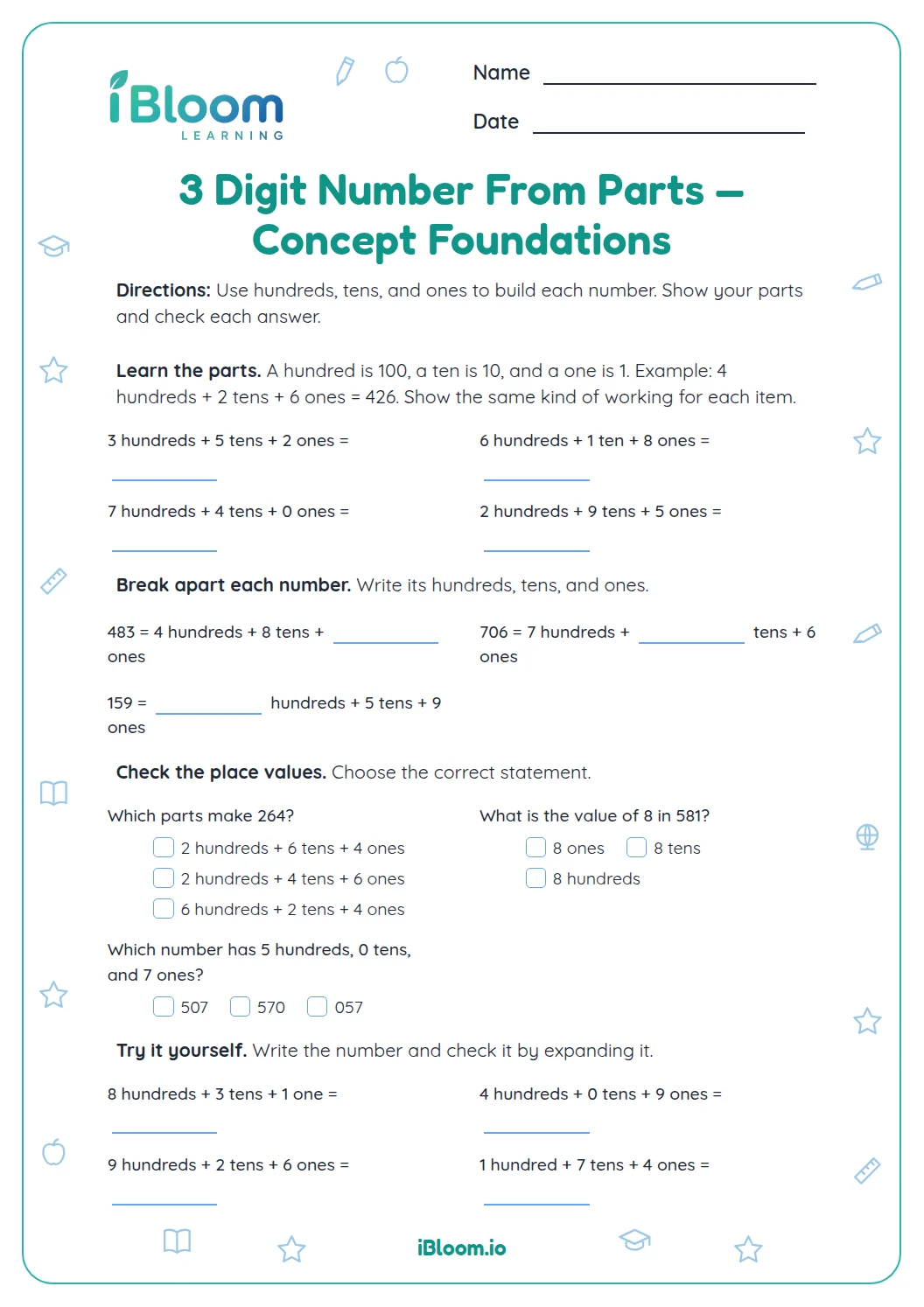
This free printable worksheet gives Grade 3 students 14 questions about digit place value through thousands. Children identify digits and places, complete four statements, choose numbers and expanded forms, and finish with three written responses. The questions distinguish a digit, its place name, and the amount it represents. Zeros appear inside numbers such as 6,205 and 8,072, so students must keep every position. The expanded-form work practices Common Core 4.NBT.A.2. A separate answer key includes the choices, missing entries, and model explanations.
Aligned to 4.NBT.A.2
How are digit, place, and value different?
A digit is one symbol from 0 through 9. Its place tells which unit it counts. Its value tells the amount. In question 2, the digit is 2, its place is hundreds, and its value is 200.
- 16,205 has 6 thousands, 2 hundreds, 0 tens, and 5 ones.
- 2The 2 is in the hundreds place.
- 32 hundreds = 200.
Why must children keep zero places?
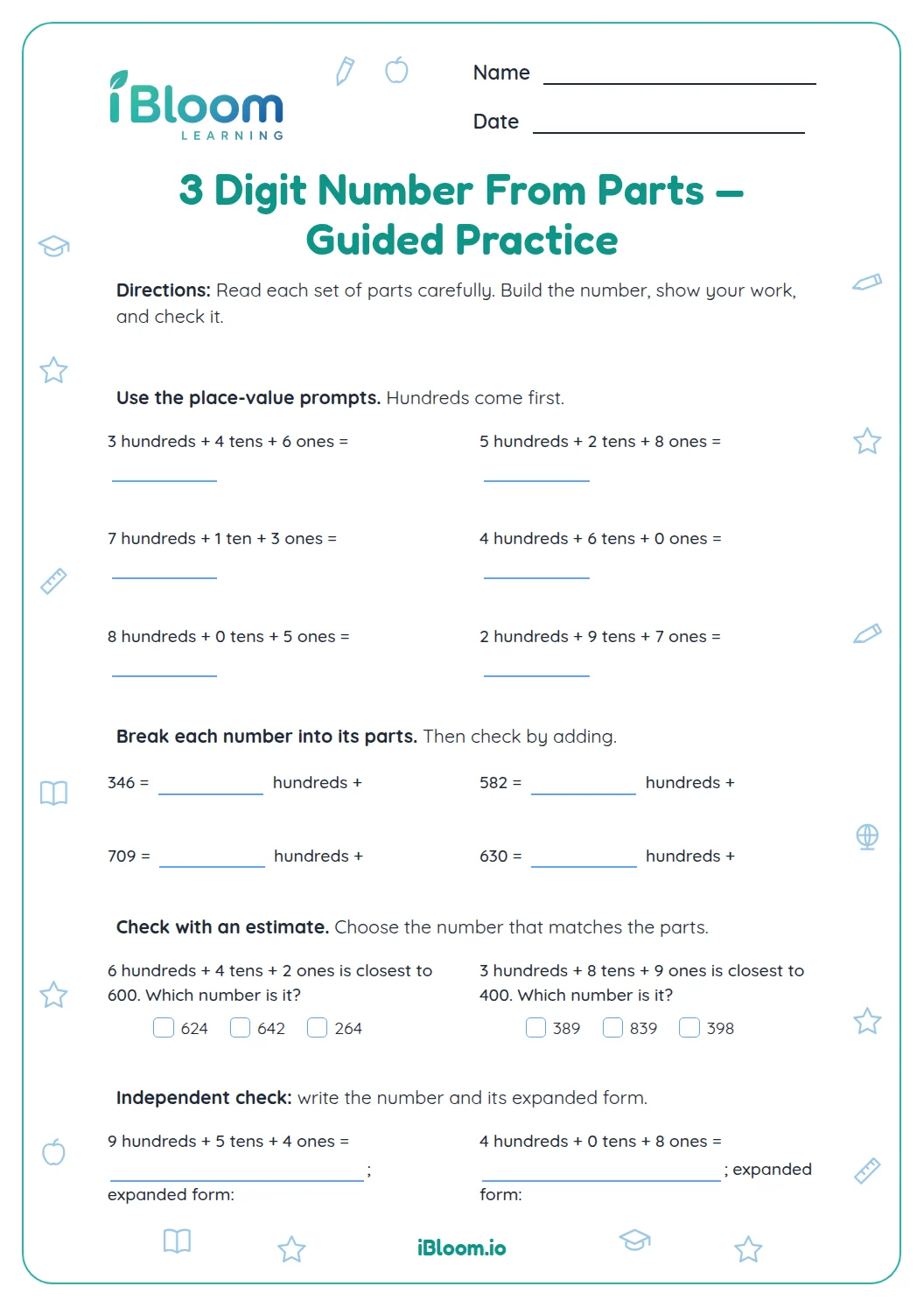
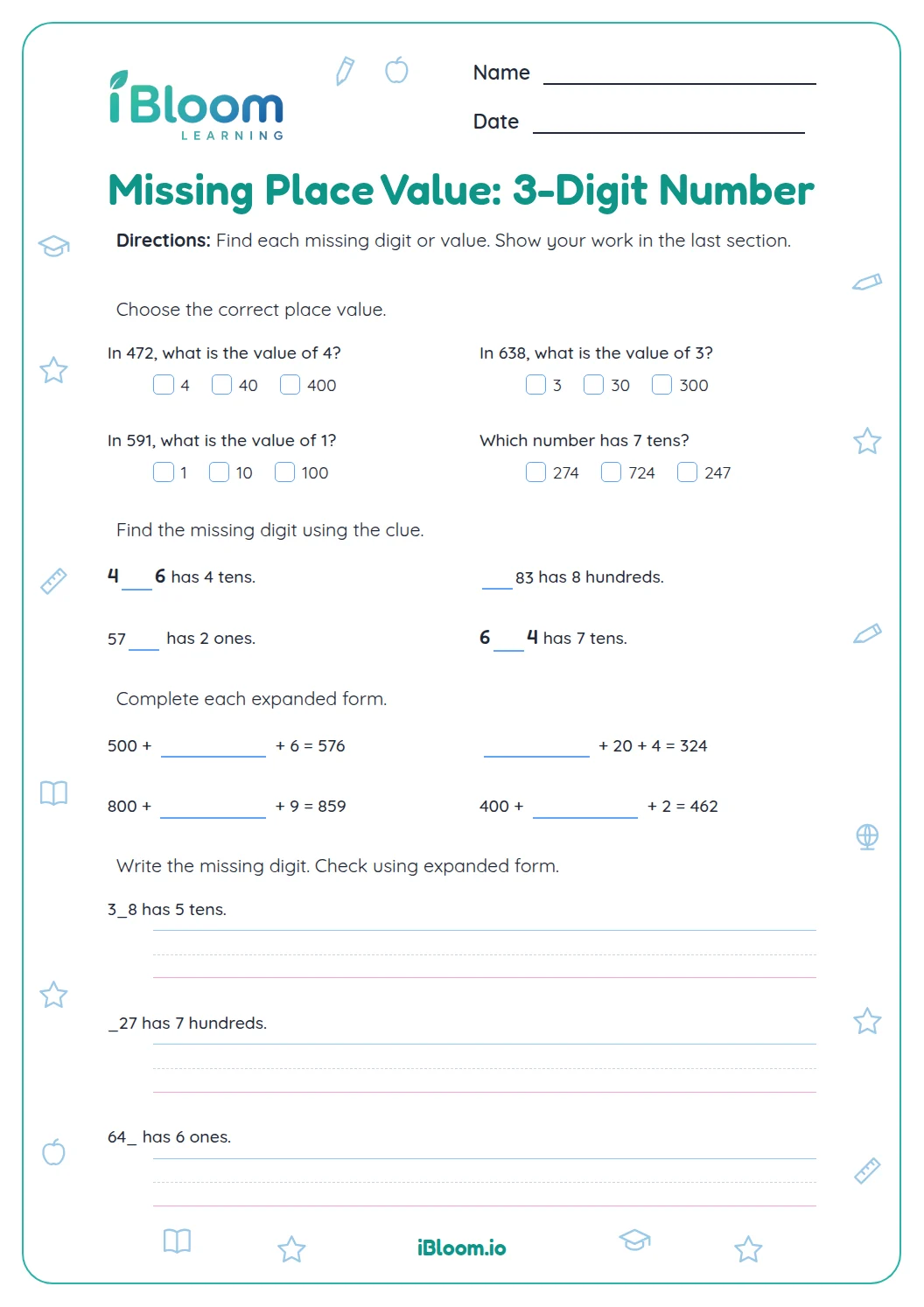
In 6,205, zero holds the tens place. The 2 remains in hundreds, and the 5 remains in ones. Question 8 asks for 3 hundreds, 0 tens, and 6 ones, which makes 306.
Have children point from right to left when naming positions. Skipping a zero would change the places and the number.
How does expanded form show digit values?
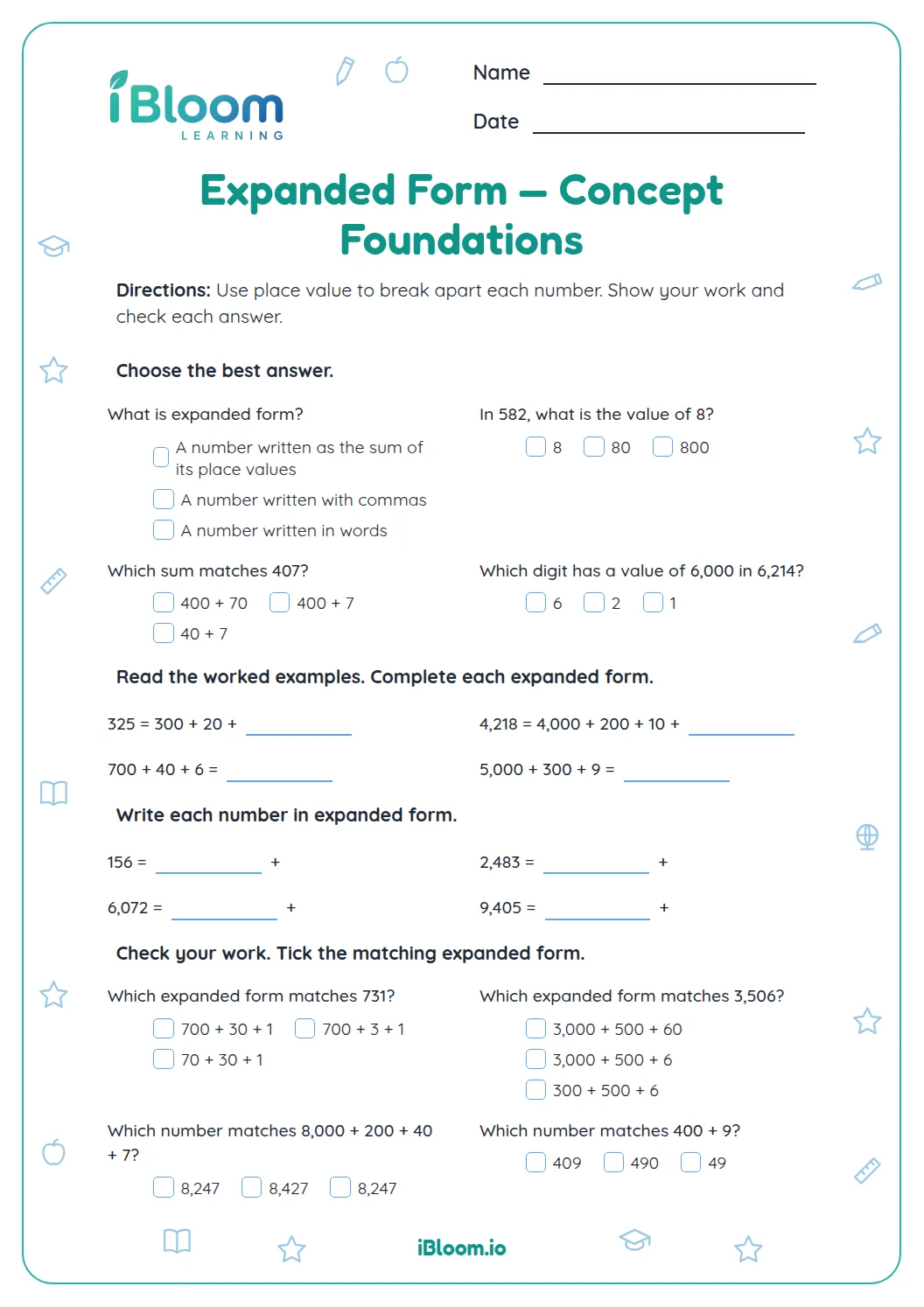
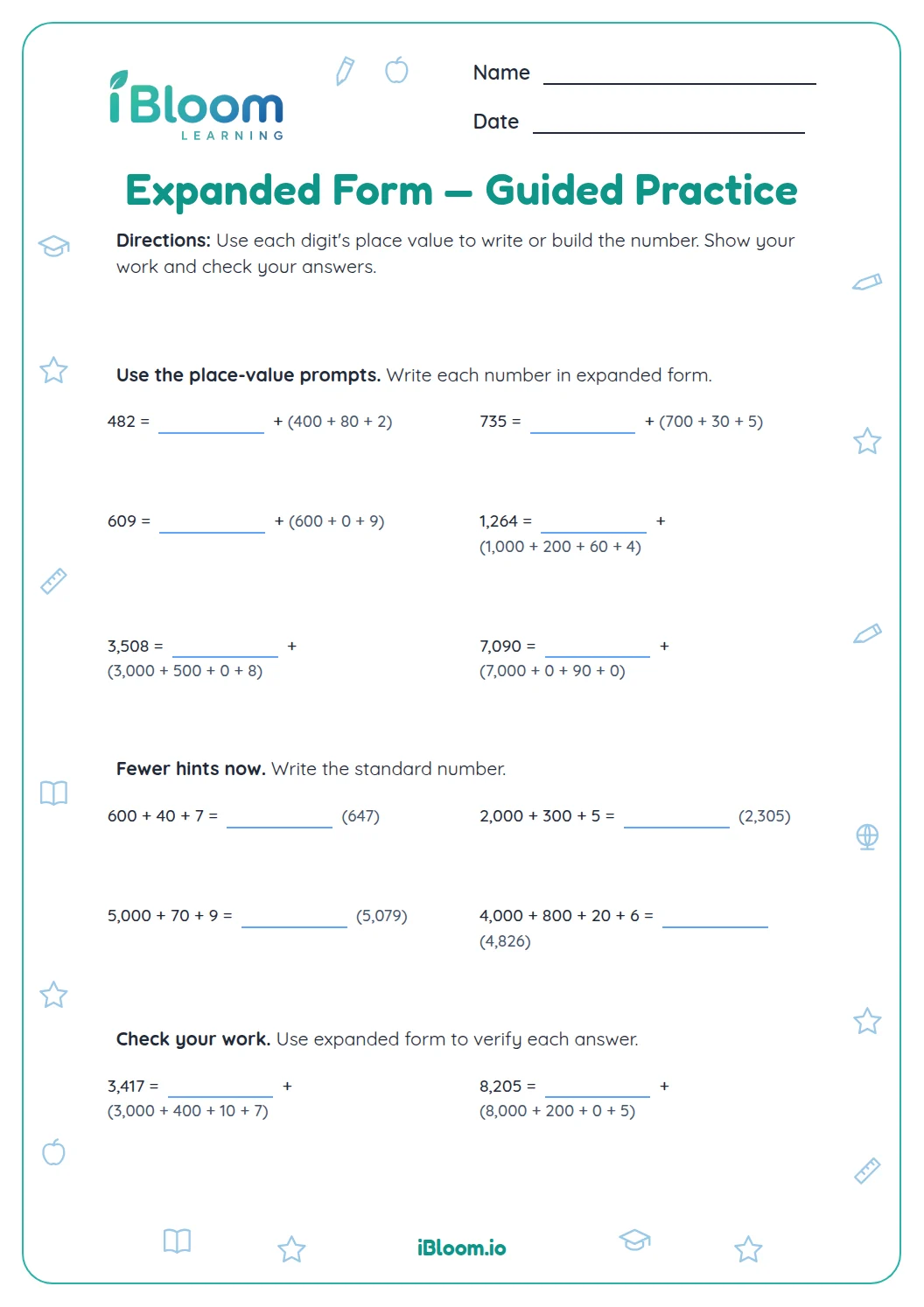
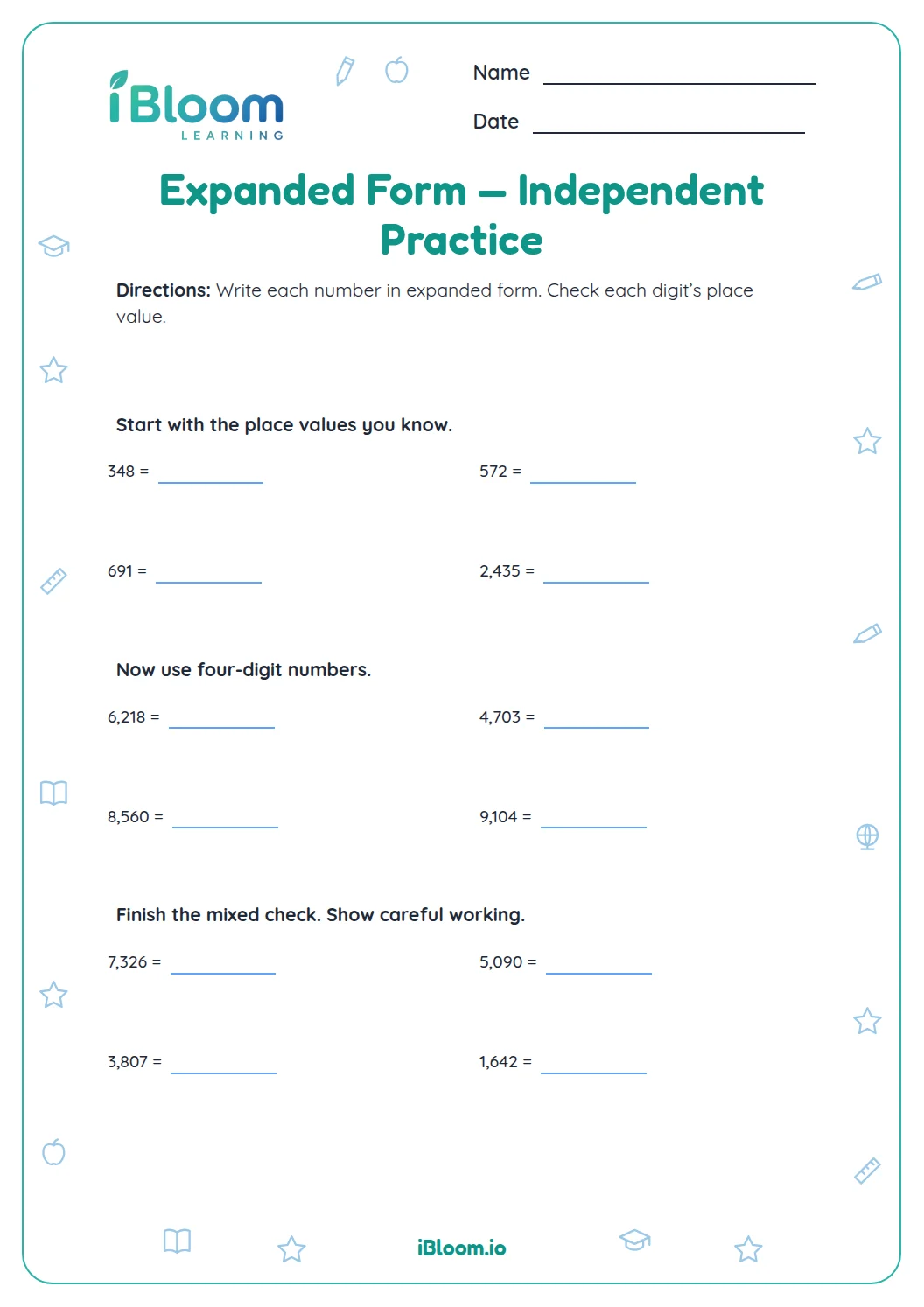
Expanded form writes a number as a sum of its place-value amounts. Question 9 uses 4,218: 4,000 + 200 + 10 + 8. Each addend matches one digit’s position.
Question 14 asks children to write 9,126 in the same way. In questions 12–13, a complete explanation names both the place and the value of the requested digit.
How to use this worksheet
- 1Read the Part A reminder about the four places.
- 2Point to the named digit before answering each question.
- 3In Part B, check whether the blank asks for a place name or a value.
- 4Read each expanded-form addend as thousands, hundreds, tens, or ones.
- 5Complete the explanations and final expanded form, then check with the key.
Mistakes to discuss
The mistake
Writing 2 for the value of 2 in 6,205.
The fix
Say two hundreds, then write 200.
The mistake
Choosing 36 for 3 hundreds and 6 ones.
The fix
Include a zero in tens: 306.
The mistake
Writing 4,000 + 20 + 8 for 4,218.
The fix
Match every digit to its place: the 2 means 200 and the 1 means 10.
Common Core alignment
Read multi-digit numbers and write their place-value parts in expanded form.
On this sheet: Children connect base-ten numerals to place-value amounts and identify or write expanded forms.
Show the official wordingHide the official wording
Read and write multi-digit whole numbers using base-ten numerals, number names, and expanded form. Compare two multi-digit numbers based on meanings of the digits in each place, using >, =, and < symbols to record the results of comparisons.
What to practice next
Make more practice
Further reading
Questions parents and teachers ask
How large are the numbers on this sheet?
Most questions use four-digit numbers through thousands, such as 3,741, 6,205, and 9,126. One question builds 306 from hundreds, tens, and ones. Children use the same right-to-left place order throughout the page, whether they are naming a digit’s position or writing its value.
Does a place-name answer need a number?
No, a place-name answer uses words such as hundreds or tens. A value answer gives an amount such as 200 or 5,000. Read the wording of each question before writing. The final two explanations about individual digits ask children to include both the place and the value.
What should children do with a zero inside a number?
Keep its position when naming places. In 6,205, the zero marks no tens while 2 still represents 200. In 8,072, the zero is in hundreds and 7 is in tens. Pointing to each digit from the right helps children avoid shifting the remaining digits.
What is the expanded form of 9,126?
The expanded form is 9,000 + 100 + 20 + 6. Each part records the value of one digit in the original number. Ask the child to say nine thousands, one hundred, two tens, and six ones before writing the addition expression for question 14.
What does the answer key include?
The key marks seven multiple-choice answers, supplies four missing entries, and gives the three written responses. For questions 12 and 13, accept another explanation when both place and value are correct. The final response shows the complete expanded form with an addend for each digit.