



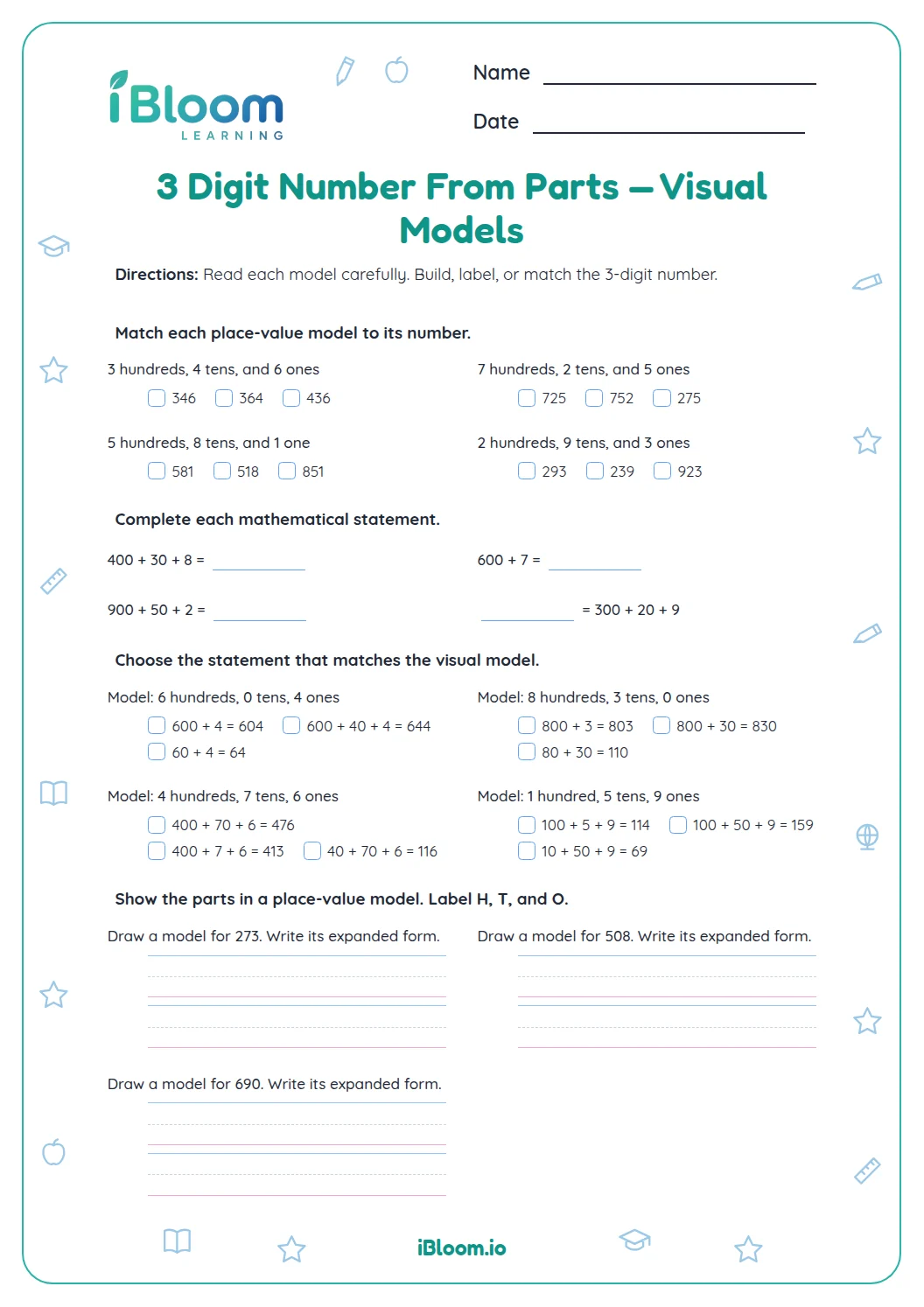
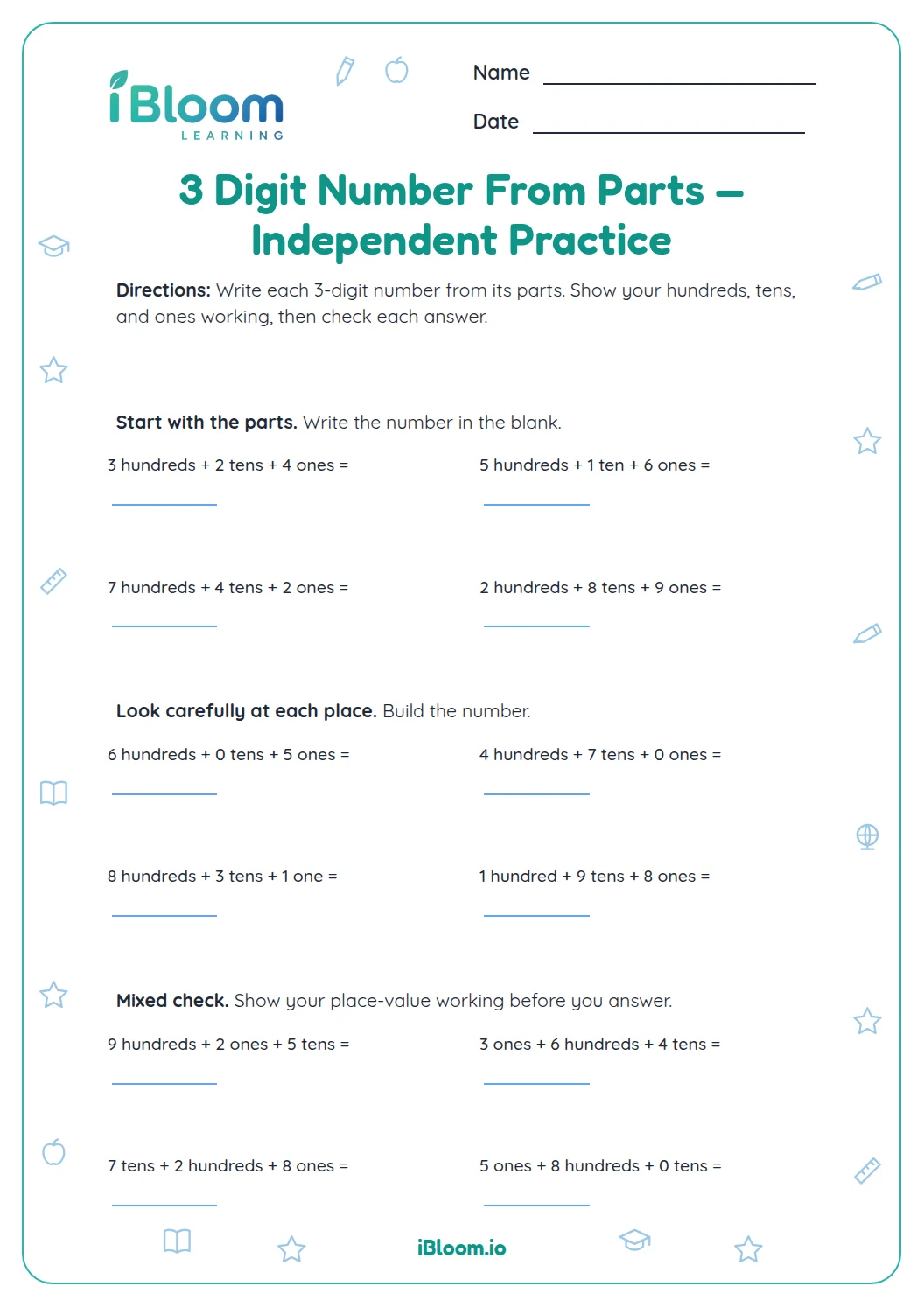
About this worksheet
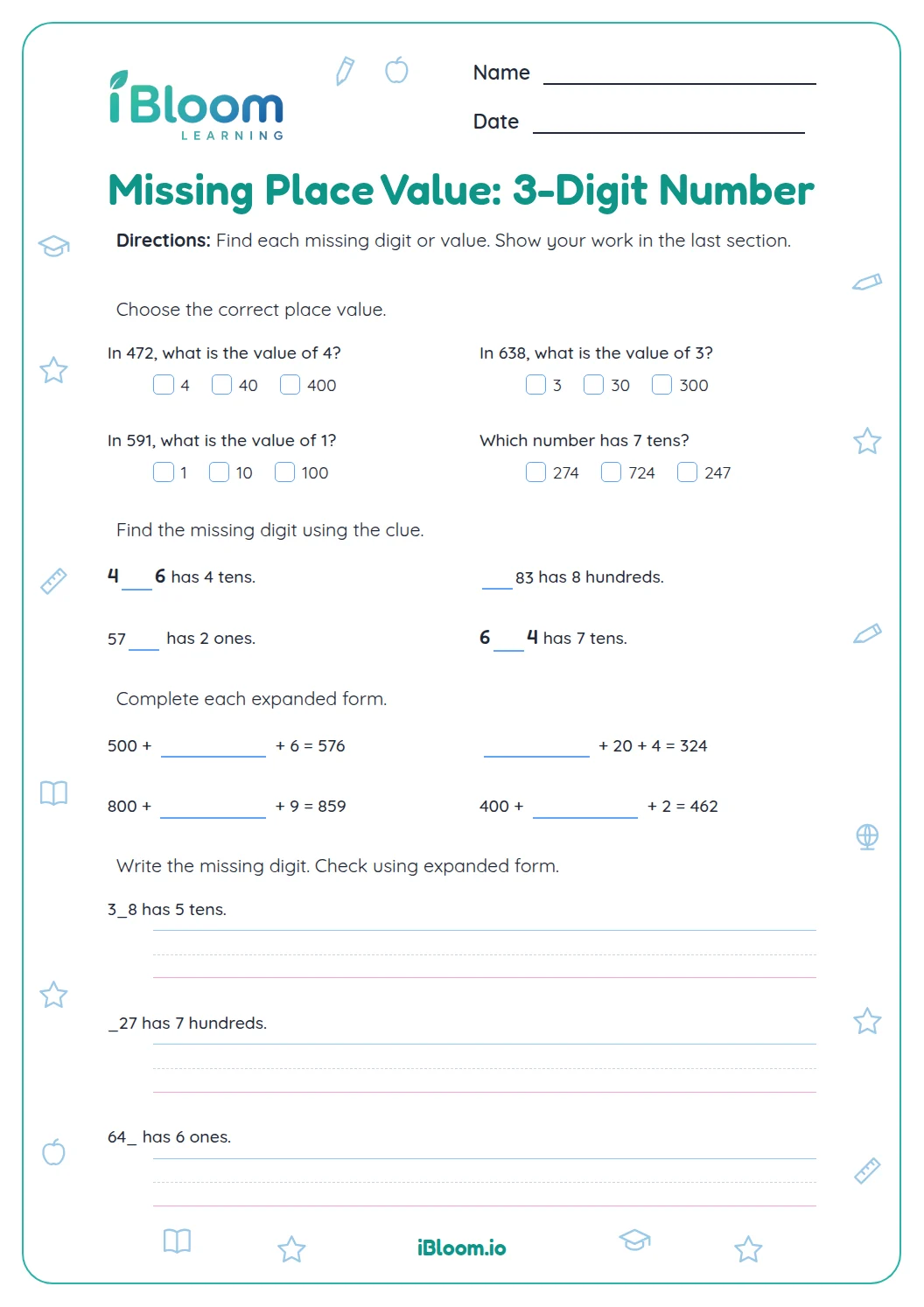
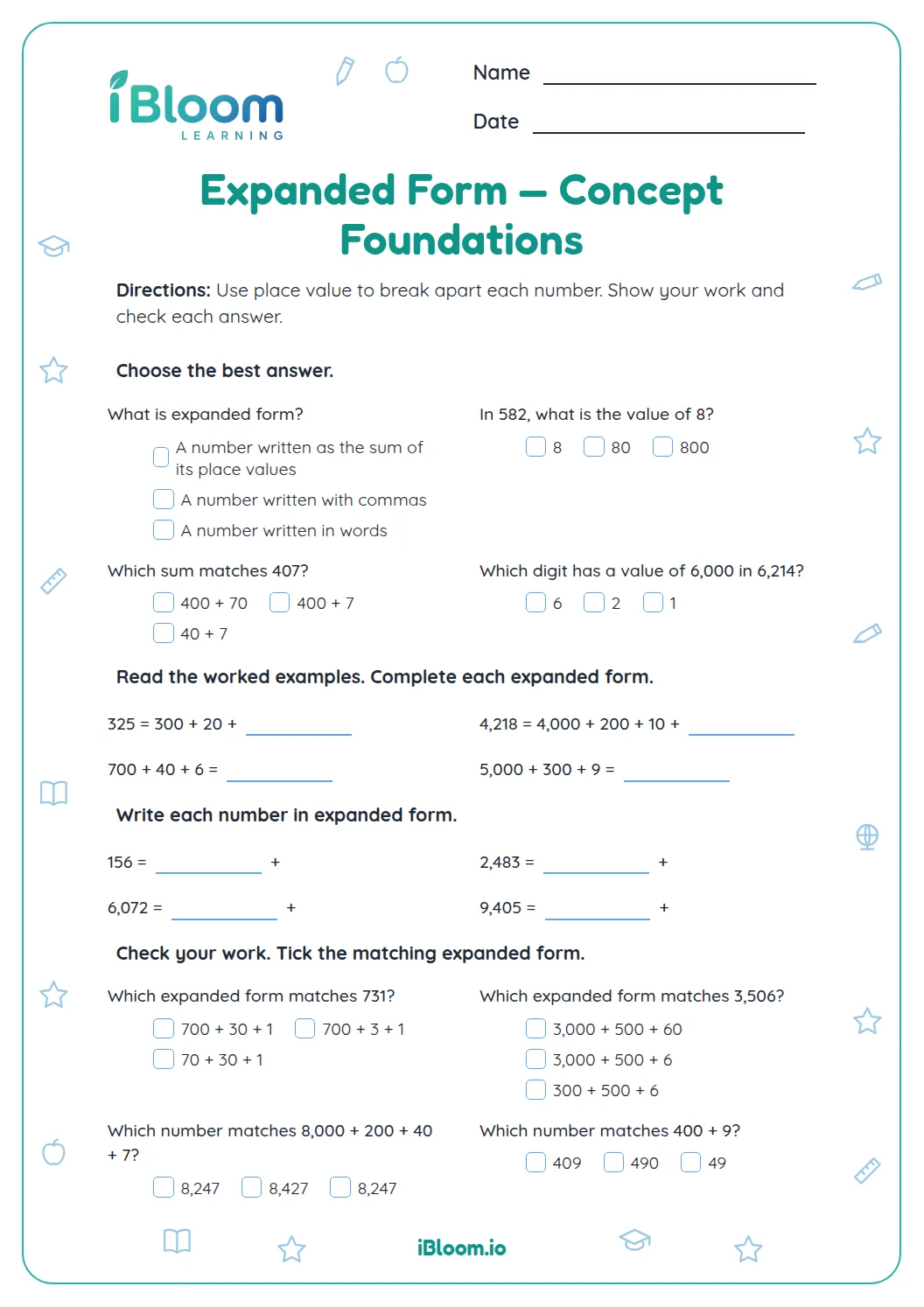
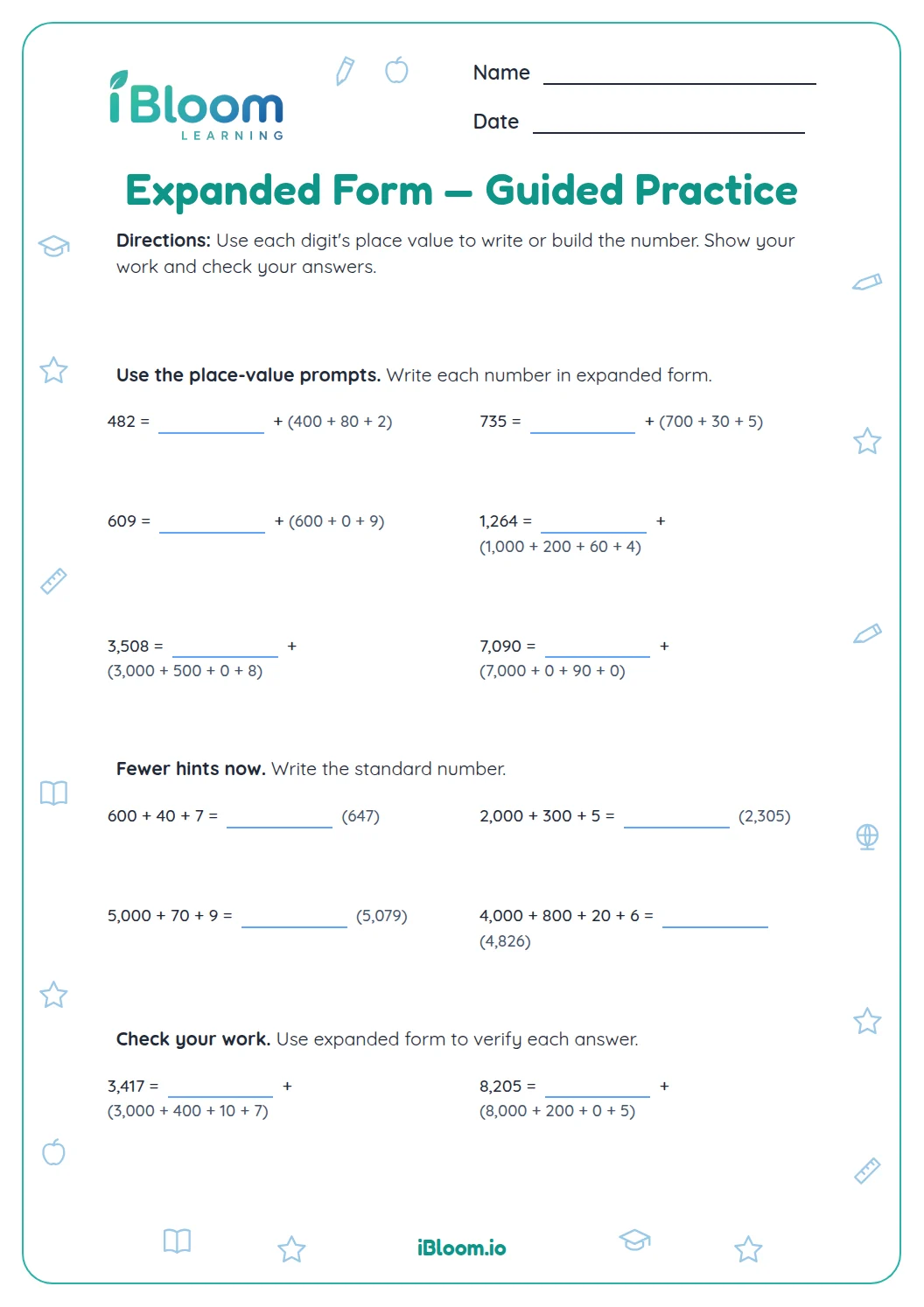
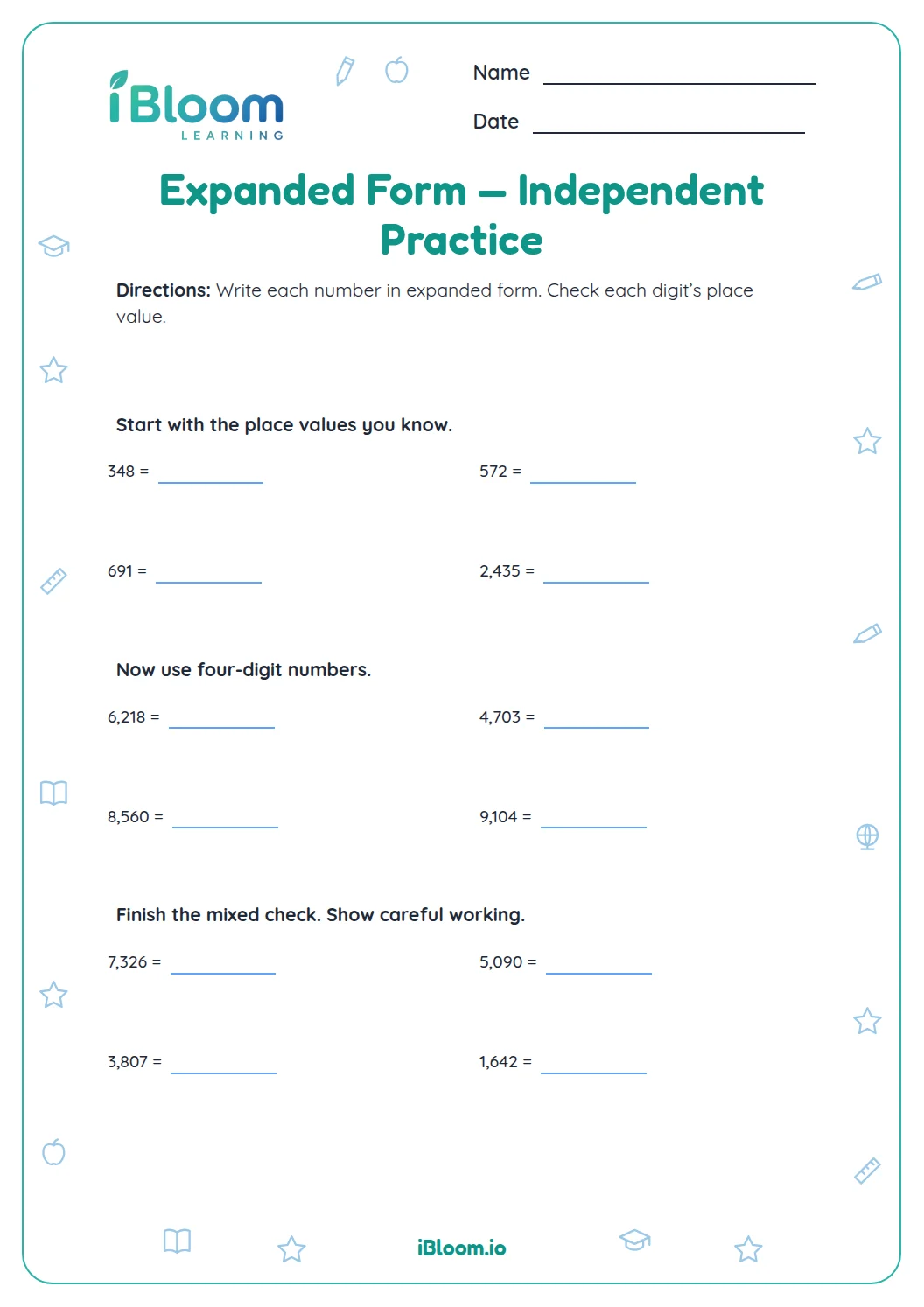
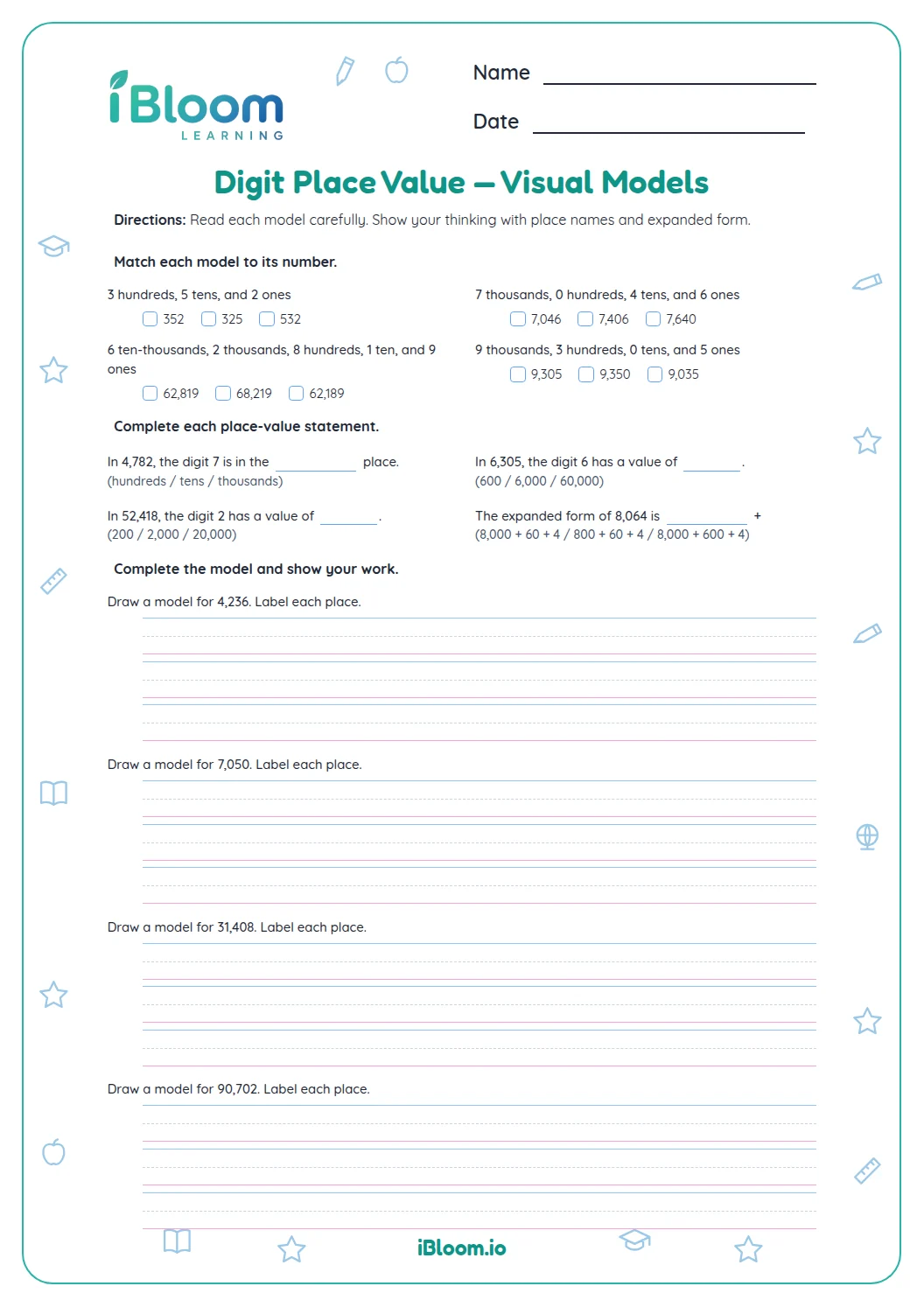
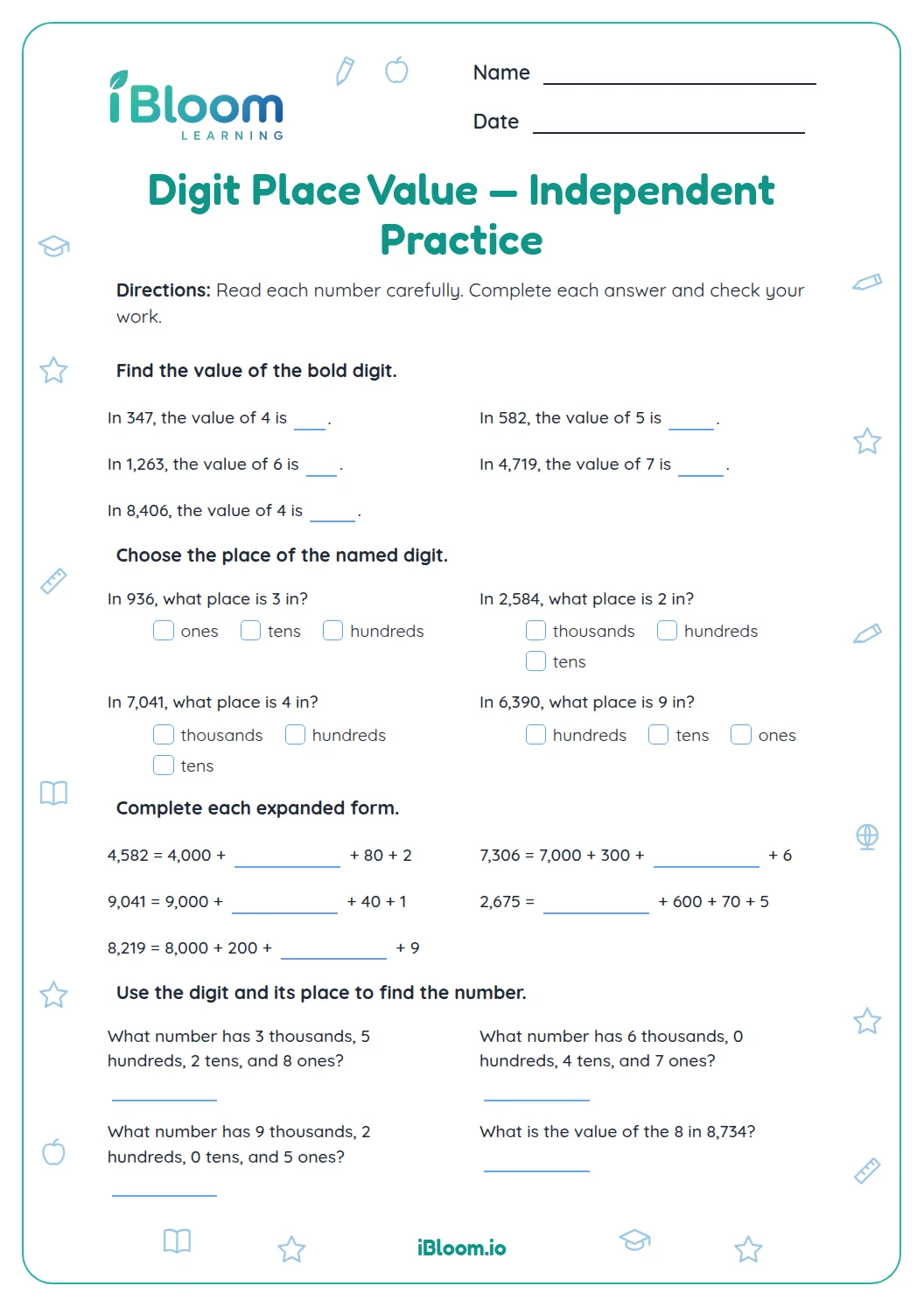
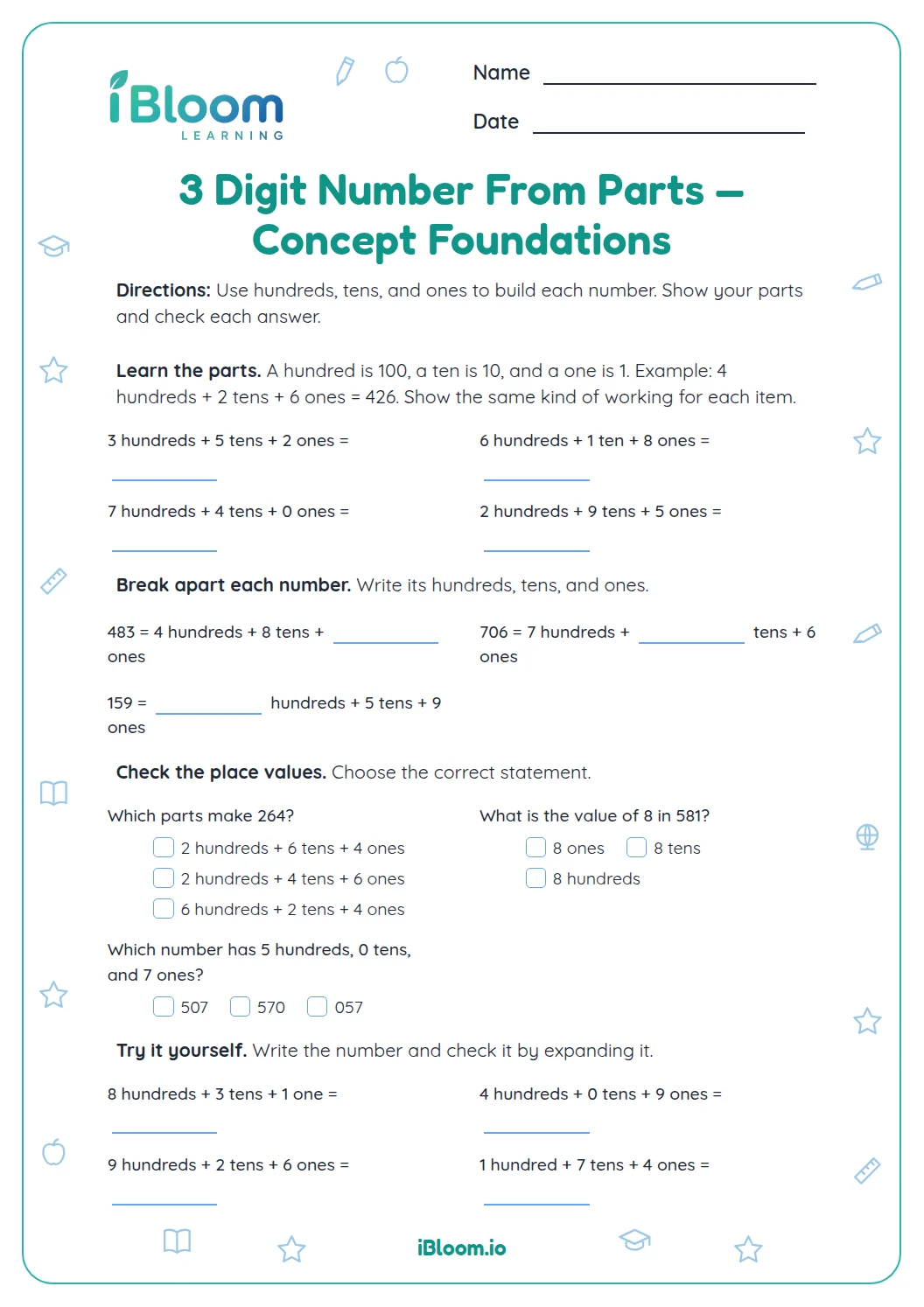
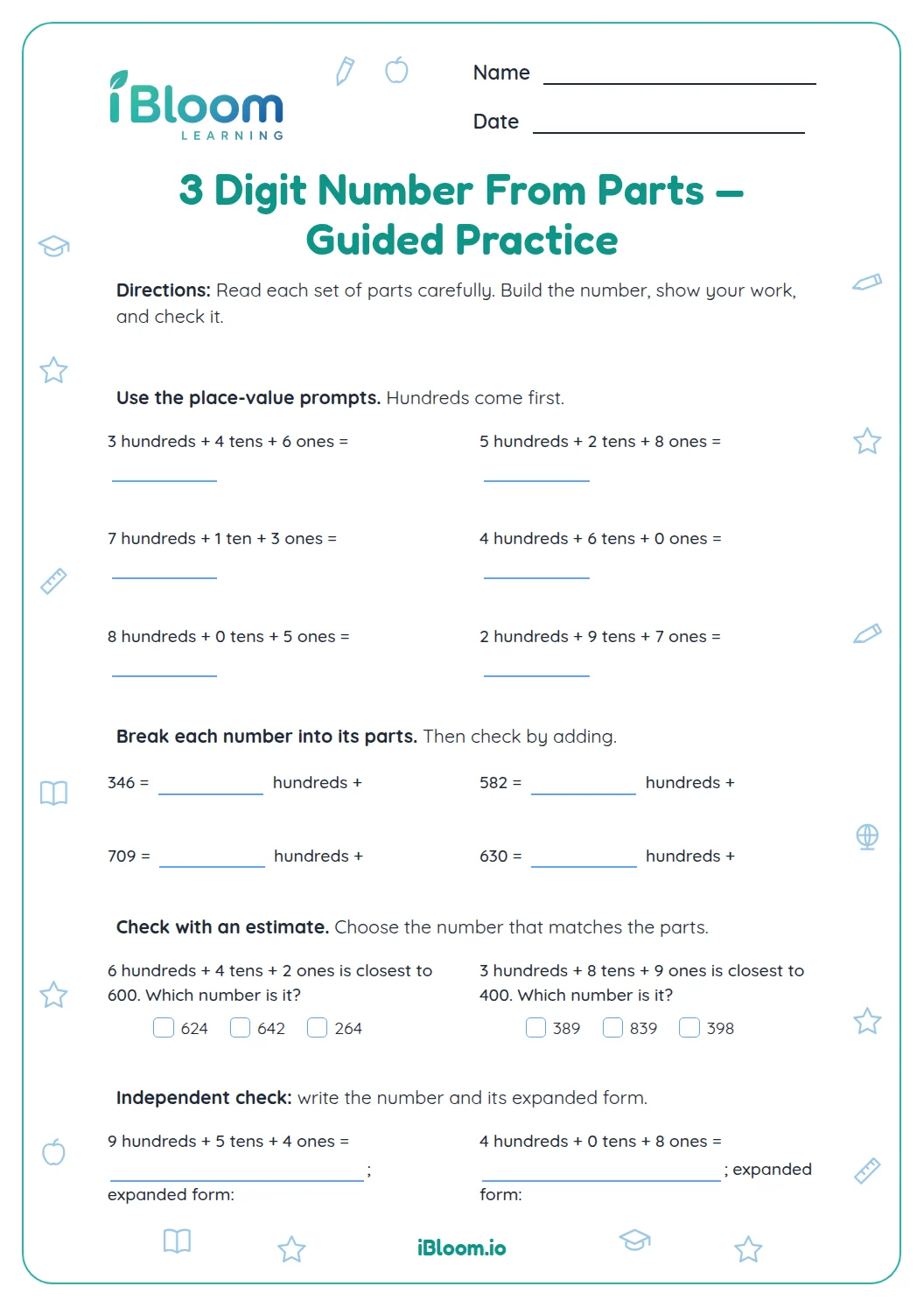
This Grade 3 guided-practice sheet uses three-digit numbers to connect digits with their values. Part A has eight missing-part equations. Part B asks for four digits in named places, and Part C has four choices about digit values. Students can check each answer using expanded form. The work practices Common Core 2.NBT.A.1, understanding hundreds, tens and ones. A separate key gives every answer.
Aligned to 2.NBT.A.1
How do you find a missing value?
In question 1, ___ + 40 + 6 = 246. The number has 2 hundreds, so the missing value is 200. Adding 200, 40 and 6 checks the answer.
When should the answer be one digit?
Read the unit after the blank. In question 3, 5 hundreds + ___ tens + 3 ones = 583, the answer is 8 because the word tens already supplies the unit. The value of those eight tens is 80.
How does zero hold a place?
In 608, the tens digit is 0. The number has six hundreds and eight ones. Keeping the zero between 6 and 8 shows that there are no tens.
How to use this worksheet
- 1Read the three-digit number.
- 2Locate its hundreds, tens and ones.
- 3Check whether the blank asks for a digit or a value.
- 4Write or choose the missing part.
- 5Rebuild the number to check the answer.
Common mistakes and quick fixes
The mistake
Reading 6 in 364 as 6.
The fix
Check its position: the 6 is in the tens place and means 60.
The mistake
Leaving out a zero when a place is empty.
The fix
A number can have zero tens or zero ones; keep that place in the number.
The mistake
Mixing up tens and hundreds.
The fix
Read the three places from left to right: hundreds, tens, ones.
Common Core alignment
Students identify the hundreds, tens and ones in three-digit numbers.
On this sheet: Every item decomposes a three-digit number or identifies the value of one of its digits.
Show the official wordingHide the official wording
Understand that the three digits of a three-digit number represent amounts of hundreds, tens, and ones; e.g., 706 equals 7 hundreds, 0 tens, and 6 ones. Understand the following as special cases:
What to practice next
Make more practice
Further reading
Questions parents and teachers ask
How is a digit different from its value?
A digit is one symbol in a number, while its value depends on its position. In 364, the digit 6 represents 60 because it is in the tens place. Read each prompt carefully: some ask for a digit, and others ask for its value.
How can children check the first answer?
They can add the three parts to rebuild 246. The known parts are 40 and 6, which leave 200 as the hundreds part. Have the child say “two hundreds, four tens, six ones” and then substitute 200 into the blank to check the complete equation.
Can zero be an answer?
Yes, zero is the tens digit in 608 in Part B. Six hundreds and eight ones make that number, with no tens between them. Writing the zero keeps each digit in its proper place; removing it would change 608 into the two-digit number 68.
Why does question 3 need 8 rather than 80?
The blank is followed by the word tens, so it asks how many tens are present. Eight tens have a value of 80. Writing 80 in that blank would mean eighty tens, which is much larger than the tens part needed to make 583.
How should students approach the final choices?
They should locate the named place before choosing an answer. Reading a number from left to right gives hundreds, tens and ones. For a value question, turn the digit into its amount, such as six tens becoming 60, then select the choice that matches that amount.