




About this worksheet
Sixteen questions move from rounding three-digit numbers to boundary ranges, midpoint errors, and explanations. The printable includes a separate answer key and focused practice that moves from direct work to reasoning.
Aligned to 3.NBT.A.1
Find the halfway point
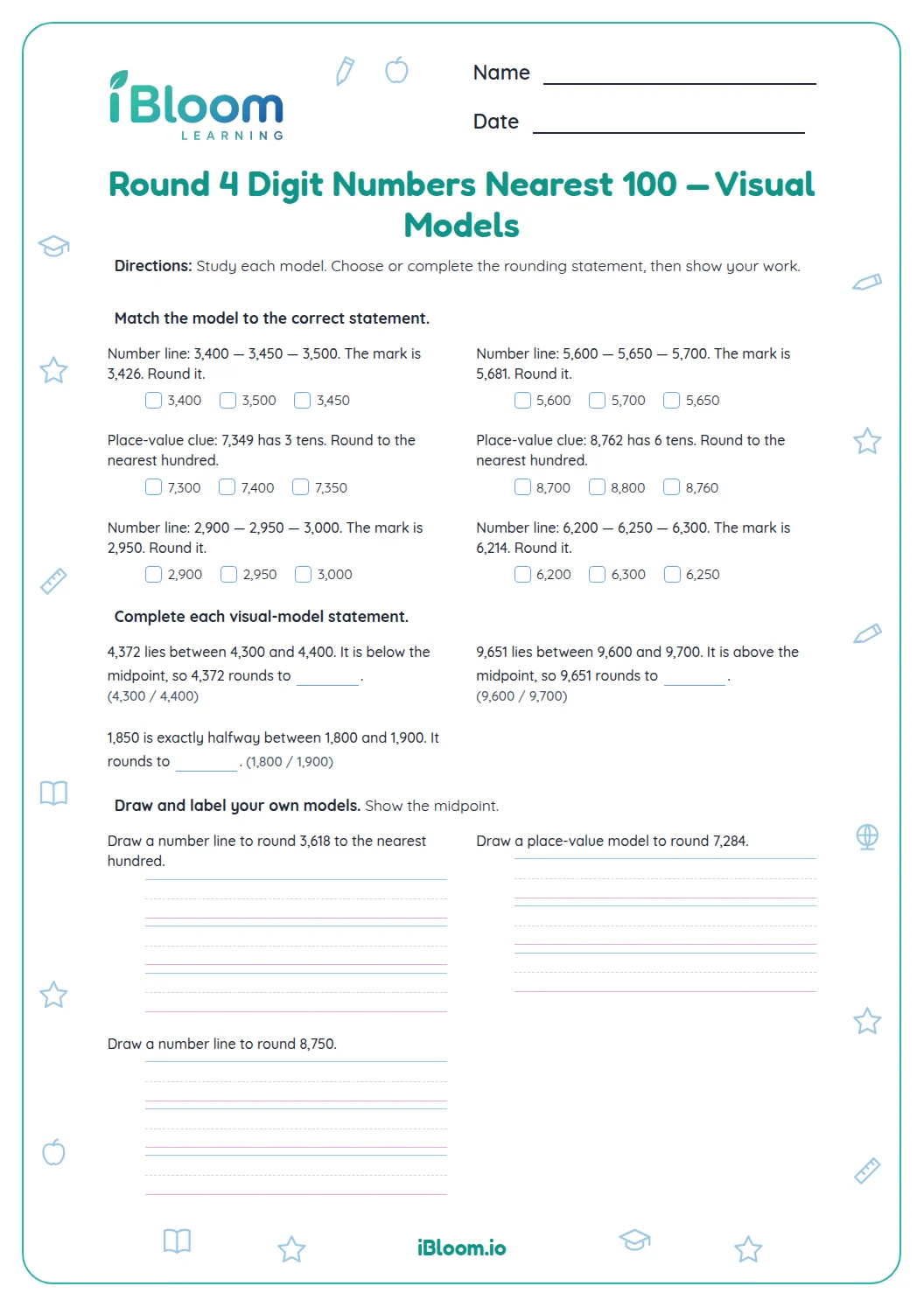
The midpoint between 400 and 500 is 450. Numbers 400 through 449 round to 400; 450 through 499 round to 500. At an exact halfway value, round up.
- 1Smallest rounding to 500: 450
- 2Greatest rounding to 500: 549
Use the tens digit
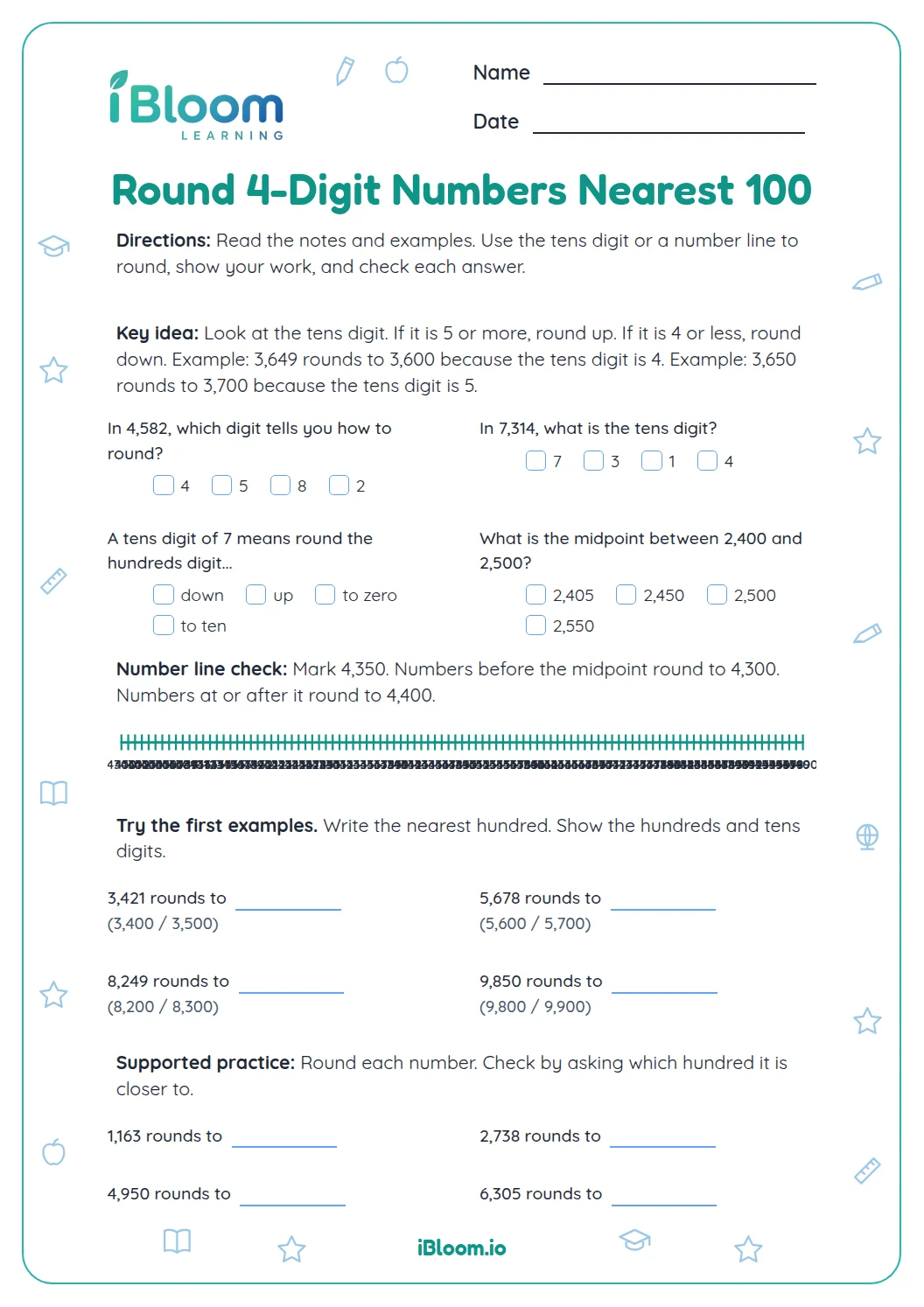
When rounding to the nearest hundred, the tens digit tells whether the number is below halfway or at least halfway. Check the hundreds and tens together, especially for numbers ending in 50.
Three steps in the challenge
Part A practices direct rounding. Part B focuses on the range of numbers that round to one hundred. Part C asks learners to detect a misconception and justify decisions.
- Part A: round and compare
- Part B: identify boundary values and possible numbers
- Part C: explain midpoint reasoning and correct an error
How to use this worksheet
- 1Find the hundreds just below and just above the number.
- 2Use the tens digit to decide whether the number is below or at least halfway.
- 3At a midpoint ending in 50, round up to the greater hundred.
- 4For a rounding range, include the lower midpoint and stop one number before the upper midpoint.
- 5Use the separate two-page key to check rounded values and boundary answers.
Common mistakes and quick fixes
The mistake
Rounding 650 down because it is in the 600s.
The fix
Compare to the midpoint 650; halfway rounds up.
The mistake
Including the upper endpoint when finding the numbers that round to a hundred.
The fix
The midpoint at the top belongs to the next hundred, so count only through one less.
The mistake
Including 850 among numbers that round to 800.
The fix
At the upper midpoint, 850 rounds up to 900; stop at 849.
Curriculum alignment
This worksheet practices the following Common Core skills.
Use place value understanding to round whole numbers to the nearest 10 or 100.
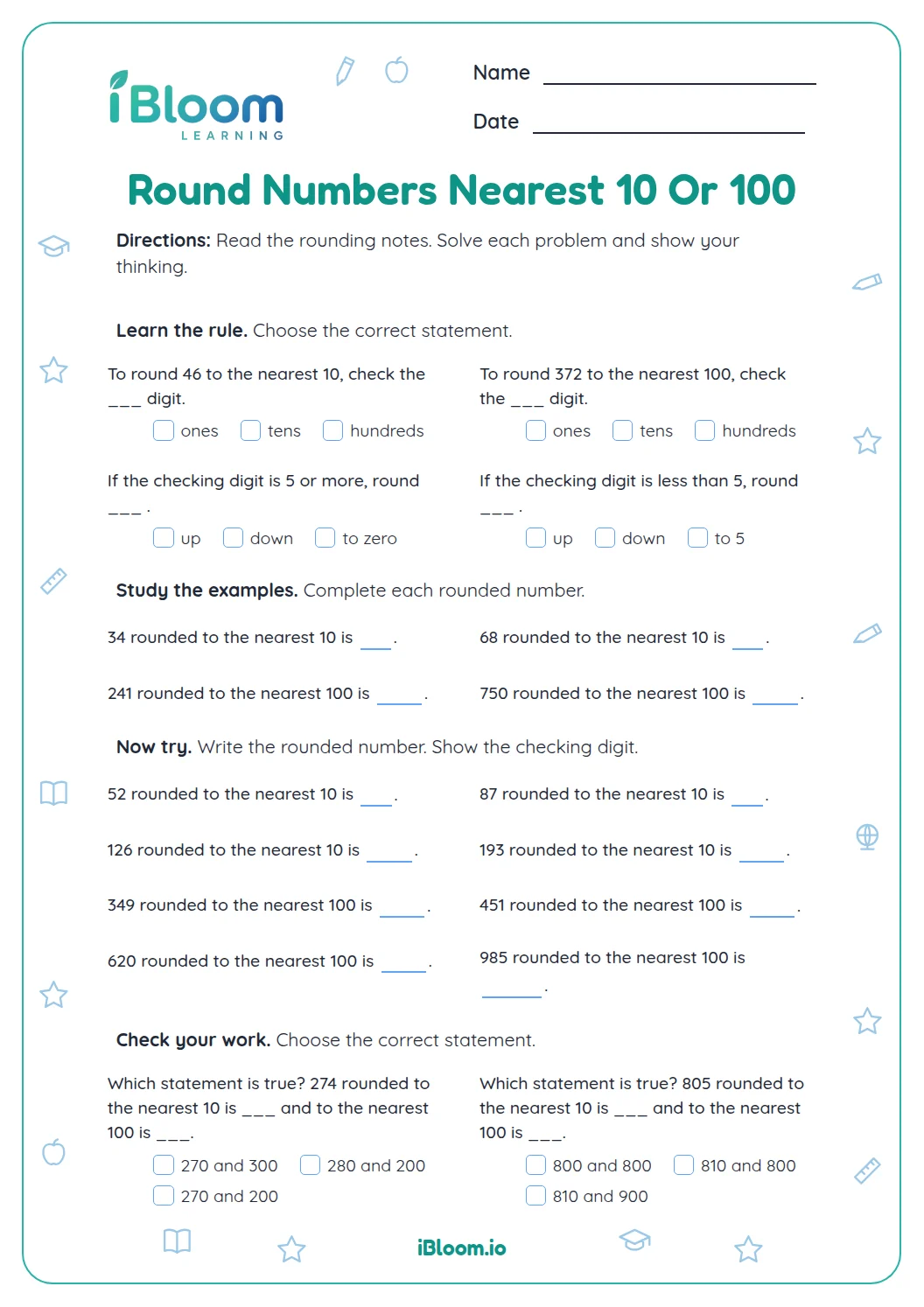
On this sheet: The full page rounds three-digit numbers to hundreds and reasons about midpoint boundaries.
Show the official wordingHide the official wording
Use place value understanding to round whole numbers to the nearest 10 or 100.
What to practice next
Make more practice
Further reading
Questions parents and teachers ask
What happens at a halfway point when rounding to a hundred?
An exact midpoint rounds to the greater hundred. For example, 750 is halfway between 700 and 800, so it rounds to 800. Learners practice this rule with values such as 450 and 650.
Which whole numbers round to 500?
Whole numbers from 450 through 549 round to 500. The lower midpoint, 450, rounds up to 500. The next midpoint, 550, rounds up to 600, so 549 is the greatest number in the range.
What extra reasoning does this worksheet include?
After rounding individual three-digit numbers, learners find the smallest and greatest values that round to a target hundred. They also correct a midpoint error, identify cutoff values, and explain why 749 and 750 round to different hundreds.
What is included in the answer key?
The separate key gives rounded hundreds, boundary values, and sample responses where more than one number can work. For an open response, compare the learner’s number with the stated rounding condition rather than requiring the exact sample.
How do I find a range of numbers that rounds to one hundred?
Find the midpoint below and the midpoint above that hundred. Include the lower midpoint because it rounds up to the target. Exclude the upper midpoint because it rounds up to the next hundred; the greatest whole number is one less.
How many questions and pages are included?
There are 18 questions in three parts. The printable uses two worksheet pages and a separate two-page answer key. Questions begin with direct rounding, then move to possible-number ranges and reasoning about midpoint decisions.