
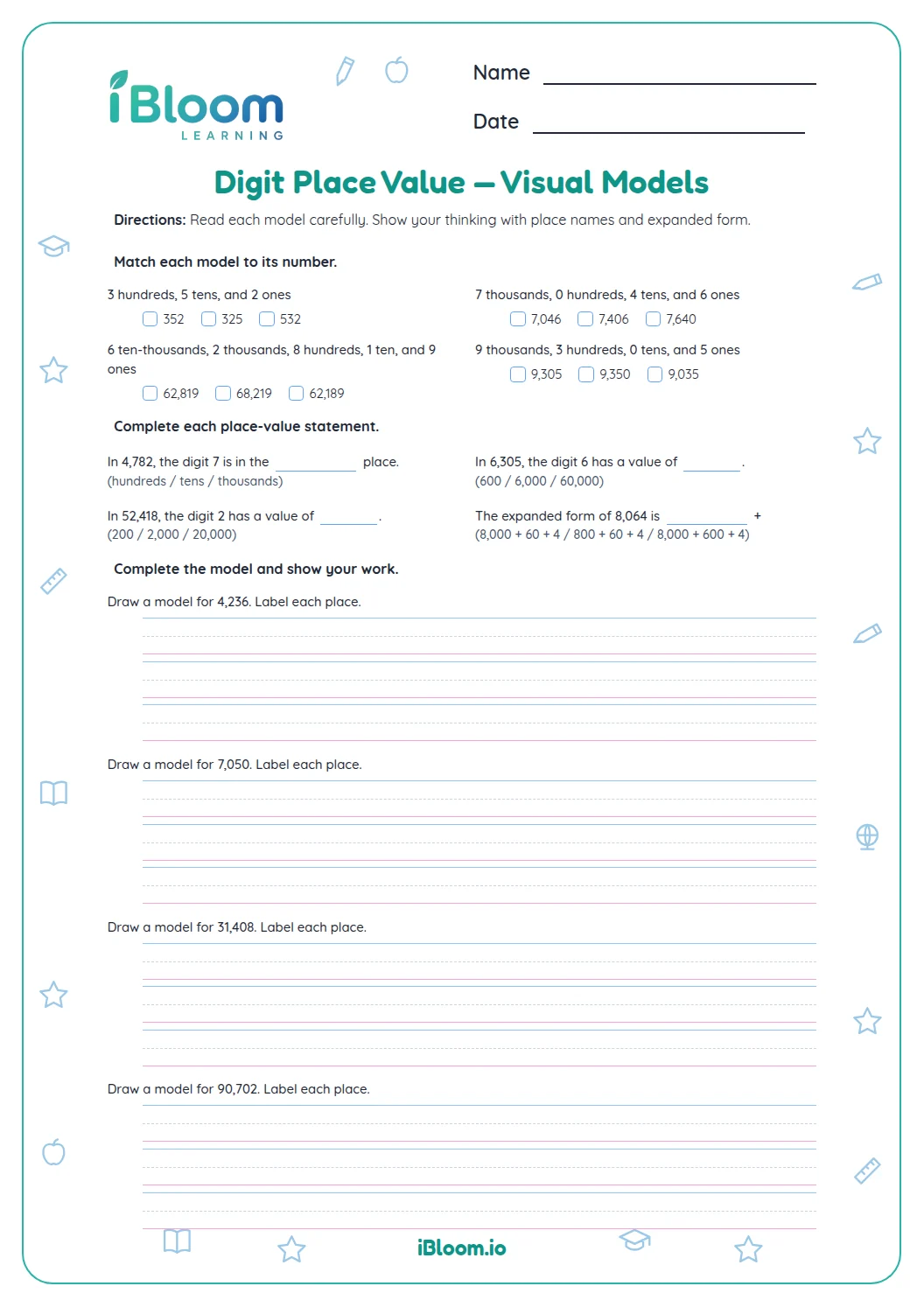
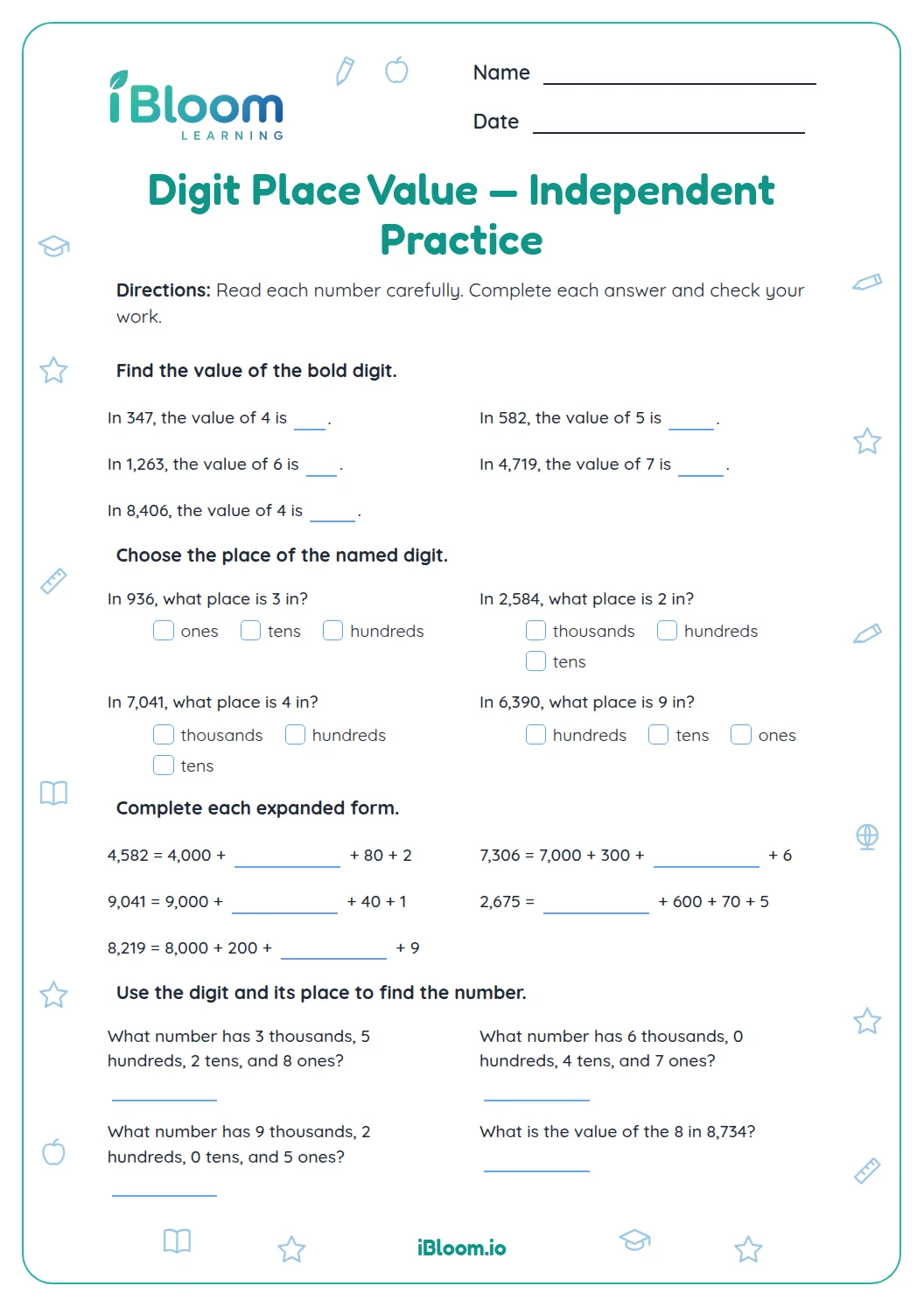
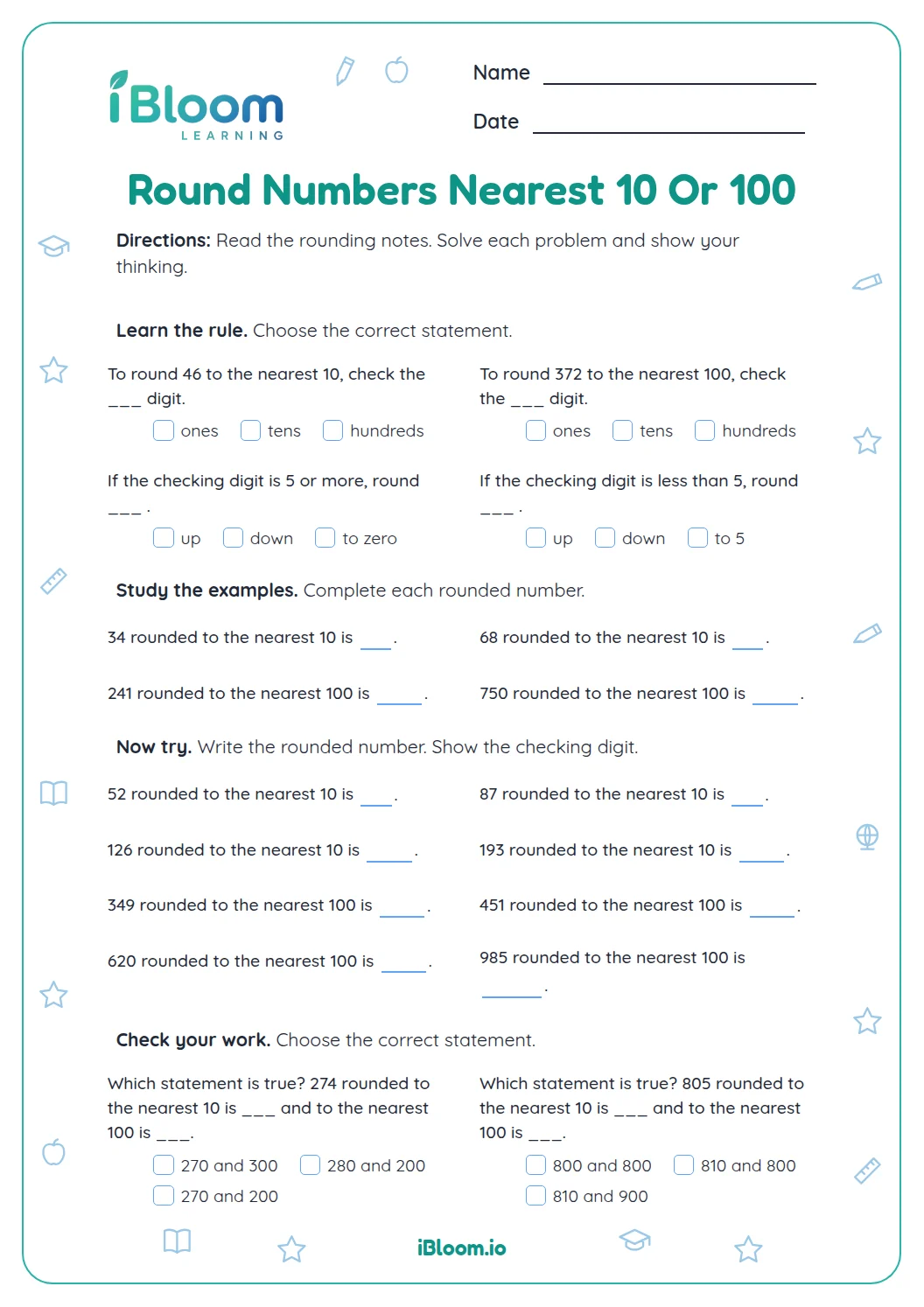


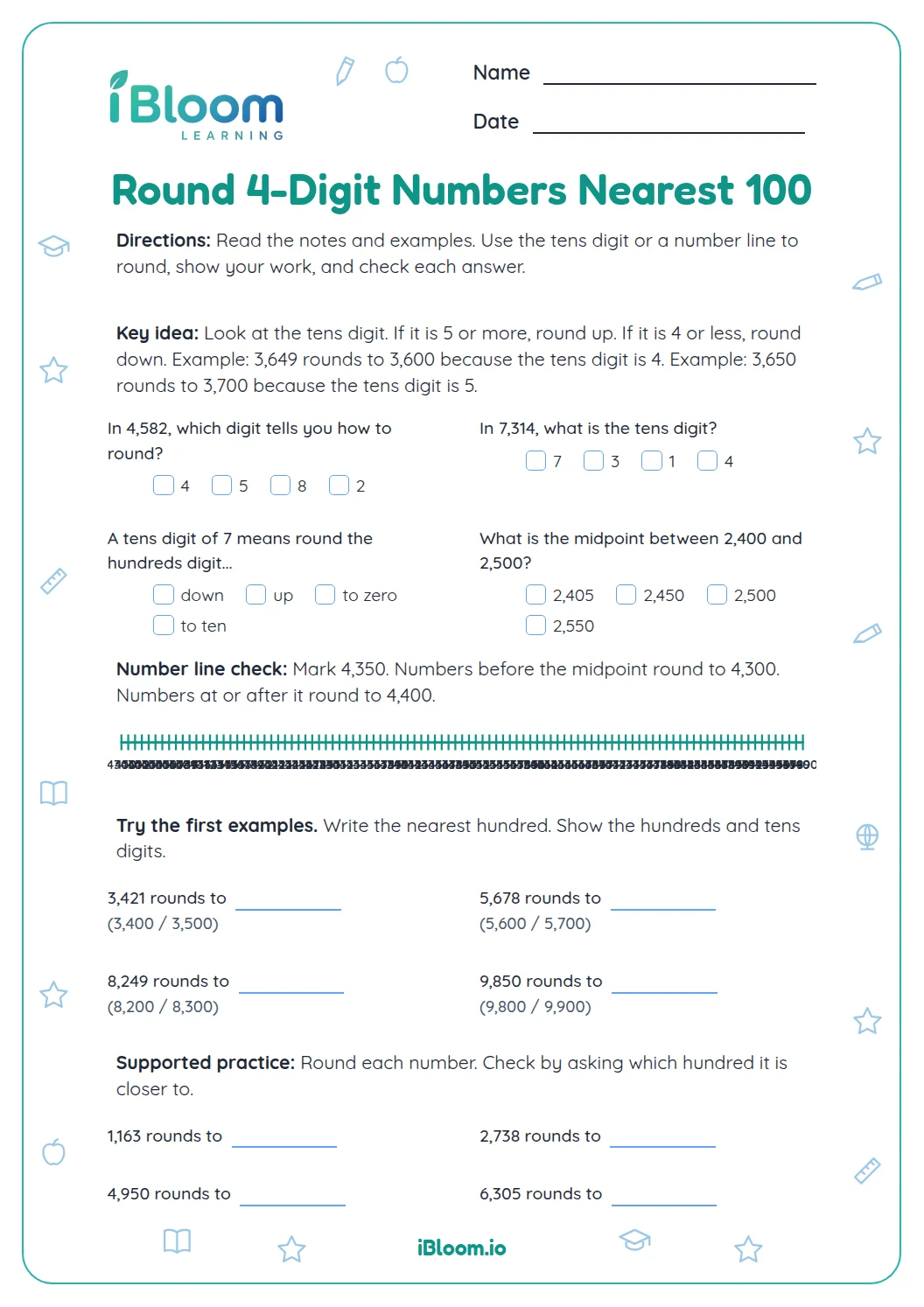

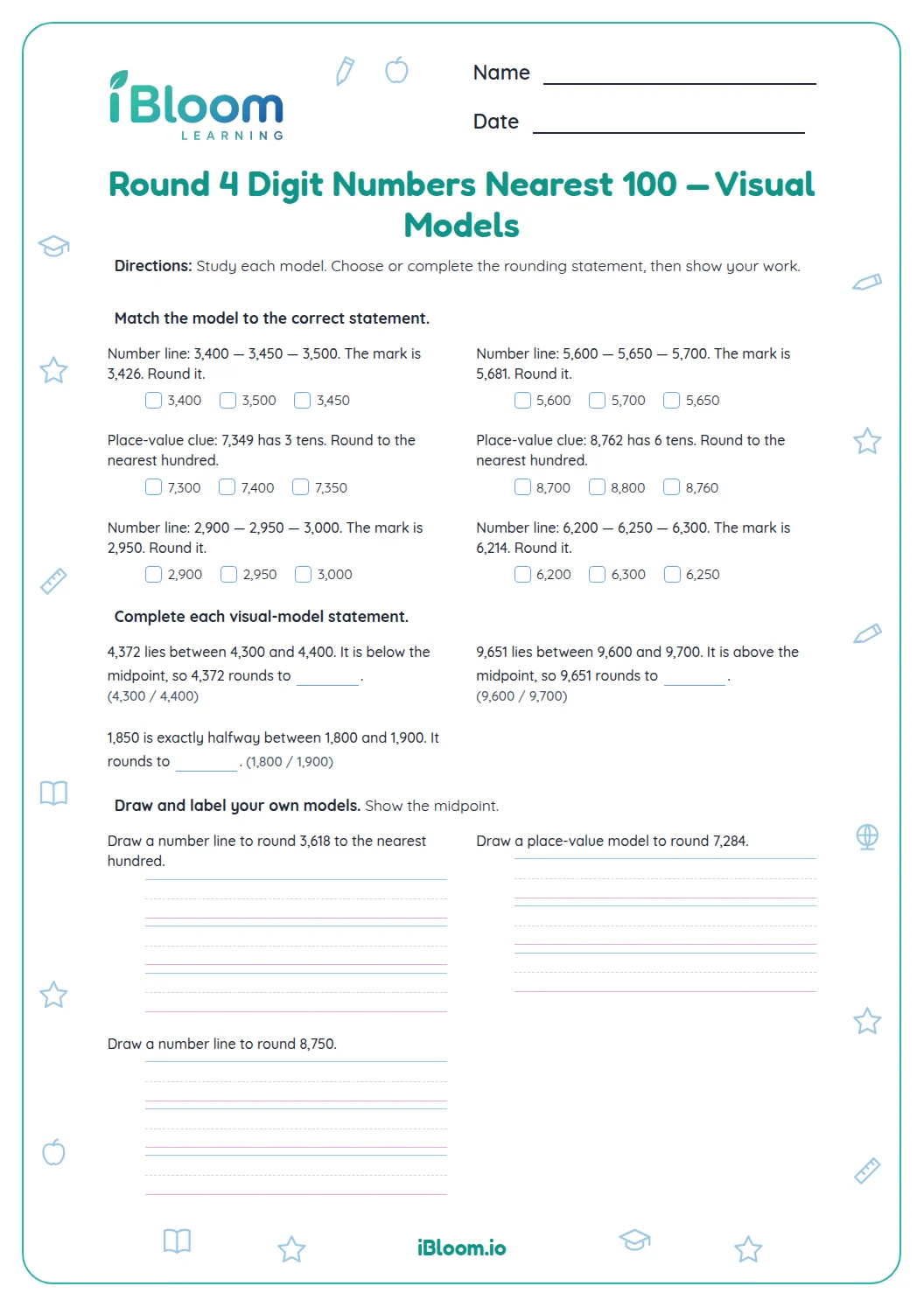

About this worksheet
This Grade 3 printable gives children 14 short situations involving visitor counts, supplies, distances, and other quantities. For each one, they round a three-digit number to the nearest hundred. The mix includes numbers below and above the halfway point and numbers ending in 50, where the next hundred is closer under the usual rounding rule. The answer key lists the rounded values.
Aligned to 3.NBT.A.1
How do you round to the nearest hundred?
Look at the tens digit. If it is 0, 1, 2, 3, or 4, keep the hundreds digit and change the tens and ones to zero. If it is 5, 6, 7, 8, or 9, go up to the next hundred.
How does the worksheet use real situations?
Each item places a three-digit number in a setting such as a garden, library, or park. Children round the quantity, then name the approximate amount in that context.
- 1A nature center counted 263 visitors.
- 2The tens digit is 6, so round up from 200 to 300.
- 3Answer: about 300 visitors.
What should children do with halfway numbers?
A number such as 550 is halfway between 500 and 600. With the standard classroom rule, 5 or more in the tens place rounds up, so 550 rounds to 600. The worksheet includes a halfway example to practice that rule.
How to use this worksheet
- 1Circle the three-digit number in the situation.
- 2Look at its tens digit.
- 3Choose the hundred below or above.
- 4Change the tens and ones to zero.
- 5Write the rounded amount with its context unit when useful.
Common mistakes and quick fixes
The mistake
Looking only at the ones digit.
The fix
Check the tens digit because it tells which hundred is nearer.
The mistake
Rounding down when the tens digit is 5.
The fix
Use the rule: 5 through 9 rounds up.
The mistake
Writing an exact count instead of an estimate.
The fix
Ask which hundred is closest, then write that rounded value.
Common Core alignment
Use place value to round three-digit numbers to the nearest hundred.
On this sheet: Each context asks for a three-digit amount rounded to the nearest hundred.
Show the official wordingHide the official wording
Use place value understanding to round whole numbers to the nearest 10 or 100.
What to practice next
Make more practice
Further reading
Questions parents and teachers ask
What does “nearest hundred” mean?
It means choosing the closest hundred, such as 300 or 400 for 358. The child checks the tens digit to decide whether the number is nearer the hundred below or the hundred above. Use the passage and printed questions as the reference when checking each response with the separate answer key.
How many problems are included?
The worksheet includes 14 short real-world questions. They use three-digit counts and amounts, with examples that round down, round up, and end in 50. Use the passage and printed questions as the reference when checking each response with the separate answer key.
What is the rule for a number ending in 50?
When rounding to the nearest hundred, a tens digit of 5 means round up. For example, 550 becomes 600. The worksheet includes this kind of halfway case. Use the passage and printed questions as the reference when checking each response with the separate answer key.
Does the worksheet ask children to show work?
The questions ask for one rounded value. Children may jot down the tens digit or compare the two nearby hundreds on scratch paper before writing the estimate. The answer key lists the nearest hundred for each context and helps adults review the rounding choice.
Can I use the answer key to check work?
Yes. The separate answer key lists the nearest hundred for each situation. If an answer is incorrect, have the child point to the tens digit and name the two hundreds on either side. Use the passage and printed questions as the reference when checking each response with the separate answer key.