



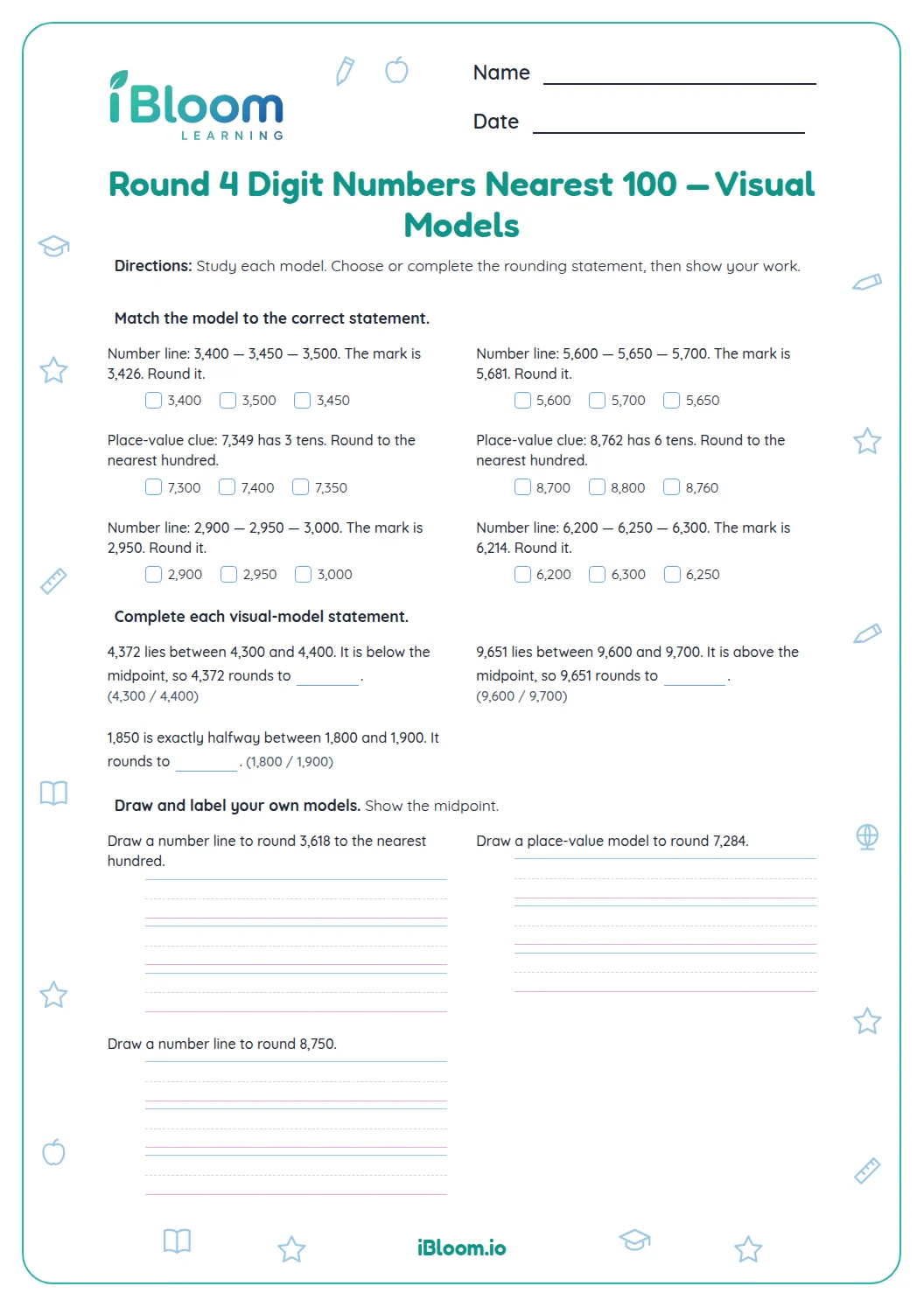


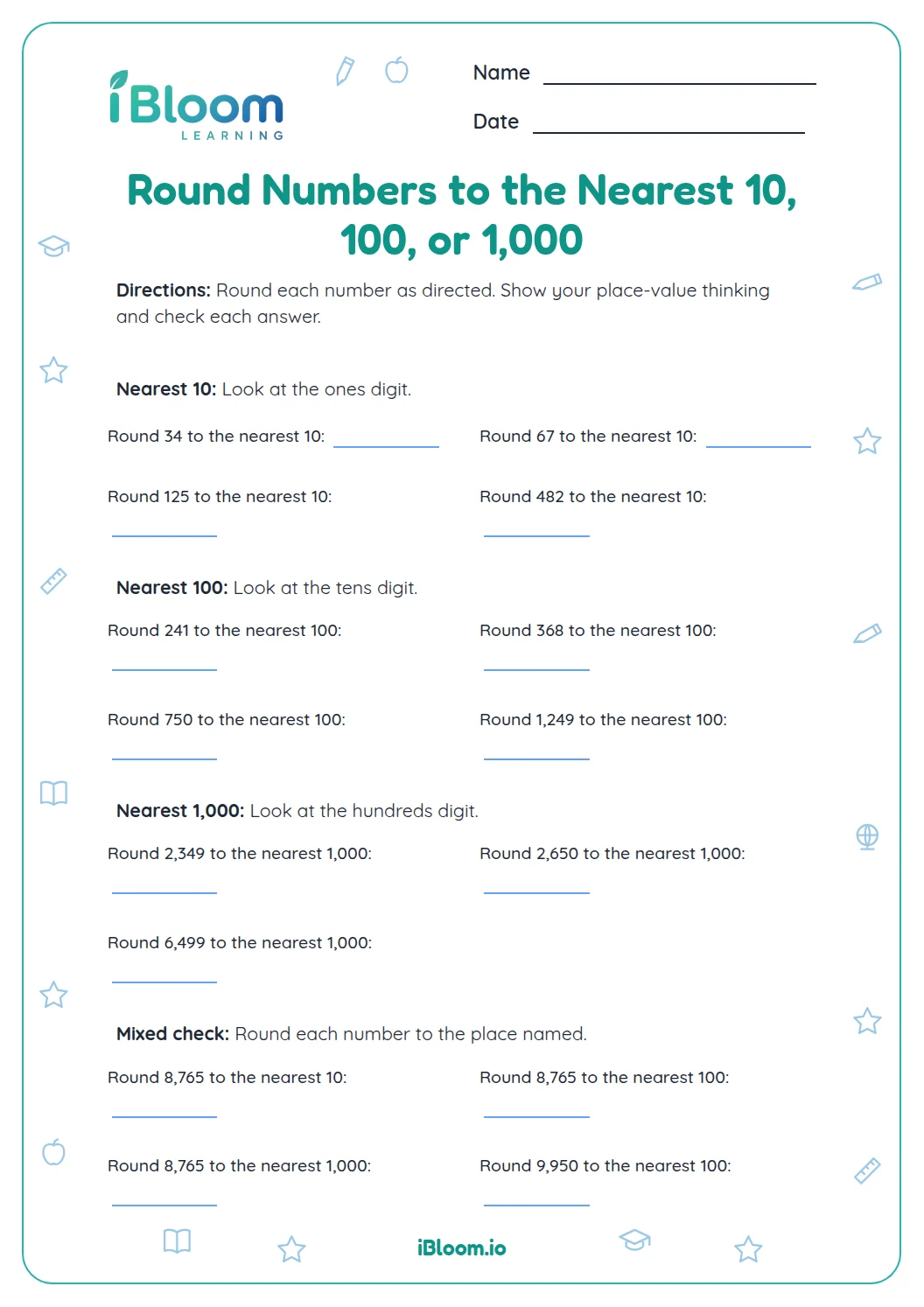
About this worksheet
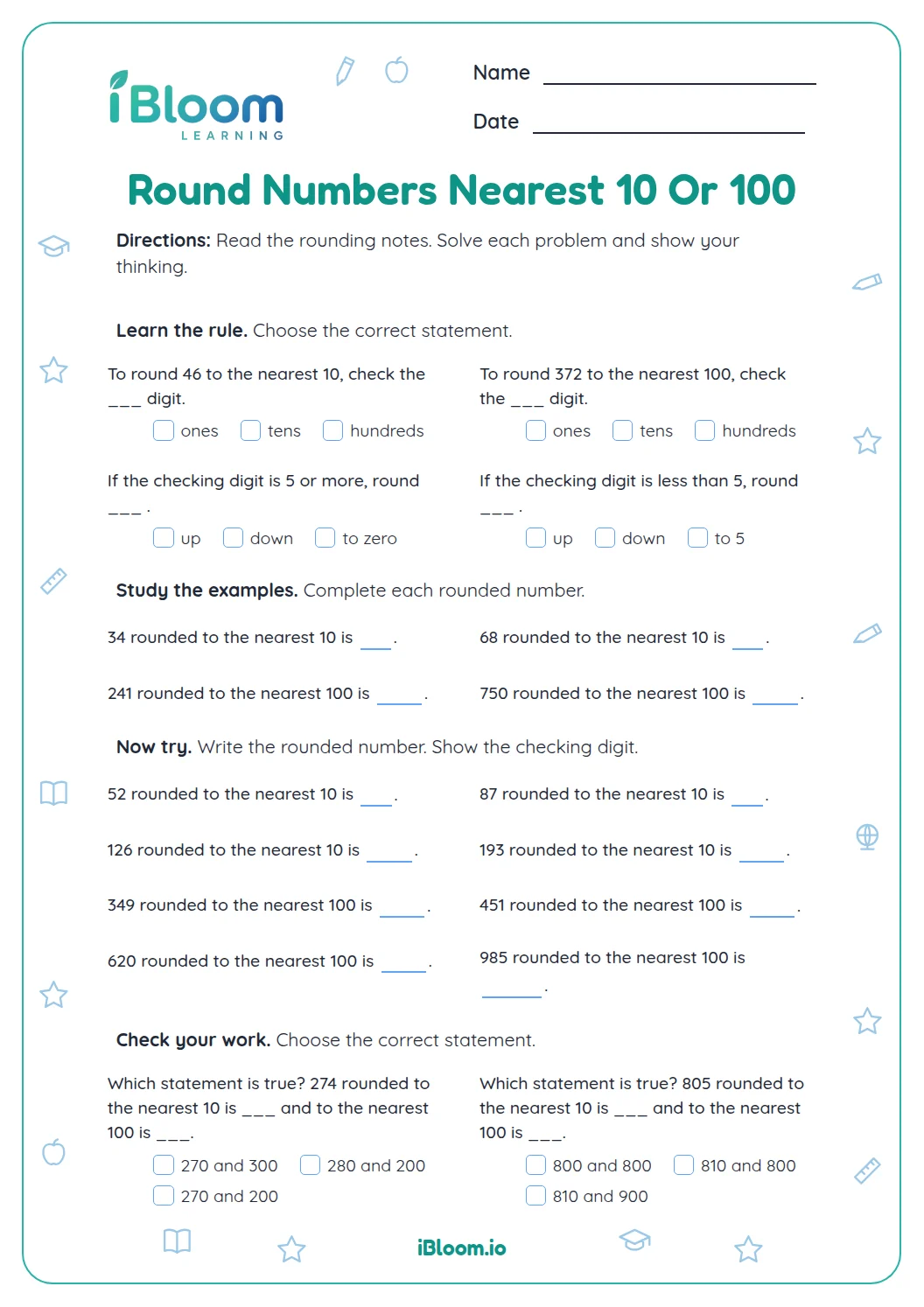
This free Grade 3 worksheet gives students twenty independent rounding questions. Part A rounds to the nearest 10, Part B rounds to the nearest 100, and Part C mixes both directions so students must choose the right place each time. The numbers include halfway cases, exact multiples, values that round to 1,000, and four-digit numbers. Common Core 3.NBT.A.1 connects this work to place value understanding. A separate answer key lists each rounded value for quick checking after students finish.
Aligned to 3.NBT.A.1
How do neighboring multiples help with rounding?
When rounding to the nearest 10, locate the two tens around the number. For 34, those are 30 and 40. The number is 4 away from 30 and 6 away from 40, so it rounds to 30. The same idea works with neighboring hundreds.
Part A has five questions about tens, and Part B has five about hundreds. Each part includes an exact multiple, 390 or 600, to check that students keep a number unchanged when it already has the requested value.
Why does 149 have two different answers?
Questions 11 and 12 use the same number with different rounding places. To the nearest 10, compare 149 with 140 and 150. To the nearest 100, compare it with 100 and 200. The instruction changes which neighbors matter.
Always round the original number directly to the requested place. Rounding 149 to 150 first and then rounding 150 to 200 would give the wrong answer for question 12.
- 1149 to the nearest 10: 1 from 150 and 9 from 140 → 150.
- 2149 to the nearest 100: 49 from 100 and 51 from 200 → 100.
- 3The starting number stays 149 in both questions.
What happens at a halfway point or across a boundary?
This sheet uses the usual whole-number rounding rule: if the number is exactly halfway, choose the greater multiple. That makes 125 round to 130 and 450 round to 500. The rule is printed in the directions.
Part C includes 950 to the nearest 100 and 995 to the nearest 10. Both round to 1,000. Students should write the full new number when rounding increases the number of digits, then check that it is a multiple of the requested place.
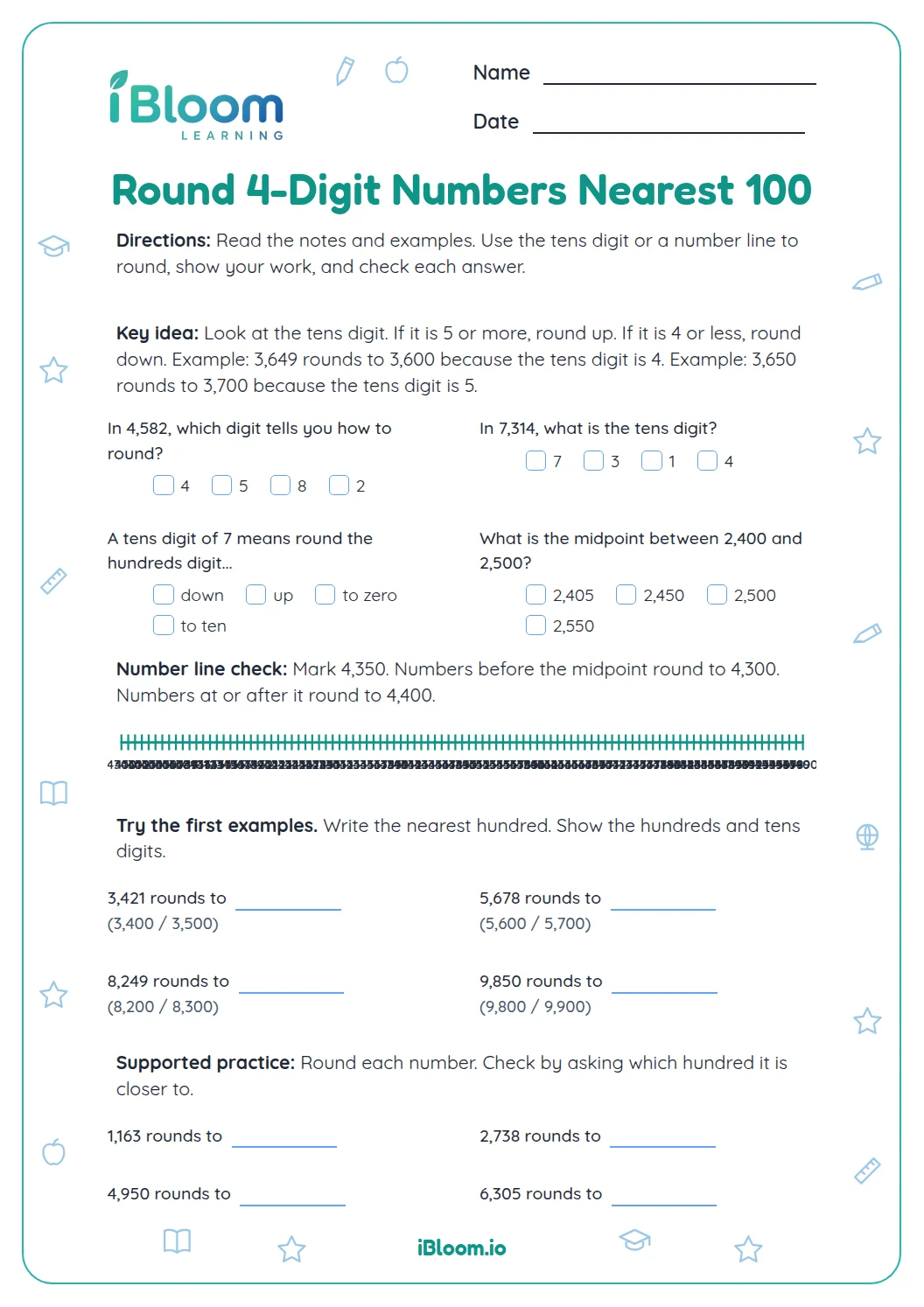
Questions 17–20 apply the same choice of rounding places with four-digit numbers. For example, 1,248 rounds to 1,250 to the nearest 10 and to 1,200 to the nearest 100. The place named in the question still determines which neighbors to use.
How to use this worksheet
- 1Read the directions and recall that an exact halfway value rounds to the greater multiple.
- 2Complete Part A by comparing each number with its neighboring tens.
- 3Complete Part B by noting the nearby hundreds in the space provided, then round. Exact hundreds stay unchanged.
- 4In Part C, mark the requested rounding place before answering each question.
- 5Check the key after finishing, and explain any correction using the original number and its two neighbors.
Mistakes to notice and how to help
The mistake
Rounding 149 to 200 because it first rounds to 150.
The fix
Start again from 149 and compare it directly with 100 and 200.
The mistake
Changing 390 to 400 when rounding to the nearest 10.
The fix
390 is already a multiple of 10, so its distance from a ten is zero.
The mistake
Writing 990 for 995 to the nearest 10.
The fix
995 is halfway between 990 and 1,000. The directions say to choose the greater multiple.
Common Core alignment
Use place value to round whole numbers to the nearest 10 or 100.
On this sheet: All twenty items ask for rounding to tens or hundreds, including halfway and boundary cases.
Show the official wordingHide the official wording
Use place value understanding to round whole numbers to the nearest 10 or 100.
What to practice next
Make more practice
Further reading
Questions parents and teachers ask
How many questions round to tens and how many to hundreds?
There are nine questions about the nearest 10 and eleven about the nearest 100. Part A has five tens questions, Part B has five hundreds questions, and Part C has ten mixed questions. The final four use 1,248 and 3,675, each rounded to both places.
Why does the worksheet use 149 twice?
The two questions show how the rounding place changes the answer. To the nearest 10, 149 becomes 150. To the nearest 100, it becomes 100. Have your child compare the original number with the two neighboring tens or hundreds each time, instead of rounding an earlier answer again.
Should 390 change when rounded to the nearest 10?
No, 390 stays 390 because it is already a multiple of 10. Its distance from 390 is zero, making that the closest ten. The sheet also includes 600 to the nearest 100 for the same reason: an exact multiple of the requested place keeps its value.
What rule should children use for halfway numbers?
Choose the greater multiple when the number is exactly halfway, as the worksheet directions state. For example, 450 is equally far from 400 and 500, so it rounds to 500. Likewise, 995 is halfway between 990 and 1,000, so the nearest-ten answer is 1,000.
How can I review errors after independent practice?
Ask your child to name the rounding place and the two neighboring multiples before looking at the key. Then compare the distances or identify the midpoint. For the paired 149 questions, confirm that both attempts start with 149. For boundary questions, check that the full rounded number is written.